

What matters to women in the postnatal period: A meta-synthesis of qualitative studies
Open accessThe DOI matches its Crossref record; 59 of the 60 references it cites were found in a registry or an index.
Abstract
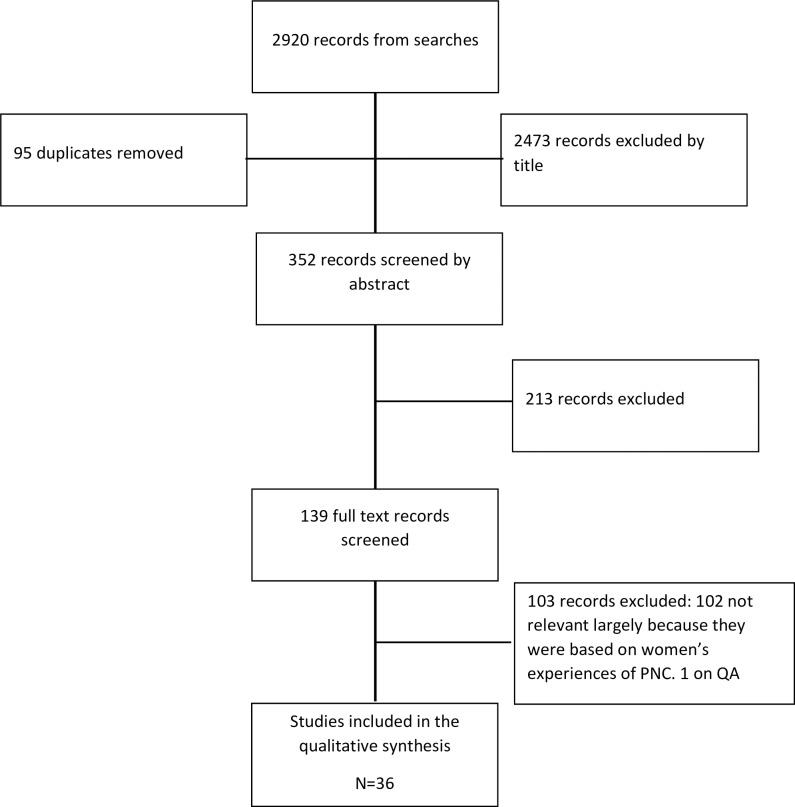
INTRODUCTION: The postnatal period is an underserved aspect of maternity care. Guidelines for postnatal care are not usually informed by what matters to the women who use it. This qualitative systematic review was undertaken to identify what matters to women in the postnatal period, to inform the scope of a new World Health Organization (WHO) postnatal guideline. METHODS: We searched MEDLINE, CINAHL, PsycINFO, POPLINE, Global Index Medicus, EMBASE, LILACS, AJOL, and reference lists of eligible studies published January 2000-July 2019, reporting qualitative data on women's beliefs, expectations, and values relating to the postnatal period. DATA COLLECTION AND ANALYSIS: Author findings were extracted, coded and synthesised using techniques derived from thematic synthesis. Confidence in the quality, coherence, relevance and adequacy of data underpinning the resulting findings was assessed using GRADE-CERQual. RESULTS: We included 36 studies from 15 countries, representing the views of more than 800 women. Confidence in most results was moderate to high. What mattered to women was a positive postnatal experience where they were able to adapt to their new self-identity and develop a sense of confidence and competence as a mother; adjust to changes in their intimate and family relationships, including their relationship to their baby; navigate ordinary physical and emotional challenges; and experience the dynamic achievement of personal growth as they adjust to the 'new normal' of motherhood and parenting in their own cultural context. CONCLUSION: This review provides evidence that what matters to women in the postnatal period is achieving positive motherhood (including maternal self-esteem, competence, and autonomy), as well as fulfilling adaptation to changed intimate and family relationships, and (re)gaining health and wellbeing for both their baby, and themselves. Where this process is optimal, it also results in joy, self-confidence, and an enhanced capacity to thrive in the new integrated identity of 'woman and mother'.
Overview
The claims and statistics of this paper haven’t been checked yet.
Free: it reads the open-access text and checks the first 5 claims that cite a source we can check. Create a free account to check every claim.
Integrity signals
Registry
Cites
Statistics
Figures
Verification
Claims the paper makes
The claims and statistics of this paper haven’t been checked yet.
Free: it reads the open-access text and checks the first 5 claims that cite a source we can check. Create a free account to check every claim.
Claims other papers make about this one
Each is checked against this paper’s own text: does it say what the citing paper says it does?
The cited source says what the claim attributes to it.
In the citing paper
“yet the mothers' health and needs are easily overshadowed by the focus on caring for the newborn [12]”
Self-check
Percentages, sums and reported differences re-computed from the paper’s own numbers.
The self-check needs the paper’s full text.
Citations
Cites
Methods for the thematic synthesis of qualitative research in systematic reviews
Thomas, J., & Harden, A. (2008) · BMC Medical Research Methodology · doi:10.1186/1471-2288-8-45 · Cited by 9,312
Global causes of maternal death: a WHO systematic analysis
Say, L., Chou, D., Gemmill, A., Tunçalp, Ö., Moller, A.-B., Daniels, J., Gülmezoglu, A. M., Temmerman, M., & Alkema, L. (2014) · The Lancet Global Health · doi:10.1016/s2214-109x(14)70227-x · Cited by 6,582 · cited 1×
“The majority of these deaths occur postnatally, with post-partum haemorrhage (PPH) the most common cause of maternal death [3].”
BackgroundEvery Newborn: progress, priorities, and potential beyond survival
Lawn, J. E., Blencowe, H., Oza, S., You, D., Lee, A. C., Waiswa, P., Lalli, M., Bhutta, Z., Barros, A. J., Christian, P., et al. (2014) · The Lancet · doi:10.1016/s0140-6736(14)60496-7 · Cited by 1,929 · cited 1×
“Neonatal data are more widely available and recent estimates indicate there are almost three million neonatal deaths (deaths in the first 28 days after birth) each year, most of which are preventable [4].”
BackgroundApplying GRADE-CERQual to qualitative evidence synthesis findings: introduction to the series
Lewin, S., Booth, A., Glenton, C., Munthe-Kaas, H., Rashidian, A., Wainwright, M., Bohren, M. A., Tunçalp, Ö., Colvin, C. J., Garside, R., et al. (2018) · Implementation Science · doi:10.1186/s13012-017-0688-3 · Cited by 1,231
What matters to women during childbirth: A systematic qualitative review
Downe, S., Finlayson, K., Oladapo, O., Bonet, M., & Gülmezoglu, A. M. (2018) · PLOS ONE · doi:10.1371/journal.pone.0194906 · Cited by 550 · cited 2×
“It is unsurprising that the hallmarks of good quality professional postnatal care are the same as those for good antenatal and intrapartum care–support, communication, and effective clinical input, based on what each mother and baby and family need, when they need it, and how they need it [61, 62].”
BackgroundSelf-citationMATERNAL IDENTITY AND THE MATERNAL EXPERIENCE
Rubin, R. (1984) · AJN, American Journal of Nursing · doi:10.1097/00000446-198412000-00030 · Cited by 528
Appraising the quality of qualitative research
Walsh, D., & Downe, S. (2006) · Midwifery · doi:10.1016/j.midw.2005.05.004 · Cited by 523
Self-citationTransition to parenthood: the needs of parents in pregnancy and early parenthood
Deave, T., Johnson, D., & Ingram, J. (2008) · BMC Pregnancy and Childbirth · doi:10.1186/1471-2393-8-30 · Cited by 418
Negron, R., Martin, A., Almog, M., Balbierz, A., & Howell, E. A. (2013) · Maternal and Child Health Journal · doi:10.1007/s10995-012-1037-4 · Cited by 405
Downe, S., Finlayson, K., Tunçalp, Ӧ., & Metin Gülmezoglu, A. (2016) · BJOG: An International Journal of Obstetrics & Gynaecology · doi:10.1111/1471-0528.13819 · Cited by 240 · cited 3×
“It is unsurprising that the hallmarks of good quality professional postnatal care are the same as those for good antenatal and intrapartum care–support, communication, and effective clinical input, based on what each mother and baby and family need, when they need it, and how they need it [61, 62].”
BackgroundSelf-citation
Research works printed but not linked: 3
- Tracking Progress towards Universal Coverage for Reproductive, Newborn and Child Health: The 2017 Report. Washington, D.C.: United Nations Children’s Fund (UNICEF) and the World Health Organization (WHO), 2017 Available at http://countdown2030.org/pdf/Countdown-2030-complete-with-profiles.pdf [Accessed 14th January 2020].
- Demarchi RF, Nascimento VFd, Borges AP, Terças ACP, Grein TAD, Baggio É. Perception of pregnant women and primiparous puerperas on maternity. Journal of Nursing UFPE on line—Qualis B2; Vol 11, No 7 (2017): Revista de Enfermagem UFPE On LineDO—105205/1981-8963-v11i7a23438p2663-2673-2017. 2017.
- Riberio JP, da Costa dL, da SS, Bubolz Oliveira B, Voss Klemtz F, Barcelos Lopes K, et al Needs Felt by Women in the Puerperal Period. Journal of Nursing UFPE / Revista de Enfermagem UFPE. 2019; 13(1): 61– 9. 10.5205/1981-8963-v13i01a235022p61-69-2019 · doi:10.5205/1981-8963-v13i01a235022p61-69-2019
Cited by
Items 201–300 of 308
Allah, R. A. E. A., Mohamed, H. A.-E., & Kamel, H. H. (2023) · International Journal of Obstetrics and Gynaecological Nursing · doi:10.33545/26642298.2023.v5.i1a.102
Foong, W. C., Foong, S. C., Ho, J. J., Gautam, D., Leong, J. J., Tan, P. Y., & Baskaran, M. (2023) · Research Square · doi:10.21203/rs.3.rs-2988037/v1
Contemporary Challenges in Postnatal Care
Connell, T. (2023) · IntechOpen eBooks · doi:10.5772/intechopen.104333
Doğum Sonu Psikososyal Adaptasyon
Baykal, S., & Günaydın, S. (2024) · doi:10.5152/0305
Eser, A., & Yılmaz, T. (2024) · doi:10.5152/0302
Doğum Sonu Laktasyon ve Emzirme
Büyükkal, T., & Yılmaz, T. (2024) · doi:10.5152/0307
Turan, A., & Yılmaz, T. (2024) · doi:10.5152/0301
Bilgiç, F. Ş., & Günaydın, S. (2024) · doi:10.5152/0308
Ebeler için Doğum ve Doğum Sonu Dönem
Eser, A., Karaahmet, A. Y., Turan, A., Bilgiç, F. Ş., Güdücü, N., Baykal, S., Günaydın, S., Aktürk, S. O., Büyükkal, T., & Kızılkaya, T. (2024) · doi:10.5152/0300
Kızılkaya, T., & Kaya, H. D. (2024) · doi:10.5152/0303
Karaahmet, A. Y., & Günaydın, S. (2024) · doi:10.5152/0309
Doğum Sonu Yenidoğanın Adaptasyonu
Aktürk, S. O., & Kaya, H. D. (2024) · doi:10.5152/0306
Güdücü, N., & Kaya, H. D. (2024) · doi:10.5152/0304
Leelavathy, R., Subramanian, D. G., & Bhuvaneshwari, D. (2024) · International Journal of Midwifery and Nursing Practice · doi:10.33545/26630427.2024.v7.i1a.149
Kırbaş, Z. Ö., Aktaş, E. O., & Özkan, H. (2024) · BMC Pregnancy and Childbirth · doi:10.1186/s12884-024-06438-7 · Cited by 1
“The postpartum period is when adaptation to parenthood and secure attachment with the newborn baby can develop [5].”
BackgroundGarfield, L., Watson‐Singleton, N. N., Mathews, H. L., & Janusek, L. W. (2024) · Brain Behavior and Immunity Integrative · doi:10.1016/j.bbii.2024.100060 · Cited by 2
“These emotions may range from intense feelings of joy and love to loneliness, guilt, and depression (Finlayson et al., 2020).”
BackgroundSaid, M. A., Daud, F., & Asiri, M. S. (2024) · SOCIAL PSYCHOLOGY AND HUMAN EXPERIENCE · doi:10.62596/1zgv3n50
Kahiga, K. W., Makworo, D., & Ndegwa, S. (2024) · International Journal of Midwifery and Nursing Practice · doi:10.33545/26630427.2024.v7.i1b.162
Kamau, I. W., Keraka, M. N., & Gitonga, E. (2024) · Pan African Medical Journal · doi:10.11604/pamj.2024.48.14.42194 · Cited by 8
Simeon, S. N., Yalla, P. E., & Kuruveettissery, S. (2024) · Practical Theology · doi:10.1080/1756073x.2024.2343521
“Traditionally, within the Indian experience, elderly female members have been the source of wisdom, knowledge and care for first-time mothers (Finlayson et al. 2020).”
Upaya Peningkatan Pengetahuan Ibu Tentang Pentingnya Mobilisasi Dini Ibu Nifas
Prisusanti, R. D., Putri, S. I., & Ka’arayeno, A. J. (2024) · Kontribusi Jurnal Penelitian dan Pengabdian Kepada Masyarakat · doi:10.53624/kontribusi.v4i2.364
Dol, J., Campbell-Yeo, M. L., Aston, M. L., McMillan, D., & Grant, A. K. (2024) · doi:10.2196/preprints.62841
Alltagsbewältigung nach der Geburt: Was kann helfen?
Lawrence, S., Hammer, K., Hasenberg, G., Hasler, I., Hoffmann-Gessner, K., Oberndörfer, K., Pfister, A., Roth, C., Wirz, A., & Loytved, C. (2024) · Hebamme · doi:10.1055/a-2287-9497
Pomiar lęku po porodzie – polska wersja Postpartum Specific Anxiety Scale- Research Short Form
Jasielska, A., Wojciechowska, M., & Maksymiuk, R. A. (2024) · Człowiek i Społeczeństwo · doi:10.14746/cis.2024.57.2 · Cited by 1
Mongwe, A., Ngoma, C. M., & Mbewe, N. (2024) · European Journal of Public Health Studies · doi:10.46827/ejphs.v7i2.177
“The findings correlate with the finding of Finlayson et al. (2020), who found that women's experiences are multifaceted and unique, influenced by various factors such as health education, emotional well-being, social support, and care from health providers during pregnancy.”
BackgroundExplainable Deep Learning with Human Feedback for Perioperative Complications Prediction
Wang, J., Wu, G., Tian, T., Lin, Q., Xiao, C., Tao, X., Li, J., Li, Y., & Chen, J. (2024) · Lecture notes in computer science · doi:10.1007/978-981-97-5581-3_17
Akik, B. K., & Batıgün, A. D. (2024) · Women s Reproductive Health · doi:10.1080/23293691.2024.2396320
Osman, A. H. M., Osman, A. A., Osman, I. A., & Hagar, T. (2024) · Frontiers in Public Health · doi:10.3389/fpubh.2024.1446494 · Cited by 2
Bonabian, H., & Altuner, Y. (2024) · Özgür Yayınları eBooks · doi:10.58830/ozgur.pub588.c2441
Can, B. (2024) · Özgür Yayınları eBooks · doi:10.58830/ozgur.pub588.c2448
Sağlık Bilimlerinde Kadın Sağlığı, Gebelik ve Yenidoğan Bakımı
Altuner, Y., İpek, İ., Kabakçı, H., Bonabian, H., Altuner, Y., İlhan, C. S., Cantimur, Y. B., Abduloğlu, S., Düzyer, A. M., Cengiz, Z., et al. (2024) · Özgür Yayınları eBooks · doi:10.58830/ozgur.pub588
İlhan, C. S. (2024) · Özgür Yayınları eBooks · doi:10.58830/ozgur.pub588.c2442
Doğum Sonrası Psiko-Sosyal Destek
Cantimur, Y. B. (2024) · Özgür Yayınları eBooks · doi:10.58830/ozgur.pub588.c2443
İpek, İ. (2024) · Özgür Yayınları eBooks · doi:10.58830/ozgur.pub588.c2439
Doğum Sonu Dönemde Yenidoğan Bakımında Güncel Yaklaşımlar
Can, B. (2024) · Özgür Yayınları eBooks · doi:10.58830/ozgur.pub588.c2449
Kontrasepsiyon ve Erkekler: Yaklaşımlar ve Belirleyici Etmenler
Kılıç, K. N., Özerdoğan, N., & Emül, E. (2024) · Özgür Yayınları eBooks · doi:10.58830/ozgur.pub588.c2447
İnfertilite ve Yardımcı Üreme Teknikleri
Abduloğlu, S. (2024) · Özgür Yayınları eBooks · doi:10.58830/ozgur.pub588.c2444
Kabakçı, H. (2024) · Özgür Yayınları eBooks · doi:10.58830/ozgur.pub588.c2440
Gestasyonel Diyabet ve Riskleri
Cengiz, Z. (2024) · Özgür Yayınları eBooks · doi:10.58830/ozgur.pub588.c2446
Postpartum Dönemde İyileşme Süreci
Düzyer, A. M. (2024) · Özgür Yayınları eBooks · doi:10.58830/ozgur.pub588.c2445
Midwives’ experiences of receiving maternity care and predictors of their overall birth experiences.
Stoliar, S. C., Dahlen, H. G., Thomson, R. J., & Sheehan, A. (2025) · Women and Birth · doi:10.1016/j.wombi.2024.101860 · Cited by 1
Moraes, M. D. S., Feitoza, F. F., & Padilha, J. F. (2024) · Fisioterapia e Pesquisa · doi:10.1590/1809-2950/e23010024en
“According to Finlayson et al. 23 , postpartum adaptations may be associated with major changes in the routine of puerperal woman, including social and relational adjustments due mainly to the prioritization of the newborn’s needs.”
The Regulatory Role of Social Support in Postpartum Women’s Mental Health
杨, 唯. (2025) · Advances in Social Sciences · doi:10.12677/ass.2025.143205
Rianti, E., Fratidhina, Y., Triwinarto, A., Tarwoto, T., Mumpuni, M., & Nurulhuda, U. (2025) · The Open Public Health Journal · doi:10.2174/0118749445371776250220115516
Mapitha, Abraham, N. A., Shabeer, M., Jacintha, A., Mano, G., Pricilla, R. A., Parveen, S., Kumar, M., Bakshi, R. K., & Mathews, J. E. (2025) · International Journal of Reproduction Contraception Obstetrics and Gynecology · doi:10.18203/2320-1770.ijrcog20252334
Okorn, A., van Hooff, M. L. M., Kluwer, E. S., Veens, A. I. M., Cillessen, A. H. N., & Beijers, R. (2025) · Parenting · doi:10.1080/15295192.2025.2544512
Kappel, S. S., Jakobsen, G. R., Oestergaard, K. L., Brunse, A., Nielsen, D. S., & Aunsholt, L. (2025) · Acta Paediatrica · doi:10.1111/apa.70333
“A study of first-time parents reported uncertainty during the immediate postnatal period, a time known for emotional and psychological transition [18].”
Attachment, Bonding, Transition to Motherhood/Parenthood: The Keys to Humanised Society
Power, C., & Stoodley, C. (2025) · Springer eBooks · doi:10.1007/978-3-031-95827-4_12
Zhang, Y., & Xinpeng, L. (2025) · Transactions in Urban Data Science and Technology · doi:10.1177/27541231251377255
“Scholars emphasize that postpartum women prioritize active maternal agency (encompassing maternal self-esteem, competence, and autonomy), adaptation to evolving familial relationships, and restoration of infant/maternal health and well-being (Finlayson et al., 2020).”
Garces, C. A. M., McNeill, L., Cooper, M., & Briley, A. L. (2025) · Sexual & Reproductive Healthcare · doi:10.1016/j.srhc.2025.101164
Beaulieu, N., Brassard, A., Lessard, I., Lafontaine, M., Brault‐Labbé, A., & Péloquin, K. (2025) · Archives of Sexual Behavior · doi:10.1007/s10508-025-03283-3
“Clinical observations and qualitative studies suggest that new mothers may feel conflicted between their roles as a sexual partner and as a mother (Finlayson et al., 2020; Hodg-kinson et al., 2014; Williamson et al., 2023).”
Dammand, M. G., Bueno, S. V., & Skejø, S. D. (2025) · medRxiv · doi:10.1101/2025.11.28.25341203
“…that many . factors and complex mechanisms may influence various health outcomes, such as physical activity, in the transition to motherhood[27, 28] and that the mode of birth has an intricate interplay with the postpartum period, which is a unique period in a woman’s life with many changes…”
Newhouse, R., McWilliams, L., Baker-Rand, H. L. A., Cullimore, V., Crosbie, E. J., Sundar, S. S., & Morrison, J. (2025) · medRxiv · doi:10.64898/2025.12.09.25341885
Mordal, E., Hanssen, I., Biratu, A. K., & Vatne, S. (2021) · Figshare · doi:10.6084/m9.figshare.14396505
Adlington, K., Vasquez, C., Pearce, E., Wilson, C. A., Nowland, R. A., Taylor, B. L., Spring, S., & Johnson, S. (2024) · Figshare · doi:10.6084/m9.figshare.26569840
McCauley, H. B., Lowe, K., Furtado, N., Mangiaterra, V., & van den Broek, N. R. (2022) · Figshare · doi:10.6084/m9.figshare.19920960
Crooks, R., Bedwell, C., & Lavender, T. (2022) · Figshare · doi:10.6084/m9.figshare.21087092
Blair, A. B., Tan, A., Homer, C., & Vogel, J. P. (2024) · Figshare · doi:10.6084/m9.figshare.26679035
Soepnel, L. M., Mabetha, K., Norris, S. A., Motlhatlhedi, M., Nkosi, N., Klingberg, S., Lye, S., & Draper, C. E. (2024) · Figshare · doi:10.6084/m9.figshare.26689205
Blair, A. B., Tan, A., Homer, C., & Vogel, J. P. (2024) · Figshare · doi:10.6084/m9.figshare.25200612
Soepnel, L. M., Mabetha, K., Norris, S. A., Motlhatlhedi, M., Nkosi, N., Klingberg, S., Lye, S., & Draper, C. E. (2024) · Figshare · doi:10.6084/m9.figshare.26689208
Brekke, M., Småstuen, M. C., Glavin, K., Amro, A., Solberg, B., Øygarden, A.-M. U., Sæther, K. M., & Haugland, T. (2024) · Figshare · doi:10.6084/m9.figshare.26651304
Brekke, M., Småstuen, M. C., Glavin, K., Amro, A., Solberg, B., Øygarden, A.-M. U., Sæther, K. M., & Haugland, T. (2024) · Figshare · doi:10.6084/m9.figshare.26651301
Smith, H., Harvey, C. M., & Portela, A. (2022) · Figshare · doi:10.6084/m9.figshare.19522530
McCauley, H. B., Lowe, K., Furtado, N., Mangiaterra, V., & van den Broek, N. R. (2022) · Figshare · doi:10.6084/m9.figshare.19920957
Adlington, K., Vasquez, C., Pearce, E., Wilson, C. A., Nowland, R. A., Taylor, B. L., Spring, S., & Johnson, S. (2024) · Figshare · doi:10.6084/m9.figshare.26569843
Blair, A. B., Tan, A., Homer, C., & Vogel, J. P. (2024) · Figshare · doi:10.6084/m9.figshare.26679029
Christie, H. E., Roach, L. A., Kennedy, M., Beetham, K. S., Meyer, B. J., Schoenaker, D. A. J. M., & Francois, M. (2022) · Figshare · doi:10.6084/m9.figshare.20374717
Adlington, K., Vasquez, C., Pearce, E., Wilson, C. A., Nowland, R. A., Taylor, B. L., Spring, S., & Johnson, S. (2024) · Figshare · doi:10.6084/m9.figshare.26569846
Blair, A. B., Tan, A., Homer, C., & Vogel, J. P. (2024) · Figshare · doi:10.6084/m9.figshare.25200689
Smith, H., Harvey, C. M., & Portela, A. (2022) · Figshare · doi:10.6084/m9.figshare.19522533
Blair, A. B., Tan, A., Homer, C., & Vogel, J. P. (2024) · Figshare · doi:10.6084/m9.figshare.26679032
Holistic perinatal care during intimate examinations: An integrative review
Tshabalala, N. M., Yazbek, M., & Maree, C. (2025) · Health SA Gesondheid · doi:10.4102/hsag.v30i0.3069 · Cited by 1
Doğum sonrası sosyal desteğin kadınların fonksiyonel durumlarına etkisi
Kaya, N., & Aksoy, Ö. D. (2020) · DergiPark (Istanbul University)
Australian Young Mothers’ Experience of Mental Health and Wellbeing During Their Perinatal Journey
Reis, A. C., Lam‐Cassettari, C., Fleming, C., Brunacci, K. A., Mainwaring, D., Webber, F., Sharpe, R., Saheb, R., Montgomery, J., Joseph, S., et al. (2026) · Youth & Society · doi:10.1177/0044118x251414419
“Mothers have described this period as one of growth in self-determination, self-confidence, and competency (Finlayson et al., 2020), and the young mothers in our study confirmed this experience.”
Schobinger, E., Lacroix, A., Ramelet, A., & Horsch, A. (2026) · International Journal of Nursing Studies Advances · doi:10.1016/j.ijnsa.2026.100508
“Adequate formal support reduces stress and risk of mental health disorders (World Health Organisation, 2022; Finlayson et al., 2020; Baldwin et al., 2019).”
Gagnon, R., St‐Laurent, D., Garban, A., & Lacharité, C. (2026) · BMC Pregnancy and Childbirth · doi:10.1186/s12884-026-08921-9 · Cited by 2
“Finlayson et al. [67] explain that the weight of responsibility, perceived as anxiety-provoking, Fig.”
Effect of Pelvic Floor Training in Managing Pelvic Floor Dysfunction in Postpartum Females-A Review
Bhatia, R., Kamboj, P., & Maneesh, A. (2026) · Critical Reviews in Physical and Rehabilitation Medicine · doi:10.1615/critrevphysrehabilmed.2026057910
Delicate, A., Hillman, S., Whitehurst, J., Morton, V. H., Morris, K. R., Man, R., & Jones, L. (2026) · Midwifery · doi:10.1016/j.midw.2026.104795
Bawuah, A., Sarfo, M., Baatiema, L., Appiah, F., & Yaya, S. (2026) · Journal of Pregnancy · doi:10.1155/jp/3035162
“…and newborns during the first 6 weeks after childbirth includes physical examinations, mental health assessments, health education, guidance on breastfeeding, contraceptive counselling, neonatal care, home visits and follow-up for any pregnancy-induced or pre-existing medical conditions [7, 8].”
47847926 Sexual and Reproductive Health and Family Planning in Armed Conflict and Violence
Torrisi, O., Leone, T., & Voir, R. L. (2025) · De Gruyter eBooks · doi:10.1515/9783111250144-027 · Cited by 1
Complex social needs and maternal postnatal care: what can primary care do?
Macdonald, C., Delicate, A., MacGregor, B., Taylor, B., MacArthur, C., Jones, E., Jones, L., & Hillman, S. (2026) · British Journal of General Practice · doi:10.3399/bjgp.2026.0069
Tracing the developmental arc of matrescence: a phenomenological study of urban Indian mothers
Mazumdar, K., & Kour, P. (2026) · BMC Women s Health · doi:10.1186/s12905-026-04521-z · Cited by 1
“Finlayson et al. [17] revealed that it is also a period during which mothers integrate their dual identity as both mothers and individuals.”
Development and Psychometric Testing of the Maternity Empowerment (MPower) instrumentPreprint
Buchanan, K., Kaumanns, A., Thalib, L., Leahy‐Warren, P., & Nieuwenhuijze, M. J. (2026) · medRxiv · doi:10.64898/2026.05.14.26353220
The Magic of Empathic Communication in Labour
Akçay, E. A. (2026) · Haliç Üniversitesi Sağlık Bilimleri Dergisi · doi:10.48124/husagbilder.1778519
Rastad, Z., Sighaldeh, S. S., Moghadam, Z. B., Siahkal, S. F., & Ebrahimi, E. S. (2026) · PLoS ONE · doi:10.1371/journal.pone.0350038
Body composition changes in the postpartum: a systematic review on measurements and predictors
Kumarasinghe, M., Hills, A. P., & Ahuja, K. (2026) · BMC Pregnancy and Childbirth · doi:10.1186/s12884-026-09393-7
“A return to pre-pregnancy body composition following delivery is important to facilitate healthy transition from pregnancy to the non-pregnancy state [1].”
Brøgger, H. S., Rom, A. L., Hegaard, H. K., & Prinds, C. (2026) · Sexual & Reproductive Healthcare · doi:10.1016/j.srhc.2026.101241 · Cited by 1
SOCCAL, M. M., & Kruel, C. S. (2026) · Revista Enfermagem Atual In Derme · doi:10.31011/reaid-2026-v.100-n.3-art.2737
Pandey, S., Sharma, R., Asthana, P., & Pandey, A. (2026) · PAIN JOINTS SPINE · doi:10.1922/pjs.16.5s.2026.832
Experiencing motherhood as a professional musician: Issues of musical identity
Papazachariou-Christoforou, M., & Tympa, M. (2026) · Psychology of Music · doi:10.1177/03057356261471415
Minari, A. B., de Oliveira‐Cardoso, É. A., & dos Santos, M. A. (2026) · Journal of Marriage and the Family · doi:10.1111/jomf.70115
Macdonald, C., Cross‐Sudworth, F., MacArthur, C., Jones, E., Bick, D., & Taylor, B. (2026) · Women s Health in Primary Care · doi:10.12968/whpc.2026.0003
Gebiru, A. M., Ambelie², S. T., Gebeyehu, S. B., & Mihret, S. A. (2026) · doi:10.2196/preprints.110060
A descriptive content analysis of TikTok videos for postnatal perineal wound care education
O'Kelly, S. M., Patton, D., & Watson, C. L. (2026) · British Journal of Midwifery · doi:10.12968/bjom.2025.0128
Hudson, A. (2026) · Culture Health & Sexuality · doi:10.1080/13691058.2026.2726337
Liu, Q., Li, J., Fang, M., Hongyu, L. I., Ya, C. H. E. N., Dai, T., Chen, C., & Xiaoyan, L. I. U. (2026) · Research Square · doi:10.21203/rs.3.rs-10008650/v1
Metadata
- Authors
- Finlayson, K., Crossland, N., Bonet, M., & Downe, S.
- Affiliations
- University of Lancashire (GB)
- World Health Organization (CH)
- Corresponding author
- Finlayson, Kenneth
- Venue
- PLOS ONE
- Publisher
- Public Library of Science (PLoS)
- Published
- 2020-04-22
- Volume
- 15
- Issue
- 4
- Pages
- e0231415
- ISSN
- 1932-6203 (ISSN-L)
- PMC
- PMC7176084
- OpenAlex
- W3016706858
- Cited by
- 307
- References
- 60
- Citations by year
- 2026: 34 · 2025: 46 · 2024: 81 · 2023: 53 · 2022: 44 · 2021: 46 · 2020: 3
- FWCI
- 4.30
- Type
- journal article
- Language
- en
- Open access
- gold
- doi.org
- Licence
- Locations
- PLoS ONE (publishedVersion, cc-by)
- PubMed Central (publishedVersion, cc-by)
- PubMed (publishedVersion)
- CLOK (University of Central Lancashire) (acceptedVersion)
- RePEc: Research Papers in Economics (submittedVersion)
- DOAJ (DOAJ: Directory of Open Access Journals) (submittedVersion, cc-by-sa)
- Figshare (submittedVersion, cc-by)
- Funders
- World Health Organization
- UNICEF
- University of Central Lancashire
- Topics
- Health Sciences › Medicine › Obstetrics and Gynecology › Maternal and Perinatal Health Interventions
- Health Sciences › Medicine › Public Health, Environmental and Occupational Health › Maternal Mental Health During Pregnancy and Postpartum
- Health Sciences › Medicine › Pediatrics, Perinatology and Child Health › Maternal and Neonatal Healthcare
- Keywords
- postpartum period, women's experiences, postpartum care, motherhood, maternal self-esteem, maternal competence, maternal autonomy, mother-infant relationship, family relationships
- MeSH terms
- Adaptation, Psychological, Emotions, Female, Humans, Maternal Health Services, Postnatal Care, Pregnancy, Self Concept, Databases, Factual
About these checks
Registry, retraction, Cites and statistics results are computed, not judged, with one exception: a printed reference that no index lists is read once by a model before it counts as a citation error. Claims are extracted by a model and kept only when their quote appears verbatim in the text; each cited source is then checked, with a model’s help, for whether it says what the claim relies on. Those verdicts can be wrong — read the claim’s quote and the cited source before relying on one.
Statistics and arithmetic are recomputed, not judged.
Confidence bands are shown only for fields calibrated on our annotated test set. None is calibrated yet, so no band is shown.
What counts as a claim ›How we measure confidence ›How we check this ›
Are you an author, or do you see a problem with this page? Request a review
Data sources
Bibliographic data: Semantic Scholar, OpenAlex, Crossref.
Contains information from the Semantic Scholar Academic Graph Datasets, made available under the ODC Attribution License (ODC-BY 1.0).
Semantic Scholar’s data is described in: Kinney, R., et al. (2023). The Semantic Scholar Open Data Platform. arXiv:2301.10140.
