

What matters to women in the postnatal period: A meta-synthesis of qualitative studies
Open accessThe DOI matches its Crossref record; 59 of the 60 references it cites were found in a registry or an index.
Abstract
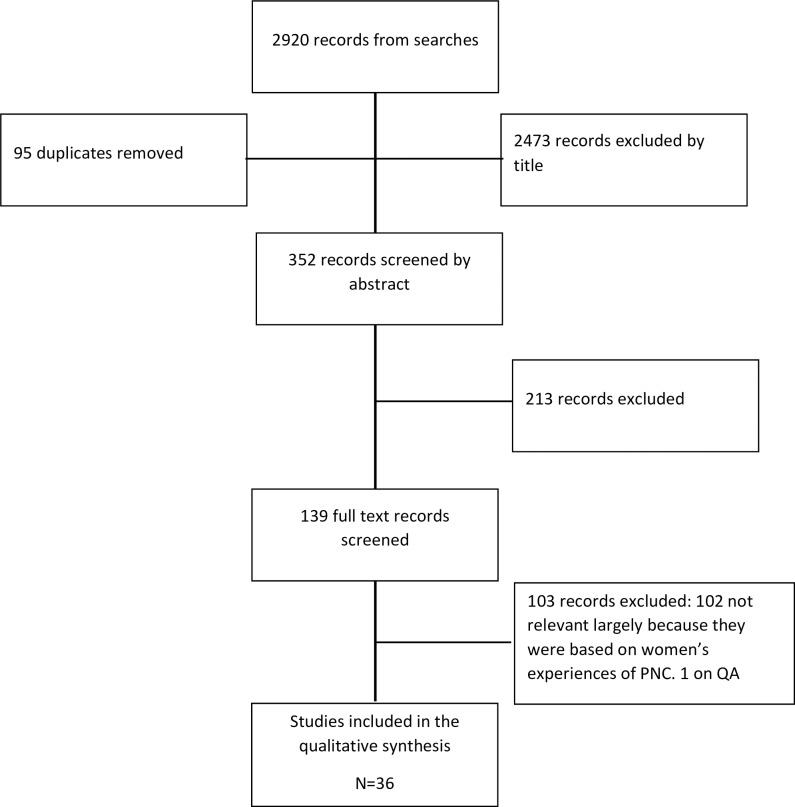
INTRODUCTION: The postnatal period is an underserved aspect of maternity care. Guidelines for postnatal care are not usually informed by what matters to the women who use it. This qualitative systematic review was undertaken to identify what matters to women in the postnatal period, to inform the scope of a new World Health Organization (WHO) postnatal guideline. METHODS: We searched MEDLINE, CINAHL, PsycINFO, POPLINE, Global Index Medicus, EMBASE, LILACS, AJOL, and reference lists of eligible studies published January 2000-July 2019, reporting qualitative data on women's beliefs, expectations, and values relating to the postnatal period. DATA COLLECTION AND ANALYSIS: Author findings were extracted, coded and synthesised using techniques derived from thematic synthesis. Confidence in the quality, coherence, relevance and adequacy of data underpinning the resulting findings was assessed using GRADE-CERQual. RESULTS: We included 36 studies from 15 countries, representing the views of more than 800 women. Confidence in most results was moderate to high. What mattered to women was a positive postnatal experience where they were able to adapt to their new self-identity and develop a sense of confidence and competence as a mother; adjust to changes in their intimate and family relationships, including their relationship to their baby; navigate ordinary physical and emotional challenges; and experience the dynamic achievement of personal growth as they adjust to the 'new normal' of motherhood and parenting in their own cultural context. CONCLUSION: This review provides evidence that what matters to women in the postnatal period is achieving positive motherhood (including maternal self-esteem, competence, and autonomy), as well as fulfilling adaptation to changed intimate and family relationships, and (re)gaining health and wellbeing for both their baby, and themselves. Where this process is optimal, it also results in joy, self-confidence, and an enhanced capacity to thrive in the new integrated identity of 'woman and mother'.
Overview
The claims and statistics of this paper haven’t been checked yet.
Free: it reads the open-access text and checks the first 5 claims that cite a source we can check. Create a free account to check every claim.
Integrity signals
Registry
Cites
Statistics
Figures
Verification
Claims the paper makes
The claims and statistics of this paper haven’t been checked yet.
Free: it reads the open-access text and checks the first 5 claims that cite a source we can check. Create a free account to check every claim.
Claims other papers make about this one
Each is checked against this paper’s own text: does it say what the citing paper says it does?
The cited source says what the claim attributes to it.
In the citing paper
“yet the mothers' health and needs are easily overshadowed by the focus on caring for the newborn [12]”
Self-check
Percentages, sums and reported differences re-computed from the paper’s own numbers.
The self-check needs the paper’s full text.
Citations
Cites
Methods for the thematic synthesis of qualitative research in systematic reviews
Thomas, J., & Harden, A. (2008) · BMC Medical Research Methodology · doi:10.1186/1471-2288-8-45 · Cited by 9,312
Global causes of maternal death: a WHO systematic analysis
Say, L., Chou, D., Gemmill, A., Tunçalp, Ö., Moller, A.-B., Daniels, J., Gülmezoglu, A. M., Temmerman, M., & Alkema, L. (2014) · The Lancet Global Health · doi:10.1016/s2214-109x(14)70227-x · Cited by 6,582 · cited 1×
“The majority of these deaths occur postnatally, with post-partum haemorrhage (PPH) the most common cause of maternal death [3].”
BackgroundEvery Newborn: progress, priorities, and potential beyond survival
Lawn, J. E., Blencowe, H., Oza, S., You, D., Lee, A. C., Waiswa, P., Lalli, M., Bhutta, Z., Barros, A. J., Christian, P., et al. (2014) · The Lancet · doi:10.1016/s0140-6736(14)60496-7 · Cited by 1,929 · cited 1×
“Neonatal data are more widely available and recent estimates indicate there are almost three million neonatal deaths (deaths in the first 28 days after birth) each year, most of which are preventable [4].”
BackgroundApplying GRADE-CERQual to qualitative evidence synthesis findings: introduction to the series
Lewin, S., Booth, A., Glenton, C., Munthe-Kaas, H., Rashidian, A., Wainwright, M., Bohren, M. A., Tunçalp, Ö., Colvin, C. J., Garside, R., et al. (2018) · Implementation Science · doi:10.1186/s13012-017-0688-3 · Cited by 1,231
What matters to women during childbirth: A systematic qualitative review
Downe, S., Finlayson, K., Oladapo, O., Bonet, M., & Gülmezoglu, A. M. (2018) · PLOS ONE · doi:10.1371/journal.pone.0194906 · Cited by 550 · cited 2×
“It is unsurprising that the hallmarks of good quality professional postnatal care are the same as those for good antenatal and intrapartum care–support, communication, and effective clinical input, based on what each mother and baby and family need, when they need it, and how they need it [61, 62].”
BackgroundSelf-citationMATERNAL IDENTITY AND THE MATERNAL EXPERIENCE
Rubin, R. (1984) · AJN, American Journal of Nursing · doi:10.1097/00000446-198412000-00030 · Cited by 528
Appraising the quality of qualitative research
Walsh, D., & Downe, S. (2006) · Midwifery · doi:10.1016/j.midw.2005.05.004 · Cited by 523
Self-citationTransition to parenthood: the needs of parents in pregnancy and early parenthood
Deave, T., Johnson, D., & Ingram, J. (2008) · BMC Pregnancy and Childbirth · doi:10.1186/1471-2393-8-30 · Cited by 418
Negron, R., Martin, A., Almog, M., Balbierz, A., & Howell, E. A. (2013) · Maternal and Child Health Journal · doi:10.1007/s10995-012-1037-4 · Cited by 405
Downe, S., Finlayson, K., Tunçalp, Ӧ., & Metin Gülmezoglu, A. (2016) · BJOG: An International Journal of Obstetrics & Gynaecology · doi:10.1111/1471-0528.13819 · Cited by 240 · cited 3×
“It is unsurprising that the hallmarks of good quality professional postnatal care are the same as those for good antenatal and intrapartum care–support, communication, and effective clinical input, based on what each mother and baby and family need, when they need it, and how they need it [61, 62].”
BackgroundSelf-citation
Research works printed but not linked: 3
- Tracking Progress towards Universal Coverage for Reproductive, Newborn and Child Health: The 2017 Report. Washington, D.C.: United Nations Children’s Fund (UNICEF) and the World Health Organization (WHO), 2017 Available at http://countdown2030.org/pdf/Countdown-2030-complete-with-profiles.pdf [Accessed 14th January 2020].
- Demarchi RF, Nascimento VFd, Borges AP, Terças ACP, Grein TAD, Baggio É. Perception of pregnant women and primiparous puerperas on maternity. Journal of Nursing UFPE on line—Qualis B2; Vol 11, No 7 (2017): Revista de Enfermagem UFPE On LineDO—105205/1981-8963-v11i7a23438p2663-2673-2017. 2017.
- Riberio JP, da Costa dL, da SS, Bubolz Oliveira B, Voss Klemtz F, Barcelos Lopes K, et al Needs Felt by Women in the Puerperal Period. Journal of Nursing UFPE / Revista de Enfermagem UFPE. 2019; 13(1): 61– 9. 10.5205/1981-8963-v13i01a235022p61-69-2019 · doi:10.5205/1981-8963-v13i01a235022p61-69-2019
Cited by
Raza, A., Siddiqui, H. U. R., Munir, K., Almutairi, M. S., Rustam, F., & Ashraf, I. (2022) · PLoS ONE · doi:10.1371/journal.pone.0276525 · Cited by 148
“Maternal health issues for women arise during pregnancy, childbirth, and the postnatal period [1].”
BackgroundWilliamson, T., Wagstaff, D., Goodwin, J., & Smith, N. (2022) · Sex Roles · doi:10.1007/s11199-022-01345-7 · Cited by 159
“Supporting women’s transition to ‘woman and mother’ (Finlayson et al., 2020, p. 17) then requires supporting women to navigate this transition, including how to navigate the pressures of modern motherhood discourse.”
BackgroundWojcieszek, A. M., Bonet, M., Portela, A. G., Althabe, F., Bahl, R., Chowdhary, N., Dua, T., Edmond, K. M., Gupta, S., Rogers, L. M., et al. (2023) · BMJ Global Health · doi:10.1136/bmjgh-2022-010992 · Cited by 128
“Evidence from a qualitative evidence synthesis exploring what matters to women during the postnatal period 13 shows that the postnatal period is generally a time of intense joy and happiness, while also characterised by marked changes in self-identity, the redefinition of relationships and…”
BackgroundSelf-citationAdlington, K., Vasquez, C., Pearce, E., Wilson, C. A., Nowland, R. A., Taylor, B. L., Spring, S., & Johnson, S. (2023) · BMC Psychiatry · doi:10.1186/s12888-023-04532-2 · Cited by 107
“Reflexivity Quality standards in qualitative research require that authors consider how their own views and opinions could influence decisions made in the design and conduct of a study and influence emerging findings and vice versa [75].”
BackgroundCall to action for a life course approach
Simmons, D., Gupta, Y., Hernandez, T. L., Levitt, N., van Poppel, M., Yang, X., Zarowsky, C., Backman, H., Feghali, M., & Nielsen, K. K. (2024) · The Lancet · doi:10.1016/s0140-6736(24)00826-2 · Cited by 66
Lau, Y., Cheng, J.-Y., Wong, S.-H., Yen, K.-Y., & Cheng, L.-J. (2021) · World Journal of Psychiatry · doi:10.5498/wjp.v11.i4.133 · Cited by 68
Sacks, E., Finlayson, K. W., Brizuela, V., Crossland, N., Ziegler, D., Sauvé, C., Langlois, É. V., Javadi, D., Downe, S. M., & Bonet, M. (2022) · PLoS ONE · doi:10.1371/journal.pone.0270264 · Cited by 78
“Based on previous related reviews of antenatal care [29] and intrapartum care [30] as well as a recent thematic synthesis of ‘what matters to women’ during the postnatal period [31] we used a deductive approach to develop a thematic framework comprising four broad concepts (Resources and access; Behaviours and attitud…”
MethodSelf-citationHossain, M. M., Kashem, M. A., Nayan, N. M., & Chowdhury, M. A. (2023) · Healthcare Analytics · doi:10.1016/j.health.2023.100285 · Cited by 80
McCauley, H. B., Lowe, K., Furtado, N., Mangiaterra, V., & van den Broek, N. R. (2022) · BMC Pregnancy and Childbirth · doi:10.1186/s12884-022-04752-6 · Cited by 72
“Other forms of community support are effective such as mother to mother support for continuation of exclusive breastfeeding, practical and emotional support from partners, family and the wider community to enhance wellbeing and promote a positive experience of the postnatal period [78, 79].”
BackgroundCrooks, R., Bedwell, C., & Lavender, T. (2022) · BMC Pregnancy and Childbirth · doi:10.1186/s12884-022-05022-1 · Cited by 81
Social support needs of first-time parents in the early-postpartum period: A qualitative study
Schobinger, E., Vanetti, M., Ramelet, A., & Horsch, A. (2022) · Frontiers in Psychiatry · doi:10.3389/fpsyt.2022.1043990 · Cited by 77
Access to, and experiences of, maternity care for women with physical disabilities: A scoping review
Blair, A., Cao, J., Wilson, A. N., & Homer, C. (2022) · Midwifery · doi:10.1016/j.midw.2022.103273 · Cited by 69
“Thematic synthesis is primarily used for reviews in the public health and health promotion fields where topics of healthcare experiences commonly require qualitative synthesis ( Finlayson et al., 2020 ; Harden et al., 20 06 , 20 04 ).”
MethodRecommendations for the prevention and treatment of postpartum depression
Dominiak, M., Antosik-Wójcińska, A. Z., Baron, M., Mierzejewski, P., & Święcicki, Ł. (2021) · Ginekologia Polska · doi:10.5603/gp.a2020.0141 · Cited by 83
“According to a meta-synthesis of studies aiming at exploration of new mothers’ needs, women want to feel ‘cared for’ during the postnatal period, to be recognised as individuals and have access to a good quality care with flexibility in recognition of their personal and cultural contexts [32].”
BackgroundSmith, H. J. J., Harvey, C. M., & Portela, A. G. (2022) · BMC Pregnancy and Childbirth · doi:10.1186/s12884-022-04577-3 · Cited by 65
“Recent qualitative evidence shows what matters to women during this period is achieving positive motherhood as well as adapting to changed intimate and family relationships and (re)gaining health and wellbeing for themselves and their baby [3].”
BackgroundPapini, N. M., Mason, T. B., Herrmann, S. D., & Lopez, N. V. (2022) · Body Image · doi:10.1016/j.bodyim.2022.09.010 · Cited by 54
Myers, S., & Emmott, E. H. (2021) · Frontiers in Psychology · doi:10.3389/fpsyg.2021.648002 · Cited by 47
Douma, M. J., Myhre, C., Ali, S., Graham, T. A. D., Ruether, K., Brindley, P. G., Dainty, K. N., Smith, K. E., Montgomery, C., Dennet, L., et al. (2023) · Journal of Emergency Nursing · doi:10.1016/j.jen.2023.07.001 · Cited by 47
Subramanian, L., Murthy, S., Bogam, P., Yan, S. D., Delaney, M. M., Goodwin, C. D. G., Bobanski, L., Rangarajan, A., Bhowmik, A., Kashyap, S., et al. (2020) · BMJ Global Health · doi:10.1136/bmjgh-2020-002660 · Cited by 42
Positive postpartum well‐being: What works for women
Hannon, S., Newnham, E. C., Hannon, K., Wuytack, F., Johnson, L., McEvoy, E., & Daly, D. (2022) · Health Expectations · doi:10.1111/hex.13605 · Cited by 52
“Additionally, positive postnatal care was found to enable women to adapt to their new identity, become confident in mothering and know and understand the physical and emotional changes that accompany childbirth and motherhood.(14) Evidently, perinatal care and quality services play pivotal roles in supporting women's…”
BackgroundGestational Diabetes: An Update 60 Years After O’Sullivan and Mahan
McIntyre, H. D., Kampmann, U., Dalsgaard Clausen, T., Laurie, J., & Ma, R. C. W. (2024) · The Journal of Clinical Endocrinology & Metabolism · doi:10.1210/clinem/dgae709 · Cited by 32
Ishaq, R., Shoaib, M., Baloch, N. S., Sadiq, A., Raziq, A., Huma, Z. E., Raza, S., Batool, F., Haider, S., Saleem, F., et al. (2022) · Frontiers in Public Health · doi:10.3389/fpubh.2021.801035 · Cited by 31
Sharma, B., Christensson, K., Bäck, L., Karlström, A., Lindgren, H. E., Mudokwenyu–Rawdon, C., Maimbolwa, M., Laisser, R. M., Omoni, G. M., Chimwaza, A. F., et al. (2021) · Midwifery · doi:10.1016/j.midw.2021.103051 · Cited by 31
Stevenson, K., Edwards, S., Ogunlana, K., Alomari, M., Agoropopoola, R., Henderson, W. G., Clemente, N. S., Rayment‐Jones, H., McGranahan, M., Castaner, M. M., et al. (2024) · EClinicalMedicine · doi:10.1016/j.eclinm.2024.102938 · Cited by 36
“66 Economic analyses are key to political decision-making on health-care interventions, but just two (7”
“The needs of women in the postpartum period: A scoping review.”
Sendas, M. V., & Freitas, M. J. (2024) · Midwifery · doi:10.1016/j.midw.2024.104098 · Cited by 52
First‐time parents' experiences related to parental self‐efficacy: A scoping review
Sæther, K. M., Berg, R. C., Fagerlund, B. H., Glavin, K., & Jøranson, N. (2022) · Research in Nursing & Health · doi:10.1002/nur.22285 · Cited by 45
“…experiences the first ‐ year postpartum exist, these focus on concepts, such as a sense of security (Werner ‐ Bierwisch et al., 2018; Wiklund et al., 2018), or more generally on parents' needs in the postpartum period (Entsieh & Hallström, 2016; Finlayson et al., 2020; Nystrom & Ohrling, 2004).”
BackgroundResultUzunçakmak, T., Gökşin, İ., & Ayaz‐Alkaya, S. (2021) · The European Journal of Contraception & Reproductive Health Care · doi:10.1080/13625187.2021.1946500 · Cited by 32
Rath, S., Perikala, V., Jena, A. B., & Dandapat, J. (2021) · Biomedicine & Pharmacotherapy · doi:10.1016/j.biopha.2021.112095 · Cited by 25
Semaan, A. T., Dey, T., Kikula, A. I., Asefa, A., Delvaux, T., Langlois, É. V., van den Akker, T., & Beňová, L. (2022) · PLOS Global Public Health · doi:10.1371/journal.pgph.0000214 · Cited by 24
“A recent meta-synthesis of qualitative studies shows that postpartum women struggle with shared rooms, lack of privacy in health facilities, and rules on visiting hours [65].”
BackgroundFinlayson, K. W., Sacks, E., Brizuela, V., Crossland, N., Cordey, S., Ziegler, D., Langlois, É. V., Javadi, D., Comrie‐Thomson, L., Downe, S. M., et al. (2023) · BMJ Global Health · doi:10.1136/bmjgh-2022-011086 · Cited by 31
“57 Strengths and limitations While our review is framed around fathers and other family members, 29 of our 30 studies incorporated the views of fathers with more limited information coming from other family members, so our findings are heavily weighted towards fathers’ perceptions.”
Self-citationTurner, L., Culliford, D., Ball, J., Kitson-Reynolds, E., & Griffiths, P. (2022) · Women and Birth · doi:10.1016/j.wombi.2022.02.005 · Cited by 20
Guure, C. B., Aviisah, P. A., Adu‐Bonsaffoh, K., Mehrtash, H., Aderoba, A. K., Irinyenikan, T. A., Baldé, M. D., Adeyanju, O. A., Maung, T. M., Tunçalp, Ö., et al. (2023) · BMJ Global Health · doi:10.1136/bmjgh-2023-011705 · Cited by 33
Lau, Y., Yen, K. Y., Wong, S. H., Cheng, J. Y., & Cheng, L. J. (2021) · Journal of Psychiatric Research · doi:10.1016/j.jpsychires.2021.11.012 · Cited by 23
Trajectories of Postpartum Recovery: What is Known and Not Known
Daly, D., Higgins, A., Hannon, S., O’Malley, D., Wuytack, F., Moran, P. S., Cusack, C., & Begley, C. (2022) · Clinical Obstetrics & Gynecology · doi:10.1097/grf.0000000000000726 · Cited by 26
Cheung, L., Thomas, P. C., Brvar, E., & Rowe, S. L. (2024) · JMIR Mental Health · doi:10.2196/57795 · Cited by 28
“To ensure high-quality qualitative research, consideration of researchers’ views and biases on design and analysis were included [57].”
Measures to assess quality of postnatal care: A scoping review
Galle, A., Moran, A. C., Bonet, M., Graham, K., Muzigaba, M., Portela, A. G., Day, L. T., Tuabu, G. K., Silva, B., & Moller, A. (2023) · PLOS Global Public Health · doi:10.1371/journal.pgph.0001384 · Cited by 29
Self-citationCOVID-19 outcomes in hospitalized puerperal, pregnant, and neither pregnant nor puerperal women
Serra, F. E., Francisco, R. P. V., de Rossi, P., Brizot, M. D. L., & Rodrigues, A. S. (2021) · PLoS ONE · doi:10.1371/journal.pone.0259911 · Cited by 25
Postnatal Care: A Comparative Review of Guidelines
Giouleka, S., Tsakiridis, I. G., Kostakis, N., Boureka, E., Mamopoulos, A. M., Kalogiannidis, I. A., Athanasiadis, A. P., & Dagklis, T. (2024) · Obstetrical & Gynecological Survey · doi:10.1097/ogx.0000000000001224 · Cited by 22
Childbirth experience during the COVID-19 pandemic: A qualitative thematic analysis
Cruz-Ramos, M. C., Resurrección, D. M., & Hernández‐Albújar, Y. (2023) · Midwifery · doi:10.1016/j.midw.2023.103669 · Cited by 19
Canadian women’s experience of postnatal care: a mixed method study
Dol, J., Hughes, B., Tomblin Murphy, G., Aston, M., McMillan, D., & Campbell-Yeo, M. (2022) · Canadian Journal of Nursing Research · doi:10.1177/08445621211052141 · Cited by 15
“…mattered most during the postnatal period was the ability to have a positive motherhood experience, including developing self-esteem, competence, and autonomy, as well as adapting to their new role and relationships while ensuring health for themselves and their infant (Finlayson et al., 2020).”
BackgroundKatou, Y., Okamura, M., & Ohira, M. (2021) · Nursing Open · doi:10.1002/nop2.1087 · Cited by 15
Javadi, D., Sacks, E., Brizuela, V., Finlayson, K. W., Crossland, N., Langlois, É. V., Ziegler, D., Chandra‐Mouli, V., & Bonet, M. (2023) · BMJ Global Health · doi:10.1136/bmjgh-2022-011560 · Cited by 24
“23 Therefore, it is important to synthesise existing evidence specifically on adolescent girls’ perceptions of and experiences with PNC, their wants and needs, and how these contribute to the use of and satisfaction with services.”
Self-citationFoong, W. C., Foong, S. C., Ho, J. J., Gautam, D., Leong, J. J., Tan, P. Y., & Baskaran, M. (2023) · BMC Pregnancy and Childbirth · doi:10.1186/s12884-023-06021-6 · Cited by 22
“If parents could be informed about KMC earlier, it would give them more time to comprehend what is to be expected, and perhaps be able to accept this as part of their norm [18, 19].”
BackgroundTinius, R. A., Duchette, C., Beasley, S., Blankenship, M. M., & Schoenberg, N. E. (2021) · International Journal of Women s Health · doi:10.2147/ijwh.s296310 · Cited by 17
“47 Social support is an important facet of future app development, as social support is useful for encouraging appropriate prenatal care and healthy behaviors during pregnancy 62 as well as exercise during postpartum.”
BackgroundLokubal, P., Calvert, C., Cousens, S. N., Daniele, M., Ganaba, R., & Filippi, V. (2021) · BMJ Open · doi:10.1136/bmjopen-2020-048230 · Cited by 14
Nazarenko, D. N., Daniel, A. L., Durfee, S., & Agbemenu, K. (2024) · Birth · doi:10.1111/birt.12832 · Cited by 17
Postpartum care content and delivery throughout the African continent: An integrative review
Gresh, A., Cohen, M. A., Anderson, J., & Glass, N. E. (2021) · Midwifery · doi:10.1016/j.midw.2021.102976 · Cited by 13
Serra, F. E., Rosa, E. R., de Rossi, P., Francisco, R. P. V., & Rodrigues, A. S. (2022) · Vaccines · doi:10.3390/vaccines10122172 · Cited by 19
“During the postpartum period, women may delay seeking medical assistance as they focus on taking care of their new-born, ignoring their own health [31,32].”
BackgroundLesser, I., Nienhuis, C. P., & Hatfield, G. L. (2023) · International Journal of Qualitative Studies on Health and Well-Being · doi:10.1080/17482631.2023.2172793 · Cited by 14
“New mothers state that an important factor in their postpartum care is re(gaining) health and well-being (Finlayson et al., 2020).”
BackgroundAderoba, A. K., & Adu‐Bonsaffoh, K. (2022) · Obstetrics and Gynecology Clinics of North America · doi:10.1016/j.ogc.2022.07.005 · Cited by 18
Measuring women’s experiences during antenatal care (ANC): scoping review of measurement tools
Mehrtash, H., Stein, K., Barreix, M., Bonet, M., Bohren, M. A., & Tunçalp, Ö. (2023) · Reproductive Health · doi:10.1186/s12978-023-01653-5 · Cited by 17
“…a priority area for WHO and the Human Reproduction Programme (HRP), the continuation of this work will be expanded across the continuum of maternity care beyond ANC to PNC, to capture women’s experiences in the postnatal period and to ensure women achieve a positive motherhood experience [44, 45].”
BackgroundSelf-citationBlair, A. B., Tan, A., Homer, C., & Vogel, J. P. (2024) · BMC Pregnancy and Childbirth · doi:10.1186/s12884-024-06295-4 · Cited by 12
“Women are also at risk of physical and psychological complications as they recover from birth, and learn and adapt to caring for a new infant [3].”
BackgroundBarr, K. R., Nguyen, T. A., Pickup, W., Cibralic, S., Diaz, A. M., Barnett, B. E. W., & Eapen, V. (2024) · Frontiers in Psychiatry · doi:10.3389/fpsyt.2024.1385120 · Cited by 20
Høgmo, B. K., Bondas, T. E., & Alstveit, M. (2022) · Scandinavian Journal of Caring Sciences · doi:10.1111/scs.13117 · Cited by 16
Olajubu, A. O., Fajemilehin, B. R., & Olajubu, T. O. (2022) · BMC Pregnancy and Childbirth · doi:10.1186/s12884-022-05177-x · Cited by 24
“Introduction The time frame that begins immediately after a baby is born and lasting up to six weeks (42 days) is known as the postnatal period [1].”
BackgroundTenaw, L. A., Ngai, F. W., & Lam, K. (2024) · Midwifery · doi:10.1016/j.midw.2024.104128 · Cited by 11
Eikemo, R., Vikström, A., Nyman, V., Jonas, W., & Barimani, M. (2023) · Scandinavian Journal of Caring Sciences · doi:10.1111/scs.13103 · Cited by 13
A Blended Cognitive–Behavioral Intervention for the Treatment of Postpartum Depression: A Case Study
Branquinho, M., Canavarro, M. C., & Fonseca, A. (2022) · Clinical Case Studies · doi:10.1177/15346501221082616 · Cited by 11
“…a demanding period in which women face challenges related to their identity, their interpersonal relationships, and emotional and physical changes (Finlayson et al., 2020), and for these reasons, it may represent a time of increased risk for women to develop mental health problems (Woolhouse et…”
BackgroundBody image of women during breastfeeding: analysis supported by nursing theory
Primo, C. Ç., Ferreira, C. B. D. C., soares, J. C. P., Muri, L. A. C., Lima, E. D. F. A., & Brandão, M. A. G. (2023) · Revista gaúcha de enfermagem · doi:10.1590/1983-1447.2023.20220051.en · Cited by 11
“For some of the participants, the transformations did not seem to be of greater relevance, considering what becoming a mother represents, leaving in the background any attention to physical and aesthetic aspects of their bodies (4,6–9) .”
BackgroundMethodInfluentialChing, H., Chua, J. Y. X., Chua, J. S., & Shorey, S. (2023) · Worldviews on Evidence-Based Nursing · doi:10.1111/wvn.12673 · Cited by 17
Starr, L. T., Washington, K. T., McPhillips, M., Pitzer, K., Demiris, G., & Oliver, D. P. (2022) · Palliative Medicine · doi:10.1177/02692163221122956 · Cited by 12
Ängeby, K., & Ternström, E. (2024) · European Journal of Midwifery · doi:10.18332/ejm/176698 · Cited by 10
“A meta-synthesis has revealed that women also want to feel ‘cared for’ during the postnatal period, emphasizing good quality care and flexibility regarding care 10 .”
BackgroundHanach, N., Saqan, R., Radwan, H. M., Bani‐Issa, W., & de Vries, N. K. (2024) · Journal of Medical Internet Research · doi:10.2196/53720 · Cited by 19
“Consistent with previous qualitative studies [35], the need for information is prominent during the first year following childbirth.”
Namutebi, M., Kabahinda, D., Mbalinda, S. N., Nabunya, R., Gingo, D., Kabiri, L., Ngabirano, T. D., & Muwanguzi, P. A. (2022) · BMC Pregnancy and Childbirth · doi:10.1186/s12884-022-05062-7 · Cited by 17
“A systematic review of what matters to women in the postpartum period found that having optimum health for the mother and baby was very important, which may explain the findings in this study [24].”
ResultSoares, B. E., Benone, N. L., Barthem, R. B., Marceniuk, A. P., & Montag, L. F. D. A. (2021) · Estuarine Coastal and Shelf Science · doi:10.1016/j.ecss.2021.107256 · Cited by 11
The Meaning of Becoming a Mother. A Phenomenological‐Hermeneutic Study
Leanderz, Å. G., Larsson, M., Lygnegård, F., Bäckström, C., & Henricson, M. (2025) · Scandinavian Journal of Caring Sciences · doi:10.1111/scs.70011 · Cited by 15
“Previous research highlights that maternal self-esteem, competence and autonomy matter in order to flourish in their new, integrated identity as a ‘woman and mother’ [44].”
Christiansen, P. K., Skjøth, M. M., Lorenzen, L. E., Draborg, E., Vinter, C. A., Kjær, T., & Rothmann, M. J. (2021) · Midwifery · doi:10.1016/j.midw.2021.102994 · Cited by 13
Christie, H. E., Roach, L. A., Kennedy, M., Beetham, K. S., Meyer, B. J., Schoenaker, D. A. J. M., & François, M. E. (2022) · BMC Pregnancy and Childbirth · doi:10.1186/s12884-022-04913-7 · Cited by 10
“Studies have reported women want, and react positively to, social support, examples of a positive motherhood experience, and regaining health and wellbeing for their baby and themselves [20, 23].”
BackgroundWilkinson, S. A., Guyatt, S., & Willcox, J. C. (2022) · Health Promotion Journal of Australia · doi:10.1002/hpja.668 · Cited by 8
“Systematic review findings highlight the complexity of the postnatal period and gaps in current understanding of effective postnatal interventions.(11,12) Recent randomised controlled trials (RCTs) resulted in modest, but clinically relevant weight, body composition and behavioural changes.”
BackgroundHadi, A. A., Paliwoda, M., Dawson, J. A., Walker, K., & New, K. (2022) · Sultan Qaboos University medical journal · doi:10.18295/squmj.10.2022.059 · Cited by 13
Interprofessional qualification of prenatal care in the context of primary health care
da Veiga, A. C., de Medeiros, L. D. S., Backes, D. S., de Sousa, F. G. M., Hämel, K., Kruel, C. S., & Häeffner, L. S. B. (2023) · Ciência & Saúde Coletiva · doi:10.1590/1413-81232023284.14402022en · Cited by 9
“These complications can be an indicator of the poor quality of prenatal care 20 .”
Stakeholder’s perspectives of postnatal discharge: a qualitative evidence synthesis
Harvey, C. M., Smith, H. J. J., Portela, A. G., & Movsisyan, A. (2023) · BMJ Global Health · doi:10.1136/bmjgh-2023-011766 · Cited by 15
Sæther, K. M., Fagerlund, B. H., Glavin, K., & Jøranson, N. (2023) · Qualitative Health Research · doi:10.1177/10497323231208972 · Cited by 19
“…and hospitals is considered one of the societal factors that aims to smooth the transition to parenthood by facilitating parents ’ sense of con fi dence and their competence as parents (Finlayson et al., 2020; Leahy-Warren et al., 2005; McLeish et al., 2020; World Health Organization, 2022).”
BackgroundOperationalizing Whole-Person Postpartum Care: Health Care Provider-Level Strategies
Fahey, J. O. (2022) · Clinical Obstetrics & Gynecology · doi:10.1097/grf.0000000000000733 · Cited by 9
de la Salud, O. P. (2022) · Pan American Health Organization eBooks · doi:10.37774/9789275326817 · Cited by 29
Sundarapperuma, T., Katulanda, P., Wijesinghe, C. J., Hettiarachchi, P., & Wasalathanthri, S. (2024) · BMC Endocrine Disorders · doi:10.1186/s12902-024-01643-z · Cited by 7
“However, since the postpartum period is a unique phase of life with its own concerns and limitations [25], the life-style change should be tailor made for optimum acceptance.”
BackgroundCatalá, P., Peñacoba, C., Écija, C., Gutiérrez, L., & Viana-Meireles, L. G. (2025) · Societies · doi:10.3390/soc15030050 · Cited by 12
Leahy‐Warren, P., & Nieuwenhuijze, M. J. (2023) · Heliyon · doi:10.1016/j.heliyon.2023.e14591 · Cited by 12
Functional status, social support, and anxiety among postnatal women of Eastern India
Chandra, N., & Smitha, M. V. (2023) · European Journal of Obstetrics & Gynecology and Reproductive Biology X · doi:10.1016/j.eurox.2023.100238 · Cited by 14
“A meta-synthesis revealed that health professionals’ advice on baby growth, hygiene, vaccines, breastfeeding, nutrition, and practical parenting advice is valued by women and impacts their ability to function normally after giving birth [35].”
BackgroundHildingsson, I., Parment, H., Öhrn, U., & Johansson, M. (2023) · European Journal of Midwifery · doi:10.18332/ejm/172573 · Cited by 8
Laureij, L. T., van der Hulst, M., Lagendijk, J., Been, J. V., Ernst‐Smelt, H. E., Franx, A., & Lugtenberg, M. (2021) · BMJ Open · doi:10.1136/bmjopen-2020-046696 · Cited by 14
Doğum sonrası sosyal desteğin kadınların fonksiyonel durumlarına etkisi
Kaya, N., & Aksoy, Ö. D. (2021) · Mersin üniversitesi sağlık bilimleri dergisi/Mersin üniversitesi sağlık bilimleri dergisi · doi:10.26559/mersinsbd.833413 · Cited by 7
Habte, A., Tamene, A., & Elilo, L. T. (2023) · Frontiers in Public Health · doi:10.3389/fpubh.2023.1272888 · Cited by 10
“Major physical, social, and emotional changes occurred during this period; nonetheless, it is typically the most neglected period on the maternal and childcare continuum (2).”
BackgroundJohansson, C., Edqvist, M., Bonnevier, A., Vilhelmsen, M., & Rubertsson, C. (2025) · Sexual & Reproductive Healthcare · doi:10.1016/j.srhc.2025.101078 · Cited by 15
Li, L., Xiao, L., Xu, Y., Wu, J., Li, J., Chen, X., Zhai, X., & Wang, B. (2025) · BMC Pregnancy and Childbirth · doi:10.1186/s12884-025-08084-z · Cited by 11
“…postpartum period represents a particularly critical phase: physiologically, most reproductive organs (excluding lactation-related breast changes) have returned to a pre-pregnancy state, and psychologically, mothers are transitioning from acute postpartum recovery to longer-term adaptation [10].”
Bulhões, É. R. F. N., Dantas, T. H. D. M., Dantas, J. H., Souza, Í. N. D., Castaneda, L., & Dantas, D. D. S. (2020) · Brazilian Journal of Physical Therapy · doi:10.1016/j.bjpt.2020.12.003 · Cited by 7
Amamentação como um direito humano: construção de material educativo pela voz das mulheres
Lutterbach, F. G. C., Serra, G. M. A., & de Souza, T. S. N. (2023) · Interface - Comunicação Saúde Educação · doi:10.1590/interface.220093 · Cited by 12
Lived experiences of mothers with postnatal anxiety: a qualitative phenomenology study from Pakistan
Saeed, Q., Shafique, K., & Chaudhry, N. (2024) · BMJ Open · doi:10.1136/bmjopen-2023-078203 · Cited by 12
Lee, M. F., Muldoon, J., Grant, R., McAuley, S., Bolton, K., Allan, M., & Burke, K. J. (2025) · Health Promotion Journal of Australia · doi:10.1002/hpja.70034 · Cited by 9
Clark, M., & Thorpe, H. (2023) · SSM - Qualitative Research in Health · doi:10.1016/j.ssmqr.2023.100261 · Cited by 9
Imagem corporal da mulher durante amamentação: análise suportada em teoria de enfermagem
Primo, C. Ç., Ferreira, C. B. D. C., soares, J. C. P., Muri, L. A. C., Lima, E. D. F. A., & Brandão, M. A. G. (2023) · Revista gaúcha de enfermagem · doi:10.1590/1983-1447.2023.20220051.pt · Cited by 5
Schobinger, E., Vanetti, M., Ramelet, A., & Horsch, A. (2024) · Midwifery · doi:10.1016/j.midw.2024.104028 · Cited by 14
“…to being challenged by physical, emotional, and social changes that occur after their infant is born and throughout the transition to parenthood (Finlayson et al., 2020; Shorey et al., 2017), are also at risk of lacking confidence in themselves and fearing for their infant ’ s safety…”
Nuwabaine, L., Namulema, A., Sserwanja, Q., Kawuki, J., Amwiine, E., Amperiize, M., Nakate, M. G., & Asiimwe, J. B. (2024) · Archives of Public Health · doi:10.1186/s13690-024-01433-y · Cited by 5
“Other studies also reported obstetric characteristics associated with PNC, for example, quality antenatal care, mode of delivery, place of delivery, and insufficient knowledge of PNC, among others [15, 17, 18].”
Munabi-Babigumira, S. K., Lewin, S. A., Glenton, C., Vélez, C. M., Gonçalves, D. C., & Bohren, M. A. (2021) · Cochrane Database of Systematic Reviews · doi:10.1002/14651858.cd014790 · Cited by 9
Sönmez, B., & Mamuk, R. (2021) · Bakirkoy Tip Dergisi / Medical Journal of Bakirkoy · doi:10.4274/bmj.galenos.2021.86158 · Cited by 9
Johansson, M., & Thies‐Lagergren, L. (2022) · European Journal of Midwifery · doi:10.18332/ejm/152547 · Cited by 8
Oral Health and Knowledge among Postpartum Women
David, M. B., Callen, Y., Eliasi, H., Peretz, B., Odeh‐Natour, R., Hadani, M. B. D., & Blumer, S. (2022) · Children · doi:10.3390/children9101449 · Cited by 6
Soepnel, L. M., Mabetha, K., Norris, S. A., Motlhatlhedi, M., Nkosi, N. G., Klingberg, S., Lye, S. J., & Draper, C. E. (2024) · BMC Women s Health · doi:10.1186/s12905-024-02982-8 · Cited by 9
“(IDI 10)”
BackgroundEmpowering Midwives and Obstetric Nurses
Ray, A. (2021) · IntechOpen eBooks · doi:10.5772/intechopen.78934 · Cited by 6
Maternal Evaluation of a Team-Based Maternity Care Model for Women of Low Obstetric Risk
Perrella, S. L., Miraudo, J., Rea, A., Geddes, D. T., & Prosser, S. A. (2022) · Journal of Patient Experience · doi:10.1177/23743735221092606 · Cited by 9
“Consistency in individualized information and support is critical as women navigate postpartum physical and emotional changes while developing their confidence and competence in breastfeeding, infant care, and self-care (8).”
BackgroundResultBrekke, M., Småstuen, M. C., Glavin, K., Amro, A., Solberg, B., Øygarden, A. U., Sæther, K. M., & Haugland, T. (2023) · BMC Public Health · doi:10.1186/s12889-023-17285-0 · Cited by 8
“Transition to motherhood is characterized by physical, psychological, and social changes [1] and the development of a relationship with the newborn [2].”
Background
Metadata
- Authors
- Finlayson, K., Crossland, N., Bonet, M., & Downe, S.
- Affiliations
- University of Lancashire (GB)
- World Health Organization (CH)
- Corresponding author
- Finlayson, Kenneth
- Venue
- PLOS ONE
- Publisher
- Public Library of Science (PLoS)
- Published
- 2020-04-22
- Volume
- 15
- Issue
- 4
- Pages
- e0231415
- ISSN
- 1932-6203 (ISSN-L)
- PMC
- PMC7176084
- OpenAlex
- W3016706858
- Cited by
- 307
- References
- 60
- Citations by year
- 2026: 34 · 2025: 46 · 2024: 81 · 2023: 53 · 2022: 44 · 2021: 46 · 2020: 3
- FWCI
- 4.30
- Type
- journal article
- Language
- en
- Open access
- gold
- doi.org
- Licence
- Locations
- PLoS ONE (publishedVersion, cc-by)
- PubMed Central (publishedVersion, cc-by)
- PubMed (publishedVersion)
- CLOK (University of Central Lancashire) (acceptedVersion)
- RePEc: Research Papers in Economics (submittedVersion)
- DOAJ (DOAJ: Directory of Open Access Journals) (submittedVersion, cc-by-sa)
- Figshare (submittedVersion, cc-by)
- Funders
- World Health Organization
- UNICEF
- University of Central Lancashire
- Topics
- Health Sciences › Medicine › Obstetrics and Gynecology › Maternal and Perinatal Health Interventions
- Health Sciences › Medicine › Public Health, Environmental and Occupational Health › Maternal Mental Health During Pregnancy and Postpartum
- Health Sciences › Medicine › Pediatrics, Perinatology and Child Health › Maternal and Neonatal Healthcare
- Keywords
- postpartum period, women's experiences, postpartum care, motherhood, maternal self-esteem, maternal competence, maternal autonomy, mother-infant relationship, family relationships
- MeSH terms
- Adaptation, Psychological, Emotions, Female, Humans, Maternal Health Services, Postnatal Care, Pregnancy, Self Concept, Databases, Factual
About these checks
Registry, retraction, Cites and statistics results are computed, not judged, with one exception: a printed reference that no index lists is read once by a model before it counts as a citation error. Claims are extracted by a model and kept only when their quote appears verbatim in the text; each cited source is then checked, with a model’s help, for whether it says what the claim relies on. Those verdicts can be wrong — read the claim’s quote and the cited source before relying on one.
Statistics and arithmetic are recomputed, not judged.
Confidence bands are shown only for fields calibrated on our annotated test set. None is calibrated yet, so no band is shown.
What counts as a claim ›How we measure confidence ›How we check this ›
Are you an author, or do you see a problem with this page? Request a review
Data sources
Bibliographic data: Semantic Scholar, OpenAlex, Crossref.
Contains information from the Semantic Scholar Academic Graph Datasets, made available under the ODC Attribution License (ODC-BY 1.0).
Semantic Scholar’s data is described in: Kinney, R., et al. (2023). The Semantic Scholar Open Data Platform. arXiv:2301.10140.
