

The DOI matches its Crossref record; 29 of the 29 references it cites were found in a registry or an index; none of the 8 sources its claims cite is checked for support yet.
Prevalence and severity of abscesses and cellulitis, and their associations with other health outcomes, in a community-based study of people who inject drugs in London, UK
Open accessAbstract
BACKGROUND: Skin and soft tissue infections (SSTI) are a common but preventable cause of morbidity and mortality among people who inject drugs (PWID). They can be severe, and hospitalisations of PWID with SSTI are rising. The most common SSTI presentations are abscesses and cellulitis. METHODS: We used data from Care & Prevent, a cross-sectional community survey of PWID in London. We reported the lifetime prevalence of SSTI, severity of infections, key risk factors, and associated sequelae. Pictorial questions were used to assess SSTI severity. RESULTS: We recruited 455 PWID. SSTI lifetime prevalence was high: 64% reported an abscess and/or cellulitis. Over one-third (37%) reported a severe infection, 137 (47%) reported hospitalisation. SSTIrisk factors were: aged 35+ years, injecting once or more times a day, subcutaneous or intra-muscular injections, and making four or more attempts to achieve an injection. Those who reported having other health conditions were at higher odds of having an abscess or cellulitis, with risk tending to increase with number of reported conditions. Half (46%) employed self-care for their worst SSTI, and 43% waited for ten or more days before seeking medical care or not seeking medical care at all. CONCLUSIONS: Abscess and cellulitis are very common among PWID in London. We corroborate findings indicating SSTIs are associated with risks, e.g. venous access problems, as well as other co-morbid conditions: septicaemia, endocarditis, DVT, and kidney disease. These co-morbidities may impact SSTIs severity and outcomes. Delayed healthcare seeking potentially exacerbates infection severity, which in turn increases poorer health outcomes and complications.
Overview
AI snapshot
Written from the paper’s full text.
TL;DR
In a cross-sectional community survey of 455 people who inject drugs in London, lifetime prevalence of abscess and/or cellulitis was 64%, with 37% reporting a severe infection and 47% of those with bacterial SSTI reporting SSTI-related hospitalisation. SSTI was associated with older age, frequent injecting, non-venous injecting, repeated injection attempts, equipment reuse, more comorbidities, and delayed healthcare seeking.
Key findings
- Lifetime abscess and/or cellulitis prevalence was 64% (95% CI 60–68); 37% reported a severe infection, and among those with bacterial SSTI, 137/291 (47%) reported SSTI-related hospitalisation, rising to 79/107 (74%) among those with severe infection.
- Adjusted odds of lifetime bacterial SSTI were higher for age 35–44 (AOR 2.03, 95% CI 1.11–3.71) and 45+ (AOR 3.68, 2.09–6.50) versus <35; injecting once a day or more (AOR 1.61, 1.05–2.45); subcutaneous injecting (AOR 2.55, 1.49–4.35); intramuscular injecting (AOR 3.10, 1.74–5.52); and four or more attempts to achieve injection (AOR 5.01, 2.75–9.14).
- Comorbidity showed a graded association: compared with no diagnosed conditions, AORs rose from 2.01 (1.16–3.49) for one condition to 10.02 (2.67–37.57) for five or more; 48% (n=220) reported at least two diagnoses.
- Care delay was common: 60% (121) waited more than five days to seek medical advice, and 43% of those with severe infections waited 10 or more days or did not seek care; severe bacterial infection was associated with waiting 10+ days (AOR 2.29, 95% CI 1.25–4.20).
Methods
- Cross-sectional community survey (Care & Prevent) of PWID in London, recruited October 2017–March 2019 through six drug treatment services and a homeless outreach team; 455 participants completed the questionnaire.
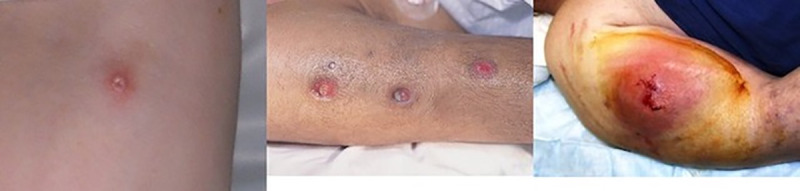
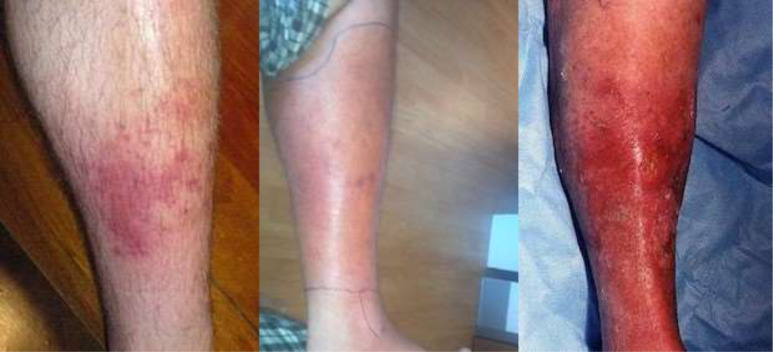
- Eligibility: aged 18+ with a history of injecting psychoactive drugs; data came from a researcher-administered questionnaire using Open Data Kit, with pictorial questions showing mild/moderate/severe abscess and cellulitis to assess SSTI severity.
- Analysis used descriptive statistics, chi-square tests, and logistic regression adjusted for sex, age, and lifetime street homelessness; all variables were reported across participants’ injecting career unless stated otherwise.
Limitations
- Stated: the cross-sectional design cannot establish temporal relationships between SSTIs and injecting risk factors or report incidence; self-reported health conditions are susceptible to recall and awareness problems, such as misconstruing urinary tract infection as kidney disease.
- Stated: the validity of still images for self-reported SSTI severity is unknown; images were chosen with skin infection specialists but were not validated against a gold standard such as clinician evaluation, and clinical diagnosis was not possible.
- Evident: recruitment was opportunistic through treatment and outreach settings, and although the authors note comparability with the national UAM survey, the sample may not represent PWID outside these service-contact populations.
Model-written summary. Check it against the paper before relying on it.
Integrity signals
Registry
Cites
Statistics
Figures
Verification
Claims the paper makes
34 Own result · 8 Own interpretation · 7 Own method · 5 Check pending · 1 Sources not found
A result the paper reports from its own data — it cites no other source for it, so there is none to check. The quote shows it is in the paper.
In the paper
“Of the 249 (55%) who reported at least one abscess, 90 (36%) rated their worst infection as severe, and 159 (64%) as mild or moderate.”
§ Prevalence and severity of abscesses and cellulitis, and their associations with other health outcomes, in a community-based study of people who inject drugs in London, UK > Results > Description of sample population
plain- Asserted: passes — The authors put it forward as true.
- Checkable: passes — It can be checked against evidence.
- Load-bearing: unclear — It is unclear whether the paper’s conclusions depend on it.
- Based: passes — The paper gives a reason why it holds.
A result the paper reports from its own data — it cites no other source for it, so there is none to check. The quote shows it is in the paper.
In the paper
“Sometimes | 156 | 108 (69.2%) | 1.67 (1.07–2.61) | 1.80 (1.14–2.84)”
§ Prevalence and severity of abscesses and cellulitis, and their associations with other health outcomes, in a community-based study of people who inject drugs in London, UK > Results > Factors associated with bacterial SSTIs
plaincorrelationaln = 291 ·- Asserted: passes — The authors put it forward as true.
- Checkable: passes — It can be checked against evidence.
- Load-bearing: unclear — It is unclear whether the paper’s conclusions depend on it.
- Based: passes — The paper gives a reason why it holds.
A result the paper reports from its own data — it cites no other source for it, so there is none to check. The quote shows it is in the paper.
In the paper
“One condition | 143 | 81 (56.6%) | 2.23 (1.30–3.82) | 2.01 (1.16–3.49)”
§ Prevalence and severity of abscesses and cellulitis, and their associations with other health outcomes, in a community-based study of people who inject drugs in London, UK > Results > Factors associated with bacterial SSTIs
plaincorrelational- Asserted: passes — The authors put it forward as true.
- Checkable: passes — It can be checked against evidence.
- Load-bearing: unclear — It is unclear whether the paper’s conclusions depend on it.
- Based: passes — The paper gives a reason why it holds.
A result the paper reports from its own data — it cites no other source for it, so there is none to check. The quote shows it is in the paper.
In the paper
“Sometimes | 255 | 184 (72.2%) | 3.17 (2.08–4.85) | 3.44 (2.23–5.30)”
§ Prevalence and severity of abscesses and cellulitis, and their associations with other health outcomes, in a community-based study of people who inject drugs in London, UK > Results > Factors associated with bacterial SSTIs
plaincorrelationaln = 291 ·- Asserted: passes — The authors put it forward as true.
- Checkable: passes — It can be checked against evidence.
- Load-bearing: passes — The paper’s conclusions depend on it.
- Based: passes — The paper gives a reason why it holds.
A result the paper reports from its own data — it cites no other source for it, so there is none to check. The quote shows it is in the paper.
In the paper
“When asked how long they took to seek medical advice, 60% of participants (121) reported waiting for more than five days after first noticing symptoms, with more than a third with severe infections waiting for 10 or more days before seeking medical advice or not seeking advice at all (41, 43%).”
§ Prevalence and severity of abscesses and cellulitis, and their associations with other health outcomes, in a community-based study of people who inject drugs in London, UK > Results > Description of sample population
plain- Asserted: passes — The authors put it forward as true.
- Checkable: passes — It can be checked against evidence.
- Load-bearing: unclear — It is unclear whether the paper’s conclusions depend on it.
- Based: passes — The paper gives a reason why it holds.
A result the paper reports from its own data — it cites no other source for it, so there is none to check. The quote shows it is in the paper.
In the paper
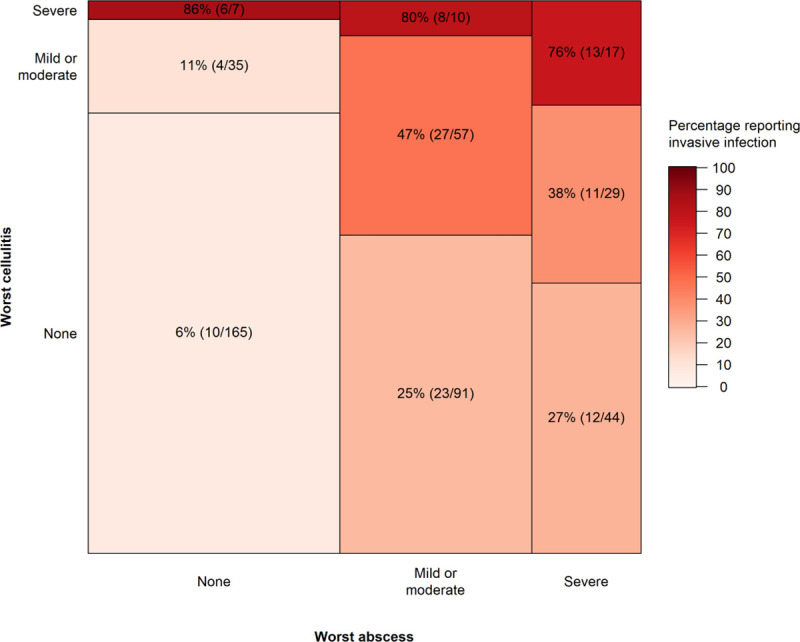
“It is also more frequent among those who have had any abscess than any cellulitis; however, when any cellulitis is co-reported with an abscess it greatly increases the likelihood of invasive disease.”
§ Prevalence and severity of abscesses and cellulitis, and their associations with other health outcomes, in a community-based study of people who inject drugs in London, UK > Results > Description of sample population
plaindirect- Asserted: passes — The authors put it forward as true.
- Checkable: passes — It can be checked against evidence.
- Load-bearing: unclear — It is unclear whether the paper’s conclusions depend on it.
- Based: passes — The paper gives a reason why it holds.
A result the paper reports from its own data — it cites no other source for it, so there is none to check. The quote shows it is in the paper.
In the paper
“Two conditions | 94 | 71 (75.5%) | 5.27 (2.80–9.92) | 4.88 (2.57–9.26)”
§ Prevalence and severity of abscesses and cellulitis, and their associations with other health outcomes, in a community-based study of people who inject drugs in London, UK > Results > Factors associated with bacterial SSTIs
plaincorrelational- Asserted: passes — The authors put it forward as true.
- Checkable: passes — It can be checked against evidence.
- Load-bearing: unclear — It is unclear whether the paper’s conclusions depend on it.
- Based: passes — The paper gives a reason why it holds.
A result the paper reports from its own data — it cites no other source for it, so there is none to check. The quote shows it is in the paper.
In the paper
“Yes | 176 | 136 (77.3%) | 2.63 (1.57–4.41) | 2.55 (1.49–4.35)”
§ Prevalence and severity of abscesses and cellulitis, and their associations with other health outcomes, in a community-based study of people who inject drugs in London, UK > Results > Factors associated with bacterial SSTIs
plaincorrelational- Asserted: passes — The authors put it forward as true.
- Checkable: passes — It can be checked against evidence.
- Load-bearing: passes — The paper’s conclusions depend on it.
- Based: passes — The paper gives a reason why it holds.
A result the paper reports from its own data — it cites no other source for it, so there is none to check. The quote shows it is in the paper.
In the paper
“Over one-third (37%) reported a severe infection, 137 (47%) reported hospitalisation.”
§ Prevalence and severity of abscesses and cellulitis, and their associations with other health outcomes, in a community-based study of people who inject drugs in London, UK > Abstract > Results
plain- Asserted: passes — The authors put it forward as true.
- Checkable: passes — It can be checked against evidence.
- Load-bearing: unclear — It is unclear whether the paper’s conclusions depend on it.
- Based: passes — The paper gives a reason why it holds.
A result the paper reports from its own data — it cites no other source for it, so there is none to check. The quote shows it is in the paper.
In the paper
“Three times | 58 | 41 (70.7%) | 2.51 (1.34–4.71) | 2.43 (1.32–4.50)”
§ Prevalence and severity of abscesses and cellulitis, and their associations with other health outcomes, in a community-based study of people who inject drugs in London, UK > Results > Factors associated with bacterial SSTIs
plaincorrelational- Asserted: passes — The authors put it forward as true.
- Checkable: passes — It can be checked against evidence.
- Load-bearing: unclear — It is unclear whether the paper’s conclusions depend on it.
- Based: passes — The paper gives a reason why it holds.
- The quote only partly states this claim. 1
- Probably not a substantial claim. 7
- It may state two separate claims as one. 7
A result the paper reports from its own data — it cites no other source for it, so there is none to check. The quote shows it is in the paper.
In the paper
“Of those who reported a bacterial infection, 137/291 (47%) reported an SSTI-related hospitalisation.”
§ Prevalence and severity of abscesses and cellulitis, and their associations with other health outcomes, in a community-based study of people who inject drugs in London, UK > Results > Description of sample population
plain- Asserted: passes — The authors put it forward as true.
- Checkable: passes — It can be checked against evidence.
- Load-bearing: unclear — It is unclear whether the paper’s conclusions depend on it.
- Based: passes — The paper gives a reason why it holds.
The quote only partly states this claim.
A result the paper reports from its own data — it cites no other source for it, so there is none to check. The quote shows it is in the paper.
In the paper
“Compared with those reporting any SSTI, those who reported having had a severe bacterial infection had higher odds of taking ten or more days before seeking medical attention, after controlling for other SSTI risks [AOR 2.29 (95%CI 1.25–4.20).”
§ Prevalence and severity of abscesses and cellulitis, and their associations with other health outcomes, in a community-based study of people who inject drugs in London, UK > Results > Factors associated with bacterial SSTIs
plaincorrelational- Asserted: fails — The authors may not put it forward as true.
- Checkable: passes — It can be checked against evidence.
- Load-bearing: fails — The paper’s conclusions may not depend on it.
- Based: fails — The paper may give no reason why it holds.
Probably not a substantial claim. The authors may not put it forward as true. The paper’s conclusions may not depend on it. The paper may give no reason why it holds.
In the paper
“It is well evidenced that PWID face significant barriers in accessing appropriate healthcare due to stigma and discrimination from healthcare professionals as well as structural difficulties in accessing and attending medical appointments [29–31].”
§ Prevalence and severity of abscesses and cellulitis, and their associations with other health outcomes, in a community-based study of people who inject drugs in London, UK > Discussion
What the sources say
- Not checked yetcites [29] D.L. Biancarelli, 2019, Strategies used by people who inject drugs to avoid stigma in healthcare settings, Drug and alcohol dependence source
- Not checked — no full text of the sourcecites [30] M. Harris, 2013, Taming systems to create enabling environments for HCV treatment: negotiating trust in the drug and alcohol setting, Social Science & Medicine source
- Check pendingcites [31] C.E. Paquette, 2018, Stigma at every turn: Health services experiences among people who inject drugs, International Journal of Drug Policy source
boosteddirect- Asserted: passes — The authors put it forward as true.
- Checkable: passes — It can be checked against evidence.
- Load-bearing: passes — The paper’s conclusions depend on it.
- Based: passes — The paper gives a reason why it holds.
It may state two separate claims as one.
What the paper did — it cites no source for this, so there is none to check. The quote shows it is in the paper.
In the paper
“The cross-sectional design meant that we were not able to establish a temporal relationship between bacterial SSTIs and these injecting risk factors, or report incidence.”
§ Prevalence and severity of abscesses and cellulitis, and their associations with other health outcomes, in a community-based study of people who inject drugs in London, UK > Discussion > Strengths and weaknesses
plain- Asserted: passes — The authors put it forward as true.
- Checkable: passes — It can be checked against evidence.
- Load-bearing: passes — The paper’s conclusions depend on it.
- Based: passes — The paper gives a reason why it holds.
It may state two separate claims as one.
What the paper did — it cites no source for this, so there is none to check. The quote shows it is in the paper.
In the paper
“The survey method allowed us to study detailed aspects of participants’ risk environment.”
§ Prevalence and severity of abscesses and cellulitis, and their associations with other health outcomes, in a community-based study of people who inject drugs in London, UK > Discussion > Strengths and weaknesses
plain- Asserted: passes — The authors put it forward as true.
- Checkable: passes — It can be checked against evidence.
- Load-bearing: fails — The paper’s conclusions may not depend on it.
- Based: passes — The paper gives a reason why it holds.
Probably not a substantial claim. The paper’s conclusions may not depend on it.
What the paper did — it cites no source for this, so there is none to check. The quote shows it is in the paper.
In the paper
“The images were chosen in consultation with skin infection specialists, but have not been validated or compared to a gold standard (such as clinician evaluation).”
§ Prevalence and severity of abscesses and cellulitis, and their associations with other health outcomes, in a community-based study of people who inject drugs in London, UK > Discussion > Strengths and weaknesses
plain- Asserted: passes — The authors put it forward as true.
- Checkable: passes — It can be checked against evidence.
- Load-bearing: passes — The paper’s conclusions depend on it.
- Based: passes — The paper gives a reason why it holds.
Probably not a substantial claim. It may state two separate claims as one.
A conclusion the paper draws from its own results — it cites no other source for it, so there is none to check. The quote shows it is in the paper.
In the paper
“Delayed healthcare seeking potentially exacerbates infection severity, which in turn increases poorer health outcomes and complications.”
§ Prevalence and severity of abscesses and cellulitis, and their associations with other health outcomes, in a community-based study of people who inject drugs in London, UK > Abstract > Conclusions
hedgeddirect- Asserted: passes — The authors put it forward as true.
- Checkable: passes — It can be checked against evidence.
- Load-bearing: passes — The paper’s conclusions depend on it.
- Based: fails — The paper may give no reason why it holds.
Probably not a substantial claim. The paper may give no reason why it holds. It may state two separate claims as one.
- Rests on an assumption: The temporal direction of the association between delayed care seeking and severe SSTI is that delay precedes and contributes to severity.
What the paper did — it cites no source for this, so there is none to check. The quote shows it is in the paper.
In the paper
“Self-reported health conditions reported are susceptible to problems with recall and awareness of diseases, such as kidney disease, where participants may have been informed of a urinary tract infection but misconstrued this as kidney disease, and/or may not be aware if the disease is acute or chronic, particularly if they are not currently engaging with healthcare services.”
§ Prevalence and severity of abscesses and cellulitis, and their associations with other health outcomes, in a community-based study of people who inject drugs in London, UK > Discussion > Strengths and weaknesses
plain- Asserted: passes — The authors put it forward as true.
- Checkable: passes — It can be checked against evidence.
- Load-bearing: fails — The paper’s conclusions may not depend on it.
- Based: passes — The paper gives a reason why it holds.
Probably not a substantial claim. The paper’s conclusions may not depend on it.
In the paper
“In a recent cohort study of PWID in opiate substitution treatment in South London, 24% of participants were hospitalised at least once for a bacterial infection over an average of eight years’ follow-up [32].”
§ Prevalence and severity of abscesses and cellulitis, and their associations with other health outcomes, in a community-based study of people who inject drugs in London, UK > Discussion
What the sources say
- Check pendingcites [32] D. Lewer, 2020, Incidence and treatment costs of severe bacterial infections among people who inject heroin: A cohort study in South London, England, Drug and Alcohol Dependence source
plain- Asserted: passes — The authors put it forward as true.
- Checkable: passes — It can be checked against evidence.
- Load-bearing: fails — The paper’s conclusions may not depend on it.
- Based: passes — The paper gives a reason why it holds.
Probably not a substantial claim. The paper’s conclusions may not depend on it.
What the paper did — it cites no source for this, so there is none to check. The quote shows it is in the paper.
In the paper
“Clinical diagnosis was not possible in this study as recruitment was opportunistic and access to skin infection specialist clinicians was not available.”
§ Prevalence and severity of abscesses and cellulitis, and their associations with other health outcomes, in a community-based study of people who inject drugs in London, UK > Discussion > Strengths and weaknesses
plaindirect- Asserted: passes — The authors put it forward as true.
- Checkable: passes — It can be checked against evidence.
- Load-bearing: passes — The paper’s conclusions depend on it.
- Based: passes — The paper gives a reason why it holds.
It may state two separate claims as one.
A conclusion the paper draws from its own results — it cites no other source for it, so there is none to check. The quote shows it is in the paper.
In the paper
“This study captured a wide range of injecting-related risk factors and measured the severity of infections, which to our knowledge has not been measured in previous studies.”
§ Prevalence and severity of abscesses and cellulitis, and their associations with other health outcomes, in a community-based study of people who inject drugs in London, UK > Discussion > Strengths and weaknesses
hedged- Asserted: passes — The authors put it forward as true.
- Checkable: passes — It can be checked against evidence.
- Load-bearing: passes — The paper’s conclusions depend on it.
- Based: passes — The paper gives a reason why it holds.
It may state two separate claims as one.
What the paper did — it cites no source for this, so there is none to check. The quote shows it is in the paper.
In the paper
“The validity of the approach of still based images for self-report of SSTI severity is not known.”
§ Prevalence and severity of abscesses and cellulitis, and their associations with other health outcomes, in a community-based study of people who inject drugs in London, UK > Discussion > Strengths and weaknesses
plain- Asserted: passes — The authors put it forward as true.
- Checkable: passes — It can be checked against evidence.
- Load-bearing: passes — The paper’s conclusions depend on it.
- Based: passes — The paper gives a reason why it holds.
Probably not a substantial claim.
In the paper
“This contrasts with longitudinal studies using healthcare records, which provide more precise estimates of incidence but often lack detailed risk factor information [32]”
§ Prevalence and severity of abscesses and cellulitis, and their associations with other health outcomes, in a community-based study of people who inject drugs in London, UK > Discussion > Strengths and weaknesses
What the sources say
- Check pendingcites [32] D. Lewer, 2020, Incidence and treatment costs of severe bacterial infections among people who inject heroin: A cohort study in South London, England, Drug and Alcohol Dependence source
plaincorrelational- Asserted: passes — The authors put it forward as true.
- Checkable: passes — It can be checked against evidence.
- Load-bearing: unclear — It is unclear whether the paper’s conclusions depend on it.
- Based: passes — The paper gives a reason why it holds.
It may state two separate claims as one.
The paper relies on this without support.
Participants' self-reported lifetime history of SSTI and other health conditions is accurate enough to estimate prevalence and associations.
“Self-reported health conditions reported are susceptible to problems with recall and awareness of diseases, such as kidney disease, where participants may have been informed of a urinary tract infection but misconstrued this as kidney disease, and/or may not be aware if the disease is acute or chronic, particularly if they are not currently engaging with healthcare services.”
The paper relies on this without support.
The pictorial severity ratings correspond to clinically meaningful severity.
“The validity of the approach of still based images for self-report of SSTI severity is not known.”
“The images were chosen in consultation with skin infection specialists, but have not been validated or compared to a gold standard (such as clinician evaluation).”
The paper relies on this without support.
The temporal direction of the association between delayed care seeking and severe SSTI is that delay precedes and contributes to severity.
“The cross-sectional design meant that we were not able to establish a temporal relationship between bacterial SSTIs and these injecting risk factors, or report incidence.”
“Given these findings we posit that duration of time in seeking healthcare impacts severity of bacterial SSTI.”
Claims other papers make about this one
Each is checked against this paper’s own text: does it say what the citing paper says it does?
In the citing paper
“Sharing and reusing of injection equipment, frequency of injections, and years of injection drug use are all known to increase the risk of SSTVI [16–19].”
In the citing paper
“Sharing and reusing of injection equipment, frequency of injections, and years of injection drug use are all known to increase the risk of SSTVI [16–19].”
In the citing paper
“Sharing and reusing of injection equipment, frequency of injections, and years of injection drug use are all known to increase the risk of SSTVI [16–19].”
Self-check
Percentages, sums and reported differences re-computed from the paper’s own numbers.
Each contradiction between two passages listed here was confirmed by an independent check.
Rated major: it would touch a result — a value a result rests on, reported and recomputed p-values on opposite sides of the significance level, two passages that conflict with no sign which is right, or a cited work retracted before this paper was published.
In the paper
§ Prevalence and severity of abscesses and cellulitis, and their associations with other health outcomes, in a community-based study of people who inject drugs in London, UK > Results > Description of sample population
“| Reuse filters | Yes | 190 (43.7%) | 177 (93.2%) | 10.52 | 0.001 | | Reuse filters | No | 245 (56.3%) | 109 (44.5%) | 10.52 | 0.001 |”
§ Prevalence and severity of abscesses and cellulitis, and their associations with other health outcomes, in a community-based study of people who inject drugs in London, UK > Results > Factors associated with bacterial SSTIs
“| Never | 190 | 109 (57.4%) | 1 | 1 | | Sometimes | 156 | 108 (69.2%) | 1.67 (1.07–2.61) | 1.80 (1.14–2.84) | | Always | 89 | 69 (77.5%) | 2.56 (1.44–4.56) | 2.67 (1.48–4.81) |”
Rated major: it would touch a result — a value a result rests on, reported and recomputed p-values on opposite sides of the significance level, two passages that conflict with no sign which is right, or a cited work retracted before this paper was published.
In the paper
§ Prevalence and severity of abscesses and cellulitis, and their associations with other health outcomes, in a community-based study of people who inject drugs in London, UK > Results > Factors associated with bacterial SSTIs
“| Once a day or more | 317 | 260 (82.0%) | 1.72 (1.14–2.59) | 1.61 (1.05–2.45) |”
§ Prevalence and severity of abscesses and cellulitis, and their associations with other health outcomes, in a community-based study of people who inject drugs in London, UK > Results > Factors associated with bacterial SSTIs
“| Less than once a day | 138 | 31 (22.5%) | 1 | 1 |”
Rated major: it would touch a result — a value a result rests on, reported and recomputed p-values on opposite sides of the significance level, two passages that conflict with no sign which is right, or a cited work retracted before this paper was published.
In the paper
§ Prevalence and severity of abscesses and cellulitis, and their associations with other health outcomes, in a community-based study of people who inject drugs in London, UK > Results > Factors associated with bacterial SSTIs
“| 35–44 | 155 | 77 (49.7%) | 1.92 (1.05–3.51) | 2.03 (1.11–3.71) |”
§ Prevalence and severity of abscesses and cellulitis, and their associations with other health outcomes, in a community-based study of people who inject drugs in London, UK > Results > Factors associated with bacterial SSTIs
“| <35 | 58 | 28 (48.3%) | 1 | 1 |”
Rated minor: it would not touch a result — a value no result rests on, a p-value that stays on the same side of the significance level, or a conflict that is clerical, resolved elsewhere in the paper, or outside its own findings.
In the paper
“| Main drug injected | Stimulants (Meth/amphetamines) | 15 (3.3%) | 6 (33.3%) | 18.60 | 0.10 |”
§ Prevalence and severity of abscesses and cellulitis, and their associations with other health outcomes, in a community-based study of people who inject drugs in London, UK > Results > Description of sample population
Reported 33.3 · recomputed 40
Citations
Cites
Role of inflammation in the pathogenesis of osteoarthritis: latest findings and interpretations
Sokolove, J., & Lepus, C. M. (2013) · Therapeutic Advances in Musculoskeletal Disease · doi:10.1177/1759720x12467868 · Cited by 1,100
Hartung, C., Lerer, A. K., Anokwa, Y., Tseng, C., Brunette, W., & Borriello, G. (2010) · International Conference on Information and Communication Technologies and Development (ICTD) · doi:10.1145/2369220.2369236 · Cited by 649
Strategies used by people who inject drugs to avoid stigma in healthcare settings
Biancarelli, D. L., Biello, K. B., Childs, E., Drainoni, M., Salhaney, P., Edeza, A., Mimiaga, M. J., Saitz, R., & Bazzi, A. R. (2019) · Drug and Alcohol Dependence · doi:10.1016/j.drugalcdep.2019.01.037 · Cited by 524
Stigma at every turn: Health services experiences among people who inject drugs
Paquette, C. E., Syvertsen, J. L., & Pollini, R. A. (2018) · International Journal of Drug Policy · doi:10.1016/j.drugpo.2018.04.004 · Cited by 469
Binswanger, I. A., Kral, A. H., Bluthenthal, R. N., Rybold, D. J., & Edlin, B. R. (2000) · Clinical Infectious Diseases · doi:10.1086/313703 · Cited by 300
A systematic review of injecting-related injury and disease among people who inject drugs
Larney, S., Peacock, A., Mathers, B. M., Hickman, M., & Degenhardt, L. (2017) · Drug and Alcohol Dependence · doi:10.1016/j.drugalcdep.2016.11.029 · Cited by 244
Ciccarone, D. (2008) · International Journal of Drug Policy · doi:10.1016/j.drugpo.2008.08.003 · Cited by 155
Self-citationCiccarone, D., Unick, G. J., Cohen, J. K., Mars, S. G., & Rosenblum, D. (2016) · Drug and Alcohol Dependence · doi:10.1016/j.drugalcdep.2016.04.009 · Cited by 132
Self-citationHarris, M., Rhodes, T., & Martin, A. (2013) · Social Science & Medicine · doi:10.1016/j.socscimed.2013.01.031 · Cited by 77
Self-citation
Research works printed but not linked: 5
- Public Health England, H.P.S., 2016, Public Health Wales, Public Health Agency Northern Ireland, Shooting Up: Infections among people who inject drugs in the UK, 2015
- V. Hope, 2010, Neglected infections, real harms: A global scoping of injection-related bacterial infections and responses, The global state of harm reduction, 89
- Cooperation, S, 2017, Stata 15
- N.H. Service, 2018, Health A-Z -Cellulitis
- N.H. Service, 2019, Health A-Z—Abscess
Cited by
Sorted by citations
Harris, M. (2020) · Social Science & Medicine · doi:10.1016/j.socscimed.2020.113183 · Cited by 72
Self-citationDrug use practices and wound care experiences in the age of xylazine adulteration
Jawa, R., Ismail, S., Shang, M., Murray, S., Murray-Krezan, C. M., Zheng, Y., Mackin, S., Washington, K., Alvarez, P., Dillon, J., et al. (2024) · Drug and Alcohol Dependence · doi:10.1016/j.drugalcdep.2024.112390 · Cited by 41
Roux, P., Jauffret‐Roustide, M., Donadille, C., Madrid, L. B., Denis, C., Célérier, I., Chauvin, C., Hamelin, N., Maradan, G., Carrieri, P., et al. (2022) · International Journal of Epidemiology · doi:10.1093/ije/dyac120 · Cited by 40
Jawa, R., Stein, M. D., Anderson, B., Liebschutz, J. M., Stewart, C., Phillips, K. T., & Barocas, J. A. (2021) · International Journal of Drug Policy · doi:10.1016/j.drugpo.2021.103198 · Cited by 28
Predictors of skin and soft tissue infections among sample of rural residents who inject drugs
Baltes, A., Akhtar, W. Z., Birstler, J., Olson-Streed, H. K., Eagen, K., Seal, D. W., Westergaard, R. P., & Brown, R. (2020) · Harm Reduction Journal · doi:10.1186/s12954-020-00447-3 · Cited by 26
Metadata
- Authors
- Wright, T., Hope, V., Ciccarone, D., Lewer, D., Scott, J., & Harris, M.
- Affiliations
- London School of Hygiene & Tropical Medicine (GB)
- Liverpool John Moores University (GB)
- University of California, San Francisco (US)
- University College London (GB)
- University of Bath (GB)
- Corresponding author
- Harris, Magdalena
- Venue
- PLOS ONE
- Publisher
- Public Library of Science (PLoS)
- Published
- 2020-07-14
- Volume
- 15
- Issue
- 7
- Pages
- e0235350
- ISSN
- 1932-6203 (ISSN-L)
- PMC
- PMC7360031
- OpenAlex
- W3043433611
- Semantic Scholar
- 64ecf6ae7ff3e53e71866a0b32519bb07fab674f
- Cited by
- 59
- References
- 29
- Citations by year
- 2026: 11 · 2025: 11 · 2024: 12 · 2023: 5 · 2022: 8 · 2021: 10 · 2020: 2
- FWCI
- 4.39
- Type
- journal article
- Language
- en
- Open access
- gold
- doi.org
- Licence
- Locations
- PLoS ONE (publishedVersion, cc-by)
- PubMed (publishedVersion)
- PubMed Central (publishedVersion, cc-by)
- Liverpool John Moores University (acceptedVersion)
- LSHTM Research Online (London School of Hygiene and Tropical Medicine) (acceptedVersion)
- DOAJ (DOAJ: Directory of Open Access Journals) (submittedVersion, cc-by-sa)
- eScholarship (California Digital Library) (submittedVersion)
- eScholarship (California Digital Library) (submittedVersion, cc-by)
- Explore Bristol Research (submittedVersion)
- Funders
- National Institute for Health Research (CDF-2016-09-014)
- Topics
- Health Sciences › Medicine › Epidemiology › HIV, Drug Use, Sexual Risk
- Health Sciences › Medicine › Infectious Diseases › Streptococcal Infections and Treatments
- Social Sciences › Cultural Studies › Tattoo and Body Piercing Complications
- Keywords
- people who inject drugs, skin and soft tissue infections, abscess, cellulitis, infection prevalence, infection severity, hospitalization, risk factors, delayed care seeking, self-care, comorbidities, septicemia, endocarditis, deep vein thrombosis, kidney disease, London
- MeSH terms
- Abscess, Adult, Cellulitis, Female, United Kingdom, Humans, London, Male, Middle Aged, Patient Acceptance of Health Care, Risk Factors, Skin Diseases, Infectious, Substance Abuse, Intravenous, Prevalence, Outcome Assessment, Health Care, Sepsis
About these checks
Registry, retraction, Cites and statistics results are computed, not judged, with one exception: a printed reference that no index lists is read once by a model before it counts as a citation error. Claims are extracted by a model and kept only when their quote appears verbatim in the text; each cited source is then checked, with a model’s help, for whether it says what the claim relies on. Those verdicts can be wrong — read the claim’s quote and the cited source before relying on one.
A language model drew the claims from the paper on 2026-11-11, under version 3 of the claim definition (model deepseek-v4.1-flash, prompt extract-v3).
A second model labelled each claim on 2026-11-11 (model jev-1.13-20260917, definition revision gold-guideline-v0.2).
Statistics and arithmetic are recomputed, not judged.
Confidence bands are shown only for fields calibrated on our annotated test set. None is calibrated yet, so no band is shown.
What counts as a claim ›How we measure confidence ›How we check this ›
Are you an author, or do you see a problem with this page? Request a review
