

The DOI matches its Crossref record; 44 of the 48 references it cites were found in a registry or an index.
Predictors of mental health during the Covid-19 pandemic in the US: Role of economic concerns, health worries and social distancing
Open accessPublished version of a preprint
Abstract
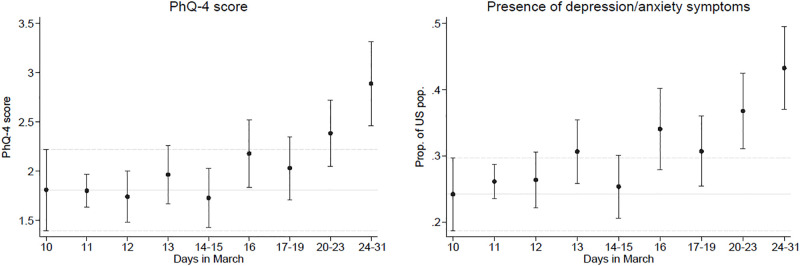
Despite the profound health and economic implications of Covid-19, there is only limited knowledge to date about the role of economic concerns, health worries and social distancing for mental health outcomes during the pandemic. We analyze online survey data from the nationally representative “Understanding America Study” (UAS) covering the period of March 10-31st 2020 (sample size: 6,585). Mental health is assessed by the validated PHQ-4 instrument for measuring symptoms of depression and anxiety. About 29% (CI:27.4-.30.4%) of the US adult population reported some depression/anxiety symptoms over the study period, with symptoms deteriorating over the month of March. Worsening mental health was most strongly associated with concerns about the economic consequences of the pandemic, while concerns about the potential implications of the virus for respondents’ own health and social distancing also predicted increases in symptoms of depression and anxiety during the early stages of the pandemic in the US, albeit less strongly. Our findings point towards the possibility of a major mental health crisis unfolding simultaneously with the pandemic, with economic concerns being a key driving force of this crisis. These results highlight the likely importance of economic countermeasures and social policy for mitigating the impact of Covid-19 on adult mental health in the US over and above an effective public health response.
Overview
The claims and statistics of this paper haven’t been checked yet.
Run the check — free, no account needed. It reads the open-access text and checks the sources it cites.
Integrity signals
Registry
Cites
Statistics
Figures
Verification
Claims the paper makes
The claims and statistics of this paper haven’t been checked yet.
Run the check — free, no account needed. It reads the open-access text and checks the sources it cites.
Claims other papers make about this one
Each is checked against this paper’s own text: does it say what the citing paper says it does?
In the citing paper
“Several studies have shown that COVID-related worry is associated with psychological distress in the pandemic [7–9].”
From Worry and mental health in the Covid-19 pandemic: vulnerability factors in the general Norwegian population (2021) · cites this paper as [9]
Self-check
Percentages, sums and reported differences re-computed from the paper’s own numbers.
The self-check needs the paper’s full text.
Citations
Cites
Kessler, R. C. (1994) · Archives of General Psychiatry · doi:10.1001/archpsyc.1994.03950010008002 · Cited by 12,370
Well-being : the foundations of hedonic psychology
Kahneman, D. J., Diener, E. F., & Schwarz, N. (1999) · Cited by 7,472
Holmes, E. A., O'Connor, R. C., Perry, V. H., Tracey, I., Wessely, S., Arseneault, L., Ballard, C., Christensen, H., Cohen Silver, R., Everall, I., et al. (2020) · The Lancet Psychiatry · doi:10.1016/s2215-0366(20)30168-1 · Cited by 5,715
An Ultra-Brief Screening Scale for Anxiety and Depression: The PHQ–4
Kroenke, K., Spitzer, R. L., Williams, J. B. W., & Löwe, B. (2009) · Psychosomatics · doi:10.1016/s0033-3182(09)70864-3 · Cited by 4,261
Unemployment impairs mental health: Meta-analyses
Paul, K. I., & Moser, K. (2009) · Journal of Vocational Behavior · doi:10.1016/j.jvb.2009.01.001 · Cited by 2,706
Utility of a new procedure for diagnosing mental disorders in primary care. The PRIME-MD 1000 study
Spitzer, R. L. (1994) · JAMA · doi:10.1001/jama.272.22.1749 · Cited by 2,648
Social relationships and health a flashpoint for health policy
Umberson, D., & Karas Montez, J. (2010) · Journal of Health and Social Behavior · doi:10.1177/0022146510383501 · Cited by 2,639
Scaling regression inputs by dividing by two standard deviations
Gelman, A. (2007) · Statistics in Medicine · doi:10.1002/sim.3107 · Cited by 2,536
Löwe, B., Wahl, I., Rose, M., Spitzer, C., Glaesmer, H., Wingenfeld, K., Schneider, A., & Brähler, E. (2010) · Journal of Affective Disorders · doi:10.1016/j.jad.2009.06.019 · Cited by 2,473
Research works printed but not linked: 2
- PT Costa, 1999, Handbook of personality, 139
- JC Nunnally, 1994, Psychometric theory 3E
Cited by
Sorted by citations
Mental disorders following COVID-19 and other epidemics: a systematic review and meta-analysis
Leung, C. M. C., Ho, M. K., Bharwani, A. A., Cogo‐Moreira, H., Wang, Y., Chow, M. S. C., Fan, X., Galea, S., Leung, G. M., & Ni, M. Y. (2022) · Translational Psychiatry · doi:10.1038/s41398-022-01946-6 · Cited by 186
Chodavadia, P. A., Teo, I., Poremski, D., Fung, D. S. S., & Finkelstein, E. A. (2023) · BMC Psychiatry · doi:10.1186/s12888-023-04581-7 · Cited by 160
COVID-19 vaccines and mental distress
Pérez‐Arce, F., Angrisani, M., Bennett, D., Darling, J. E., Kapteyn, A., & Thomas, K. (2021) · PLoS ONE · doi:10.1371/journal.pone.0256406 · Cited by 150
Post-lockdown depression and anxiety in the USA during the COVID-19 pandemic
Khubchandani, J., SHARMA, S. K., Webb, F. J., Wiblishauser, M. J., & Bowman, S. L. (2020) · Journal of Public Health · doi:10.1093/pubmed/fdaa250 · Cited by 125
Milani, S. A., Raji, M. A., Chen, L., & Kuo, Y. (2021) · JAMA Network Open · doi:10.1001/jamanetworkopen.2021.31012 · Cited by 127
Metadata
- Authors
- Kämpfen, F., Kohler, I. V., Ciancio, A., Bruine de Bruin, W., Maurer, J., & Kohler, H.-P.
- Affiliations
- University of Pennsylvania (US)
- University of Lausanne (CH)
- Corresponding author
- Kohler, Iliana V.
- Venue
- PLOS ONE
- Publisher
- Public Library of Science (PLoS)
- Published
- 2020-11-11
- Volume
- 15
- Issue
- 11
- Pages
- e0241895
- ISSN
- 1932-6203 (ISSN-L)
- PMC
- PMC7657497
- OpenAlex
- W3104772331
- Cited by
- 173
- References
- 48
- Citations by year
- 2026: 8 · 2025: 13 · 2024: 24 · 2023: 35 · 2022: 55 · 2021: 37 · 2020: 1
- FWCI
- 12.73
- Type
- journal article
- Language
- en
- Open access
- gold
- doi.org
- Licence
- Locations
- PLoS ONE (publishedVersion, cc-by)
- medRxiv (acceptedVersion, cc-by-nc-nd)
- PubMed Central (publishedVersion, cc-by)
- PubMed (publishedVersion)
- RePEc: Research Papers in Economics (submittedVersion)
- DOAJ (DOAJ: Directory of Open Access Journals) (submittedVersion, cc-by-sa)
- ENLIGHTEN (Jurnal Bimbingan dan Konseling Islam) (submittedVersion, cc-by-sa)
- Funders
- National Institutes of Health (NIA P30AG12836, NICHD R24 HD044964)
- USC’s Schaeffer Center for Health Policy and Economics
- Swedish Foundation for the Humanities and the Social Sciences
- Topics
- Social Sciences › Psychology › Clinical Psychology › COVID-19 and Mental Health
- Health Sciences › Medicine › Public Health, Environmental and Occupational Health › Employment and Welfare Studies
- Health Sciences › Medicine › Psychiatry and Mental health › Mental Health Treatment and Access
- Keywords
- COVID-19 pandemic, mental health, depression, anxiety, economic problems, health worry, social distancing, PHQ-4, Understanding America Study, economic policy, social policy, United States adults
- MeSH terms
- Betacoronavirus, Economic Status, COVID-19, SARS-CoV-2, Adult, Anxiety, Depression, Female, Humans, Male, Mental Health, Middle Aged, Pneumonia, Viral, Surveys and Questionnaires, Risk, United States, Health Behavior, Coronavirus Infections, Pandemics
About these checks
Registry, retraction, Cites and statistics results are computed, not judged, with one exception: a printed reference that no index lists is read once by a model before it counts as a citation error. Claims are extracted by a model and kept only when their quote appears verbatim in the text; each cited source is then checked, with a model’s help, for whether it says what the claim relies on. Those verdicts can be wrong — read the claim’s quote and the cited source before relying on one.
Statistics and arithmetic are recomputed, not judged.
Confidence bands are shown only for fields calibrated on our annotated test set. None is calibrated yet, so no band is shown.
What counts as a claim ›How we measure confidence ›How we check this ›
Are you an author, or do you see a problem with this page? Request a review
