

What is the lived experience of anxiety for people with Parkinson’s? A phenomenological study
Open accessThe DOI matches its Crossref record; 137 of the 139 references it cites were found in a registry or an index, and 1 are not checked yet.
Abstract
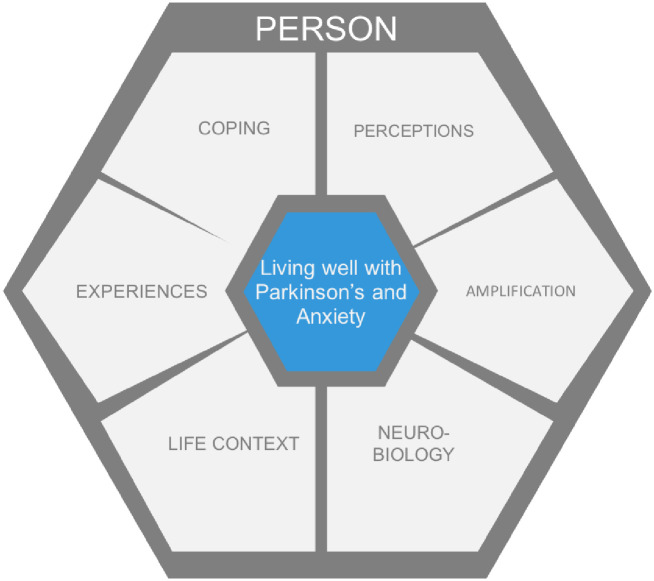
Purpose: Anxiety is a common non-motor symptom of Parkinson’s and there is no specific pharmacological intervention for people with Parkinson’s who experience anxiety. Yet there is little specific research documenting how individuals with this condition experience anxiety. It is important to explore the experiences of people with Parkinson’s to identify potential issues in developing future non-pharmacological interventions. This study explored the lived experience of anxiety for people with Parkinson’s. Materials and methods: Six participants were recruited into a descriptive phenomenological study, through the charity Parkinson’s UK, using a maximum variation sampling strategy. Face to face interviews were conducted. Data analysis employed thematic analysis. Results: Three key themes encapsulated the data: Finding ways to cope to “Try not to let it rule your life”, Amplifies symptoms “It’s emotionally draining it it’s also physically draining” and “Anxiety is a funny thing” experienced in myriad ways. A model of the experience of PWP experience of anxiety is proposed. Conclusions: Anxiety is a complex experience constructed of interlinked parts affecting people with Parkinson’s in myriad ways. Researchers and healthcare professionals should take these findings into account when designing future studies and interventions.
Overview
The claims and statistics of this paper haven’t been checked yet.
Free: it reads the open-access text and checks the first 5 claims that cite a source we can check. Create a free account to check every claim.
Integrity signals
Registry
Cites
Statistics
Figures
Verification
Claims the paper makes
The claims and statistics of this paper haven’t been checked yet.
Free: it reads the open-access text and checks the first 5 claims that cite a source we can check. Create a free account to check every claim.
Claims other papers make about this one
Each is checked against this paper’s own text: does it say what the citing paper says it does?
The cited source says what the claim attributes to it.
In the citing paper
“the study interviewed only six participants, and the causes and symptoms of anxiety described were diverse33”
From The experience of Anxiety for people with Parkinson’s disease (2023) · cites this paper as [33]
The cited source says what the claim attributes to it.
In the citing paper
“To our knowledge, only one qualitative paper has explored the subjective experience of anxiety.”
From The experience of Anxiety for people with Parkinson’s disease (2023) · cites this paper as [33]
Self-check
Percentages, sums and reported differences re-computed from the paper’s own numbers.
The self-check needs the paper’s full text.
Citations
Cites
Using thematic analysis in psychology
Braun, V., & Clarke, V. (2006) · Qualitative Research in Psychology · doi:10.1191/1478088706qp063oa · Cited by 194,414
S., N. L. (2017) · doi:10.1177/1609406917733847 · Cited by 14,051
(2013) · Cited by 12,072
Developing and evaluating complex interventions: the new Medical Research Council guidance
Craig, P., Dieppe, P., Macintyre, S., Michie, S., Nazareth, I., & Petticrew, M. (2008) · BMJ · doi:10.1136/bmj.a1655 · Cited by 10,995 · cited 1×
“Given its prevalence, the lack of a specific pharmacological intervention, and the dearth of specific research, it is vital to gain an understanding of the experience of anxiety for PWPs to inform the development of future complex interventions [33].”
Background(2014) · Medical Entomology and Zoology · Cited by 6,828
The qualitative research interview
DiCicco‐Bloom, B., & Crabtree, B. F. (2006) · Medical Education · doi:10.1111/j.1365-2929.2006.02418.x · Cited by 4,995 · cited 2×
“The aim of this was to increase convenience and privacy as it is suggested, that if participants are comfortable, they are more likely to reveal the nature of their lived experience [47, 48].”
BackgroundMethodEnhancing the quality and credibility of qualitative analysis.
(1999) · PubMed Central · Cited by 4,133
Epidemiology of Parkinson's disease
de Lau, L. M., & Breteler, M. M. (2006) · The Lancet Neurology · doi:10.1016/s1474-4422(06)70471-9 · Cited by 4,110
Member Checking: A Tool to Enhance Trustworthiness or Merely a Nod to Validation?
Birt, L., Scott, S., Cavers, D., Campbell, C., & Walter, F. (2016) · Qualitative Health Research · doi:10.1177/1049732316654870 · Cited by 3,970
The Use of Triangulation in Qualitative Research
Carter, N., Bryant-Lukosius, D., DiCenso, A., Blythe, J., & Neville, A. J. (2014) · Oncology Nursing Forum · doi:10.1188/14.onf.545-547 · Cited by 3,915
Research works printed but not linked: 1
- Husserl E. Ideas. London: Routledge; 1931. 1– 376 p.
Cited by
The experience of Anxiety for people with Parkinson’s disease
Blundell, E. K., Grover, L. E., Stott, J., & Schrag, A. (2023) · npj Parkinson's Disease · doi:10.1038/s41531-023-00512-1 · Cited by 41
“Its fi ndings highlighted the importance of anxiety in the subjective experience of PD; however, the study interviewed only six participants, and the causes and symptoms of anxiety described were diverse 33 .”
Non-motor symptoms of Parkinson’s disease
Carroll, V., Rossiter, R. C., & Blanchard, D. L. (2021) · Australian Journal of General Practice · doi:10.31128/ajgp-07-21-6093 · Cited by 25
Lovegrove, C., Sturkenboom, I. H. W. M., Marsden, J. F., & Bannigan, K. (2023) · Journal of Parkinson s Disease · doi:10.3233/jpd-230150 · Cited by 8
“This is reflected in research exploring the lived experience of anxiety in PD and will be an important consideration for the next stage of intervention development [17].”
InfluentialSelf-citationHodgson, P., Jordan, A., Sinani, C., Charura, D., & Orange, S. T. (2024) · CNS Neuroscience & Therapeutics · doi:10.1111/cns.14562 · Cited by 12
Personal Tools and Psychosocial Resources of Resilient Gender-Based Violence Women
García-Montes, R., Corral‐Liria, I., Fernández, R. J., Vázquez, R. R., Valllejo, R. B. D. B., & Iglesias, M. L. (2021) · International Journal of Environmental Research and Public Health · doi:10.3390/ijerph18168306 · Cited by 6
“This is a qualitative study using Interpretative Phenomenological Analysis, in line with Heidegger's principles [12-15].”
Method
Metadata
- Authors
- Lovegrove, C. J., & Bannigan, K.
- Affiliations
- Glasgow Caledonian University (GB)
- Venue
- PLOS ONE
- Publisher
- Public Library of Science (PLoS)
- Published
- 2021-04-08
- Volume
- 16
- Issue
- 4
- Pages
- e0249390
- ISSN
- 1932-6203 (ISSN-L)
- PMC
- PMC8031398
- OpenAlex
- W2981522886
- Cited by
- 15
- References
- 130
- Citations by year
- 2026: 4 · 2025: 2 · 2024: 4 · 2023: 2 · 2022: 1 · 2021: 2
- FWCI
- 1.08
- Type
- journal article
- Language
- en
- Open access
- gold
- doi.org
- Licence
- Locations
- PLoS ONE (publishedVersion, cc-by)
- PubMed Central (publishedVersion, cc-by)
- PubMed (publishedVersion)
- ResearchOnline (Glasgow Caledonian University) (acceptedVersion, cc-by)
- PEARL (University of Plymouth) (submittedVersion, cc-by-sa)
- DOAJ (DOAJ: Directory of Open Access Journals) (submittedVersion, cc-by-sa)
- Royal Devon and Exeter Research Repository (Royal Devon and Exeter) (submittedVersion, public-domain)
- Newcastle University ePrints (Newcastle Univesity) (cc-by)
- Funders
- National Institute for Health Research (MRES-2015-03-013-105)
- Topics
- Health Sciences › Medicine › Clinical Neurology › Parkinson's Disease Mechanisms and Treatments
- Health Sciences › Medicine › Oncology › Cancer survivorship and care
- Social Sciences › Psychology › Experimental and Cognitive Psychology › Anxiety, Depression, Psychometrics, Treatment, Cognitive Processes
- Keywords
- Parkinson's disease, anxiety, lived experience, non-motor symptoms, coping, non-pharmacological treatment
- MeSH terms
- Adaptation, Psychological, Aged, Anxiety, Female, Humans, Male, Middle Aged, Parkinson Disease
About these checks
Registry, retraction, Cites and statistics results are computed, not judged, with one exception: a printed reference that no index lists is read once by a model before it counts as a citation error. Claims are extracted by a model and kept only when their quote appears verbatim in the text; each cited source is then checked, with a model’s help, for whether it says what the claim relies on. Those verdicts can be wrong — read the claim’s quote and the cited source before relying on one.
Statistics and arithmetic are recomputed, not judged.
Confidence bands are shown only for fields calibrated on our annotated test set. None is calibrated yet, so no band is shown.
What counts as a claim ›How we measure confidence ›How we check this ›
Are you an author, or do you see a problem with this page? Request a review
How to cite
Cite CoChat for the checks on this page, and the paper for its own findings.
- This page
- CoChat. (2026). Citation check: What is the lived experience of anxiety for people with Parkinson’s? A phenomenological study. https://app.cochat.ai/papers/10.1371/journal.pone.0249390
- The paper
- Lovegrove, C. J., & Bannigan, K. (2021). What is the lived experience of anxiety for people with Parkinson’s? A phenomenological study. PLOS ONE. https://doi.org/10.1371/journal.pone.0249390
Data sources
Bibliographic data: Semantic Scholar, OpenAlex, Crossref.
Contains information from the Semantic Scholar Academic Graph Datasets, made available under the ODC Attribution License (ODC-BY 1.0).
Semantic Scholar’s data is described in: Kinney, R., et al. (2023). The Semantic Scholar Open Data Platform. arXiv:2301.10140.
