

Health anxiety, coping mechanisms and COVID 19: An Indian community sample at week 1 of lockdown
Open accessThe DOI matches its Crossref record; 72 of the 72 references it cites were found in a registry or an index; 5 of the 19 sources its claims cite were checked for support.
Abstract
It is critical to gain an understanding of the impact of the COVID 19 pandemic and the associated lockdown restrictions on the psychological, social and behavioural functioning of the general public, in order to inform public health promotion and future health service resource allocation. This cross-sectional study, completed during week 1 of lockdown in India, reports on data from 234 participants using an online survey. Data regarding health anxiety, coping mechanisms and locus of control was collected. Structural equation modelling was used to assess the relationship between locus of control, coping mechanisms, health anxiety and age. Age related differences in both locus of control and coping strategies were found. Younger people experienced more health-related anxiety and were more likely to engage with social media as a coping mechanism. Mindfulness-based strategies may reduce health anxiety by increasing tolerance of uncertainty experienced during the COVID 19 pandemic. Copyright: © 2021 Barron Millar et al. This is an open access article distributed under the terms of the Creative Commons Attribution License, which permits unrestricted use, distribution, and reproduction in any medium, provided the original author and source are credited.
Overview
CoChat Summary
## TL;DR
This cross-sectional online survey of 234 adults in India during week 1 of COVID-19 lockdown found that younger participants reported more health anxiety and used social media coping more often. Structural equation modeling suggested age-related differences in locus of control and coping, with mindfulness-based coping potentially helping reduce anxiety by increasing tolerance of uncertainty.
## Key findings
- The sample included 234 participants: 148 men (63%) and 86 women (37%); 101 (43%) were 18–31 years, 75 (32%) were 32–45 years, and 58 (25%) were 46+ years.
- Younger age predicted greater health anxiety in the regression analysis (β = -0.233, p < 0.001); coping through social media also predicted higher health anxiety (β = 0.192, p < 0.001), and external locus of control predicted higher health anxiety (β = 0.210, p < 0.01).
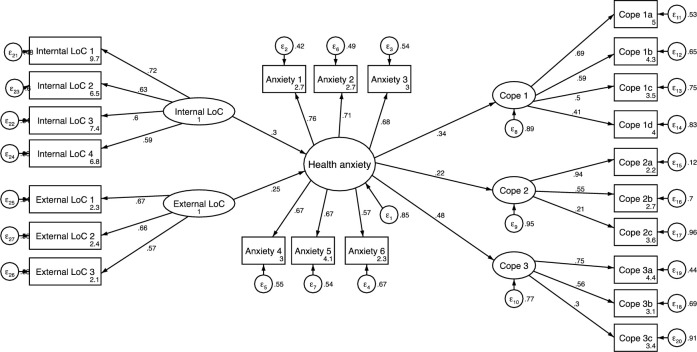
- The three coping factors from exploratory factor analysis explained 52.6% of the total variance: Behavioural coping (α = 0.623), Mindful coping (α = 0.522), and Coping through social media (α = 0.511).
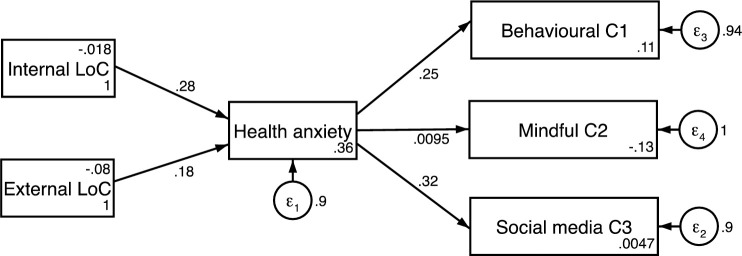
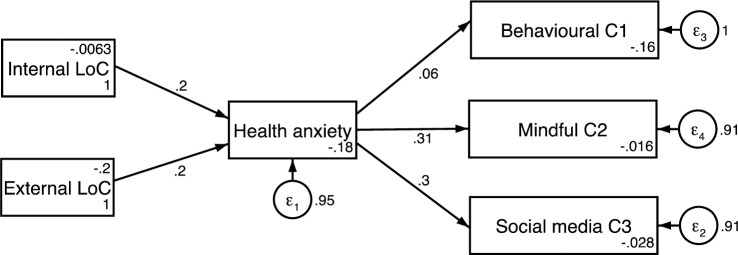
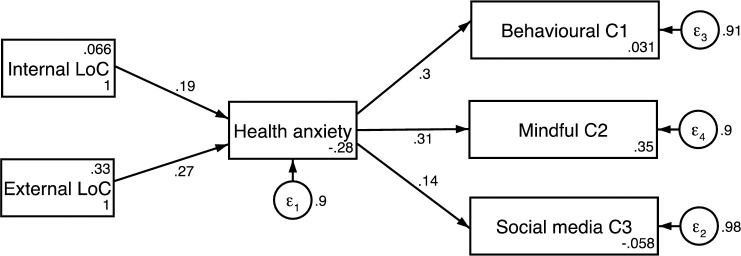
- Age-group models showed different patterns: ages 18–31 were weighted toward internal locus of control (β = 0.28, p < 0.01) and social media coping (β = 0.32, p < 0.001); ages 32–45 were balanced between internal and external locus of control (β = 0.2 for both, p < 0.05) and between mindful and social media coping (β = 0.31 and β = 0.30, both p < 0.01); ages 46+ were weighted toward external locus of control (β = 0.27, p < 0.05) and behavioural/mindful coping (β = 0.30 and β = 0.31, both p < 0.01).
## Methods
- Design: Cross-sectional study using an anonymous online survey completed during week 1 of lockdown in India (24–30 March 2020).
- Sample/data: 234 participants recruited via WhatsApp and Facebook; the survey was in English and included 23 items assessing health anxiety, coping mechanisms, and internal/external locus of control.
- Analysis: Structural equation modelling (SEM) in Stata assessed relationships among latent constructs and age; the authors also used exploratory factor analysis, bivariate correlations, and linear regression.
## Limitations
- The paper states the findings are preliminary and that further work is required to understand the effects of coping strategies and uncertainty.
- The small sample size limits generalisability, and recruitment through social media plus the English-language survey are stated limitations.
- The authors note that some scales were adapted for this study and that cross-cultural adaptation and validation is yet to be undertaken.
- Evident from the text: the study is cross-sectional, so it cannot establish causality between coping, locus of control, age, and health anxiety.
Model-written summary. Check it against the paper before relying on it.
Integrity signals
Registry
Cites
Statistics
Figures
Verification
Claims the paper makes
4 Valid · 2 Not valid · 8 Not checked · 40 Own results and interpretations
The cited sources support only part of this claim — read each source’s verdict below.
In the paper
“Mindfulness-based strategies may reduce health anxiety by increasing tolerance of uncertainty experienced during the COVID 19 pandemic.”
- Also stated in: § Discussion · hedged
“The use of behavioural and mindful coping strategies may help alleviate anxiety, through a process akin to acceptance and active engagement, supporting previous research on the putative benefits of mindfulness [64] and Acceptance and Commitment Therapy (ACT) [65] for health anxiety.”
- Also stated in: § Conclusions · hedged
“Tentative support for previous work indicates that mindfulness-based strategies may reduce risk for anxiety potentially by increasing tolerance of the inevitable uncertainty currently experienced.”
§ Health anxiety, coping mechanisms and COVID 19: An Indian community sample at week 1 of lockdown > Abstract
What the sources say
- Partly supportedcites [64] O’Bryan EM, Luberto CM, Kraemer KM, McLeish AC. An examination of mindfulness skills in terms of affect tolerance among individuals with elevated levels of health anxiety. Anxiety, Stress & Coping. 2018; 31(6): 702– 13. 10.1080/10615806.2018.1521515 30205718 PMC6540987 sourceExperimental — accuracy not yet measured
The Discussion (page unavailable) reports that greater mindfulness was associated with lower intolerance of uncertainty in people with elevated health anxiety and suggests mindfulness training may help. But the study was cross-sectional: it did not show that a strategy reduces health anxiety through that mechanism, and it did not study uncertainty during the COVID-19 pandemic. (LLM, conf=0.88)
- Not checked — no full text of the sourcecites [65] Eilenberg T, Hoffmann D, Jensen JS, Frostholm L. Intervening variables in group-based acceptance & commitment therapy for severe health anxiety. Behaviour research and therapy. 2017; 92: 24– 31. 10.1016/j.brat.2017.01.009 28196772 source
hedgedstates a possible causen = 234 ·- Asserted: passes — The authors put it forward as true.
- Checkable: passes — It can be checked against evidence.
- Load-bearing: passes — The paper’s conclusions depend on it.
- Based: passes — The paper gives a reason why it holds.
- Rests on an assumption not shown here.
- Also stated in: § Discussion · hedged
The cited sources support only part of this claim — read each source’s verdict below.
In the paper
“The use of behavioural and mindful coping strategies may help alleviate anxiety, through a process akin to acceptance and active engagement, supporting previous research on the putative benefits of mindfulness [64] and Acceptance and Commitment Therapy (ACT) [65] for health anxiety.”
§ Health anxiety, coping mechanisms and COVID 19: An Indian community sample at week 1 of lockdown > Discussion
What the sources say
- Partly supportedcites [64] O’Bryan EM, Luberto CM, Kraemer KM, McLeish AC. An examination of mindfulness skills in terms of affect tolerance among individuals with elevated levels of health anxiety. Anxiety, Stress & Coping. 2018; 31(6): 702– 13. 10.1080/10615806.2018.1521515 30205718 PMC6540987 sourceExperimental — accuracy not yet measured
The Discussion (page not available) links mindful awareness and nonjudgment with greater tolerance of distress in people with elevated health anxiety, and proposes acceptance as a possible mechanism. It suggests mindfulness training may improve related factors, but the study was cross-sectional and did not test whether coping strategies alleviate anxiety. The separate ACT citation is not attributed to this source. (LLM, conf=0.82)
- Not checked — no full text of the sourcecites [65] Eilenberg T, Hoffmann D, Jensen JS, Frostholm L. Intervening variables in group-based acceptance & commitment therapy for severe health anxiety. Behaviour research and therapy. 2017; 92: 24– 31. 10.1016/j.brat.2017.01.009 28196772 source
hedgedstates a possible cause- Asserted: passes — The authors put it forward as true.
- Checkable: passes — It can be checked against evidence.
- Load-bearing: passes — The paper’s conclusions depend on it.
- Based: passes — The paper gives a reason why it holds.
- Partly supported
The cited sources support only part of this claim — read each source’s verdict below.
In the paper
“There is emerging literature to suggest that public health interventions such as lockdowns may add further to this dysfunction [3].”
§ Health anxiety, coping mechanisms and COVID 19: An Indian community sample at week 1 of lockdown > Introduction
What the sources say
- Partly supportedcites [3] Hiremath P, Suhas Kowshik CS, Manjunath M, Shettar M. COVID 19: Impact of lock-down on mental health and tips to overcome. Asian Journal of Psychiatry. 2020; 51: 1– 2. 10.1016/j.ajp.2020.102088 32302964 PMC7151434 sourceExperimental — accuracy not yet measured
In the main text (page unavailable), the paper says isolation and reduced social contact can cause loneliness and increase anxiety and depression, supporting the psychological and social parts of the claim. Its impact table mentions difficulty concentrating, work routines, and financial strain, but does not clearly establish that lockdown adds to occupational dysfunction. (LLM, conf=0.82)
hedgedstates a possible cause- Asserted: passes — The authors put it forward as true.
- Checkable: passes — It can be checked against evidence.
- Load-bearing: passes — The paper’s conclusions depend on it.
- Based: passes — The paper gives a reason why it holds.
- Partly supported
A result the paper reports from its own data — it cites no other source for it, so there is none to check. The quote shows it is in the paper.
In the paper
“Younger people experienced more health-related anxiety and were more likely to engage with social media as a coping mechanism.”
- Also stated in: § Results · hedged
“Results indicated that younger age was predictive of greater health anxiety associated with COVID 19 (β = -0.233, p<0.001).”
- Also stated in: § Discussion · plain
“In addition, health-related anxiety was highest in the 18–31 years group which has been previously reported [6, 57, 58].”
§ Health anxiety, coping mechanisms and COVID 19: An Indian community sample at week 1 of lockdown > Abstract
plainstates an associationn = 234 ·- Asserted: passes — The authors put it forward as true.
- Checkable: passes — It can be checked against evidence.
- Load-bearing: passes — The paper’s conclusions depend on it.
- Based: passes — The paper gives a reason why it holds.
- Also stated in: § Results · hedged
A result the paper reports from its own data — it cites no other source for it, so there is none to check. The quote shows it is in the paper.
In the paper
“There are significant indirect effects mediated by health anxiety from internal and external locus of control to all of the coping strategies as illustrated in the table above.”
§ Health anxiety, coping mechanisms and COVID 19: An Indian community sample at week 1 of lockdown > Results
plainstates a cause- Asserted: passes — The authors put it forward as true.
- Checkable: passes — It can be checked against evidence.
- Load-bearing: passes — The paper’s conclusions depend on it.
- Based: passes — The paper gives a reason why it holds.
19 more claims
Create a free account to see all 54 claims and every source verdict.
- Probably not a substantial claim. 23
- It may state two separate claims as one. 12
Statistics recomputed
Every reported test result, recomputed from its test statistic and degrees of freedom. A result shows as not adding up only once an independent check has confirmed it.
- Consistentχ²(14) = 10.942reported p = .691 · recomputed p = .691
“χ2(14) = 10.942, p = .691”
Self-check
Percentages, sums and reported differences re-computed from the paper’s own numbers.
Self-check results appear here once an independent check has confirmed them.
Citations
Cites
Hu, L., & Bentler, P. M. (1999) · Structural Equation Modeling A Multidisciplinary Journal · doi:10.1080/10705519909540118 · Cited by 108,788 · cited 1×
“Hu and Bentler [47] suggest various cut offs for these fit indices.”
Background(1998) · Cited by 36,049
Alternative Ways of Assessing Model Fit
Browne, M. W., & Cudeck, R. (1992) · Sociological Methods & Research · doi:10.1177/0049124192021002005 · Cited by 27,200
Comparative fit indexes in structural models.
Bentler, P. M. (1990) · Psychological Bulletin · doi:10.1037/0033-2909.107.2.238 · Cited by 25,266
Generalized expectancies for internal versus external control of reinforcement.
Rotter, J. B. (1966) · Psychological Monographs: General and Applied · doi:10.1037/h0092976 · Cited by 21,937
Evaluating Goodness-of-Fit Indexes for Testing Measurement Invariance
Cheung, G. W., & Rensvold, R. B. (2002) · Structural Equation Modeling: A Multidisciplinary Journal · doi:10.1207/s15328007sem0902_5 · Cited by 16,280 · cited 1×
“These tests of the structural model gave non-significant results across all structural path parameters indicating that the constructs within this model hold across groups [55, 56].”
ResultConfirmatory factor analysis for applied research
(2007) · Choice Reviews Online · doi:10.5860/choice.44-2769 · Cited by 15,614 · cited 2×
“Loadings greater than or equal to 0.3 are said to be salient, relating meaningfully to a primary or secondary factor (Brown, 2006).”
BackgroundMethodInfluentialTesting Structural Equation Models.
Mueller, C. W., Bollen, K. A., & Long, J. S. (1994) · Contemporary Sociology · doi:10.2307/2074955 · Cited by 14,120
Sensitivity of Goodness of Fit Indexes to Lack of Measurement Invariance
Chen, F. F. (2007) · Structural Equation Modeling: A Multidisciplinary Journal · doi:10.1080/10705510701301834 · Cited by 12,217 · cited 1×
“027) demonstrates the models measurement invariance [53, 54].”
SPSS for Windows Step by Step: A Simple Guide and Reference
Mallery, P., & George, D. (1998) · Cited by 10,394
Research works printed but not linked: 3
- World Health Organisation. mhGAP Intervention Guide. Geneva: World Health Organisation, 2010.
- Kline RB. Methodology in the social sciences. Principles and practice of structured equation modelling. 4th ed. Guildford: Guildford Press; 2016.
- Ranjan Basu A, Murthy RS. Disaster and Mental Health: Revisiting Bhopal. Economic and Political Weekly. 2003; 38(11): 1074– 82.
Cited by
Pandey, V., Talan, A., Mahendru, M., & Shahzad, U. (2021) · Environmental Science and Pollution Research · doi:10.1007/s11356-021-16002-x · Cited by 30
Hagan, J. E., Quansah, F., Ankomah, F., Agormedah, E. K., Srem‐Sai, M., Frimpong, J. B., & Schack, T. (2022) · Social Sciences · doi:10.3390/socsci11030137 · Cited by 24
Covid-19 Pandemi Sürecinde Bireylerin Sağlık Kaygılarının Siberkondri Üzerindeki Etkisi
DOĞANYİĞİT, P. B., & Keçeligil, H. T. (2022) · Celal Bayar Üniversitesi Sağlık Bilimleri Enstitüsü Dergisi · doi:10.34087/cbusbed.1021471 · Cited by 23
Htet, K. K. K., Phyu, A. N., Thwin, T., & Chongsuvivatwong, V. (2022) · JMIR Formative Research · doi:10.2196/37779 · Cited by 16
Correlation between COVID-19-related health anxiety and coping styles among frontline nurses
Saeedi, M., Abedini, Z., Latif, M., & Piruzhashemi, M. (2023) · BMC Nursing · doi:10.1186/s12912-023-01344-3 · Cited by 12
“Religious coping [34], engaging with social media [35], wishful thinking [36], using emotional social support, and behavioral disengagement [37], were reported as the dominant coping strategies in people with high COVID-19-related health anxiety.”
BackgroundBibliometric Study of Scientific Productivity on the Impacts on Mental Health in Times of Pandemic
Caballero-Apaza, L., Vidal-Espinoza, R., Curaca-Arroyo, S. D., Gómez‐Campos, R., Gallegos, Z. E. C., Fuentes-López, J. D., & Cossio‐Bolaños, M. (2021) · Medicina · doi:10.3390/medicina58010024 · Cited by 8
Damra, J. K. M., Akour, M. M., & Omari, O. A. (2023) · Nursing Children and Young People · doi:10.7748/ncyp.2023.e1456 · Cited by 10
Online Learning Anxiety and their Academic Self-Efficacy During the COVID-19 Crisis
Chaleila, W. A., Qadan, E., Touma, L. G.-A., Assaly, I., Atamna, U., Habayib, H., & Masarweh, A. (2024) · Online Learning · doi:10.24059/olj.v28i2.3428 · Cited by 11
Torres, M. M. Q., & Cruz, C. P. A. D. L. (2021) · Revista Cuidado y Salud Pública · doi:10.53684/csp.v1i2.21 · Cited by 4
Devgun, M., Kittridge, C., Seshadri, S. P., Rodgers, J., & Sharma, A. (2023) · BJPsych International · doi:10.1192/bji.2023.22 · Cited by 3
Self-citationCunningham, M., Druen, P. B., Logsdon, M. C., Dreschler, B. W., Barbee, A. P., Carrico, R., Billings, S. W., & Jones, J. W. (2022) · Frontiers in Psychology · doi:10.3389/fpsyg.2022.837365 · Cited by 4
Social Media Self-expression as Form of Coping During the 2020 Pandemic Lockdown
Lazo, M. P., & Ramos, C. D. (2022) · Lecture notes in networks and systems · doi:10.1007/978-3-031-10464-0_44 · Cited by 4
The Impact of COVID-19 on Educational Leader Wellbeing
Burke, J., & Dempsey, M. (2021) · Advances in media, entertainment and the arts (AMEA) book series · doi:10.4018/978-1-7998-8630-3.ch012 · Cited by 2
Arifin, B., Saputra, S. Y., Muzakki, A., Setiawan, E., & Jumareng, H. (2022) · Jurnal Obsesi Jurnal Pendidikan Anak Usia Dini · doi:10.31004/obsesi.v6i5.2456 · Cited by 4
“Several factors caused the level of anxiety during the pandemic increase drastically, were students were afraid of contracting COVID-19, students had to undergo isolation/lock down (Millar et al., 2021), or the difficulty of carrying out physical education learning online (Jumareng et al., 2021).”
BackgroundResultMedia and anxiety in consumer behavior and its effect on decision making during turbulent situations
Santos‐Corrada, M., Flecha-Ortiz, J. A., López, E., Dones, V., Soto, M. O., Mena-Candelaria, S., & Melendez, L. (2025) · Journal of Marketing Communications · doi:10.1080/13527266.2025.2527241 · Cited by 3
Ajmal, H. B., Melia, R., Young, K. L., Bogue, J., Wood, H., Sullivan, M. O., & Duggan, J. (2023) · Behaviour and Information Technology · doi:10.1080/0144929x.2023.2284242 · Cited by 1
Kłosowska, J., Bajcar, E. A., Bieniek, H., Brączyk, J., Joshanloo, M., Mattarozzi, K., Bagnis, A., Pontén, M., Lalouni, M., Geers, A. L., et al. (2022) · doi:10.31234/osf.io/s5up3
Borgohain, J., Behera, R. R., Rath, C. S., & Patnaik, P. (2022) · Signals and communication technology · doi:10.1007/978-3-031-18444-4_13
Elkin, N., & Sarıkavak, T. (2023) · Research Square · doi:10.21203/rs.3.rs-3322200/v1
Fahrizal, Y., & Faiga, N. (2024) · AIP conference proceedings · doi:10.1063/5.0218046
Xu, K., Jiang, H., & Wang, H. (2026) · Frontiers in Psychology · doi:10.3389/fpsyg.2025.1678651
Metadata
- Authors
- Barron Millar, E., Singhal, D., Vijayaraghavan, P., Seshadri, S., Smith, E., Dixon, P., Humble, S., Rodgers, J., & Sharma, A. N.
- Affiliations
- National Institute of Mental Health and Neurosciences (IN)
- Cumbria Northumberland Tyne and Wear NHS Foundation Trust (GB)
- Newcastle University (GB)
- Corresponding author
- Sharma, Aditya Narain
- Venue
- PLoS ONE
- Publisher
- Public Library of Science (PLoS)
- Published
- 2021-04-21
- Volume
- 16
- Issue
- 4
- Pages
- e0250336
- ISSN
- 1932-6203 (ISSN-L)
- PMC
- PMC8059846
- OpenAlex
- W3155712649
- Semantic Scholar
- 76c9f035f9278f69b510f6d835e4704c03b0ad3c
- Cited by
- 21
- References
- 71
- Citations by year
- 2026: 1 · 2025: 1 · 2024: 2 · 2023: 5 · 2022: 8 · 2021: 4
- FWCI
- 3.24
- Type
- journal article
- Language
- en
- Open access
- gold
- doi.org
- Licence
- Locations
- PLoS ONE (publishedVersion, cc-by)
- PubMed Central (publishedVersion, cc-by)
- PubMed (publishedVersion)
- DOAJ (DOAJ: Directory of Open Access Journals) (submittedVersion, cc-by-sa)
- Greater South Information System
- Topics
- Social Sciences › Psychology › Clinical Psychology › COVID-19 and Mental Health
- Social Sciences › Sociology and Political Science › COVID-19 Prevention and Impact
- Social Sciences › Communication › Communication and COVID-19 Impact
- Keywords
- health anxiety, coping strategies, COVID-19 pandemic, lockdown, locus of control, age differences, social media use, mindfulness, uncertainty tolerance, Indian population
- MeSH terms
- COVID-19, SARS-CoV-2, Adaptation, Psychological, Adolescent, Adult, Anxiety, Anxiety Disorders, Communicable Disease Control, Cross-Sectional Studies, Female, Humans, India, Male, Mental Health, Middle Aged, Quarantine, Surveys and Questionnaires, Stress, Psychological, Young Adult
About these checks
Registry, retraction, Cites and statistics results are computed, not judged, with one exception: a printed reference that no index lists is read once by a model before it counts as a citation error. Claims are extracted by a model and kept only when their quote appears verbatim in the text; each cited source is then checked, with a model’s help, for whether it says what the claim relies on. Those verdicts can be wrong — read the claim’s quote and the cited source before relying on one.
The claim verdicts this report counts are experimental: their accuracy is not yet measured.
A language model drew the claims from the paper on 2026-10-11, under version 3 of the claim definition (model deepseek-v4.1-flash, prompt extract-v3).
A second model labelled each claim on 2026-10-11 (model jev-1.13-20260917, definition revision gold-guideline-v0.2).
Cited sources are checked with a language model’s help (gpt-6-sol).
Statistics and arithmetic are recomputed, not judged.
Confidence bands are shown only for fields calibrated on our annotated test set. None is calibrated yet, so no band is shown.
What counts as a claim ›How we measure confidence ›How we check this ›
Are you an author, or do you see a problem with this page? Request a review
Data sources
Bibliographic data: Semantic Scholar, OpenAlex, Crossref.
Contains information from the Semantic Scholar Academic Graph Datasets, made available under the ODC Attribution License (ODC-BY 1.0).
Semantic Scholar’s data is described in: Kinney, R., et al. (2023). The Semantic Scholar Open Data Platform. arXiv:2301.10140.
