

The DOI matches its Crossref record; 3 of the 3 references it cites were found in a registry or an index.
Pet primates for sale in the United States
Abstract
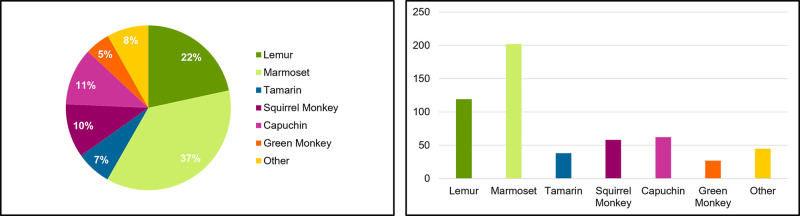
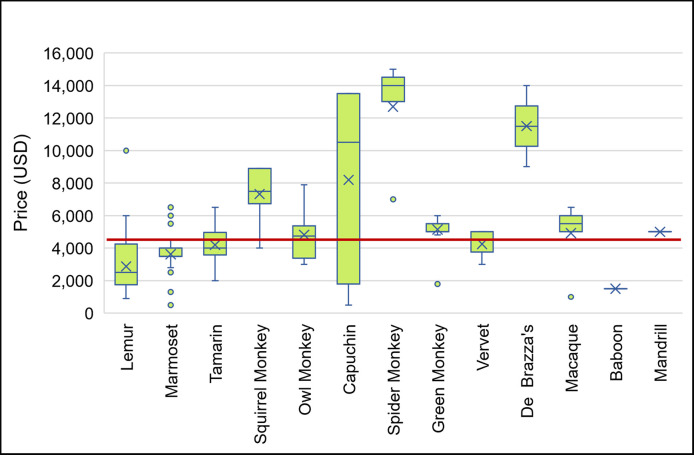
Our research goal was to investigate the primate pet trade in the United States. While dogs and cats are the most common type of pet, there are an estimated 15,000 pet primates in the United States and the demand for exotic pets in general has been rising. Most research on pet primates occurs in habitat countries and little is known about these pets in the United States. We collected data from six exotic pet-trade websites twice a month for 12 months. We recorded the type of primate for sale, sex, age, location, and price. We used Chi-Square Goodness-of-Fit tests to compare whether the number of male and female pet primates for sale and the number of different age categories of pet primates for sale differed from equality and Spearman Correlation to examine associations between price and size and price and supply. We recorded 551 pet primates for sale between June 2019-June 2020, with 69.1% platyrrhines, 21.6% strepsirrhines, and 8.9% catarrhines. Marmosets were sold most often (36.7%, N = 202) followed by lemurs (21.6%, N = 119), capuchins (11.3%, N = 62), and squirrel monkeys (10.5%, N = 58). Almost two-thirds of the pet primates for sale were male (Chi-Square = 16.056, df = 1, P = 0. 00006) and 78.7% were under one year old (Chi-Square = 440.264, df = 2, P<0.00001). The median price was $3,800 though price was highly variable, even for the same taxa. There are several potential drivers for the primate pet trade, including media influence, fashion/status, and profitable breeding though these are not mutually exclusive. Primates do not make good pets and even when captive-bred, pet primates impact the conservation of their wild counterparts. Advertisement campaigns focusing on disease transmission and legal consequences and a federal ban on pet primate ownership are two avenues to pursue to end the ownership of pet primates in the United States.
Overview
The claims and statistics of this paper haven’t been checked yet.
Run the check — free, no account needed. It reads the open-access text and checks the sources it cites.
Integrity signals
Registry
Cites
Statistics
Figures
Verification
Claims the paper makes
The claims and statistics of this paper haven’t been checked yet.
Run the check — free, no account needed. It reads the open-access text and checks the sources it cites.
Claims other papers make about this one
Each is checked against this paper’s own text: does it say what the citing paper says it does?
In the citing paper
“Some species, either unusual, rare or expensive, are kept as status symbols [87,91,92]; some breeds may serve as status objects and are appreciated just for their pedigree or appearance [93].”
From The Complexity of the Human–Animal Bond: Empathy, Attachment and Anthropomorphism in Human–Animal Relationships and Animal Hoarding (2022) · cites this paper as [92]
Self-check
Percentages, sums and reported differences re-computed from the paper’s own numbers.
The self-check needs the paper’s full text.
Citations
Cites
Rarity Value and Species Extinction: The Anthropogenic Allee Effect
Courchamp, F., Angulo, E., Rivalan, P., Hall, R. J., Signoret, L., Bull, L., & Meinard, Y. (2006) · PLoS Biology · doi:10.1371/journal.pbio.0040415 · Cited by 650 · cited 1×
“those more highly endangered) may have the opposite effect and increase their attractiveness as a pet [20,87].”
BackgroundWeiss, E., Miller, K., Mohan-Gibbons, H., & Vela, C. (2012) · Animals · doi:10.3390/ani2020144 · Cited by 178
Fashion vs. Function in Cultural Evolution: The Case of Dog Breed Popularity
Ghirlanda, S., Acerbi, A., Herzog, H., & Serpell, J. A. (2013) · PLoS ONE · doi:10.1371/journal.pone.0074770 · Cited by 100
Research works printed but not linked: 78
- ER Bush, 2014, Global trade in exotic pets 2006–2012., Cons Biol, 28, 663, 10.1111/cobi.12240 · DOI
- DD Blouin, 2012, Understanding relations between people and their pets., Sociol Compass, 6, 856, 10.1111/j.1751-9020.2012.00494.x · DOI · Paper page
- E Hirschman, 1994, Consumers and their animal companions., J Consum Res, 20, 616, 10.1086/209374 · DOI · Paper page
- Jyrinki H, editor The attitude-behavior relations in pet-related consumption. Proceedings of the University of Vaasa 2010; Vaasan Yliopiston Julkaisuja.
- P. Laufer, 2011, Forbidden Creatures: Inside the World of Animal Smuggling and Exotic Pets, 274
- M Germonpré, 2009, Fossil dogs and wolves from Palaeolithic sites in Belgium, the Ukraine and Russia: osteometry, ancient DNA and stable isotopes, J Archaeol Sci, 36, 473, 10.1016/j.jas.2008.09.033 · DOI
- DF Morey, 2006, Burying key evidence: the social bond between dogs and people., J Archaeol Sci, 33, 158, 10.1016/j.jas.2005.07.009 · DOI
- M. O’Haire, 2005, Companion animals and human health: benefits, challenges, and the road ahead., J Vet Behav., 5, 226, 10.1016/j.jveb.2010.02.002 · DOI
- C Minniti, 2019, New data on non‐human primates from the ancient Near East: the recent discovery of a rhesus macaque burial at Shahr-i Sokhta (Iran)., Int J Osteoarchaeol., 1
- H. Herzog, 2011, The impact of pets on human health and psychological well-being: fact, fiction, or hypothesis?, Curr Dir Psychol Sci, 20, 236, 10.1177/0963721411415220 · DOI · Paper page
- J. Archer, 1997, Why do people love their pets?, Evol Hum Behav, 18, 237, 10.1016/S0162-3095(99)80001-4 · DOI · Paper page
- C Reeve, 2021, Dog owners’ survey reveals Medical Alert Dogs can alert to multiple conditions and multiple people., PLoS One, 16, e0249191, 10.1371/journal.pone.0249191 · DOI
- CD Soulsbury, 2009, The welfare and suitability of primates kept as pets., J Appl Anim Welf Sci, 12, 1, 10.1080/10888700802536483 · DOI
- F Moutou, 2010, Why own an exotic pet?, Rev Sci Tech., 29, 359
- CA McMurray, 2009, Wildlife trafficking: U.S. efforts to tackle a global crisis., Nt Resour Environ, 23, 16
- MA Morgan, 2015, Exotic Addiction., Duke Law J, 65, 1
- KE Reuter, 2019, A national survey of household pet lemur ownership in Madagascar., PLoS One, 14, e0216593, 10.1371/journal.pone.0216593 · DOI
- A Duarte-Quiroga, 2003, Primates as pets in Mexico City: an assessment of the species involved, source of origin, and general aspects of treatment, Am J Primatol, 61, 53, 10.1002/ajp.10108 · DOI
- N Ceballos-Mago, 2010, Impact of the pet trade on the Margarita capuchin monkey Cebus apella magaritae., Endanger Species Res., 12, 57, 10.3354/esr00289 · DOI
- V Nijman, 2017, Changes in the primate trade in Indonesian wildlife markets over a 25-year period: fewer apes and langurs, more macaques, and slow lorises, Am J Primatol, 79, e22517, 10.1002/ajp.22517 · DOI
- Y-H Sung, 2018, Assessing consumer trends and illegal activity by monitoring the online wildlife trade, Biol Conserv, 227
- OC Stringham, 2020, A guide to using the Internet to monitor and quantify the wildlife trade, Cons Biol
- A. Lavorgna, 2014, Wildlife trafficking in the Internet age, Crime Sci, 3, 1, 10.1186/s40163-014-0005-2 · DOI
- P Siriwat, 2020, Wildlife trade shifts from brick-and-mortar markets to virtual marketplaces: a case study of birds of prey trade in Thailand., J Asia Pac Biodivers, 13, 454, 10.1016/j.japb.2020.03.012 · DOI
- V. Nijman, 2020, Illegal trade in Indonesia’s National Rare Animal has moved online., Oryx, 54, 12, 10.1017/S0030605319001157 · DOI
- B. Price, 2020, Resource Networks of Pet Scam Websites:, 10.1109/eCrime51433.2020.9493253 · DOI
- Norazman NSdA, Zamin N, editors. Development of scammed posts detector: a case study of pet scammed posting. Proceedings of the 18th World Multi-Conference on Systemics, Cybernetics and Informatics (WMSCI); 2014.
- D Bergin, 2018, Online trade of Barbary macaques Macaca sylvanus in Algeria and Morocco., Biodivers Conserv, 27, 531, 10.1007/s10531-017-1434-5 · DOI
- RJ Smith, 1997, Body mass in comparative primatology, J Hum Evol, 32, 523, 10.1006/jhev.1996.0122 · DOI · Paper page
- NF Ramsay, 2007, The red-eared slider (Trachemys scripta elegans) in Asia: a review. Biological Invaders in Inland Waters: Profiles, Distribution, and Threats., 161
- J. Prosek, 2010, Beautiful friendship: bound in an alliance of mutal benefit, clownfish and their host anemones are the crown jewels of coral reefs., Natl Geogr Mag., 120
- V Nijman, 2017, The Harry Potter effect: the rise in trade of owls as pets in Java and Bali, Indonesia., Glob Ecol Conserv, 11, 84, 10.1016/j.gecco.2017.04.004 · DOI
- DA Megias, 2017, Investigating the impact of media on demand for wildlife: a case study of Harry Potter and the UK trade in owls., PLoS One., 12, e0182368, 10.1371/journal.pone.0182368 · DOI
- S Ghirlanda, 2014, Dog movie stars and dog breed popularity: a case study in media influence on choice., PLoS One., 9, e106565, 10.1371/journal.pone.0106565 · DOI
- H. Herzog, 2006, Forty-two thousand and one Dalmatians: fads, social contagion, and dog breed popularity., Soc Anim, 14, 383, 10.1163/156853006778882448 · DOI
- JM Eaves, 2005, The Effects of Dog and Owner Personality on Pet Satisfaction
- BC Aldrich, 2018, The use of primate "actors" in feature films 1990–2013., Anthrozoös, 31, 5, 10.1080/08927936.2018.1406197 · DOI
- L Asher, 2009, Inherited defects in pedigree dogs. Part 1: Disorders related to breed standards., Vet J, 182, 402, 10.1016/j.tvjl.2009.08.033 · DOI · Paper page
- M. Mott, 2003, The Perils of Keeping Monkeys as Pets., Nat Geograph Mag.
- T Cekavicius, 2012, Pets as status symbols:
- B. Garrod, 2019, The Chimpanzee & Me., 256
- TA Clarke, 2019, A viral video and pet lemurs on Twitter., PLoS One, 14, e0208577, 10.1371/journal.pone.0208577 · DOI
- KA-I Nekaris, 2013, Tickled to death: analysing public perceptions of ’cute’ videos of threatened species (slow loris Nycticebus spp.) on Web 2.0 sites., PLoS One, 8
- S. Piccoli, 2013, Rihanna’s slow loris selfie leads to arrest., New York Post., 2013
- E Djafarova, 2017, Exploring the credibility of online celebrities’ Instagram profiles in influencing the purchase decisions of young female users., Comput Human Behav, 68, 1, 10.1016/j.chb.2016.11.009 · DOI
- M Muda, 2012, Breaking through the clutter in media environment: how do celebrities help?, Procedia Soc Behav Sci, 42, 374, 10.1016/j.sbspro.2012.04.201 · DOI
- WP Brown, 2013, Effects of phenotypic characteristics on the length of stay of dogs at two no kill animal shelters, J Appl Anim Welf Sci, 16, 2, 10.1080/10888705.2013.740967 · DOI
- M Lepper, 2002, Prediction of adoption versus euthanasia among dogs and cats in a California animal shelter, J Appl Anim Welf Sci, 5, 29, 10.1207/S15327604JAWS0501_3 · DOI
- JM Posage, 1998, Determining factors for successful adoption of dogs from an animal shelter, J Am Vet Med Assoc, 213, 478, 10.2460/javma.1998.213.04.478 · DOI
- HJ Svoboda, 2015, Investigating the role of coat colour, age, sex, and breed on outcomes for dogs at two animal shelters in the United States., Anim Welf., 24, 497, 10.7120/09627286.24.4.497 · DOI
- S Diverio, 2016, The Italian perception of the ideal companion dog, J Vet Behav, 12, 27, 10.1016/j.jveb.2016.02.004 · DOI
- DW Boden, 2008, Miniature cattle: for real, for pets, for production., J Agri Food Info, 9, 167, 10.1080/10496500802174036 · DOI
- DCV Metre, 1999, Miniature pigs., Vet Clin North Am Exot Anim Pract, 2, 519, 10.1016/S1094-9194(17)30108-1 · DOI
- S. Stall, 2007, 100 Cats Who Changed Civilization: History’s Most Influential Felines
- VV Tynes, 1999, Potbellied pig husbandry and nutrition., Vet Clin North Am Exot Anim Pract, 2, 193, 10.1016/S1094-9194(17)30147-0 · DOI
- PH Harvey, 1985, Life history variation in primates, Evolution, 39, 559, 10.1111/j.1558-5646.1985.tb00395.x · DOI · Paper page
- MBCD Sousa, 1999, Reproductive patterns and birth seasonality in a South-American breeding colony of common marmosets, Callithrix jacchus., Primates, 40, 327, 10.1007/BF02557556 · DOI
- DA Smucny, 2004, Reproductive output, maternal age, and survivorship in captive common marmoset females (Callithrix jacchus)., Am J Primatol, 64, 107, 10.1002/ajp.20065 · DOI
- MJ Hurt, 2016, Evaluating the physical welfare of dogs in commercial breeding facilities in the United States:
- FD McMillan, 2011, Mental health of dogs formerly used as ‘breeding stock’in commercial breeding establishments, Appl Anim Behav Sci, 135, 86, 10.1016/j.applanim.2011.09.006 · DOI · Paper page
- WP Brown, 2015, Age, breed designation, coat color, and coat pattern influenced the length of stay of cats at a no-kill shelter, J Appl Anim Welf Sci, 18, 169, 10.1080/10888705.2014.971156 · DOI
- J Clevenger, 2003, Determinants of adoption and euthanasia of shelter dogs spayed or neutered in the University of California veterinary student surgery program compared to other shelter dogs, J Vet Med Educ, 30, 372, 10.3138/jvme.30.4.372 · DOI
- GJ Patronek, 1995, Population dynamics and the risk of euthanasia for dogs in an animal shelter., Anthrozoös, 8, 31, 10.2752/089279395787156455 · DOI
- L. Sinn, 2016, Factors affecting the selection of cats by adopters, J Vet Behav, 14, 5, 10.1016/j.jveb.2016.06.001 · DOI
- ACDA Moura, 2003, Sibling age and intragroup aggression in captive Saguinus midas midas., Int J Primatol, 24, 639, 10.1023/A:1023748616043 · DOI
- L. Harrington, 2015, International commercial trade in live carnivores and primates 2006–2012: response to Bush, Cons Biol, 29, 293, 10.1111/cobi.12448 · DOI
- TP Moorhouse, 2017, Information could reduce consumer demand for exotic pets., Conserv Lett, 10, 337, 10.1111/conl.12270 · DOI
- K Reuter, 2019, Lemur yoga: fueling the capture of wild lemurs?, Mongabay, 3, 2019
- SR Ross, 2008, Inappropriate use and portrayal of chimpanzees, Science, 319, 1487, 10.1126/science.1154490 · DOI
- SR Ross, 2011, Specific image characteristics influence attitudes about chimpanzee conservation and use as pets., PLoS One., 6
- KA Leighty, 2015, Impact of visual context on public perceptions of non-human primate performers., PLoS One., 10, 10.1371/journal.pone.0118487 · DOI · Paper page
- MA Norconk, 2021, ASP-CAN Action letter—How Can Primatologists Deter Ownership of Pet Primates in the U.S.? History and Legislation., Conservation Action Network.
- T Andreyeva, 2011, Estimating the potential of taxes on sugar-sweetened beverages to reduce consumption and generate revenue., Prev Med., 52, 413, 10.1016/j.ypmed.2011.03.013 · DOI
- FJ Chaloupka, 2012, Tobacco taxes as a tobacco control strategy., Tob Control, 21, 172, 10.1136/tobaccocontrol-2011-050417 · DOI · Paper page
- CP Durrance, 2011, Taxing sin and saving lives: can alcohol taxation reduce female homicides?, Soc Sci Med., 73, 169, 10.1016/j.socscimed.2011.04.027 · DOI
- O Mytton, 2007, Could target food taxes improve health?, Am J Public Health, 61, 689
- T-W Hu, 1995, Reducing cigarette consumption in California: tobacco taxes vs an anti-smoking media campaign., Am J Public Health, 85, 1218, 10.2105/AJPH.85.9.1218 · DOI
- S. Kieswetter, 2019, The motivations behind obtaining exotic pets: a discussion paper
Cited by
Sorted by citations
Prato-Previde, E., Basso Ricci, E., & Colombo, E. S. (2022) · Animals · doi:10.3390/ani12202835 · Cited by 121
Metadata
- Authors
- Seaboch, M. S., & Cahoon, S. N.
- ORCID
- Seaboch, Melissa S.
- Venue
- PLOS ONE
- Publisher
- Public Library of Science (PLoS)
- Published
- 2021-09-08
- Volume
- 16
- Issue
- 9
- Pages
- e0256552
- ISSN
- 1932-6203
- PMC
- PMC8425555
- Cited by
- 19
- References
- 3
- Language
- en
About these checks
Registry, retraction, Cites and statistics results are computed, not judged, with one exception: a printed reference that no index lists is read once by a model before it counts as a citation error. Claims are extracted by a model and kept only when their quote appears verbatim in the text; each cited source is then checked, with a model’s help, for whether it says what the claim relies on. Those verdicts can be wrong — read the claim’s quote and the cited source before relying on one.
Statistics and arithmetic are recomputed, not judged.
Confidence bands are shown only for fields calibrated on our annotated test set. None is calibrated yet, so no band is shown.
What counts as a claim ›How we measure confidence ›How we check this ›
Are you an author, or do you see a problem with this page? Request a review
