

The DOI matches its Crossref record; 47 of the 55 references it cites were found in a registry or an index.
Supporting mental health and wellbeing of university and college students: A systematic review of review-level evidence of interventions
Open accessAbstract
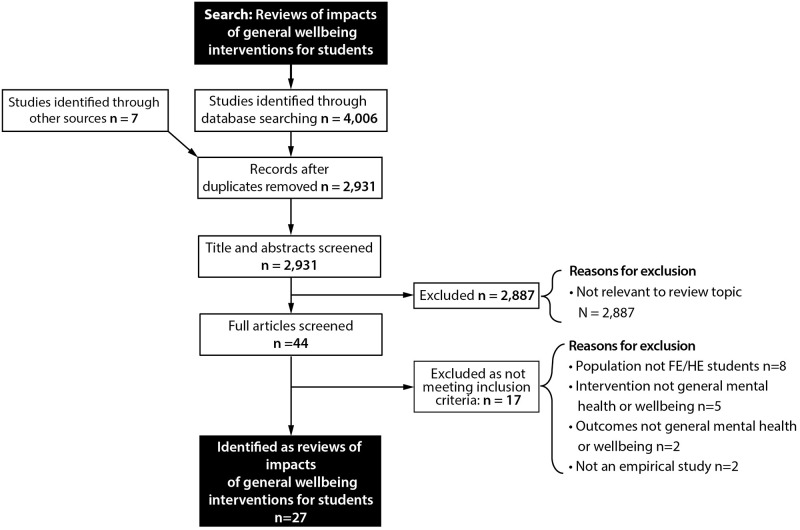
Aims: The review of reviews had three aims: (i) to synthesize the available evidence on interventions to improve college and university students’ mental health and wellbeing; (ii) to identify the effectiveness of interventions, and (iii) to highlight gaps in the evidence base for future study. Methods: Electronic database searches were conducted to identify reviews in English from high-income OECD countries published between 1999 and 2020. All review-level empirical studies involving post-secondary students attending colleges of further education or universities that examined interventions to improve general mental health and wellbeing were included. Articles were critically appraised using an amended version of the AMSTAR 2 tool. Evidence from the included reviews were narratively synthesized and organised by intervention types. Results: Twenty-seven reviews met the review of reviews inclusion criteria. The quality of the included reviews varied considerably. Intervention types identified included: mindfulness-based interventions, psychological interventions, psychoeducation interventions, recreation programmes, relaxation interventions, setting-based interventions, and stress management/reduction interventions. There was evidence that mindfulness-based interventions, cognitive behavioural therapy (CBT), and interventions delivered via technology were effective when compared to a passive control. Some evidence suggested that the effects of CBT-related interventions are sustained over time. Psychoeducation interventions do not appear to be as effective as other forms of intervention, with its effects not enduring over time. Conclusions: The review of reviews located a sizeable body of evidence on specific interventions such as mindfulness and cognitive-behavioural interventions. The evidence suggests that these interventions can effectively reduce common mental health difficulties in the higher education student body. Gaps and limitations in the reviews and the underlying body of evidence have been identified. These include a notable gap in the existing body of review-level evidence on setting-based interventions, acceptance and commitment training, and interventions for students attending colleges in UK settings.
Overview
The claims and statistics of this paper haven’t been checked yet.
Run the check — free, no account needed. It reads the open-access text and checks the sources it cites.
Integrity signals
Registry
Cites
Statistics
Figures
Verification
Claims the paper makes
The claims and statistics of this paper haven’t been checked yet.
Run the check — free, no account needed. It reads the open-access text and checks the sources it cites.
Claims other papers make about this one
Each is checked against this paper’s own text: does it say what the citing paper says it does?
The source backs part of the claim, not all of it — or backs it for a different population, condition or comparison.
In the citing paper
“CBT-related interventions were also found to deliver sustained effects over time; 344”
From The Lancet Psychiatry Commission on youth mental health (2024) · cites this paper as [344]
Experimental — accuracy not yet measuredThe cited source says what the claim attributes to it.
In the citing paper
“Regarding higher education, a 2022 systematic review on mental health interventions in university and college settings found evidence for the effectiveness of mindfulness-based interventions, cognitive behavioural therapy (CBT), and interventions delivered via technology, whereas psychoeducation appeared to be less effective.”
From The Lancet Psychiatry Commission on youth mental health (2024) · cites this paper as [344]
The check wasn’t confident either way, so it gives no verdict — never disputed.
In the citing paper
“extreme prolonged psychological distress has been linked to an increased tendency to turn to drugs and alcohol as a coping mechanism, an increased risk of cardiovascular illness, and higher rates of suicide”
From A Scoping Review of Acceptance and Commitment Therapy in Higher Education (2024) · cites this paper as Worsley et al., 2022
Experimental — accuracy not yet measured
Self-check
Percentages, sums and reported differences re-computed from the paper’s own numbers.
The self-check needs the paper’s full text.
Citations
Cites
Shea, B. J., Reeves, B. C., Wells, G., Thuku, M., Hamel, C., Moran, J., Moher, D., Tugwell, P., Welch, V., Kristjansson, E., et al. (2017) · BMJ · doi:10.1136/bmj.j4008 · Cited by 10,636 · cited 1×
“All reviews that met the inclusion criteria were critically appraised using an amended version of the AMSTAR 2 tool [22].”
MethodGulliver, A., Griffiths, K. M., & Christensen, H. (2010) · BMC Psychiatry · doi:10.1186/1471-244x-10-113 · Cited by 3,292
Mental health problems and help-seeking behavior among college students
Hunt, J., & Eisenberg, D. (2010) · Journal of Adolescent Health · doi:10.1016/j.jadohealth.2009.08.008 · Cited by 1,949
Interventions to reduce stress in university students: A review and meta-analysis
Regehr, C., Glancy, D., & Pitts, A. (2013) · Journal of Affective Disorders · doi:10.1016/j.jad.2012.11.026 · Cited by 956 · cited 2×
“(Continued) Howell and Passmore (2018) University students 5 Acceptance and Commitment Training, a positive psychological intervention Anxiety Depression Stress Wellbeing Miller and Chung (2009) College students 4 Cognitive therapy and education intervention Depression Reavley and Jorm (2010) Higher education student…”
InfluentialLipson, S. K., Lattie, E. G., & Eisenberg, D. (2019) · Psychiatric Services · doi:10.1176/appi.ps.201800332 · Cited by 947 · cited 1×
“US college students are also increasingly reporting common mental health problems and suicidality [7].”
BackgroundThe relation of depression and anxiety to life-stress and achievement in students
Andrews, B., & Wilding, J. M. (2004) · British Journal of Psychology · doi:10.1348/0007126042369802 · Cited by 919 · cited 1×
“In a UK study, anxiety and depression were found to be higher at mid-course compared to one-month pre-entry into university [8].”
Lattie, E. G., Adkins, E. C., Winquist, N., Stiles-Shields, C., Wafford, Q. E., & Graham, A. K. (2019) · Journal of Medical Internet Research · doi:10.2196/12869 · Cited by 843 · cited 1×
“[48] conducted a systematic review of evidence (rated as moderate methodological quality) on the effectiveness of digital mental health interventions on mental health outcomes in college students.”
BackgroundA systematic review: Students with mental health problems—A growing problem
Storrie, K., Ahern, K., & Tuckett, A. (2010) · International Journal of Nursing Practice · doi:10.1111/j.1440-172x.2009.01813.x · Cited by 696 · cited 1×
“Given the increase in mental health problems among students and the surge in demand for formal support [1, 20, 21], reactive services alone cannot effectively support student mental health and wellbeing [11].”
BackgroundChanges in undergraduate students’ psychological well‐being as they progress through university
Bewick, B., Koutsopoulou, G., Miles, J., Slaa, E., & Barkham, M. (2010) · Studies in Higher Education · doi:10.1080/03075070903216643 · Cited by 597 · cited 1×
“Similarly, a UK cohort study found that levels of psychological distress increase on entering university and levels of distress did not return to pre-registration levels [9].”
BackgroundDavies, E. B., Morriss, R., & Glazebrook, C. (2014) · Journal of Medical Internet Research · doi:10.2196/jmir.3142 · Cited by 499
Research works printed but not linked: 1
- Pennington A, Watkins M, Bagnall AM, South J, Corcoran R. A systematic review of evidence on the impacts of joint decision-making on community wellbeing. London; 2018.
Cited by
Sorted by citations
The Lancet Psychiatry Commission on youth mental health
McGorry, P. D., Mei, C., Dalal, N., Alvarez-Jimenez, M., Blakemore, S.-J., Browne, V., Dooley, B., Hickie, I. B., Jones, P. B., McDaid, D., et al. (2024) · The Lancet Psychiatry · doi:10.1016/s2215-0366(24)00163-9 · Cited by 663
Madrid‐Cagigal, A., Kealy, C., Potts, C., Mulvenna, M. D., Byrne, M., Barry, M. M., & Donohoe, G. (2025) · Early Intervention in Psychiatry · doi:10.1111/eip.70017 · Cited by 78
“For example, in 2017, 94% of universities in the UK reported an increase in demand for counselling services compared to the prior five years (Thorley 2017; Worsley, Pennington, and Corcoran 2022).”
Public Health Approaches to Promoting University Students’ Mental Health: A Global Perspective
Bantjes, J. R., Hunt, X., & Stein, D. J. (2022) · Current Psychiatry Reports · doi:10.1007/s11920-022-01387-4 · Cited by 95
Yu-peng, L., & Yu, Z. (2024) · Behaviour and Information Technology · doi:10.1080/0144929x.2024.2332458 · Cited by 66
“…contexts and educational psychology must have widely referenced publications in computer science, human – computer interaction studies, psychology, cognitive studies, management, public health, medical treatment, and diverse related subjects (e.g. Worsley, Pennington, and Corcoran 2022).”
de Fine Licht, K. (2024) · Philosophy & Technology · doi:10.1007/s13347-024-00799-9 · Cited by 40
“This is why universities invest significant efforts and resources into student health and wellness (see, e.g., Leshner & Scherer, 2021) and why so many researchers focus on it (see, e.g., Worsley et al. 2022).”
Understanding how the university curriculum impacts student wellbeing: a qualitative study
Upsher, R., Percy, Z., Cappiello, L., Byrom, N., Hughes, G., Oates, J., Nobili, A., Rakow, K. E., Anaukwu, C., & Foster, J. L. (2022) · Higher Education · doi:10.1007/s10734-022-00969-8 · Cited by 35
Psychological well-being and its associated factors among university students in Sichuan, China
Wan, J., Wee, L. H., Siau, C. S., & Wong, Y. H. (2025) · Frontiers in Psychology · doi:10.3389/fpsyg.2025.1473871 · Cited by 48
“Additionally, research indicates that mental health tends to worsen after students enter college, with college students generally reporting worse mental health than non-students (Worsley et al., 2022).”
Malagodi, F., Dommett, E., Findon, J. L., & Gardner, B. (2023) · Mental Health and Physical Activity · doi:10.1016/j.mhpa.2023.100563 · Cited by 29
Farrer, L. M., Jackson, H. M., Gulliver, A., Calear, A. L., & Batterham, P. J. (2024) · Psychological Reports · doi:10.1177/00332941241295978 · Cited by 25
“…fi ed signi fi cant gaps in the available evidence base to inform effective approaches for university student mental health (Fernandez et al., 2016; Worsley et al., 2022), insuf fi cient capacity of counselling services to meet demand (Stallman, 2011), and poor alignment of existing services…”
Transforming mental healthcare in higher education through scalable mental health interventions
Brown, A. D., Ross, N., Sangraula, M., Laing, A., & Kohrt, B. (2023) · Global Mental Health · doi:10.1017/gmh.2023.29 · Cited by 21
“Additionally, although there is considerable evidence that interventions such as mindfulness and cognitive behavioral therapy (CBT) are effective treatments for mental health concerns such as anxiety and depression in university students (Huang et al., 2018; Worsley et al., 2022), this population does not always seek…”
McCoy, S. S., Dimler, L. M., & Rodrigues, L. (2024) · Journal of Adult Development · doi:10.1007/s10804-024-09496-5 · Cited by 33
Mascia, M. L., Agus, M., Cabras, C., Bellini, D., Renati, R., & Penna, M. P. (2023) · Education sciences · doi:10.3390/educsci13020202 · Cited by 20
“The need to find reference models has also been emphasised in recent reviews and meta-analyses, questioning what can be considered the antecedents of well-being among university students [18,19].”
Yuan, Y., Yang, J., Huang, W., Hu, C., Zhang, W., & Chen, B. (2025) · Frontiers in Psychology · doi:10.3389/fpsyg.2025.1694344 · Cited by 20
Kwak, Y., Kim, Y., & Chae, H. (2025) · BMC Psychology · doi:10.1186/s40359-025-02995-4 · Cited by 20
Zhao, G. X., Zhao, M. Y., Bean, C. R., Robbins, A. S., & Mahrer, N. E. (2025) · Frontiers in Psychology · doi:10.3389/fpsyg.2025.1601955 · Cited by 19
Hernández-Torrano, D., & Ibrayeva, L. (2024) · The Asia-Pacific Education Researcher · doi:10.1007/s40299-024-00839-0 · Cited by 17
“Prioritizing both positive mental health and psychopathology, universities can help ensure that their students are better equipped to handle the challenges of university life and beyond (Worsley et al., 2022).”
Allen, R. E., Hochard, K. D., Kannangara, C. S., & Carson, J. F. (2024) · Behavioral Sciences · doi:10.3390/bs14121146 · Cited by 22
Well-being of Chinese students - a review in the context of implications for the educational proces
Dobosz, D., & Hetmańczyk, H. (2023) · International Journal of Chinese Education · doi:10.1177/2212585x231163388 · Cited by 16
“Research indicates that the mental health and well-being of college students is worse than that of non-students; moreover, mental health deteriorates after starting college compared to before the commencement of studies (Worsley et al., 2022).”
Prevalence and level of stress among final-year students at a health science institute in Bangladesh
Alam, M. J., Pratik, M. I. K., Khan, A. H., Islam, M. S., & Hossain, M. M. (2025) · Discover Mental Health · doi:10.1007/s44192-025-00136-2 · Cited by 22
The Sources of Research Self-Efficacy in Postgraduate Nursing Students: A Qualitative Study
Gong, J., Chen, M., & Li, Q.-P. (2022) · Healthcare · doi:10.3390/healthcare10091712 · Cited by 14
“Cognitive interventions were recommended as the main approach to support in this area [40].”
BackgroundKulari, G., Ribeiro, L., & Tomé‐Pires, C. (2025) · Studies in Higher Education · doi:10.1080/03075079.2025.2456999 · Cited by 13
“Consequently, universities are reporting ongoing and dramatic increases in the number of students seeking mental health services, particularly for depression and anxiety (Abrams 2022; Kulari 2024; Worsley, Pennington, and Corcoran 2022).”
Chen, M., Padmapriya, N., Chua, X. H., Escobosa, L. L. T., Tay, A. E., Tai, B. C., Petrunoff, N., & Müller‐Riemenschneider, F. (2024) · BMC Public Health · doi:10.1186/s12889-024-19608-1 · Cited by 18
“Poor mental wellbeing and psychological distress are increasingly recognized as major public health concerns among young adults, with higher incidence rates reported in this age group than in others [16, 17].”
BackgroundLuu, X., Keilar, C., Paras, L., Tavener, M., James, E. L., & Johnson, N. (2024) · Mental Health & Prevention · doi:10.1016/j.mhp.2024.200338 · Cited by 16
Factors Associated with Psychological Flexibility in Higher Education Students: A Systematic Review
Mursalzade, G., Escriche‐Martinez, S., Valdivia‐Salas, S., Jiménez, T. I., & Crespo, G. A. L. (2025) · Sustainability · doi:10.3390/su17125557 · Cited by 17
Verdugo, J. L., Kong, Z., Liyanage, D. S. S., Keum, B. T., Moody, M. D., & Oh, H. Y. (2024) · Journal of Affective Disorders · doi:10.1016/j.jad.2024.06.082 · Cited by 15
Schaab, B. L., Cunha, L. F., Silveira, D. C., da Silva, P. C., Ballejos, K. G., Diaz, G. B., Kaiser, V., Calvetti, P. Ü., Cazella, S. C., Barros, H. M. T., et al. (2024) · Frontiers in Psychology · doi:10.3389/fpsyg.2024.1414948 · Cited by 16
Winder, L., Stanley-Clarke, N., Maris, R., Hay, A., & Knook, J. (2024) · The Journal of Agricultural Education and Extension · doi:10.1080/1389224x.2024.2351545 · Cited by 11
“Wellbeing education can take several forms such as one-off programmes, embedded components of courses, mindfulness, psychological psychoeducation, recreation, as well as general strategies to reduce or manage stress (Worsley, Pennington, and Corcoran 2022).”
Hughes, G., Priestley, M. J., & Spanner, L. (2024) · Education Sciences · doi:10.3390/educsci15010013 · Cited by 11
Brami, C., Sultan, S., Robieux, L., Piot, M., Gartili, H., & Zenasni, F. (2023) · BMC Complementary Medicine and Therapies · doi:10.1186/s12906-023-03949-2 · Cited by 13
Castro‐Ramirez, F., Pérez, M. A. P., McGuire, T. C., Rankin, O., García-Alfaro, M. C., Melchor-Audirac, A., Campuzano, M. L. G., Coady, P., Núñez-Delgado, M. J., Mañaná, J., et al. (2023) · Journal of Behavioral and Cognitive Therapy · doi:10.1016/j.jbct.2023.04.001 · Cited by 13
Upsher, R., Prabhakar, S., Damjanović, T., Conner, S., Ward, J., Rakow, K. E., Waqar, L., Lawson, H., & Byrom, N. (2025) · Educational Research and Reviews · doi:10.1016/j.edurev.2025.100716 · Cited by 8
College Student Mental Health Is Stable Across College Career, but Declining Over Time
Seehuus, M., Burt, K. B., & Moeller, R. W. (2025) · Journal of Adolescence · doi:10.1002/jad.70010 · Cited by 8
Khaled, K., Abdulbaki, N., Almilaji, O., Casey, C., & Tsofliou, F. (2026) · Journal of Human Nutrition and Dietetics · doi:10.1111/jhn.70217 · Cited by 8
Factors related to well-being and psychological health in nursing students: A cross-sectional survey
Calderón-Cruz, B., García-Sánchez, U., González-Oya, J. L., & Prieto-Campo, Á. (2025) · International Journal of Nursing Studies Advances · doi:10.1016/j.ijnsa.2025.100421 · Cited by 6
Moreta‐Herrera, R., Jadán-Guerrero, J. L., Villalba, P. D. R. G., Mayorga-Lascano, M., Shugulí-Zambrano, C., Caycho‐Rodríguez, T., Cuesta-Andaluz, E., & Fernández, A. L. (2025) · International Journal of Applied Positive Psychology · doi:10.1007/s41042-025-00242-0 · Cited by 6
“…that a defi - ciency in elements contributing to overall well-being – encompassing subjective, psychological, and social dimensions – can negatively affect the normal trajectory of an individual’s mental health (Worsley et al., 2022), as well as various cognitive processes (Smith, 2018 ).”
An untapped potential: Curiosity in medical school
Schwarz, T. A., Nikendei, C., Cranz, A., Friederich, H.-C., & Bugaj, T. J. (2023) · Medical Teacher · doi:10.1080/0142159x.2023.2288546 · Cited by 7
“A review from 2022 (Worsley et al. 2022) analyzed 26 other reviews on mental health interventions in students more broadly.”
Lukenga, M.-P., Billonnet, L., Gaugue, J., & Denis, J. (2023) · Frontiers in Psychology · doi:10.3389/fpsyg.2023.1199038 · Cited by 9
“In addition, at some universities, students can also benefit from interventions based on stress reduction methods through psychoeducation workshops, stress management training, and support groups (Worsley et al., 2022).”
BackgroundA Scoping Review of Acceptance and Commitment Therapy in Higher Education
Caimano, S., Malkin, A., Monroy, P., Horoky, D., & Kum, J. J. Y. (2024) · The Psychological Record · doi:10.1007/s40732-024-00586-0 · Cited by 6
Ross, F., Dommett, E. J., & Byrom, N. (2026) · npj Mental Health Research · doi:10.1038/s44184-026-00196-4 · Cited by 10
Marques, M., Caetano, A. S., Xavier, S., Melo, A., Ferreira, A., Martins, J., Lavaredas, C., Silva, B., Morais, S., Moura, D., et al. (2024) · Portuguese Journal of Public Health · doi:10.1159/000540772 · Cited by 6
‘What happens then?’: A 6‐month follow‐up on students accessing a university counselling service
Bani, M., Zorzi, F., Russo, S., Ardenghi, S., Rampoldi, G., & Strepparava, M. G. (2024) · Counselling and Psychotherapy Research · doi:10.1002/capr.12756 · Cited by 10
Cho, S., Bastien, L., Petrovic, J., Böke, B. N., & Heath, N. L. (2024) · JMIR Formative Research · doi:10.2196/50018 · Cited by 9
“Specific cognitive, behavioral, and mindfulness-based approaches have been shown to effectively reduce levels of anxiety, depression, and the physiological stress response [9-11].”
BackgroundMahon, A., Holt, C., Hibbert, M., Jago, R., Tinner, L., & Kidger, J. (2025) · Discover Public Health · doi:10.1186/s12982-025-00933-8 · Cited by 6
García-Navarro, S., Garcia-Navarro, E. B., Hernández, M. A., Ortega‐Galán, Á. M., & Cáceres-Titos, M. J. (2024) · Healthcare · doi:10.3390/healthcare12242571 · Cited by 6
“For this reason, the incorporation of the values of support and compassion in a university model is necessary—as is working with students on values such as commitment, emotional wellbeing, and self-care [21,22].”
Ray, E. C., Perko, A., Oehme, K., Bradley, L., & Arpan, L. M. (2024) · Discover Education · doi:10.1007/s44217-024-00199-3 · Cited by 4
“Extant research is centered on student-facing interventions [5], such as traditional counseling [6] and digital interventions [7–9].”
Chim, K., & Lai, J. T. C. (2024) · Frontiers in Education · doi:10.3389/feduc.2024.1328711 · Cited by 7
Lovell, J., & Webber, M. (2023) · Journal of Higher Education Policy and Management · doi:10.1080/1360080x.2023.2242079 · Cited by 12
“Connecting People therefore offers an efficient and cost-effective alternative or addition to psychological therapies which, although effective (Worsley et al., 2022), are often unable to keep pace with demand (Lipson et al., 2019; Thorley, 2017).”
BackgroundWang, X., She, S.-X., & Junaidi, J. (2026) · Journal of ethnic and cultural studies · doi:10.66815/ejecs/2989 · Cited by 4
“A supportive educational environment through emotional encouragement, mentoring, and access to mental health services can help students to manage their emotions and motivation (McLean et al., 2022; Nygaard et al., 2022; Worsley et al., 2022).”
Oliveira, S., Maçarico, T., Pacheco, R., Janeiro, I. N., & Pinto, A. M. (2025) · European Journal of Investigation in Health Psychology and Education · doi:10.3390/ejihpe15080162 · Cited by 4
“…has provided evidence supporting the relationship between higher education students’ SEC and their mental health and well-being, academic engagement, academic performance, and college completion (e.g., Abelson et al., 2022; Conley & Donahue-Keegan, 2025; Santos et al., 2023; Worsley et al., 2022).”
Díaz‐Guerra, D. D., Hernández-Lugo, M. D. L. C., de Camba, A. H., & Briñez, K. T. (2024) · Pedagogical Constellation · doi:10.69821/constellations.v3i1.33 · Cited by 7
Lee, J., & Weiss, R. A. (2024) · Journal of College Student Mental Health · doi:10.1080/28367138.2024.2365641 · Cited by 4
“In view of the well-demonstrated potency of therapy for college students (e.g., Worsley et al., 2022), as well as growing concerns over their mental health, it is important to understand the prevalence of, and factors relating to, students’ use of mental health services.”
Perrella, L., Patrizi, P., Lepri, G., Scarpa, M. L., & Lodi, E. (2026) · Behavioral Science · doi:10.3390/bs16030410 · Cited by 3
“In recent years, the university environment has become increasingly central in promoting students’ mental health and well-being (Hernández-Torrano et al., 2020; Worsley et al., 2022).”
Wang, L., Zhang, X., Pan, L., & Guo, R. (2025) · Frontiers in Psychology · doi:10.3389/fpsyg.2025.1649395 · Cited by 3
Positive psychological well-being and psychological distress in higher education students
Lam, J. A., Seo, V., Overhage, L., Keane, E. P., Dobbins, A. R., Granoff, M. D., Progovac, A. M., & Amonoo, H. L. (2025) · Journal of Affective Disorders · doi:10.1016/j.jad.2025.120550 · Cited by 7
Combined HRT-WB and mandala art therapy in university groups: A mixed-methods study
Li, F., Bian, X.-Q., Liu, R.-F., & Abdullah, S. M. B. S. (2025) · American Journal of Clinical Hypnosis · doi:10.1080/00029157.2025.2544170 · Cited by 3
“In recent years, intervention strategies targeting the mental health of university students have become increasingly diverse, with art therapy demonstrating unique advantages in several high-quality studies (Smriti et al., 2022; Worsley et al., 2022).”
Rostami, S., Bermudo-Gallaguet, A., Camins-Vila, N., Ferrer-Uris, B., Busquets, A., Ribera, M., Coll‐Planas, L., Vila, J. G., Martínez, R. O., Slater, M., et al. (2025) · PLoS ONE · doi:10.1371/journal.pone.0328538 · Cited by 5
“While these findings are robust, the benefits for other aspects, such as sleep quality, life satisfaction, resilience, mindfulness, subjective well-being, and physical health, are more varied [19–26].”
Frausing, K. P., Flammild, M. H., & Dahlgaard, J. (2025) · Healthcare · doi:10.3390/healthcare13162049 · Cited by 5
“…on an embodied emotion regulation perspective have been explored in educational contexts, and mind–body practices—such as guided imagery, progressive muscle relaxation, diaphragmatic breathing, and mindfulness-based interventions—have shown promising effects on stress and anxiety reduction [14–18].”
Arponen, H., & Juuri, E. (2025) · Journal of Dental Education · doi:10.1002/jdd.13995 · Cited by 3
“The need to promote mental health and well-being among young university students has been affirmed by several studies, and educational institutions have recognized the need to increase attention to providing support [15].”
Virtual reality relaxation for student wellbeing: a systematic review
Sunthararajah, S., Valmaggia, L., Uddin, T., & Riches, S. (2025) · Mental Health and Digital Technologies · doi:10.1108/mhdt-12-2024-0035 · Cited by 5
Dar, D. R., & Sobhana, H. (2025) · Archives of Medicine and Health Sciences · doi:10.4103/amhs.amhs_103_24
A novel approach to peer support for academic researchers
Khodabakhsh, S., Hoffmann, C., Sauchelli, S., Shi, G., & Mitchell, A. (2024) · Occupational Medicine · doi:10.1093/occmed/kqae091 · Cited by 3
“However, the evidence on the impact of peer support on overall well-being in academic settings is mostly based on support for young adults and the early years of university life [11].”
BackgroundLlopis, N., Antoine, E., Grové, C., Marinucci, A., Touchard, F., & Montagni, I. (2023) · Early Intervention in Psychiatry · doi:10.1111/eip.13471 · Cited by 3
Peng, H., Hadier, S. G., Zhang, Y., Hamdani, S. D., & Hamdani, S. M. Z. H. (2026) · Healthcare · doi:10.3390/healthcare14091246 · Cited by 3
“Consistent with prior person-centred research in student populations [67,68], low-activity students were not simply less active; they were simultaneously more anxious and less resilient, suggesting a coherent psychological profile rather than isolated trait differences [69].”
Jeada, V. Y., Astudillo, N. C. L., & C., E. R. F. (2026) · Industry and Higher Education · doi:10.1177/09504222261436530 · Cited by 3
Granero, R., Fernández‐Aranda, F., Demetrovics, Z., & Jiménez‐Múrcia, S. (2026) · Journal of Gambling Studies · doi:10.1007/s10899-026-10476-5 · Cited by 2
“Recent reviews show that mindfulness and cognitive-behavioral interventions can reduce common mental health problems in higher education students, while evidence on setting-based approaches remains limited (Worsley et al., 2022).”
Häussl, A., Zwigl, I., Lackner, H., Reiter, V., Stross, T. M., Fellendorf, F. T., Schönthaler, E. M. D., Huber, M., Huber, V., Schedlberger, J., et al. (2026) · Frontiers in Virtual Reality · doi:10.3389/frvir.2026.1720655 · Cited by 5
Xu, K., Sun, Z., Dong, D., Tan, Z., Chen, J., Castagna, C., Krustrup, P., Xu, J., & Shuang, W. (2026) · PLoS ONE · doi:10.1371/journal.pone.0343808 · Cited by 5
“Literature has displayed that Tai Chi, an conventional mind-body intervention approach, has significant positive impacts on enhancing mental health, particularly in relieving symptoms of anxiety, and depression [3,5–7].”
Creative Partnerships between Humans and AI: A Fourth Learning Format?
Vikhrova, E. N., & Petrovskiy, V. (2026) · Высшее образование в России · doi:10.31992/0869-3617-2025-34-12-10-32 · Cited by 2
Feasibility of Katatagan Plus as a mental health early intervention for at-risk youth
Co, T. A. C., Hechanova, M. R., Castro, E. D. B., Yusay, C., & Egusquiza, F. R. (2026) · Journal of Child and Adolescent Mental Health · doi:10.2989/17280583.2025.2580472 · Cited by 2
Vásquez, G. I. V., Ochoa, E. D. Q., Quizhpe, C. F. B., & Orellana, S. M. (2025) · Salud Ciencia y Tecnología · doi:10.56294/saludcyt20262366 · Cited by 3
Ravi, R. K., Baby, P., Sarate, S., Pareek, B., Krishnamurthy, D., Renitha, S., Krishnapriya, K., Ahmed, M. F., Radhakrishnan, R., & Jacob, J. (2026) · SAGE Open Nursing · doi:10.1177/23779608261471697 · Cited by 2
“…indicated that, among healthcare professionals, female students are more prone to anxiety, depression, and emotional exhaustion than male students (Worsley et al., 2022), and psychological resilience among male mental health professional tend to be greater than that of females (Özbay & Bülbül,…”
Alcopra, A. R., Fadare, S. A., Pandapatan, S. A. T., Villan, K. A., Tawasil, R. I., Cosain, H. O., & Said, A. R. (2025) · Salud, Ciencia y Tecnología · doi:10.56294/saludcyt20252656 · Cited by 2
Hargreaves, J., Cooke, B., & McKenna, J. (2025) · Education sciences · doi:10.3390/educsci15050529 · Cited by 2
University Student Mentor Experiences of the Comfort Corner Well-being Program
Whitehorne-Smith, P., Simpson, P., Hayden-Evans, M., Liu, G., Girdler, S., & Milbourn, B. (2025) · Higher Education Studies · doi:10.5539/hes.v15n2p211 · Cited by 2
“These programs involve students (mentors) who are equipped with skills in communication and well-being coaching with other students (mentees) who want to access support (Pointon-Haas et al., 2024; Worsley et al., 2022).”
Barbera, L., & Bernstein, M. J. (2025) · Pastoral Psychology · doi:10.1007/s11089-025-01204-8 · Cited by 2
“The emotional well-being of undergraduate students—the focus of the current study—remains a significant area of concern (Duffy et al., 2019; Kalkbrenner et al., 2022; Lipson et al., 2022; Worsley et al., 2022).”
Tomaino, S. C. M., Venier, E., & Cipolletta, S. (2025) · Journal of Community & Applied Social Psychology · doi:10.1002/casp.70059 · Cited by 2
University student experiences of digital mental health packages
Barnwell, A. M., & Patton, R. (2025) · Journal of Further and Higher Education · doi:10.1080/0309877x.2025.2451693 · Cited by 2
“Furthermore, cCBT can be effective at reducing symptoms of depression in students (Mitchell and Dunn 2007), and interventions delivered via technology are more effective at supporting students mental health compared to passive control conditions (Worsley et al. 2022).”
Singh, M., Kardam, N., Rahmatulla, S., Laskar, N. H., & Bhattacharjee, A. (2025) · Journal of Management World · doi:10.53935/jomw.v2024i4.748 · Cited by 2
“Both institutions and policymakers, including the Institute for Public Policy Research (IPPR), emphasise the incorporation of mental health and resilience-building initiatives in adult education to enhance learner well-being (Worsley, Pennington, & Corcoran, 2022).”
The Relationship Between Anti-Mattering Perceptions and Social Health Among University Students
FİLİZ, M., & Johnson, K. F. (2024) · Emerging Adulthood · doi:10.1177/21676968241266870 · Cited by 4
Manajemen Depresi Berbasis Kelompok Dukungan Sebaya pada Mahasiswa Kesehatan
As, A., Padad, A., & Jauhar, M. (2024) · Jurnal Inovasi Penelitian dan Pengabdian Masyarakat · doi:10.53621/jippmas.v4i1.287 · Cited by 2
“Terapi yang dapat dilakukan pada pasien depresi adalah melakukan intervensi psikoedukasi dan terapi perilaku ( cognitive behavior therapy ) (Worsley et al., 2022).”
BackgroundBrooke‐Sumner, C., Machisa, M., Sikweyiya, Y. M., & Mahlangu, P. (2024) · BMJ Open · doi:10.1136/bmjopen-2023-080629 · Cited by 1
Browning, M. E., Lloyd‐Richardson, E. E., Trisal, A. V., Kelleher, V. G., Kayyal, M. H., & Scherr, A. E. S. (2023) · The Cognitive Behaviour Therapist · doi:10.1017/s1754470x23000193 · Cited by 3
“Students also face multiple barriers to mental health care access related to mental health stigma, attitudes towards mental health care, consequences, and financial, cultural and time barriers (Conley et al., 2013b; Ebert et al., 2019; Kazdin, 2019; Vidourek et al., 2014; Worsley et al., 2022).”
BackgroundReschke, T., Lobinger, T., & Reschke, K. (2023) · Frontiers in Education · doi:10.3389/feduc.2023.1130648 · Cited by 3
“Cognitive-behavioral therapy, and mindfulness- and mind-bodyoriented programs have continuously been reported to be most effective especially when lasting over several weeks (Worsley et al., 2022).”
BackgroundKakar, S., Khan, A., Saeed, S., & Katpar, S. (2026) · Journal of Global Social Transformation · doi:10.71317/jgst.2.8(s).2026.451 · Cited by 1
Han, R., Maccallum, F., Walter, Z. C., Tanksale, R., Huang, K., Alhadad, S. S. J., Beckman, E. M., Bentley, S. V., Gomersall, S. R., Hides, L. M., et al. (2026) · Mental Health & Prevention · doi:10.1016/j.mhp.2026.200552 · Cited by 1
Weng, W., Hammer, J. H., Kim, N., McDermott, R. C., Li, M., Wang, F., & Shi, X. (2026) · The Counseling Psychologist · doi:10.1177/00110000261458370 · Cited by 1
“This dual approach can serve to reshape existing norms, making professional help-seeking a socially acceptable endeavor, and simultaneously instilling confidence in the individual’s capacity to seek and benefit from professional assistance (Worsley et al., 2022).”
Lathabhavan, R., Bharti, T., Mishra, N., & Sahay, V. S. (2026) · Acta Psychologica · doi:10.1016/j.actpsy.2026.106820 · Cited by 1
Perrella, L., Zarbo, R., Buccheri, S. L., Cuccu, S., Fadda, D., Lodi, E., Patrizi, P., Guarnera, M. A., Magnano, P., Pedditzi, M., et al. (2026) · Frontiers in Education · doi:10.3389/feduc.2026.1758453 · Cited by 1
Wang, J. (2026) · Informatica · doi:10.31449/inf.v50i8.11347 · Cited by 1
“As an effective MBI practice, mindfulness includes meditation and focused breathing while doing other tasks to increase present-moment awareness and make a concerted effort to mitigate stressors [20].”
Franzoi, I. G., Sauta, M. D., Luca, A. D., & Granieri, A. (2025) · Journal of Further and Higher Education · doi:10.1080/0309877x.2025.2601754
“Consistent with literature, interventions were most commonly administered by psychologists, psychotherapists, and counselors (Barnett et al. 2021; Cerolini et al. 2023; Pizzo et al. 2024; Worsley, Pennington, and Corcoran 2022).”
Bastien, L., Cho, S., Petrovic, J., Khoury, B., Bloom, E. L., & Heath, N. L. (2025) · Internet Interventions · doi:10.1016/j.invent.2025.100868 · Cited by 1
Park, J., Zhou, A. Q., Chu, S., & Lee, S. (2025) · Theory and Practice · doi:10.1080/00405841.2025.2528548 · Cited by 1
“For example, psychoeducational interventions grounded in cognitive-behavioral therapy (CBT) or mind-fulness techniques have demonstrated effectiveness in improving mental health outcomes over and above non-evidence based interventions (Worsley et al., 2022).”
Ferreira, A., Xavier, S., Caetano, S., Marques, M., Martins, J., Queirós, A., & Martins, M. J. (2025) · The Psychologist · doi:10.33525/5c62xv54 · Cited by 1
“Literature has widely shown the efficacy of contextual approaches to emotional difficulties in academic contexts (Worsley et al., 2022; Howell & Passmore, 2019).”
Dentisterie inspirée et inspirante : Dr Cloé Brami & Médecine intégrative
Mocquot, C. (2025) · Hegel · doi:10.3917/heg.151.0073 · Cited by 1
Böke, B. N., Mettler, J., Bastien, L., Cho, S., & Heath, N. L. (2025) · JMIR Mental Health · doi:10.2196/74205 · Cited by 1
“To date, efforts aimed at improving student mental health and well-being in university settings have included a wide variety of interventions targeting stress [23], depression [24], anxiety [6], resilience [25], and general mental health and well-being [26].”
Soares, A. R., Soares, S., Brandão, T., Teixeira, R. J., & Tavares, I. (2025) · Frontiers in Psychology · doi:10.3389/fpsyg.2025.1422205 · Cited by 1
“A recent systematic review of review-level evidence of interventions in university students, including medical students, showed that mindfulness-based interventions (MBI) reduce common mental health challenges (Worsley et al., 2022).”
Lee, J., Lee, J. M., Kim, J., & Shamrova, D. (2025) · Journal of Human Behavior in the Social Environment · doi:10.1080/10911359.2025.2473626 · Cited by 1
“Mindfulness interventions, cognitive-behavioral approaches, and animal-assisted therapies have been studied as ways to enhance awareness and emotional coping skills among college students (Burgon, 2011; Tekin & Satan, 2024; Worsley et al., 2022).”
Buhari, O. N., Olalusi, K., Alatishe-Muhammad, B., Ajokpaniovo, M., Ogunmodede, A., & Bolarinwa, A. (2024) · Nigerian Medical Journal · doi:10.60787/nmj-v65i3.538 · Cited by 1
“7,8 7 There is compelling evidence that therapies such as skill practice and mindfulness Currently the program incorporates preventive education such as enlightenment programs on campus, workshops on stress management, resilience building and coping strategies, improving the skills of the…”
Baker, E. A., Canan, C., & Downing, M. (2024) · Journal of American College Health · doi:10.1080/07448481.2024.2400108 · Cited by 1
“13 Not only do these support services help students navigate challenges and build healthy lifestyles, but they also help foster inclusion and community to create a sense of belonging and encourage help-seeking behaviors.”
Liverpool, S., Fletcher, K., Chopra, T. K., Jay, D., Walters, F., & Kaye, L. K. (2024) · Mental Health and Digital Technologies · doi:10.1108/mhdt-07-2024-0015 · Cited by 1
Metadata
- Authors
- Worsley, J. D., Pennington, A., & Corcoran, R.
- Affiliations
- University of Liverpool (GB)
- Corresponding author
- Worsley, Joanne Deborah
- Venue
- PLOS ONE
- Publisher
- Public Library of Science (PLoS)
- Published
- 2022-07-29
- Volume
- 17
- Issue
- 7
- Pages
- e0266725
- ISSN
- 1932-6203 (ISSN-L)
- PMC
- PMC9337666
- OpenAlex
- W4288703165
- Cited by
- 205
- References
- 55
- Citations by year
- 2026: 64 · 2025: 61 · 2024: 42 · 2023: 33 · 2022: 5
- FWCI
- 7.18
- Type
- journal article
- Language
- en
- Open access
- gold
- doi.org
- Licence
- Locations
- PLoS ONE (publishedVersion, cc-by)
- PubMed Central (publishedVersion, cc-by)
- PubMed (publishedVersion)
- RePEc: Research Papers in Economics (publishedVersion)
- DOAJ (DOAJ: Directory of Open Access Journals) (submittedVersion, cc-by-sa)
- Funders
- Economic and Social Research Council (ESRC) and partners
- Topics
- Social Sciences › Psychology › Developmental and Educational Psychology › Student Stress and Coping
- Social Sciences › Psychology › Applied Psychology › Digital Mental Health Interventions
- Social Sciences › Psychology › Clinical Psychology › Mindfulness and Compassion Interventions
- Keywords
- student mental health, student well-being, university students, mental health interventions, mindfulness-based interventions, cognitive behavioral therapy, psychoeducation, relaxation intervention, stress management, technology-based interventions, intervention effectiveness, evidence gaps, acceptance and commitment training
- MeSH terms
- Humans, Mental Health, Students, Universities, Cognitive Behavioral Therapy, Mindfulness
About these checks
Registry, retraction, Cites and statistics results are computed, not judged, with one exception: a printed reference that no index lists is read once by a model before it counts as a citation error. Claims are extracted by a model and kept only when their quote appears verbatim in the text; each cited source is then checked, with a model’s help, for whether it says what the claim relies on. Those verdicts can be wrong — read the claim’s quote and the cited source before relying on one.
Statistics and arithmetic are recomputed, not judged.
Confidence bands are shown only for fields calibrated on our annotated test set. None is calibrated yet, so no band is shown.
What counts as a claim ›How we measure confidence ›How we check this ›
Are you an author, or do you see a problem with this page? Request a review
