

The DOI matches its Crossref record; 4 of the 4 references it cites were found in a registry or an index.
Factors which influence ethnic minority women’s participation in maternity research: A systematic review of quantitative and qualitative studies
Abstract
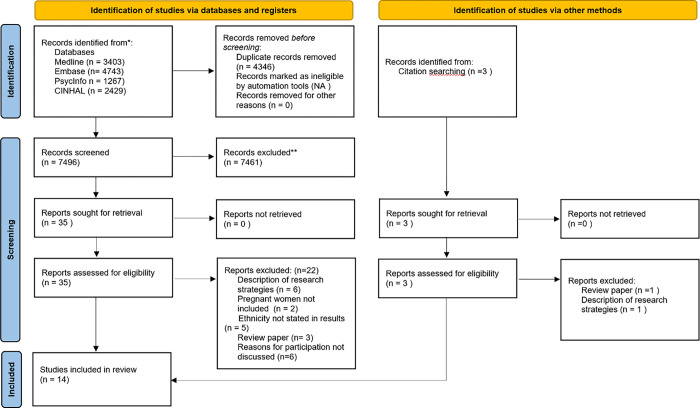
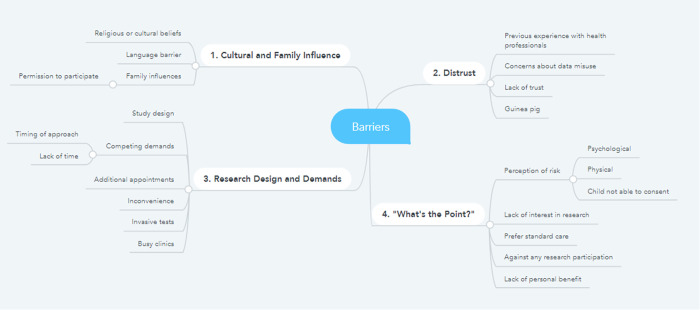
Background: Women from Black, Asian and mixed ethnicity backgrounds in the UK experience higher rates of maternal and neonatal mortality and morbidity, and report poorer experiences of maternity care. Research is required to understand how to reduce these disparities, however, it is acknowledged these groups of women are under-represented in clinical research. Aim: To investigate factors which influence participation in maternity research for women from an ethnic minority background. Methods: A systematic review was conducted to examine influencing factors for research participation. MEDLINE/CINHAL/PsycInfo/EMBASE databases were systematically searched in March 2021 and updated in March 2022. Papers were eligible if they explored maternal research participation and identified a woman’s ethnicity in the results. No restrictions were placed on methodology. A convergent integrated approach was used to synthesise findings. Findings: A total of 14 papers met the inclusion criteria. Results were divided into eight overarching themes. A personalised approach to recruitment and incorporating culturally sensitive communication and considerations enhanced research participation. Distrust around sharing data, a perception of risk to research participation, and research lacking in personal relevance adversely affected the decision to participate. Large variation existed in the quality of the studies reviewed. Conclusions: Consideration of a woman’s culture and background in the design and the delivery of a maternity research study may facilitate participation, particularly when sampling from a specific population. Further research, informed by women from ethnic minority backgrounds is warranted to develop women-centred recommendations for conducting inclusive maternity research. Prospero registration: www.crd.york.ac.uk/PROSPERO/display_record.asp?ID=CRD42021261686 .
Overview
The claims and statistics of this paper haven’t been checked yet.
Run the check — free, no account needed. It reads the open-access text and checks the sources it cites.
Integrity signals
Registry
Cites
Statistics
Figures
Verification
Claims the paper makes
The claims and statistics of this paper haven’t been checked yet.
Run the check — free, no account needed. It reads the open-access text and checks the sources it cites.
Claims other papers make about this one
Each is checked against this paper’s own text: does it say what the citing paper says it does?
The cited source says what the claim attributes to it.
In the citing paper
“In the context of the current study, this fi nding is surprising, given the vast body of evidence exploring this notion [17,19-21,23,44-50].”
From The birth trauma earthquake: A qualitative investigation of first-time mothers who perceived their birth as traumatic (2026) · cites this paper as [48]
Self-check
Percentages, sums and reported differences re-computed from the paper’s own numbers.
The self-check needs the paper’s full text.
Citations
Cites
The PRISMA 2020 statement: An updated guideline for reporting systematic reviews
Page, M. J., McKenzie, J. E., Bossuyt, P. M., Boutron, I., Hoffmann, T. C., Mulrow, C. D., Shamseer, L., Tetzlaff, J. M., Akl, E. A., Brennan, S. E., et al. (2021) · BMJ · doi:10.1136/bmj.n71 · Cited by 108,283
Methods for the thematic synthesis of qualitative research in systematic reviews
Thomas, J., & Harden, A. (2008) · BMC Medical Research Methodology · doi:10.1186/1471-2288-8-45 · Cited by 9,312
Hong, Q. N., Pluye, P., Bujold, M., & Wassef, M. (2017) · Systematic Reviews · doi:10.1186/s13643-017-0454-2 · Cited by 754
Strategies to improve recruitment to randomised trials
Treweek, S., Pitkethly, M., Cook, J., Fraser, C., Mitchell, E., Sullivan, F., Jackson, C., Taskila, T. K., & Gardner, H. (2018) · Cochrane Database of Systematic Reviews · doi:10.1002/14651858.mr000013.pub6 · Cited by 521
Research works printed but not linked: 61
- M. Knight, 2021, Saving Lives, Improving Mothers’ Care Maternal, Newborn and Infant Clinical Outcome Review, Programme’,, 16, 2022
- E. S. Draper, 2021, Maternal, Newborn and Infant Clinical Outcome Review Programme MBRRACE-UK Perinatal Mortality Surveillance Report, 16, 2022
- 2020, Public Health England, ‘Maternity high impact area: Reducing the inequality of outcomes for women from Black, Asian and Minority Ethnic (BAME) communities and their babies’
- Y. Li, 2019, Ethnic differences in singleton preterm birth in England and Wales, 2006‐12: Analysis of national routinely collected data, Paediatr Perinat Epidemiol, 33, 449, 10.1111/ppe.12585 · DOI
- 2015, Diabetes in pregnancy
- J. D. Johnson, Does race or ethnicity play a role in the origin, pathophysiology, and outcomes of preeclampsia? An expert review of the literature’, American Journal of Obstetrics and Gynecology, Mosby Inc, 24, 2020
- M. Redshaw, 2016, Who is actually asked about their mental health in pregnancy and the postnatal period?, Findings from a national survey’, BMC Psychiatry, 16, 1
- S. Pilav, 2022, A qualitative study of minority ethnic women’s experiences of access to and engagement with perinatal mental health care.’,, BMC Pregnancy Childbirth, 22, 421, 10.1186/s12884-022-04698-9 · DOI
- M. Knight, 2014, Maternal near-miss case reviews: the UK approach, BJOG, 121, 112, 10.1111/1471-0528.12802 · DOI
- M. Knight, 2020, Saving Lives, Improving Mothers’ Care Maternal, Newborn and Infant Clinical Outcome Review Programme, 07, 2021
- RCOG, 2020, RCOG Position Statement: Racial disparities in women’s healthcare
- L. A. Penner, N. Hagiwara, S. Eggly, S. L. Gaertner, T. L. Albrecht, and J. F. Dovidio, ‘Racial healthcare disparities: A social psychological analysis’, http://dx.doi.org/10.1080/10463283.2013.840973, vol. 24, no. 1, pp. 70–122, 2013. · DOI
- D. Kapadia, 2022, Ethnic Inequalities in Healthcare: A Rapid Evidence Review
- T. Awe, 2022, THE BLACK MATERNITY EXPERIENCES SURVEY A NATIONWIDE STUDY OF BLACK WOMEN’S EXPERIENCES OF MATERNITY SERVICES IN THE UNITED KINGDOM
- B. Liu, 2022, Reducing health inequality in Black, Asian and other minority ethnic pregnant women: impact of first trimester combined screening for placental dysfunction on perinatal mortality, BJOG, 00, 1
- A. Farooqi, 2022, Developing a toolkit for increasing the participation of black, Asian and minority ethnic communities in health and social care research, BMC Med Res Methodol, 22, 1, 10.1186/s12874-021-01489-2 · DOI
- M. S. Chen, 2014, Twenty years post-NIH Revitalization Act: Enhancing minority participation in clinical trials (EMPaCT): Laying the groundwork for improving minority clinical trial accrual’, Cancer, 120, 1091, 10.1002/cncr.28575 · DOI
- K. Khunti, 2017, ‘Representation of people of South Asian origin in cardiovascular outcome trials of glucose-lowering therapies in Type 2 diabetes’, Diabetic Medicine, 34, 64, 10.1111/dme.13103 · DOI
- M. VH, 2004, Participation in cancer clinical trials: race-, sex-, and age-based disparities, JAMA, 291, 2720, 10.1001/jama.291.22.2720 · DOI · Paper page
- K. M. Diehl, 2011, ‘Features Associated with Successful Recruitment of Diverse Patients onto Cancer Clinical Trials: Report from the American College of Surgeons Oncology Group’, Oncol, 18, 3544
- A. Smart, 2017, The under-representation of minority ethnic groups in UK medical research, Ethn Health, 22, 65, 10.1080/13557858.2016.1182126 · DOI
- A. Caplan, 2017, Health disparities and clinical trial recruitment: Is there a duty to tweet?’, PLoS Biol, 15, e2002040, 10.1371/journal.pbio.2002040 · DOI
- L. T. Clark, 2019, Increasing Diversity in Clinical Trials: Overcoming Critical Barriers, Current Problems in Cardiology, 44, 148, 10.1016/j.cpcardiol.2018.11.002 · DOI
- P. Healy, 2018, Identifying trial recruitment uncertainties using a James Lind Alliance Priority Setting Partnership—the PRioRiTy (Prioritising Recruitment in Randomised Trials) study’, Trials, 19, 10.1186/s13063-018-2544-4 · DOI
- S. Treweek, 2021, Developing the INCLUDE Ethnicity Framework—a tool to help trialists design trials that better reflect the communities they serve, Trials, 22, 1, 10.1186/s13063-021-05276-8 · DOI
- G. Mallett, 2020, Characteristics Associated With Consent and Reasons for Declining in a Randomized Trial in Pregnancy, Obstetrics and gynecology, 136, 731, 10.1097/AOG.0000000000003998 · DOI
- I. S. E. van der Zande, 2018, ‘Facilitators and barriers to pregnant women’s participation in research: A systematic review’, Women and Birth, 31, 350, 10.1016/j.wombi.2017.12.009 · DOI
- C. Stern, 2020, Methodological guidance for the conduct of mixed methods systematic reviews, JBI Evid Synth, 18, 2108, 10.11124/JBISRIR-D-19-00169 · DOI
- M. Sandelowski, 2006, Defining and Designing Mixed Research Synthesis Studies
- C. Pope, 2007, Synthesizing Qualitative and Quantitative Health Research, Adelaide: Ramsay
- Q. Nha HONG, 2018, MIXED METHODS APPRAISAL TOOL (MMAT) VERSION 2018 User guide’, Canadian Intellectual Property Office, Industry Canada
- N. Garg, 2017, Attitudes to participating in a birth cohort study, views from a multiethnic population: a qualitative study using focus groups, Health Expectations, 20, 146, 10.1111/hex.12445 · DOI
- S. Neelotpol, 2016, Challenges in collecting clinical samples for research from pregnant women of South Asian origin: evidence from a UK study, BMJ Open, 6, 10554, 10.1136/bmjopen-2015-010554 · DOI
- K. van Delft, 2013, Recruitment of pregnant women in research, J Obstet Gynaecol (Lahore),, 33, 442, 10.3109/01443615.2013.767787 · DOI
- S. D. Brown, 2015, Outreach to diversify clinical trial participation: A randomized recruitment study, Clinical Trials, 12, 205, 10.1177/1740774514568125 · DOI
- A. Cristina Lindsay, 2021, Faith, Family, and Social Networks: Effective Strategies for Recruiting Brazilian Immigrants in Maternal and Child Health Research, J Racial Ethn Health Disparities, 8, 47, 10.1007/s40615-020-00753-3 · DOI
- A. Martin, 2013, Recruitment of Black and Latina Women to a Randomized Controlled Trial, J Health Care Poor Underserved, 24, 1102, 10.1353/hpu.2013.0125 · DOI
- J. Barnett, 2012, Recruiting and retaining low-income, multi-ethnic women into randomized controlled trials: Successful strategies and staffing, Contemp Clin Trials, 33, 925, 10.1016/j.cct.2012.06.005 · DOI
- R. D. Savich, 2020, Willingness of women to participate in obstetrical and pediatric research involving biobanks’, J Community Genet, 11, 215, 10.1007/s12687-019-00446-3 · DOI
- S. L. Gillespie, 2021, A Comparison of Recruitment Methods for a Prospective Cohort Study of Perinatal Psychoneuroimmunology among Black American Women, J Urban Health, 98, 115, 10.1007/s11524-021-00548-9 · DOI
- S. Nechuta, 2009, Attitudes of pregnant women towards participation in perinatal epidemiological research, Paediatr Perinat Epidemiol, 23, 424, 10.1111/j.1365-3016.2009.01058.x · DOI
- G. Lamvu, 2005, Racial differences among reasons for participating in research of pregnancy outcomes: The right from the start experience, Gend Med, 2, 166, 10.1016/S1550-8579(05)80045-2 · DOI
- S. Nechuta, 2012, Attitudes of pregnant women towards collection of biological specimens during pregnancy and at birth, Paediatr Perinat Epidemiol, 26, 272, 10.1111/j.1365-3016.2012.01265.x · DOI
- H. H. Gatny, 2012, Willingness to Participate in Research during Pregnancy: Race, Experience, and Motivation, Field Methods,, 24, 135, 10.1177/1525822X11419819 · DOI
- C. Houghton, 2020, Factors that impact on recruitment to randomised trials in health care: a qualitative evidence synthesis, Cochrane Database Syst Rev, 2020
- L. McKechnie, 2006, Consent for neonatal research, Arch Dis Child Fetal Neonatal Ed, 91, F374, 10.1136/adc.2005.075036 · DOI
- A. Hoberman, 2013, Factors That Influence Parental Decisions to Participate in Clinical Research: Consenters vs Nonconsenters’, JAMA Pediatr,, 167, 561, 10.1001/jamapediatrics.2013.1050 · DOI
- H. Yoder and L. R. Hardy, ‘Midwifery and Antenatal Care for Black Women: A Narrative Review’:, https://doi.org/10.1177/2158244017752220, vol. 8, no. 1, Jan. 2018. · DOI
- G. Corbie-Smith, 2002, George, ‘Distrust, race, and research’, Arch Intern Med, 162, 2458
- D. P. Scharf, 2010, More than Tuskegee: Understanding Mistrust about Research Participation, J Health Care Poor Underserved, 21, 879, 10.1353/hpu.0.0323 · DOI
- D. H. Bodicoat, 2021, Promoting inclusion in clinical trials—a rapid review of the literature and recommendations for action, Trials, 22, 1, 10.1186/s13063-021-05849-7 · DOI
- L. Baker, 2005, Factors that influence women’s decisions about whether to participate in research: an exploratory study’, Birth, 32, 60, 10.1111/j.0730-7659.2005.00346.x · DOI
- National Institute for Health Research, 2020, Improving inclusion of under-served groups in clinical research: Guidance from INCLUDE project’, 16, 2022
- S. Kenyon, 2006, Participating in a trial in a critical situation: a qualitative study in pregnancy, Qual Saf Health Care, 15, 98, 10.1136/qshc.2005.015636 · DOI
- S. Myles, 2018, ‘A Multicenter Investigation of Factors Influencing Women’s Participation in Clinical Trials’, J Womens Health, 27, 258, 10.1089/jwh.2017.6458 · DOI
- R. L. Tooher, 2008, A thematic analysis of factors influencing recruitment to maternal and perinatal trials, BMC Pregnancy and Childbirth, 8, 36, 10.1186/1471-2393-8-36 · DOI
- J. Jomeen and M. Redshaw, ‘Ethnic minority women’s experience of maternity services in England’, https://doi.org/10.1080/13557858.2012.730608, vol. 18, no. 3, pp. 280–296, Jun. 2013. · DOI · Paper page
- J. Henderson, 2013, ‘Experiencing maternity care: The care received and perceptions of women from different ethnic groups’, BMC Pregnancy Childbirth, 13, 1, 10.1186/1471-2393-13-196 · DOI
- J. R. John, 2021, Exploring ethnic minority women’s experiences of maternity care during the SARS-CoV-2 pandemic: a qualitative study’, BMJ Open, 0, 50666
- R. A. Powell, 2022, Tackling racism in UK health research, BMJ, 376
- E. B. Carter, 2021, A paradigm shift to address racial inequities in perinatal healthcare, Am J Obstet Gynecol, 224, 359, 10.1016/j.ajog.2020.11.040 · DOI · Paper page
Cited by
Sorted by citations
Silverio, S. A., George-Carey, R., Memtsa, M., Kent-Nye, F. E., Magee, L. A., Sheen, K. S., Burgess, K., Oza, M., Storey, C., Sandall, J., et al. (2024) · BMC Pregnancy and Childbirth · doi:10.1186/s12884-024-06721-7 · Cited by 7
Bailey, E. C., Barry, Z., Buabeng, R., Fellows, R. E., Khazaezadeh, N., Rajasingam, D., Silverio, S. A., & Sheen, K. S. (2026) · Women and Birth · doi:10.1016/j.wombi.2026.102171
Self-citation
Metadata
- Authors
- Lovell, H., Silverio, S. A., Story, L., Skelton, E., & Matthew, J.
- Venue
- PLOS ONE
- Publisher
- Public Library of Science (PLoS)
- Published
- 2023-02-24
- Volume
- 18
- Issue
- 2
- Pages
- e0282088
- ISSN
- 1932-6203
- PMC
- PMC9956875
- Cited by
- 39
- References
- 4
- Language
- en
- Update notices
- correction (2025-02-19)
- Funders
- NIHR Doctoral Fellowships (NIHR300555, NIHR-INF-2170)
- College of Radiographers Research and Industrial Partners Award (ref:-CBRHvaCoRIPS197)
- NIHR Applied Research Collaboration (ARC) South London
About these checks
Registry, retraction, Cites and statistics results are computed, not judged, with one exception: a printed reference that no index lists is read once by a model before it counts as a citation error. Claims are extracted by a model and kept only when their quote appears verbatim in the text; each cited source is then checked, with a model’s help, for whether it says what the claim relies on. Those verdicts can be wrong — read the claim’s quote and the cited source before relying on one.
Statistics and arithmetic are recomputed, not judged.
Confidence bands are shown only for fields calibrated on our annotated test set. None is calibrated yet, so no band is shown.
What counts as a claim ›How we measure confidence ›How we check this ›
Are you an author, or do you see a problem with this page? Request a review
