

Does willpower mindset really moderate the ego-depletion effect? A preregistered replication of Job, Dweck, and Walton (2010)
Open accessThe DOI matches its Crossref record; 41 of the 41 references it cites were found in a registry or an index; none of the 93 sources its claims cite is checked for support yet.
Abstract
This article reports a preregistered study in which we attempted to replicate the results of an influential study on the ego-depletion effect reported by Job, Dweck, and Walton in 2010. The original Job et al. study (Study 1, N = 60) provided evidence that the ego-depletion effect—a performance decrease on a self-control task after performing another self-control task—occurs only for individuals who hold a belief that their willpower is limited. This moderation of the ego-depletion effect by one’s willpower mindset (limited vs. nonlimited) has been interpreted as evidence against a prevalent limited-resource account of self-control. Although this alternative account of the ego-depletion effect has become well-known, the statistical evidence of the original study was on shaky ground. We therefore conducted a preregistered replication of the original study with some methodological improvements. As in the original study, participants (N = 187) performed a self-control task (Stroop color-word interference task) after performing the control or depletion version of a letter cancelation task. Despite extensive analyses, we failed to replicate the original results: There was neither a significant main effect of ego depletion nor a significant moderation of this ego-depletion effect by individual differences in willpower mindset. Together with other recent failures to replicate the original moderation effect, our results cast doubts on the claim that an individual’s view of whether willpower is limited or not affects one’s susceptibility to the ego-depletion effect.
Overview
CoChat Summary
TL;DR
In a preregistered replication with N = 187, the authors found no significant overall ego-depletion effect and no significant moderation of it by willpower mindset, contrary to Job et al. (2010). They conclude the original moderation finding is not robust and should be interpreted cautiously.
Key findings
- The final sample was 187 participants (control n = 95; depletion n = 92). There was no significant main effect of ego depletion on Stroop interference: Block 1 error data, t(185) = –1.620, p = .107, d = –0.239; Block 1 log RT, t(185) = –0.360, p = .719, d = –0.053; Block 2 error data, t(185) = –.721, p = .472, d = –0.106; Block 2 log RT, t(185) = –.366, p = .715, d = –0.053.
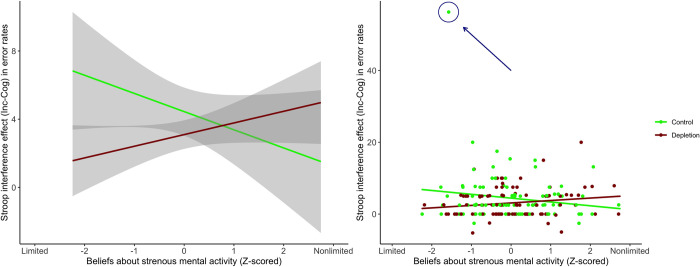
- In fixed-effects regression, Block 1 error data showed a significant Condition × Mindset interaction, B = .875, p = .038, but it was opposite in direction to Job et al.’s prediction and was driven by one extreme outlier; after excluding that outlier, the interaction was nonsignificant, B = .444, p = .162. The RT interaction was not significant (B = .001). Block 2 showed no moderation for error data, B = .287, p = .414, or log RT data, B = –.003, p = .558.
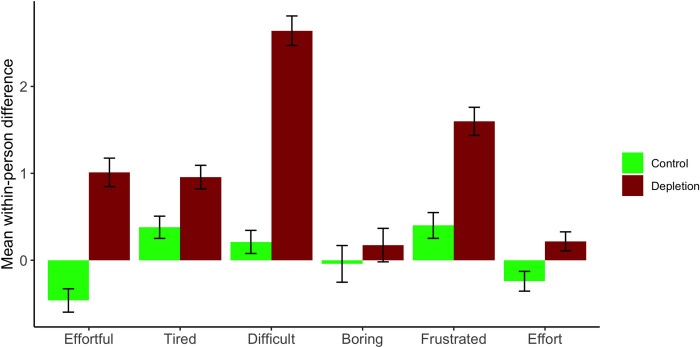
- Mixed-effects models found no significant Condition × Mindset × Trial Type interaction in Block 1 or Block 2 for either errors or log RTs. Manipulation checks were generally successful: a one-way MANOVA on difference scores gave Pillai-Bartlett trace V = 0.470, approximate F(6, 180) = 26.55, p < .001, though the “boring” rating did not differ as expected.
- Exploratory analyses found no evidence that trait self-control moderated the ego-depletion effect. The authors also note that among 13 qualifying studies reviewed, 5 reported some evidence for the willpower-mindset moderation and 8 failed to observe it; only Chow et al. provided clean statistical evidence for the original finding.
Methods
- Preregistered replication of Job et al.’s Study 1, preregistered on October 18, 2016, with data collected October 2016–May 2017. A total of 194 participants were recruited; 7 were excluded, leaving N = 187.
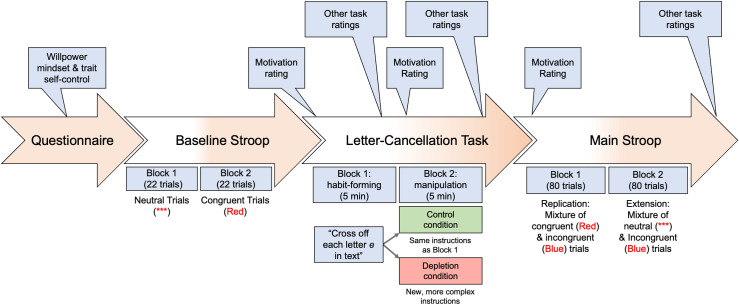
- Participants completed the Beliefs about Willpower Scale and the 36-item Self-Control Scale, baseline vocal-response Stroop blocks, a letter cancelation task (control vs. depletion; the depletion condition did not use blurred text), and a main vocal-response Stroop task. Block 1 had 80 mixed congruent/incongruent trials; Block 2 had 80 neutral/incongruent trials. Manipulation-check ratings were administered after each letter-cancelation block.
- Primary preregistered analyses used fixed-effects t tests and regressions on Stroop interference scores (incongruent minus congruent/neutral), with condition, willpower mindset, and their interaction. Exploratory mixed-effects models included participant and trial random effects; additional exploratory analyses tested trait self-control as a moderator.
Limitations
- The paper states the study was underpowered: with N = 187, 80% power was available to detect d = .412 for the main effect and f2 = .042 (d = .410) for the moderation effect, so smaller effects could have been missed.
- The paper states the final protocol deviated from preregistration in several minor ways, and the study was not a direct replication because of design changes (e.g., manipulation-check ratings at multiple time points, no blurred text in the depletion condition, vocal-response Stroop, an added Stroop extension block). It also could not analyze the data exactly as Job et al. did because the attempted hierarchical logistic regression models did not converge, and the original dataset was unavailable.
- The paper states that the failure may partly reflect the absence of a main ego-depletion effect, and that it cannot rule out that the moderation effect requires such a main effect. The text also makes evident that the intended sample size of 100 per condition was not reached because the subject pool closed at the end of the semester.
Model-written summary. Check it against the paper before relying on it.
Integrity signals
Registry
Cites
Statistics
Figures
Verification
Claims the paper makes
0 Valid · 0 Not valid · 57 Not checked · 67 Own results and interpretations
A result the paper reports from its own data — it cites no other source for it, so there is none to check. The quote shows it is in the paper.
In the paper
“There was neither a significant main effect of ego depletion nor a significant moderation of this ego-depletion effect by individual differences in willpower mindset.”
§ Does willpower mindset really moderate the ego-depletion effect? A preregistered replication of Job, Dweck, and Walton (2010) > Abstract
plainn = 187- Asserted: passes — The authors put it forward as true.
- Checkable: passes — It can be checked against evidence.
- Load-bearing: passes — The paper’s conclusions depend on it.
- Based: passes — The paper gives a reason why it holds.
A result the paper reports from its own data — it cites no other source for it, so there is none to check. The quote shows it is in the paper.
In the paper
“However, the hypothesized willpower-mindset moderation effect, namely the three-way interaction term (Condition × Mindset × Trial Type), was not significant for either error or log RT data.”
§ Does willpower mindset really moderate the ego-depletion effect? A preregistered replication of Job, Dweck, and Walton (2010) > Results > Exploratory analyses: Mixed-effects models
plain- Asserted: passes — The authors put it forward as true.
- Checkable: passes — It can be checked against evidence.
- Load-bearing: passes — The paper’s conclusions depend on it.
- Based: passes — The paper gives a reason why it holds.
A result the paper reports from its own data — it cites no other source for it, so there is none to check. The quote shows it is in the paper.
In the paper
“The bottom line is that there was no evidence for such a moderation effect by trait self-control.”
§ Does willpower mindset really moderate the ego-depletion effect? A preregistered replication of Job, Dweck, and Walton (2010) > Results > Secondary (exploratory) analyses: Analyses based on the trait self-control measure
plain- Asserted: passes — The authors put it forward as true.
- Checkable: passes — It can be checked against evidence.
- Load-bearing: unclear — It is unclear whether the paper’s conclusions depend on it.
- Based: passes — The paper gives a reason why it holds.
In the paper
“we reanalyzed our data, focusing only on the first 40 trials of the replication block (Block 1) so that the number of Stroop trials in the current study would be comparable to that of the Job et al. study. The results remained the same, however, as reported in Tables C–E in S1 Appendix.”
§ Does willpower mindset really moderate the ego-depletion effect? A preregistered replication of Job, Dweck, and Walton (2010) > Results > Testing the main effect of ego depletion
What the sources say
- Not checked yetcites [1] Job V, Dweck CS, Walton GM. Ego Depletion—Is It All in Your Head?: Implicit Theories About Willpower Affect Self-Regulation. Psychol Sci. 2010; 21(11): 1686– 93. doi: 10.1177/0956797610384745. 20876879 source
plain- Asserted: passes — The authors put it forward as true.
- Checkable: passes — It can be checked against evidence.
- Load-bearing: unclear — It is unclear whether the paper’s conclusions depend on it.
- Based: passes — The paper gives a reason why it holds.
56 more claims
Create a free account to see all 124 claims and to verify the 92 references still open.
- It may state two separate claims as one. 31
- Probably not a substantial claim. 43
Statistics that don’t add up
Each reported p-value recomputed from its test statistic and degrees of freedom, each partial η² from its F, and each ratio, mean difference or B printed with a p checked against its own confidence interval.
Rated minor: it would not touch a result — a value no result rests on, a p-value that stays on the same side of the significance level, or a conflict that is clerical, resolved elsewhere in the paper, or outside its own findings.
In the paper
“t(185) = –0.840, p = .933”
§ Does willpower mindset really moderate the ego-depletion effect? A preregistered replication of Job, Dweck, and Walton (2010) > Results > Manipulation checks
Reported p = .933 · recomputed p = .402
Statistics recomputed
Every reported test result, recomputed from its test statistic and degrees of freedom. A result shows as not adding up only once an independent check has confirmed it.
- Doesn’t add upt(185) = -0.84reported p = .933 · recomputed p = .402
“t(185) = -0.840, p = .933”
- Consistentt(1433) = 6.71reported p < .01 · recomputed p < .001
“t(1433) = 6.71, p < .01”
- Consistentt(185) = -0.754reported p = .452 · recomputed p = .452
“t(185) = -.754, p = .452”
- ConsistentF(6, 180) = 26.55reported p < .001 · recomputed p < .001
“F(6, 180) = 26.55, p < .001”
- Consistentt(185) = -0.297reported p = .767 · recomputed p = .767
“t(185) = -0.297, p = .767”
7 more recomputed tests
Create a free account to see every test the Stats check recomputed.
Self-check
Percentages, sums and reported differences re-computed from the paper’s own numbers.
Each contradiction between two passages listed here was confirmed by an independent check.
Rated minor: it would not touch a result — a value no result rests on, a p-value that stays on the same side of the significance level, or a conflict that is clerical, resolved elsewhere in the paper, or outside its own findings.
In the paper
§ Does willpower mindset really moderate the ego-depletion effect? A preregistered replication of Job, Dweck, and Walton (2010) > Results > Testing the moderation effect
“The B estimate for the interaction term was .001, p = .778.”
§ Does willpower mindset really moderate the ego-depletion effect? A preregistered replication of Job, Dweck, and Walton (2010) > Results > Testing the moderation effect
“| C × M | 0.875 | 0.418 | [0.051, 1.699] | 0.038 | 0.001 | 0.005 | [–0.009, 0.012] | 0.823 |”
Rated minor: it would not touch a result — a value no result rests on, a p-value that stays on the same side of the significance level, or a conflict that is clerical, resolved elsewhere in the paper, or outside its own findings.
In the paper
§ Does willpower mindset really moderate the ego-depletion effect? A preregistered replication of Job, Dweck, and Walton (2010) > Results > Manipulation checks
“with the exception of boring, t(185) = –.754, p = .452.”
§ Does willpower mindset really moderate the ego-depletion effect? A preregistered replication of Job, Dweck, and Walton (2010) > Results > Manipulation checks
“| Boring | 95 | –0.04 | 2.06 | 92 | 0.17 | 1.85 | 0.754 | 0.452 |”
Citations
Cites
Miyake, A., Friedman, N. P., Emerson, M. J., Witzki, A. H., Howerter, A., & Wager, T. D. (2000) · Cognitive Psychology · doi:10.1006/cogp.1999.0734 · Cited by 15,798
Self-citationMindset: The New Psychology of Success
(2006) · Choice Reviews Online · doi:10.5860/choice.44-2397 · Cited by 7,804
High self-control predicts good adjustment, less pathology, better grades, and interpersonal success
Tangney, J. P., Baumeister, R. F., & Boone, A. L. (2004) · Journal of Personality · doi:10.1111/j.0022-3506.2004.00263.x · Cited by 6,557
Half a century of research on the Stroop effect: An integrative review.
MacLeod, C. M. (1991) · Psychological Bulletin · doi:10.1037/0033-2909.109.2.163 · Cited by 5,500
The Strength Model of Self-Control
Baumeister, R. F., Vohs, K. D., & Tice, D. M. (2007) · Current Directions in Psychological Science · doi:10.1111/j.1467-8721.2007.00534.x · Cited by 3,567
Statistical difficulties of detecting interactions and moderator effects.
McClelland, G. H., & Judd, C. M. (1993) · Psychological Bulletin · doi:10.1037/0033-2909.114.2.376 · Cited by 3,270
Ego depletion and the strength model of self-control: a meta-analysis
Hagger, M. S., Wood, C., Stiff, C., & Chatzisarantis, N. L. D. (2010) · Psychological Bulletin · doi:10.1037/a0019486 · Cited by 2,265
Kane, M. J., & Engle, R. W. (2003) · Journal of Experimental Psychology: General · doi:10.1037/0096-3445.132.1.47 · Cited by 1,725
Individual differences in executive functions are almost entirely genetic in origin.
Friedman, N. P., Miyake, A., Young, S. E., DeFries, J. C., Corley, R. P., & Hewitt, J. K. (2008) · Journal of Experimental Psychology: General · doi:10.1037/0096-3445.137.2.201 · Cited by 1,547
Self-citationA Multilab Preregistered Replication of the Ego-Depletion Effect
Hagger, M. S., Chatzisarantis, N. L. D., Alberts, H., Anggono, C. O., Batailler, C., Birt, A. R., Brand, R., Brandt, M. J., Brewer, G., Bruyneel, S., et al. (2016) · Perspectives on Psychological Science · doi:10.1177/1745691616652873 · Cited by 1,310
Self-citationJudd, C. M., Westfall, J., & Kenny, D. A. (2012) · Journal of Personality and Social Psychology · doi:10.1037/a0028347 · Cited by 1,236
Ego Depletion—Is It All in Your Head?: Implicit Theories About Willpower Affect Self-Regulation
Job, V., Dweck, C. S., & Walton, G. M. (2010) · Psychological Science · doi:10.1177/0956797610384745 · Cited by 910
Small Telescopes: Detectability and the Evaluation of Replication Results
Simonsohn, U. (2015) · Psychological Science · doi:10.1177/0956797614567341 · Cited by 742
Carter, E. C., Kofler, L. M., Forster, D. E., & McCullough, M. E. (2015) · Journal of Experimental Psychology: General · doi:10.1037/xge0000083 · Cited by 594 · cited 1×
“…studies, yielded moderate effect sizes (Cohen’s d = .62), more recent meta-analyses suggested that, due to the well-known phenomenon of publication bias and possible questionable research practices such as p -hacking [6], the actual effect size might be much smaller [7–9] or even nonexistent [10].”
Is Ego Depletion Real? An Analysis of Arguments
Friese, M., Loschelder, D. D., Gieseler, K., Frankenbach, J., & Inzlicht, M. (2019) · Personality and Social Psychology Review · doi:10.1177/1088868318762183 · Cited by 393
Carter, E. C., & McCullough, M. E. (2014) · Frontiers in Psychology · doi:10.3389/fpsyg.2014.00823 · Cited by 381
High self-control predicts good adjustment, less pathology, better grades, and interpersonal success
Tangney, J. P., Boone, A. L., & Baumeister, R. F. (2018) · Self-Regulation and Self-Control · doi:10.4324/9781315175775-5 · Cited by 292
A Multisite Preregistered Paradigmatic Test of the Ego-Depletion Effect
Vohs, K. D., Schmeichel, B. J., Lohmann, S., Gronau, Q. F., Finley, A. J., Ainsworth, S. E., Alquist, J. L., Baker, M. D., Brizi, A., Bunyi, A., et al. (2021) · Psychological Science · doi:10.1177/0956797621989733 · Cited by 288
Self-citationA Multilab Replication of the Ego Depletion Effect
Dang, J., Barker, P., Baumert, A., Bentvelzen, M., Berkman, E., Buchholz, N., Buczny, J., Chen, Z., De Cristofaro, V., de Vries, L., et al. (2021) · Social Psychological and Personality Science · doi:10.1177/1948550619887702 · Cited by 222
Lurquin, J., Michaelson, L., Barker, J. E., Gustavson, D. E., von Bastian, C. C., Carruth, N. P., & Miyake, A. (2016) · PLoS ONE · doi:10.1371/journal.pone.0147770 · Cited by 186
Self-citationMisguided Effort With Elusive Implications
Baumeister, R. F., & Vohs, K. D. (2016) · Perspectives on Psychological Science · doi:10.1177/1745691616652878 · Cited by 183
An updated meta-analysis of the ego depletion effect
Dang, J. (2018) · Psychological Research · doi:10.1007/s00426-017-0862-x · Cited by 179
Beliefs about willpower determine the impact of glucose on self-control
Job, V., Walton, G. M., Bernecker, K., & Dweck, C. S. (2013) · Proceedings of the National Academy of Sciences · doi:10.1073/pnas.1313475110 · Cited by 164
Savani, K., & Job, V. (2017) · Journal of Personality and Social Psychology · doi:10.1037/pspi0000099 · Cited by 148
Lurquin, J. H., & Miyake, A. (2017) · Frontiers in Psychology · doi:10.3389/fpsyg.2017.00568 · Cited by 92
Self-citationEgo Depletion Reduces Attention Control: Evidence From Two High-Powered Preregistered Experiments.
Garrison, K. E., Finley, A. J., & Schmeichel, B. J. (2019) · Personality and Social Psychology Bulletin · doi:10.1177/0146167218796473 · Cited by 72
Wolff, W., Baumann, L., & Englert, C. (2018) · PLoS ONE · doi:10.1371/journal.pone.0199554 · Cited by 66
Chow, J. T., Hui, C. M., & Lau, S. (2015) · European Journal of Social Psychology · doi:10.1002/ejsp.2120 · Cited by 61
Baumeister, R. F., Tice, D. M., & Bushman, B. J. (2023) · Perspectives on Psychological Science · doi:10.1177/17456916221121815 · Cited by 53
Dang, J., Liu, Y., Liu, X., & Mao, L. (2017) · Social Psychology · doi:10.1027/1864-9335/a000308 · Cited by 52
Francis, Z., & Job, V. (2018) · Social and Personality Psychology Compass · doi:10.1111/spc3.12381 · Cited by 40
Gustavson, D. E., Lurquin, J., Michaelson, L., Barker, J. E., Carruth, N. P., von Bastian, C. C., & Miyake, A. (2020) · Emotion · doi:10.1037/emo0000584 · Cited by 35
Self-citationWorking Memory Capacity and Stroop Interference: Global Versus Local Indices of Executive Control.
Meier, M. E., & Kane, M. J. (2013) · Journal of Experimental Psychology: Learning, Memory, and Cognition · doi:10.1037/a0029200 · Cited by 33
Revisiting Ego Depletion: Moderators and Measurement.
Singh, R. K., & Göritz, A. S. (2019) · Basic and Applied Social Psychology · doi:10.1080/01973533.2018.1530671 · Cited by 21
Self-Control Depletion Impairs Goal Maintenance: A Meta-Analysis.
Dang, J., Björklund, F., & Bäckström, M. (2017) · Scandinavian Journal of Psychology · doi:10.1111/sjop.12371 · Cited by 21
Bernecker, K., Job, V., & Hofmann, W. (2018) · Journal of Research in Personality · doi:10.1016/j.jrp.2018.07.007 · Cited by 19
Searching for the Bottom of the Ego Well: Failure to Uncover Ego Depletion in Many Labs 3.
Vadillo, M. A., Gold, N., & Osman, M. (2018) · Royal Society Open Science · doi:10.1098/rsos.180390 · Cited by 19
Ego Depletion Does Not Interfere With Working Memory Performance.
Singh, R. K., & Göritz, A. S. (2018) · Frontiers in Psychology · doi:10.3389/fpsyg.2018.00538 · Cited by 16
Wenzel, M., Lind, M., Rowland, Z., Zahn, D., & Kubiak, T. (2019) · Social Psychology · doi:10.1027/1864-9335/a000365 · Cited by 13
A Within-Subjects Test of Ego Depletion and Potential Moderators.
Calvillo, D. P., Rodriguez, K., & Nguyen, T. N. (2022) · The Journal of General Psychology · doi:10.1080/00221309.2021.1922341 · Cited by 6
Miyake, A., & Carruth, N. P. (2023) · Frontiers in Psychology · doi:10.3389/fpsyg.2023.1208299 · Cited by 4
Self-citation
Research works printed but not linked: 1
- Schimmack U. Replicability Report No. 1: Is Ego-Depletion a Replicable Effect? Replicability-Index. 2016. Available from: https://replicationindex.com/2016/04/18/is-replicability-report-ego-depletionreplicability-report-of-165-ego-depletion-articles/
Cited by
Rattan, A., & Ozgumus, E. (2019) · Research in Organizational Behavior · doi:10.1016/j.riob.2020.100127 · Cited by 44
A Schema-Activation Approach to Failure and Success in Self-Control
Bertrams, A. (2020) · Frontiers in Psychology · doi:10.3389/fpsyg.2020.02256 · Cited by 31
Li, J., Gillebaart, M., & van Timmeren, T. (2024) · Current Opinion in Psychology · doi:10.1016/j.copsyc.2024.101898 · Cited by 7
Miyake, A., & Carruth, N. P. (2023) · Frontiers in Psychology · doi:10.3389/fpsyg.2023.1208299 · Cited by 4
Self-citationHow rethinking difficulties can shape important life outcomes
Job, V., Mlynski, C., & Bauer, C. A. (2025) · Trends in Cognitive Sciences · doi:10.1016/j.tics.2025.05.018 · Cited by 4
Metadata
- Authors
- Carruth, N. P., Ramos, J. A., & Miyake, A.
- Affiliations
- DePaul University (US)
- University of Colorado Boulder (US)
- Corresponding author
- Miyake, Akira
- Venue
- PLOS ONE
- Publisher
- Public Library of Science (PLoS)
- Published
- 2023-06-29
- Volume
- 18
- Issue
- 6
- Pages
- e0287911
- ISSN
- 1932-6203 (ISSN-L)
- PMC
- PMC10310002
- OpenAlex
- W4382601574
- Cited by
- 6
- References
- 41
- Citations by year
- 2025: 1 · 2024: 1 · 2023: 1
- FWCI
- 0.50
- Type
- journal article
- Language
- en
- Open access
- gold
- doi.org
- Licence
- Locations
- PLoS ONE (publishedVersion, cc-by)
- PsyArXiv (OSF Preprints) (submittedVersion, cc-by)
- PubMed Central (publishedVersion, cc-by)
- PubMed (publishedVersion)
- CU Scholar (University of Colorado Boulder) (submittedVersion, cc-by)
- RePEc: Research Papers in Economics (submittedVersion)
- DOAJ (DOAJ: Directory of Open Access Journals) (submittedVersion)
- PsyArXiv (OSF Preprints) (submittedVersion)
- Topics
- Social Sciences › Psychology › Applied Psychology › Behavioral Health and Interventions
- Social Sciences › Psychology › Social Psychology › Grit, Self-Efficacy, and Motivation
- Social Sciences › Arts and Humanities › Philosophy › Free Will and Agency
- Keywords
- ego depletion, self-control, moderation, replication failure, Stroop task, individual differences
- MeSH terms
- Self-Control, Ego, Emotions, Humans, Individuality
About these checks
Registry, retraction, Cites and statistics results are computed, not judged, with one exception: a printed reference that no index lists is read once by a model before it counts as a citation error. Claims are extracted by a model and kept only when their quote appears verbatim in the text; each cited source is then checked, with a model’s help, for whether it says what the claim relies on. Those verdicts can be wrong — read the claim’s quote and the cited source before relying on one.
A language model drew the claims from the paper on 2026-11-24, under version 3 of the claim definition (model deepseek-v4.1-flash, prompt extract-v3).
A second model labelled each claim on 2026-11-24 (model jev-1.13-20260917, definition revision gold-guideline-v0.2).
Statistics and arithmetic are recomputed, not judged.
Confidence bands are shown only for fields calibrated on our annotated test set. None is calibrated yet, so no band is shown.
What counts as a claim ›How we measure confidence ›How we check this ›
Are you an author, or do you see a problem with this page? Request a review
Data sources
Bibliographic data: Semantic Scholar, OpenAlex, Crossref.
Contains information from the Semantic Scholar Academic Graph Datasets, made available under the ODC Attribution License (ODC-BY 1.0).
Semantic Scholar’s data is described in: Kinney, R., et al. (2023). The Semantic Scholar Open Data Platform. arXiv:2301.10140.
