

Exploring associations between social media addiction, social media fatigue, fear of missing out and sleep quality among university students: A cross-section study
Open accessThe DOI matches its Crossref record; 58 of the 59 references it cites were found in a registry or an index, and 1 are not checked yet.
Abstract
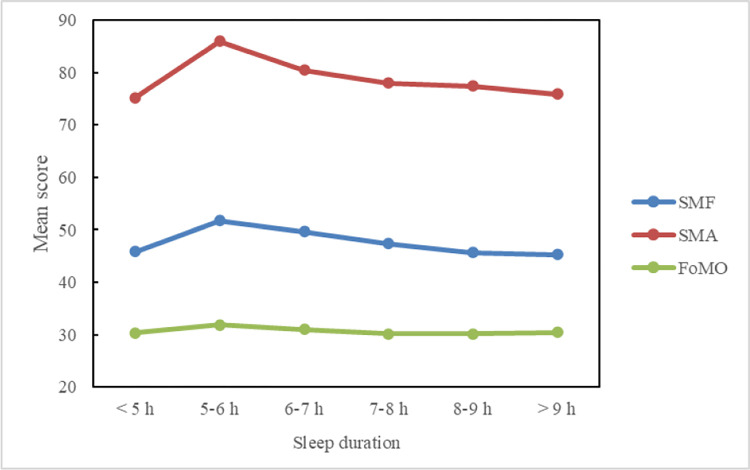
Background: Social media use has been linked to poor sleep outcomes among university students in the cyber age, but the association between the negative consequences of social media use and sleep problems is not yet well understood. The present study investigated the relationships among social media usage, social media fatigue (SMF), fear of missing out (FoMO), social media addiction (SMA) and sleep quality in university students. Method: An online survey was administered to 2744 respondents that included the Pittsburgh Sleep Quality Index (PSQI); questionnaires evaluating FoMO, SMF, and SMA; and questions regarding sleep duration, social media use, health status, and demographic information. Result: A total of 19.9% of respondents suffered from sleep disturbance. A total of 15.6% of participants had sleep durations less than 5 h, and 21.6% of subjects had sleep durations longer than 9 h. Sleep quality was positively associated with SMF (OR = 1.387, 95% CI: 1.103~1.743), and SMA (OR = 1.415, 95% CI: 1.118~1.791). The relationship between FoMO and sleep disturbance was not significant. Compared to a sleep duration > 9 h, SMF increased the risk of shorter sleep durations [5–6 h sleep (OR = 2.226, 95% CI: 1.132~4.375), 6–7 h sleep (OR = 1.458, 95% CI: 1.061~2.002), and 7–8 h sleep (OR = 1.296, 95% CI: 1.007~1.670)]. FoMO and SMA did not significantly affect sleep duration. In addition, SMA (OR = 3.775, 95% CI: 3.141~4.537), FoMO (OR = 3.301, 95% CI: 2.753~3.958), and sleep disorders (OR = 1.284, 95% CI: 1.006~1.638) increased SMF. Conclusion: Upon experiencing negative consequences of social media use, such as SMF and SMA, university students were likely to experience sleep problems. Further research exploring the interventions that improve sleep and alleviate negative consequences of social media use should be conducted.
Overview
The claims and statistics of this paper haven’t been checked yet.
Free: it reads the open-access text and checks the first 5 claims that cite a source we can check. Create a free account to check every claim.
Integrity signals
Registry
Cites
Statistics
Figures
Verification
Claims the paper makes
The claims and statistics of this paper haven’t been checked yet.
Free: it reads the open-access text and checks the first 5 claims that cite a source we can check. Create a free account to check every claim.
Claims other papers make about this one
Each is checked against this paper’s own text: does it say what the citing paper says it does?
The source backs part of the claim, not all of it — or backs it for a different population, condition or comparison.
In the citing paper
“Studies have also found that adolescents who have the fear of missing out are more prone to social media addiction, which can significantly affect their sleep quality. This is further exacerbated by using portable smartphones before bed, reducing melatonin secretion and desynchronizing the hypothalamus's circadian rhythm [37].”
From Social Media Algorithms and Teen Addiction: Neurophysiological Impact and Ethical Considerations (2025) · cites this paper as [37]
Experimental — accuracy not yet measured
Self-check
Percentages, sums and reported differences re-computed from the paper’s own numbers.
The self-check needs the paper’s full text.
Citations
Cites
Guidelines for the process of cross-cultural adaptation of self-report measures
Beaton, D. E., Bombardier, C., Guillemin, F., & Ferraz, M. B. (2000) · Spine · doi:10.1097/00007632-200012150-00014 · Cited by 14,542 · cited 3×
“The Chinese version of FoMO, which was adapted by Li et al following standardized international guidelines, was implemented to measure FoMO among university students in China [42, 43].”
MethodInfluentialElectronic media use and sleep in school-aged children and adolescents: A review
Cain, N., & Gradisar, M. (2010) · Sleep Medicine · doi:10.1016/j.sleep.2010.02.006 · Cited by 1,376
Dhir, A., Yossatorn, Y., Kaur, P., & Chen, S. (2018) · International Journal of Information Management · doi:10.1016/j.ijinfomgt.2018.01.012 · Cited by 1,033
How “phubbing” becomes the norm: The antecedents and consequences of snubbing via smartphone
Chotpitayasunondh, V., & Douglas, K. M. (2016) · Computers in Human Behavior · doi:10.1016/j.chb.2016.05.018 · Cited by 954
Blackwell, D., Leaman, C., Tramposch, R., Osborne, C., & Liss, M. (2017) · Personality and Individual Differences · doi:10.1016/j.paid.2017.04.039 · Cited by 897
Lee, A. R., Son, S.-M., & Kim, K. K. (2016) · Computers in Human Behavior · doi:10.1016/j.chb.2015.08.011 · Cited by 814 · cited 1×
“The scale was based on previous studies [8, 40, 41].”
MethodSleep disturbance in cancer patients
Davidson, J. R., MacLean, A. W., Brundage, M. D., & Schulze, K. (2002) · Social Science & Medicine · doi:10.1016/s0277-9536(01)00043-0 · Cited by 661
Hawi, N. S., & Samaha, M. (2017) · Social Science Computer Review · doi:10.1177/0894439316660340 · Cited by 618 · cited 1×
“SMA, the consequence of the compulsive use of social media platforms, manifests as behavioral addiction symptoms [21].”
BackgroundBecker, S. P., Jarrett, M. A., Luebbe, A. M., Garner, A. A., Burns, G. L., & Kofler, M. J. (2018) · Sleep Health · doi:10.1016/j.sleh.2018.01.001 · Cited by 602
Van den Bulck, J. (2004) · Sleep · doi:10.1093/sleep/27.1.101 · Cited by 599 · cited 1×
“It was reported that the sleep patterns of social media users may be disrupted when they are preoccupied and fear of missing out on any information on social media, which may not be well limited in time [48].”
Background
Cited by
Social Media Algorithms and Teen Addiction: Neurophysiological Impact and Ethical Considerations
De, D., El Jamal, M., Aydemir, E., & Khera, A. (2025) · Cureus · doi:10.7759/cureus.77145 · Cited by 54
“This is further exacerbated by using portable smartphones before bed, reducing melatonin secretion and desynchronizing the hypothalamus's circadian rhythm [37].”
Rahman, M., Rabby, M. F., Kabir, M. R., Anjum, R., Saha, O., Bhuiyan, M. A. A., Emon, H. H., & Hossain, M. M. (2025) · Journal of Health Population and Nutrition · doi:10.1186/s41043-025-00896-1 · Cited by 39
“This study confirms the association between fatigue and sleep problems, particularly in students who spend more time on social media than on real-world [8].”
InfluentialAhmed, O., Dawel, A., Walsh, E., & Cherbuin, N. (2025) · Addictive Behaviors · doi:10.1016/j.addbeh.2025.108446 · Cited by 30
The Decline in Adolescents’ Mental Health with the Rise of Social Media: A Narrative Review
Burgess, K. (2025) · Creative Nursing · doi:10.1177/10784535251328925 · Cited by 25
“…et al., 2024), depression (Dardas et al., 2021; Durante & Lau, 2022; Radovic et al., 2017; Rocha, 2019; Shrager et al., 2022; Stein et al., 2018), sleep problems (Zhu et al., 2023), self-harm (Bye et al., 2023; Shrager et al., 2022), and suicide (Boyd et al., 2024; Liu et al., 2019; Rocha, 2019).”
Berdida, D. J. E. (2024) · Journal of Professional Nursing · doi:10.1016/j.profnurs.2024.11.004 · Cited by 19
Zhang, H., Li, H., Li, C., & Lu, X. (2024) · Internet Research · doi:10.1108/intr-07-2023-0565 · Cited by 20
Işık, C. M., & Öztürk, M. (2024) · Chronobiology International · doi:10.1080/07420528.2024.2416986 · Cited by 15
“Research on how social media affects sleep quality has indicated that high FoMO levels are associated with increased social media use and, thus, poor sleep quality (Zhu et al. 2023).”
Camadan, F., & Uzunoğlu, Ö. (2025) · BMC Psychology · doi:10.1186/s40359-025-03865-9 · Cited by 12
Ye, Y., Wang, H., Ye, L., & Gao, H. (2024) · International Journal of Mental Health Promotion · doi:10.32604/ijmhp.2024.049606 · Cited by 13
“Social media addiction not only poses a threat to individuals ’ psychological health but also affects sleep quality [29,30].”
BackgroundXie, F., & Li, M. (2025) · Frontiers in Psychology · doi:10.3389/fpsyg.2025.1632396 · Cited by 11
Ren, Z., Lu, H., Ma, X., Min, G., Liu, L., Wu, L., Xu, R., & Yu, K. (2025) · Journal of Youth and Adolescence · doi:10.1007/s10964-025-02310-9 · Cited by 11
“Additionally, problematic social media use and social media fatigue have been associated with disrupted sleep duration and quality among college students (Zhu et al., 2023).”
Network modeling of problematic social media use components in college student social media users
Chen, J., Su, T., Dong, J., Li, Y., Feng, J., Chen, Y., & Liu, G. (2025) · Frontiers in Psychiatry · doi:10.3389/fpsyt.2024.1386845 · Cited by 7
Association between internet addiction and sleep quality in medical students: a longitudinal study
Guo, C., Chen, M., Ji, X., Jiang, L., Ma, Y., & Zang, S. (2025) · Frontiers in Psychology · doi:10.3389/fpsyg.2025.1517590 · Cited by 8
Zhou, M., Gao, G., Rong, B., Zhao, H., Huang, J., Tu, N., Bu, L., Ling, X., & Wang, G. (2024) · Frontiers in Psychiatry · doi:10.3389/fpsyt.2024.1379259 · Cited by 6
Balcı, Ş., & Sarıtaş, H. (2025) · Erciyes İletişim Dergisi · doi:10.17680/erciyesiletisim.1631084 · Cited by 5
Balcı, Ş., & Özben, K. (2025) · Anadolu Üniversitesi Sosyal Bilimler Dergisi · doi:10.18037/ausbd.1661095 · Cited by 5
“This is because social media addiction triggers social media fatigue, and as a result, individuals can experience anxiety, depression, irritability, loneliness, restlessness, and fatigue (Dhir et al., 2018; Gotlib et al., 2022, Khan et al., 2018; Zhu et al., 2023).”
Investigating University Students Social Media Stalking Situations
Özdemir, İ. L., & Önal, N. (2024) · Ahmet Keleşoğlu Eğitim Fakültesi Dergisi · doi:10.38151/akef.2024.132 · Cited by 5
Basu, S. K., Sharma, P., Singh, A., Makhija, D., Raghu, P., Mohanty, P., & Mourya, S. (2025) · Annals of Neurosciences · doi:10.1177/09727531251360116 · Cited by 4
“37 Interventions should aim at decreasing the dependence on social media and encouraging digital well-being to eventually improve the sleep habits of young adults.”
Ahmad, I., Inayat, K., Ali, M. A., Hayee, R., & Azhar, R. (2024) · Qlantic journal of social sciences. · doi:10.55737/qjss.v-iv.24263 · Cited by 5
The psychological impact of social media: FOMO, social comparison, and media fatigue
Konstantopoulou, A., & Brailas, A. (2025) · Homo Virtualis · doi:10.12681/homvir.40950 · Cited by 3
Behavioral Addiction to Social Media in Children and Adolescents
Akbarizadeh, M., Sabagh, K., & Naderifar, M. (2025) · Innovative Journal of Pediatrics · doi:10.5812/ijpediatr-156408 · Cited by 3
Hernández-Mariano, J. Á., Castañeda-Márquez, A. C., Olmos-Rivera, G. M., Díaz, R. C., Rivas, F. V., Cano-Estrada, E. A., Orihuela, Y. C. O., Trujillo-Martínez, M., & Cureño-Díaz, M. A. (2025) · European Journal of Investigation in Health Psychology and Education · doi:10.3390/ejihpe15110229 · Cited by 3
“…studies conducted in nursing students and the general university population, which have documented that addictive use of social media and smartphones is associated with altered sleep patterns (Haddaouy et al., 2025; Kalal et al., 2023; Rahman et al., 2025; Setyowati et al., 2023; Zhu et al., 2023).”
Shi, Q., Shen, W., Li, H., Yu, L., & Liu, J. (2025) · International Journal of Human-Computer Interaction · doi:10.1080/10447318.2025.2580548 · Cited by 4
Hakiki, M., Nadziran, S. N., & Mulyeni, S. (2026) · Jurnal Pendidikan Dirgantara · doi:10.61132/jupendir.v3i1.1011 · Cited by 2
“Penelitian terkini menunjukkan bahwa FOMO berkorelasi dengan peningkatan intensitas penggunaan media sosial, serta berdampak pada kesehatan mental seperti stres, kecemasan, dan gangguan tidur (Zhu et al., 2023).”
Haunted by what you are missing: when and how fear of missing out influences sleep quality
Addai, P. (2026) · Cogent Psychology · doi:10.1080/23311908.2026.2651523 · Cited by 2
Gazale, S., Horato, N., Nardi, A. E., & King, A. L. S. (2025) · Trends in Psychiatry and Psychotherapy · doi:10.47626/2237-6089-2025-1086 · Cited by 1
Ismail, F. H., Qamar, M. S. G., Nasaruddin, N. A. M., Fatini, N., & Govindan, S. N. (2025) · The Malaysian Journal of Nursing · doi:10.31674/mjn.2025.v17i02.012 · Cited by 1
Xie, Y., Chen, Y., Han, Y., Zhai, S., Xiao, L., Yin, D., & Chen, Y. (2026) · Frontiers in Psychology · doi:10.3389/fpsyg.2025.1732946 · Cited by 1
LARAICHI, L., & Radouani, N. (2024) · Journal of Advances in Humanities and Social Sciences · doi:10.20474/jahss-10.1.6 · Cited by 1
Alzahrani, F., Raidan, R., Harbi, W. A., Aljutily, S. S., Almuzainy, L., Aljohani, J., Aljohani, E. M., Alrefaei, M., Aljohani, S., Alorfi, Y., et al. (2026) · Frontiers in Psychology · doi:10.3389/fpsyg.2026.1847930 · Cited by 2
Yaman, H., & Bahadır, Z. (2026) · BMC Public Health · doi:10.1186/s12889-026-27812-4 · Cited by 1
Hagag, A. M., Shehata, A. G. S. F., Abdelhamed, A. M., Ahmed, G. A., Ghanem, O. A., Akwaisah, A., & Abdelghani, M. (2026) · Scientific Reports · doi:10.1038/s41598-026-56057-9 · Cited by 1
Yang, S., Dong, T., WANG, X. Y., Lyu, S., & Bo, S. (2026) · Behavioral Sciences · doi:10.3390/bs16071232 · Cited by 1
“On the other hand, according to the time-displacement theory, time spent on short videos reduces the time available for other beneficial activities; adolescents’ addiction to short videos may encroach on sleep time, thereby lowering sleep quality (Cain & Gradisar, 2010; X. Zhu et al., 2023).”
Association between social media addiction and mental health among Greek young adultsPreprint
Katsiroumpa, A., Moisoglou, I., Mitropoulos, A., Paschali, A., Konstantakopoulou, O., Katsiroumpa, Z., & Galanis, P. (2025) · Research Square · doi:10.21203/rs.3.rs-5874582/v1 · Cited by 5
Banasthali Vidyapith, R., Kaur, H., Singh, B., & Banasthali Vidyapith, R. (2025) · International Journal of Advanced Research in Commerce Management & Social Science · doi:10.62823/ijarcmss/8.1(i).7267 · Cited by 1
Terán, J. L. P., Mondragón, J. C. D., Delgado, D. J. V., Bazualdo-Fiorini, E. R., & Ordoñez, S. B. (2025) · Neurodivergences · doi:10.56294/neuro2025187
The impact of social media addiction on presleep arousal among adults: A cross-sectional study
Tural, E., Incekara, F., & Dayan, A. (2025) · Medicine · doi:10.1097/md.0000000000044707
Einschlafen: Ein Problem für viele Menschen – Was sagt die Wissenschaft?
Spitzer, M. (2025) · Nervenheilkunde · doi:10.1055/a-2693-9372
Olubela, A., & Iyunade, O. T. (2025) · Journal of Pedagogy and Education Science · doi:10.56741/iistr.jpes.00901
Wei, L.-W. (2025) · International Journal of Cognitive Research in Science Engineering and Education · doi:10.23947/2334-8496-2025-13-3-589-602 · Cited by 1
Social Media, Religion, and Anxiety: Comparison of Age Groups
Redeker, K. E. (2025) · Digital Commons (Liberty University) · Cited by 1
Purnama, K. A., Nurmaguphita, D., & Sutejo, S. (2025) · Jurnal Keperawatan · doi:10.22219/jk.v16i2.39075
Hairul, M. H., Hasbullah, N. Q., Jamaludin, N. S., Mohd Isa, S. H., Zamsari, Z., Hassan, M. S., & Sah Allam, S. N. (2025) · UiTM Institutional Repositories (Universiti Teknologi MARA)
What Is to Be Done? (Liberté Égalité Fraternité)
Seravalli, G. (2025) · Contributions to economics · doi:10.1007/978-3-032-12653-5_3
Ghosal, A., Chukkali, S., Mukherjee, O., & Sahni, A. (2026) · Annals of Neurosciences · doi:10.1177/09727531251404762 · Cited by 1
“48 Another study pointed out that individuals experiencing FOMO and sleep reactivity did not show signs of daytime sleepiness.”
Hubungan Penggunaan Media Sosial dengan Kualitas Tidur pada Remaja di SMP Negeri 1 Abiansemal
Lestari, N. W. T. A., Jayanti, D. M. A. D., & Yundari, A. A. I. D. H. (2026) · JPNM Jurnal Pustaka Nusantara Multidisiplin · doi:10.59945/jpnm.v4i1.978
PHYSICIANS' SLEEP QUALITY AND WORK PRODUCTIVITY: FOMO AS A MEDIATOR
Göksel, P., & Usta, M. B. (2026) · Celal Bayar Üniversitesi Sağlık Bilimleri Enstitüsü Dergisi · doi:10.34087/cbusbed.1689596
Obiyinka, S. O., Araromi, A. A., & Osobisi, D. A. (2026) · NIU journal of humanities. · doi:10.58709/niujhu.v11i1.2465
Social Media Fatigue and Coping Mechanism: An Integrative Review and Future Research Directions
Kumar, J., Rishi, B., & Sharma, V. (2026) · International Journal of Human-Computer Interaction · doi:10.1080/10447318.2026.2678529
SAIMSARA (2026) · SAIMSARA Journal · doi:10.62487/saimsaraab2dbdf3
Prihatmoko, S., Sumaryanto, S., & Susatyono, J. D. (2026) · Jurnal Publikasi Ilmu Komputer dan Multimedia · doi:10.55606/jupikom.v5i2.7018
Caballero, N., Holloway, E., & Uzcategui, G. (2026) · doi:10.61838/kman.jayps.5421
Tinghong, H., Lian, R., & Lv, F. (2026) · Behavioral Sciences · doi:10.3390/bs16071085
“…digital engagement, bedtime procrastination, and sleep disruption, while adding a discourse-level perspective on how users describe this process in everyday language (Brombach et al., 2025; T. Huang et al., 2023; Zhu et al., 2023; Bozkurt et al., 2024; Hill et al., 2022; Pirdehghan et al., 2021).”
Saputra, N. :. 2. M. N. A. F. (2026) · Digital Library UIN Sunan Kalijaga (Sunan Kalijaga State Islamic University)
Asociación entre salud mental y adicción a las redes sociales: Revisión sistemática
Bustamante-Aguilar, D., Mandujano, J. L., Núñez-Lauriano, M., & Cruz-Morales, S. E. (2026) · Journal of Basic and Applied Psychology Research · doi:10.29057/jbapr.v8i15.16169
“…al., 2022), y once se centraron en adultos jóvenes de entre 18 y 44 años (Chen et al., 2022; Feng et al., 2025; Haand & Shuwang, 2020; Landa-Blanco et al., 2024; Leung et al., 2021; Piko et al., 2024; Portillo-Reyes et al., 2021; Samra et al., 2022; Vera et al., 2024; Zhao, 2021; Zhu et al., 2023).”
InfluentialApplications of Mindfulness in Media and Communication Studies
Liu, C., Wen-Ko, C., Chen, H. C., & Lin, J. (2026) · Frontiers research topics · doi:10.3389/978-2-8325-8309-8
Khodjaev, B. K., Kadirjanovich, A. R., Bozorova, M., Ismailov, M. K., Bekzod, B., & Zinatdinovna, S. N. (2026) · Online Journal of Communication and Media Technologies · doi:10.30935/ojcmt/18954
Development and validation of the Digital Detox Need Assessment Scale among young adults
Sneha, D., Govarthini, R., & Yogeswarie, S. (2026) · Frontiers in Education · doi:10.3389/feduc.2026.1883421
Ha, C. T. T., Oanh, N. T. P., Tùng, B. V., Anh, T. T. M., Nhung, L. T. H., Anh, T. Q., Dao, A. T. M., & Hoàn, L. T. (2026) · Tạp chí Y học Dự phòng · doi:10.51403/0868-2836/2026/3302
Kumar, D. R. (2026) · International Journal of Integrative Studies (IJIS) · doi:10.63856/ijis/v2i8/00004
Sanz-Martín, D., González-Valero, G., Caracuel-Cáliz, R. F., & Zurita-Ortega, F. (2026) · Psychological Reports · doi:10.1177/00332941261480098
Zhu, W., & Xiong, X. (2026) · Research Square · doi:10.21203/rs.3.rs-10679408/v1
El-Rahman, A. A., Yousif, H., Mohieldin, H., Abdulmoneim, M., & Hashim, A. (2026) · Research Square · doi:10.21203/rs.3.rs-10471243/v1
Social Media Fatigue, Fear of Missing Out, and Psychological Well-Being Among College Students
., R., ., P., ., J., ., A., & ., R. (2026) · International Journal For Multidisciplinary Research · doi:10.36948/ijfmr.2026.v08i05.88160
DIGITAL INTERACTION DYNAMICS AND UNIVERSITY STUDENTS' PSYCHOLOGICAL WELL-BEING
Abidah, A., Aklima, A., & Razak, A. (2026) · JURNAL EDUCATION AND DEVELOPMENT · doi:10.37081/ed.v14i3.8510
Relação entre as redes sociais, a qualidade do sono e o bem-estar psicológico de jovens adultos
Araújo, A. R. P. D. A. (2025) · Repositório Institucional da Universidade Autónoma de Lisboa (Universidade Autónoma de Lisboa)
Hubungan Intensitas Penggunaan Media Sosial dengan Kualitas Tidur dan Tingkat Stres pada Generasi Z
Winata, I., Rosalina, N., & Supriadi, S. (2026) · Journal of Medical and Health Sciences · doi:10.71094/jmhs.v2i1.373
Habib, B., Ishfaq, U., Tahir, T., Iqra, & Fida, S. (2026) · journal of social sciences review · doi:10.62843/jssr.v6i3.763
Irshad, S., Zafer, A., & Majid, S. (2026) · Scholar Insight Journal · doi:10.68024/wswsvn55
Fatoro, H. I. (2026) · Jurnal Ilmu Komputer dan Sistem Komputer Terapan (JIKSTRA)
Alotaibi, M. S. (2026) · Healthcare · doi:10.3390/healthcare14203537
“The link with fatigue is consistent with Zhu et al. 2023 [12], who found that higher social media addiction corresponded to a markedly greater likelihood of social media fatigue among 2744 university students (OR = 3.775, 95% CI [3.141, 4.537]), and with Feng et al. 2025 [13], whose network…”
InfluentialNas, S., & Icoz, R. O. (2026) · Journal of Technology in Behavioral Science · doi:10.1007/s41347-026-00743-y
Mandal, D., Said, F. M., & Panduragan, S. L. (2026) · Genetics and Molecular Research · doi:10.4238/zda9an49
Wang, Q., Wang, M., & Wang, N. (2026) · Frontiers in Psychology · doi:10.3389/fpsyg.2026.1974406
Pengalaman Mahasiswa dalam Menghadapi Fear of Missing Out (FoMO) di Media Sosial
M.Firjatullah, M.Firjatullah, & Selian, S. N. (2026) · JPIM: Jurnal Penelitian Ilmiah Multidisipliner · doi:10.70294/ebpxcm15
LOSS OF AN ADOLESCENT PEER BY SUICIDE THROUGH THE LENS OF QUALITATIVE INTERPRETIVE DESCRIPTION
Burgess, K. S. (2026) · Scholar Works at UT Tyler (The University of Texas at Tyler)
Metadata
- Authors
- Zhu, X., Zheng, T., Ding, L., Zhang, X., Li, Z., & Jiang, H.
- Affiliations
- Hubei University of Chinese Medicine (CN)
- Corresponding author
- Zhu, Xinhong
- Venue
- PLOS ONE
- Publisher
- Public Library of Science (PLoS)
- Published
- 2023-10-05
- Volume
- 18
- Issue
- 10
- Pages
- e0292429
- ISSN
- 1932-6203 (ISSN-L)
- PMC
- PMC10553250
- OpenAlex
- W4387378956
- Semantic Scholar
- ee7a797ea258cbd2c029392c44f1e4ac8d08bc8f
- Cited by
- 48
- References
- 58
- Citations by year
- 2026: 17 · 2025: 24 · 2024: 7
- FWCI
- 20.63
- Type
- journal article
- Language
- en
- Open access
- gold
- doi.org
- Licence
- Locations
- PLoS ONE (publishedVersion, cc-by)
- PubMed Central (publishedVersion, cc-by)
- PubMed (publishedVersion)
- DOAJ (DOAJ: Directory of Open Access Journals) (submittedVersion, cc-by-sa)
- Funders
- Philosophy and Social Science Project of Hubei Provincial Department of Education (21Q132)
- National Natural Science Foundation of China (82003448)
- Topics
- Social Sciences › Sociology and Political Science › Impact of Technology on Adolescents
- Social Sciences › Psychology › Experimental and Cognitive Psychology › Sleep and related disorders
- Social Sciences › Communication › Digital Media and Philosophy
- Keywords
- social media addiction, social media fatigue, fear of missing out, sleep quality, sleep duration, sleep disorders, university students, social media use, Pittsburgh Sleep Quality Index, short sleep duration, long sleep, college student mental health
- MeSH terms
- Internet Addiction Disorder, Sleep Quality, Fear, Humans, Sleep Wake Disorders, Students, Universities, Social Media
About these checks
Registry, retraction, Cites and statistics results are computed, not judged, with one exception: a printed reference that no index lists is read once by a model before it counts as a citation error. Claims are extracted by a model and kept only when their quote appears verbatim in the text; each cited source is then checked, with a model’s help, for whether it says what the claim relies on. Those verdicts can be wrong — read the claim’s quote and the cited source before relying on one.
Statistics and arithmetic are recomputed, not judged.
Confidence bands are shown only for fields calibrated on our annotated test set. None is calibrated yet, so no band is shown.
What counts as a claim ›How we measure confidence ›How we check this ›
Are you an author, or do you see a problem with this page? Request a review
Data sources
Bibliographic data: Semantic Scholar, OpenAlex, Crossref.
Contains information from the Semantic Scholar Academic Graph Datasets, made available under the ODC Attribution License (ODC-BY 1.0).
Semantic Scholar’s data is described in: Kinney, R., et al. (2023). The Semantic Scholar Open Data Platform. arXiv:2301.10140.
