

Consumers purchase intention in live-streaming e-commerce: A consumption value perspective and the role of streamer popularity
Open accessThe DOI matches its Crossref record; 145 of the 148 references it cites were found in a registry or an index; 3 of the 70 sources its claims cite were checked for support.
Abstract
The rapid development of live-streaming e-commerce has driven billions of sales revenues and made customers' purchase intention a life-and-death issue for sellers. This study examines the influencing factors of customers' purchase intention from a value perspective by adopting and extending the Theory of Consumption Values (TCV). We also incorporated streamer popularity as a moderating variable to reveal its significant impact on live-streaming e-commerce. This study collected 457 valid online questionnaires from Chinese live-streaming e-commerce users. Our findings show that five of six consumption values, namely functional, social, emotional, conditional, and self-gratification value, are significant drivers of purchase intention. In addition, streamer popularity has strengthened the influence of functional, social, emotional, and self-gratification value on purchase intention. This study deepens the current understanding of live-streaming and customer value research by establishing and validating a comprehensive research model, and reveals the decisive role of multi-dimensional value and streamer popularity in live-streaming industry. The research findings could guide live-streaming merchants to increase sales by reallocating their resources to different consumption values and optimising their investment strategy in popular streamers.
Overview
CoChat Summary
TL;DR
This paper examines purchase intention in live-streaming e-commerce through the Theory of Consumption Values, using survey data from 457 Chinese users. It finds that five of six consumption values predict purchase intention, and streamer popularity strengthens four of those value-to-intention relationships.
Key findings
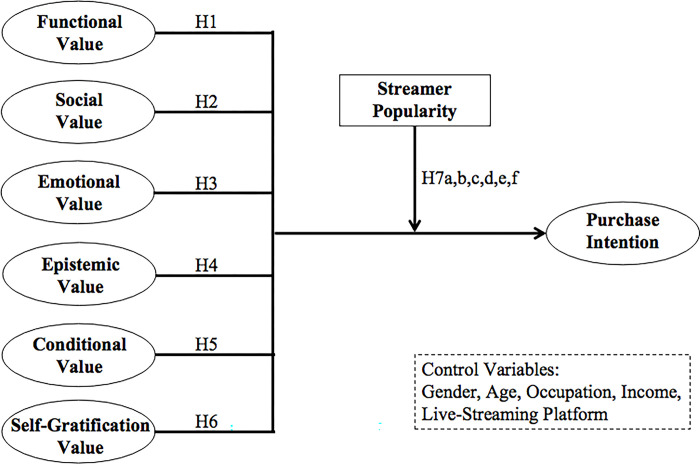
- Surveying 457 valid online questionnaires from Chinese live-streaming e-commerce users, the study finds that five of six consumption values significantly drive purchase intention: functional (β = 0.226, t = 5.482, p = 0.000), social (β = 0.117, t = 2.210, p = 0.014), emotional (β = 0.145, t = 5.482, p = 0.000), conditional (β = 0.174, t = 4.410, p = 0.000), and self-gratification (β = 0.162, t = 3.330, p = 0.000).
- Epistemic value is not a significant predictor of purchase intention (β = 0.022, t = 0.544, p = 0.383).
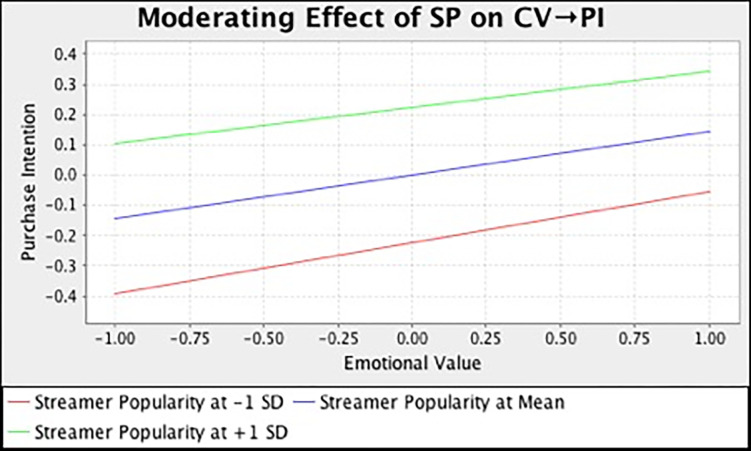
- Streamer popularity significantly strengthens the effects of functional (β = 0.136, t = 3.185, p = 0.000), social (β = 0.225, t = 4.167, p = 0.000), emotional (β = 0.115, t = 2.581, p = 0.023), and self-gratification (β = 0.180, t = 4.461, p = 0.000) value on purchase intention.
- Streamer popularity does not moderate the effects of epistemic (β = -0.033, t = 0.744, p = 0.693) or conditional value (β = -0.025, t = 0.395, p = 0.530).
Methods
- The study uses a survey questionnaire of live-streaming e-commerce users in China; 590 questionnaires were distributed and 457 valid responses were analyzed.
- The questionnaire contained 33 items measuring eight constructs, using a seven-point Likert scale; the model included six consumption values, purchase intention, streamer popularity, and five controls (gender, age, occupation, income, preferred live-streaming platform).
- The authors analyzed the data with SEM, specifically PLS-SEM, using SPSS 26 and SmartPLS 3.3.3, with bootstrapping (5,000 subsamples).
Limitations
- The paper states that the data come from users of several Chinese live-streaming platforms, so the findings may not generalize to other countries or cultural backgrounds.
- The study does not consider different product types, which the authors say may influence purchase intention.
- It focuses only on the consumer perspective; the authors note that platforms and merchants are also important parts of live-streaming e-commerce.
- It is a cross-sectional study, so it can only explain behavior at a specific point in time.
Model-written summary. Check it against the paper before relying on it.
Integrity signals
Registry
Cites
Statistics
Figures



Verification
Claims the paper makes
2 Valid · 0 Not valid · 42 Not checked · 61 Own results and interpretations
A result the paper reports from its own data — it cites no other source for it, so there is none to check. The quote shows it is in the paper.
In the paper
“In addition, streamer popularity has strengthened the influence of functional, social, emotional, and self-gratification value on purchase intention.”
§ Consumers purchase intention in live-streaming e-commerce: A consumption value perspective and the role of streamer popularity > Abstract
plainstates a cause- Asserted: passes — The authors put it forward as true.
- Checkable: passes — It can be checked against evidence.
- Load-bearing: passes — The paper’s conclusions depend on it.
- Based: passes — The paper gives a reason why it holds.
A result the paper reports from its own data — it cites no other source for it, so there is none to check. The quote shows it is in the paper.
In the paper
“Our findings show that five of six consumption values, namely functional, social, emotional, conditional, and self-gratification value, are significant drivers of purchase intention.”
- Also stated in: § 6.1 Consumption values and purchase intention · plain
“Conditional value is found to be a significant driver of purchase intention in live-streaming e-commerce.”
§ Consumers purchase intention in live-streaming e-commerce: A consumption value perspective and the role of streamer popularity > Abstract
plainstates a cause- Asserted: passes — The authors put it forward as true.
- Checkable: passes — It can be checked against evidence.
- Load-bearing: passes — The paper’s conclusions depend on it.
- Based: passes — The paper gives a reason why it holds.
- Also stated in: § 6.1 Consumption values and purchase intention · plain
A result the paper reports from its own data — it cites no other source for it, so there is none to check. The quote shows it is in the paper.
In the paper
“In addition, streamer popularity has strengthened the influence of functional, social, emotional, and self-gratification value on purchase intention.”
§ Consumers purchase intention in live-streaming e-commerce: A consumption value perspective and the role of streamer popularity > Abstract
plainstates a cause- Asserted: passes — The authors put it forward as true.
- Checkable: passes — It can be checked against evidence.
- Load-bearing: passes — The paper’s conclusions depend on it.
- Based: passes — The paper gives a reason why it holds.
53 more claims
Create a free account to see all 105 claims and to verify the 6 references still open.
- Probably not a substantial claim. 39
- It may state two separate claims as one. 12
Citations
Cites
Evaluating structural equation models with unobservable variables and measurement error
Fornell, C., & Larcker, D. F. (1981) · Journal of Marketing Research · doi:10.1177/002224378101800104 · Cited by 109,190
A new criterion for assessing discriminant validity in variance-based structural equation modeling
Henseler, J., Ringle, C. M., & Sarstedt, M. (2015) · Journal of the Academy of Marketing Science · doi:10.1007/s11747-014-0403-8 · Cited by 38,459
Statistical Power Analysis for the Behavioral Sciences
Cohen, J. (2013) · doi:10.4324/9780203771587 · Cited by 25,373
Pls-Sem: indeed a silver bullet
Hair, J. F., Ringle, C. M., & Sarstedt, M. (2011) · Journal of Marketing Theory and Practice · doi:10.2753/mtp1069-6679190202 · Cited by 21,631
Consumer Perceptions of Price, Quality, and Value: A Means-End Model and Synthesis of Evidence
Zeithaml, V. A. (1988) · Journal of Marketing · doi:10.1177/002224298805200302 · Cited by 18,292 · cited 1×
“Zeithaml [56] brought up the most commonly used and widely spread definition of perceived value as users’ evaluation of a product’s performance based on their assessment of what is gained and what is given.”
BackgroundSources of method bias in social science research and recommendations on how to control it
Podsakoff, P. M., MacKenzie, S. B., & Podsakoff, N. P. (2012) · Annual Review of Psychology · doi:10.1146/annurev-psych-120710-100452 · Cited by 15,744
Partial least squares structural equation modeling (PLS-SEM): An emerging tool in business research
F. Hair Jr, J., Sarstedt, M., Hopkins, L., & G. Kuppelwieser, V. (2014) · European Business Review · doi:10.1108/ebr-10-2013-0128 · Cited by 11,728
Common Method Bias in PLS-SEM: A Full Collinearity Assessment Approach
Kock, N. (2015) · International Journal of e-Collaboration · doi:10.4018/ijec.2015100101 · Cited by 10,215
Consumer Perceived Value: The Development of a Multiple Item Scale
Sweeney, J. C., & Soutar, G. N. (2001) · Journal of Retailing · doi:10.1016/s0022-4359(01)00041-0 · Cited by 6,643
Why we buy what we buy: A theory of consumption values
Sheth, J. N., Newman, B. I., & Gross, B. L. (1991) · Journal of Business Research · doi:10.1016/0148-2963(91)90050-8 · Cited by 4,930
Research works printed but not linked: 10
- Qianzhan Industrial Research Institute, “ Report of Commercial Model Innovation and Investment Opportunities Analysis on China Webcast Industry (2021–2026),” 2020. [Online]. Available: https://bg.qianzhan.com/report/detail/1703101733143305.html.
- Chen Z., Benbasat I., and Cenfetelli R., “ Grassroots Internet Celebrity Live Streaming Activating IT-Mediated Lifestyle Marketing Services at e-Commerce Websites,” ICIS 2017 Transform. Soc. with Digit. Innov., 2018.
- Hyun Jung P. and Li Min L., “ The effects of match-ups on the consumer attitudes toward internet celebrities and their live streaming contents in the context of product endorsement,” J. Retail. Consum. Serv., vol. 52, 2020.
- Kainth J. S. and V Verma H., “ Consumer Perceived Value: Construct Apprehension and its Evolution Consumer Perceived Value: Construct Apprehension and its Evolution,” J. Adv. Soc. Res., vol. 1, no. January 2011, pp. 20– 57, 2011.
- Doss S., “ The transference of brand attitude: the effect on the celebrity endorser,” J. Manag. Mark. Res., vol. 7, no. 1, pp. 1– 11, 2011.
- Christina, “ Maar liefst 86% van de internetgebruikers zegt dat ze influencers niet vertrouwen.,” Reputatiefabriek, 2019.
- Zhang M. and Wang W., “ Characteristics of Online Live-streaming E-commerce: A Follower’s Perspective,” Craddle Journal., vol. 11, no. 2, 2020.
- Liu H. and Liu L., “ A deep analysis in influencers’ promotional competence in live-streaming e-commerce.,” China Cosmet., vol. 12, no. 9, 2019.
- Guo T., Zhang D., and Raju V., “ Exploring the Factors That Influence Consumers’ Purchase Intentions in the Context of Live Streaming Commerce,” Int. J. Manag., vol. 12, no. 3, pp. 134– 147, 2021.
- Chinn W. W., “ The Partial Least Squares Approach to Structural Equation Modelling,” Mod. Methods Bus. Res., vol. 29, no. 2, pp. 295– 336, 1998.
Cited by
Huang, Y., & Rojniruttikul, N. (2026) · International Journal of Information Technology · doi:10.1007/s41870-025-02851-z · Cited by 51
Mapping the Theory of Consumption Values: A Systematic Review Using the TCCM Approach
Sharma, C., & Kushwah, S. S. (2024) · Journal of Consumer Behaviour · doi:10.1002/cb.2434 · Cited by 60
A Novel Group Decision Making Model to Compare Online Shopping Platforms
Biswas, S., Biswas, B., & Mitra, K. (2024) · Spectrum of Decision Making and Applications. · doi:10.31181/sdmap2120259 · Cited by 47
Ong, A. K. S., German, J. D., Almario, A. Y. V., Vistan, J. M. V., Galang, J. A. P., Dantis, J. R., & Balboa, E. (2024) · Journal of Open Innovation Technology Market and Complexity · doi:10.1016/j.joitmc.2024.100283 · Cited by 43
Yu, L., Tang, W., & Gao, W. (2025) · Acta Psychologica · doi:10.1016/j.actpsy.2025.104950 · Cited by 35
Li, W., Cujilema, S., Hu, L., & Gang, X. (2025) · Journal of theoretical and applied electronic commerce research · doi:10.3390/jtaer20020085 · Cited by 58
Imanuddin, K. A., & Handayani, P. W. (2025) · Cogent Business & Management · doi:10.1080/23311975.2025.2479178 · Cited by 28
“…to use livestream shopping. consumers who actively interact with streamers and other viewers feel more involved and connected. this creates a higher sense of ownership and increases their trust in the benefits of livestream shopping (Wang et al., 2024). selain itu. diketahui dari hasil survei,”
Influential factors of streamer popularity in the live streaming platform
Guo, S., Chen, H., Dai, B., Wang, M., Liu, S., Zhang, C., Liu, S., & Lu, X. B. (2024) · Journal of Retailing and Consumer Services · doi:10.1016/j.jretconser.2024.104194 · Cited by 12
Towards Sustainable Mobility: Determinants of Intention to Purchase Used Electric Vehicles in China
Zou, J., Kamarudin, K. M., Liu, J., & Zhang, J. (2024) · Sustainability · doi:10.3390/su16198588 · Cited by 16
Li, J., Li, Y., & Wang, X. (2025) · Journal of Retailing and Consumer Services · doi:10.1016/j.jretconser.2025.104684 · Cited by 17
Sales through note-sharing: influences on the shopping behavior of “Xiaohongshu” users
Xie, G., & Wang, X. (2025) · Frontiers in Psychology · doi:10.3389/fpsyg.2024.1334637 · Cited by 13
“…are developing rapidly, and new technologies and features are the ongoing competitiveness of the platforms to retain and strengthen users’ purchase intention (Chiang et al., 2019; Kuo and Chen, 2020; Sarker et al., 2020; Mafruchah and Hartono, 2023; Liu and Zhang, 2024; Zhang et al., 2024).”
Cai, X., & Suh, W. (2025) · Journal of theoretical and applied electronic commerce research · doi:10.3390/jtaer20040296 · Cited by 9
Xie, Q. (2025) · Innovation The European Journal of Social Science Research · doi:10.1080/13511610.2025.2487461 · Cited by 12
Nguyen, L., Thị, U. N., & Hanh, Q. V. (2025) · Cogent Business & Management · doi:10.1080/23311975.2025.2527917 · Cited by 7
“…is the second most decisive factor in building customer perceived value. along with prior studies by ahn et al. (2004), guo et al. (2022), and Zhang et al. (2024), this finding confirms the importance of a streamer’s popularity in attracting viewers and enhancing their trust in businesses.”
Zheng, D., Ding, Y., & Bai, S. (2025) · Acta Psychologica · doi:10.1016/j.actpsy.2025.105040 · Cited by 4
Li, J., Chen, J., Shi, Y., & Cui, Y. (2025) · PLoS ONE · doi:10.1371/journal.pone.0334530 · Cited by 10
“Live e-commerce, as an emerging business model combining real-time interaction and online shopping, has profoundly transformed consumer shopping experiences and the operational models of the retail industry [14].”
Influence of Livestream Selling on Purchase Intention Fashion Products on TikTok
Thuy, D. C., & Quang, N. N. (2025) · SAGE Open · doi:10.1177/21582440251375733 · Cited by 18
“This is similar to some previous studies by N. Li et al. (2024) and Q. Zhang et al. (2024), emphasizing the role of streamers.”
InfluentialZhang, L., & Wu, X. (2025) · PLoS ONE · doi:10.1371/journal.pone.0314682 · Cited by 7
Consumption Value and Organic Food Purchasing Behavior of Online Consumers
Prince, S. A., Wahid, I., & Islam, S. A. (2024) · Journal of Risk Analysis and Crisis Response (JRACR) · doi:10.54560/jracr.v14i2.468 · Cited by 4
“In a recent study conducted by Zhang et al. [70], self-gratification value, along with other consumption values, was investigated in streamer purchasing behavior research.”
BackgroundLive streaming and consumer purchase behavior: Current and future opportunities in E-commerce
Fauzi, M. A., Al‐Adwan, A. S., Tan, C. N.-L., Wider, W., Zhuzeyev, S., & Wei, C. C. (2026) · Social Sciences & Humanities Open · doi:10.1016/j.ssaho.2026.102737 · Cited by 13
Bouriche, A., Hamli, A., Ali, N., & BENAISSA, B. (2024) · Economy of Ukraine · doi:10.15407/economyukr.2024.10.066 · Cited by 7
Factors Affecting Customers' Purchase Intention on Live Streaming Commerce
Kanchanatanee, K. (2024) · Advances in business strategy and competitive advantage book series · doi:10.4018/979-8-3693-8850-1.ch002 · Cited by 2
Caesalpinia, N. S., & Suryawardani, B. (2025) · Journal of Consumer Sciences · doi:10.29244/jcs.10.2.376-393 · Cited by 7
Muliadewi, Z. P., Windasari, N. A., & Garnida, N. (2025) · International Journal of Social Service and Research · doi:10.46799/ijssr.v5i1.1171 · Cited by 1
Dong, J., Wang, J., & Kim, K.-M. (2026) · Journal of theoretical and applied electronic commerce research · doi:10.3390/jtaer21090294 · Cited by 1
Hu, K., Yang, J., Wu, H., Yang, H., Huang, Y., & Wei, W. (2026) · Frontiers in Sustainable Food Systems · doi:10.3389/fsufs.2026.1806039
Mujkić, A., Marić, E., & Čvirik, M. (2026) · Journal of Brand Management · doi:10.1057/s41262-026-00446-y
Wisedpanich, N., & Wittayakom, S. (2026) · Multidisciplinary Science Journal · doi:10.31893/multiscience.2026748 · Cited by 1
Decoding Live-streaming Commerce and Customer Engagement: A Review and Research Directions
Yadav, I., Tak, P., & Gupta, A. K. (2026) · FIIB Business Review · doi:10.1177/23197145261426224 · Cited by 3
Sun, X., Gong, X., & Zheng, P. (2026) · International Journal of Consumer Studies · doi:10.1111/ijcs.70214
What Drives Acceptance of Gamified Live Selling? A Mobile Commerce Perspective
Paderanga, R. A., Carin, P. J., Cruz, J. A., Tumamak, Z. G., Moreno, D. E. L., & Bernardo, M. D. (2026) · International Conference on e-Education, e-Business, e-Management and e-Learning · doi:10.1109/ic4e69618.2026.11631318
“Studies in live streaming commerce suggest that enjoyment significantly increases users’ acceptance of gamified selling mechanisms, as pleasurable experiences reduce perceived effort and enhance perceived value [5][12].”
InfluentialPan, Y., Damit, D. H. D. A., & Guliling, H. H. (2026) · International Journal of Innovation and Industrial Revolution · doi:10.35631/ijirev.824027 · Cited by 1
Impact of content and emotion congruency on tipping: evidence from live streaming
Huang, Z., Chen, K., & Xu, T. (2026) · Journal of Business Research · doi:10.1016/j.jbusres.2026.116000 · Cited by 1
From broadcast to mobile: Cross-channel effects in home shopping platforms
Kim, Y., Yoo, S., & Kim, J. (2026) · Telematics and Informatics Reports · doi:10.1016/j.teler.2026.100295
Liang, S., CHOUNLAMOUNTRY, L., Zhang, X., Geng, L., & Chang, X. (2026) · SSRN Electronic Journal · doi:10.2139/ssrn.6644176
Feng, S., Yuan, R., & Liu, J. (2026) · IEEE Access · doi:10.1109/access.2026.3715196
“…mining [28], and questionnaire surveys [20], [29] to conduct relevant studies, which showed that the personality traits of streamers [30], [31], [32], the amount of time the streamer spends introducing each product [33], and the types of topics discussed in the live-streaming [34] may directly…”
Zhu, M., Liang, W., & Wei, J. (2026) · Lecture notes in electrical engineering · doi:10.1007/978-981-92-2321-3_15
Kumar, V., Kaur, A., Kaushik, A. K., & Kaur, P. (2025) · Global Business Review · doi:10.1177/09721509251403641 · Cited by 2
Truong, K. H. V. T., & Luong, H. T. (2025) · International Conference on E-Society, E-Education and E-Technology (ICSET) · doi:10.1145/3802409.3802446
Khanh, N. N., & Tran, H. M. N. (2025) · International Conference on E-Society, E-Education and E-Technology (ICSET) · doi:10.1145/3802409.3802459
The Impact of Livestream on the Relationship Customers and Brands
Nguyen, G. T. T., & Nguyen, L. T. (2025) · International Conference on Educational Communications and Technology (ICTAECT) · doi:10.1109/ictaect67351.2025.11391271
The role of streamer and live streaming characteristics in driving customer value and engagement
Chen, H., Eunike, I. J., Phuong, D. T. T., Tedjakusuma, A. P., & Silalahi, A. D. K. (2025) · The TQM Journal · doi:10.1108/tqm-12-2024-0497 · Cited by 5
Tee, P. K., Amanda, T. M. F., Ng, C. P., Wong, L. C., & Ahmad, R. (2025) · IGI Global eBooks · doi:10.4018/979-8-3373-2018-2.ch008 · Cited by 1
А.Л., П. А. Л. П., & S., D. G. K. (2024) · DESIGN CONSTRUCTION MAINTENANCE · doi:10.37394/232022.2024.4.22 · Cited by 1
Emotional Connections Between Brands and Consumers in Digital Age
Musyfiqoh, A., & Roosdhani, M. R. (2024) · Jurnal Ilmu Manajemen Advantage · doi:10.30741/adv.v8i2.1433 · Cited by 6
“Study (Q. Zhang et al., 2024) shows believe social media is crucial for creating deep emotional bonds between customers and brands.”
Live Streaming Shopping: Does Number of Viewers Affect Purchase Intention?
Susanti, L. A., Adawiyah, W. R., & Rahab, R. (2024) · IEEE Technology & Engineering Management Conference - Asia Pacific (TEMSCON-ASPAC) · doi:10.1109/temscon-aspac62480.2024.11024796
“In addition, research by Zhang et al. (2024) states that interactivity in live-streaming shopping can increase shopping enjoyment and psychological situation of consumers, thereby increasing purchase intention.”
The Impact of Short Video Live Broadcast on the Sales of Sports Machinery and Equipment
Huang, C., & Chen, L. (2024) · International Journal of e-Collaboration · doi:10.4018/ijec.344027
Metadata
- Authors
- Zhang, Q., Wang, Y., & Ariffin, S. K.
- Affiliations
- Chongqing University of Education (CN)
- Universiti Sains Malaysia (MY)
- Venue
- PLoS ONE
- Publisher
- Public Library of Science (PLoS)
- Published
- 2024-02-15
- Volume
- 19
- Issue
- 2
- Pages
- e0296339
- ISSN
- 1932-6203 (ISSN-L)
- PMC
- PMC10868799
- OpenAlex
- W4391839406
- Cited by
- 50
- References
- 148
- Citations by year
- 2026: 17 · 2025: 21 · 2024: 12
- FWCI
- 22.91
- Type
- journal article
- Language
- en
- Open access
- gold
- doi.org
- Licence
- Locations
- PLoS ONE (publishedVersion, cc-by)
- PubMed Central (publishedVersion, cc-by)
- PubMed (publishedVersion)
- DOAJ (DOAJ: Directory of Open Access Journals) (submittedVersion, cc-by-sa)
- Greater South Information System
- Funders
- Two-way Synergistic Development Research Platform in Language Research and Application, Chongqing University of Education (2021XJP06)
- Disciplinary Construction Platform in Translation, Chongqing University of Education (23XJXK08)
- Topics
- Social Sciences › Business, Management and Accounting › Marketing › Consumer Behavior and Marketing Influence
- Social Sciences › Business, Management and Accounting › Marketing › Digital Marketing and Social Media
- Social Sciences › Decision Sciences › Information Systems and Management › Technology Adoption and User Behaviour
- Keywords
- live streaming e-commerce, purchase intention, consumption values, theory of consumption values, functional value, social values, emotional value, conditional value, consumer behavior, moderating effect
- MeSH terms
- Commerce, Consumer Behavior, Humans, Industry, Investments, Internet, Intention
About these checks
Registry, retraction, Cites and statistics results are computed, not judged, with one exception: a printed reference that no index lists is read once by a model before it counts as a citation error. Claims are extracted by a model and kept only when their quote appears verbatim in the text; each cited source is then checked, with a model’s help, for whether it says what the claim relies on. Those verdicts can be wrong — read the claim’s quote and the cited source before relying on one.
The claim verdicts this report counts are experimental: their accuracy is not yet measured.
A language model drew the claims from the paper on 2026-10-10, under version 3 of the claim definition (model deepseek-v4.1-flash, prompt extract-v3).
A second model labelled each claim on 2026-10-10 (model jev-1.13-20260917, definition revision gold-guideline-v0.2).
Statistics and arithmetic are recomputed, not judged.
Confidence bands are shown only for fields calibrated on our annotated test set. None is calibrated yet, so no band is shown.
What counts as a claim ›How we measure confidence ›How we check this ›
Are you an author, or do you see a problem with this page? Request a review
Data sources
Bibliographic data: Semantic Scholar, OpenAlex, Crossref.
Contains information from the Semantic Scholar Academic Graph Datasets, made available under the ODC Attribution License (ODC-BY 1.0).
Semantic Scholar’s data is described in: Kinney, R., et al. (2023). The Semantic Scholar Open Data Platform. arXiv:2301.10140.
