

The DOI matches its Crossref record; 50 of the 50 references it cites were found in a registry or an index; none of the 45 sources its claims cite is checked for support yet.
Frequency and perceived influence of menopausal symptoms on training and performance in female endurance athletes
Open accessAbstract
Menopause is associated with several negative health concerns and common menopausal symptoms. Physical activity is essential to mitigate these negative effects, but menopausal symptoms may interfere with participation in physical activity. The purpose of this study was to determine the frequency and the perceived negative effect of menopausal symptoms among female endurance athletes. Female runners, cyclists, swimmers, and triathletes 40–60 years of age were recruited ( N = 187). Participants completed an online, anonymous survey that included self-reported menopausal status; the Menopausal Rating Scale (MRS), a validated measure for assessing menopausal symptoms; and the perceived effect of menopausal symptoms on training and performance. Kruskal-Wallis tests were used to examine differences in total MRS scores among participants reporting no, slight, moderate, and strong negative effects of symptoms on training and performance. The most commonly reported menopausal symptoms were sleep problems (88%), physical and mental exhaustion (83%), sexual problems (74%), anxiety (72%), irritability (68%), depressive mood (67%), weight gain (67%), hot flushes (65%), and joint and muscular discomfort (63%). The symptoms that were perceived to most negatively affect training and performance were joint and muscular discomfort, weight gain, sleep problems, and physical and mental exhaustion. Participants with a perceived strong negative effect of symptoms on training and performance demonstrated higher total MRS scores compared to participants reporting no negative effect or slight negative effect of symptoms on training and performance (p’s ≤ .001), suggesting women with more severe menopausal symptoms had a greater perceived negative effect of symptoms on training and performance. In summary, frequency of menopausal symptoms among female endurance athletes is high and severity of menopausal symptoms is similar to that reported in the general population. Despite high physical activity levels in this population, clinicians should address these symptoms to promote continued participation in physical activity.
Overview
CoChat Summary
TL;DR
This cross-sectional survey of 187 female endurance athletes aged 40–60 found that menopausal symptoms were highly prevalent despite high physical activity levels, with sleep problems (88%) and physical/mental exhaustion (83%) most common. Athletes reporting more severe menopausal symptoms (higher total Menopausal Rating Scale scores) also reported a greater perceived negative effect of symptoms on training and performance.
Key findings
- Most common symptoms reported: sleep problems (88%, n = 164), physical and mental exhaustion (83%, n = 155), sexual problems (74%, n = 139), anxiety (72%, n = 136), irritability (68%, n = 128), depressive mood (67%, n = 125), weight gain (67%, n = 126), hot flushes (65%, n = 122), and joint and muscular discomfort (63%, n = 118). Most symptoms were rated mild or moderate.
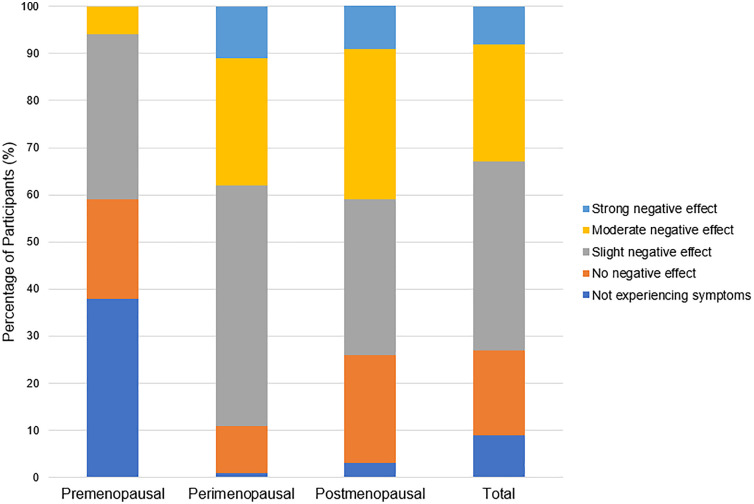
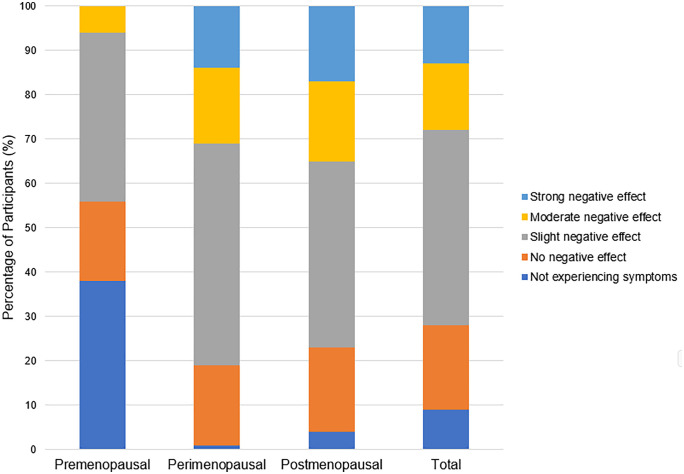
- Symptoms most likely perceived to negatively affect training and performance: joint and muscular discomfort (97% negative effect on training, 91% on performance), sleep problems (92% training, 89% performance), physical and mental exhaustion (87% training, 88% performance), and weight gain (79% training, 88% performance).
- Total MRS scores differed significantly by menopausal group (p < .001): premenopausal 8.0 ± 4.7, perimenopausal 14.2 ± 6.0, postmenopausal 11.7 ± 6.1; perimenopausal scores were significantly higher than both pre- (p < .001) and postmenopausal (p = .009) scores.
- Total MRS score increased with perceived negative effect on training (no effect 8.5 ± 4.7; slight 11.4 ± 4.3; moderate 15.1 ± 5.5; strong 19.5 ± 7.8; p < .001) and on performance (8.8 ± 5.0; 12.1 ± 4.7; 14.1 ± 5.7; 18.4 ± 7.0; p < .001).
Methods
- Cross-sectional anonymous online survey (Qualtrics) of female runners, cyclists, swimmers, and triathletes aged 40–60, recruited February 6–August 31, 2024 via social media, word of mouth, and local/regional athletic groups in the United States. Inclusion required ≥5 years in the sport, ≥3 days/week, and ≥3 hours/week of activity.
- Of 384 completed screening surveys, 265 met criteria; 187 participants completed the survey (71% response rate). Primary sport: running 55% (n = 102), swimming 22% (n = 41), cycling 14% (n = 27), triathlon 9% (n = 17). Menopausal status: 18% premenopausal (n = 34), 39% perimenopausal (n = 73), 43% postmenopausal (n = 80); 28% (n = 53) reported current HRT use.
- Measures: self-reported menopausal status, the validated 11-item Menopausal Rating Scale (MRS, 0–4 per item, summed for total score), weight gain rated separately (excluded from total MRS), and perceived effect of symptoms on training/performance (none/slight/moderate/strong). Kruskal-Wallis tests compared total MRS scores across menopausal groups and across perceived-effect categories; significance set at p < .05; IBM SPSS v29.
Limitations
- Stated by the authors: cross-sectional design prevents causal conclusions about symptoms, training, and performance; no demographic information collected (race/ethnicity, education, income), limiting generalizability; menopausal status was self-reported (though definitions followed STRAW criteria); other personal factors (work stress, caregiving, other health conditions) and uncollected health history may contribute to symptoms; HRT, medications, and/or supplements may have influenced results.
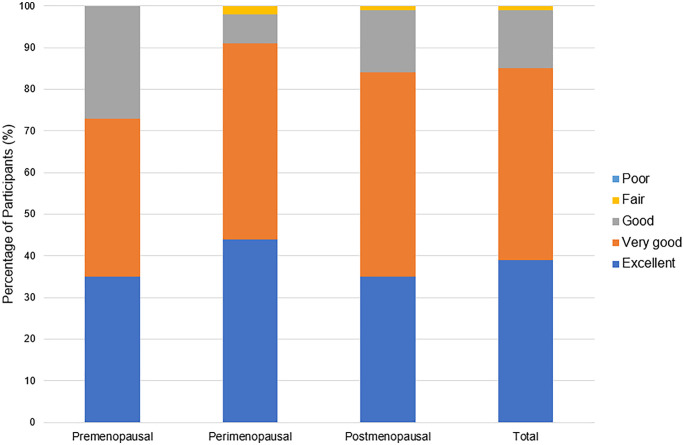
- Evident from the text: the sample was predominantly runners and recruited via convenience methods (social media, athletic groups), and the MRS total excludes weight gain, so the total score may not reflect all reported symptom burden; figures for general negative effect on training/performance are reported as n = 183 and health as n = 182, indicating some item nonresponse.
Model-written summary. Check it against the paper before relying on it.
Integrity signals
Registry
Cites
Statistics
Figures
Verification
Claims the paper makes
0 Valid · 0 Not valid · 24 Not checked · 70 Own results and interpretations
A result the paper reports from its own data — it cites no other source for it, so there is none to check. The quote shows it is in the paper.
In the paper
“hot flushes (65%, n = 122)”
§ Frequency and perceived influence of menopausal symptoms on training and performance in female endurance athletes > Results
plainn = 122- Asserted: passes — The authors put it forward as true.
- Checkable: passes — It can be checked against evidence.
- Load-bearing: unclear — It is unclear whether the paper’s conclusions depend on it.
- Based: passes — The paper gives a reason why it holds.
- Rests on an assumption not shown here.
A result the paper reports from its own data — it cites no other source for it, so there is none to check. The quote shows it is in the paper.
In the paper
“total MRS score was greater for postmenopausal participants compared to premenopausal participants (p = .005).”
§ Frequency and perceived influence of menopausal symptoms on training and performance in female endurance athletes > Results
plainstates an association- Asserted: passes — The authors put it forward as true.
- Checkable: passes — It can be checked against evidence.
- Load-bearing: unclear — It is unclear whether the paper’s conclusions depend on it.
- Based: passes — The paper gives a reason why it holds.
A result the paper reports from its own data — it cites no other source for it, so there is none to check. The quote shows it is in the paper.
In the paper
“total MRS score is significantly higher in perimenopausal females compared to premenopausal females (p < .001)”
§ Frequency and perceived influence of menopausal symptoms on training and performance in female endurance athletes > Results
plainstates an association- Asserted: passes — The authors put it forward as true.
- Checkable: passes — It can be checked against evidence.
- Load-bearing: passes — The paper’s conclusions depend on it.
- Based: passes — The paper gives a reason why it holds.
A result the paper reports from its own data — it cites no other source for it, so there is none to check. The quote shows it is in the paper.
In the paper
“total MRS score is significantly higher among participants reporting a strong negative effect of symptoms on performance compared to those reporting a slight negative effect (p = .001)”
§ Frequency and perceived influence of menopausal symptoms on training and performance in female endurance athletes > Results
plainstates an association- Asserted: passes — The authors put it forward as true.
- Checkable: passes — It can be checked against evidence.
- Load-bearing: passes — The paper’s conclusions depend on it.
- Based: passes — The paper gives a reason why it holds.
In the paper
“Total MRS scores in the peri- (14.2 ± 6.0) and postmenopausal (11.7 ± 6.1) participants are considered “moderate” severity of symptoms (total score range 9–15)”
§ Frequency and perceived influence of menopausal symptoms on training and performance in female endurance athletes > Discussion
What the sources say
- Not checked yetcites [24] K Heinemann, 2004, The Menopause Rating Scale (MRS) scale: a methodological review, Health Qual Life Outcomes source
plain- Asserted: passes — The authors put it forward as true.
- Checkable: passes — It can be checked against evidence.
- Load-bearing: unclear — It is unclear whether the paper’s conclusions depend on it.
- Based: passes — The paper gives a reason why it holds.
46 more claims
Create a free account to see all 94 claims and to verify the 45 references still open.
- Probably not a substantial claim. 33
- It may state two separate claims as one. 18
- The quote only partly states this claim. 1
Claims other papers make about this one
Each is checked against this paper’s own text: does it say what the citing paper says it does?
In the citing paper
“despite their known negative effects [74].”
From Effects of Aging on Determinants of Endurance Performance in Women Masters Athletes: A Scoping Review (2026) · cites this paper as [74]
Self-check
Percentages, sums and reported differences re-computed from the paper’s own numbers.
Each contradiction between two passages listed here was confirmed by an independent check.
Rated minor: it would not touch a result — a value no result rests on, a p-value that stays on the same side of the significance level, or a conflict that is clerical, resolved elsewhere in the paper, or outside its own findings.
In the paper
§ Frequency and perceived influence of menopausal symptoms on training and performance in female endurance athletes > Introduction
“Ussher et al. (2008) studied female master swimmers”
§ Frequency and perceived influence of menopausal symptoms on training and performance in female endurance athletes > References
“17. Ussher M, Mount C, Greenberg S, Perz J. Perceived effects of menopause among women masters swimmers. Int J Aquat Res Educ. 2009; 3: 368– 77.”
Citations
Cites
Garber, C. E., Blissmer, B., Deschenes, M. R., Franklin, B. A., Lamonte, M. J., Lee, I.-M., Nieman, D. C., & Swain, D. P. (2011) · Medicine & Science in Sports & Exercise · doi:10.1249/mss.0b013e318213fefb · Cited by 9,319 · cited 1×
“Middle-aged females are encouraged to follow established recommendations for physical activity [11], including both aerobic exercise and resistance training for optimal health outcomes [12].”
Likert scales, levels of measurement, and the “laws” of statistics
Norman, G. (2010) · Advances in Health Sciences Education · doi:10.1007/s10459-010-9222-y · Cited by 4,850
Harlow, S. D., Gass, M., Hall, J. E., Lobo, R., Maki, P., Rebar, R. W., Sherman, S., Sluss, P. M., de Villiers, T. J., & for the STRAW + 10 Collaborative Group (2012) · The Journal of Clinical Endocrinology & Metabolism · doi:10.1210/jc.2011-3362 · Cited by 1,325
The Menopause Rating Scale (MRS) scale: A methodological review
Heinemann, K., Ruebig, A., Potthoff, P., Schneider, H. P., Strelow, F., Heinemann, L. A., & Thai, D. M. (2004) · Health and Quality of Life Outcomes · doi:10.1186/1477-7525-2-45 · Cited by 618
El Khoudary, S. R., Greendale, G., Crawford, S. L., Avis, N. E., Brooks, M. M., Thurston, R. C., Karvonen-Gutierrez, C., Waetjen, L. E., & Matthews, K. (2019) · Menopause · doi:10.1097/gme.0000000000001424 · Cited by 562
The Impact of Menopausal Symptoms on Quality of Life, Productivity, and Economic Outcomes
Whiteley, J., DiBonaventura, M. D., Wagner, J.-S., Alvir, J., & Shah, S. (2013) · Journal of Women's Health · doi:10.1089/jwh.2012.3719 · Cited by 324
Sleep problems during the menopausal transition: prevalence, impact, and management challenges
Baker, F. C., de Zambotti, M., Colrain, I. M., & Bei, B. (2018) · Nature and Science of Sleep · doi:10.2147/nss.s125807 · Cited by 286
Optimizing sleep to maximize performance: implications and recommendations for elite athletes
Simpson, N. S., Gibbs, E. L., & Matheson, G. O. (2017) · Scandinavian Journal of Medicine & Science in Sports · doi:10.1111/sms.12703 · Cited by 265
Bonnar, D., Bartel, K., Kakoschke, N., & Lang, C. (2018) · Sports Medicine · doi:10.1007/s40279-017-0832-x · Cited by 235
Muscle and bone mass in middle-aged women: role of menopausal status and physical activity
Sipilä, S., Törmäkangas, T., Sillanpää, E., Aukee, P., Kujala, U. M., Kovanen, V., & Laakkonen, E. K. (2020) · Journal of Cachexia, Sarcopenia and Muscle · doi:10.1002/jcsm.12547 · Cited by 228
Research works printed but not linked: 1
- M Ussher, 2009, Perceived effects of menopause among women masters swimmers, Int J Aquat Res Educ, 3, 368
Cited by
Vangsgaard, D., Noumi, M., Hayden, K. A., & Doyle-Baker, P. K. (2026) · Healthcare · doi:10.3390/healthcare14081080
Time to act: why menopause should be a priority in sports and exercise medicine
Fagher, K., Billing, S. J., Hirschberg, A. L., Kallner, H. K., Henriksson, M., & Hammar, M. L. (2026) · British Journal of Sports Medicine · doi:10.1136/bjsports-2026-111836
Cullinan, S., Pochay-McBain, S., Jamil, I., & Doyle–Baker, P. K. (2026) · International Journal of Kinesiology and Sports Science · doi:10.7575/aiac.ijkss.v.14n.3p.89
Onsoriasl, E. (2026) · ODU Digital Commons (Old Dominion University) · doi:10.25777/xt2s-x256
Demarie, S., di Palumbo, A. S., Guidotti, F., Galvani, C., & Billat, V. L. (2026) · Sports · doi:10.3390/sports14100430
Metadata
- Authors
- Hamilton, H. M., Yarish, N. M., & Heron, K. E.
- Affiliations
- Old Dominion University (US)
- Corresponding author
- Hamilton, Heather M.
- Venue
- PLOS One
- Publisher
- Public Library of Science (PLoS)
- Published
- 2025-12-17
- Volume
- 20
- Issue
- 12
- Pages
- e0335738
- ISSN
- 1932-6203 (ISSN-L)
- PMC
- PMC12711079
- OpenAlex
- W4417497410
- Semantic Scholar
- bbbb2389572f18c2e5670af6741b2e0d763a1ff9
- Cited by
- 6
- References
- 50
- Citations by year
- 2026: 6
- FWCI
- 3.05
- Type
- journal article
- Language
- en
- Open access
- gold
- doi.org
- Licence
- Locations
- PLoS ONE (publishedVersion, cc-by)
- PubMed (publishedVersion)
- PubMed Central (publishedVersion, cc-by)
- ODU Digital Commons (Old Dominion University) (submittedVersion, cc-by)
- DOAJ (DOAJ: Directory of Open Access Journals) (submittedVersion, cc-by-sa)
- Funders
- National Heart, Blood, Lung Institute (K01 HL159348-01)
- Old Dominion University (N/A (Salary))
- Topics
- Health Sciences › Medicine › Endocrinology, Diabetes and Metabolism › Menopause: Health Impacts and Treatments
- Health Sciences › Medicine › Public Health, Environmental and Occupational Health › Physical Activity and Health
- Health Sciences › Medicine › Orthopedics and Sports Medicine › Sports Performance and Training
- Keywords
- menopausal symptoms, female endurance athletes, training performance, Menopausal Rating Scale, sleep disorders, weight gain, hot flashes, physical and mental exhaustion, middle-aged women, physical activity participation
- MeSH terms
- Adult, Female, Humans, Menopause, Middle Aged, Physical Endurance, Surveys and Questionnaires, Exercise, Hot Flashes, Athletic Performance, Athletes
About these checks
Registry, retraction, Cites and statistics results are computed, not judged, with one exception: a printed reference that no index lists is read once by a model before it counts as a citation error. Claims are extracted by a model and kept only when their quote appears verbatim in the text; each cited source is then checked, with a model’s help, for whether it says what the claim relies on. Those verdicts can be wrong — read the claim’s quote and the cited source before relying on one.
A language model drew the claims from the paper on 2026-11-14, under version 3 of the claim definition (model deepseek-v4.1-flash, prompt extract-v3).
A second model labelled each claim on 2026-11-14 (model jev-1.13-20260917, definition revision gold-guideline-v0.2).
Statistics and arithmetic are recomputed, not judged.
Confidence bands are shown only for fields calibrated on our annotated test set. None is calibrated yet, so no band is shown.
What counts as a claim ›How we measure confidence ›How we check this ›
Are you an author, or do you see a problem with this page? Request a review
How to cite
Cite CoChat for the checks on this page, and the paper for its own findings.
- This page
- CoChat. (2026). Citation check: Frequency and perceived influence of menopausal symptoms on training and performance in female endurance athletes. https://app.cochat.ai/papers/10.1371/journal.pone.0335738
- The paper
- Hamilton, H. M., Yarish, N. M., & Heron, K. E. (2025). Frequency and perceived influence of menopausal symptoms on training and performance in female endurance athletes. PLOS One. https://doi.org/10.1371/journal.pone.0335738
Data sources
Bibliographic data: Semantic Scholar, OpenAlex, Crossref.
Contains information from the Semantic Scholar Academic Graph Datasets, made available under the ODC Attribution License (ODC-BY 1.0).
Semantic Scholar’s data is described in: Kinney, R., et al. (2023). The Semantic Scholar Open Data Platform. arXiv:2301.10140.
