

Nod1 Signaling Overcomes Resistance of S. pneumoniae to Opsonophagocytic Killing
Open accessThe DOI matches its Crossref record; 49 of the 49 references it cites were found in a registry or an index.
Abstract
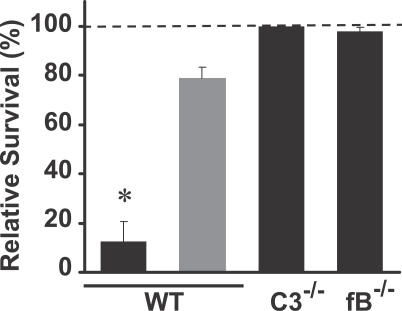
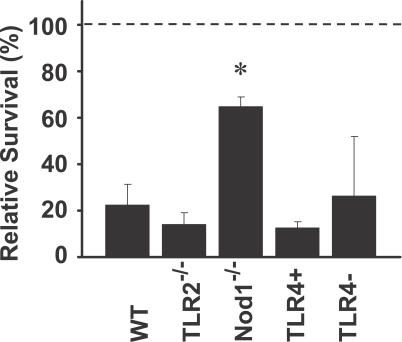
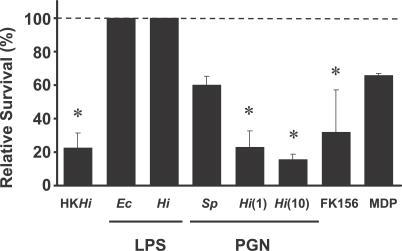
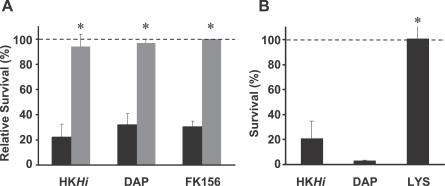
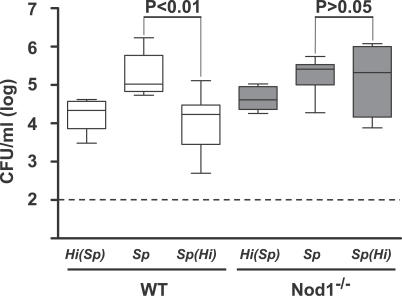
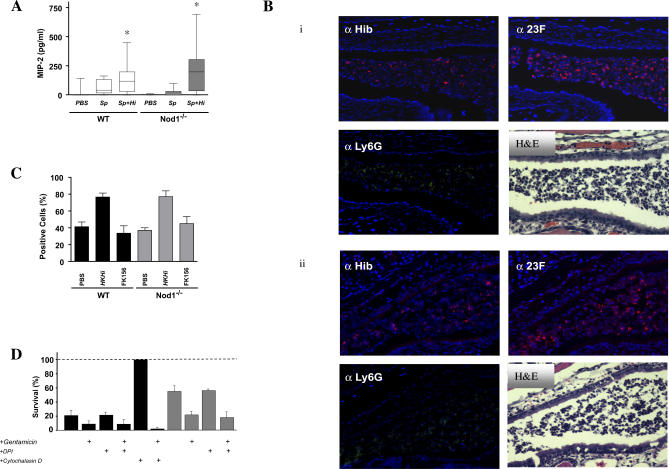
Airway infection by the Gram-positive pathogen Streptococcus pneumoniae (Sp) leads to recruitment of neutrophils but limited bacterial killing by these cells. Co-colonization by Sp and a Gram-negative species, Haemophilus influenzae (Hi), provides sufficient stimulus to induce neutrophil and complement-mediated clearance of Sp from the mucosal surface in a murine model. Products from Hi, but not Sp, also promote killing of Sp by ex vivo neutrophil-enriched peritoneal exudate cells. Here we identify the stimulus from Hi as its peptidoglycan. Enhancement of opsonophagocytic killing was facilitated by signaling through nucleotide-binding oligomerization domain-1 (Nod1), which is involved in recognition of gamma-D-glutamyl-meso-diaminopimelic acid (meso-DAP) contained in cell walls of Hi but not Sp. Neutrophils from mice treated with Hi or compounds containing meso-DAP, including synthetic peptidoglycan fragments, showed increased Sp killing in a Nod1-dependent manner. Moreover, Nod1(-/-) mice showed reduced Hi-induced clearance of Sp during co-colonization. These observations offer insight into mechanisms of microbial competition and demonstrate the importance of Nod1 in neutrophil-mediated clearance of bacteria in vivo.
Overview
The claims and statistics of this paper haven’t been checked yet.
Free: it reads the open-access text and checks the first 5 claims that cite a source we can check. Create a free account to check every claim.
Integrity signals
Registry
Cites
Statistics
Figures
Verification
Claims the paper makes
The claims and statistics of this paper haven’t been checked yet.
Free: it reads the open-access text and checks the first 5 claims that cite a source we can check. Create a free account to check every claim.
Claims other papers make about this one
Each is checked against this paper’s own text: does it say what the citing paper says it does?
The source backs part of the claim, not all of it — or backs it for a different population, condition or comparison.
In the citing paper
“gut microbiota-induced priming of innate immune cells at the intestinal mucosa was shown to affect respiratory health; for example, through NOD1 receptor-mediated activation of the neutrophils that are required for the clearance of Streptococcus pneumoniae in the URT72,166.”
From The microbiota of the respiratory tract: gatekeeper to respiratory health (2017) · cites this paper as [72]
Experimental — accuracy not yet measuredThe cited source says what the claim attributes to it.
In the citing paper
“Furthermore, colonization resistance may be enhanced by interactions with the host immune system.”
From The microbiota of the respiratory tract: gatekeeper to respiratory health (2017) · cites this paper as [72]
The cited source says what the claim attributes to it.
In the citing paper
“However, specific members of the microbiota have been identified that can actively exclude pathogens from the nasopharyngeal niche.”
From The microbiota of the respiratory tract: gatekeeper to respiratory health (2017) · cites this paper as [72]
The cited source says what the claim attributes to it.
In the citing paper
“For example, neutrophils seemed more able to kill S. pneumoniae following priming with Haemophilus influenzae72.”
From The microbiota of the respiratory tract: gatekeeper to respiratory health (2017) · cites this paper as [72]
Self-check
Percentages, sums and reported differences re-computed from the paper’s own numbers.
The self-check needs the paper’s full text.
Citations
Cites
Defective LPS Signaling in C3H/HeJ and C57BL/10ScCr Mice: Mutations in Tlr4 Gene
Poltorak, A., He, X., Smirnova, I., Liu, M.-Y., Huffel, C. V., Du, X., Birdwell, D., Alejos, E., Silva, M., Galanos, C., et al. (1998) · Science · doi:10.1126/science.282.5396.2085 · Cited by 7,631
Current Protocols in Immunology
(2018) · Current Protocols in Immunology · doi:10.1002/(issn)1934-368x · Cited by 3,566
Westphal, O. (1965) · Medical Entomology and Zoology · Cited by 2,533
Nod2 Is a General Sensor of Peptidoglycan through Muramyl Dipeptide (MDP) Detection
Girardin, S. E., Boneca, I. G., Viala, J., Chamaillard, M., Labigne, A., Thomas, G., Philpott, D. J., & Sansonetti, P. J. (2003) · Journal of Biological Chemistry · doi:10.1074/jbc.c200651200 · Cited by 2,408 · cited 3×
“In addition, another peptidoglycan fragment, muramyl dipeptide (MDP), common among most Gram-negative and Gram-positive bacteria, is the minimal structure needed for responses involving a separate cytoplasmic immune signaling molecule, Nod2 [12].”
BackgroundInfluentialNod1 Detects a Unique Muropeptide from Gram-Negative Bacterial Peptidoglycan
Girardin, S. E., Boneca, I. G., Carneiro, L. A. M., Antignac, A., Jéhanno, M., Viala, J., Tedin, K., Taha, M.-K., Labigne, A., Zäthringer, U., et al. (2003) · Science · doi:10.1126/science.1084677 · Cited by 1,577 · cited 1×
“Peptidoglycan fragments containing the minimal structure c-D-glutamyl-meso-diaminopimelic acid (meso-DAP) found in Gram-negative bacteria, including Hi, act through a cytoplasmic signaling molecule, nucleotide-binding oligomerization domain-1 (Nod1) [8–10].”
BackgroundChamaillard, M., Hashimoto, M., Horie, Y., Masumoto, J., Qiu, S., Saab, L., Ogura, Y., Kawasaki, A., Fukase, K., Kusumoto, S., et al. (2003) · Nature Immunology · doi:10.1038/ni945 · Cited by 1,323 · cited 1×
“Peptidoglycan fragments containing the minimal structure c-D-glutamyl-meso-diaminopimelic acid (meso-DAP) found in Gram-negative bacteria, including Hi, act through a cytoplasmic signaling molecule, nucleotide-binding oligomerization domain-1 (Nod1) [8–10].”
BackgroundNod1 responds to peptidoglycan delivered by the Helicobacter pylori cag pathogenicity island
Viala, J., Chaput, C., Boneca, I. G., Cardona, A., Girardin, S. E., Moran, A. P., Athman, R., Mémet, S., Huerre, M. R., Coyle, A. J., et al. (2004) · Nature Immunology · doi:10.1038/ni1131 · Cited by 1,226
NOD-LRR PROTEINS: Role in Host-Microbial Interactions and Inflammatory Disease
Inohara, N., Chamaillard, M., McDonald, C., & Nuñez, G. (2005) · Annual Review of Biochemistry · doi:10.1146/annurev.biochem.74.082803.133347 · Cited by 991 · cited 2×
“Pathways for the recognition of and response to peptidoglycan fragments leading to NF-jB-dependent transcriptional activation and pro-inflammatory responses have been partially characterized [7].”
BackgroundNod-like proteins in immunity, inflammation and disease
Fritz, J. H., Ferrero, R. L., Philpott, D. J., & Girardin, S. E. (2006) · Nature Immunology · doi:10.1038/ni1412 · Cited by 892 · cited 1×
“effects of bacteria or their cell wall products in vitro, our understanding of its contribution to innate immune responses to bacterial infection in vivo remains limited (reviewed in [7,19]).”
BackgroundCoxon, A., Rieu, P., Barkalow, F. J., Askari, S., Sharpe, A. H., von Andrian, U. H., Arnaout, M. A., & Mayadas, T. N. (1996) · Immunity · doi:10.1016/s1074-7613(00)80278-2 · Cited by 627 · cited 1×
“Mac-1 (CD11b/ CD18)-deficient mice (Jackson Laboratories) have a targeted mutation in the gene for integrin alpha M or CR3 [35].”
Background
Research works printed but not linked: 1
- Weiser J Nahm M 2007 Immunity to extracellular bacteria Paul WE Fundamental immunology Baltimore Lippincott, Williams and Wilkins In press.
Cited by
The microbiota of the respiratory tract: gatekeeper to respiratory health
Man, W. H., de Steenhuijsen Piters, W. A. A., & Bogaert, D. (2017) · Nature Reviews Microbiology · doi:10.1038/nrmicro.2017.14 · Cited by 1,384
“In addition, gut microbiota-induced priming of innate immune cells at the intestinal mucosa was shown to affect respiratory health; for example, through NOD1 receptor-mediated activation of the neutrophils that are required for the clearance of Streptococcus pneumoniae in the URT 72, 166 .”
BackgroundRecognition of peptidoglycan from the microbiota by Nod1 enhances systemic innate immunity
Clarke, T. B., Davis, K. M., Lysenko, E. S., Zhou, A. Y., Yu, Y., & Weiser, J. N. (2010) · Nature Medicine · doi:10.1038/nm.2087 · Cited by 1,154
Self-citationStreptococcus pneumoniae: transmission, colonization and invasion
Weiser, J. N., Ferreira, D. M., & Paton, J. C. (2018) · Nature Reviews Microbiology · doi:10.1038/s41579-018-0001-8 · Cited by 1,098
Self-citationFrom bacterial killing to immune modulation: Recent insights into the functions of lysozyme
Ragland, S. A., & Criss, A. K. (2017) · PLOS Pathogens · doi:10.1371/journal.ppat.1006512 · Cited by 877
Role of Pore-Forming Toxins in Bacterial Infectious Diseases
Los, F. C. O., Randis, T. M., Aroian, R. V., & Ratner, A. J. (2013) · Microbiology and Molecular Biology Reviews · doi:10.1128/mmbr.00052-12 · Cited by 402
Self-citation
Metadata
- Authors
- Lysenko, E. S., Clarke, T. B., Shchepetov, M., Ratner, A. J., Roper, D. I., Dowson, C. G., & Weiser, J. N.
- Affiliations
- University of Warwick (GB)
- University of Pennsylvania (US)
- Corresponding author
- Weiser, Jeffrey N
- Venue
- PLoS Pathogens
- Publisher
- Public Library of Science (PLoS)
- Published
- 2007-08-24
- Volume
- 3
- Issue
- 8
- Pages
- e118
- ISSN
- 1553-7366 (ISSN-L)
- 1553-7374
- PMC
- PMC1950946
- OpenAlex
- W2111374509
- Cited by
- 79
- References
- 49
- Citations by year
- 2026: 1 · 2025: 1 · 2024: 1 · 2023: 3 · 2022: 5 · 2021: 3 · 2020: 3 · 2019: 3 · 2018: 3 · 2017: 4 · 2016: 1 · 2015: 4 · 2014: 4 · 2013: 9 · 2012: 6
- FWCI
- 2.60
- Type
- journal article
- Language
- en
- Open access
- gold
- doi.org
- Locations
- PLoS Pathogens (publishedVersion, cc-by)
- PubMed Central (publishedVersion, cc-by)
- PubMed (publishedVersion)
- Warwick Research Archive Portal (University of Warwick) (acceptedVersion)
- DOAJ (DOAJ: Directory of Open Access Journals) (submittedVersion, cc-by-sa)
- Funders
- Directorate for Biological Sciences
- Biotechnology and Biological Sciences Research Council
- National Institute of Allergy and Infectious Diseases (R01AI038446, AI05467, AI 38446, K08AI065450, R21AI044231, AI065450, R01AI044231, AI44231, R37AI038446)
- National Institute of Diabetes and Digestive and Kidney Diseases (P30DK50306, P30DK050306)
- Topics
- Life Sciences › Immunology and Microbiology › Immunology › Immune Response and Inflammation
- Life Sciences › Immunology and Microbiology › Immunology › Neutrophil, Myeloperoxidase and Oxidative Mechanisms
- Life Sciences › Immunology and Microbiology › Immunology › Inflammation biomarkers and pathways
- Keywords
- Streptococcus pneumoniae, Haemophilus influenzae, opsonophagocytic killing, neutrophils, peptidoglycan, co-colonization, microbial competition, innate immunity, airway infection
- MeSH terms
- Animals, Humans, Immunity, Innate, Mice, Inbred C57BL, Neutrophils, Opsonin Proteins, Peptidoglycan, Phagocytosis, Pneumonia, Pneumococcal, Streptococcus pneumoniae, Signal Transduction, Mice, Knockout, Mice, Congenic, Neutrophil Infiltration, Gene Silencing, Adaptor Proteins, Signal Transducing, Mice, Nod1 Signaling Adaptor Protein
About these checks
Registry, retraction, Cites and statistics results are computed, not judged, with one exception: a printed reference that no index lists is read once by a model before it counts as a citation error. Claims are extracted by a model and kept only when their quote appears verbatim in the text; each cited source is then checked, with a model’s help, for whether it says what the claim relies on. Those verdicts can be wrong — read the claim’s quote and the cited source before relying on one.
Statistics and arithmetic are recomputed, not judged.
Confidence bands are shown only for fields calibrated on our annotated test set. None is calibrated yet, so no band is shown.
What counts as a claim ›How we measure confidence ›How we check this ›
Are you an author, or do you see a problem with this page? Request a review
How to cite
Cite CoChat for the checks on this page, and the paper for its own findings.
- This page
- CoChat. (2026). Citation check: Nod1 Signaling Overcomes Resistance of S. pneumoniae to Opsonophagocytic Killing. https://app.cochat.ai/papers/10.1371/journal.ppat.0030118
- The paper
- Lysenko, E. S., Clarke, T. B., Shchepetov, M., Ratner, A. J., Roper, D. I., Dowson, C. G., & Weiser, J. N. (2007). Nod1 Signaling Overcomes Resistance of S. pneumoniae to Opsonophagocytic Killing. PLoS Pathogens. https://doi.org/10.1371/journal.ppat.0030118
Data sources
Bibliographic data: Semantic Scholar, OpenAlex, Crossref.
Contains information from the Semantic Scholar Academic Graph Datasets, made available under the ODC Attribution License (ODC-BY 1.0).
Semantic Scholar’s data is described in: Kinney, R., et al. (2023). The Semantic Scholar Open Data Platform. arXiv:2301.10140.
