

The DOI matches its Crossref record; 75 of the 75 references it cites were found in a registry or an index.
Mosquitoes Put the Brake on Arbovirus Evolution: Experimental Evolution Reveals Slower Mutation Accumulation in Mosquito Than Vertebrate Cells
Open accessAbstract
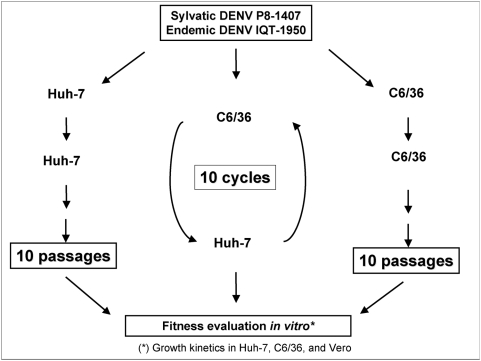
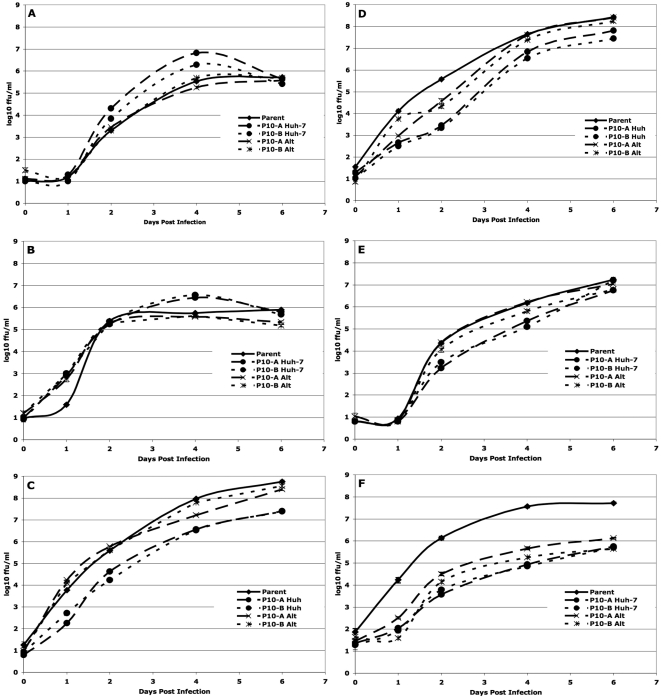
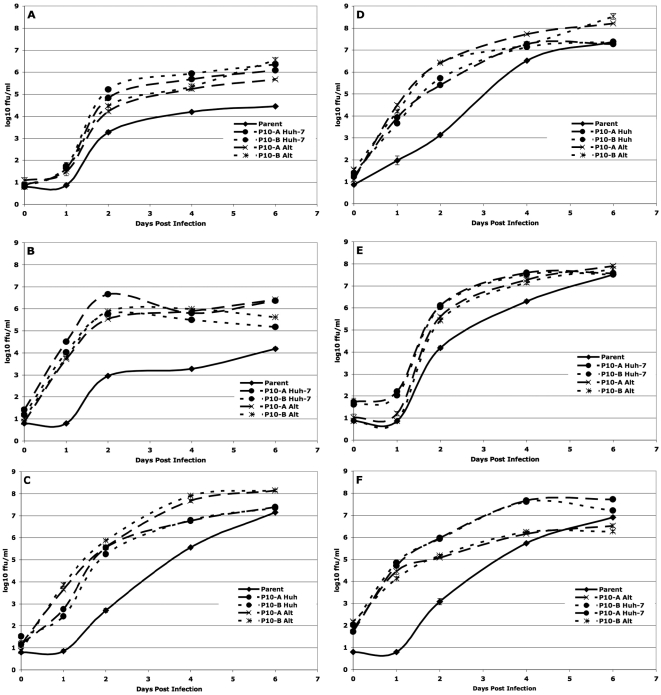
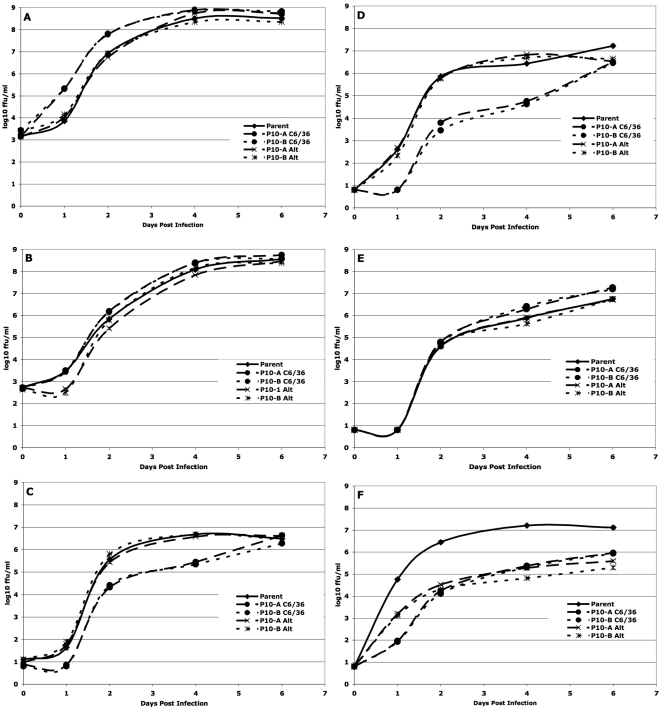
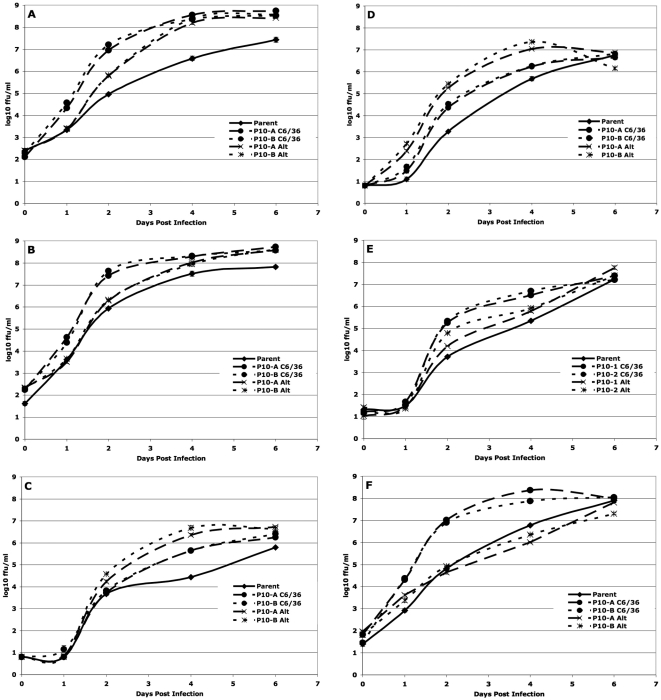
Like other arthropod-borne viruses (arboviruses), mosquito-borne dengue virus (DENV) is maintained in an alternating cycle of replication in arthropod and vertebrate hosts. The trade-off hypothesis suggests that this alternation constrains DENV evolution because a fitness increase in one host usually diminishes fitness in the other. Moreover, the hypothesis predicts that releasing DENV from host alternation should facilitate adaptation. To test this prediction, DENV was serially passaged in either a single human cell line (Huh-7), a single mosquito cell line (C6/36), or in alternating passages between Huh-7 and C6/36 cells. After 10 passages, consensus mutations were identified and fitness was assayed by evaluating replication kinetics in both cell types as well as in a novel cell type (Vero) that was not utilized in any of the passage series. Viruses allowed to specialize in single host cell types exhibited fitness gains in the cell type in which they were passaged, but fitness losses in the bypassed cell type, and most alternating passages, exhibited fitness gains in both cell types. Interestingly, fitness gains were observed in the alternately passaged, cloned viruses, an observation that may be attributed to the acquisition of both host cell-specific and amphi-cell-specific adaptations or to recovery from the fitness losses due to the genetic bottleneck of biological cloning. Amino acid changes common to both passage series suggested convergent evolution to replication in cell culture via positive selection. However, intriguingly, mutations accumulated more rapidly in viruses passed in Huh-7 cells than in those passed in C6/36 cells or in alternation. These results support the hypothesis that releasing DENV from host alternation facilitates adaptation, but there is limited support for the hypothesis that such alternation necessitates a fitness trade-off. Moreover, these findings suggest that patterns of genetic evolution may differ between viruses replicating in mammalian and mosquito cells.
Overview
The claims and statistics of this paper haven’t been checked yet.
Run the check — free, no account needed. It reads the open-access text and checks the sources it cites.
Integrity signals
Registry
Cites
Statistics
Figures
Verification
Claims the paper makes
The claims and statistics of this paper haven’t been checked yet.
Run the check — free, no account needed. It reads the open-access text and checks the sources it cites.
Claims other papers make about this one
Each is checked against this paper’s own text: does it say what the citing paper says it does?
The source backs part of the claim, not all of it — or backs it for a different population, condition or comparison.
In the citing paper
“The trade-off hypothesis predicts that constraining evolution in one host species diminishes fitness in the other (Vasilakis et al., 2009).”
From Codon Pair Bias Is a Direct Consequence of Dinucleotide Bias (2016) · cites this paper as Vasilakis et al., 2009
Experimental — accuracy not yet measured
Self-check
Percentages, sums and reported differences re-computed from the paper’s own numbers.
The self-check needs the paper’s full text.
Citations
Cites
Dengue and Dengue Hemorrhagic Fever
Gubler, D. J. (1998) · Clinical Microbiology Reviews · doi:10.1128/cmr.11.3.480 · Cited by 4,394
Risk factors for human disease emergence
Taylor, L. H., Latham, S. M., & woolhouse, M. E. J. (2001) · Philosophical Transactions of the Royal Society of London. Series B: Biological Sciences · doi:10.1098/rstb.2001.0888 · Cited by 2,835
Rates of Molecular Evolution in RNA Viruses: A Quantitative Phylogenetic Analysis
Jenkins, G. M., Rambaut, A., Pybus, O. G., & Holmes, E. C. (2002) · Journal of Molecular Evolution · doi:10.1007/s00239-001-0064-3 · Cited by 693
Origins of Dengue Type 2 Viruses Associated with Increased Pathogenicity in the Americas
Rico-Hesse, R., Harrison, L. M., Salas, R. A., Tovar, D., Nisalak, A., Ramos, C., Bóshell, J., de Mesa, M. T. R., Nogueira, R. M. R., & da Rosa, A. T. (1997) · Virology · doi:10.1006/viro.1997.8504 · Cited by 676
Dengue Virus Structural Differences That Correlate with Pathogenesis
Leitmeyer, K. C., Vaughn, D. W., Watts, D. M., Salas, R., Villalobos, I., de Chacon, Ramos, C., & Rico-Hesse, R. (1999) · Journal of Virology · doi:10.1128/jvi.73.6.4738-4747.1999 · Cited by 622
Origin and Evolution of Viruses
Holland, J. J., & Domingo, E. (1998) · Virus Genes · doi:10.1023/a:1007989407305 · Cited by 524
Kliks, S. C., Nisalak, A., Brandt, W. E., Wahl, L. M., & Burke, D. S. (1989) · American Journal of Tropical Medicine and Hygiene · doi:10.4269/ajtmh.1989.40.444 · Cited by 519
Fitness of RNA virus decreased by Muller’s ratchet
Chao, L. (1990) · Nature · doi:10.1038/348454a0 · Cited by 488
Dengue and dengue hemorrhagic fever : Its history and resurgence as a global public health problem
GUBLER, D. J. (1997) · Medical Entomology and Zoology · Cited by 453
Evolutionary Relationships of Endemic/Epidemic and Sylvatic Dengue Viruses
Wang, E., Ni, H., Xu, R., Barrett, A. D. T., Watowich, S. J., Gubler, D. J., & Weaver, S. C. (2000) · Journal of Virology · doi:10.1128/jvi.74.7.3227-3234.2000 · Cited by 445
Self-citation
Cited by
Sorted by citations
Items 101–192 of 192
Does adaptation to vertebrate codon usage relate to flavivirus emergence potential?
Paola, N. D., Freire, C. C. D. M., & Zanotto, P. M. D. A. (2018) · PLoS ONE · doi:10.1371/journal.pone.0191652 · Cited by 15
Nam, B., Mekuria, Z. H., Carossino, M., Li, G., Zheng, Y., Zhang, J., Cook, R. F., Shuck, K. M., Campos, J., Squires, E. L., et al. (2019) · Journal of Virology · doi:10.1128/jvi.00045-19 · Cited by 14
Detection of Dengue Virus Serotype 2 inAedes aegyptiin Quintana Roo, Mexico, 2011
Sánchez‐Casas, R., Alpuche-Delgado, R. H., Blitvich, B. J., González, E. E. D., Ramírez-Jiménez, R., Zárate-Nahón, E. A., Sánchez-Rodríguez, O. S., Laguna-Aguilar, M., Alvarado-Moreno, M. S., Ibarra‐Juárez, L. A., et al. (2013) · Southwestern Entomologist · doi:10.3958/059.038.0115 · Cited by 13
Alto, B. W., Civana, A., Wiggins, K., Eastmond, B. H., & Shin, D. (2020) · Viruses · doi:10.3390/v12070719 · Cited by 13
Yu, J., Bong, L., Panthawong, A., Chareonviriyaphap, T., & Neoh, K. (2020) · Journal of Medical Entomology · doi:10.1093/jme/tjaa172 · Cited by 13
Talavera-Aguilar, L. G., Murrieta, R. A., Kiem, S., Cetina-Trejo, R. C., Baak‐Baak, C. M., Ebel, G. D., Blitvich, B. J., & Machaín-Williams, C. (2021) · Parasites & Vectors · doi:10.1186/s13071-021-04726-1 · Cited by 12
Zhou, N., Huang, E., Guo, X., Xiong, Y., Xie, J., Cai, T., Du, Y., Qi-xing, W., Guo, S., Han, W., et al. (2023) · Parasites & Vectors · doi:10.1186/s13071-023-06033-3 · Cited by 13
Strategies for Assessing Arbovirus Genetic Variability in Vectors and/or Mammals
Migné, C. V., Moutailler, S., & Attoui, H. (2020) · Pathogens · doi:10.3390/pathogens9110915 · Cited by 13
Lehmann, T., Kouam, C., Woo, J., Diallo, M., Wilkerson, R. C., & Linton, Y. (2023) · Proceedings of the Royal Society B Biological Sciences · doi:10.1098/rspb.2023.1581 · Cited by 13
Scroggs, S. L. P., Gass, J. T., Ramesh, C., Widen, S. G., Azar, S. R., Rossi, S. L., Arterburn, J. B., Vasilakis, N., & Hanley, K. A. (2020) · Virology · doi:10.1016/j.virol.2020.09.004 · Cited by 12
Self-citationMulyatno, K. C., Kotaki, T., Yotopranoto, S., Rohmah, E. A., Churrotin, S., Sucipto, T. H., Amarullah, I. H., Wardhani, P., Soegijanto, S., & Kameoka, M. (2017) · Japanese Journal of Infectious Diseases · doi:10.7883/yoken.jjid.2017.117 · Cited by 11
Extracellular vesicles restrict dengue virus fusion in Aedes aegypti cells
Freitas, M. N., Marten, A. D., Moore, G. A., Tree, M. O., McBrayer, S. P., & Conway, M. J. (2019) · Virology · doi:10.1016/j.virol.2019.12.010 · Cited by 11
McCurdy, K. S., Joyce, J., Hamilton, S. B., Nevins, C., Sosna, W. A., Puricelli, K., & Rayner, J. O. (2011) · Virology · doi:10.1016/j.virol.2011.03.030 · Cited by 10
Animal models of alphavirus infection and human disease
Lucas, C. J., & Morrison, T. E. (2022) · Advances in virus research · doi:10.1016/bs.aivir.2022.07.001 · Cited by 9
Satoto, T. B. T., Umniyati, S. R., Astuti, F. D., Wijayanti, N., Gavotte, L., Devaux, C. A., & Frutos, R. (2014) · Asian Pacific Journal of Tropical Disease · doi:10.1016/s2222-1808(14)60677-0 · Cited by 9
Chavhan, Y., Malusare, S., & Dey, S. (2021) · Ecology Letters · doi:10.1111/ele.13831 · Cited by 8
Velasco, J. M., Klungthong, C., Chinnawirotpisan, P., Diones, P. C., Valderama, M. T., Leonardia, S., Manasatienkij, W., Joonlasak, K., Rodpradit, P., Mateo, J., et al. (2024) · PLoS neglected tropical diseases · doi:10.1371/journal.pntd.0012697 · Cited by 7
Getting to Know Viral Evolutionary Strategies: Towards the Next Generation of Quasispecies Models
Manrubia, S. C., & Lázaro, E. (2015) · Current topics in microbiology and immunology · doi:10.1007/82_2015_457 · Cited by 6
Pontremoli, C., Forni, D., Clerici, M., Cagliani, R., & Sironi, M. (2021) · Virus Evolution · doi:10.1093/ve/veab040 · Cited by 6
Halabi, K., & Mayrose, I. (2021) · Journal of Molecular Evolution · doi:10.1007/s00239-021-10013-5 · Cited by 7
Full-length infectious clone of a low passage dengue virus serotype 2 from Brazil
Santos, J. J. D. S., Magalhães, T., Júnior, J. V. J. S., da Silva, A. N. M. R., Cordeiro, M. T., & Gil, L. H. V. G. (2015) · Memórias do Instituto Oswaldo Cruz · doi:10.1590/0074-02760150053 · Cited by 6
Evolution and adaptation of dengue virus in response to high-temperature passaging in mosquito cells
Ware‐Gilmore, F., Jones, M. J., Mejia, A. J., Dennington, N. L., Audsley, M. D., Hall, M. D., Sgrò, C. M., Buckley, T. S., Anand, G. S., Jose, J., et al. (2025) · Virus Evolution · doi:10.1093/ve/veaf016 · Cited by 5
Effect of low-passage number on dengue consensus genomes and intra-host variant frequencies
Fung, C. K., Li, T., Pollett, S., Alera, M. T., Yoon, I.-K., Hang, J., Macareo, L. R., Srikiatkhachorn, A., Ellison, D. W., Rothman, A. L., et al. (2021) · Journal of General Virology · doi:10.1099/jgv.0.001553 · Cited by 5
Banho, C. Á., Marques, B. C., Nascimento, O. B., Parra, M. C. P., Ferreira, M. V. M., Lemos, A. P., Magnani, G. P., Lourenço, K. L., Souza, B. C., Hernandes, V. M., et al. (2025) · Virus Evolution · doi:10.1093/ve/veaf102 · Cited by 4
Self-citationIdentification of a Flavivirus Sequence in a Marine Arthropod
Conway, M. J. (2015) · PLoS ONE · doi:10.1371/journal.pone.0146037 · Cited by 5
MOLECULAR AND EVOLUTIONARY MECHANISMS OF VIRAL EMERGENCE
Sáiz, J., Sobrino, F., Sevilla, N., Martı́n, V., Perales, C., & Domingo, E. (2013) · Wiley eBooks · doi:10.1002/9781118297469.ch16 · Cited by 4
Hafsia, S., Gomard, Y., Graaf, C. D., Baudino, F., Alout, H., Lebon, C., Rabarison, P., Idaroussi, A.-B., Yssouf, A., Julienne, S., et al. (2025) · Parasites & Vectors · doi:10.1186/s13071-025-07193-0 · Cited by 5
A conserved in-frame stop codon acts as a multipotent defense mechanism in alphaviruses
Bhattacharya, T., Freeman, T. S., Alleman, E. M., Wang, F., Chechik, L., Emerman, M., Myles, K. M., & Malik, H. S. (2026) · Science Advances · doi:10.1126/sciadv.aee6015 · Cited by 3
Culicoides-Specific Fitness Increase of Vesicular Stomatitis Virus in Insect-to-Insect Infections
Rozo-López, P., & Drolet, B. S. (2024) · Insects · doi:10.3390/insects15010034 · Cited by 3
Genetic Evolution of Japanese Encephalitis Virus
Chuang, C.-K., & Che, W.-J. (2011) · InTech eBooks · doi:10.5772/21252 · Cited by 3
The African mosquito-borne diseasosome: Geographical patterns and range expansionPreprint
Lehmann, T., Kouam, C., Woo, J., Diallo, M., Wilkerson, R. C., & Linton, Y. (2021) · bioRxiv (Cold Spring Harbor Laboratory) · doi:10.1101/2021.12.21.473756 · Cited by 3
Complete genome of DENV2 isolated from mosquitoes in Mexico
Zárate, S., Hernández-Pérez, C. F., Taboada, B., Martínez, N. E., Alcaráz‐Estrada, S. L., del Moral, O., & Yocupicio‐Monroy, M. (2019) · Infection Genetics and Evolution · doi:10.1016/j.meegid.2019.03.018 · Cited by 2
Kassen, R. (2024) · Oxford University Press eBooks · doi:10.1093/oso/9780192898661.003.0003 · Cited by 1
RNA Virus Evolution at Variable Error Rate
Lázaro, E. (2014) · Future Virology · doi:10.2217/fvl.14.47 · Cited by 2
Cell Type-Dependent RNA Recombination Frequency in the Japanese Encephalitis Virus
Chiang, W.-W., Chuang, C.-K., Chao, M., & Chen, W. (2014) · BioMed Research International · doi:10.1155/2014/471323 · Cited by 2
Molecular arms race: Viral adaptations to mosquito immune defenses
Gutiérrez, G., Dong, S., & Dimopoulos, G. (2026) · Advances in insect physiology · doi:10.1016/bs.aiip.2026.05.003 · Cited by 1
Predicting the virulence of future emerging zoonotic viruses
Alizon, S. (2023) · PLoS Biology · doi:10.1371/journal.pbio.3002286 · Cited by 1
Morais, P., Trovão, N. S., Abecasis, A. B., & Parreira, R. (2021) · Virus Research · doi:10.1016/j.virusres.2021.198507 · Cited by 1
Reverse Genetics and Quasispecies
Bordería, A. V., & Vignuzzi, M. (2012) · Wiley eBooks · doi:10.1002/9781118405338.ch11 · Cited by 1
Hasson, S., Hasson, E. M., Anne, T., & Katherine, T. (2012) · Cited by 1
An interplay of population size and environmental heterogeneity explains why fitness costs are rarePreprint
Chavhan, Y., Malusare, S., & Dey, S. (2020) · bioRxiv (Cold Spring Harbor Laboratory) · doi:10.1101/2020.10.26.355297 · Cited by 1
Vector Transmission of Animal Viruses
Attoui, H., Jaafar, F. M., Fragkoudis, R., & Mertens, P. (2020) · Elsevier eBooks · doi:10.1016/b978-0-12-814515-9.00135-1 · Cited by 1
Ciota, A. T., Jia, Y., Payne, A. F., Jerzak, G., Davis, L. J., Young, D. S., Ehrbar, D. J., & Kramer, L. D. (2010) · PLoS ONE · doi:10.1371/annotation/8e335f18-47c3-4748-b6b7-acca14f94e5c · Cited by 1
Vanlandingham, D. L., & Horne, K. M. (2014) · Encyclopedia of Life Sciences · doi:10.1002/9780470015902.a0001005.pub3
Task 1.5 Genomic Shift and Drift Trends of Emerging Pathogens
Borucki, M. K. (2010) · doi:10.2172/972402
Huang, Y. S. (2014) · K-State Research Exchange (Kansas State University)
EVOLUTION OF RHABDO- AND FILOVIRUSES
Novella, I. S., Presloid, J. B., & Taylor, R. T. (2014) · WORLD SCIENTIFIC eBooks · doi:10.1142/9789814635349_0012
Investigação de mutações adaptativas no vírus da dengue em diferentes sistemas de cultivo
Salvador, F. S. (2016) · Digital Library of Theses and Dissertations (Universidade de São Paulo) · doi:10.11606/d.99.2016.tde-24112016-155459
Descoberta e caracterização de vírus emergentes e reergentes em áreas peri-florestais.
Paola, N. D. (2018) · Digital Library of Theses and Dissertations (Universidade de São Paulo) · doi:10.11606/t.42.2018.tde-26062018-095508
Fung, C. K., Li, T., Pollett, S., Alera, M. T., Yoon, I., Hang, J., Macareo, L. R., Srikiatkhachorn, A., Ellison, D. W., Rothman, A. L., et al. (2020) · bioRxiv (Cold Spring Harbor Laboratory) · doi:10.1101/2020.08.17.254417
An alternating transmission model between mice and mosquitoes for genetic study of dengue virus
Zhu, X., Jiang, Y., Zhang, H., Li, C., Xing, D., Guo, X., & Zhao, T. (2023) · Acta Tropica · doi:10.1016/j.actatropica.2023.106834
Multiple infection theory rather than ‘socio-virology’? A commentary on Leeks et al. 2023
Alizon, S. (2023) · Journal of Evolutionary Biology · doi:10.1111/jeb.14245
Insect vectors of human pathogens in a warming world
González-Rete, B., Jiménez-Cortés, J. G., Bravo, M. C., Salazar-Schettino, P. M., Flores-Villegas, A. L., Fuentes-Vicente, J. A. D., & Córdoba‐Aguilar, A. (2024) · Oxford University Press eBooks · doi:10.1093/oso/9780192864161.003.0014
Kassen, R. (2024) · Oxford University Press eBooks · doi:10.1093/oso/9780192898661.003.0008
Kassen, R. (2024) · Oxford University Press eBooks · doi:10.1093/oso/9780192898661.002.0006
Kassen, R. (2024) · Oxford University Press eBooks · doi:10.1093/oso/9780192898661.002.0004
An Introduction to Microbial Experimental Evolution
Kassen, R. (2024) · Oxford University Press eBooks · doi:10.1093/oso/9780192898661.003.0001
Kassen, R. (2024) · Oxford University Press eBooks · doi:10.1093/oso/9780192898661.003.0012
Coevolutionary Diversification
Kassen, R. (2024) · Oxford University Press eBooks · doi:10.1093/oso/9780192898661.003.0009
Kassen, R. (2024) · Oxford University Press eBooks · doi:10.1093/oso/9780192898661.002.0003
Kassen, R. (2024) · Oxford University Press eBooks · doi:10.1093/oso/9780192898661.003.0006
Adaptation to a Single Environment
Kassen, R. (2024) · Oxford University Press eBooks · doi:10.1093/oso/9780192898661.003.0002
Selection in Variable Environments
Kassen, R. (2024) · Oxford University Press eBooks · doi:10.1093/oso/9780192898661.003.0004
Kassen, R. (2024) · Oxford University Press eBooks · doi:10.1093/oso/9780192898661.002.0005
Kassen, R. (2024) · Oxford University Press eBooks · doi:10.1093/oso/9780192898661.003.0007
Kassen, R. (2024) · Oxford University Press eBooks · doi:10.1093/oso/9780192898661.002.0007
The Rate and Extent of Diversification
Kassen, R. (2024) · Oxford University Press eBooks · doi:10.1093/oso/9780192898661.003.0010
Genetics and Genomics of Diversification
Kassen, R. (2024) · Oxford University Press eBooks · doi:10.1093/oso/9780192898661.003.0011
Kassen, R. (2024) · Oxford University Press eBooks · doi:10.1093/oso/9780192898661.002.0010
Kassen, R. (2024) · Oxford University Press eBooks · doi:10.1093/oso/9780192898661.003.0005
Moreau, Y., Gil, P., Exbrayat, A., Rakotoarivony, I., Bréard, E., Sailleau, C., Viarouge, C., Zientara, S., Savini, G., Goffredo, M., et al. (2025) · bioRxiv (Cold Spring Harbor Laboratory) · doi:10.64898/2025.12.04.692277
Zhou, N., Huang, E., Guo, X., Xiong, Y., Xie, J., Cai, T., Du, Y., Wu, Q., Guo, S., Han, W., et al. (2024) · Figshare · doi:10.6084/m9.figshare.26636172
Talavera-Aguilar, L. G., Murrieta, R. A., Kiem, S., Cetina-Trejo, R. C., Baak-Baak, C. M., Ebel, G. D., Blitvich, B. J., & Machain-Williams, C. (2021) · Figshare · doi:10.6084/m9.figshare.14615486
Zhou, N., Huang, E., Guo, X., Xiong, Y., Xie, J., Cai, T., Du, Y., Wu, Q., Guo, S., Han, W., et al. (2024) · Figshare · doi:10.6084/m9.figshare.26636178
Zhou, N., Huang, E., Guo, X., Xiong, Y., Xie, J., Cai, T., Du, Y., Wu, Q., Guo, S., Han, W., et al. (2024) · Figshare · doi:10.6084/m9.figshare.26636175
de Fabritus, L. (2015) · theses.fr (ABES) · doi:10.70675/076d7622z5fd0z4238za7aczf4435a7232a4
Role of viral defectives genomes of arboviruses in regulating viral infection in insects
Poirier, E. Z. (2017) · theses.fr (ABES) · doi:10.70675/a6749c8fz0e57z4aa7zbdb9z031154e80f29
O'Connor, O. (2021) · theses.fr (ABES) · doi:10.70675/03c4a009zaf47z4f8ezaa39za8bd471fbbb1
The Evolution of Dengue Virus in India
Sankaradoss, A. (2026) · Annual Review of Virology · doi:10.1146/annurev-virology-100424-122700
Marti, A., Nater, A., Magalhaes, J. P., Donzé, N., Gerber, M., Almeida, L., Liniger, M., Chenaux, S., Ruggli, N., Alnaji, F. G., et al. (2026) · Virology Journal · doi:10.1186/s12985-026-03231-0
Mosquito-microbiota interactions affect viral diversity and evolution
de Lataillade, L. D. G., Perdomo, H. D., Brettell, L. E., & Hughes, G. L. (2026) · Advances in insect physiology · doi:10.1016/bs.aiip.2026.06.003
Hick, T. A. H., Cirksena, K., Evander, M., & Gerold, G. (2026) · Emerging Microbes & Infections · doi:10.1080/22221751.2026.2721742
Jamestown Canyon Virus Rapidly Adapts to Mosquito Cells Through Multiple M Segment Mutations
Dysinger, S., Srivastava, T., Cherry, S. R., & Bates, P. F. (2026) · Viruses · doi:10.3390/v18091018
Limited adaptive mutations but deterministic genome formula variation in bluetongue virus
Moreau, Y., Gil, P., Exbrayat, A., Rakotoarivony, I., Bréard, E., Sailleau, C., Viarouge, C., Zientara, S., Savini, G., Goffredo, M., et al. (2026) · Journal of Virology · doi:10.1128/jvi.00983-26
Metadata
- Authors
- Vasilakis, N., Deardorff, E. R., Kenney, J. L., Rossi, S. L., Hanley, K. A., & Weaver, S. C.
- Affiliations
- The University of Texas Medical Branch at Galveston (US)
- New Mexico State University (US)
- Corresponding author
- Weaver, Scott C.
- Venue
- PLoS Pathogens
- Publisher
- Public Library of Science (PLoS)
- Published
- 2009-06-05
- Volume
- 5
- Issue
- 6
- Pages
- e1000467
- ISSN
- 1553-7366 (ISSN-L)
- 1553-7374
- PMC
- PMC2685980
- OpenAlex
- W2098987669
- Cited by
- 191
- References
- 75
- Citations by year
- 2026: 8 · 2025: 5 · 2024: 24 · 2023: 6 · 2022: 3 · 2021: 15 · 2020: 13 · 2019: 13 · 2018: 11 · 2017: 8 · 2016: 12 · 2015: 11 · 2014: 21 · 2013: 8 · 2012: 5
- FWCI
- 6.43
- Type
- journal article
- Language
- en
- Open access
- gold
- doi.org
- Locations
- PLoS Pathogens (publishedVersion, cc-by)
- PubMed Central (publishedVersion, cc-by)
- PubMed (publishedVersion)
- DOAJ (DOAJ: Directory of Open Access Journals) (submittedVersion, cc-by-sa)
- Funders
- National Institutes of Health (NIH T32)
- Centers for Disease Control and Prevention (T01 CCT622892)
- U.S. Public Health Service (T01/CCT 622892)
- National Institute of Allergy and Infectious Diseases (R01AI069145, AI069145)
- National Center for Research Resources (P20RR016480)
- Topics
- Life Sciences › Biochemistry, Genetics and Molecular Biology › Genetics › Evolution and Genetic Dynamics
- Health Sciences › Medicine › Public Health, Environmental and Occupational Health › Mosquito-borne diseases and control
- Physical Sciences › Mathematics › Applied Mathematics › Mathematical and Theoretical Epidemiology and Ecology Models
- Keywords
- dengue virus, mosquito-borne arboviruses, host alternation, trade-off hypothesis, host adaptation, viral fitness, mutation accumulation, serial passage, C6/36 cells, Huh7 cells, Vero cells, convergent evolution, positive selection, host cell specificity
- MeSH terms
- Adaptation, Biological, Aedes, Analysis of Variance, Animals, Arboviruses, Cell Line, Chlorocebus aethiops, Dengue Virus, Humans, Kinetics, Mutation, Research Design, Selection, Genetic, Serial Passage, Vero Cells, Virulence, Virus Replication, Consensus Sequence, Sequence Analysis, RNA, Evolution, Molecular, Cell Line, Tumor
About these checks
Registry, retraction, Cites and statistics results are computed, not judged, with one exception: a printed reference that no index lists is read once by a model before it counts as a citation error. Claims are extracted by a model and kept only when their quote appears verbatim in the text; each cited source is then checked, with a model’s help, for whether it says what the claim relies on. Those verdicts can be wrong — read the claim’s quote and the cited source before relying on one.
Statistics and arithmetic are recomputed, not judged.
Confidence bands are shown only for fields calibrated on our annotated test set. None is calibrated yet, so no band is shown.
What counts as a claim ›How we measure confidence ›How we check this ›
Are you an author, or do you see a problem with this page? Request a review
