

A GATA Transcription Factor Recruits Hda1 in Response to Reduced Tor1 Signaling to Establish a Hyphal Chromatin State in Candida albicans
Open accessThe DOI matches its Crossref record; 46 of the 47 references it cites were found in a registry or an index.
Abstract
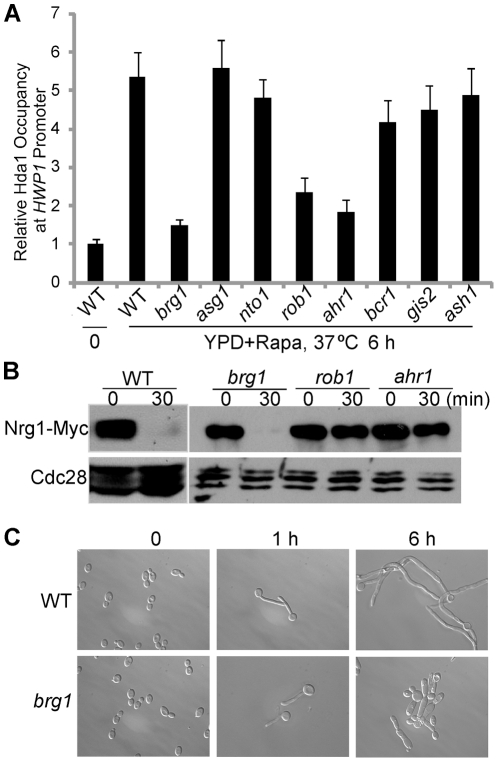
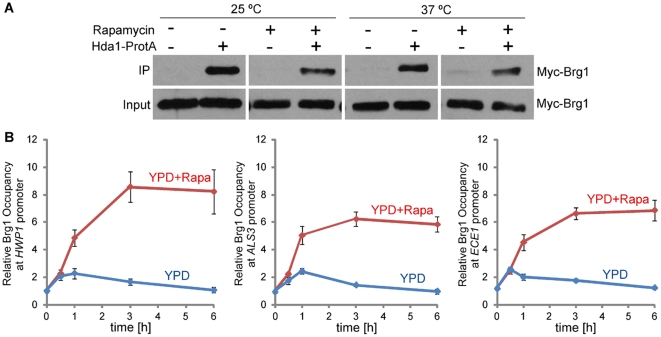
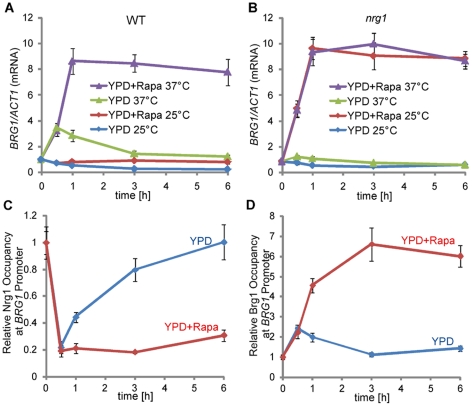
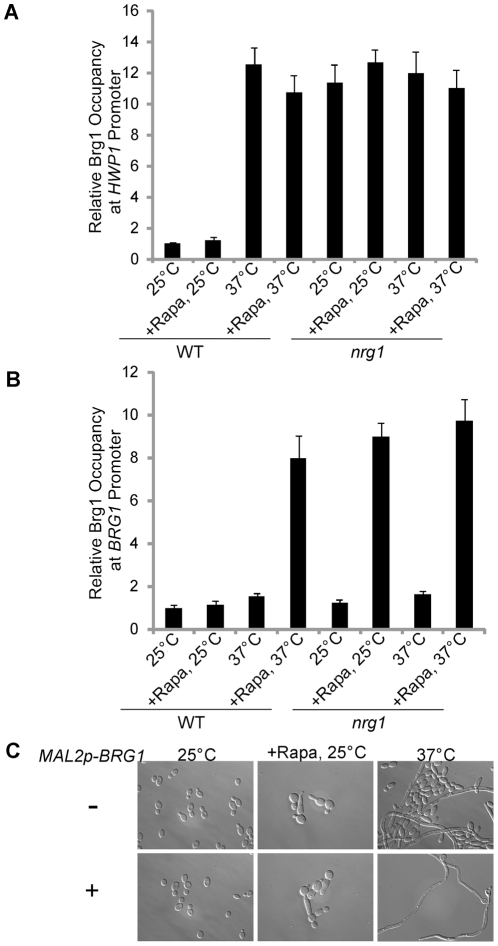
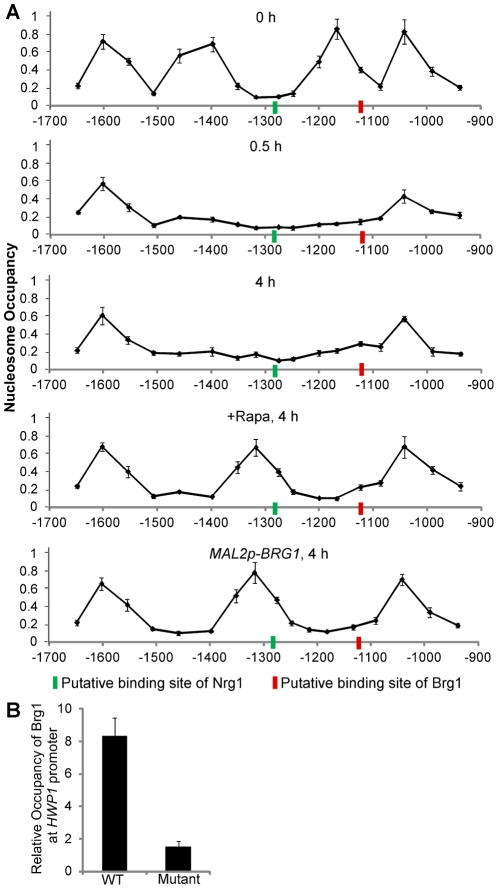
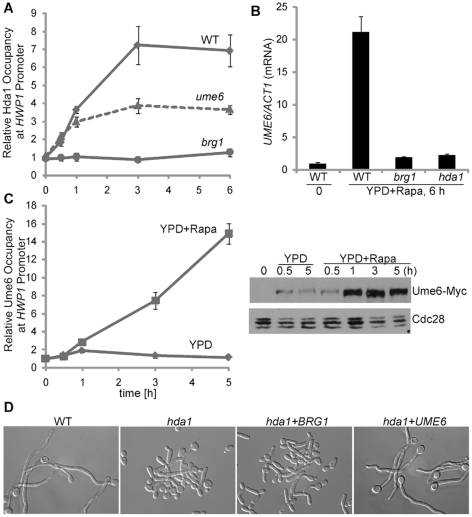
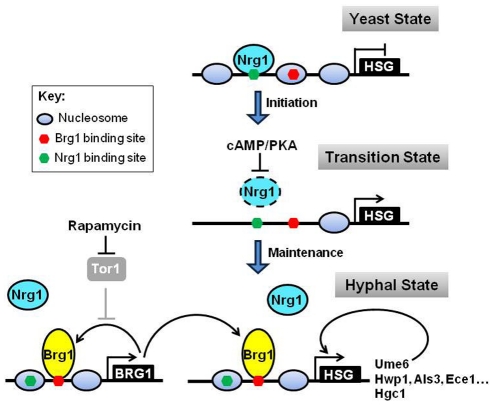
Candida albicans is an important opportunistic fungal pathogen of immunocompromised individuals. One critical virulence attribute is its morphogenetic plasticity. Hyphal development requires two temporally linked changes in promoter chromatin, which is sequentially regulated by temporarily clearing the transcription inhibitor Nrg1 upon activation of the cAMP/PKA pathway and promoter recruitment of the histone deacetylase Hda1 under reduced Tor1 signaling. Molecular mechanisms for the temporal connection and the link to Tor1 signaling are not clear. Here, through a forward genetic screen, we report the identification of the GATA family transcription factor Brg1 as the factor that recruits Hda1 to promoters of hypha-specific genes during hyphal elongation. BRG1 expression requires both the removal of Nrg1 and a sub-growth inhibitory level of rapamycin; therefore, it is a sensitive readout of Tor1 signaling. Interestingly, promoters of hypha-specific genes are not accessible to Brg1 in yeast cells. Furthermore, ectopic expression of Brg1 cannot induce hyphae, but can sustain hyphal development. Nucleosome mapping of a hypha-specific promoter shows that Nrg1 binding sites are in nucleosome free regions in yeast cells, whereas Brg1 binding sites are occupied by nucleosomes. Nucleosome disassembly during hyphal initiation exposes the binding sites for both regulators. During hyphal elongation, Brg1-mediated Hda1 recruitment causes nucleosome repositioning and occlusion of Nrg1 binding sites. We suggest that nucleosome repositioning is the underlying mechanism for the yeast-hyphal transition. The hypha-specific regulator Ume6 is a key downstream target of Brg1 and functions after Brg1 as a built-in positive feedback regulator of the hyphal transcriptional program to sustain hyphal development. With the levels of Nrg1 and Brg1 dynamically and sensitively controlled by the two major cellular growth pathways, temporal changes in nucleosome positioning during the yeast-to-hypha transition provide a mechanism for signal integration and cell fate specification. This mechanism is likely used broadly in development.
Overview
The claims and statistics of this paper haven’t been checked yet.
Free: it reads the open-access text and checks the first 5 claims that cite a source we can check. Create a free account to check every claim.
Integrity signals
Registry
Cites
Statistics
Figures
Verification
Claims the paper makes
The claims and statistics of this paper haven’t been checked yet.
Free: it reads the open-access text and checks the first 5 claims that cite a source we can check. Create a free account to check every claim.
Claims other papers make about this one
Each is checked against this paper’s own text: does it say what the citing paper says it does?
The cited source says what the claim attributes to it.
In the citing paper
“Recently, it has been demonstrated that chromatin and chromatin-modifying enzymes are important for mediating the expression of morphogenesis-related genes in C. albicans (21, 22).”
From A Histone Deacetylase Complex Mediates Biofilm Dispersal and Drug Resistance in Candida albicans (2014) · cites this paper as [21]
Self-check
Percentages, sums and reported differences re-computed from the paper’s own numbers.
The self-check needs the paper’s full text.
Citations
Cites
Virulence factors of Candida albicans
Calderone, R. A., & Fonzi, W. A. (2001) · Trends in Microbiology · doi:10.1016/s0966-842x(01)02094-7 · Cited by 1,331 · cited 1×
“Candida albicans is a major opportunistic fungal pathogen of humans [1,2].”
BackgroundOdds, F. C. (1979) · Medical Entomology and Zoology · Cited by 1,297
Genome-Scale Identification of Nucleosome Positions in S. cerevisiae
Yuan, G.-C., Liu, Y.-J., Dion, M. F., Slack, M. D., Wu, L. F., Altschuler, S. J., & Rando, O. J. (2005) · Science · doi:10.1126/science.1112178 · Cited by 1,139 · cited 1×
“Nucleosomes are generally inhibitory to transcription factor binding, and changes in nucleosome position are associated with changes in gene expression by affecting the accessibility of transcription factors to promoters”
BackgroundThe TOR signalling pathway controls nuclear localization of nutrient-regulated transcription factors
Beck, T., & Hall, M. N. (1999) · Nature · doi:10.1038/45287 · Cited by 924 · cited 2×
“Gln3 and Gat1, two GATA family transcription activators for genes that are subject to nitrogen catabolite repression, are targets of the TOR kinases in Saccharomyces cerevisiae [23].”
BackgroundA Recently Evolved Transcriptional Network Controls Biofilm Development in Candida albicans
Nobile, C. J., Fox, E. P., Nett, J. E., Sorrells, T. R., Mitrovich, Q. M., Hernday, A. D., Tuch, B. B., Andes, D. R., & Johnson, A. D. (2012) · Cell · doi:10.1016/j.cell.2011.10.048 · Cited by 711 · cited 2×
“Brg1 sites [red]: [A/C]GGTA[C/A]) [46].”
Saville, S. P., Lazzell, A. L., Monteagudo, C., & Lopez-Ribot, J. L. (2003) · Eukaryotic Cell · doi:10.1128/ec.2.5.1053-1060.2003 · Cited by 655 · cited 1×
“Considering that misregulation of either Nrg1 or Ume6 level causes altered virulence [9,40], our identification of Brg1 as an output of the Tor1 signaling that regulates Nrg1 binding and Ume6 expression should provide a better understanding of the molecular mechanisms that control the yeast-hyphal development in its h…”
BackgroundAls3 Is a Candida albicans Invasin That Binds to Cadherins and Induces Endocytosis by Host Cells
Phan, Q. T., Myers, C. L., Fu, Y., Sheppard, D. C., Yeaman, M. R., Welch, W. H., Ibrahim, A. S., Edwards, J. E., & Filler, S. G. (2007) · PLoS Biology · doi:10.1371/journal.pbio.0050064 · Cited by 641 · cited 1×
“For example, HWP1, ALS3, and RBT5 encode cell wall proteins that are important for adhesion to host cells and iron acquisition from the host [5–8].”
BackgroundAdhesive and Mammalian Transglutaminase Substrate Properties of Candida albicans Hwp1
Staab, J. F., Bradway, S. D., Fidel, P. L., & Sundstrom, P. (1999) · Science · doi:10.1126/science.283.5407.1535 · Cited by 607 · cited 1×
“encode cell wall proteins that are important for adhesion to host cells and iron acquisition from the host”
BackgroundFungal morphogenesis and host invasion
Gow, N. A. R., Brown, A. J. P., & Odds, F. C. (2002) · Current Opinion in Microbiology · doi:10.1016/s1369-5274(02)00338-7 · Cited by 482 · cited 1×
“Mutants that are defective in hyphal formation display much reduced virulence in animal models of systemic candidiasis [3,4].”
BackgroundNRG1 represses yeast–hypha morphogenesis and hypha‐specific gene expression in Candida albicans
Murad, A. M. A., Leng, P., Straffon, M., Wishart, J., Macaskill, S., MacCallum, D., Schnell, N., Talibi, D., Marechal, D., Tekaia, F., et al. (2001) · The EMBO Journal · doi:10.1093/emboj/20.17.4742 · Cited by 452 · cited 3×
“CCCT/C containing sequences [20] and Brg1 binds to the DNA”
Background
Research works printed but not linked: 1
- Nobile CJ Fox EP Nett JE Sorrells TR Mitrovich QM A Recently Evolved Transcriptional Network Controls Biofilm Development in Candida albicans. Cell 148 126 138 22265407 PMC3266547 · DOI · Paper page
Cited by
Candida albicans cell-type switching and functional plasticity in the mammalian host
Noble, S. M., Gianetti, B. A., & Witchley, J. N. (2017) · Nature Reviews Microbiology · doi:10.1038/nrmicro.2016.157 · Cited by 521
Witchley, J. N., Penumetcha, P., Abon, N. V., Woolford, C. A., Mitchell, A. P., & Noble, S. M. (2019) · Cell Host & Microbe · doi:10.1016/j.chom.2019.02.008 · Cited by 240
“As shown in the schematic in Figure 1D, Efg1, Rob1, Brg1, and Tec1 activate the expression of genes associated with yeastto-hypha morphogenesis (Lassak et al., 2011; Leng et al., 2001; Lu et al., 2012; Nobile et al., 2012).”
BackgroundCandida albicans hyphal initiation and elongation
Lu, Y., Su, C., & Liu, H. (2014) · Trends in Microbiology · doi:10.1016/j.tim.2014.09.001 · Cited by 193
Self-citationPolke, M., Hube, B., & Jacobsen, I. D. (2015) · Advances in Applied Microbiology · doi:10.1016/bs.aambs.2014.12.002 · Cited by 184
A Core Filamentation Response Network in Candida albicans Is Restricted to Eight Genes
Martin, R., Albrecht-Eckardt, D., Brunke, S., Hube, B., Hünniger, K., & Kurzai, O. (2013) · PLoS ONE · doi:10.1371/journal.pone.0058613 · Cited by 129
“Modification of histone proteins has shown to be involved in regulation of morphogenesis [58] and it was recently shown that chromatin remodeling plays an important role in allowing Nrg1 to get access to its target DNA sequences [21,22].”
Background
Metadata
- Authors
- Lu, Y., Su, C., & Liu, H.
- Affiliations
- University of California, Irvine (US)
- Corresponding author
- Liu, Haoping
- Venue
- PLoS Pathogens
- Publisher
- Public Library of Science (PLoS)
- Published
- 2012-04-19
- Volume
- 8
- Issue
- 4
- Pages
- e1002663
- ISSN
- 1553-7366 (ISSN-L)
- 1553-7374
- PMC
- PMC3334898
- OpenAlex
- W2057932064
- Cited by
- 92
- References
- 47
- Citations by year
- 2026: 7 · 2025: 7 · 2024: 6 · 2023: 6 · 2022: 5 · 2021: 9 · 2020: 5 · 2019: 6 · 2018: 5 · 2017: 6 · 2016: 7 · 2015: 8 · 2014: 4 · 2013: 7 · 2012: 4
- FWCI
- 2.96
- Type
- journal article
- Language
- en
- Open access
- gold
- doi.org
- Locations
- PLoS Pathogens (publishedVersion, cc-by)
- Europe PMC (PubMed Central) (publishedVersion, cc-by)
- PubMed Central (publishedVersion, cc-by)
- PubMed (publishedVersion)
- DOAJ (DOAJ: Directory of Open Access Journals) (submittedVersion, cc-by-sa)
- eScholarship (California Digital Library) (submittedVersion, cc-by)
- Figshare (submittedVersion, cc-by)
- Funders
- National Institutes of Health (R01GM, GM76516)
- National Institute of General Medical Sciences (GM76516, P50GM076516)
- National Institute of Allergy and Infectious Diseases (R01GM/AI55155, R01AI099190)
- Topics
- Life Sciences › Biochemistry, Genetics and Molecular Biology › Molecular Biology › Fungal and yeast genetics research
- Life Sciences › Biochemistry, Genetics and Molecular Biology › Molecular Biology › Genomics and Chromatin Dynamics
- Health Sciences › Medicine › Infectious Diseases › Antifungal resistance and susceptibility
- Keywords
- Candida albicans, hyphal development, neuregulin-1, nucleosome repositioning, promoter chromatin, yeast-to-hypha transition, Ume6, cAMP/PKA signaling, morphogenesis, cell fate specification, forward genetic screen
- MeSH terms
- Candida albicans, Fungal Proteins, Histone Deacetylases, Transcription Factors, Signal Transduction, Gene Expression Regulation, Fungal, Phosphatidylinositol 3-Kinases, Hyphae
About these checks
Registry, retraction, Cites and statistics results are computed, not judged, with one exception: a printed reference that no index lists is read once by a model before it counts as a citation error. Claims are extracted by a model and kept only when their quote appears verbatim in the text; each cited source is then checked, with a model’s help, for whether it says what the claim relies on. Those verdicts can be wrong — read the claim’s quote and the cited source before relying on one.
Statistics and arithmetic are recomputed, not judged.
Confidence bands are shown only for fields calibrated on our annotated test set. None is calibrated yet, so no band is shown.
What counts as a claim ›How we measure confidence ›How we check this ›
Are you an author, or do you see a problem with this page? Request a review
How to cite
Cite CoChat for the checks on this page, and the paper for its own findings.
- This page
- CoChat. (2026). Citation check: A GATA Transcription Factor Recruits Hda1 in Response to Reduced Tor1 Signaling to Establish a Hyphal Chromatin State in Candida albicans. https://app.cochat.ai/papers/10.1371/journal.ppat.1002663
- The paper
- Lu, Y., Su, C., & Liu, H. (2012). A GATA Transcription Factor Recruits Hda1 in Response to Reduced Tor1 Signaling to Establish a Hyphal Chromatin State in Candida albicans. PLoS Pathogens. https://doi.org/10.1371/journal.ppat.1002663
Data sources
Bibliographic data: Semantic Scholar, OpenAlex, Crossref.
Contains information from the Semantic Scholar Academic Graph Datasets, made available under the ODC Attribution License (ODC-BY 1.0).
Semantic Scholar’s data is described in: Kinney, R., et al. (2023). The Semantic Scholar Open Data Platform. arXiv:2301.10140.
