

A call to arms: Mustering secondary metabolites for success and survival of an opportunistic pathogen
Open accessThe DOI matches its Crossref record; 52 of the 52 references it cites were found in a registry or an index.
Abstract
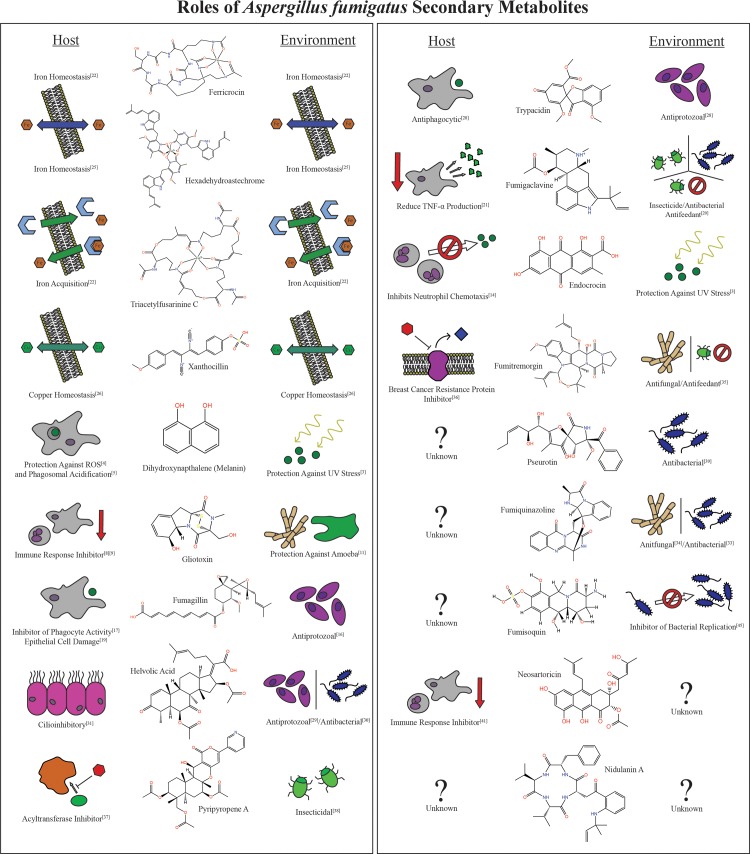
Dihydroxynapthalene melaninDihydroxynapthalene (DHN) melanin is a polymer consisting of 1,8-dihydroxynapthalene, found on the conidial surface.As an environmental benefit, DHN melanin helps to prevent
Overview
The claims and statistics of this paper haven’t been checked yet.
Free: it reads the open-access text and checks the first 5 claims that cite a source we can check. Create a free account to check every claim.
Integrity signals
Registry
Cites
Statistics
Figures
Verification
Claims the paper makes
The claims and statistics of this paper haven’t been checked yet.
Free: it reads the open-access text and checks the first 5 claims that cite a source we can check. Create a free account to check every claim.
Claims other papers make about this one
Each is checked against this paper’s own text: does it say what the citing paper says it does?
The source backs part of the claim, not all of it — or backs it for a different population, condition or comparison.
In the citing paper
“Toxic secondary metabolites produced by A. fumigatus (fumigaclavin, trypacidin, helvolic acid, gliotoxin, fumitremorgin, fumagillin, and pseurotin) do impact host cells (433, 440–443).”
From Aspergillus fumigatus and Aspergillosis in 2019 (2019) · cites this paper as [433]
Experimental — accuracy not yet measured
Self-check
Percentages, sums and reported differences re-computed from the paper’s own numbers.
The self-check needs the paper’s full text.
Citations
Cites
Pathogenesis of Aspergillus fumigatus in Invasive Aspergillosis
Dagenais, T. R. T., & Keller, N. P. (2009) · Clinical Microbiology Reviews · doi:10.1128/cmr.00055-08 · Cited by 993
Self-citationSchrettl, M., Bignell, E., Kragl, C., Joechl, C., Rogers, T., Arst, H. N., Haynes, K., & Haas, H. (2004) · The Journal of Experimental Medicine · doi:10.1084/jem.20041242 · Cited by 493
Taccone, F. S., Van den Abeele, A.-M., Bulpa, P., Misset, B., Meersseman, W., Cardoso, T., Paiva, J.-A., Blasco-Navalpotro, M., De Laere, E., Dimopoulos, G., et al. (2015) · Critical Care · doi:10.1186/s13054-014-0722-7 · Cited by 405
Hissen, A. H. T., Wan, A. N. C., Warwas, M. L., Pinto, L. J., & Moore, M. M. (2005) · Infection and Immunity · doi:10.1128/iai.73.9.5493-5503.2005 · Cited by 243
Accurate prediction of secondary metabolite gene clusters in filamentous fungi
Andersen, M. R., Nielsen, J. B., Klitgaard, A., Petersen, L. M., Zachariasen, M., Hansen, T. J., Blicher, L. H., Gotfredsen, C. H., Larsen, T. O., Nielsen, K. F., et al. (2013) · Proceedings of the National Academy of Sciences · doi:10.1073/pnas.1205532110 · Cited by 239
Li, X.-J., Zhang, Q., Zhang, A.-L., & Gao, J.-M. (2012) · Journal of Agricultural and Food Chemistry · doi:10.1021/jf300146n · Cited by 224
UV-protectant metabolites from lichens and their symbiotic partners
Nguyen, K.-H., Chollet-Krugler, M., Gouault, N., & Tomasi, S. (2013) · Natural Product Reports · doi:10.1039/c3np70064j · Cited by 216
Amitani, R., Taylor, G., Elezis, E. N., Llewellyn-Jones, C., Mitchell, J., Kuze, F., Cole, P. J., & Wilson, R. (1995) · Infection and Immunity · doi:10.1128/iai.63.9.3266-3271.1995 · Cited by 200
Recognition of DHN-melanin by a C-type lectin receptor is required for immunity to Aspergillus
Stappers, M. H. T., Clark, A. E., Aimanianda, V., Bidula, S., Reid, D. M., Asamaphan, P., Hardison, S. E., Dambuza, I. M., Valsecchi, I., Kerscher, B., et al. (2018) · Nature · doi:10.1038/nature25974 · Cited by 200
Prototype of an intertwined secondary-metabolite supercluster
Wiemann, P., Guo, C.-J., Palmer, J. M., Sekonyela, R., Wang, C. C. C., & Keller, N. P. (2013) · Proceedings of the National Academy of Sciences · doi:10.1073/pnas.1313258110 · Cited by 195
Self-citation
Cited by
Items 101–115 of 115
Genome sequence of Talaromyces trachyspermus , a biocontrol fungus isolated from broomrapePreprint
Hemmati, R., Dolatabadian, A., Saeedi, S., & Batley, J. (2025) · bioRxiv (Cold Spring Harbor Laboratory) · doi:10.1101/2025.07.07.663553
“This compound has yet to be tested for antimicrobial or virulence-related properties (Raffa and Keller, 2019).”
Genome sequence of Talaromyces trachyspermus, a biocontrol fungus isolated from broomrapePreprint
Hemmati, R., Dolatabadian, A., Saeedi, S., & Batley, J. (2025) · Research Square · doi:10.21203/rs.3.rs-6606347/v1
Lifestyles shape genome size and gene content in fungal pathogensPreprint
Fijarczyk, A., Hessenauer, P., Hamelin, R. C., & Landry, C. R. (2025) · eLife · doi:10.7554/elife.104975.2
Author response: Lifestyles shape genome size and gene content in fungal pathogens
Fijarczyk, A., Hessenauer, P., Hamelin, R. C., & Landry, C. R. (2025) · eLife · doi:10.7554/elife.104975.4.sa3
Yan, Y., Wang, X., Ma, Q., Lou, Y., Chen, Z., Li, N., & Wang, N. (2026) · BMC Genomics · doi:10.1186/s12864-026-12569-2
“%) to the nidulanin A biosynthetic cluster in A. nidulans FGSC A4 [34, 35] which is known for producing tetracyclopeptide/isoprene hybrid metabolites (Figs.”
Lou, Y. (2021) · theses.fr (ABES) · doi:10.70675/1cda4eb6z7d83z4700za9f7zcc2ad6c961a7 · Cited by 3
Devasahayam, B. R. F., Poeschl, Y., Uthe, H., Rennert, R. C., Hartmann, L., & Deising, H. B. (2026) · Applied and Environmental Microbiology · doi:10.1128/aem.02180-25
“Phenotypic changes observed during microbial interactions may be associated with differential regulation of SMBGCs and transcriptomic and metabolomic remodeling in response to interspecies chemical signaling (8, 51).”
Hossain, F. (2026) · Microbial Bioactives · doi:10.25163/microbbioacts.9110634
Fungal Secondary Metabolites as Antibiotics
Bishnoi, S., Rathi, V., Sharma, R. C., Rathi, G., Sohal, J. S., Prakash, A., & Kumar, U. (2026) · Springer eBooks · doi:10.1007/978-3-032-23507-7_3
Opportunistic pathogenicity in fungi can transcend species boundariesPreprint
Rinker, D. C., Sauters, T. J. C., Gumilang, A., Riedling, O. L., Steffen, K., Pinzan, C. F., dos Reis, T. F., de Castro, P. A., Rangel‐Grimaldo, M., Raja, H. A., et al. (2026) · bioRxiv (Cold Spring Harbor Laboratory) · doi:10.64898/2026.07.02.736111
Dell’Acqua, A. N., Palladino, G., Rampelli, S., Leuzzi, D., Scicchitano, D., Doménech, R., Mencher-Beltrán, A., Delgado, T., Perales, M., Corinaldesi, C., et al. (2026) · Frontiers in Microbiology · doi:10.3389/fmicb.2026.1872113
“…anthraquinone endocrocin, whose ecological role remains incompletely understood but whose related compounds often contribute to UV protection (Raffa and Keller, 2019); and (iii) 1,8-dihydroxynaphthalene, a polyketide-derived precursor of melanin associated with brown to black pigmentation,…”
Repurposing FDA‐Approved Drugs to Inhibit Fungal PPTases for Broad‐Spectrum Synergy
Song, Z., Zhao, C., WANG, Q., Zhang, H., Liu, X., Wang, L., Bromley, M., & Yin, W. (2026) · Advanced Science · doi:10.1002/advs.77354
“They also significantly contribute to fungal virulence [ 14, 15 ] and exhibit structural characteristics distinct from mammalian metabolites.”
Faruk, O., Aroni, S., Rahman, M., Rana, M. R. K., Sohrab, M. H., Kabir, M. H., Khan, H., Uddin, M. A., Rashid, M. A., Jaspars, M., et al. (2026) · The Microbe · doi:10.1016/j.microb.2026.100791
Modena, N. A., PESSI, F., Casa, P. L., Oliveira, N. S. D., Dani, J. G., Schwambach, J., & Silva, S. D. Á. E. (2023) · Exatas Online · doi:10.22481/exon.v14i1.20528
Metadata
- Authors
- Raffa, N., & Keller, N. P.
- Affiliations
- University of Wisconsin–Madison (US)
- Corresponding author
- Keller, Nancy P.
- Venue
- PLOS Pathogens
- Publisher
- Public Library of Science (PLoS)
- Published
- 2019-04-04
- Volume
- 15
- Issue
- 4
- Pages
- e1007606
- ISSN
- 1553-7366 (ISSN-L)
- 1553-7374
- PMC
- PMC6448812
- OpenAlex
- W2926400466
- Cited by
- 123
- References
- 51
- Citations by year
- 2026: 11 · 2025: 22 · 2024: 14 · 2023: 18 · 2022: 20 · 2021: 23 · 2020: 11 · 2019: 4
- FWCI
- 8.99
- Type
- journal article
- Language
- en
- Open access
- gold
- doi.org
- Licence
- Locations
- PLoS Pathogens (publishedVersion, cc-by)
- PubMed Central (publishedVersion, cc-by)
- PubMed (publishedVersion)
- DOAJ (DOAJ: Directory of Open Access Journals) (submittedVersion, cc-by-sa)
- Funders
- National Institutes of Health
- National Institute of General Medical Sciences (T32GM008349)
- National Institute of Allergy and Infectious Diseases (R01AI065728)
- Topics
- Life Sciences › Immunology and Microbiology › Applied Microbiology and Biotechnology › Microbial Natural Products and Biosynthesis
- Life Sciences › Agricultural and Biological Sciences › Plant Science › Plant Pathogens and Fungal Diseases
- Life Sciences › Biochemistry, Genetics and Molecular Biology › Biotechnology › Microbial Metabolism and Applications
- Keywords
- secondary metabolites, opportunistic pathogens, fungal pathogen survival, melanin
- MeSH terms
- Anti-Bacterial Agents, Aspergillosis, Aspergillus fumigatus, Humans, Opportunistic Infections, Host-Pathogen Interactions, Metabolome
About these checks
Registry, retraction, Cites and statistics results are computed, not judged, with one exception: a printed reference that no index lists is read once by a model before it counts as a citation error. Claims are extracted by a model and kept only when their quote appears verbatim in the text; each cited source is then checked, with a model’s help, for whether it says what the claim relies on. Those verdicts can be wrong — read the claim’s quote and the cited source before relying on one.
Statistics and arithmetic are recomputed, not judged.
Confidence bands are shown only for fields calibrated on our annotated test set. None is calibrated yet, so no band is shown.
What counts as a claim ›How we measure confidence ›How we check this ›
Are you an author, or do you see a problem with this page? Request a review
Data sources
Bibliographic data: Semantic Scholar, OpenAlex, Crossref.
Contains information from the Semantic Scholar Academic Graph Datasets, made available under the ODC Attribution License (ODC-BY 1.0).
Semantic Scholar’s data is described in: Kinney, R., et al. (2023). The Semantic Scholar Open Data Platform. arXiv:2301.10140.
