

The prevalence and intensity of external and internal parasites in working donkeys (Equus asinus.) in Egypt
Open accessThe DOI matches its Crossref record; 45 of the 47 references it cites were found in a registry or an index; none of the 5 sources its claims cite is checked for support yet.
Abstract
AIM: ) in Egypt during the period from January to December 2017. MATERIALS AND METHODS: A total of 120 donkeys (10 donkeys each month) were examined at Giza zoo abattoir through bimonthly visits. The examined donkeys were obtained from five governorates (Giza [20], Fayoum [40], Beni Suef [30], Monofia [20], and Assiut [10]). The animals were grouped according to age and sex. RESULTS: All examined donkeys were positive with at least one internal or even external parasitic species. The overall prevalence rate was 100%. A total of 11 helminths species (10 nematodes and 1 metacestode); 7 protozoal and 7 arthropod species were collected. The number of each parasite and intensity of infection with regard to age and sex was recorded. CONCLUSION: All examined donkeys were infected with parasites with an overall prevalence of 100%. So, we recommended following up and continuous treatment of such diseased animal.
Overview
CoChat Summary
## TL;DR
This study examined 120 working donkeys in Egypt (January–December 2017) and found that all were infected with at least one internal or external parasite, for an overall prevalence of 100%. The paper reports a broad parasite burden, including 11 helminth species, 7 protozoal species, and 7 arthropod species.
## Key findings
- All 120 donkeys were positive for at least one parasitic species; the overall prevalence rate was 100%.
- The study recorded 11 helminths species, 7 protozoal species, and 7 arthropod species.
- Among helminths, the highest prevalence was Cylicocyclus asini (91.66%) and Cyathostomum spp. (83.33%); the lowest were Draschia megastoma and hydatid cyst (8.33%).
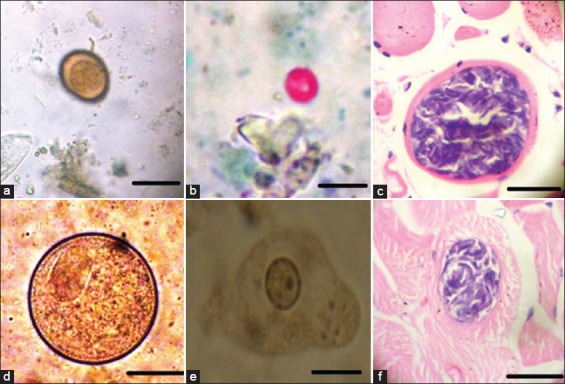
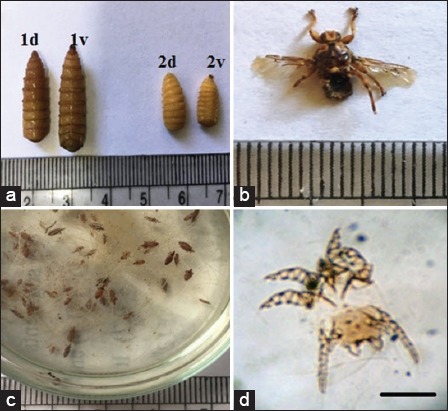
- Among protozoa, Balantidium coli was most prevalent at 91.6%, while Cryptosporidium spp. was lowest at 6.66%; among arthropods, Gasterophilus intestinalis was highest at 97.5%, while Haematopinus asini and P. equi were lowest at 8.33%.
## Methods
- Cross-sectional postmortem survey of 120 donkeys examined at Giza Zoo abattoir during January–December 2017, with animals coming from five governorates: Giza, Fayoum, Beni Suef, Monofia, and Assiut.
- Donkeys were grouped by age and sex; fecal, blood, tissue, gastrointestinal, and skin samples were examined using microscopy, flotation/sedimentation, staining methods, and parasite identification based on morphological descriptions.
- Prevalence and intensity were analyzed using Chi-square tests in SPSS v.11.0, with p<0.05 considered significant.
## Limitations
- The paper does not state formal study limitations.
- Evident from the text: the sample was limited to 120 slaughtered working donkeys from one abattoir and five governorates, so the findings may not represent all donkeys in Egypt.
- Evident from the text: parasite identification relied on microscopy and morphology, and the discussion notes that some blood-parasite results may be false-negative at low parasitemia.
Model-written summary. Check it against the paper before relying on it.
Integrity signals
Registry
Cites
Statistics
Figures
Verification
Claims the paper makes
0 Valid · 0 Not valid · 5 Not checked · 46 Own results and interpretations
A result the paper reports from its own data — it cites no other source for it, so there is none to check. The quote shows it is in the paper.
In the paper
“A total of 11 helminths species (10 nematodes and 1 metacestode); 7 protozoal and 7 arthropod species were collected.”
- Also stated in: § Results · plain
“The findings on the arthropods in this study include 7 species were recorded with highest infestation rate in Gasterophilus intestinalis (97.5%) and lower infestation rate recorded in Haematopinus asini and P. equi (8.33%) (Table-3 and Figures-3a and 7).”
§ The prevalence and intensity of external and internal parasites in working donkeys (Equus asinus) in Egypt > Abstract > Results:
plain- Asserted: passes — The authors put it forward as true.
- Checkable: passes — It can be checked against evidence.
- Load-bearing: unclear — It is unclear whether the paper’s conclusions depend on it.
- Based: passes — The paper gives a reason why it holds.
- Also stated in: § Results · plain
A result the paper reports from its own data — it cites no other source for it, so there is none to check. The quote shows it is in the paper.
In the paper
“A total of 11 helminths species (10 nematodes and 1 metacestode); 7 protozoal and 7 arthropod species were collected.”
- Also stated in: § Results · plain
“A total of 11 helminths species (10 nematodes and 1 metacestode) were recorded.”
§ The prevalence and intensity of external and internal parasites in working donkeys (Equus asinus) in Egypt > Abstract > Results:
plain- Asserted: passes — The authors put it forward as true.
- Checkable: passes — It can be checked against evidence.
- Load-bearing: unclear — It is unclear whether the paper’s conclusions depend on it.
- Based: passes — The paper gives a reason why it holds.
- Also stated in: § Results · plain
A result the paper reports from its own data — it cites no other source for it, so there is none to check. The quote shows it is in the paper.
In the paper
“Higher prevalence was estimated in Cylicocyclus asini (91.66%) followed by Cyathostomum spp. (83.33%) while lower prevalence recorded in Draschia megastoma and hydatid cyst (8.33%).”
§ The prevalence and intensity of external and internal parasites in working donkeys (Equus asinus) in Egypt > Results
hedged- Asserted: passes — The authors put it forward as true.
- Checkable: passes — It can be checked against evidence.
- Load-bearing: unclear — It is unclear whether the paper’s conclusions depend on it.
- Based: passes — The paper gives a reason why it holds.
A result the paper reports from its own data — it cites no other source for it, so there is none to check. The quote shows it is in the paper.
In the paper
“A total of 11 helminths species (10 nematodes and 1 metacestode); 7 protozoal and 7 arthropod species were collected.”
- Also stated in: § Results · plain
“A total of seven protozoal species were recorded with the most prevalent one being Balantidium coli with 91.6% and the lowest prevalent one being Cryptosporidium spp. 6.66% which was present mainly in young donkeys aged between 1 and 2 years and become lower at the older age.”
§ The prevalence and intensity of external and internal parasites in working donkeys (Equus asinus) in Egypt > Abstract > Results:
plain- Asserted: passes — The authors put it forward as true.
- Checkable: passes — It can be checked against evidence.
- Load-bearing: unclear — It is unclear whether the paper’s conclusions depend on it.
- Based: passes — The paper gives a reason why it holds.
- Also stated in: § Results · plain
23 more claims
Create a free account to see all 51 claims and to verify the 5 references still open.
- It may state two separate claims as one. 21
- Probably not a substantial claim. 5
Self-check
Percentages, sums and reported differences re-computed from the paper’s own numbers.
Rated major: it would touch a result — a value a result rests on, reported and recomputed p-values on opposite sides of the significance level, two passages that conflict with no sign which is right, or a cited work retracted before this paper was published.
In the paper
“The prevalence of Cryptosporidium spp. in donkeys was 6.6% (8 out of 90).”
§ The prevalence and intensity of external and internal parasites in working donkeys (Equus asinus) in Egypt > Discussion
Reported 6.6 · recomputed 8.888889
Citations
Cites
Parasitology Meets Ecology on Its Own Terms: Margolis et al. Revisited
Bush, A. O., Lafferty, K. D., Lotz, J. M., & Shostak, A. W. (1997) · The Journal of Parasitology · doi:10.2307/3284227 · Cited by 7,879
A brief version of the Fear of Negative Evaluation Scale
Leary, M. R. (1983) · Personality and Social Psychology Bulletin · doi:10.1177/0146167283093007 · Cited by 2,178
Staining of Cryptosporidia by a Modified Ziehl-Neelsen Technique
Henriksen, S. A., & Pohlenz, J. F. L. (1981) · Acta Veterinaria Scandinavica · doi:10.1186/bf03548684 · Cited by 891
(2000) · Choice Reviews Online · doi:10.5860/choice.37-4169 · Cited by 542
Probst, M., Vandereycken, W., Coppenolle, H. V., & Vanderlinden, J. (1995) · Eating Disorders · doi:10.1080/10640269508249156 · Cited by 253
The prevalence and epidemiology of gastrointestinal parasites of horses in Victoria, Australia
Bucknell, D. G., Gasser, R. B., & Beveridge, I. (1995) · International Journal for Parasitology · doi:10.1016/0020-7519(94)00214-9 · Cited by 205
The prevalence and intensity of internal parasites of horses in the U.S.A.
Reinemeyer, C. R., Smith, S. A., Gabel, A. A., & Herd, R. P. (1984) · Veterinary Parasitology · doi:10.1016/0304-4017(84)90112-2 · Cited by 178
Long-term study of Cryptosporidium prevalence on a lowland farm in the United Kingdom
Sturdee, A. P., Bodley‐Tickell, A. T., Archer, A., & Chalmers, R. M. (2003) · Veterinary Parasitology · doi:10.1016/s0304-4017(03)00261-9 · Cited by 117
Lichtenfels, J. R. (1975) · Cited by 112
Gastrointestinal parasites of working donkeys of Ethiopia
Getachew, M., Trawford, A., Feseha, G., & Reid, S. W. J. (2009) · Tropical Animal Health and Production · doi:10.1007/s11250-009-9381-0 · Cited by 108
Research works printed but not linked: 5
- Tolliver S.C A Practical Method of Identification of the North American Cyathostomes (Small Strongyles) in Equids in Kentucky Agricultural Experiment Station, University of Kentucky, College of Agriculture 2000 Lexington, KY, USA. Bulletin Number SR-2000-1 Department of Veterinary Science
- Alemayehu H Prevalence of Equine Helminthiasis in Specific Site of Arsi and Bale Region DVM Thesis 1995 Debrezeit Addis Ababa University, FVM
- Kuzmina T.A Kharchenko V.A Trawford A Getachew M The Strongylid Nematodes of Working Donkeys from Ethiopia 2007 Gent, Belgium 21th International Conference World Assassin for the Advancement of Veterinary Parasitology (WAAVP) 380
- Zweygart E Just M.C Waal D.T Lopez-Rebollar L.M Wernery U Wade FJ Mumford JA Kaaden OR In vitro diagnosis of Babesia equi Equine Infectious Diseases VIII 1999 Dubai, UAE Proceedings of the 8th Equine Infectious Diseases Conference. Newmarket: R & W Publications 232e6
- Hilali M Derhalli F.S Baraka A Incidence and monthly prevalence (Equus asinu s) in Egypt Vet. Parasitol 1987 23 297 305 3564358
Cited by
Balantidium coli in domestic animals: An emerging protozoan pathogen of zoonotic significance
Ahmed, A., Ijaz, M. U., Ayyub, R. M., Ghaffar, A., Ghauri, H. N., Aziz, M. U., Ali, S., Altaf, M., Awais, M., Naveed, M., et al. (2019) · Acta Tropica · doi:10.1016/j.actatropica.2019.105298 · Cited by 138
The Use of Draught Animals in Rural Labour
Mota‐Rojas, D., Braghieri, A., Álvarez-Macías, A., Serrapica, F., Ramírez‐Bribiesca, J. E., Cruz-Monterrosa, R. G., Masucci, F., Mora‐Medina, P., & Napolitano, F. (2021) · Animals · doi:10.3390/ani11092683 · Cited by 74
“[56] noted that all of 120 work donkeys examined in Egypt suffered parasitic infections.”
BackgroundRecent Advances in the Control of Helminths of Domestic Animals by Helminthophagous Fungi
de Araújo, J. V., Braga, F. R., de Gives, P. M., Paz-Silva, A., & Vilela, V. L. R. (2021) · Parasitologia · doi:10.3390/parasitologia1030018 · Cited by 56
Habronematidosis in Equids: Current Status, Advances, Future Challenges
Barlaam, A., Traversa, D., Papini, R., & Giangaspero, A. (2020) · Frontiers in Veterinary Science · doi:10.3389/fvets.2020.00358 · Cited by 34
Attia, M. M., Yehia, N., Soliman, M. M., Shukry, M., El‐Saadony, M. T., & Salem, H. M. (2021) · Saudi Journal of Biological Sciences · doi:10.1016/j.sjbs.2021.10.067 · Cited by 34
Self-citationBuono, F., Veneziano, V., Veronesi, F., & Molento, M. B. (2023) · Parasitology · doi:10.1017/s0031182023000525 · Cited by 26
Hussein, D., El‐Shiekh, R. A., Saber, F. R., Attia, M. M., Mousa, M. R., Atta, A. H., Abdel-Sattar, E. A., & Mouneir, S. M. (2021) · Journal of Ethnopharmacology · doi:10.1016/j.jep.2021.114083 · Cited by 22
Self-citationSalem, S. E., El‐Ghany, A. M. A., Hamad, M. H., Abdelaal, A. M., Elsheikh, H. A., Hamid, A. A., Saud, M. A., Daniels, S., & Ras, R. (2020) · Equine Veterinary Journal · doi:10.1111/evj.13325 · Cited by 22
Prevalence and Intensity of Gastrointestinal Parasites in Donkeys in Selected Abattoirs in Kenya
Mulwa, N. N., Githigia, S. M., Karanja, D. N., Mbae, C. K., Zeyhle, E. E., Mulinge, E., Magambo, J., & Ogolla, K. O. (2020) · Scientifica · doi:10.1155/2020/5672140 · Cited by 19
“[34] found that females were majorly affected compared with males.”
BackgroundCRESCENTE AUMENTO DA HIPERTENSÃO ARTERIAL ENTRE OS IDOSOS DO NORDESTE E NO CEARÁ
SIQUEIRA, A. S. M. D., ALVES, M. L. D. S., Brito, R. A., CARACAS, R. G. N., Lima, I. M. T., & Moreira, H. H. T. (2023) · Editora In Vivo eBooks · doi:10.47242/978-65-87959-28-3-17 · Cited by 17
Bastos, P. I. S. D. A., Lóssio, J. L. C. M., Lima, F. E. D. S., Rondon, F. C. M., Barbosa, G. M. D. O., Vasconcelos, A. L. C. F., & Brito, B. G. D. M. (2023) · Editora In Vivo eBooks · doi:10.47242/978-65-87959-28-3-16 · Cited by 17
FISIOTERAPIA E REABILITAÇÃO DE CÃES COM DISPLASIA COXOFEMORAL
Monteiro, I. L., França, B. F. D. M., Barbosa, G. M. D. O., Chaves, R. N., & Brito, B. G. D. M. (2023) · Editora In Vivo eBooks · doi:10.47242/978-65-87959-28-3-14 · Cited by 17
Peixoto, J. Y. F., Aguiar, A. A. R. M., Duarte, V. M. D. S., de Freitas, V. E., Silva, J. N. D., Fidelis, P. H. D. S., Rolim, C. M. D. M., Dantas, I. L. M., de Souza, M. H. P., Coelho, W. A. C., et al. (2023) · Editora In Vivo eBooks · doi:10.47242/978-65-87959-28-3-18 · Cited by 17
Health evaluation of donkeys: parasite control methods and a model for challenge infections
Molento, M. B., & Vilela, V. L. R. (2021) · Brazilian Journal of Veterinary Research and Animal Science · doi:10.11606/issn.1678-4456.bjvras.2021.174275 · Cited by 12
“2021;58(special issue):e174275 great efficacy values (100%) for more than 40 days, even to 72 days (90%) using extra-label ivermectin. Coproculture should also be performed when doing a FECRT to identify the genus/species of the third stage larvae for the parasites present in the animals, using a newly released identi…”
BackgroundInfluentialAttia, M. M., Soliman, S. M., Salaeh, N. M. K., Salem, H. M., Alkafafy, M., Saad, A. M., El‐Saadony, M. T., & El-Gameel, S. M. (2021) · Saudi Journal of Biological Sciences · doi:10.1016/j.sjbs.2021.11.044 · Cited by 12
Self-citationAttia, M. M., Okada, M. A., Shamseldean, M. M., & El-Gameel, S. M. (2021) · International Journal of Tropical Insect Science · doi:10.1007/s42690-021-00618-0 · Cited by 10
Self-citationEpidemiological study on equine coccidiosis in North and Northeast of Iran
Gorji, F. F., Sadr, S., & Borji, H. (2023) · Veterinary Medicine and Science · doi:10.1002/vms3.1197 · Cited by 9
Intestinal Strongyle Genera in Different Typology of Donkey Farms in Tuscany, Central Italy
Maestrini, M., Molento, M. B., Mancini, S., Martini, M., Angeletti, F. G. S., & Perrucci, S. (2020) · Veterinary Sciences · doi:10.3390/vetsci7040195 · Cited by 12
“In recent studies in donkeys in Egypt and Sudan [36,38] a high prevalence of both small strongyles (cyathostomins, 72.”
BackgroundInfluentialEl-Gameel, S. M., Al‐Mokaddem, A. K., Salaeh, N. M. K., & Attia, M. M. (2022) · Journal of Parasitic Diseases · doi:10.1007/s12639-022-01498-y · Cited by 9
“The Strongylus spp were cleared using lactophenol and mounted in gelatin (Attia et al. 2018).”
BackgroundMethodSelf-citationMorphological and molecular characterization of Setaria equina in donkeys
Abdel Rahman, M. M. I. (2020) · Beni-Suef University Journal of Basic and Applied Sciences · doi:10.1186/s43088-020-00046-y · Cited by 6
AbouLaila, M. R., Allam, T. S., Roshdy, T. M., & Elkhatam, A. (2020) · Veterinary Parasitology Regional Studies and Reports · doi:10.1016/j.vprsr.2020.100478 · Cited by 7
Nts’aoana, M. E., Molapo, S., & Kompi, P. P. (2021) · World s Veterinary Journal · doi:10.54203/scil.2021.wvj31 · Cited by 2
Photodynamic therapy in the treatment of cutaneous habronemosis in a horse: Case report
Ferreira, I., Pinto, J. G., Oliveira, E. G. L., de Azevedo, M. C. B. S., Marcolino, L. M. C., & Ferreira–Strixino, J. (2025) · Journal of Equine Veterinary Science · doi:10.1016/j.jevs.2025.105674 · Cited by 1
Seasonal assessment of welfare and Endoparasitic infections in Balkan donkeys
Nadaškić, M., Ilić, T., Jovanović, N. M., Petrović, T., Bugarski, D., Aleksić, J., Vučinić, M. M., & Nenadović, K. (2025) · Journal of Equine Veterinary Science · doi:10.1016/j.jevs.2025.105714 · Cited by 1
Prevalence of Endoparasites in the Balkan Donkey (Equus asinus) from Serbia
Mijatović, B., Pavlović, I., Živković, S., Trailović, I., Ćirić, J., & Trailović, D. (2022) · Comparative Parasitology · doi:10.1654/copa-d-22-00005 · Cited by 1
PARASITOS GASTRINTESTINAIS EM Felis catus Linnaeus, 1758 DE MOSSORÓ, RN
Rolim, C. M. D. M., Aguiar, A. A. R. M., Lima, L. F., de Souza, M. H. P., Duarte, V. M. D. S., Dantas, I. L. M., Batista, A. I. V., Guimarães, R. B. M., Medeiros, F. L. M., Coelho, W. A. C., et al. (2023) · Editora In Vivo eBooks · doi:10.47242/978-65-87959-28-3-5 · Cited by 1
ASPECTOS EPIDEMIOLÓGICOS DA LEISHMANIOSE CANINA
Santos, J. V. B. D., dos Santos, I. G., dos Santos, A. L. H., da Costa, A. C. S., de Carvalho, J. F., Neto, M. B. O., Oliveira, M. R., Silva, L. M. S., Barata, C. V., Gomes, A. C., et al. (2023) · Editora In Vivo eBooks · doi:10.47242/978-65-87959-28-3-2 · Cited by 1
LEISHMANIOSE FELINA E SUA RELEVÂNCIA NA SAÚDE ÚNICA
dos Santos, A. L. H., dos Santos, I. G., Santos, J. V. B. D., Silva, L. M. S., Barata, C. V., Batista, D. D. C. S., da Silva, W. S. I., Vidal, D. D. S., Gomes, A. C., Neto, M. B. O., et al. (2023) · Editora In Vivo eBooks · doi:10.47242/978-65-87959-28-3-6 · Cited by 1
Phenotypic and pathological characterizations of different Sarcocystis species in donkeys
Rahman, M. M. I. A. (2020) · Egyptian Veterinary Medical Society of Parasitology Journal (EVMSPJ) · doi:10.21608/evmspj.2020.81866
“Also, it reached 66.66 % in Egypt by Attia et al. 2018, 16.6% in Ethiopia by Woldemeskel and Gebreab, 1996.”
BackgroundInfluentialMousa, S. A., Attia, M. M., Khalphallah, A., & Salem, N. Y. (2021) · Advances in Animal and Veterinary Sciences · doi:10.17582/journal.aavs/2021/9.10.1504.1510
“The stained blood smears were examined under the microscope (×400 and ×1000; OLYMPUS CX41) for detection of Leishmania spp (Attia et al., 2018; Zaki et al., 2021).”
MethodSelf-citationTRATAMENTOS PARA COMPORTAMENTOS ATÍPICOS EM FELINOS DOMÉSTICOS
Victor, V. P. O., Bezerra, B. M. O., Lima, F. E. D. S., & Barbosa, G. M. D. O. (2023) · Editora In Vivo eBooks · doi:10.47242/978-65-87959-28-3-15
ASPECTOS DA TOXOPLASMOSE E TRIPANOSSOMÍASE EM ANIMAIS E SUA IMPORTÂNCIA EM SAÚDE ÚNICA
dos Santos, A. L. H., Santos, J. V. B. D., Silva, L. M. S., Barata, C. V., Batista, D. D. C. S., Oliveira, M. R., Gomes, A. C., da Silva, W. S. I., de Jesus, J. V., dos Santos, I. G., et al. (2023) · Editora In Vivo eBooks · doi:10.47242/978-65-87959-28-3-1
A EXPERIÊNCIA DE RESIDENTES EM MEDICINA VETERINÁRIA NA ÁREA DE VIGILÂNCIA À SAÚDE
Nascimento, J. D. O., Feitosa, R. O., de Alcântara, A. M., Barbosa, S. M. V., da Silva, R. F., de Melo, V. S., da Silva, W. S. I., Oliveira, M. R., Alves, L. C., Lima, V. F. S., et al. (2023) · Editora In Vivo eBooks · doi:10.47242/978-65-87959-28-3-11 · Cited by 1
DIROFILARIOSE EM ANIMAIS SILVESTRES: ZOONOSE EMERGENTE NEGLIGÊNCIA
Silva, L. M. S., dos Santos, A. L. H., Santos, J. V. B. D., Barata, C. V., Gomes, A. C., Lima, V. F. S., Oliveira, M. R., dos Santos, I. G., da Silva, W. S. I., de Jesus, J. V., et al. (2023) · Editora In Vivo eBooks · doi:10.47242/978-65-87959-28-3-9
Santos, J. V. B. D., dos Santos, I. G., dos Santos, A. L. H., da Costa, A. C. S., de Carvalho, J. F., Neto, M. B. O., Oliveira, M. R., Silva, L. M. S., Barata, C. V., Gomes, A. C., et al. (2023) · Editora In Vivo eBooks · doi:10.47242/978-65-87959-28-3-7
GIARDIA SP. E CRIPTOSPORIDIUM SP. EM ANIMAIS E SUA RELEVÂNCIA NA SAÚDE PÚBLICA
Silva, L. M. S., dos Santos, A. L. H., Santos, J. V. B. D., Barata, C. V., Gomes, A. C., de Jesus, D. S., Oliveira, M. R., dos Santos, I. G., Neto, M. B. O., da Silva, W. S. I., et al. (2023) · Editora In Vivo eBooks · doi:10.47242/978-65-87959-28-3-8
LUTO DA COVID-19 E ISOLAMENTO SOCIAL: UM OLHAR DE ATENÇÃO AOS IDOSOS SOB A LUZ DA PSICOLOGIA
Teixeira, J. H. L., & do Vale, T. M. (2023) · Editora In Vivo eBooks · doi:10.47242/978-65-87959-28-3-12
PARASITOS GASTROINTESTINAIS DE ROEDORES E SUAS IMPLICAÇÕES NA SAÚDE PÚBLICA
de Jesus, J. V., Vidal, D. D. S., Santos, A. B. R., Costa, É. D. N., Silva, L. M. S., Barata, C. V., de Jesus, D. S., Gomes, A. C., dos Santos, I. G., da Silva, W. S. I., et al. (2023) · Editora In Vivo eBooks · doi:10.47242/978-65-87959-28-3-3
MAGALHÃES, C. C., EVANGELISTA, C. B., Barbosa, G. M. D. O., Silva, F. M. D. O. E., Rondon, F. C. M., & Brito, B. G. D. M. (2023) · Editora In Vivo eBooks · doi:10.47242/978-65-87959-28-3-13
LEISHMANIOSE TEGUMENTAR E VISCERAL EM ROEDORES
Vidal, D. D. S., de Jesus, J. V., Costa, É. D. N., Barata, C. V., Silva, L. M. S., Gomes, A. C., de Jesus, D. S., dos Santos, I. G., da Silva, W. S. I., Neto, M. B. O., et al. (2023) · Editora In Vivo eBooks · doi:10.47242/978-65-87959-28-3-4
Paiva, R. R. L. T., Marques, I. D. S., Aguiar, A. A. R. M., Batista, A. I. V., Dantas, I. L. M., Silva, J. N. D., Lima, M. D. L. O., Rolim, C. M. D. M., Gomes, L. V. L., Coelho, W. A. C., et al. (2023) · Editora In Vivo eBooks · doi:10.47242/978-65-87959-28-3-10
Mostafa, W., Felefel, W., El-Rady, A. A., Khalifa, F. A., Youseef, A. G., El-Dakroury, M. F., Selim, S., Elkamshishi, M., & Mohammed, E. S. (2024) · Egyptian Veterinary Medical Society of Parasitology Journal (EVMSPJ) · doi:10.21608/evmspj.2024.347440
Zerek, A., Erdem, İ., & Yaman, M. (2024) · DergiPark (Istanbul University)
Gamal, F. A., Abdel-Wahab, A. M., Khalifa, M. M. E., Khattab, M. S., & Nassar, A. M. (2025) · Veterinary Parasitology Regional Studies and Reports · doi:10.1016/j.vprsr.2025.101290
Self-citationInterpretation of risk factors of foot and mouth disease in the East of Libya
Zafir, A., Abdullah, A., Saad, S., Hamad, R., & Bufarwa, S. (2025) · Open Veterinary Journal · doi:10.5455/ovj.2025.v15.i11.70
Capitulo 9. Bienestar de los animales de trabajo, actores anónimos en el medio rural
Mota‐Rojas, D., Napolitano, F., Bragaglio, A., Álvarez-Macías, A., Braghieri, A., Hufana-Duran, D., Marcelo, G., Masucci, F., & Pereira, A. (2022) · Portuguese National Funding Agency for Science, Research and Technology (RCAAP Project by FCT)
Epidemiological study of strongyle infections in equines in Egypt: prevalence and risk factors
Selim, A., Marzok, M., Gattan, H. S., Alruhaili, M. H., Ismail, H., Almubarak, A. I., & Hereba, A. M. (2026) · Frontiers in Veterinary Science · doi:10.3389/fvets.2026.1901312
“Several studies have reported infection rates exceeding 60% in horses and donkeys (16–18).”
Potential risk factors associated with large intestinal impaction in working donkeys at Egypt
Abbaspour, Z., Marzok, M., Hamad, Y., Almubarak, A. I., & El‐Khodery, S. (2026) · Online Journal of Animal and Feed Research · doi:10.51227/ojafr.2026.41
Metadata
- Authors
- Attia, M. M., Khalifa, M. M., & Atwa, M. T.
- Affiliations
- Cairo University (EG)
- Fayoum University (EG)
- Corresponding author
- Attia, Marwa M.
- Venue
- Veterinary World
- Publisher
- Veterinary World
- Published
- 2018-09
- Volume
- 11
- Issue
- 9
- Pages
- 1298-1306
- ISSN
- 0972-8988 (ISSN-L)
- 2231-0916
- PMC
- PMC6200562
- OpenAlex
- W2891214613
- Cited by
- 43
- References
- 47
- Citations by year
- 2026: 1 · 2025: 3 · 2023: 21 · 2022: 1 · 2021: 9 · 2020: 7 · 2019: 1
- FWCI
- 6.24
- Type
- journal article
- Language
- en
- Open access
- gold
- doi.org
- Licence
- cc-by
- creativecommons.org/licenses/by/4.0/ (vor, 18 d)
- creativecommons.org/licenses/by/4.0/ (am, 18 d)
- creativecommons.org/licenses/by/4.0/ (tdm, 18 d)
- Locations
- Veterinary World (publishedVersion, cc-by)
- Europe PMC (PubMed Central) (publishedVersion, cc-by)
- PubMed Central (publishedVersion, cc-by)
- PubMed (publishedVersion)
- DOAJ (DOAJ: Directory of Open Access Journals) (submittedVersion, cc-by-sa)
- Funders
- Cairo University
- Faculty of Veterinary Medicine, Cairo University
- Topics
- Life Sciences › Immunology and Microbiology › Parasitology › Helminth infection and control
- Health Sciences › Veterinary › Equine › Veterinary Equine Medical Research
- Life Sciences › Immunology and Microbiology › Parasitology › Parasite Biology and Host Interactions
- Keywords
- donkeys, ectoparasites, endoparasites, helminths, nematodes, protozoa, arthropods, parasite prevalence, infection intensity, age and sex differences, Egypt
About these checks
Registry, retraction, Cites and statistics results are computed, not judged, with one exception: a printed reference that no index lists is read once by a model before it counts as a citation error. Claims are extracted by a model and kept only when their quote appears verbatim in the text; each cited source is then checked, with a model’s help, for whether it says what the claim relies on. Those verdicts can be wrong — read the claim’s quote and the cited source before relying on one.
A language model drew the claims from the paper on 2026-10-11, under version 3 of the claim definition (model deepseek-v4.1-flash, prompt extract-v3).
A second model labelled each claim on 2026-10-11 (model jev-1.13-20260917, definition revision gold-guideline-v0.2).
Statistics and arithmetic are recomputed, not judged.
Confidence bands are shown only for fields calibrated on our annotated test set. None is calibrated yet, so no band is shown.
What counts as a claim ›How we measure confidence ›How we check this ›
Are you an author, or do you see a problem with this page? Request a review
Data sources
Bibliographic data: Semantic Scholar, OpenAlex, Crossref.
Contains information from the Semantic Scholar Academic Graph Datasets, made available under the ODC Attribution License (ODC-BY 1.0).
Semantic Scholar’s data is described in: Kinney, R., et al. (2023). The Semantic Scholar Open Data Platform. arXiv:2301.10140.
