

The prevalence and intensity of external and internal parasites in working donkeys (Equus asinus.) in Egypt
Open accessThe DOI matches its Crossref record; 45 of the 47 references it cites were found in a registry or an index; none of the 5 sources its claims cite is checked for support yet.
Abstract
AIM: ) in Egypt during the period from January to December 2017. MATERIALS AND METHODS: A total of 120 donkeys (10 donkeys each month) were examined at Giza zoo abattoir through bimonthly visits. The examined donkeys were obtained from five governorates (Giza [20], Fayoum [40], Beni Suef [30], Monofia [20], and Assiut [10]). The animals were grouped according to age and sex. RESULTS: All examined donkeys were positive with at least one internal or even external parasitic species. The overall prevalence rate was 100%. A total of 11 helminths species (10 nematodes and 1 metacestode); 7 protozoal and 7 arthropod species were collected. The number of each parasite and intensity of infection with regard to age and sex was recorded. CONCLUSION: All examined donkeys were infected with parasites with an overall prevalence of 100%. So, we recommended following up and continuous treatment of such diseased animal.
Overview
CoChat Summary
## TL;DR
This study examined 120 working donkeys in Egypt (January–December 2017) and found that all were infected with at least one internal or external parasite, for an overall prevalence of 100%. The paper reports a broad parasite burden, including 11 helminth species, 7 protozoal species, and 7 arthropod species.
## Key findings
- All 120 donkeys were positive for at least one parasitic species; the overall prevalence rate was 100%.
- The study recorded 11 helminths species, 7 protozoal species, and 7 arthropod species.
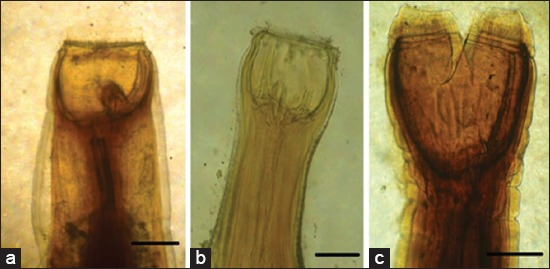
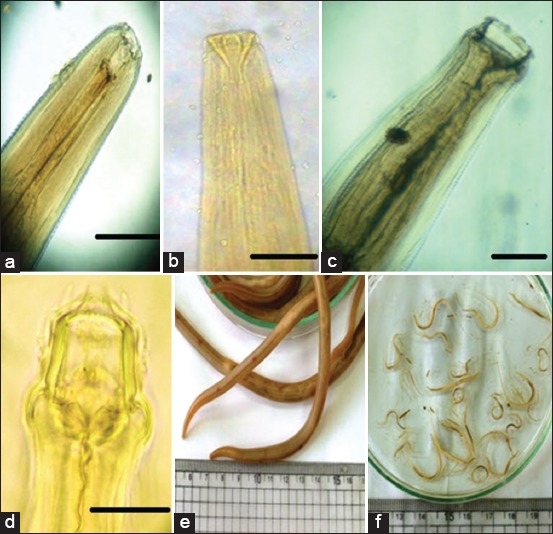
- Among helminths, the highest prevalence was Cylicocyclus asini (91.66%) and Cyathostomum spp. (83.33%); the lowest were Draschia megastoma and hydatid cyst (8.33%).
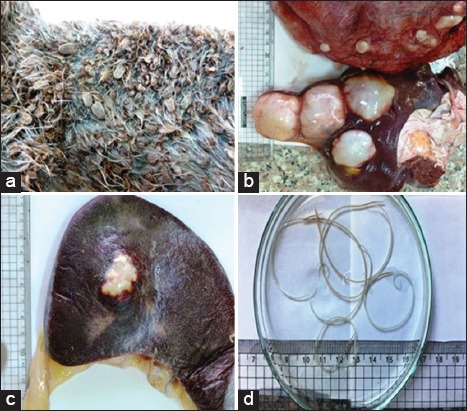
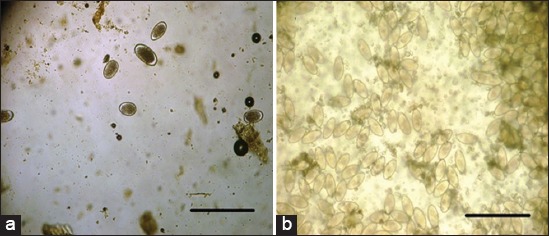
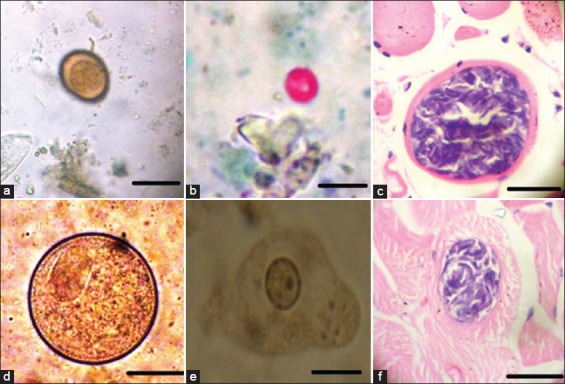
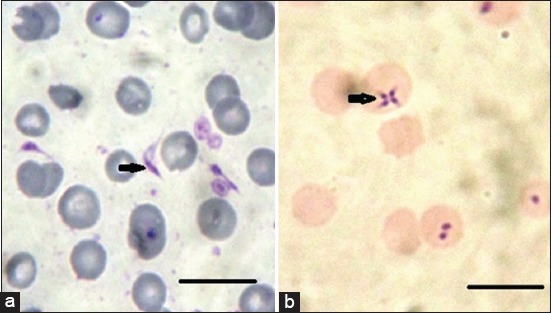
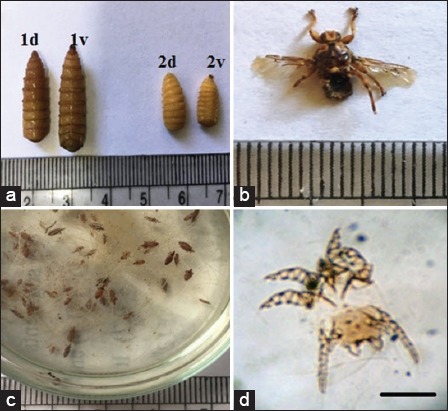
- Among protozoa, Balantidium coli was most prevalent at 91.6%, while Cryptosporidium spp. was lowest at 6.66%; among arthropods, Gasterophilus intestinalis was highest at 97.5%, while Haematopinus asini and P. equi were lowest at 8.33%.
## Methods
- Cross-sectional postmortem survey of 120 donkeys examined at Giza Zoo abattoir during January–December 2017, with animals coming from five governorates: Giza, Fayoum, Beni Suef, Monofia, and Assiut.
- Donkeys were grouped by age and sex; fecal, blood, tissue, gastrointestinal, and skin samples were examined using microscopy, flotation/sedimentation, staining methods, and parasite identification based on morphological descriptions.
- Prevalence and intensity were analyzed using Chi-square tests in SPSS v.11.0, with p<0.05 considered significant.
## Limitations
- The paper does not state formal study limitations.
- Evident from the text: the sample was limited to 120 slaughtered working donkeys from one abattoir and five governorates, so the findings may not represent all donkeys in Egypt.
- Evident from the text: parasite identification relied on microscopy and morphology, and the discussion notes that some blood-parasite results may be false-negative at low parasitemia.
Model-written summary. Check it against the paper before relying on it.
Integrity signals
Registry
Cites
Statistics
Figures
Verification
Claims the paper makes
0 Valid · 0 Not valid · 5 Not checked · 46 Own results and interpretations
A result the paper reports from its own data — it cites no other source for it, so there is none to check. The quote shows it is in the paper.
In the paper
“A total of 11 helminths species (10 nematodes and 1 metacestode); 7 protozoal and 7 arthropod species were collected.”
- Also stated in: § Results · plain
“The findings on the arthropods in this study include 7 species were recorded with highest infestation rate in Gasterophilus intestinalis (97.5%) and lower infestation rate recorded in Haematopinus asini and P. equi (8.33%) (Table-3 and Figures-3a and 7).”
§ The prevalence and intensity of external and internal parasites in working donkeys (Equus asinus) in Egypt > Abstract > Results:
plain- Asserted: passes — The authors put it forward as true.
- Checkable: passes — It can be checked against evidence.
- Load-bearing: unclear — It is unclear whether the paper’s conclusions depend on it.
- Based: passes — The paper gives a reason why it holds.
- Also stated in: § Results · plain
A result the paper reports from its own data — it cites no other source for it, so there is none to check. The quote shows it is in the paper.
In the paper
“A total of 11 helminths species (10 nematodes and 1 metacestode); 7 protozoal and 7 arthropod species were collected.”
- Also stated in: § Results · plain
“A total of 11 helminths species (10 nematodes and 1 metacestode) were recorded.”
§ The prevalence and intensity of external and internal parasites in working donkeys (Equus asinus) in Egypt > Abstract > Results:
plain- Asserted: passes — The authors put it forward as true.
- Checkable: passes — It can be checked against evidence.
- Load-bearing: unclear — It is unclear whether the paper’s conclusions depend on it.
- Based: passes — The paper gives a reason why it holds.
- Also stated in: § Results · plain
A result the paper reports from its own data — it cites no other source for it, so there is none to check. The quote shows it is in the paper.
In the paper
“Higher prevalence was estimated in Cylicocyclus asini (91.66%) followed by Cyathostomum spp. (83.33%) while lower prevalence recorded in Draschia megastoma and hydatid cyst (8.33%).”
§ The prevalence and intensity of external and internal parasites in working donkeys (Equus asinus) in Egypt > Results
hedged- Asserted: passes — The authors put it forward as true.
- Checkable: passes — It can be checked against evidence.
- Load-bearing: unclear — It is unclear whether the paper’s conclusions depend on it.
- Based: passes — The paper gives a reason why it holds.
A result the paper reports from its own data — it cites no other source for it, so there is none to check. The quote shows it is in the paper.
In the paper
“A total of 11 helminths species (10 nematodes and 1 metacestode); 7 protozoal and 7 arthropod species were collected.”
- Also stated in: § Results · plain
“A total of seven protozoal species were recorded with the most prevalent one being Balantidium coli with 91.6% and the lowest prevalent one being Cryptosporidium spp. 6.66% which was present mainly in young donkeys aged between 1 and 2 years and become lower at the older age.”
§ The prevalence and intensity of external and internal parasites in working donkeys (Equus asinus) in Egypt > Abstract > Results:
plain- Asserted: passes — The authors put it forward as true.
- Checkable: passes — It can be checked against evidence.
- Load-bearing: unclear — It is unclear whether the paper’s conclusions depend on it.
- Based: passes — The paper gives a reason why it holds.
- Also stated in: § Results · plain
23 more claims
Create a free account to see all 51 claims and to verify the 5 references still open.
- It may state two separate claims as one. 21
- Probably not a substantial claim. 5
Self-check
Percentages, sums and reported differences re-computed from the paper’s own numbers.
Rated major: it would touch a result — a value a result rests on, reported and recomputed p-values on opposite sides of the significance level, two passages that conflict with no sign which is right, or a cited work retracted before this paper was published.
In the paper
“The prevalence of Cryptosporidium spp. in donkeys was 6.6% (8 out of 90).”
§ The prevalence and intensity of external and internal parasites in working donkeys (Equus asinus) in Egypt > Discussion
Reported 6.6 · recomputed 8.888889
Citations
Cites
Parasitology Meets Ecology on Its Own Terms: Margolis et al. Revisited
Bush, A. O., Lafferty, K. D., Lotz, J. M., & Shostak, A. W. (1997) · The Journal of Parasitology · doi:10.2307/3284227 · Cited by 7,879
A brief version of the Fear of Negative Evaluation Scale
Leary, M. R. (1983) · Personality and Social Psychology Bulletin · doi:10.1177/0146167283093007 · Cited by 2,178
Staining of Cryptosporidia by a Modified Ziehl-Neelsen Technique
Henriksen, S. A., & Pohlenz, J. F. L. (1981) · Acta Veterinaria Scandinavica · doi:10.1186/bf03548684 · Cited by 891
(2000) · Choice Reviews Online · doi:10.5860/choice.37-4169 · Cited by 542
Probst, M., Vandereycken, W., Coppenolle, H. V., & Vanderlinden, J. (1995) · Eating Disorders · doi:10.1080/10640269508249156 · Cited by 253
The prevalence and epidemiology of gastrointestinal parasites of horses in Victoria, Australia
Bucknell, D. G., Gasser, R. B., & Beveridge, I. (1995) · International Journal for Parasitology · doi:10.1016/0020-7519(94)00214-9 · Cited by 205
The prevalence and intensity of internal parasites of horses in the U.S.A.
Reinemeyer, C. R., Smith, S. A., Gabel, A. A., & Herd, R. P. (1984) · Veterinary Parasitology · doi:10.1016/0304-4017(84)90112-2 · Cited by 178
Long-term study of Cryptosporidium prevalence on a lowland farm in the United Kingdom
Sturdee, A. P., Bodley‐Tickell, A. T., Archer, A., & Chalmers, R. M. (2003) · Veterinary Parasitology · doi:10.1016/s0304-4017(03)00261-9 · Cited by 117
Lichtenfels, J. R. (1975) · Cited by 112
Gastrointestinal parasites of working donkeys of Ethiopia
Getachew, M., Trawford, A., Feseha, G., & Reid, S. W. J. (2009) · Tropical Animal Health and Production · doi:10.1007/s11250-009-9381-0 · Cited by 108
Laatamna, A., Wagnerová, P., Sak, B., Květoňová, D., Xiao, L., Rost, M., McEvoy, J., Saadi, A. R., Aissi, M., & Kváč, M. (2015) · Veterinary Parasitology · doi:10.1016/j.vetpar.2015.01.007 · Cited by 96
Prevalence, intensity and seasonality of gastrointestinal parasites in abattoir horses in Germany
Rehbein, S., Visser, M., & Winter, R. (2013) · Parasitology Research · doi:10.1007/s00436-012-3150-0 · Cited by 91
Otranto, D., Milillo, P., Capelli, G., & Colwell, D. D. (2005) · Veterinary Parasitology · doi:10.1016/j.vetpar.2005.05.015 · Cited by 80
Occurrence of Gasterophilus intestinalis and some parasitic nematodes of horses in Sweden
Höglund, J., Ljungström, B.-L., Nilsson, O., Lundquist, H., Osterman, E., & Uggla, A. (1997) · Acta Veterinaria Scandinavica · doi:10.1186/bf03548495 · Cited by 72
Holland, W. G., Do, T., Huong, N. T., Dung, N. T., Thanh, N. G., Vercruysse, J., & Goddeeris, B. M. (2003) · Veterinary Parasitology · doi:10.1016/s0304-4017(02)00363-1 · Cited by 68
Gastrointestinal parasitic worms in equines in the Paraíba Valley, State of São Paulo, Brazil
Pereira, J. R., & Vianna, S. S. S. (2006) · Veterinary Parasitology · doi:10.1016/j.vetpar.2006.03.036 · Cited by 66
Prevalence of Gastrointestinal Parasites of Horses and Donkeys in and around Gondar Town, Ethiopia
Mezgebu, T., Tafess, K., & Tamiru, F. (2013) · Open Journal of Veterinary Medicine · doi:10.4236/ojvm.2013.36043 · Cited by 62
Souza, P. N. B. D., do Bomfim, T. C. B., Huber, F. G., Abboud, L. C. D. S., & Gomes, R. S. (2008) · Veterinary Parasitology · doi:10.1016/j.vetpar.2008.10.103 · Cited by 53
Nicholson, W. L., Paddock, C. D., Demma, L. J., Traeger, M. S., JOHNSON, B., DICKSON, J., McQuiston, J. H., & Swerdlow, D. L. (2006) · Annals of the New York Academy of Sciences · doi:10.1196/annals.1374.065 · Cited by 51
Equine Cryptosporidium parvum infections in western Poland
Majewska, A. C., Solarczyk, P., Tamang, L., & Graczyk, T. K. (2004) · Parasitology Research · doi:10.1007/s00436-004-1111-y · Cited by 46
PREVALENCE AND BIODIVERSITY OF HELMINTH PARASITES IN DONKEYS FROM SOUTH AFRICA
Matthee, S., Krecek, R. C., & Milne, S. A. (2000) · Journal of Parasitology · doi:10.1645/0022-3395(2000)086[0756:pabohp]2.0.co;2 · Cited by 42
Wells, D., Krecek, R. C., Wells, M., Guthrie, A. J., & Lourens, J. C. (1998) · Veterinary Parasitology · doi:10.1016/s0304-4017(98)00105-8 · Cited by 41
A study of neonatal cryptosporidosis of foals in New Zealand
Grinberg, A., Pomroy, W. E., Carslak, H., Shi, Y., Gibson, I., & Drayton, B. (2009) · New Zealand Veterinary Journal · doi:10.1080/00480169.2009.58622 · Cited by 41
The prevalence of Gasterophilus intestinalis in horses in northern England and Wales
Edwards, G. (1982) · Veterinary Parasitology · doi:10.1016/0304-4017(82)90044-9 · Cited by 40
Morphometric identification of equid cyathostome (Nematoda: Cyathostominae) infective larvae
Kornaś, S. A., Gawor, J., Cabaret, J., Molenda, K., Skalska, M., & Nowosad, B. (2009) · Veterinary Parasitology · doi:10.1016/j.vetpar.2009.03.018 · Cited by 35
Prevalence of non-strongyle gastrointestinal parasites of horses in Riyadh region of Saudi Arabia
AL Anazi, A. D., & Alyousif, M. S. (2011) · Saudi Journal of Biological Sciences · doi:10.1016/j.sjbs.2011.02.001 · Cited by 34
Gastro-intestinal helminths of donkeys in Burkina Faso
Vercruysse, J., Harris, E. A., Kaboret, Y. Y., Pangui, L. J., & Gibson, D. I. (1986) · Zeitschrift f�r Parasitenkunde Parasitology Research · doi:10.1007/bf00925102 · Cited by 30
Molecular characterization of Cryptosporidium spp. from foals in Italy
Caffara, M., Piva, S., Pallaver, F., Iacono, E., & Galuppi, R. (2013) · The Veterinary Journal · doi:10.1016/j.tvjl.2013.09.004 · Cited by 30
Small strongyle infections in donkeys from the highveld in Zimbabwe
Eysker, M., & Pandey, V. (1989) · Veterinary Parasitology · doi:10.1016/0304-4017(89)90104-0 · Cited by 27
Hilali, M., Mahdy, O. A., & Attia, M. M. (2014) · Journal of Advanced Research · doi:10.1016/j.jare.2014.12.003 · Cited by 26
Self-citationPrincipato, M. A. (1988) · PubMed · Cited by 25
Prevalence, hematology, and treatment of balantidiasis among donkeys in and around Lahore, Pakistan
Khan, A., Khan, M. S., Avais, M., Ijaz, M. U., Ali, M. M., & Abbas, T. (2013) · Veterinary Parasitology · doi:10.1016/j.vetpar.2013.01.017 · Cited by 21
Tolliver, S. C., Lyons, Ε. T., & Drudge, J. H. (1985) · Cited by 19
Piroplasmosis in Donkeys—A Hematological and Serological Study in Central Ethiopia
Gizachew, A., Schuster, R. K., Joseph, S., Wernery, R., Patteril, N. A. G., Elizabeth, S. K., Asfaw, Y., Regassa, F., & Wernery, U. (2012) · Journal of Equine Veterinary Science · doi:10.1016/j.jevs.2012.04.003 · Cited by 19
Epidemiological observations on stomach worms of donkeys in Morocco
Pandey, V. S., Ouhelli, H., & Verhulst, A. (1992) · Veterinary Research Communications · doi:10.1007/bf01839326 · Cited by 19
Prevalence of endo-parasites in donkeys and camels in Karamoja sub-region, North-eastern Uganda
Nakayima, J., William, K., Daniel, A., & Duke, O. (2017) · Journal of Veterinary Medicine and Animal Health · doi:10.5897/jvmah2016.0499 · Cited by 19
Prevalence of Sarcocystis infection in horses in Mongolia.
Fukuyo, M., Battsetseg, G., & Byambaa, B. (2002) · PubMed · Cited by 17
Hilali, M., Derhalli, F. S., & Baraka, A. (1987) · Veterinary Parasitology · doi:10.1016/0304-4017(87)90015-x · Cited by 16
Mushi, E. Z., Binta, M. G., Chabo, R. G., & Monnafela, L. (2003) · Journal of the South African Veterinary Association · doi:10.4102/jsava.v74i1.496 · Cited by 15
Ayele, G., & Ayana, D. (2010) · Livestock research for rural development · Cited by 12
The Incidence of Helminth Parasites in Donkeys
Shrikhande, G. B., Rewatkar, S., Deshmukh, S. S., & Raghorte, D. K. M. A. Y. M. (2009) · DOAJ (DOAJ: Directory of Open Access Journals) · Cited by 11
Getahun, T. K., & Kassa, Z. (2017) · Journal of Veterinary Medicine and Animal Health · doi:10.5897/jvmah2016.0528 · Cited by 11
Gastrointestinal parasites of domesticated and Feral Horses (Equus Caballus) in Sri Lanka
Dissanayake, S., Rajapakse, R. P. V. J., & Rajakaruna, R. S. (2017) · Ceylon Journal of Science · doi:10.4038/cjs.v46i1.7414 · Cited by 9
Prevalence of the stomach helminths in equines.
Aypak, S., & Burgu, A. (2013) · Van veterinary journal · Cited by 8
Atawalna, J., Emikpe, B. O., Sallah, E., Shaibu, W., & Folitse, R. D. (2015) · African Journal of Biomedical Research · Cited by 8
Research works printed but not linked: 5
- Tolliver S.C A Practical Method of Identification of the North American Cyathostomes (Small Strongyles) in Equids in Kentucky Agricultural Experiment Station, University of Kentucky, College of Agriculture 2000 Lexington, KY, USA. Bulletin Number SR-2000-1 Department of Veterinary Science
- Alemayehu H Prevalence of Equine Helminthiasis in Specific Site of Arsi and Bale Region DVM Thesis 1995 Debrezeit Addis Ababa University, FVM
- Kuzmina T.A Kharchenko V.A Trawford A Getachew M The Strongylid Nematodes of Working Donkeys from Ethiopia 2007 Gent, Belgium 21th International Conference World Assassin for the Advancement of Veterinary Parasitology (WAAVP) 380
- Zweygart E Just M.C Waal D.T Lopez-Rebollar L.M Wernery U Wade FJ Mumford JA Kaaden OR In vitro diagnosis of Babesia equi Equine Infectious Diseases VIII 1999 Dubai, UAE Proceedings of the 8th Equine Infectious Diseases Conference. Newmarket: R & W Publications 232e6
- Hilali M Derhalli F.S Baraka A Incidence and monthly prevalence (Equus asinu s) in Egypt Vet. Parasitol 1987 23 297 305 3564358
Cited by
Balantidium coli in domestic animals: An emerging protozoan pathogen of zoonotic significance
Ahmed, A., Ijaz, M. U., Ayyub, R. M., Ghaffar, A., Ghauri, H. N., Aziz, M. U., Ali, S., Altaf, M., Awais, M., Naveed, M., et al. (2019) · Acta Tropica · doi:10.1016/j.actatropica.2019.105298 · Cited by 138
The Use of Draught Animals in Rural Labour
Mota‐Rojas, D., Braghieri, A., Álvarez-Macías, A., Serrapica, F., Ramírez‐Bribiesca, J. E., Cruz-Monterrosa, R. G., Masucci, F., Mora‐Medina, P., & Napolitano, F. (2021) · Animals · doi:10.3390/ani11092683 · Cited by 74
“[56] noted that all of 120 work donkeys examined in Egypt suffered parasitic infections.”
BackgroundRecent Advances in the Control of Helminths of Domestic Animals by Helminthophagous Fungi
de Araújo, J. V., Braga, F. R., de Gives, P. M., Paz-Silva, A., & Vilela, V. L. R. (2021) · Parasitologia · doi:10.3390/parasitologia1030018 · Cited by 56
Habronematidosis in Equids: Current Status, Advances, Future Challenges
Barlaam, A., Traversa, D., Papini, R., & Giangaspero, A. (2020) · Frontiers in Veterinary Science · doi:10.3389/fvets.2020.00358 · Cited by 34
Attia, M. M., Yehia, N., Soliman, M. M., Shukry, M., El‐Saadony, M. T., & Salem, H. M. (2021) · Saudi Journal of Biological Sciences · doi:10.1016/j.sjbs.2021.10.067 · Cited by 34
Self-citation
Metadata
- Authors
- Attia, M. M., Khalifa, M. M., & Atwa, M. T.
- Affiliations
- Cairo University (EG)
- Fayoum University (EG)
- Corresponding author
- Attia, Marwa M.
- Venue
- Veterinary World
- Publisher
- Veterinary World
- Published
- 2018-09
- Volume
- 11
- Issue
- 9
- Pages
- 1298-1306
- ISSN
- 0972-8988 (ISSN-L)
- 2231-0916
- PMC
- PMC6200562
- OpenAlex
- W2891214613
- Cited by
- 43
- References
- 47
- Citations by year
- 2026: 1 · 2025: 3 · 2023: 21 · 2022: 1 · 2021: 9 · 2020: 7 · 2019: 1
- FWCI
- 6.24
- Type
- journal article
- Language
- en
- Open access
- gold
- doi.org
- Licence
- cc-by
- creativecommons.org/licenses/by/4.0/ (vor, 18 d)
- creativecommons.org/licenses/by/4.0/ (am, 18 d)
- creativecommons.org/licenses/by/4.0/ (tdm, 18 d)
- Locations
- Veterinary World (publishedVersion, cc-by)
- Europe PMC (PubMed Central) (publishedVersion, cc-by)
- PubMed Central (publishedVersion, cc-by)
- PubMed (publishedVersion)
- DOAJ (DOAJ: Directory of Open Access Journals) (submittedVersion, cc-by-sa)
- Funders
- Cairo University
- Faculty of Veterinary Medicine, Cairo University
- Topics
- Life Sciences › Immunology and Microbiology › Parasitology › Helminth infection and control
- Health Sciences › Veterinary › Equine › Veterinary Equine Medical Research
- Life Sciences › Immunology and Microbiology › Parasitology › Parasite Biology and Host Interactions
- Keywords
- donkeys, ectoparasites, endoparasites, helminths, nematodes, protozoa, arthropods, parasite prevalence, infection intensity, age and sex differences, Egypt
About these checks
Registry, retraction, Cites and statistics results are computed, not judged, with one exception: a printed reference that no index lists is read once by a model before it counts as a citation error. Claims are extracted by a model and kept only when their quote appears verbatim in the text; each cited source is then checked, with a model’s help, for whether it says what the claim relies on. Those verdicts can be wrong — read the claim’s quote and the cited source before relying on one.
A language model drew the claims from the paper on 2026-10-11, under version 3 of the claim definition (model deepseek-v4.1-flash, prompt extract-v3).
A second model labelled each claim on 2026-10-11 (model jev-1.13-20260917, definition revision gold-guideline-v0.2).
Statistics and arithmetic are recomputed, not judged.
Confidence bands are shown only for fields calibrated on our annotated test set. None is calibrated yet, so no band is shown.
What counts as a claim ›How we measure confidence ›How we check this ›
Are you an author, or do you see a problem with this page? Request a review
Data sources
Bibliographic data: Semantic Scholar, OpenAlex, Crossref.
Contains information from the Semantic Scholar Academic Graph Datasets, made available under the ODC Attribution License (ODC-BY 1.0).
Semantic Scholar’s data is described in: Kinney, R., et al. (2023). The Semantic Scholar Open Data Platform. arXiv:2301.10140.
