

The DOI matches its Crossref record; 77 of the 77 references it cites were found in a registry or an index.
Intervention for physician burnout: A systematic review
Open accessAbstract
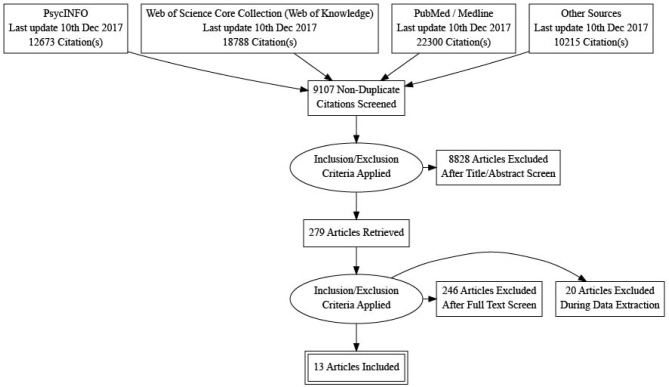
Burnout is an important problem for physicians, with a strong impact on their quality of life and a corresponding decrease in the quality of care with an evident economical burden for the healthcare system. However, the range of interventions used to decrease this problem could be very fragmented and with the aim to shed some light on this issue, this study reviews and summarizes the currently available studies. We conducted a systematic review using the Preferred Reporting Items for Systematic Reviews and Meta-Analysis (PRISMA) guidelines to identify studies about intervention on physician burnout. Two authors independently searched into scientific databases to analyze and review the full papers that met the inclusion criteria. As a result, from an initial search of 11029 articles, 13 studies met full criteria and were included in this review. Of the 13 studies presented, only 4 utilized randomized controlled trials, therefore the results should be interpreted with caution. Future interventions should focus on a more holistic approach using a wider range of techniques. According to the studies selected in this review, it appears that a successful intervention for burnout should take into account the broad range of causes incorporating a variety of therapeutic tools.
Overview
The claims and statistics of this paper haven’t been checked yet.
Run the check — free, no account needed. It reads the open-access text and checks the sources it cites.
Integrity signals
Registry
Cites
Statistics
Figures
Verification
Claims the paper makes
The claims and statistics of this paper haven’t been checked yet.
Run the check — free, no account needed. It reads the open-access text and checks the sources it cites.
Claims other papers make about this one
Each is checked against this paper’s own text: does it say what the citing paper says it does?
The cited source says what the claim attributes to it.
In the citing paper
“In regard to therapeutic strategies, a 2018 systematic review of 13 studies summarizes the results of the research in proposing training, starting from medical graduation, or coping strategies, interpersonal skills, management of negative emotions and relaxation techniques.[63]”
From Burnout syndrome among medical residents: A systematic review and meta-analysis (2018) · cites this paper as [63]
The cited source says what the claim attributes to it.
In the citing paper
“Although limited, emerging evidence suggests that creative art therapies can also reduce burnout among healthcare providers [15, 16].”
From Recruitment, retention and recouperation: lessons learned from a study aimed at assessing burnout mitigation in physician learners (2025) · cites this paper as [16]
Self-check
Percentages, sums and reported differences re-computed from the paper’s own numbers.
The self-check needs the paper’s full text.
Citations
Cites
Preferred Reporting Items for Systematic Reviews and Meta-Analyses: the PRISMA statement
Moher, D., Liberati, A., Tetzlaff, J., Altman, D. G., & for the PRISMA Group (2009) · BMJ · doi:10.1136/bmj.b2535 · Cited by 83,823
Preferred Reporting Items for Systematic Reviews and Meta-Analyses: The PRISMA Statement
Moher, D., Liberati, A., Tetzlaff, J., Altman, D. G., & The PRISMA Group (2009) · PLoS Medicine · doi:10.1371/journal.pmed.1000097 · Cited by 64,042
Preferred reporting items for systematic reviews and meta-analyses: the PRISMA Statement.
(2009) · PubMed Central · Cited by 44,859
Wang, G., Ma, R., Qiao, G., Wada, K., Aizawa, Y., & Satoh, T. (2015) · Integrative Medicine International · doi:10.1159/000368408 · Cited by 18,762
Maslach, C., Schaufeli, W. B., & Leiter, M. P. (2001) · Annual Review of Psychology · doi:10.1146/annurev.psych.52.1.397 · Cited by 12,852
Handbook of Industrial and Organizational Psychology.
Hammer, T. H., Anderson, J. F., Gurdon, M. A., Jick, T. D., Petit, A., Stern, R. N., Schwartz, H., Vardi, Y., & Dunnette, M. D. (1977) · Administrative Science Quarterly · doi:10.2307/2391755 · Cited by 11,947
(1996) · Consulting Psychologists Press eBooks · Cited by 7,863
A Review and an Integration of Research on Job Burnout
Cordes, C. L., & Dougherty, T. W. (1993) · Academy of Management Review · doi:10.5465/amr.1993.9402210153 · Cited by 2,753
The Burnout Companion to Study and Practice: A Critical Analysis
Schaufeli, W. B., & Enzmann, D. (2020) · CRC Press eBooks · doi:10.1201/9781003062745 · Cited by 2,184
Burnout and self-reported patient care in an internal medicine residency program
Shanafelt, T. D., Bradley, K. A., Wipf, J. E., & Back, A. L. (2002) · Annals of Internal Medicine · doi:10.7326/0003-4819-136-5-200203050-00008 · Cited by 2,165
Research works printed but not linked: 1
- Bergner T: Burnout beu Arzten: Lebensaufgabe statt Lebens-Aufgabe. Dtsch Arztebl 2004, 101(33): 2232-2234
Cited by
Sorted by citations
Burnout syndrome among medical residents: A systematic review and meta-analysis
Rodrigues, H., Cobucci, R., Oliveira, A., Cabral, J. V., Medeiros, L., Gurgel, K., Souza, T., & Gonçalves, A. K. (2018) · PLoS ONE · doi:10.1371/journal.pone.0206840 · Cited by 589
The psychological impact of the COVID-19 outbreak on health professionals: A cross-sectional study
Giusti, E. M., Pedroli, E., D'Aniello, G. E., Stramba Badiale, C., Pietrabissa, G., Manna, C., Stramba Badiale, M., Riva, G., Castelnuovo, G., & Molinari, E. (2020) · Frontiers in Psychology · doi:10.3389/fpsyg.2020.01684 · Cited by 533
Self-citationBurnout among healthcare workers in the COVID 19 era: a review of the existing literature
Leo, C. G., Sabina, S., Tumolo, M. R., Bodini, A., Ponzini, G., Sabato, E., & Mincarone, P. (2021) · Frontiers in Public Health · doi:10.3389/fpubh.2021.750529 · Cited by 303
Zhang, X.-J., Song, Y., Jiang, T., Ding, N., & Shi, T.-Y. (2020) · Medicine · doi:10.1097/md.0000000000020992 · Cited by 233
Metadata
- Authors
- Wiederhold, B. K., Cipresso, P., Pizzioli, D., Wiederhold, M., & Riva, G.
- Affiliations
- Virtual Reality Medical Center (US)
- Università Cattolica del Sacro Cuore (IT)
- Virtual Reality Medical Institute (BE)
- Corresponding author
- Wiederhold, Brenda K
- Venue
- Open Medicine
- Publisher
- Walter de Gruyter GmbH
- Published
- 2018-01-01
- Volume
- 13
- Issue
- 1
- Pages
- 253-263
- ISSN
- 1895-1058 (ISSN-L)
- 2391-5463
- PMC
- PMC6034099
- OpenAlex
- W2836537003
- Cited by
- 161
- References
- 77
- Citations by year
- 2026: 7 · 2025: 12 · 2024: 16 · 2023: 30 · 2022: 30 · 2021: 18 · 2020: 31 · 2019: 16 · 2018: 1
- FWCI
- 2.99
- Type
- journal article
- Language
- en
- Open access
- gold
- doi.org
- Licence
- Locations
- Open Medicine (publishedVersion, cc-by-nc-nd)
- Europe PMC (PubMed Central) (publishedVersion, cc-by-nc-nd)
- PubMed Central (publishedVersion, cc-by-nc-nd)
- PubMed (publishedVersion)
- Institutional Research Information System University of Turin (University of Turin) (submittedVersion, other-oa)
- DOAJ (DOAJ: Directory of Open Access Journals) (submittedVersion, cc-by-sa)
- Topics
- Health Sciences › Health Professions › General Health Professions › Healthcare professionals’ stress and burnout
- Social Sciences › Psychology › Social Psychology › Stress and Burnout Research
- Health Sciences › Medicine › Public Health, Environmental and Occupational Health › Occupational Health and Burnout
- Keywords
- physician burnout, burnout intervention, medical workforce, quality of care, quality of life, holistic intervention, therapeutic tools
About these checks
Registry, retraction, Cites and statistics results are computed, not judged, with one exception: a printed reference that no index lists is read once by a model before it counts as a citation error. Claims are extracted by a model and kept only when their quote appears verbatim in the text; each cited source is then checked, with a model’s help, for whether it says what the claim relies on. Those verdicts can be wrong — read the claim’s quote and the cited source before relying on one.
Statistics and arithmetic are recomputed, not judged.
Confidence bands are shown only for fields calibrated on our annotated test set. None is calibrated yet, so no band is shown.
What counts as a claim ›How we measure confidence ›How we check this ›
Are you an author, or do you see a problem with this page? Request a review
