

The DOI matches its Crossref record; 23 of the 24 references it cites were found in a registry or an index.
Pheromonally induced release of luteinizing hormone in male mice: involvement of the vomeronasal system
Open accessAbstract
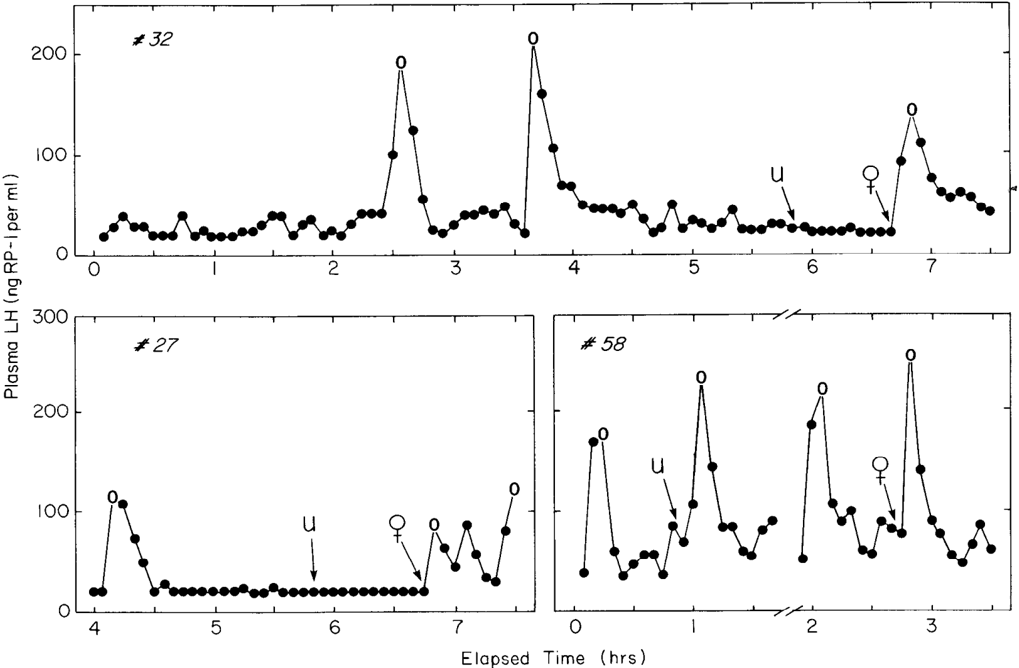
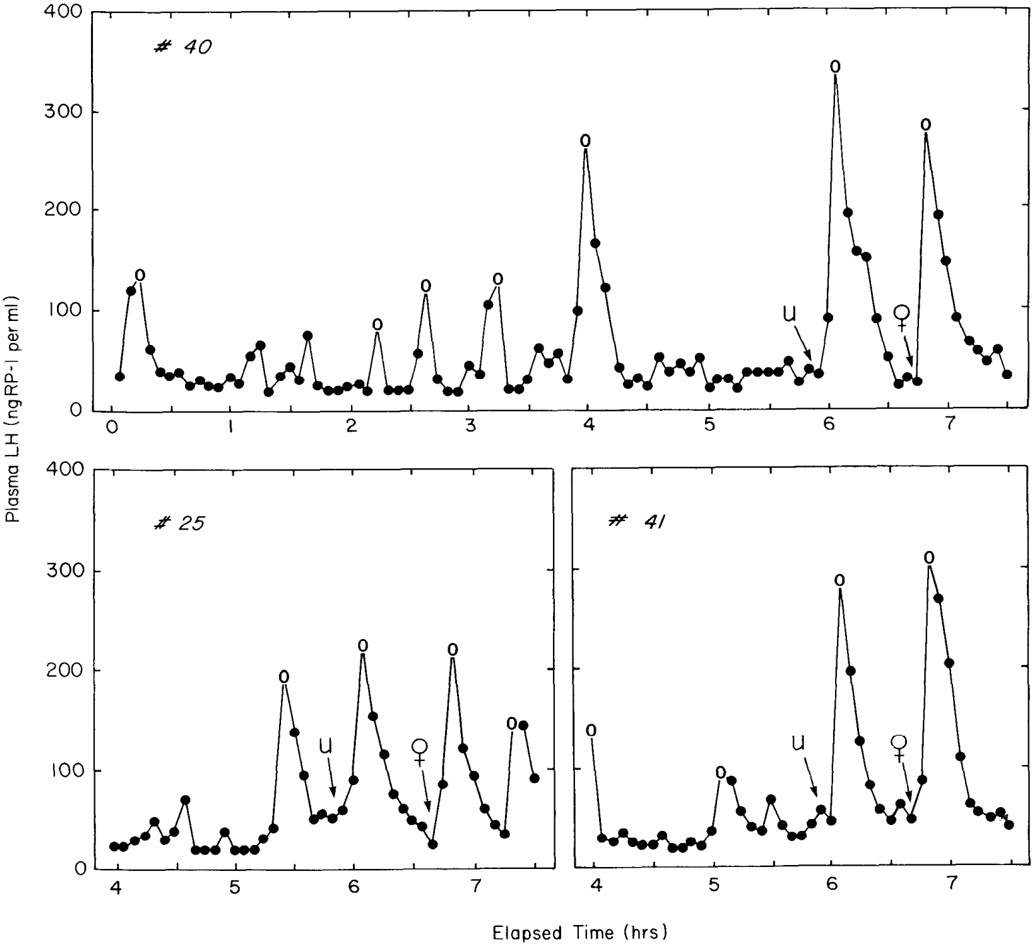
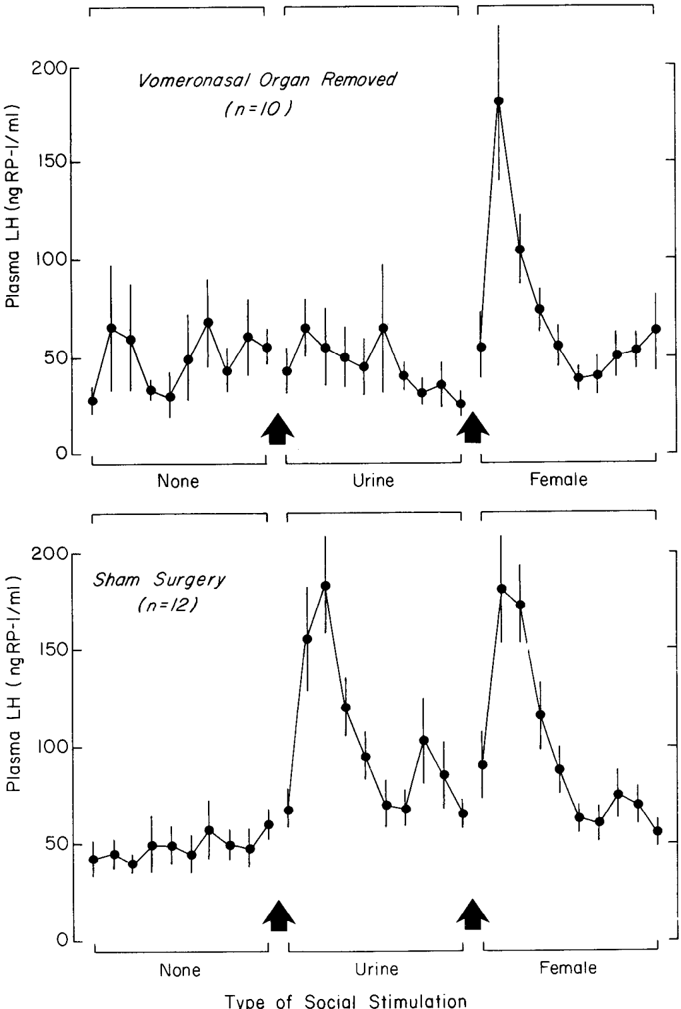
Evidence has accumulated demonstrating that the vomeronasal (accessory olfactory) system mediates intraspecific chemosensory communication in several mammals. For example, the neuroendocrine effects of priming pheromones in females and the behavioral responses to signaling pheromones in males are disrupted in mice with damage to the vomeronasal system. The experiment reported here examined the potential involvement of the vomeronasal system in the neuroendocrine reflexes observed in male mice following exposure to female and chemosensory stimuli. Excision of the vomeronasal organ (VNO) or sham VNO ablation was performed on sexually experienced males. Next, consecutive blood samples were withdrawn through chronic, intracardiac cannulas while the males were exposed to female mouse urine and then to an ovariectomized female. Plasma levels of luteinizing hormone (LH) were measured in the sequential samples by radioimmunoassay. Removal of the VNO did not affect the spontaneous pattern of episodic LH release that is characteristic of male mice. Reflexive release of LH following the urine stimulus was blocked in males lacking the VNO, but the female stimulus did cause LH responses in these mice. Our results therefore demonstrate that the VNO mediates pheromonally induced release of LH in male mice and that additional cues which emanate from behaving females also effectively stimulate a hormonal response in sexually experienced males.
Overview
The claims and statistics of this paper haven’t been checked yet.
Run the check — free, no account needed. It reads the open-access text and checks the sources it cites.
Integrity signals
Registry
Cites
Statistics
Figures
Verification
Claims the paper makes
The claims and statistics of this paper haven’t been checked yet.
Run the check — free, no account needed. It reads the open-access text and checks the sources it cites.
Claims other papers make about this one
Each is checked against this paper’s own text: does it say what the citing paper says it does?
The source backs part of the claim, not all of it — or backs it for a different population, condition or comparison.
In the citing paper
“The increase in serum luteinizing hormone and testosterone when male mice and hamsters are exposed to chemosensory stimuli from females appears to be absolutely dependent on vomeronasal integrity (Coquelin et al., 1984;Pfeiffer and Johnston, 1994).”
From Human Vomeronasal Organ Function: A Critical Review of Best and Worst Cases (2001) · cites this paper as Coquelin et al., 1984
Experimental — accuracy not yet measured
Self-check
Percentages, sums and reported differences re-computed from the paper’s own numbers.
The self-check needs the paper’s full text.
Citations
Cites
Introduction to Statistical Analysis.
Latshaw, V. V., Dixon, W. J., & Massey, F. J. (1957) · American Mathematical Monthly · doi:10.2307/2309989 · Cited by 5,072
Biology of the Laboratory Mouse
(1941) · JAMA · doi:10.1001/jama.1941.02820440081034 · Cited by 805
Neurobehavioral evidence for the involvement of the vomeronasal system in mammalian reproduction.
Wysocki, C. (1979) · Neuroscience and Biobehavioral Reviews · doi:10.1016/0149-7634(79)90015-0 · Cited by 478
Pheromones and Reproduction in Mammals
(1983) · Elsevier eBooks · doi:10.1016/b978-0-12-710780-6.x5001-8 · Cited by 416 · cited 1×
“The substances released by mammals often profoundly alter the reproductive processes of the individuals exposed to the stimuli (see reviews in Doty, 1976, and Vandenbergh, 1983).”
BackgroundGraham, J. M., & Desjardins, C. (1980) · Science · doi:10.1126/science.7434016 · Cited by 268 · cited 1×
“In male rats, an olfactory cue from a decidedly non-female originodor of wintergreen-has been shown by Graham and Desjardins (1980) to cause a neuroendocrine reflex when the conditioned stimulus previously had been associated with females in a sexual context.”
BackgroundStrange Females Increase Plasma Testosterone Levels in Male Mice
Macrides, F., Bartke, A., & Dalterio, S. L. (1975) · Science · doi:10.1126/science.1162363 · Cited by 184 · cited 1×
“Mediation of primer responses by the vomeronasal system in male mice is likely, given the neuroendocrine reflexes that are stimulated by females or by the urine of females (Macrides et al., 1975; Maruniak and Bronson, 1976).”
BackgroundSelf-citationSexual behavior and aggression in male mice: involvement of the vomeronasal system
Clancy, A., Coquelin, A., Macrides, F., Gorski, R., & Noble, E. P. (1984) · Journal of Neuroscience · doi:10.1523/jneurosci.04-09-02222.1984 · Cited by 180 · cited 8×
“Thus, excision of the VNO from 10 males virtually eliminated its afferent projections to the accessory olfactory bulb, whereas the projections of the VNO remained intact in the 12 mice receiving sham surgeries (see Clancy et al., 1984, for further details).”
BackgroundMethodInfluentialSelf-citationRussell, E. S., & Bernstein, S. E. (1966) · The Mouseion at the JAXlibrary (Jackson Laboratory) · Cited by 176
Bellringer, J. F., Pratt, H. P. M., & Keverne, E. B. (1980) · Reproduction · doi:10.1530/jrf.0.0590223 · Cited by 166 · cited 2×
“This function of the vomeronasal system in male ,mice seems analogous to its clearly documented role in the responses of female mice to pheromones (Reynolds and Keverne, 1979; Bellringer et al., 1980; Kaneko et al., 1980).”
BackgroundThe vomeronasal organ: Primary role in mouse chemosensory gender recognition
Wysocki, C. J., Nyby, J., Whitney, G., Beauchamp, G. K., & Katz, Y. (1982) · Physiology & Behavior · doi:10.1016/0031-9384(82)90021-x · Cited by 163 · cited 1×
“Furthermore, the vomeronasal system is involved in the ultrasonic vocalizations evoked in male mice by female odors and in the agonistic and copulatory behaviors of male mice, all of which are responses to signaling pheromones (Wysocki et al., 1982; Clancy et al., 1984).”
Background
Research works printed but not linked: 3
- Bronson, F. H. (1974) Pheromonal influences on reproductive activities in rodents. In Pheromones, M. C. Birch, ed., pp. 344-365, Elsevier, New York.
- Dixon, W. J., and F. J. Massey, Jr. (1969) Introduction to Statistical Anal&s. Ed. 3. McGraw-Hill. New York.
- Doty, 6. i. (1976) Mammalian'Olfaction, Reproductive Processes, and Bkhauior, Academic Press, Inc., New York.
Cited by
Sorted by citations
Items 101–127 of 127
Neural pathway from the olfactory bulbs regulating tonic gonadotropin secretion.
Pieper, D., & Newman, S. (1999) · Neuroscience and Biobehavioral Reviews · doi:10.1016/s0149-7634(98)00049-9 · Cited by 10
Sánchez‐Criado, J. E., Mora, O. A., & Gallego, A. (1989) · Progress in sensory physiology · doi:10.1007/978-3-642-74058-9_5 · Cited by 10
Introduction and Historical Perspective
Doty, R. L. (2015) · Wiley eBooks · doi:10.1002/9781118971758.ch1 · Cited by 10
“However, this does not occur following exposure to an awake female mouse, suggesting several sensory cues can produce the LH surge (Coquelin et al., 1984; Wysocki et al., 1983).”
InfluentialRepair of Reproductive Deficits by Neural Transplantation
Silverman, A., Silverman, R. C., & Gibson, M. J. (1990) · Biology of Reproduction · doi:10.1095/biolreprod42.1.29 · Cited by 10
Contreras, C. M., Gutiérrez‐García, A. G., & Molina‐Jiménez, T. (2013) · Behavioural Brain Research · doi:10.1016/j.bbr.2013.05.037 · Cited by 10
Mirto, A. J., Austin, K. J., Uthlaut, V. A., Roselli, C. E., & Alexander, B. M. (2015) · Applied Animal Behaviour Science · doi:10.1016/j.applanim.2015.09.001 · Cited by 9
“As opposed to rodents (Coquelin et al., 1984; Meredith, 1986; Keverne, 1999), the main olfactory bulb identifies sexually relevant odors in rams and is required for the expression of sexual behavior (Blissitt et al., 1990).”
BackgroundAlmeida, R. G., Massoco, C. D. O., Spinosa, H. D. S., & Bernardi, M. M. (1996) · Comparative Biochemistry and Physiology Part C Pharmacology Toxicology and Endocrinology · doi:10.1016/0742-8413(96)00013-8 · Cited by 7
Recent Advances in Reproductive Technologies
Honaramooz, A., Schlatt, S., Orwig, K. E., & Kim, N. H. (2011) · Veterinary Medicine International · doi:10.4061/2011/915031 · Cited by 6
Zufall, F., Leinders‐Zufall, T., & Puché, A. C. (2008) · Elsevier eBooks · doi:10.1016/b978-012370880-9.00128-6 · Cited by 6
Hormones and Neurotransmitters in the Mammalian Olfactory System a
Macrides, F., Schoenfeld, T. A., Clancy, A., Kumar, M. S., & Kream, R. (1987) · Annals of the New York Academy of Sciences · doi:10.1111/j.1749-6632.1987.tb36294.x · Cited by 5
Self-citationPheromones and Reproduction in Mammals
Petrulis, A. (2011) · Elsevier eBooks · doi:10.1016/b978-0-12-374928-4.10009-4 · Cited by 4
Male chemosignals inhibit the neural responses of male mice to female chemosignals
Reyes, R., Mendoza, J., Ballesteros, J., & Moffatt, C. A. (2004) · Brain Research Bulletin · doi:10.1016/j.brainresbull.2004.03.006 · Cited by 4
Garcia, M. S., Schwanzel-Fukuda, M., Morrell, J., & Pfaff, D. (1987) · Annals of the New York Academy of Sciences · doi:10.1111/j.1749-6632.1987.tb36317.x · Cited by 5
Lipocalycins Associated with Mammalian Pheromones
Singer, A., & Macrides, F. (1992) · Springer eBooks · doi:10.1007/978-1-4757-9655-1_19 · Cited by 6
Self-citationZuri, I., Nguyen, D., Daniels, Y. C., & Halpern, M. (2007) · Canadian Journal of Zoology · doi:10.1139/z07-022 · Cited by 3
“Males and females typically respond differentially to pheromones derived from conspecifics of the opposite sex, particularly those associated with reproduction, compared with pheromones from same-sexed conspecifics (e.g., Stern 1970; Nyby et al. 1979; Johnston and Bronson 1982; Vandenbergh 1983; Coquelin et al. 1984;…”
BackgroundAujard, F., Schilling, A., & Perret, M. (2005) · Brain Research · doi:10.1016/j.brainres.2005.02.056 · Cited by 3
Male Adaptations to Female Ovulation
Lund, E. M., & Miller, S. L. (2014) · Evolutionary psychology · doi:10.1007/978-1-4939-0314-6_5 · Cited by 2
DiRocco, D. P., & Xia, Z. (2007) · Nature Neuroscience · doi:10.1038/nn0807-938 · Cited by 2
Experiential and Endocrine Dependence of Gonadotropin Responses in Male Mice to Conspecific Urinea
Clancy, A. N., Bronson, F. H., Singer, A. G., Agosta, W. C., & Macrides, F. (1987) · Annals of the New York Academy of Sciences · doi:10.1111/j.1749-6632.1987.tb43512.x · Cited by 2
Self-citationEffect of different biostimulation methods on endocrinological profiles of mithun bulls
Perumal, P. (2018) · The Indian Journal of Animal Sciences · doi:10.56093/ijans.v88i11.85025 · Cited by 1
Comunicación química en primates
Cerda‐Molina, A. L., Ceballos, R. M., & Sánchez, V. D. (2000) · Salud Mental · Cited by 1
Categorization of Pheromonal Chemosignals by Medial Amygdala
Westberry, J. M. (2003) · Cited by 1
Fornai, F., & Orzi, F. (2001) · Neuroreport · doi:10.1097/00001756-200101220-00021 · Cited by 1
Goldey, K. L. (2015) · Deep Blue (University of Michigan) · Cited by 1
Estrogen Receptor Alpha in the Medial Preopic Area Mediates Male Rat Sexual Responses to Estrogen
Russell, N. V. (2022) · Digital Archive @ GSU · doi:10.57709/1397246 · Cited by 1
Dendritic neurotransmitter release and its modulation in accessory olfactory bulb circuits
Castro, J. B. (2008) · D-Scholarship@Pitt (University of Pittsburgh)
Pheromones and Reproduction in Mammals
Petrulis, A. (2011) · Elsevier eBooks · doi:10.1016/b978-0-12-374932-1.00056-1
Metadata
- Authors
- Coquelin, A., Clancy, A., Macrides, F., Noble, E., & Gorski, R.
- Affiliations
- University of California, Los Angeles (US)
- Venue
- The Journal of Neuroscience
- Publisher
- Society for Neuroscience
- Published
- 1984-09-01
- Volume
- 4
- Issue
- 9
- Pages
- 2230-2236
- ISSN
- 0270-6474 (ISSN-L)
- 1529-2401
- PMC
- PMC6564801
- OpenAlex
- W1868854124
- Cited by
- 127
- References
- 24
- Citations by year
- 2022: 1 · 2021: 1 · 2018: 2 · 2016: 1 · 2015: 3 · 2014: 4 · 2013: 3 · 2012: 3
- FWCI
- 4.34
- Type
- journal article
- Language
- en
- Open access
- hybrid
- doi.org
- Licence
- Locations
- Journal of Neuroscience (publishedVersion, cc-by-nc-sa)
- PubMed Central (publishedVersion)
- PubMed (publishedVersion)
- Topics
- Life Sciences › Neuroscience › Sensory Systems › Olfactory and Sensory Function Studies
- Health Sciences › Medicine › Reproductive Medicine › Hypothalamic control of reproductive hormones
- Life Sciences › Neuroscience › Endocrine and Autonomic Systems › Neuroendocrine regulation and behavior
- Keywords
- vomeronasal organ, vomeronasal system, luteinizing hormone, pheromones, chemosensory communication, male mice, female urine, ovariectomized females, reproductive hormones, intraspecific communication
- MeSH terms
- Animals, Castration, Horseradish Peroxidase, Luteinizing Hormone, Male, Mice, Inbred Strains, Nose, Pheromones, Sex Attractants, Mice
About these checks
Registry, retraction, Cites and statistics results are computed, not judged, with one exception: a printed reference that no index lists is read once by a model before it counts as a citation error. Claims are extracted by a model and kept only when their quote appears verbatim in the text; each cited source is then checked, with a model’s help, for whether it says what the claim relies on. Those verdicts can be wrong — read the claim’s quote and the cited source before relying on one.
Statistics and arithmetic are recomputed, not judged.
Confidence bands are shown only for fields calibrated on our annotated test set. None is calibrated yet, so no band is shown.
What counts as a claim ›How we measure confidence ›How we check this ›
Are you an author, or do you see a problem with this page? Request a review
