

The DOI matches its Crossref record; 23 of the 24 references it cites were found in a registry or an index.
Pheromonally induced release of luteinizing hormone in male mice: involvement of the vomeronasal system
Open accessAbstract
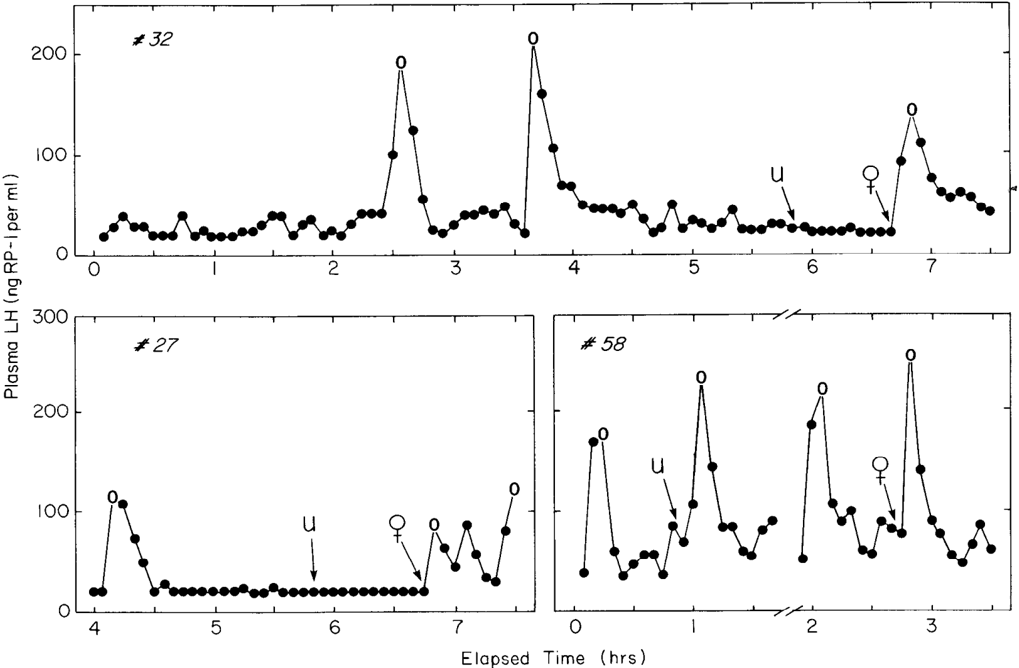
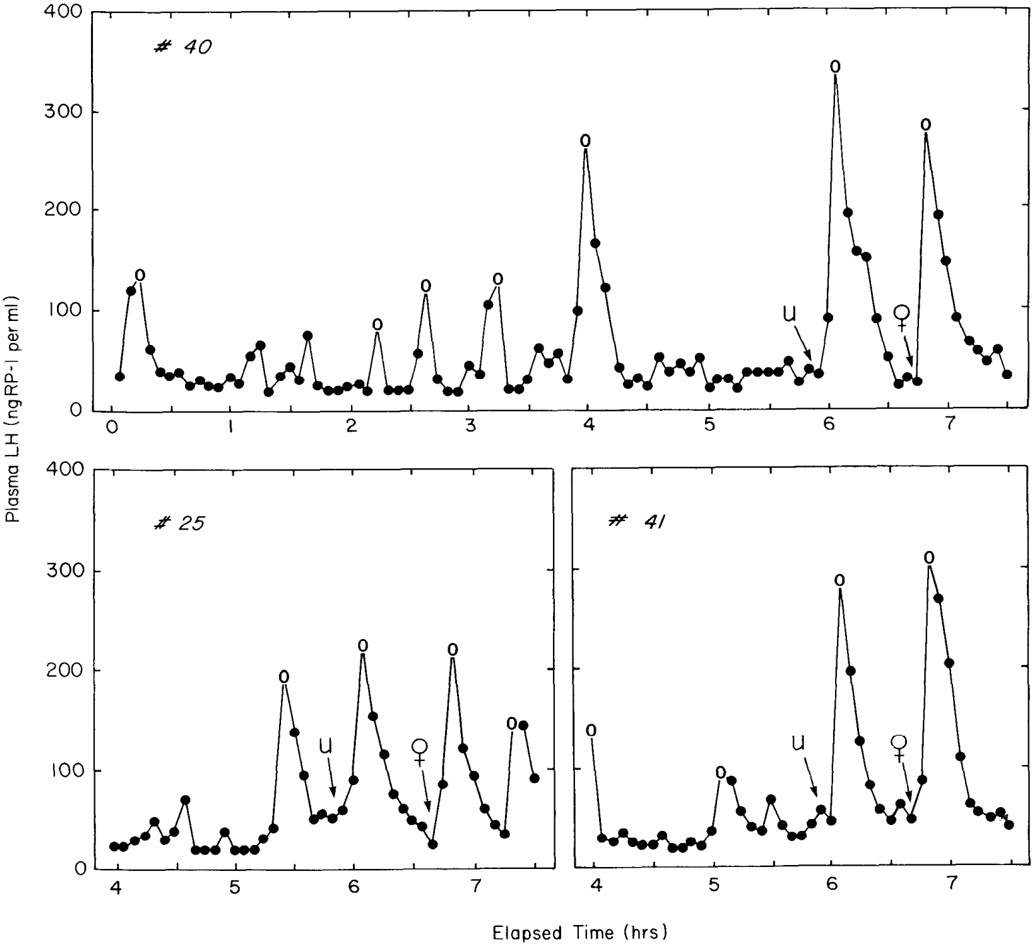
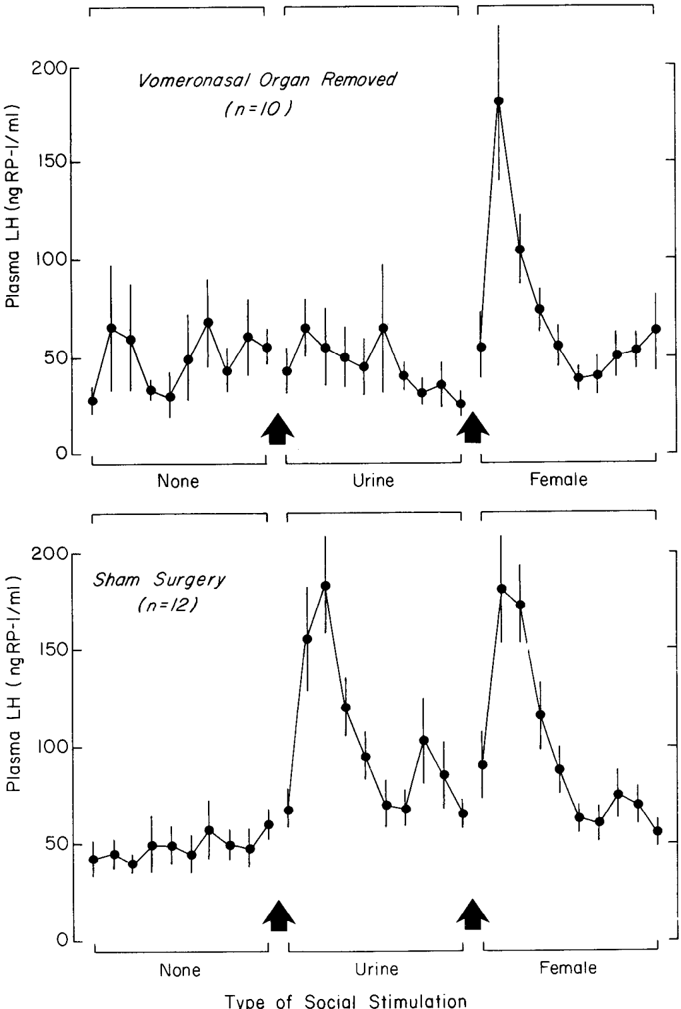
Evidence has accumulated demonstrating that the vomeronasal (accessory olfactory) system mediates intraspecific chemosensory communication in several mammals. For example, the neuroendocrine effects of priming pheromones in females and the behavioral responses to signaling pheromones in males are disrupted in mice with damage to the vomeronasal system. The experiment reported here examined the potential involvement of the vomeronasal system in the neuroendocrine reflexes observed in male mice following exposure to female and chemosensory stimuli. Excision of the vomeronasal organ (VNO) or sham VNO ablation was performed on sexually experienced males. Next, consecutive blood samples were withdrawn through chronic, intracardiac cannulas while the males were exposed to female mouse urine and then to an ovariectomized female. Plasma levels of luteinizing hormone (LH) were measured in the sequential samples by radioimmunoassay. Removal of the VNO did not affect the spontaneous pattern of episodic LH release that is characteristic of male mice. Reflexive release of LH following the urine stimulus was blocked in males lacking the VNO, but the female stimulus did cause LH responses in these mice. Our results therefore demonstrate that the VNO mediates pheromonally induced release of LH in male mice and that additional cues which emanate from behaving females also effectively stimulate a hormonal response in sexually experienced males.
Overview
The claims and statistics of this paper haven’t been checked yet.
Run the check — free, no account needed. It reads the open-access text and checks the sources it cites.
Integrity signals
Registry
Cites
Statistics
Figures
Verification
Claims the paper makes
The claims and statistics of this paper haven’t been checked yet.
Run the check — free, no account needed. It reads the open-access text and checks the sources it cites.
Claims other papers make about this one
Each is checked against this paper’s own text: does it say what the citing paper says it does?
The source backs part of the claim, not all of it — or backs it for a different population, condition or comparison.
In the citing paper
“The increase in serum luteinizing hormone and testosterone when male mice and hamsters are exposed to chemosensory stimuli from females appears to be absolutely dependent on vomeronasal integrity (Coquelin et al., 1984;Pfeiffer and Johnston, 1994).”
From Human Vomeronasal Organ Function: A Critical Review of Best and Worst Cases (2001) · cites this paper as Coquelin et al., 1984
Experimental — accuracy not yet measured
Self-check
Percentages, sums and reported differences re-computed from the paper’s own numbers.
The self-check needs the paper’s full text.
Citations
Cites
Introduction to Statistical Analysis.
Latshaw, V. V., Dixon, W. J., & Massey, F. J. (1957) · American Mathematical Monthly · doi:10.2307/2309989 · Cited by 5,072
Biology of the Laboratory Mouse
(1941) · JAMA · doi:10.1001/jama.1941.02820440081034 · Cited by 805
Neurobehavioral evidence for the involvement of the vomeronasal system in mammalian reproduction.
Wysocki, C. (1979) · Neuroscience and Biobehavioral Reviews · doi:10.1016/0149-7634(79)90015-0 · Cited by 478
Pheromones and Reproduction in Mammals
(1983) · Elsevier eBooks · doi:10.1016/b978-0-12-710780-6.x5001-8 · Cited by 416 · cited 1×
“The substances released by mammals often profoundly alter the reproductive processes of the individuals exposed to the stimuli (see reviews in Doty, 1976, and Vandenbergh, 1983).”
BackgroundGraham, J. M., & Desjardins, C. (1980) · Science · doi:10.1126/science.7434016 · Cited by 268 · cited 1×
“In male rats, an olfactory cue from a decidedly non-female originodor of wintergreen-has been shown by Graham and Desjardins (1980) to cause a neuroendocrine reflex when the conditioned stimulus previously had been associated with females in a sexual context.”
BackgroundStrange Females Increase Plasma Testosterone Levels in Male Mice
Macrides, F., Bartke, A., & Dalterio, S. L. (1975) · Science · doi:10.1126/science.1162363 · Cited by 184 · cited 1×
“Mediation of primer responses by the vomeronasal system in male mice is likely, given the neuroendocrine reflexes that are stimulated by females or by the urine of females (Macrides et al., 1975; Maruniak and Bronson, 1976).”
BackgroundSelf-citationSexual behavior and aggression in male mice: involvement of the vomeronasal system
Clancy, A., Coquelin, A., Macrides, F., Gorski, R., & Noble, E. P. (1984) · Journal of Neuroscience · doi:10.1523/jneurosci.04-09-02222.1984 · Cited by 180 · cited 8×
“Thus, excision of the VNO from 10 males virtually eliminated its afferent projections to the accessory olfactory bulb, whereas the projections of the VNO remained intact in the 12 mice receiving sham surgeries (see Clancy et al., 1984, for further details).”
BackgroundMethodInfluentialSelf-citationRussell, E. S., & Bernstein, S. E. (1966) · The Mouseion at the JAXlibrary (Jackson Laboratory) · Cited by 176
Bellringer, J. F., Pratt, H. P. M., & Keverne, E. B. (1980) · Reproduction · doi:10.1530/jrf.0.0590223 · Cited by 166 · cited 2×
“This function of the vomeronasal system in male ,mice seems analogous to its clearly documented role in the responses of female mice to pheromones (Reynolds and Keverne, 1979; Bellringer et al., 1980; Kaneko et al., 1980).”
BackgroundThe vomeronasal organ: Primary role in mouse chemosensory gender recognition
Wysocki, C. J., Nyby, J., Whitney, G., Beauchamp, G. K., & Katz, Y. (1982) · Physiology & Behavior · doi:10.1016/0031-9384(82)90021-x · Cited by 163 · cited 1×
“Furthermore, the vomeronasal system is involved in the ultrasonic vocalizations evoked in male mice by female odors and in the agonistic and copulatory behaviors of male mice, all of which are responses to signaling pheromones (Wysocki et al., 1982; Clancy et al., 1984).”
Background
Research works printed but not linked: 3
- Bronson, F. H. (1974) Pheromonal influences on reproductive activities in rodents. In Pheromones, M. C. Birch, ed., pp. 344-365, Elsevier, New York.
- Dixon, W. J., and F. J. Massey, Jr. (1969) Introduction to Statistical Anal&s. Ed. 3. McGraw-Hill. New York.
- Doty, 6. i. (1976) Mammalian'Olfaction, Reproductive Processes, and Bkhauior, Academic Press, Inc., New York.
Cited by
Sorted by citations
Olfactory Inputs to Hypothalamic Neurons Controlling Reproduction and Fertility
Yoon, H., Enquist, L. W., & Dulac, C. G. (2005) · Cell · doi:10.1016/j.cell.2005.08.039 · Cited by 435
“Experimental Design Chemosensory inputs have been reported in a number of rodent species to modulate the activity of LHRHexpressing neurons (Coquelin et al., 1984; Richardson et al., 2004).”
BackgroundFeedback Loops Link Odor and Pheromone Signaling with Reproduction
Boehm, U., Zou, Z., & Buck, L. B. (2005) · Cell · doi:10.1016/j.cell.2005.09.027 · Cited by 331
Membrane and synaptic properties of identified neurons in the olfactory bulb
Mori, K. (1987) · Progress in Neurobiology · doi:10.1016/0301-0082(87)90024-4 · Cited by 320
Steyn, F. J., Wan, Y., Clarkson, J., Veldhuis, J. D., Herbison, A. E., & Chen, C. (2013) · Endocrinology · doi:10.1210/en.2013-1502 · Cited by 304
“Seminal studies by Coquelin and coworkers (8, 9) and Kokoris et al (10) were the first to define the pulsatile patterns of LH secretion in the adult male mouse, and subsequent studies have provided similar information for adult female mice (11, 12).”
BackgroundStructure and function of the vomeronasal organ
Döving, K. B., & Trotier, D. (1998) · Journal of Experimental Biology · doi:10.1242/jeb.201.21.2913 · Cited by 293
Human Vomeronasal Organ Function: A Critical Review of Best and Worst Cases
Meredith, M. (2001) · Chemical Senses · doi:10.1093/chemse/26.4.433 · Cited by 280
“The increase in serum luteinizing hormone and testosterone when male mice and hamsters are exposed to chemosensory stimuli from females appears to be absolutely dependent on vomeronasal integrity (Coquelin et al., 1984; Pfeiffer and Johnston, 1994).”
BackgroundTestosterone release and social context: When it occurs and why
Gleason, E. D., Fuxjager, M. J., Oyegbile, T. O., & Marler, C. A. (2009) · Frontiers in Neuroendocrinology · doi:10.1016/j.yfrne.2009.04.009 · Cited by 268
Wersinger, S. R., & Rissman, E. F. (2000) · Journal of Neuroendocrinology · doi:10.1046/j.1365-2826.2000.00418.x · Cited by 198
Leptin signaling and circuits in puberty and fertility
Elias, C. F., & Purohit, D. (2012) · Cellular and Molecular Life Sciences · doi:10.1007/s00018-012-1095-1 · Cited by 200
“In response to opposite sex odors, males and females from different species exhibit increased circulating levels of gonadotropins and sex steroids [26, 85, 180, 214, 223, 264].”
BackgroundSexual behavior and aggression in male mice: involvement of the vomeronasal system
Clancy, A., Coquelin, A., Macrides, F., Gorski, R., & Noble, E. P. (1984) · Journal of Neuroscience · doi:10.1523/jneurosci.04-09-02222.1984 · Cited by 180
“…blocks a variety of pheromonally mediated responses in mice including pregnancy block (Bellringer et al., 1980), puberty acceleration (Kaneko et al., 1980), estrus suppression (Reynolds and Keverne, 1979), and the female-elicited LH/T surge in males (Wysocki et al., 1983; Coquelin et al., 1984).”
BackgroundResultInfluentialSelf-citationFernandez-Fewell, G. D., & Meredith, M. (1994) · Journal of Neuroscience · doi:10.1523/jneurosci.14-06-03643.1994 · Cited by 176
“Given the evidence for an LH response in males exposed to females (Wysocki et al., 1983; Coquelin et al., 1984) it seems more likely that there is activation, but at too low a level to be visible as an increase in Fos expression.”
BackgroundTHE OSTEOLOGY OF RHOMBOMYLUS (MAMMALIA, GLIRES): IMPLICATIONS FOR PHYLOGENY AND EVOLUTION OF GLIRES
Meng, J., Hu, Y., & Li, C. (2003) · Bulletin of the American Museum of Natural History · doi:10.1206/0003-0090(2003)275 · Cited by 172
Consequences of removing the vomeronasal organ
Wysocki, C. J., & Lepri, J. J. (1991) · The Journal of Steroid Biochemistry and Molecular Biology · doi:10.1016/0960-0760(91)90265-7 · Cited by 177
Regulation of neuronal growth cone filopodia by nitric oxide
Wagenen, S. V., & Rehder, V. (1999) · Journal of Neurobiology · doi:10.1002/(sici)1097-4695(199905)39:2 · Cited by 77
Chemosignals, hormones and mammalian reproduction
Petrulis, A. (2013) · Hormones and Behavior · doi:10.1016/j.yhbeh.2013.03.011 · Cited by 142
“VNO removal eliminates or reduces LH/androgen surges in both sexually experienced and naïve males in response to female chemosignals, but not to the female herself; damage to MOE is without effect (Coquelin et al., 1984; Pfeiffer and Johnston, 1994; Wysocki et al., 1983).”
Hypothalamic Sites of Leptin Action Linking Metabolism and Reproduction
Donato, J., Cravo, R. M., Frazão, R., & Elias, C. F. (2010) · Neuroendocrinology · doi:10.1159/000322472 · Cited by 141
The “male effect” in sheep and goats: a review of the respective roles of the two olfactory systems
Gelez, H., & Fabre‐Nys, C. (2004) · Hormones and Behavior · doi:10.1016/j.yhbeh.2004.05.002 · Cited by 140
Pfeiffer, C. A., & Johnston, R. E. (1994) · Physiology & Behavior · doi:10.1016/0031-9384(94)90020-5 · Cited by 125
Satou, M. (1990) · Progress in Neurobiology · doi:10.1016/0301-0082(90)90004-z · Cited by 123
Sensory processing in the main and accessory olfactory systems: Comparisons and contrasts
Meredith, M. (1991) · The Journal of Steroid Biochemistry and Molecular Biology · doi:10.1016/0960-0760(91)90258-7 · Cited by 155
Halem, H. A., Baum, M. J., & Cherry, J. A. (2001) · The Journal of Neuroscience · doi:10.1523/jneurosci.21-07-02474.2001 · Cited by 108
“For example, in male mice, exposure to female pheromones facilitates luteinizing hormone secretion (Johnston and Bronson, 1982; Coquelin et al., 1984) and stimulates ultrasonic vocalizations (Nyby et al.”
BackgroundDaikoku‐Ishido, H., Okamura, Y., Yanaihara, N., & Daikoku, S. (1990) · Developmental Biology · doi:10.1016/0012-1606(90)90087-y · Cited by 108
Vomeronasal, Olfactory, Hormonal Convergence in the Brain: Cooperation or Coincidence? a
MEREDITH, M. (1998) · Annals of the New York Academy of Sciences · doi:10.1111/j.1749-6632.1998.tb10593.x · Cited by 121
Estrogen Receptor α Influences Socially Motivated Behaviors
Imwalle, D. B., Scordalakes, E. M., & Rissman, E. F. (2002) · Hormones and Behavior · doi:10.1006/hbeh.2002.1837 · Cited by 95
Sexual Differentiation of the Neuroendocrine Mechanisms Regulating Mate Recognition in Mammals
Bakker, J. (2003) · Journal of Neuroendocrinology · doi:10.1046/j.1365-2826.2003.01036.x · Cited by 91
Terminal nerve damage impairs the mating behavior of the male hamster.
Wirsig, C., & Leonard, C. (1987) · Brain Research · doi:10.1016/0006-8993(87)90454-9 · Cited by 78
McGivern, R. F., Sokol, R. Z., & Berman, N. (1991) · Toxicology and Applied Pharmacology · doi:10.1016/s0041-008x(05)80003-1 · Cited by 81
Evolution of the Amygdala in Vertebrates
Martínez‐Garciá, F., Novejarque, A., & Lanuza, E. (2007) · Elsevier eBooks · doi:10.1016/b0-12-370878-8/00139-7 · Cited by 80
Vomeronasal organ removal and female mouse aggression: The role of experience
Bean, N. J., & Wysocki, C. J. (1989) · Physiology & Behavior · doi:10.1016/0031-9384(89)90209-6 · Cited by 79
The combined role of the main olfactory and vomeronasal systems in social communication in mammals
Kelliher, K. R. (2007) · Hormones and Behavior · doi:10.1016/j.yhbeh.2007.08.012 · Cited by 82
“;) an effect that appears primarily (or absolutely in the case of hamsters) mediated by vomeronasal organ (Wysocki et al., 1983; Coquelin et al., 1984; Pfeiffer and Johnston, 1994).”
BackgroundMediation of male mouse urine marking and aggression by the vomeronasal organ
MARUNIAK, J. A., Wysocki, C. J., & Taylor, J. A. (1986) · Physiology & Behavior · doi:10.1016/0031-9384(86)90300-8 · Cited by 75
Petrulis, A., Peng, M., & Johnston, R. E. (1999) · Physiology & Behavior · doi:10.1016/s0031-9384(98)00259-5 · Cited by 74
Processing by the main olfactory system of chemosignals that facilitate mammalian reproduction
Baum, M. J., & Cherry, J. A. (2014) · Hormones and Behavior · doi:10.1016/j.yhbeh.2014.06.003 · Cited by 79
Aujard, F. (1997) · Physiology & Behavior · doi:10.1016/s0031-9384(97)00206-0 · Cited by 73
Mouse vomeronasal organ: Effects on chemosignal production and maternal behavior
Lepri, J. J., Wysocki, C. J., & Vandenbergh, J. G. (1985) · Physiology & Behavior · doi:10.1016/0031-9384(85)90416-0 · Cited by 71
Mori, K., Imamura, K., Fujita, S. C., & Obata, K. (1987) · Neuroscience · doi:10.1016/0306-4522(87)90018-2 · Cited by 71
Inhibition Shapes Sex Selectivity in the Mouse Accessory Olfactory Bulb
Hendrickson, R. C., Krauthamer, S., Essenberg, J. M., & Holy, T. E. (2008) · Journal of Neuroscience · doi:10.1523/jneurosci.2715-08.2008 · Cited by 69
“This hormonal surge may (Coquelin et al., 1984) or may not (Pfeiffer and Johnston, 1994) rely exclusively on the accessory olfactory system.”
Kumar, A., Dudley, C. A., & Moss, R. L. (1999) · Journal of Neuroscience · doi:10.1523/jneurosci.19-20-j0003.1999 · Cited by 68
“The publication date is the date of posting online at www.jneurosci.org. http://www.jneurosci.org/cgi /content/full /3549 in luteinizing hormone and testosterone (Wysocki et al., 1983; Coquelin et al., 1984) and to promote copulatory behavior (Clancy et al., 1984).”
BackgroundA chemistry of mammalian pheromones
Singer, A. G. (1991) · The Journal of Steroid Biochemistry and Molecular Biology · doi:10.1016/0960-0760(91)90261-3 · Cited by 66
Dudley, C. A., & Moss, R. L. (1999) · Neuroscience · doi:10.1016/s0306-4522(98)00711-8 · Cited by 63
Clancy, A. N., Macrides, F., Singer, A. G., & Agosta, W. C. (1984) · Physiology & Behavior · doi:10.1016/0031-9384(84)90386-x · Cited by 83
Self-citationNeuroanatomical pathways linking vision and olfaction in mammals
Cooper, H. M., Parvopassu, F., Herbin, M., & Magnin, M. (1994) · Psychoneuroendocrinology · doi:10.1016/0306-4530(94)90046-9 · Cited by 63
Neural pathways involved in the endocrine response of anestrous ewes to the male or its odor
Gelez, H., & Fabre‐Nys, C. (2006) · Neuroscience · doi:10.1016/j.neuroscience.2006.02.066 · Cited by 61
Schwanzel-Fukuda, M., Garcia, M. S., Morrell, J., & Pfaff, D. (1987) · The Journal of comparative neurology · doi:10.1002/cne.902550207 · Cited by 60
The functionality of the human vomeronasal organ (VNO): Evidence for steroid receptors
Berliner, D. L., Monti-Bloch, L., Jennings-White, C., & Diaz-Sanchez, V. (1996) · The Journal of Steroid Biochemistry and Molecular Biology · doi:10.1016/0960-0760(96)00062-3 · Cited by 87
Female odors stimulate CART neurons in the ventral premammillary nucleus of male rats
Cavalcante, J. C., Bittencourt, J. C., & Elias, C. F. (2006) · Physiology & Behavior · doi:10.1016/j.physbeh.2006.03.032 · Cited by 58
Vomeronasal system, LHRH, and sex behaviour
Meredith, M. J., & Fernandez-Fewell, G. (1994) · Psychoneuroendocrinology · doi:10.1016/0306-4530(94)90048-5 · Cited by 57
Samuelsen, C. L., & Meredith, M. J. (2009) · Neuroscience · doi:10.1016/j.neuroscience.2009.09.030 · Cited by 58
Chiropteran vomeronasal complex and the interfamilial relationships of bats
Wible, J. R., & Bhatnagar, K. P. (1996) · Journal of Mammalian Evolution · doi:10.1007/bf02077447 · Cited by 55
“Among mammals, the VNO is widely distributed (Broom, 1897; Wysocki, 1979) and sensory input from it has been implicated in the control of sexual behavior (Coquelin et al., 1984; Halpern, 1987; Meredith and Fernfindez-Fewell, 1994).”
BackgroundFernandez-Fewell, G., & Meredith, M. J. (1995) · Physiology & Behavior · doi:10.1016/0031-9384(94)00276-b · Cited by 52
Mendoza, A. S. (1993) · Annals of Anatomy · doi:10.1016/s0940-9602(11)80110-x · Cited by 53
Role of the Vomeronasal Organ in Neonatal Offspring Recognition in Sheep1
Booth, K. K., & Katz, L. S. (2000) · Biology of Reproduction · doi:10.1095/biolreprod63.3.953 · Cited by 50
Men Smelling Women: Null Effects of Exposure to Ovulatory Sweat on Men's Testosterone
Roney, J. R., & Simmons, Z. L. (2012) · Evolutionary Psychology · doi:10.1177/147470491201000404 · Cited by 48
Wysocki, C., Beauchamp, G., Reidinger, R. R., & Wellington, J. (1985) · Journal of Chemical Ecology · doi:10.1007/bf01024105 · Cited by 18
“, 1980), modulation of hormone levels (Wysocki et al., 1983; Coquelin et al., 1984), maternal behavior (Fleming et al.”
Johnston, R. E., & Peng, M. (2000) · Physiology & Behavior · doi:10.1016/s0031-9384(00)00304-8 · Cited by 48
Alexander, B. M., Stellflug, J. N., Rose, J. D., Fitzgerald, J. A., & Moss, G. E. (1999) · Journal of Animal Science · doi:10.2527/1999.7771869x · Cited by 47
Das vomeronasale Organ des Menschen
Knecht, M., Witt, M., Abolmaali, N., Hüttenbrink, K., & Hummel, T. R. (2003) · Der Nervenarzt · doi:10.1007/s00115-003-1573-7 · Cited by 45
Sexual Modulation of Testosterone: Insights for Humans from Across Species
Goldey, K. L., & van Anders, S. M. (2014) · Adaptive Human Behavior and Physiology · doi:10.1007/s40750-014-0005-1 · Cited by 45
“However, while removal of the vomeronasal organ in male mice blocked LH responses to female urine, LH still responded to an interaction with a female, suggesting that visual and/or auditory components of female behavior can compensate for the lack of pheromonal stimuli (Coquelin et al. 1984).”
BackgroundJansen, H. T., Iwamoto, G. A., & Jackson, G. L. (1998) · Brain Research Bulletin · doi:10.1016/s0361-9230(97)00279-7 · Cited by 45
The Septal Region and Social Behavior
Sheehan, T. P., & Numan, M. (2000) · Springer eBooks · doi:10.1007/978-1-4612-1302-4_8 · Cited by 46
The Ventral Premammillary Nucleus Links Metabolic Cues and Reproduction
Donato, J., & Elias, C. F. (2011) · Frontiers in Endocrinology · doi:10.3389/fendo.2011.00057 · Cited by 46
“In response to conspecific odors, males and females of different species exhibit increased circulating levels of gonadotropins and sex steroids (Maruniak and Bronson, 1976; Kamel et al., 1977; Beltramino and Taleisnik, 1983; Coquelin et al., 1984).”
BackgroundKelliher, K. R., & Wersinger, S. R. (2009) · ILAR Journal · doi:10.1093/ilar.50.1.28 · Cited by 40
Anand, S., Losee-Olson, S. H., Turek, F. W., & Horton, T. H. (2002) · Endocrinology · doi:10.1210/endo.143.6.8839 · Cited by 39
“LH and T secretion as well as behavioral changes have been shown to be induced in male mice, sheep, and Golden hamsters by exposure to conspecific females (16, 17, 19).”
BackgroundAggarwal, S., Tang, C., Sing, K., Kim, H. W., Millar, R. P., & Tello, J. A. (2018) · Neuroendocrinology · doi:10.1159/000496106 · Cited by 41
Westberry, J. M., & Meredith, M. J. (2003) · Brain Research · doi:10.1016/s0006-8993(03)02535-6 · Cited by 38
ROLE OF THE VOMERONASAL INPUT IN MATERNAL BEHAVIOR
del Cerro, M. C. R. (1998) · Psychoneuroendocrinology · doi:10.1016/s0306-4530(98)00060-2 · Cited by 36
“hormone levels (Coquelin et al. 1984; Pfeiffer and Johnston 1994), in aggression (Novikov,”
BackgroundPfeiffer, C. A., & Johnston, R. E. (1992) · Hormones and Behavior · doi:10.1016/0018-506x(92)90048-z · Cited by 37
Mendoza, A. S., & Szabó, K. (1988) · Brain Research · doi:10.1016/0165-3806(88)90030-2 · Cited by 35
Odor here, odor there: chemosensation and reproductive function
Keverne, E. B. (2005) · Nature Neuroscience · doi:10.1038/nn1205-1637 · Cited by 34
The Chemistry of Vomeronasally Detected Pheromones: Characterization of an Aphrodisiac Protein a
Singer, A., Agosta, W. C., Clancy, A., & Macrides, F. (1987) · Annals of the New York Academy of Sciences · doi:10.1111/j.1749-6632.1987.tb36304.x · Cited by 35
Self-citationUltrasonic vocalizations by adult prairie voles,Microtus ochrogaster
Lepri, J. J., Theodorides, M. L., & Wysocki, C. J. (1988) · Cellular and Molecular Life Sciences · doi:10.1007/bf01941736 · Cited by 33
Intracerebroventricular LHRH relieves behavioral deficits due to vomeronasal organ removal
Meredith, M. J., & Howard, G. (1992) · Brain Research Bulletin · doi:10.1016/0361-9230(92)90011-l · Cited by 33
Gelez, H., & Fabre‐Nys, C. (2006) · annales de biologie animale biochimie biophysique · doi:10.1051/rnd:2006021 · Cited by 30
“For example, the destruction of the VNO impairs the surge of LH and testosterone elicited by female odor in both sexually naive and experienced males [55,56].”
BackgroundThe vomeronasal system in mice: From the nose to the hypothalamus- and back!
Boehm, U. (2006) · Seminars in Cell and Developmental Biology · doi:10.1016/j.semcdb.2006.04.013 · Cited by 31
Chemical properties of a female mouse pheromone that stimulates gonadotropin secretion in males.
Singer, A., Clancy, A., Macrides, F., Agosta, W. C., & Bronson, F. (1988) · Biology of Reproduction · doi:10.1095/biolreprod38.1.193 · Cited by 31
Self-citationDistribution of the neuronal inputs to the ventral premammillary nucleus of male and female rats
Cavalcante, J. C., Bittencourt, J. C., & Elias, C. F. (2014) · Brain Research · doi:10.1016/j.brainres.2014.07.034 · Cited by 29
Johnston, R., & delBarco‐Trillo, J. (2009) · Elsevier eBooks · doi:10.1016/b978-008088783-8.00011-5 · Cited by 28
“In male mammals the VNO is also important in modulation of hormones; for example, lesions of the VNO or the AOB eliminate the following effects: (1) an increase in LH and testosterone in male mice after exposure to female mice or their odors (Coquelin and Bronson, 1980; Coquelin et al., 1984) and (2) increases in test…”
BackgroundLoi, P. K., & Tublitz, N. J. (2000) · The Journal of Comparative Neurology · doi:10.1002/(sici)1096-9861(20000515)420:4 · Cited by 38
Experiential and endocrine dependence of gonadotropin responses in male mice to conspecific urine.
Clancy, A., Singer, A., Macrides, F., Bronson, F., & Agosta, W. (1988) · Biology of Reproduction · doi:10.1095/biolreprod38.1.183 · Cited by 19
Self-citationVomeronasal organ: electrical stimulation activates Fos in mating pathways and in GnRH neurons
Meredith, M. J., & Fewell, G. D. (2001) · Brain Research · doi:10.1016/s0006-8993(01)03153-5 · Cited by 26
Blake, C. B., & Meredith, M. J. (2011) · Neuroscience · doi:10.1016/j.neuroscience.2011.05.056 · Cited by 25
“Conspecific chemosignals are known to induce testosterone surges in hamsters (Macrides et al., 1974) and mice (Coquelin et al., 1984), an effect dependent on an intact vomeronasal organ in both species (Pfeiffer and Johnston, 1994; Coquelin et al., 1984; Wysocki et al., 1983).”
Luteinizing Hormone‐Releasing Hormone in the Vomeronasal System and Terminal Nerve of the Hamster a
Lehman, M. N., Newman, S., & Silverman, A. (1987) · Annals of the New York Academy of Sciences · doi:10.1111/j.1749-6632.1987.tb36300.x · Cited by 28
Dulka, J. G., & Stacey, N. E. (1991) · Journal of Experimental Zoology · doi:10.1002/jez.1402570212 · Cited by 25
The Mammalian Vomeronasal System: Its Role in Learning and Social Behaviors
Wysocki, C. J., Bean, N. J., & Beauchamp, G. K. (1986) · Springer eBooks · doi:10.1007/978-1-4613-2235-1_36 · Cited by 24
Booth, K. K., & Webb, E. C. (2010) · Veterinary Medicine International · doi:10.4061/2011/305468 · Cited by 28
“Pheromones, which are detected by the vomeronasal organ [25], are known to influence a variety of animal activities from sexual maturation to maternal offspring recognition during nursing [3, 26–41].”
BackgroundSaito, H., Mimmack, M. L., Keverne, E. B., Kishimoto, J., & Emson, P. C. (1998) · Molecular Brain Research · doi:10.1016/s0169-328x(98)00183-1 · Cited by 23
Russell, N. V., Ogaga-Mgbonyebi, E. V., Habteab, B. S., Dunigan, A. I., Tesfay, M. A., & Clancy, A. N. (2012) · Hormones and Behavior · doi:10.1016/j.yhbeh.2012.04.017 · Cited by 22
Self-citationBeny, Y., & Kimchi, T. (2016) · Genes Brain & Behavior · doi:10.1111/gbb.12320 · Cited by 21
“…of cop-ulatory behavioral and physiological responses in sexually naïve males, for example the rapid elevation of circulating luteinizing hormone (Coquelin et al. 1984; Gleason et al. 2009; Goldey & van Anders 2014) and testosterone levels (Amstislavskaya et al. 2013; Gleason et al. 2009; Swaney…”
BackgroundGore, A. C., Wersinger, S. R., & Rissman, E. F. (2000) · Journal of Neuroendocrinology · doi:10.1046/j.1365-2826.2000.00578.x · Cited by 22
Blissitt, M. J., Bland, K. P., & Cottrell, D. F. (1990) · Applied Animal Behaviour Science · doi:10.1016/0168-1591(90)90128-z · Cited by 21
Sex-specific Responses to Urinary Chemicals by the Mouse Vomeronasal Organ
Thompson, R. N. (2004) · Chemical Senses · doi:10.1093/chemse/bjh076 · Cited by 21
“For example, in male mice, exposure to female pheromones facilitates luteinizing hormone secretion (Johnston and Bronson, 1982; Coquelin et al., 1984) and stimulates ultrasonic vocalizations (Nyby et al., 1979), whereas exposure to male pheromones elicits inter-male aggressive behavior (Guillot and…”
BackgroundMota‐Rojas, D., Marcet‐Rius, M., Freitas‐de‐Melo, A., Muns, R., Mora‐Medina, P., Domínguez-Oliva, A., & Orihuela, A. (2021) · Animals · doi:10.3390/ani11113092 · Cited by 22
Olfactory Systems in Mate Recognition and Sexual Behavior
Keller, M., Pillon, D., & Bakker, J. (2010) · Vitamins and hormones · doi:10.1016/s0083-6729(10)83014-6 · Cited by 19
“…indirectly) to GnRH neurons (Boehm et al., 2005), and various experiments suggest that pheromonal signals processed through these systems have the potential to activate these neurons (Coquelin et al., 1984; Meredith and Fewell, 2001; Pfeiffer and Johnston, 1994; Westberry and Meredith, 2003a,b).”
BackgroundMoeller, J. F., & Meredith, M. J. (1998) · Brain Research · doi:10.1016/s0006-8993(98)00683-0 · Cited by 17
The Role of the Vomeronasal Organ in Behavioral Control of Reproduction
JOHNS, M. A. (1986) · Annals of the New York Academy of Sciences · doi:10.1111/j.1749-6632.1986.tb28007.x · Cited by 16
Dudley, C. A., Chakravarty, S., & Barnea, A. (2001) · Brain Research · doi:10.1016/s0006-8993(01)02820-7 · Cited by 15
Wirsig‐Wiechmann, C. R. (1993) · Physiology & Behavior · doi:10.1016/0031-9384(93)90201-p · Cited by 15
Anand, S., Turek, F. W., & Horton, T. H. (2004) · Biology of Reproduction · doi:10.1095/biolreprod.103.019380 · Cited by 14
“This is in contrast with the well-documented ability of urine from female mice to induce LH and testosterone secretion in male mice [5, 6, 9, 30, 31].”
ResultSelective enhancement of main olfactory input to the medial amygdala by GnRH
Blake, C. B., & Meredith, M. J. (2009) · Brain Research · doi:10.1016/j.brainres.2009.10.078 · Cited by 14
“Inmalemice, the LH increase occurs within 5 min of female chemosensory exposure (Coquelin et al., 1984), implying a rapid intracerebral release of GnRH.”
BackgroundInfluentialAlmeida, R. G., Flório, J. C., Spinosa, H. D. S., & Bernardi, M. M. (2002) · Neurotoxicology and Teratology · doi:10.1016/s0892-0362(02)00203-9 · Cited by 11
Metadata
- Authors
- Coquelin, A., Clancy, A., Macrides, F., Noble, E., & Gorski, R.
- Affiliations
- University of California, Los Angeles (US)
- Venue
- The Journal of Neuroscience
- Publisher
- Society for Neuroscience
- Published
- 1984-09-01
- Volume
- 4
- Issue
- 9
- Pages
- 2230-2236
- ISSN
- 0270-6474 (ISSN-L)
- 1529-2401
- PMC
- PMC6564801
- OpenAlex
- W1868854124
- Cited by
- 127
- References
- 24
- Citations by year
- 2022: 1 · 2021: 1 · 2018: 2 · 2016: 1 · 2015: 3 · 2014: 4 · 2013: 3 · 2012: 3
- FWCI
- 4.34
- Type
- journal article
- Language
- en
- Open access
- hybrid
- doi.org
- Licence
- Locations
- Journal of Neuroscience (publishedVersion, cc-by-nc-sa)
- PubMed Central (publishedVersion)
- PubMed (publishedVersion)
- Topics
- Life Sciences › Neuroscience › Sensory Systems › Olfactory and Sensory Function Studies
- Health Sciences › Medicine › Reproductive Medicine › Hypothalamic control of reproductive hormones
- Life Sciences › Neuroscience › Endocrine and Autonomic Systems › Neuroendocrine regulation and behavior
- Keywords
- vomeronasal organ, vomeronasal system, luteinizing hormone, pheromones, chemosensory communication, male mice, female urine, ovariectomized females, reproductive hormones, intraspecific communication
- MeSH terms
- Animals, Castration, Horseradish Peroxidase, Luteinizing Hormone, Male, Mice, Inbred Strains, Nose, Pheromones, Sex Attractants, Mice
About these checks
Registry, retraction, Cites and statistics results are computed, not judged, with one exception: a printed reference that no index lists is read once by a model before it counts as a citation error. Claims are extracted by a model and kept only when their quote appears verbatim in the text; each cited source is then checked, with a model’s help, for whether it says what the claim relies on. Those verdicts can be wrong — read the claim’s quote and the cited source before relying on one.
Statistics and arithmetic are recomputed, not judged.
Confidence bands are shown only for fields calibrated on our annotated test set. None is calibrated yet, so no band is shown.
What counts as a claim ›How we measure confidence ›How we check this ›
Are you an author, or do you see a problem with this page? Request a review
