

The DOI matches its Crossref record; 29 of the 29 references it cites were found in a registry or an index.
The phase of ongoing oscillations mediates the causal relation between brain excitation and visual perception.
Open accessAbstract
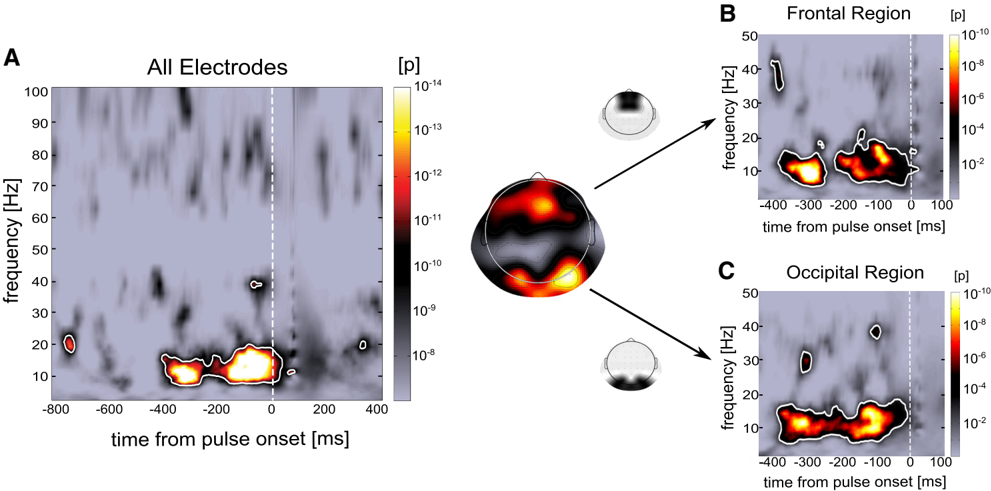
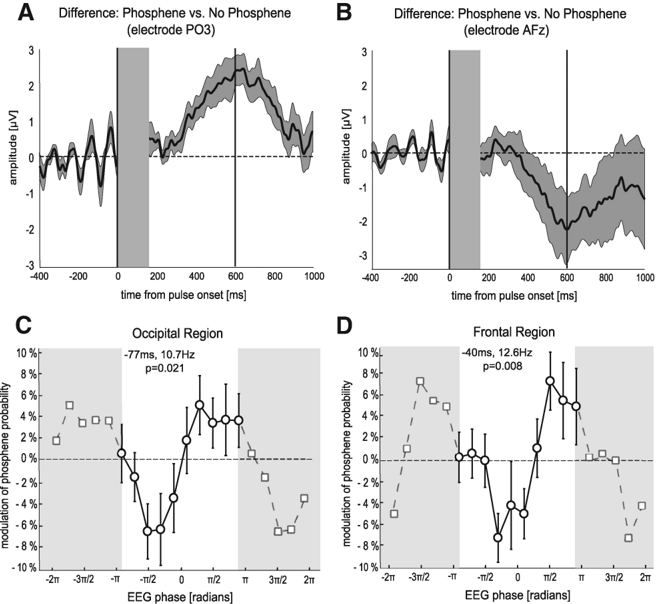
Why does neuronal activity in sensory brain areas sometimes give rise to perception, and sometimes not? Although neuronal noise is often invoked as the key factor, a portion of this variability could also be due to the history and current state of the brain affecting cortical excitability. Here we directly test this idea by examining whether the phase of prestimulus oscillatory activity is causally linked with modulations of cortical excitability and with visual perception. Transcranial magnetic stimulation (TMS) was applied over human visual cortex to induce illusory perceptions (phosphenes) while electroencephalograms (EEGs) were simultaneously recorded. Subjects reported the presence or absence of an induced phosphene following a single pulse of TMS at perceptual threshold. The phase of ongoing alpha (∼10 Hz) oscillations within 400 ms before the pulse significantly covaried with the perceptual outcome. This effect was observed in occipital regions around the site of TMS, as well as in a distant frontocentral region. In both regions, we found a systematic relationship between prepulse EEG phase and perceptual performance: phosphene probability changed by ∼15% between opposite phases. In summary, we provide direct evidence for a chain of causal relations between the phase of ongoing oscillations, neuronal excitability, and visual perception: ongoing oscillations create periodic "windows of excitability," with sensory perception being more likely to occur at specific phases.
Overview
The claims and statistics of this paper haven’t been checked yet.
Run the check — free, no account needed. It reads the open-access text and checks the sources it cites.
Integrity signals
Registry
Cites
Statistics
Figures
Verification
Claims the paper makes
The claims and statistics of this paper haven’t been checked yet.
Run the check — free, no account needed. It reads the open-access text and checks the sources it cites.
Claims other papers make about this one
Each is checked against this paper’s own text: does it say what the citing paper says it does?
In the citing paper
“Moreover, it has been shown in humans that there is a causal relationship between cortical excitation and phosphenes perception so that the phase of pre-stimulus oscillatory activity seems linked to visual perception (Dugue et al., 2011)”
From Toward a personalized closed-loop stimulation of the visual cortex: Advances and challenges (2022) · cites this paper as Dugue et al., 2011
In the citing paper
“This has been reported in experiments in rats (Allison-Walker et al., 2020) and using non-invasive transcranial magnetic stimulation (TMS) in sighted humans (Dugue et al., 2011), but the feasibility of LFP phase-locked stimulation with intracortical electrodes in humans still remains unexplored.”
From Toward a personalized closed-loop stimulation of the visual cortex: Advances and challenges (2022) · cites this paper as Dugue et al., 2011
In the citing paper
“it seems that the frequency of ongoing oscillations is around 10 Hz (Dugue et al., 2011)”
From Toward a personalized closed-loop stimulation of the visual cortex: Advances and challenges (2022) · cites this paper as Dugue et al., 2011
Self-check
Percentages, sums and reported differences re-computed from the paper’s own numbers.
The self-check needs the paper’s full text.
Citations
Cites
Neuronal Oscillations in Cortical Networks
Buzsáki, G., & Draguhn, A. (2004) · Science · doi:10.1126/science.1099745 · Cited by 6,576
Rossi, S., Hallett, M., Rossini, P. M., & Pascual-Leone, A. (2009) · Clinical Neurophysiology · doi:10.1016/j.clinph.2009.08.016 · Cited by 5,367
Wassermann, E. M. (1998) · Electroencephalography and Clinical Neurophysiology/Evoked Potentials Section · doi:10.1016/s0168-5597(97)00096-8 · Cited by 2,337
Lakatos, P., Shah, A. S., Knuth, K. H., Ulbert, I., Karmos, G., & Schroeder, C. E. (2005) · Journal of Neurophysiology · doi:10.1152/jn.00263.2005 · Cited by 1,281
The Phase of Ongoing EEG Oscillations Predicts Visual Perception
Busch, N. A., Dubois, J., & VanRullen, R. (2009) · Journal of Neuroscience · doi:10.1523/jneurosci.0113-09.2009 · Cited by 1,208
Fries, P., Nikolić, D., & Singer, W. (2007) · Trends in Neurosciences · doi:10.1016/j.tins.2007.05.005 · Cited by 1,044
Entrainment of Neocortical Neurons and Gamma Oscillations by the Hippocampal Theta Rhythm
Sirota, A., Montgomery, S., Fujisawa, S., Isomura, Y., Zugaro, M., & Buzsáki, G. (2008) · Neuron · doi:10.1016/j.neuron.2008.09.014 · Cited by 1,015
To See or Not to See: Prestimulus α Phase Predicts Visual Awareness
Mathewson, K. E., Gratton, G., Fabiani, M., Beck, D. M., & Ro, T. (2009) · Journal of Neuroscience · doi:10.1523/jneurosci.3963-08.2009 · Cited by 1,011
Prestimulus Oscillatory Activity in the Alpha Band Predicts Visual Discrimination Ability
van Dijk, H., Schoffelen, J., Oostenveld, R., & Jensen, O. B. (2008) · Journal of Neuroscience · doi:10.1523/jneurosci.1853-07.2008 · Cited by 831
Romei, V., Brodbeck, V., Michel, C. M., Amedi, A., Pascual‐Leone, Á., & Thut, G. (2007) · Cerebral Cortex · doi:10.1093/cercor/bhm229 · Cited by 717
Cited by
Sorted by citations
Items 101–200 of 366
Brain activity underlying visual perception and attention as inferred from TMS–EEG: A review
Taylor, P. C. J., & Thut, G. (2012) · Brain stimulation · doi:10.1016/j.brs.2012.03.003 · Cited by 56
“In addition to alpha power, the phase of ongoing alphaoscillations predicts perception at phosphene threshold [25].”
İşcan, Z., Nazarova, M. A., Fedele, T., Blagovechtchenski, E., & Nikulin, V. V. (2016) · Frontiers in Human Neuroscience · doi:10.3389/fnhum.2016.00504 · Cited by 55
“…of Neurology, Moscow, Russia, 3 Department of Neurosurgery, University Hospital of Zurich, University of Zurich, Zurich, Switzerland, 4 Laboratory of Neuroscience and Molecular Pharmacology, Institute of Translational Biomedicine, Saint Petersburg State University, Saint Petersburg, Russia, 5…”
BackgroundInfluentialPhasic Modulation of Human Somatosensory Perception by Transcranially Applied Oscillating Currents
Gundlach, C., Müller, M. M., Nierhaus, T., Villringer, A., & Sehm, B. (2016) · Brain stimulation · doi:10.1016/j.brs.2016.04.014 · Cited by 54
“Recent evidence in the visual domain demonstrated that visual perception varies as a function of the phase of ongoing visual alpha oscillations [19–21,75,76].”
BackgroundTranscranial Magnetic Stimulation Reveals Intrinsic Perceptual and Attentional Rhythms
Dugué, L., & VanRullen, R. (2017) · Frontiers in Neuroscience · doi:10.3389/fnins.2017.00154 · Cited by 50
“…VanRullen, 2010; Dugué et al., 2015a, 2016; Landau et al., 2015), perception (e.g., Ergenoglu et al., 2004; Busch et al., 2009; Romei et al., 2010; Dugué et al., 2011b), and memory (e.g., Jensen et al., 2002; Bonnefond and Jensen, 2012), have been correlated to oscillations in specific brain areas…”
InfluentialHigh-frequency neural oscillations and visual processing deficits in schizophrenia
Tan, H. M., Lana, L., & Uhlhaas, P. J. (2013) · Frontiers in Psychology · doi:10.3389/fpsyg.2013.00621 · Cited by 53
“The alpha-band rhythm (8–12 Hz) is particularly relevant for the understanding of visual perception as the alpha cycle modulates perceptual detection rates (Valera et al., 1981; Dugué et al., 2011).”
BackgroundLateralized power spectra of the EEG as an index of visuospatial attention
Lubbe, R. H. J. V. D., & Utzerath, C. (2013) · Advances in Cognitive Psychology · doi:10.5709/acp-0144-7 · Cited by 52
Bompas, A., Sumner, P., Muthumumaraswamy, S. D., Singh, K. D., & Gilchrist, I. D. (2014) · NeuroImage · doi:10.1016/j.neuroimage.2014.11.057 · Cited by 49
“This absence contrastswith the robust role of pre-stimulus alpha phase in visual perception for near-threshold stimuli (Busch et al., 2009; Dugue et al., 2011; Mathewson et al., 2009) and may be due to differences in task requirements or statistical power issues.”
Terhune, D. B., Murray, E., Near, J., Stagg, C. J., Cowey, A., & Kadosh, R. C. (2015) · Cerebral Cortex · doi:10.1093/cercor/bhv015 · Cited by 50
“2008) and intra-individual variability in phosphene perception is driven in part by endogenous fluctuations in prestimulus α-band power and phase (Romei, Brodbeck, et al. 2008; Dugué et al. 2011; Romei et al. 2012).”
BackgroundRhythmic sampling revisited: Experimental paradigms and neural mechanisms
Kienitz, R., Schmid, M. C., & Dugué, L. (2021) · European Journal of Neuroscience · doi:10.1111/ejn.15489 · Cited by 55
“…performance during perception and attention tasks on pre-stimulus phases in the lower frequency range (Busch et al., 2009; Busch & VanRullen, 2010; Dugué et al., 2011; Dugué, Marque, & VanRullen, 2015a; Fakche et al., 2021; Mathewson et al., 2009), post-stimulus phase-locking (Dugué, Marque, &…”
The Triple-Flash Illusion Reveals a Driving Role of Alpha-Band Reverberations in Visual Perception
Gulbinaite, R., İlhan, B., & Rufin Vanrullen, A. (2017) · Journal of Neuroscience · doi:10.1523/jneurosci.3929-16.2017 · Cited by 49
“These findings are in accordance with previous reports linking relatively lower occipito-parietal alpha power and certain alpha phases to higher cortical excitability and better visual sensitivity (Romei et al., 2008; Mathewson et al., 2009; Dugue et al., 2011; Lange et al., 2013).”
BackgroundResultInfluentialHamm, J. P., Dyckman, K. A., McDowell, J. E., & Clementz, B. A. (2012) · Journal of Neuroscience · doi:10.1523/jneurosci.5198-11.2012 · Cited by 50
“Yet, other investigations have found similar pre-trial alpha phase effects in occipital sensors (Mathewson et al., 2009, Dugué et al., 2011).”
ResultWilsch, A., Mercier, M. R., Obleser, J., Schroeder, C. E., & Haegens, S. (2020) · Journal of Cognitive Neuroscience · doi:10.1162/jocn_a_01567 · Cited by 45
The Effect of Alpha tACS on the Temporal Resolution of Visual Perception
Battaglini, L., Mena, F., Ghiani, A., Casco, C., Melcher, D., & Ronconi, L. (2020) · Frontiers in Psychology · doi:10.3389/fpsyg.2020.01765 · Cited by 50
Goldsworthy, M. R., Vallence, A., Yang, R., Pitcher, J. B., & Ridding, M. C. (2015) · European Journal of Neuroscience · doi:10.1111/ejn.13142 · Cited by 46
“…on the down-going phase of the alpha oscillation than on the up-going phase (Haegens et al., 2011), and transcranial magnetic stimulation (TMS)-induced phosphene detection is greater during the trough than the peak of the alpha oscillation recorded in the human visual cortex (Dugue et al., 2011).”
BackgroundEvoked Alpha Power is Reduced in Disconnected Consciousness During Sleep and Anesthesia
Darracq, M., Funk, C. M., Polyakov, D., Riedner, B. A., Gosseries, O., Nieminen, J. O., Bonhomme, V. L., Brichant, J. F., Boly, M., Laureys, S., et al. (2018) · Scientific Reports · doi:10.1038/s41598-018-34957-9 · Cited by 48
O’Hare, L., & Hibbard, P. B. (2015) · Cephalalgia · doi:10.1177/0333102415618952 · Cited by 43
“These are ongoing rhythms of the visual cortex, thought to be the readiness state of the visual areas of the brain, and involved in controlling perception (119), termed a ‘window of excitability’ (120).”
BackgroundZazio, A., Ruhnau, P., Weisz, N., & Wutz, A. (2021) · European Journal of Neuroscience · doi:10.1111/ejn.15138 · Cited by 41
“Intriguingly, our finding on prestimulus alpha phase match the results of a previous EEG study (Dugué et al., 2011), in which prestimulus alphaband activity in both posterior and frontalcentral electrodes predicted phosphene perception evoked by near- threshold transcranial magnetic stimulation.”
ResultTranscranial magnetic stimulation to frontal but not occipital cortex disrupts endogenous attention
Fernández, A., Hanning, N. M., & Carrasco, M. (2023) · Proceedings of the National Academy of Sciences · doi:10.1073/pnas.2219635120 · Cited by 39
“exogenous attention manipulation (1), and also similar to dual-pulse protocols that have been successfully used before in visual perception and attention tasks (66,77,80).”
Human Brain Oscillations: From Physiological Mechanisms to Analysis and Cognition
Jensen, O. B., Spaak, E., & Zumer, J. M. (2014) · Springer eBooks · doi:10.1007/978-3-642-33045-2_17 · Cited by 47
Han, B., & Rufin Vanrullen, A. (2017) · Scientific Reports · doi:10.1038/srep43573 · Cited by 42
“…2013), which has already been suggested based on attentional phase effects on perception (Busch et al., 2009; Busch and VanRullen, 2010), reaction time (Drewes and VanRullen, 2011; Huang et al., 2015; Song et al., 2014) and perceptual variability in TMS-induced effects (Dugue et al., 2015, 2011).”
Individual Alpha Frequency Predicts Perceived Visuotactile Simultaneity
Migliorati, D., Zappasodi, F., Perrucci, M. G., Donno, B., Northoff, G., Romei, V., & Costantini, M. (2019) · Journal of Cognitive Neuroscience · doi:10.1162/jocn_a_01464 · Cited by 42
Griffiths, B., Zaehle, T., Repplinger, S., Schmitt, F. C., Voges, J., Hanslmayr, S., & Staudigl, T. (2022) · Nature Communications · doi:10.1038/s41467-022-31407-z · Cited by 40
Concurrent TMS/fMRI reveals individual DLPFC dose-response pattern
Tik, M., Vasileiadi, M., Woletz, M., Linhardt, D., Schuler, A., Williams, N., & Windischberger, C. (2023) · NeuroImage · doi:10.1016/j.neuroimage.2023.120394 · Cited by 40
“Thirdly, intrinsic excitability fluctuations may differ considerably across cortical regions (Dugu ´ e et al., 2011; Gal et al., 2010; Johnson et al., 2012).”
BackgroundPrestimulus EEG alpha oscillations modulate task-related fMRI BOLD responses to auditory stimuli
Walz, J. M., Goldman, R. I., Carapezza, M. A., Muraskin, J., Brown, T. R., & Sajda, P. (2015) · NeuroImage · doi:10.1016/j.neuroimage.2015.03.028 · Cited by 40
“Alpha phase has also been associated with behavioral performance related to visual perception (Dugue et al., 2011; Mathewson et al., 2009), but the brain regions underlying such phase effects are yet to be identified (Palva & Palva, 2011).”
α Phase-Amplitude Tradeoffs Predict Visual Perception
Fakche, C., Rufin Vanrullen, A., Marqué, P., & Dugué, L. (2022) · eNeuro · doi:10.1523/eneuro.0244-21.2022 · Cited by 39
“This average was then compared with a surrogate distribution obtained with a permutation procedure (Dugué et al., 2011a, 2015; VanRullen, 2016b) consisting in shuffling the perceived-phosphene and unperceived-phosphene labels (5000 repetitions) and recalculating phase-locking values (including…”
Influentialde Graaf, T. A., Thomson, A. C., Janssens, S. E. W., van Bree, S., ten Oever, S., & Sack, A. T. (2020) · European Journal of Neuroscience · doi:10.1111/ejn.14677 · Cited by 35
Cortical localization of phase and amplitude dynamics predicting access to somatosensory awareness
Hirvonen, J., & Palva, S. (2015) · Human Brain Mapping · doi:10.1002/hbm.23033 · Cited by 37
“Importantly, phase dynamics in both delta [Besle et al., 2011; Schroeder and Lakatos, 2009] as well as in alpha [Drewes and Vanrullen, 2011; Dugue et al., 2011] bands have been shown to regulate neuronal excitability fluctuations and thereby to support sensory perception of attended information.”
BackgroundOscillatory Correlates of Visual Consciousness
Gallotto, S., Sack, A. T., Schuhmann, T., & de Graaf, T. A. (2017) · Frontiers in Psychology · doi:10.3389/fpsyg.2017.01147 · Cited by 41
“It is thus non-trivial that similar alpha power/phase effects on conscious experience (phosphene perception) were found in these studies (Romei et al., 2008a; Dugué et al., 2011).”
BackgroundPrestimulation phase predicts the TMS-evoked response
Kundu, B., Johnson, J. S., & Postle, B. R. (2014) · Journal of Neurophysiology · doi:10.1152/jn.00390.2013 · Cited by 35
“…our data support the proposal that fluctuation in the phase of an underlying oscillation effectively creates " windows of excitability " during which the brain, or a particular brain area, is in a state that is more open to perturbation or communication with other brain areas (Dugué et al. 2011).”
EEG brain waves and alpha rhythms: Past, current and future direction
Pascucci, D., Menétrey, M. Q., Passarotto, E., Luo, J., Paramento, M., & Rubega, M. (2025) · Neuroscience & Biobehavioral Reviews · doi:10.1016/j.neubiorev.2025.106288 · Cited by 34
“In particular, TMS and tACS have emerged as powerful tools for causally probing the involvement of alpha rhythms in a frequency-and region-specific manner (Dugu ´ e et al., 2011).”
State-Dependent Visual Processing
Britz, J., & Michel, C. M. (2011) · Frontiers in Psychology · doi:10.3389/fpsyg.2011.00370 · Cited by 35
“…by means of single-pulse transcranial magnetic stimulation (TMS) have been shown to be modulated by both spontaneous trial-to-trial variations (Romei et al., 2008a) and inter-individual differences (Romei et al., 2008b) in pre-stimulus posterior alpha power and alpha phase (Dugué et al., 2011).”
BackgroundLocal entrainment of oscillatory activity induced by direct brain stimulation in humans
Amengual, J. L., Vernet, M., Adam, C., & Valero‐Cabré, A. (2017) · Scientific Reports · doi:10.1038/srep41908 · Cited by 31
Tapia, E., & Beck, D. M. (2014) · Frontiers in Psychology · doi:10.3389/fpsyg.2014.01173 · Cited by 36
“Similarly, alpha phase predicts whether or not participants will experience a TMS induced occipital phosphene (Dugué et al., 2011).”
BackgroundRonconi, L., & Marotti, R. B. (2017) · Consciousness and Cognition · doi:10.1016/j.concog.2017.04.020 · Cited by 31
Fehér, K. D., Nakataki, M., & Morishima, Y. (2017) · Frontiers in Human Neuroscience · doi:10.3389/fnhum.2017.00471 · Cited by 33
“In humans, the variability of neural response and behavioral performance has been shown to depend on ongoing endogenous and experimentally induced neural oscillations (Dugué et al., 2011; Fellinger et al., 2011; VanRullen et al., 2011; Neuling et al., 2012; Riecke et al., 2015).”
BackgroundTranscranial magnetic stimulation entrains alpha oscillatory activity in occipital cortex
Lin, Y.-J., Shukla, L., Dugué, L., Valero‐Cabré, A., & Carrasco, M. (2021) · Scientific Reports · doi:10.1038/s41598-021-96849-9 · Cited by 39
Rhythmic Gamma Stimulation Affects Bistable Perception
Cabral‐Calderín, Y., Schmidt‐Samoa, C., & Wilke, M. (2015) · Journal of Cognitive Neuroscience · doi:10.1162/jocn_a_00781 · Cited by 31
Functional Dissociation of Ongoing Oscillatory Brain States
Salari, N., Büchel, C., & Rose, M. (2012) · PLoS ONE · doi:10.1371/journal.pone.0038090 · Cited by 35
“A recent TMS EEG study has assured a frequency specific phase modulation in the alpha band range before stimulus onset [25].”
BackgroundAutomatized set‐up procedure for transcranial magnetic stimulation protocols
Harquel, S., Diard, J., Raffin, E., Passera, B., Dall'Igna, G., Marendaz, C., David, O., & Chauvin, A. (2017) · NeuroImage · doi:10.1016/j.neuroimage.2017.04.001 · Cited by 32
“For example, the model could be modified for developing a phosphene tresholding procedure over the occipital cortex (Dugué et al., 2011; Herring et al., 2015).”
MethodAlpha Power Modulates Perception Independently of Endogenous Factors
Brüers, S., & Rufin Vanrullen, A. (2018) · Frontiers in Neuroscience · doi:10.3389/fnins.2018.00279 · Cited by 30
“…magnetic stimulation (TMS) between (Romei et al., 2008a) as well as within subjects: participants were more likely to report a “phosphene” (illusory percept) when the ongoing EEG alpha power was (relatively) lower (Romei et al., 2008a, replicated by Dugué et al., 2011 and Samaha et al., 2017).”
BackgroundTop–Down Control of Alpha Phase Adjustment in Anticipation of Temporally Predictable Visual Stimuli
Solís‐Vivanco, R., Jensen, O. B., & Bonnefond, M. (2018) · Journal of Cognitive Neuroscience · doi:10.1162/jocn_a_01280 · Cited by 32
Estimation of phase in EEG rhythms for real-time applications
McIntosh, J. R., & Sajda, P. (2020) · Journal of Neural Engineering · doi:10.1088/1741-2552/ab8683 · Cited by 31
“This may be of interest, for example in order to explain brain activity and behavior after an event, given a rhythms phase at the moment of that event [11, 12, 13, 14, 15, 16, 17, 18].”
BackgroundManganotti, P., Formaggio, E., Felice, A. D., Storti, S. F., Zamboni, A., Bertoldo, A., Fiaschi, A., & TOFFOLO, G. M. (2013) · Frontiers in Human Neuroscience · doi:10.3389/fnhum.2013.00767 · Cited by 32
“…www.frontiersin.org November 2013 | Volume 7 | Article 767 | 6 “fnhum-07-00767” — 2013/11/18 — 11:00 — page 7 — #7 been identified in the phase locking of ongoing brain oscillations (Dugué et al., 2011), the encoding of different aspects of the stimulus by different frequencies (“multiplexing;””
BackgroundAt What Latency Does the Phase of Brain Oscillations Influence Perception?
Brüers, S., & Rufin Vanrullen, A. (2017) · eNeuro · doi:10.1523/eneuro.0078-17.2017 · Cited by 30
“…and phase has been studied using transcranial magnetic stimulation (TMS) and electroencephalography (EEG): an illusory percept (a “phosphene”) was most likely to occur when the TMS pulse was applied at a certain phase of the ongoing EEG oscillation than at the opposite phase (Dugué et al., 2011).”
BackgroundEEG, MEG and neuromodulatory approaches to explore cognition: Current status and future directions
Beppi, C., Violante, I. R., Scott, G., & Sandrone, S. (2021) · Brain and Cognition · doi:10.1016/j.bandc.2020.105677 · Cited by 41
Perceptual inference employs intrinsic alpha frequency to resolve perceptual ambiguity
Shen, L., Han, B., Chen, L., & Chen, Q. (2019) · PLoS Biology · doi:10.1371/journal.pbio.3000025 · Cited by 31
“It has been proposed that perception is discrete and cyclic in a manner of perceptual cycles [15,16,45,61,62].”
Are alpha oscillations instrumental in multisensory synchrony perception?
BASTIAANSEN, M. C. M., Berberyan, H. S., Stekelenburg, J. J., Schoffelen, J., & Vroomen, J. (2020) · Brain Research · doi:10.1016/j.brainres.2020.146744 · Cited by 30
“, 2009), saccadic reaction times to a peripheral target (Drewes and VanRullen, 2011), and the detection of a TMS-induced phosphene (Dugué et al., 2011) all depend on the phase of occipital alpha oscillations immediately preceding stimulus onset.”
Nakayama, R., & Motoyoshi, I. (2019) · Journal of Neuroscience · doi:10.1523/jneurosci.2494-18.2019 · Cited by 30
“Correlation of EEG phase with binding performance We subsequently examined the effect of neural oscillatory phases, specifically before stimulus onset (Busch et al., 2009; Mathewson et al., 2009; Dugué et al., 2011; Chakravarthi and VanRullen, 2012), on slow attentional binding performance.”
BackgroundResting-State Alpha-Band Oscillations in Migraine
O’Hare, L., Menchinelli, F., & Durrant, S. J. (2018) · Perception · doi:10.1177/0301006618755639 · Cited by 29
“The alpha band is thought to control the processing of visual stimuli and has been called the ‘window of excitability’ (Dugue et al., 2011).”
BackgroundCan Oscillatory Alpha-Gamma Phase-Amplitude Coupling be Used to Understand and Enhance TMS Effects?
Wagner, J., Makeig, S., Hoopes, D., & Gola, M. (2019) · Frontiers in Human Neuroscience · doi:10.3389/fnhum.2019.00263 · Cited by 23
Michail, G., Jenner, L. T., & Keil, J. (2021) · European Journal of Neuroscience · doi:10.1111/ejn.15169 · Cited by 29
“(2014) extended this idea and proposed that neural oscillations provide windows of opportunity for stimulus processing (Dugué et al., 2011).”
BackgroundUsing brain stimulation to disentangle neural correlates of conscious vision
de Graaf, T. A., & Sack, A. T. (2014) · Frontiers in Psychology · doi:10.3389/fpsyg.2014.01019 · Cited by 30
“The relevance of these alpha oscillations had already been probed with TMS by demonstrating that their power (Romei et al., 2008) and phase (Dugué et al., 2011) at TMS pulse onset directly reflected visual cortex excitability as measured by phosphene perception.”
BackgroundMethodDistinct perceptual rhythms for feature and conjunction searches
Dugué, L., Xue, A. M., & Carrasco, M. (2017) · Journal of Vision · doi:10.1167/17.3.22 · Cited by 30
“This proposal is primarily based on observations in the visual domain (e.g., Dugué et al., 2011; Dugué & VanRullen, 2014; Fiebelkorn et al., 2013; Huang et al., 2015; Landau et al., 2015; Landau & Fries, 2012; Song, Meng, Chen, Zhou, & Luo, 2014), but evidence has also accumulated in the auditory…”
MethodZareian, B., Maboudi, K., Daliri, M. R., Moghaddam, H. A., Treue, S., & Esghaei, M. (2020) · Scientific Reports · doi:10.1038/s41598-020-61359-7 · Cited by 28
Ronconi, L., Melcher, D., Junghöfer, M., Wolters, C. H., & Busch, N. A. (2020) · European Journal of Neuroscience · doi:10.1111/ejn.15017 · Cited by 27
“The relationship between these sampling rhythms and perception has been corroborated using magneto- and electro-encephalography (M/EEG) in humans, in particular by observing a consistent relationship between oscillations of the alpha rhythms (8–12 Hz) and sensitivity to new visual input (Busch et al., 2009; Dugué et a…”
Juxtaposing the real-time unfolding of subjective experience and ERP neuromarker dynamics
Rutiku, R., & Bachmann, T. (2017) · Consciousness and Cognition · doi:10.1016/j.concog.2017.05.003 · Cited by 28
Visual sensitivity and bias oscillate phase-locked to saccadic eye movements
Benedetto, A., & Morrone, M. C. (2019) · Journal of Vision · doi:10.1167/19.14.15 · Cited by 28
Pre-stimulus alpha-band phase gates early visual cortex responses
Dou, W., Morrow, A., Iemi, L., & Samaha, J. (2022) · NeuroImage · doi:10.1016/j.neuroimage.2022.119060 · Cited by 26
“Scalp topographies from pre-stimulus time points (Figure 2, right panel) indicate an occipital and frontal distribution, consistent with the scalp distribution of the effects of alpha-band phase on visual cortex excitability inferred from TMS-EEG experiments (Dugué et al., 2011; Samaha et al., 2017).”
BackgroundResultTranscranial magnetic stimulation effects support an oscillatory model of ERP genesis
Trajkovic, J., Gregorio, F. D., Thut, G., & Romei, V. (2024) · Current Biology · doi:10.1016/j.cub.2024.01.069 · Cited by 29
Baumgarten, T. J., Neugebauer, J., Oeltzschner, G., Füllenbach, N.-D., KIRCHEIS, G., Häussinger, D., Lange, J., Wittsack, H.-J., Butz, M., & Schnitzler, A. (2018) · NeuroImage Clinical · doi:10.1016/j.nicl.2018.08.013 · Cited by 26
“Nonetheless, recent findings demonstrate that perceptual sampling of visual stimuli is primarily determined by the frequency of individual alpha band activity (Dugué et al., 2011; Chakravarthi and Vanrullen, 2012; Cecere et al., 2015; Samaha and Postle, 2015).”
Janssens, S. E. W., & Sack, A. T. (2021) · Frontiers in Human Neuroscience · doi:10.3389/fnhum.2021.802244 · Cited by 27
Alpha-band suppression in the visual word form area as a functional bottleneck to consciousness
Lévy, J., Vidal, J. R., Oostenveld, R., FitzPatrick, I., Démonet, J., & Fries, P. (2013) · NeuroImage · doi:10.1016/j.neuroimage.2013.04.020 · Cited by 26
The phase of ongoing EEG oscillations predicts the amplitude of peri-saccadic mislocalization
McLelland, D., Lavergne, L., & Rufin Vanrullen, A. (2016) · Scientific Reports · doi:10.1038/srep29335 · Cited by 26
de Graaf, T. A., Duecker, F., Stankevich, Y., ten Oever, S., & Sack, A. T. (2017) · Brain stimulation · doi:10.1016/j.brs.2017.04.127 · Cited by 24
Why not record from every electrode with a CMOS scanning probe?Preprint
Dimitriadis, G., Neto, J. P., Aarts, A. A. A., Andrei, A., Ballini, M., Battaglia, F. P., Calcaterra, L., Chen, S., David, F., Fiáth, R., et al. (2018) · bioRxiv (Cold Spring Harbor Laboratory) · doi:10.1101/275818 · Cited by 23
Pietrelli, M., Zanon, M., Làdavas, E., Grasso, P. A., Romei, V., & Bertini, C. (2019) · Cortex · doi:10.1016/j.cortex.2019.09.008 · Cited by 23
Visual Causality Judgments Correlate with the Phase of Alpha Oscillations
Cravo, A. M., Santos, K. M., Reyes, M. B., Caetano, M. S., & Claessens, P. M. E. (2015) · Journal of Cognitive Neuroscience · doi:10.1162/jocn_a_00832 · Cited by 22
“…studies show that frontocentral alpha phase modulates a number of aspects of perception and action (Hanslmayr, Volberg, Wimber, Dalal, &Greenlee, 2013; Chakravarthi & VanRullen, 2012; Romei et al., 2012; Drewes & VanRullen, 2011; Dugué et al., 2011; Busch & VanRullen, 2010; Busch et al., 2009).”
BackgroundRetractedA Traveling Waves Perspective on Temporal Binding
Alamia, A., & VanRullen, R. (2023) · Journal of Cognitive Neuroscience · doi:10.1162/jocn_a_02004 · Cited by 21
“…oscillations have been reliably associated with many cognitive processes, such as perception (Arnal & Giraud, 2012; VanRullen & MacDonald, 2012; Dugué, Marque, & VanRullen, 2011), memory (Lundqvist, Herman, Warden, Brincat, & Miller, 2018; Benchenane, Tiesinga, & Battaglia, 2011), attention…”
Fedele, T., Blagovechtchenski, E., Nazarova, M. A., İşcan, Z., Moiseeva, V., & Nikulin, V. V. (2016) · Neuroscience · doi:10.1016/j.neuroscience.2016.06.015 · Cited by 23
Aberrant thalamocortical coherence in an animal model of tinnitus
Rodrigues, P. V., Auerbach, B. D., & Salvi, R. (2019) · Journal of Neurophysiology · doi:10.1152/jn.00053.2018 · Cited by 22
“A growing body of evidence suggests that alpha band oscillations can exert critical influence on neuronal function and perception (Dugué et al. 2011; Jensen and Mazaheri 2010; Weisz et al. 2011).”
BackgroundInteractions of transcranial magnetic stimulation with brain oscillations: a narrative review
Wang, Q., Gong, A., Feng, Z., Bai, Y., & Ziemann, U. (2024) · Frontiers in Systems Neuroscience · doi:10.3389/fnsys.2024.1489949 · Cited by 22
Voluntary Motor Command Release Coincides with Restricted Sensorimotor Beta Rhythm Phases
Hussain, S. J., Vollmer, M. K., Iturrate, I., & Quentin, R. (2022) · Journal of Neuroscience · doi:10.1523/jneurosci.1495-21.2022 · Cited by 21
Perceptual Cycles Travel Across Retinotopic Space
Fakche, C., & Dugué, L. (2023) · Journal of Cognitive Neuroscience · doi:10.1162/jocn_a_02075 · Cited by 25
Gramowski, A., Schwertle, H.-J., Pielka, A.-M., Schultz, L., Steder, A., Jügelt, K., Axmann, J., & Pries, W. (2015) · Frontiers in Neurology · doi:10.3389/fneur.2015.00158 · Cited by 21
“Rhythmic activity in the alpha band (8–13 Hz) is a core feature of cortical communication (59) and cognition (60) and was demonstrated in various studies to modulate neural firing (61), perceptual detection rates (62, 63), and cerebral blood flow (64).”
BackgroundUsami, K., Milsap, G., Korzeniewska, A., Collard, M., Wang, Y., Lesser, R. P., Anderson, W. S., & Crone, N. E. (2018) · Cerebral Cortex · doi:10.1093/cercor/bhx361 · Cited by 21
“The phase of alpha and/or beta oscillations can also modulate perceptual processing (Busch et al. 2009; Mathewson et al. 2009; Dugue et al. 2011; Ng et al. 2012), and some investigators have speculated that each cycle of an alpha oscillation encodes the output of an individual perceptual sample or quantum (Baumgarten…”
BackgroundVisual Entrainment at 10 Hz Causes Periodic Modulation of the Flash Lag Illusion
Chota, S., & Rufin Vanrullen, A. (2019) · Frontiers in Neuroscience · doi:10.3389/fnins.2019.00232 · Cited by 21
O’Hare, L., Asher, J. M., & Hibbard, P. B. (2021) · Vision · doi:10.3390/vision5020030 · Cited by 21
“An individual’s alpha band oscillations are thought to act as a "window of excitability" [153].”
BackgroundVanRullen, R. (2018) · Wiley eBooks · doi:10.1002/9781119170174.epcn212 · Cited by 21
Juan, C., Cappe, C., Alric, B., Roby, B., Gilardeau, S., Barone, P., & Girard, P. (2017) · PLoS ONE · doi:10.1371/journal.pone.0172480 · Cited by 20
“The phase synchronisation is indeed crucial as the perception level is highly dependent on the phase at which the stimulus is presented [68].”
Zazio, A., Schreiber, M., Miniussi, C., & Bortoletto, M. (2020) · Neuroscience & Biobehavioral Reviews · doi:10.1016/j.neubiorev.2020.01.037 · Cited by 20
Phase reset affects auditory-visual simultaneity judgment
Kambe, J., Yuta, K., & Araki, O. (2015) · Cognitive Neurodynamics · doi:10.1007/s11571-015-9342-4 · Cited by 20
“In addition to oscillatory amplitude, its phase is involved in visual processing (VanRullen and Koch 2003; Busch et al. 2009;Mathewson et al. 2009; Dugue et al. 2011).”
Alpha and theta rhythm support perceptual and attentional sampling in vision
Gallina, J., Ronconi, L., Marsicano, G., & Bertini, C. (2024) · Cortex · doi:10.1016/j.cortex.2024.04.020 · Cited by 19
“Many of the paradigms (Dugu (cid:1) e et al., 2011; McLelland et al., 2016; Van Rullen, 2016) employing this methodology reported the existence of an intrinsic rhythm in behavioral performance fluctuating at approximately 10 Hz.”
BackgroundMethodResultInfluentialAnticipation-induced delta phase reset improves human olfactory perception
Arabkheradmand, G., Zhou, G., Noto, T., Yang, Q., Schuele, S., Parvizi, J., Gottfried, J. A., Wu, S., Rosenow, J. M., Koubeissi, M. Z., et al. (2020) · PLoS Biology · doi:10.1371/journal.pbio.3000724 · Cited by 19
A guideline for linking brain wave findings to the various aspects of discrete perception
Menétrey, M. Q., Vogelsang, L., & Herzog, M. H. (2021) · European Journal of Neuroscience · doi:10.1111/ejn.15349 · Cited by 19
Bressler, S., Neely, R., Yost, R. M., & Wang, D. (2024) · Scientific Reports · doi:10.1038/s41598-024-63385-1 · Cited by 19
“The ENMod consisted of a wearable headband with 3 EEG channels roughly corresponding to Fp1, Fp2, and Fpz according to the 10–20 convention and was controlled by a custom smartphone application.”
MethodModulation of Illusory Reversal in Tactile Temporal Order by the Phase of Posterior α Rhythm
Takahashi, T., & Kitazawa, S. (2017) · Journal of Neuroscience · doi:10.1523/jneurosci.2899-15.2017 · Cited by 19
“A range of visual perceptions has been shown to correlate with the phase of the posterior rhythm (Varela et al., 1981; Busch et al., 2009; Mathewson et al., 2009; Dugué et al., 2011; Sokoliuk and VanRullen, 2013).”
BackgroundPeriodic attention operates faster during more complex visual search
Merholz, G., Grabot, L., VanRullen, R., & Dugué, L. (2022) · Scientific Reports · doi:10.1038/s41598-022-10647-5 · Cited by 22
“We first replicated previous results showing that pre78 stimulus phase [20,32,55-63] and post-stimulus phase-locking across trials [20,64,65] of low79 frequency oscillations predict successful task performance (same task as in [20]).”
ResultHebron, H., Lugli, B., Dimitrova, R., Jaramillo, V., Yeh, L. R., Rhodes, E., Grossman, N., Dijk, D., & Violante, I. R. (2024) · PLoS Biology · doi:10.1371/journal.pbio.3002651 · Cited by 18
Kasten, F. H., & Herrmann, C. S. (2020) · European Journal of Neuroscience · doi:10.1111/ejn.15006 · Cited by 18
“A particularly elegant approach to investigate this relationship has been applied in a study which assessed the role of the alpha phase on the perception of phosphenes, an illusory percept that was directly evoked in the visual cortex by means of single-pulse transcranial magnetic stimulation (TMS; Dugue et al., 2011).”
BackgroundMethodWolpert, N., & Tallon‐Baudry, C. (2021) · NeuroImage · doi:10.1016/j.neuroimage.2021.118050 · Cited by 22
Human Brain Oscillations: From Physiological Mechanisms to Analysis and Cognition
Jensen, O. B., Spaak, E., & Zumer, J. M. (2019) · Springer eBooks · doi:10.1007/978-3-030-00087-5_17 · Cited by 22
Alpha oscillations and the control of voluntary saccadic behavior
Hamm, J. P., Sabatinelli, D., & Clementz, B. A. (2012) · Experimental Brain Research · doi:10.1007/s00221-012-3167-8 · Cited by 17
“For example rhythmic transcranial magnetic stimulation can entrain intrinsic cortical alpha rhythms (Thut et al. 2011), affecting perception (Dugué et al. 2011) as well as concomitantly modifying frontal/ parietal alpha power and coherence and psychotic symptomology in SZ (Jin et al. 2006; 2011).”
Alpha oscillation, criticality, and responsiveness in complex brain networks
Kim, M., & Lee, U. (2019) · Network Neuroscience · doi:10.1162/netn_a_00113 · Cited by 19
“Phosphenes artificially induced by TMS are more detectable in lower prestimulus alpha power and specific alpha phase ranges (Dugue et al., 2011; Romei et al., 2008; Samaha, Gosseries, & Postle, 2017).”
BackgroundAlpha-Band Phase Modulates Bottom-up Feature Processing
Jia, J., Fan, Y., & Luo, H. (2021) · Cerebral Cortex · doi:10.1093/cercor/bhab291 · Cited by 17
Anticipatory alpha phase influences visual working memory performance
Zanto, T. P., Chadick, J. Z., & Gazzaley, A. H. (2013) · NeuroImage · doi:10.1016/j.neuroimage.2013.07.048 · Cited by 17
“For example, a single pulse of TMS (spTMS) to the occipital cortex is more likely to evoke a phosphene when applied during peak alpha phase (Dugue et al., 2011) and neural entrainment to 10 Hz-TMS (i.”
Toward a personalized closed-loop stimulation of the visual cortex: Advances and challenges
Grani, F., Soto-Sánchez, C., Fimia, A., & Fernández, E. (2022) · Frontiers in Cellular Neuroscience · doi:10.3389/fncel.2022.1034270 · Cited by 16
“, 2020) and using non-invasive transcranial magnetic stimulation (TMS) in sighted humans (Dugue et al., 2011), but the feasibility of LFP phase-locked stimulation with intracortical electrodes in humans still remains unexplored.”
BackgroundInfluentialChota, S., Marque, P., & Rufin Vanrullen, A. (2021) · NeuroImage · doi:10.1016/j.neuroimage.2021.118173 · Cited by 16
Jaramillo, V., Hebron, H., Wong, S., Atzori, G., Bartsch, U., Dijk, D., & Violante, I. R. (2024) · SLEEP · doi:10.1093/sleep/zsae193 · Cited by 16
Fröhlich, F. (2016) · Elsevier eBooks · doi:10.1016/b978-0-12-801560-5.00015-x · Cited by 7
Hori, S., Matsumoto, J., Hori, E., Kuwayama, N., Ono, T., Kuroda, S., & Nishijo, H. (2013) · Brain Topography · doi:10.1007/s10548-013-0304-z · Cited by 16
Metadata
- Authors
- Dugué, L., Marque, P., & VanRullen, R.
- Affiliations
- Centre National de la Recherche Scientifique (FR)
- ORCID
- Dugué, Laura
- Venue
- The Journal of Neuroscience
- Publisher
- Society for Neuroscience
- Published
- 2011-08-17
- Volume
- 31
- Issue
- 33
- Pages
- 11889-11893
- ISSN
- 0270-6474 (ISSN-L)
- 1529-2401
- PMC
- PMC6623205
- OpenAlex
- W2003309602
- Cited by
- 364
- References
- 29
- Citations by year
- 2026: 20 · 2025: 25 · 2024: 19 · 2023: 17 · 2022: 26 · 2021: 21 · 2020: 19 · 2019: 27 · 2018: 36 · 2017: 40 · 2016: 28 · 2015: 21 · 2014: 23 · 2013: 21 · 2012: 18
- FWCI
- 10.40
- Type
- journal article
- Language
- en
- Open access
- hybrid
- doi.org
- Licence
- Locations
- Journal of Neuroscience (publishedVersion, cc-by-nc-sa)
- Europe PMC (PubMed Central) (publishedVersion)
- PubMed Central (publishedVersion)
- PubMed (publishedVersion)
- HAL (submittedVersion)
- Topics
- Life Sciences › Neuroscience › Cognitive Neuroscience › Neural dynamics and brain function
- Life Sciences › Neuroscience › Neurology › Transcranial Magnetic Stimulation Studies
- Life Sciences › Neuroscience › Cognitive Neuroscience › Visual perception and processing mechanisms
- Keywords
- EEG phase, alpha oscillations, cortical excitability, visual perception, phosphenes, transcranial magnetic stimulation, illusory perception, neural noise, perceptual thresholds, visual cortex
- MeSH terms
- Adult, Alpha Rhythm, Electroencephalography, Female, Humans, Male, Phosphenes, Photic Stimulation, Visual Cortex, Visual Perception, Transcranial Magnetic Stimulation, Young Adult
About these checks
Registry, retraction, Cites and statistics results are computed, not judged, with one exception: a printed reference that no index lists is read once by a model before it counts as a citation error. Claims are extracted by a model and kept only when their quote appears verbatim in the text; each cited source is then checked, with a model’s help, for whether it says what the claim relies on. Those verdicts can be wrong — read the claim’s quote and the cited source before relying on one.
Statistics and arithmetic are recomputed, not judged.
Confidence bands are shown only for fields calibrated on our annotated test set. None is calibrated yet, so no band is shown.
What counts as a claim ›How we measure confidence ›How we check this ›
Are you an author, or do you see a problem with this page? Request a review
