

The DOI matches its Crossref record; 38 of the 38 references it cites were found in a registry or an index.
The Effect of Lateral Septum Corticotropin-Releasing Factor Receptor 2 Activation on Anxiety Is Modulated by Stress
Open accessAbstract
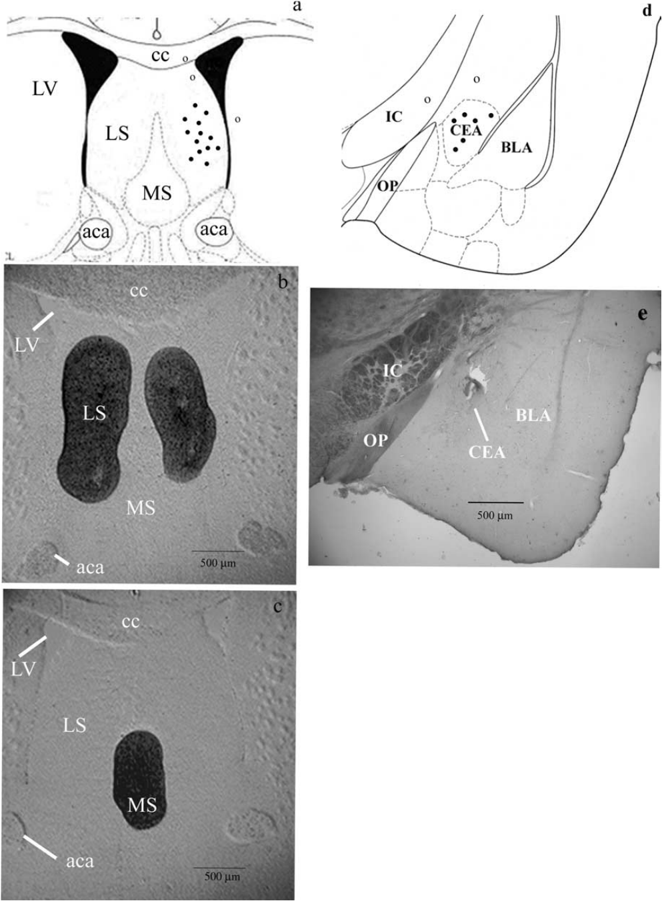
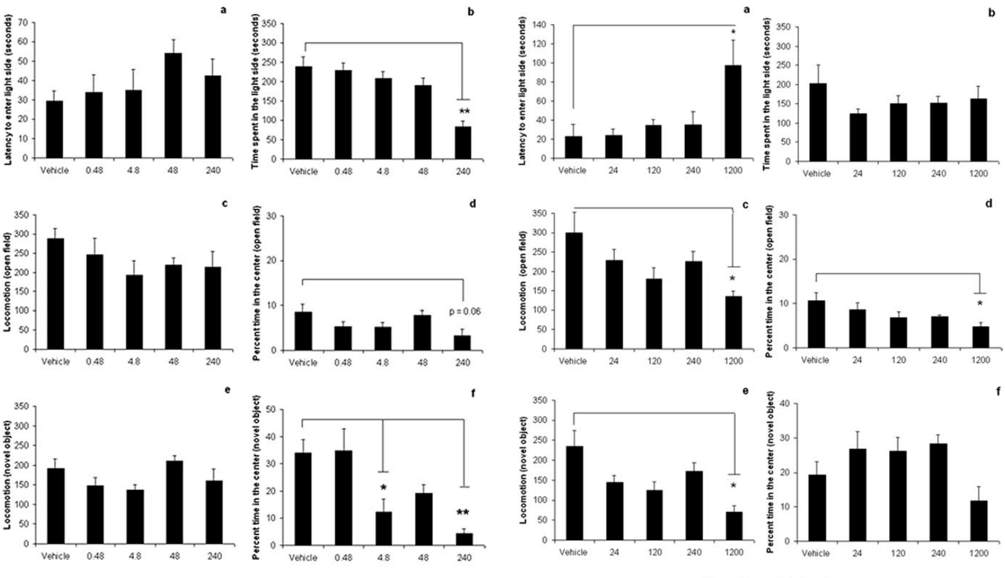
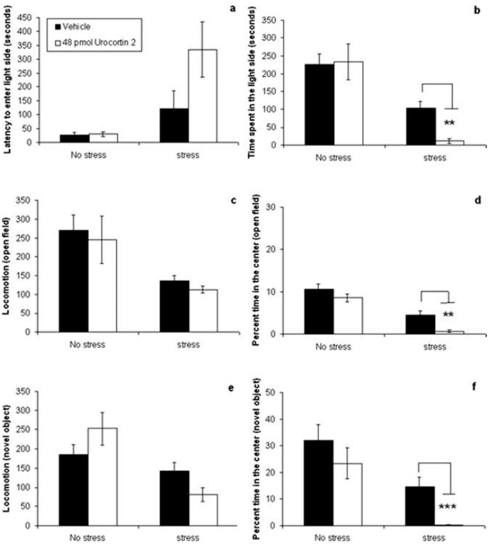
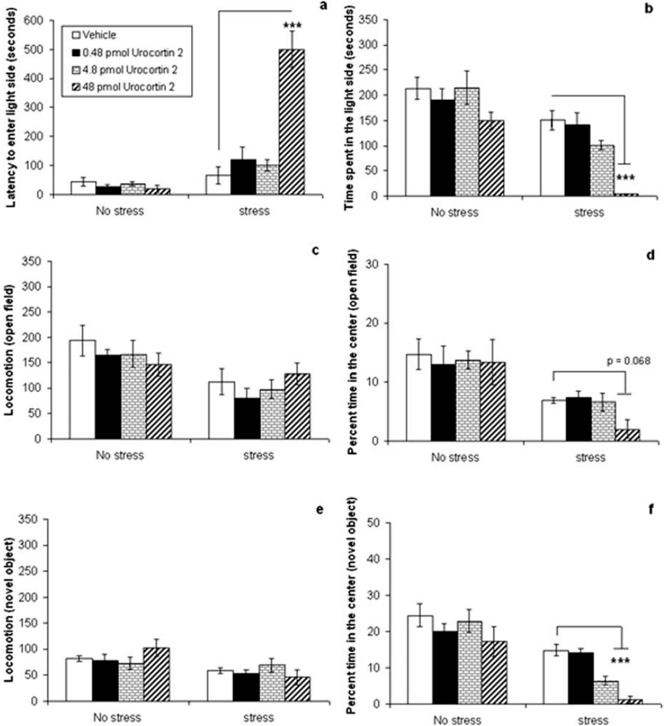
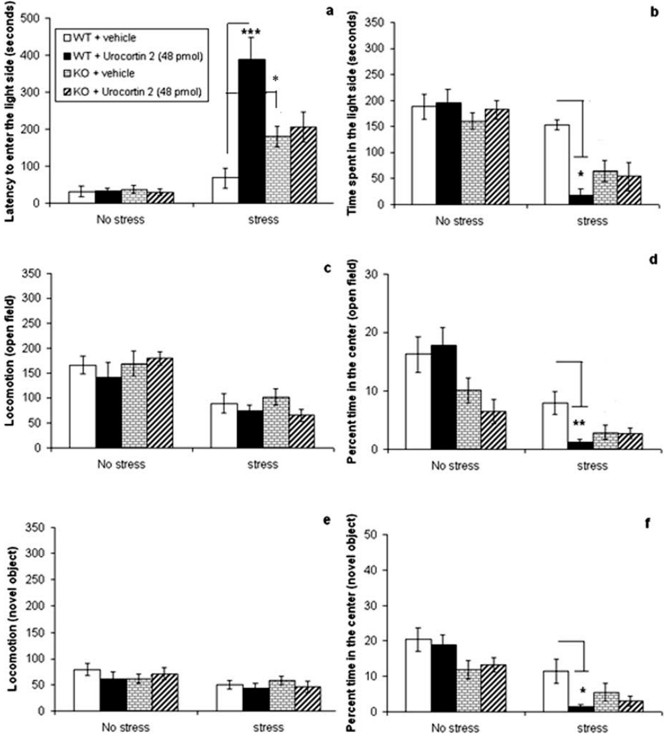
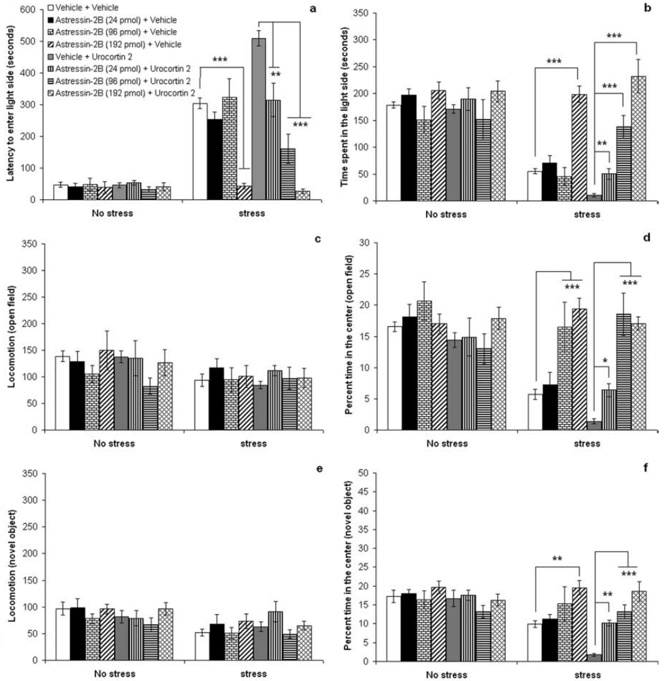
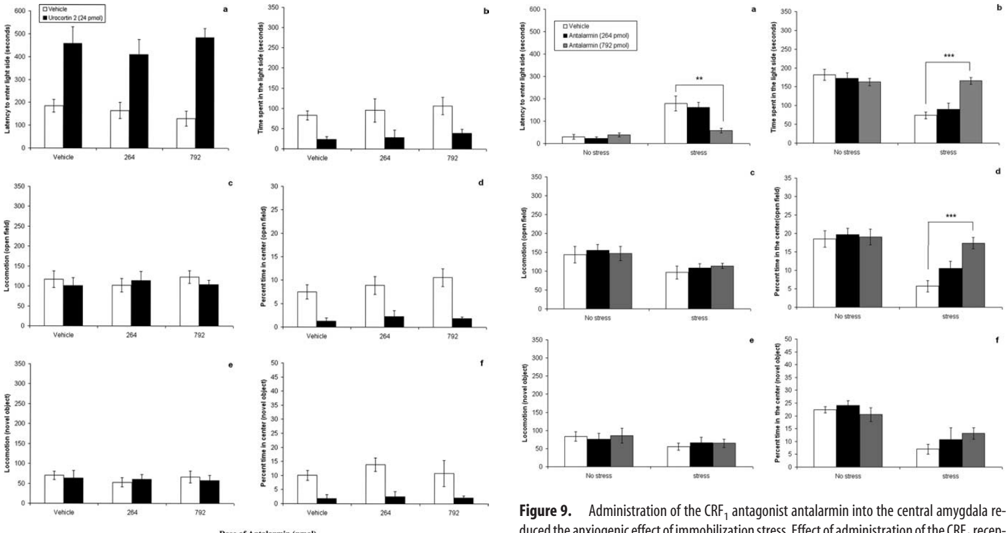
Corticotropin-releasing factor (CRF), a 41 amino acid peptide, mediates endocrine, autonomic, and behavioral responses to stress. Whereas the CRF 1 receptor appears to contribute to anxiety associated with stress, the role of the CRF 2 receptor remains unclear and may depend on drug dose, brain location, or testing environment. Results involving treatments with selective CRF 2 receptor agonists or antagonists and the behavior of CRF 2 receptor knock-out mice suggest both anxiogenic and anxiolytic effects of CRF 2 receptor activation. The present study tested the hypothesis that the effect of CRF 2 receptor activation on anxiety depends on the stress level of the animal. The selective CRF 2 receptor agonist urocortin 2 was infused into the lateral septum of mice under low- or high-stress (30 min of immobilization) testing conditions, and then behavior in the light–dark box, open-field, and novel-object tests was assessed. In the low-stress environment, 240 pmol of septal urocortin 2 increased anxiety, but lower doses (0.48, 4.8, and 48 pmol) did not have consistent effects. However, in the high-stress condition, 48 pmol of septal urocortin 2 significantly increased anxiety compared with control in wild-type but not CRF 2 receptor knock-out mice in the light–dark box. Septal administration of the relatively selective CRF 2 antagonist astressin-2B, but not the CRF 1- selective antagonist antalarmin, blocked the anxiogenic effects of urocortin 2. Urocortin 2 infusion into the medial septum or lateral ventricle did not affect anxiety measures. These results indicate that the effect of septal CRF 2 receptor activation on anxiety is dependent on stress level.
Overview
The claims and statistics of this paper haven’t been checked yet.
Run the check — free, no account needed. It reads the open-access text and checks the sources it cites.
Integrity signals
Registry
Cites
Statistics
Figures
Verification
Claims the paper makes
The claims and statistics of this paper haven’t been checked yet.
Run the check — free, no account needed. It reads the open-access text and checks the sources it cites.
Claims other papers make about this one
Each is checked against this paper’s own text: does it say what the citing paper says it does?
The source backs part of the claim, not all of it — or backs it for a different population, condition or comparison.
In the citing paper
“these tests were chosen as pharmacological experiments showed them to be sensitive to modulation of LS Crfr2+ neuronal function (Henry et al., 2006).”
From Control of Stress-Induced Persistent Anxiety by an Extra-Amygdala Septohypothalamic Circuit (2014) · cites this paper as Henry et al., 2006
Experimental — accuracy not yet measuredIn the citing paper
“Corticotropin releasing factor receptor (CRFR) activation in the lateral septum increases anxiety-related phenotypes96 by way of activation of CRFR type 2–expressing GABAergic projection neurons residing there97.”
From Resolving the neural circuits of anxiety (2015) · cites this paper as [96]
In the citing paper
“For example, LS injections of agonists of the type 2 corticotropin-releasing factor receptor (Crfr2) have resulted in increased anxiety (Radulovic et al., 1999; Bakshi et al., 2002; Henry et al., 2006).”
From Control of Stress-Induced Persistent Anxiety by an Extra-Amygdala Septohypothalamic Circuit (2014) · cites this paper as Henry et al., 2006
In the citing paper
“Anxiogenic cell populations in the LS were, therefore, inferred to act by providing local inhibition on such anxiolytic output (Henry et al., 2006).”
From Control of Stress-Induced Persistent Anxiety by an Extra-Amygdala Septohypothalamic Circuit (2014) · cites this paper as Henry et al., 2006
Self-check
Percentages, sums and reported differences re-computed from the paper’s own numbers.
The self-check needs the paper’s full text.
Citations
Cites
The Mouse Brain in Stereotaxic Coordinates
Paxinos, G. (2001) · Cited by 12,859
Vale, W., Spiess, J., Rivier, C., & Rivier, J. (1981) · Science · doi:10.1126/science.6267699 · Cited by 3,965
Self-citationVale, W., Spiess, J., RIVIER, C. L., & Rivier, J. (1982) · Obstetrical & Gynecological Survey · doi:10.1097/00006254-198205000-00013 · Cited by 3,904
Self-citationDunn, A. J., & Berridge, C. W. (1990) · Brain Research Reviews · doi:10.1016/0165-0173(90)90012-d · Cited by 1,352
CRF and CRF receptors: role in stress responsivity and other behaviors
Bale, T. L., & Vale, W. W. (2004) · Annual Review of Pharmacology and Toxicology · doi:10.1146/annurev.pharmtox.44.101802.121410 · Cited by 1,270
Self-citationSmith, G. W., Aubry, J.-M., Dellu, F., Contarino, A., Bilezikjian, L. M., Gold, L. H., Chen, R., Marchuk, Y., Hauser, C., Bentley, C. A., et al. (1998) · Neuron · doi:10.1016/s0896-6273(00)80491-2 · Cited by 892
Self-citationBale, T. L., Contarino, A., Smith, G. W., Chan, R. K. W., Gold, L. H., Sawchenko, P. E., Koob, G. F., Vale, W. W., & Lee, K. (2000) · Nature Genetics · doi:10.1038/74263 · Cited by 850
Self-citationCoste, S. C., Kesterson, R. A., Heldwein, K. A., Stevens, S. L., Heard, A. D., Hollis, J. H., Murray, S., Hill, J. K., Pantely, G. A., Hohimer, A. R., et al. (2000) · Nature Genetics · doi:10.1038/74255 · Cited by 588
Regulation of affect by the lateral septum: implications for neuropsychiatry
Sheehan, T. P., Chambers, R. A., & Russell, D. S. (2004) · Brain Research Reviews · doi:10.1016/j.brainresrev.2004.04.009 · Cited by 514
Deletion of Crhr2 reveals an anxiolytic role for corticotropin-releasing hormone receptor-2
Kishimoto, T., Radulović, J., Radulović, M., Lin, C. R., Schrick, C., Hooshmand, F., Hermanson, O., Rosenfeld, M. G., & Spiess, J. (2000) · Nature Genetics · doi:10.1038/74271 · Cited by 502
Research works printed but not linked: 1
- 10.1210/en.141.1.256 · DOI
Cited by
Sorted by citations
Items 101–146 of 146
Lamontagne, S. J., Olmstead, M. C., & Menard, J. L. (2016) · Behavioural Brain Research · doi:10.1016/j.bbr.2016.07.034 · Cited by 11
Spinieli, R. L., & Leite‐Panissi, C. R. A. (2017) · Brain Research Bulletin · doi:10.1016/j.brainresbull.2017.12.006 · Cited by 10
Li, L., Zhang, L.-Z., He, Z., Yuan, W., Ma, H., Xun, Y., Zhang, J., Hou, W., Zhang, X., Cai, W., et al. (2021) · Psychoneuroendocrinology · doi:10.1016/j.psyneuen.2021.105353 · Cited by 12
Central CRF2 receptor antagonism reduces anxiety states during amphetamine withdrawal
Reinbold, E. D., Scholl, J. L., Oliver, K. M., Watt, M. J., & Forster, G. L. (2014) · Neuroscience Research · doi:10.1016/j.neures.2014.08.010 · Cited by 13
Kas, M. J., Gelegen, Ç., Nieuwerburgh, F. V., Westenberg, H. G. M., Deforce, D. L. D., & Denys, D. A. J. P. (2009) · American Journal of Medical Genetics Part B Neuropsychiatric Genetics · doi:10.1002/ajmg.b.30994 · Cited by 11
Effect of Urocortin on strength and microarchitecture of osteopenic rat femur
Tezval, M., Hansen, S., Schmelz, U., Komrakova, M., Stürmer, K. M., & Sehmisch, S. (2014) · Journal of Bone and Mineral Metabolism · doi:10.1007/s00774-014-0578-6 · Cited by 10
D'Anna‐Hernandez, K., Stevenson, S. A., & Gammie, S. C. (2008) · Brain Research · doi:10.1016/j.brainres.2008.08.071 · Cited by 10
Chapter 4.1 Peptide receptor ligands to treat anxiety disorders
Steckler, T. (2008) · Handbook of behavioral neuroscience · doi:10.1016/s1569-7339(07)00010-0 · Cited by 10
Role of Corticotropin Releasing Factor-Related Peptides in the Neural Regulation of Maternal Defense
Gammie, S. C., D'Anna‐Hernandez, K., Lee, G. S., & Stevenson, S. A. (2008) · Elsevier eBooks · doi:10.1016/b978-0-12-374285-8.00007-x · Cited by 10
Davis, S. M., Zuke, J. T., Berchulski, M. R., & Burman, M. A. (2021) · Frontiers in Physiology · doi:10.3389/fphys.2021.660792 · Cited by 7
Silva, M. S. C. F., Souza, T. M. O., Pereira, B. A., Ribeiro, D. A., Céspedes, I. C., Bittencourt, J. C., & Viana, M. D. B. (2017) · Behavioural Brain Research · doi:10.1016/j.bbr.2017.04.030 · Cited by 9
Anxiolytic action of urocortin 3 fragments in mice
Telegdy, G., Kádár, K., & Tóth, G. K. (2011) · Behavioural Brain Research · doi:10.1016/j.bbr.2011.03.047 · Cited by 9
Impact of superantigenic molecules on central nervous system function
Urbach‐Ross, D. (2009) · Frontiers in bioscience · doi:10.2741/3537 · Cited by 9
The regulative role and mechanism of BNST in anxiety disorder
Xie, M., Xiong, Y., & Wang, H. (2024) · Frontiers in Psychiatry · doi:10.3389/fpsyt.2024.1437476 · Cited by 7
Warnock, G., Moechars, D., Langlois, X., & Steckler, T. (2009) · Peptides · doi:10.1016/j.peptides.2009.01.005 · Cited by 7
Fatima, A., Haroon, M. F., Wolf, G. L., Engelmann, M., & Spina, M. G. (2009) · Amino Acids · doi:10.1007/s00726-009-0349-1 · Cited by 6
Single Intranasal Administration of Ucn3 Affects the Development of PTSD Symptoms in an Animal Model
Tillinger, A., Zvozilová, A., Mach, M., Horváthová, Ľ., Dziewiczová, L., & Osacká, J. (2024) · International Journal of Molecular Sciences · doi:10.3390/ijms252211908 · Cited by 8
Garcίa, M. T., Tran, D. N., Peterson, R. E., Ibrahim, L. A., Reid, C. M., Hanson, S. M., Ren, Y., Dale-Huang, F., Xie, Y., Stegmann, S. K., et al. (2023) · bioRxiv (Cold Spring Harbor Laboratory) · doi:10.1101/2023.09.24.559205 · Cited by 7
Novel molecular insights into the role of CRH type 1 receptor in the pathophysiology of depression
Rakeshkumar, P. P., Bommaraju, S., Datusalia, A. K., & Nayak, P. K. (2025) · Biochemical Pharmacology · doi:10.1016/j.bcp.2025.117430 · Cited by 4
Lalonde, R., & Strazielle, C. (2017) · Reviews in the Neurosciences · doi:10.1515/revneuro-2016-0075 · Cited by 4
The Neurobehavioral State hypothesis
Ontiveros-Araiza, L. F. (2024) · Biosystems · doi:10.1016/j.biosystems.2024.105361 · Cited by 2
Action of CRF/Urocortin Peptides
Deussing, J. M., Ryabinin, A. E., Zuniga, A., & Kozicz, T. (2016) · Elsevier eBooks · doi:10.1016/b978-0-12-803592-4.00062-6 · Cited by 3
Feature-specific threat coding in lateral septum guides defensive action
Bhatti, D. L., Berger, M. Z. C., Pasqualini, A. L., Wu, S. J., Reid, C. M., Brito, S. I., Qiu, S., Levitt, P. R., Harwell, C. C., Anthony, T. E., et al. (2026) · Nature · doi:10.1038/s41586-026-10520-9 · Cited by 5
Kohman, R. A., Hash-Converse, J. M., & Kusnecov, A. W. (2008) · Springer eBooks · doi:10.1007/978-0-387-84851-8_10 · Cited by 2
Yin and yang in regulation of alcohol and sucrose intake by CRF1 and CRF2 receptors.
Timofeeva, E. (2010) · The Canadian Journal of Addiction · doi:10.1097/02024458-201012000-00001 · Cited by 2
Weera, M. M., Agoglia, A. E., Douglass, E. A., Jiang, Z., Rajamanickam, S., Shackett, R. S., Herman, M. A., Justice, N. J., & Gilpin, N. W. (2021) · bioRxiv (Cold Spring Harbor Laboratory) · doi:10.1101/2021.02.23.432551 · Cited by 2
Sonic Hedgehog Signaling: Linking in Anxiety in Murine Modeling
Wosiski‐Kuhn, M., Lullmann, O., & Luo, Y. (2025) · Springer eBooks · doi:10.1007/978-3-031-73368-0_15 · Cited by 1
Benson, A. A., & Gao, W. (2026) · Neuroscience & Biobehavioral Reviews · doi:10.1016/j.neubiorev.2026.106762 · Cited by 2
Chang, S. L. (2011) · eScholarship (California Digital Library) · Cited by 1
Spinieli, R. L. (2014) · Digital Library of Theses and Dissertations (Universidade de São Paulo) · doi:10.11606/d.59.2014.tde-26062014-140049
Contarino, A. (2014) · Cambridge University Press eBooks · doi:10.1017/cbo9781107360556.029
Valdez, G. R. (2016) · Springer eBooks · doi:10.1007/978-81-322-2803-5_44
Novel targets, biomarkers, and models in the neurobiology of anxiety
Yeung, M. (2015) · ERA: Education and Research Archive (University of Alberta) · doi:10.7939/r33b5wg9h
Sebastiano, D., & Andrea, R. C. (2012) · Scholarship@Western (Western University)
Testa, R., & Angelico, P. (2008) · Faculty Opinions – Post-Publication Peer Review of the Biomedical Literature · doi:10.3410/f.1118798.574885
Stein, D. J. (2020) · Faculty Opinions – Post-Publication Peer Review of the Biomedical Literature · doi:10.3410/f.736787310.793580435
Substance dependence and abuse
Pietropaolo, S., Sluyter, F., & Crusio, W. E. (2014) · Cambridge University Press eBooks · doi:10.1017/cbo9781107360556.024
Sonic Hedgehog Signaling: Linking in Anxiety in Murine Modeling
Wosiski‐Kuhn, M., Lullmann, O., & Luo, Y. (2024) · Springer eBooks · doi:10.1007/978-3-031-32035-4_15-1
The Receptors for CRF Peptides
Li, S., & Zhu, C. (2025) · Springer eBooks · doi:10.1007/978-981-96-5322-5_3
Jacobskind, J. S. (2021) · Scholars Archive - University at Albany (University at Albany, State University of New York) · doi:10.54014/aqje-q7ge
Garcίa, M. T., Tran, D. N., Peterson, R. E., Ibrahim, L. A., Reid, C. M., Hanson, S. M., Ren, Y., Dale-Huang, F., Xie, Y., Stegmann, S. K., et al. (2026) · eLife · doi:10.7554/elife.112110.1
Garcίa, M. T., Tran, D. N., Peterson, R. E., Ibrahim, L. A., Reid, C. M., Hanson, S. M., Ren, Y., Dale-Huang, F., Xie, Y., Stegmann, S. K., et al. (2026) · eLife · doi:10.7554/elife.112110
Urbach‐Ross, D. (2009) · Rutgers University Community Repository (Rutgers University) · doi:10.7282/t3rr1zf9
Metadata
- Authors
- Henry, B., Vale, W., & Markou, A.
- Affiliations
- Scripps Research Institute (US)
- Salk Institute for Biological Studies (US)
- Corresponding author
- Markou, Athina
- ORCID
- Vale, Wylie
- Venue
- The Journal of Neuroscience
- Publisher
- Society for Neuroscience
- Published
- 2006-09-06
- Volume
- 26
- Issue
- 36
- Pages
- 9142-9152
- ISSN
- 0270-6474 (ISSN-L)
- 1529-2401
- PMC
- PMC6674509
- OpenAlex
- W1996743601
- Cited by
- 147
- References
- 38
- Citations by year
- 2026: 5 · 2025: 3 · 2024: 7 · 2023: 2 · 2022: 5 · 2021: 8 · 2020: 2 · 2019: 2 · 2018: 3 · 2017: 8 · 2016: 7 · 2015: 5 · 2014: 11 · 2013: 3 · 2012: 10
- FWCI
- 5.57
- Type
- journal article
- Language
- en
- Open access
- hybrid
- doi.org
- Licence
- Locations
- Journal of Neuroscience (publishedVersion, cc-by-nc-sa)
- PubMed Central (publishedVersion)
- PubMed (publishedVersion)
- Funders
- National Institutes of Health
- National Institute of Mental Health (U01 MH 69062, R01MH62527, U01MH069062, R01MH062527)
- National Institute of Diabetes and Digestive and Kidney Diseases (DK 26741, P01DK026741)
- Topics
- Life Sciences › Neuroscience › Cellular and Molecular Neuroscience › Neuropeptides and Animal Physiology
- Life Sciences › Neuroscience › Behavioral Neuroscience › Stress Responses and Cortisol
- Life Sciences › Neuroscience › Cellular and Molecular Neuroscience › Neurotransmitter Receptor Influence on Behavior
- Keywords
- corticotropin-releasing factor, CRF2 receptor, urocortin 2, antalarmin, lateral septum, anxiety, stress levels, restraint stress, CRF1 receptor, medial septum, dose dependence
- MeSH terms
- CRF Receptor, Type 1, Animals, Anxiety, Corticotropin-Releasing Hormone, Dose-Response Relationship, Drug, Injections, Intraventricular, Male, Mice, Inbred ICR, Stress, Psychological, Receptors, Corticotropin-Releasing Hormone, Mice, Knockout, Septum of Brain, Mice, Urocortins
About these checks
Registry, retraction, Cites and statistics results are computed, not judged, with one exception: a printed reference that no index lists is read once by a model before it counts as a citation error. Claims are extracted by a model and kept only when their quote appears verbatim in the text; each cited source is then checked, with a model’s help, for whether it says what the claim relies on. Those verdicts can be wrong — read the claim’s quote and the cited source before relying on one.
Statistics and arithmetic are recomputed, not judged.
Confidence bands are shown only for fields calibrated on our annotated test set. None is calibrated yet, so no band is shown.
What counts as a claim ›How we measure confidence ›How we check this ›
Are you an author, or do you see a problem with this page? Request a review
