

The DOI matches its Crossref record; 35 of the 35 references it cites were found in a registry or an index.
Memory of Learning Facilitates Saccadic Adaptation in the Monkey
Open accessAbstract
A motor learning mechanism called saccadic adaptation ensures accuracy of saccades throughout life despite growth, aging, and some pathologies of the oculomotor plant or nervous system. The present study investigates effects of preceding adaptation on the speed of subsequent adaptation during single experiments. Adaptive changes in gain (movement size divided by target eccentricity) were induced by intrasaccadic step (ISS) of the target. After the gain was altered (control block), we reversed the direction of ISS to bring the gain back to approximately 1.0 (recovery). We then reversed ISS direction again to induce another adaptation (test block). Analyses revealed that the gain changed at a higher rate in the early part of test adaptation than in the corresponding part of control. After approximately 100-300 saccades in the test block, adaptation slowed down. The gain value at which adaptation slowed was correlated with the gain achieved in the control. We further examined effects of a 30 min intervention inserted between recovery and test blocks. When zero-visual-error trials ( approximately 700 saccades) were repeated during this period, the rate of test adaptation was similar to that of control. In contrast, when the animal was deprived of visual inputs during this period, test adaptation was still influenced by preceding learning. We conclude that a memory of previous learning remains during recovery to facilitate subsequent adaptation and that such a memory does not disappear merely with time but is erased actively by repeated zero-error movements. Our results, which cannot be explained by a single mechanism, suggest that the saccadic system is equipped with more than one plasticity process.
Overview
The claims and statistics of this paper haven’t been checked yet.
Run the check — free, no account needed. It reads the open-access text and checks the sources it cites.
Integrity signals
Registry
Cites
Statistics
Figures
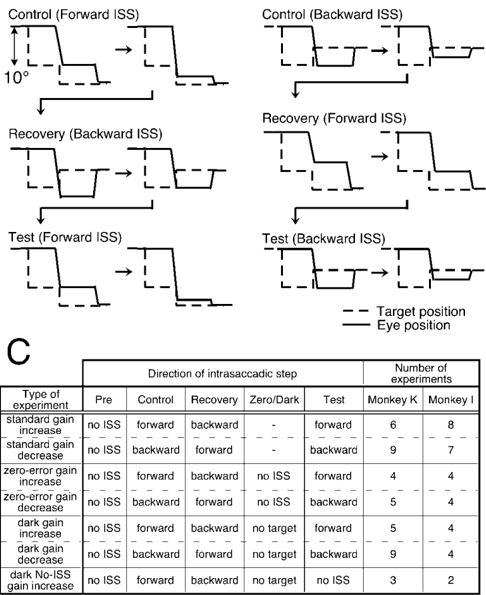
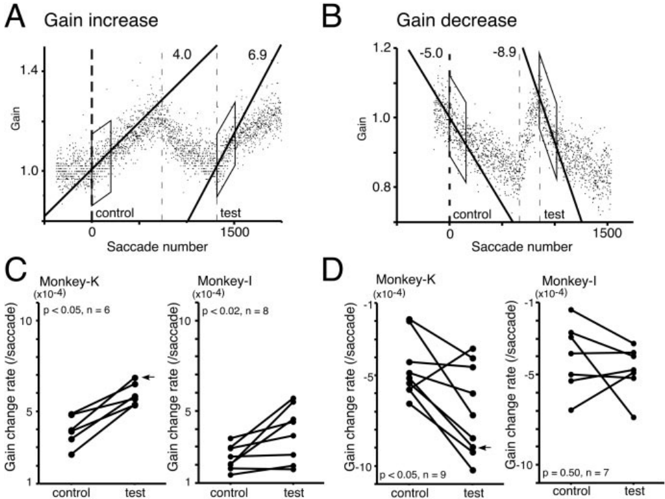
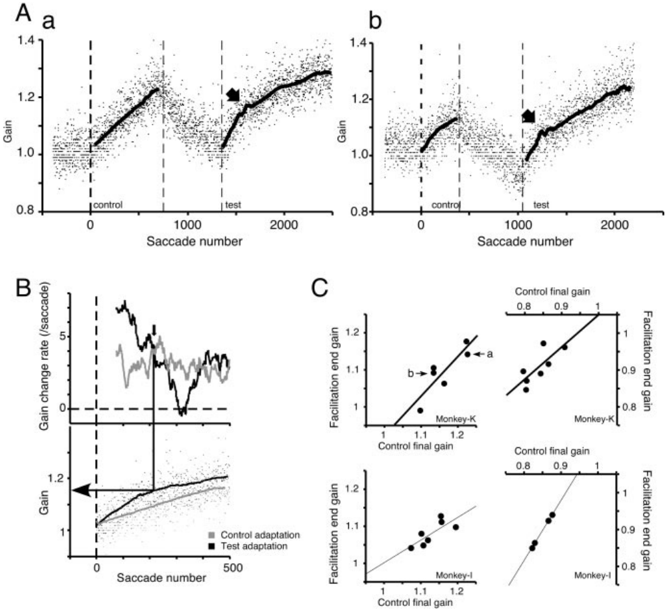
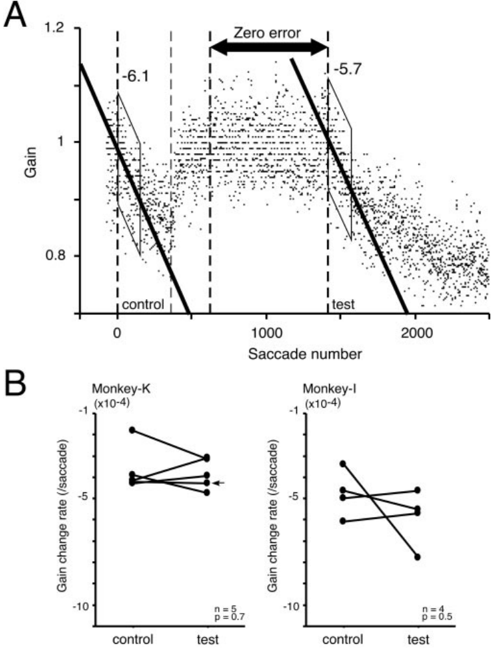
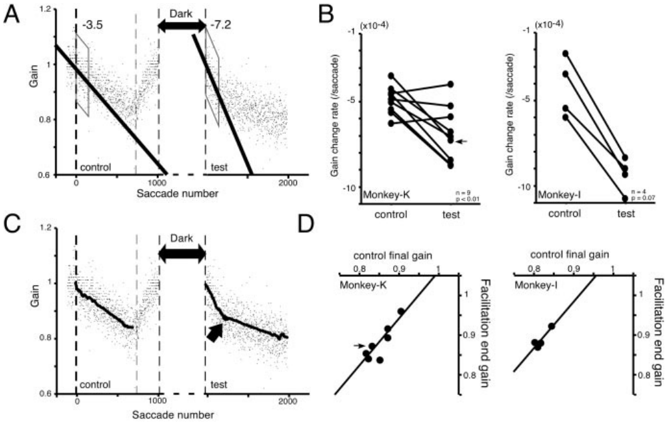
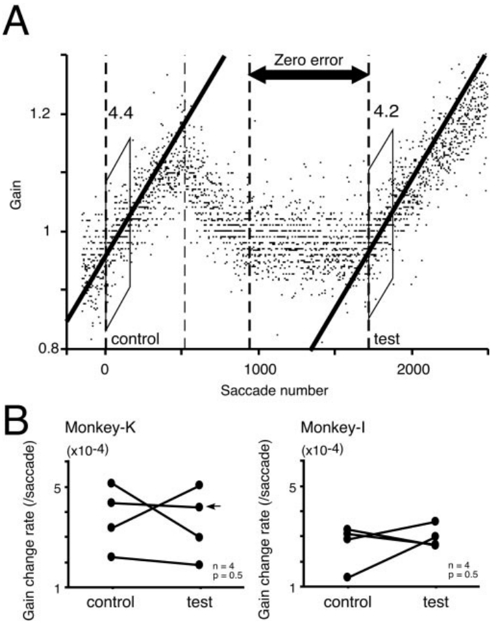
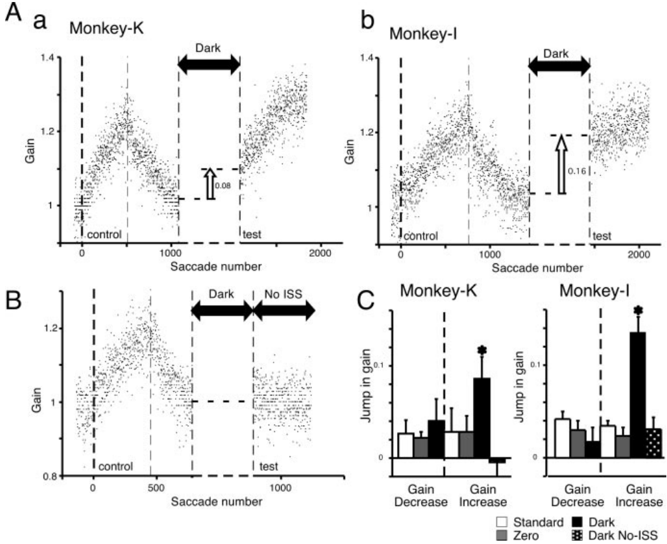
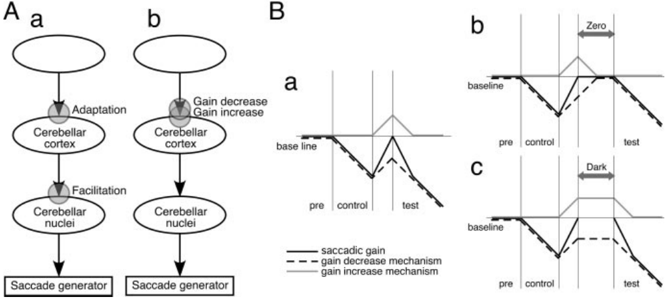
Verification
Claims the paper makes
The claims and statistics of this paper haven’t been checked yet.
Run the check — free, no account needed. It reads the open-access text and checks the sources it cites.
Claims other papers make about this one
Each is checked against this paper’s own text: does it say what the citing paper says it does?
In the citing paper
“In particular, relearning of a given perturbation for a second time is faster than initial learning – a phenomenon known as savings (Ebbinghaus, 1913; Kojima et al., 2004; Krakauer et al., 2005; Smith et al., 2006; Zarahn et al., 2008) – whereas a basic single-timescale SSM predicts that learning should always occur at the same rate, regardless of past experience (Zarahn et al., 2008).”
From Rethinking motor learning and savings in adaptation paradigms: model-free memory for successful actions combines with internal models (2011) · cites this paper as Kojima et al., 2004
Self-check
Percentages, sums and reported differences re-computed from the paper’s own numbers.
The self-check needs the paper’s full text.
Citations
Cites
A method for measuring horizontal and vertical eye movement chronically in the monkey.
Fuchs, A. F., & Robinson, D. A. (1966) · Journal of Applied Physiology · doi:10.1152/jappl.1966.21.3.1068 · Cited by 795 · cited 2×
“Two rhesus monkeys (Macaca mulatta, male; 4.5 and 6.8 kg) were prepared for eye movement recording by the magnetic search coil method (Fuchs and Robinson, 1966).”
MethodInfluentialCerebellar-dependent adaptive control of primate saccadic system
Optican, L. M., & Robinson, D. A. (1980) · Journal of Neurophysiology · doi:10.1152/jn.1980.44.6.1058 · Cited by 773 · cited 2×
“The oculo - motor vermis and the fastigial oculomotor region ( FOR ) of the cerebellum have been shown to be key players in saccadic adap - tation ( Optican and Robinson , 1980 ; Takagi et al .”
BackgroundParametric adjustment in saccadic eye movements
McLaughlin, S. C. (1967) · Perception & Psychophysics · doi:10.3758/bf03210071 · Cited by 570 · cited 3×
“Adaptive changes in saccade amplitude were induced by a conventional intrasaccadic target step paradigm (McLaughlin, 1967).”
BackgroundMethodEffects of Lesions of the Oculomotor Vermis on Eye Movements in Primate: Saccades
Takagi, M., Zee, D. S., & Tamargo, R. J. (1998) · Journal of Neurophysiology · doi:10.1152/jn.1998.80.4.1911 · Cited by 374 · cited 1×
“The oculomotor vermis and the fastigial oculomotor region (FOR) of the cerebellum have been shown to be key players in saccadic adaptation (Optican and Robinson, 1980; Takagi et al., 1998; Barash et al., 1999; Scudder, 2002; Inaba et al., 2003; Scudder and McGee, 2003).”
BackgroundLev‐Ram, V., Wong, S. T., Storm, D. R., & Tsien, R. Y. (2002) · Proceedings of the National Academy of Sciences · doi:10.1073/pnas.122206399 · Cited by 330 · cited 1×
“Recent results describe a previously unrecognized form of long-term potentiation in the cerebellar cortex (Lev-Ram et al., 2002) and a synaptic depotentiation in the hippocampus (Montgomery and Madison, 2002).”
BackgroundThe characteristics and neuronal substrate of saccadic eye movement plasticity
Hopp, J. J., & Fuchs, A. F. (2004) · Progress in Neurobiology · doi:10.1016/j.pneurobio.2003.12.002 · Cited by 316 · cited 1×
“This is because the saccadic gain (saccade amplitude divided by target eccentricity) is constantly recalibrated by a learning mechanism called saccadic adaptation (for review, see Hopp and Fuchs, 2004).”
BackgroundSaccadic Dysmetria and Adaptation after Lesions of the Cerebellar Cortex
Barash, S., Melikyan, A., Sivakov, A., Zhang, M., Glickstein, M., & Thier, P. (1999) · Journal of Neuroscience · doi:10.1523/jneurosci.19-24-10931.1999 · Cited by 312 · cited 1×
“The oculomotor vermis and the fastigial oculomotor region (FOR) of the cerebellum have been shown to be key players in saccadic adaptation (Optican and Robinson, 1980; Takagi et al., 1998; Barash et al., 1999; Scudder, 2002; Inaba et al., 2003; Scudder and McGee, 2003).”
BackgroundA Mechanism for Savings in the Cerebellum
Medina, J. F., Garcia, K. S., & Mauk, M. D. (2001) · Journal of Neuroscience · doi:10.1523/jneurosci.21-11-04081.2001 · Cited by 224 · cited 1×
“In the subsequent recovery block, the cortical plasticity decreases back to and possibly beyond the preadaptation level, as has been suggested for the extinction of eye blink conditioning (Medina et al., 2001), but the nuclear plasticity remains potentiated.”
BackgroundSaccadic Gain Modification: Visual Error Drives Motor Adaptation
Wallman, J., & Fuchs, A. F. (1998) · Journal of Neurophysiology · doi:10.1152/jn.1998.80.5.2405 · Cited by 218 · cited 2×
“There is good evidence that saccadic adaptation is a form of motor learning driven by visual error immediately after the end of saccades (Wallman and Fuchs, 1998; Shafer et al., 2000; Noto and Robinson, 2001).”
BackgroundCharacteristics of Saccadic Gain Adaptation in Rhesus Macaques
Straube, A. M., Fuchs, A. F., Usher, S., & Robinson, F. R. (1997) · Journal of Neurophysiology · doi:10.1152/jn.1997.77.2.874 · Cited by 211 · cited 6×
“Adaptation is fairly specific to the amplitude and direction of adapted saccades and does not generalize fully to those with different vectors (Straube et al., 1997; Wallman and Fuchs, 1998; Noto et al., 1999; Watanabe et al., 2000).”
BackgroundInfluential
Research works printed but not linked: 5
- 2003, Soc Neurosci Abstr, 29, 441.7
- 2003, Neurosci Res, 46, S159
- 2002, Soc Neurosci Abstr, 28, 265.2
- 2003, Neurosci Res, 46, S49
- 2003, Soc Neurosci Abstr, 29, 79.1
Cited by
Sorted by citations
Items 101–177 of 177
Adaptive control of movement deceleration during saccades
Orozco, S. P., Albert, S. T., & Shadmehr, R. (2021) · PLoS Computational Biology · doi:10.1371/journal.pcbi.1009176 · Cited by 11
“Yet, following passage of time, and without presence of errors, the saccade endpoints revert back toward the previously adapted state [4,5].”
BackgroundInfluentialEffects of lorazepam on prosaccades and saccadic adaptation
Bey, K., Lippold, J. V., Aslan, B., Hurlemann, R., & Ettinger, U. (2020) · Journal of Psychopharmacology · doi:10.1177/0269881120972424 · Cited by 11
“Email: katharina.bey@ukbonn.de Backward and forward adaptation may rely on separate mechanisms (Catz et al., 2008; Ethier et al., 2008; Golla et al., 2008; Kojima et al., 2004; Panouillères et al., 2009).”
BackgroundZhou, W., Kruse, E. A., Brower, R., North, R., & Joiner, W. M. (2022) · Journal of Neurophysiology · doi:10.1152/jn.00520.2021 · Cited by 11
The role of motor memory dynamics in structuring bodily self-consciousness
Ishikawa, R., Ayabe‐Kanamura, S., & Izawa, J. (2021) · iScience · doi:10.1016/j.isci.2021.103511 · Cited by 9
The effects of probabilistic context inference on motor adaptation
Rivera, D. C., & Kiebel, S. J. (2023) · PLoS ONE · doi:10.1371/journal.pone.0286749 · Cited by 9
“The term ’savings’ refers to the ability to remember a previously-learned adaptation, 266 observed as an instant recall of the previously-learned adaptation [12,19], or as 267 accelerated re-learning [20]; in the case of instant recall, the phenomenon is often called 268 ’switching’.”
BackgroundPanouilleres, M. T. N., Gaveau, V., Debatisse, J., Jacquin, P., LeBlond, M., & Pélisson, D. (2016) · Frontiers in Human Neuroscience · doi:10.3389/fnhum.2016.00091 · Cited by 9
“…difficult and slower to develop than adaptive shortening (Miller et al., 1981; Straube and Deubel, 1995; Straube et al., 1997; Noto et al., 1999; Robinson et al., 2003; Alahyane and Pélisson, 2004; Kojima et al., 2004; Panouillères et al., 2009, 2012a,b, 2013, 2015; Zimmermann and Lappe, 2010).”
BackgroundDecreased Temporal Sensorimotor Adaptation Due to Perturbation-Induced Measurement Noise
Knelange, E. B., & López‐Moliner, J. (2019) · Frontiers in Human Neuroscience · doi:10.3389/fnhum.2019.00046 · Cited by 9
“(2006) is a simple descriptive model that can account for a series of motor learning features, like savings (Kojima et al., 2004; Ebbinghaus, 2013), anterograde interference (Sing and Smith, 2010), lack of adaptation (Krakauer et al.”
BackgroundEffect of Saccadic Adaptation on Sequences of Saccades
Panouilleres, M. T. N., Salemme, R., Urquizar, C., & Pélisson, D. (2012) · Journal of Eye Movement Research · doi:10.16910/jemr.5.1.1 · Cited by 9
Ueyama, Y. (2016) · Advanced Robotics · doi:10.1080/01691864.2016.1266966 · Cited by 9
“when subjects are re-exposed to the same rotation or force field after some time interval, adaptation occurs more rapidly [29,30].”
BackgroundResultWu, M., Brown, G., Kim, K. A., Kim, J., & Gordon, K. E. (2019) · Journal of NeuroEngineering and Rehabilitation · doi:10.1186/s12984-018-0475-7 · Cited by 9
Multiple timescales and uncertainty in motor adaptation
Kording, K. P., Tenenbaum, J. B., & Shadmehr, R. (2007) · The MIT Press eBooks · doi:10.7551/mitpress/7503.003.0098 · Cited by 9
“E) Double reversal paradigm with darkness, reprinted from [12].”
BackgroundMethodInfluentialHadjiosif, A. M., Krakauer, J. W., & Haith, A. M. (2020) · bioRxiv (Cold Spring Harbor Laboratory) · doi:10.1101/2020.01.22.914473 · Cited by 10
“This capacity, referred to as adaptation, has been demonstrated across a wide variety of behaviors including eye movements (Kojima et al., 2004; Wong & Shelhamer, 2011), reaching movements (Hadjiosif & Smith, 2015; Krakauer et al., 2000, 2005; Shadmehr & Mussa-Ivaldi, 1994; Smith et al., 2006),…”
BackgroundHermans, P., Vandevoorde, K., & de Xivry, J. O. (2025) · Journal of Neurophysiology · doi:10.1152/jn.00412.2024 · Cited by 10
Interference Underlies Attenuation upon Relearning in Sensorimotor Adaptation
Avraham, G., & Ivry, R. B. (2025) · eNeuro · doi:10.1523/eneuro.0132-25.2025 · Cited by 9
“…(Ebbinghaus, 1913), savings has since come to be recognized as a rather ubiquitous phenomenon, including many examples in the motor learning literature (Milner, 1962; Medina et al., 2001; Walker et al., 2002; Kojima et al., 2004; Doyon et al., 2009; Mawase et al., 2014; Coltman et al., 2019).”
Park, S. H., Yan, S., Dee, W., Reed, R., Roth, E. J., Rymer, W. Z., & Wu, M. (2022) · Journal of Neurophysiology · doi:10.1152/jn.00046.2022 · Cited by 8
Long-term size-increasing adaptation of saccades in macaques
Mueller, A. L., Davis, A. J., & Robinson, F. R. (2012) · Neuroscience · doi:10.1016/j.neuroscience.2012.08.012 · Cited by 8
“Kojima et al. (2004) argue, based on consecutive size-decreasing and size-increasing STSAs, that size-increasing and size-decreasing STSA rely on distinct mechanisms.”
An implicit memory of errors limits human sensorimotor adaptationPreprint
Albert, S. T., Jang, J., Sheahan, H., Teunissen, L., Vandevoorde, K., & Shadmehr, R. (2019) · bioRxiv (Cold Spring Harbor Laboratory) · doi:10.1101/868406 · Cited by 13
Saccadic Adaptation to Moving Targets
Havermann, K., Volcic, R., & Lappe, M. (2012) · PLoS ONE · doi:10.1371/journal.pone.0039708 · Cited by 7
“Therefore, in later blocks, adaptation was facilitated by earlier blocks like described in [6].”
BackgroundMethodResultInfluentialUnilateral step training can drive faster learning of novel gait patterns
Song, C. N., Stenum, J., Leech, K. A., Keller, C. K., & Roemmich, R. T. (2020) · Scientific Reports · doi:10.1038/s41598-020-75839-3 · Cited by 6
James, R., & Wang, J. (2023) · Neurobiology of Learning and Memory · doi:10.1016/j.nlm.2023.107801 · Cited by 7
Visuomotor Adaptation is a Disturbance Rejection Problem
Gawad, A. A., & Broucke, M. E. (2020) · IEEE Conference on Decision and Control (CDC) · doi:10.1109/cdc42340.2020.9304251 · Cited by 6
“First, an immediate fact also confirmed experimentally [11] is that they cannot arise from a first-order LTI model.”
BackgroundResultInfluentialA software tool for at-home measurement of sensorimotor adaptationPreprint
Jang, J., Shadmehr, R., & Albert, S. T. (2023) · bioRxiv (Cold Spring Harbor Laboratory) · doi:10.1101/2023.12.12.571359 · Cited by 5
Voges, C., Helmchen, C., Heide, W., & Sprenger, A. (2015) · PLoS ONE · doi:10.1371/journal.pone.0123831 · Cited by 5
“In non-human primate studies monkeys’ were sitting in a dark room where they were able to sleep [6] or their heads were covered [21].”
BackgroundMethodInfluentialAdaptive coupling influences generalization of sensorimotor learning
Sadeghi, M., Ingram, J. N., & Wolpert, D. M. (2018) · PLoS ONE · doi:10.1371/journal.pone.0207482 · Cited by 5
Spontaneous recovery of adaptation aftereffects of natural facial categories
Qiu, S., & Mei, G. (2021) · Vision Research · doi:10.1016/j.visres.2021.07.015 · Cited by 5
Heins, F., & Lappe, M. (2024) · PLoS ONE · doi:10.1371/journal.pone.0302872 · Cited by 4
Memories of motor adaptation do not necessarily decay with behavioral unlearning
Yan, C., Chen, Y., Lu, Z., & Li, Z. (2019) · Experimental Brain Research · doi:10.1007/s00221-019-05703-y · Cited by 3
Hirano, M., & Furuya, S. (2023) · iScience · doi:10.1016/j.isci.2023.108604 · Cited by 5
Single versus dual-rate learning when exposed to Coriolis forces during reaching movements
Rudolph, J. L., Stapel, J. C., Selen, L. P. J., & Medendorp, W. P. (2020) · PLoS ONE · doi:10.1371/journal.pone.0240666 · Cited by 4
“Support for dual-rate learning has now been reported for adaptation of reaches in force fields [5–7] and under visuomotor perturbations [2,3,8] as well as for saccadic gain adaptation [9,10].”
BackgroundDiscrete-time Output Regulation and Visuomotor Adaptation
Hafez, M. A., Uzeda, E. M., & Broucke, M. E. (2021) · IEEE Conference on Decision and Control (CDC) · doi:10.1109/cdc45484.2021.9683247 · Cited by 4
“Examples include saccades with an intersaccadic step of the target [11]; the visuomotor rotation experiment with fast arm reaches [29]; and throwing darts while looking through prism glasses [18].”
BackgroundSpontaneous recovery and the multiple timescales of human motor memoryPreprint
Orozco, S. P., Albert, S. T., & Shadmehr, R. (2020) · bioRxiv (Cold Spring Harbor Laboratory) · doi:10.1101/2020.03.24.006023 · Cited by 4
“However, with passage of time the behavior spontaneously reverts back: subjects reproduce the motor commands that they had originally learned (Criscimagna-Hemminger & Shadmehr, 2008; Kojima et al., 2004; Sarwary et al., 2018; Smith et al., 2006).”
BackgroundLearning-to-learn as a metacognitive correlate of functional outcomes after stroke: a cohort study
Sugiyama, T., Uehara, S., Yuasa, A., Ushizawa, K., Izawa, J., & Otaka, Y. (2024) · European Journal of Physical and Rehabilitation Medicine · doi:10.23736/s1973-9087.24.08446-6 · Cited by 1
“Third, meta-learning can occur in as little as minutes to hours of training 4, 20, 21 in experiment tasks, possibly because these tasks employ simple perturbation on familiar movements ( e.g. , learning how to change the direction of arm-reach to counteract visual rotation and touch a target…”
A triple distinction of cerebellar function for oculomotor learning and fatigue compensation
Masselink, J., Cheviet, A., Tilikete, C., Pélisson, D., & Lappe, M. (2023) · PLoS Computational Biology · doi:10.1371/journal.pcbi.1011322 · Cited by 3
“Differences in adaptation levels between target step directions have been reported before [12, 26, 58, 59].”
BackgroundComparison of adaptation characteristics between visually and memory-guided saccades
Kojima, Y., Yoshino, H., Ling, L., & Phillips, J. O. (2024) · Journal of Neurophysiology · doi:10.1152/jn.00050.2024 · Cited by 3
Body Representation and Neuroprosthetics
Hagura, N., & Haggard, P. (2014) · Springer eBooks · doi:10.1007/978-4-431-55037-2_10 · Cited by 3
“[ 19 ], monkeys learned to increase the gain of the saccade to a certain point and then decrease back to the original gain.”
BackgroundSalemi, A., Ardekani, A. A., Vette, A. H., & Nazarahari, M. (2025) · Computers in Biology and Medicine · doi:10.1016/j.compbiomed.2025.111198 · Cited by 2
Postsaccadic eye position contributes to oculomotor error estimation in saccadic adaptation
Gremmler, S., & Lappe, M. (2019) · Journal of Neurophysiology · doi:10.1152/jn.00095.2019 · Cited by 2
“Therefore, the adaptation that brings the amplitude to the baseline state includes a component that modifies the amplitude according to visual error signals rather than being the consequence of a simple passive return to the baseline state (Ethier et al. 2008; Kojima et al. 2004).”
BackgroundParmar, P. N., & Patton, J. L. (2021) · Frontiers in Neurorobotics · doi:10.3389/fnbot.2021.651214 · Cited by 2
“Furthermore, their theoretical framework used error-dependent learning rate to explain the phenomenon of “savings” and “meta-learning,” where prior experience can facilitate re-adaptation (Kojima et al., 2004; Braun et al., 2009; Malone et al., 2011; Turnham et al., 2012; Sarwary et al., 2013; Herzfeld et al., 2014).”
BackgroundPlan- versus motion-referenced generalization of fast and slow processes in reach adaptation
Rudolph, J. L., Selen, L. P. J., & Medendorp, W. P. (2023) · Journal of Neurophysiology · doi:10.1152/jn.00294.2022 · Cited by 2
A conversion from slow to fast memory in response to passive motionPreprint
Javidialsaadi, M., Albert, S. T., & Wang, J. (2021) · bioRxiv (Cold Spring Harbor Laboratory) · doi:10.1101/2021.03.09.434594 · Cited by 2
“…that is observed across several motor effectors: the reaching system (Smith et al., 2006; Zarahn et al., 2008; Leow et al., 2013; Haith et al., 2015; Coltman et al., 2020; Yin & Wei, 2020), walking (Mawase et al., 2014; Day et al., 2018), and even the oculomotor system (Kojima et al., 2004).”
BackgroundModeling human visuomotor adaptation with a disturbance observer framework
Sharma, G., Hart, B. M. ’., de Xivry, J. O., Henriques, D. Y. P., & Broucke, M. E. (2026) · PLoS Computational Biology · doi:10.1371/journal.pcbi.1013937 · Cited by 1
Salemi, A., Ardekani, A. A., Vette, A. H., & Nazarahari, M. (2026) · Computers in Biology and Medicine · doi:10.1016/j.compbiomed.2026.111702 · Cited by 1
Najafi, F. (2014) · ScholarlyCommons (University of Pennsylvania) · Cited by 1
Disturbance Rejection in the Cerebellum
Broucke, M. E. (2024) · SN Computer Science · doi:10.1007/s42979-023-02472-y · Cited by 1
“Examples include saccades with an intersaccadic step of the target [121]; the visuomotor rotation experiment with fast arm reaches [122, 123]; and throwing darts while looking through prism glasses [124].”
Masselink, J., & Lappe, M. (2025) · PLoS Computational Biology · doi:10.1371/journal.pcbi.1013041 · Cited by 1
Struber, L., Lamalle, L., Barraud, P.-A., Courvoisier, A., Laboissière, R., Ito, T., Nougier, V., Ostry, D. J., & Cignetti, F. (2025) · Brain Structure and Function · doi:10.1007/s00429-025-03013-4 · Cited by 1
“A key phenomenon observed in these adaptation paradigms is savings, wherein error reduction occurs more rapidly (i.e., in fewer trials) upon re-exposure to a previously experienced perturbation (Kojima et al. 2004 ; Krakauer et al. 2005 ; Smith et al. 2006 ; Zarahn et al. 2008).”
Eggert, T., Kaltenbach, K., & Straube, A. M. (2022) · Physiological Reports · doi:10.14814/phy2.15180 · Cited by 1
“By using this procedure, we followed the traditional notion of a gain adaptation (Deubel et al., 1986, 1987; Kojima et al., 2004).”
MethodReproducing Human Motor Adaptation in Spiking Neural Simulation and known Synaptic Learning RulesPreprint
Wu, Y., Haar, S., & Faisal, A. A. (2021) · bioRxiv (Cold Spring Harbor Laboratory) · doi:10.1101/2021.06.24.449760 · Cited by 1
“This sudden jump is caused by the preserved 224 memory of motor compensated at the beginning of the relearning phase and the same 225 phenomenon in human adaptation is referred to as ‘savings’ [34, 35].”
BackgroundMotor Memories for Expectation and Uncertainty in the Environment
Hadjiosif, A. M. (2015) · Digital Access to Scholarship at Harvard (DASH) (Harvard University)
Computational models of motor adaptation under multiple classes of sensorimotor disturbance
Haith, A. M. (2009) · ERA
Wojaczynski, G. J., Ivry, R. B., Hussain, S. J., Morton, S. M., Tanaka, H., B, T. J. S. A., Wang, J., Lei, Y., & Binder, J. R. (2015)
in saccadic adaptation The relative importance of retinal error and prediction
Wallman, J., Azadi, R., Harwood, M. R., Havermann, K., Cherici, C., Rucci, M., Lappe, M., Raashid, R. A., WONG, A. M. F., Blakeman, A. W., et al. (2015)
Criscimagna-Hemminger, S. E., & Hemminger, S. (2010)
The Neural Mechanism of the Cerebellum and Brainstem for Saccade Adaptation
Kojima, Y. (2012) · The Brain & Neural Networks · doi:10.3902/jnns.19.126
A Unified Model of Motor Learning
Takiyama, K. (2016) · The Brain & Neural Networks · doi:10.3902/jnns.23.14
Short-term Saccadic Adaptation in Patients with Amblyopia
Raashid, R. A. (2013) · TSpace (University of Toronto)
A State Space Model of a Visuomotor Rotation ExperimentPreprint
Broucke, M. E. (2017) · bioRxiv (Cold Spring Harbor Laboratory) · doi:10.1101/197483
Cerebellar Transcranial Direct Current Stimulation to Influence Motor Learning
Kumari, N. (2020) · Tuwhera (Auckland University of Technology)
People can learn new walking patterns without walkingPreprint
Song, C. N., Stenum, J., Leech, K. A., Keller, C. K., & Roemmich, R. T. (2020) · bioRxiv (Cold Spring Harbor Laboratory) · doi:10.1101/2020.04.02.021949
“Many studies have shown that learning occurs faster when people experiences similar errors repeatedly (Herzfeld et al., 2014; Kojima et al., 2004; Leech et al., 2018; Malone et al., 2011; Medina et al., 2001; Roemmich and Bastian, 2015), a phenomenon termed ‘savings’ (or ‘retention’, if the…”
BackgroundTanamachi, K., Izawa, J., Yamamoto, S., Ishii, D., Yozu, A., & Kohno, Y. (2021) · Frontiers in Human Neuroscience · doi:10.3389/fnhum.2021.602405
“, savings) has been reported in the earlier reports (Krakauer et al., 1999; Kojima et al., 2004; Burge et al., 2008; Huang et al., 2011; Leow et al., 2012).”
BackgroundResultA Control-theoretic Model of Sensorimotor Adaptation
Gawad, A. A. (2020)
The effects of probabilistic context inference on motor adaptationPreprint
Rivera, D. C., & Kiebel, S. J. (2021) · bioRxiv (Cold Spring Harbor Laboratory) · doi:10.1101/2021.11.30.470569
Plan versus motion-referenced generalization of fast and slow processes in reach adaptationPreprint
Rudolph, J. L., Selen, L. P. J., & Medendorp, W. P. (2022) · bioRxiv (Cold Spring Harbor Laboratory) · doi:10.1101/2022.07.13.499894
“These two processes, which together contribute to the update of the internal model, do not only explain spontaneous recovery (Ethier et al., 2008), but also behavioral observations such as faster re-relearning/re-adaptation (Kojima et al., 2004) and interference (Davidson & Wolpert, 2004).”
BackgroundLim, H., Yan, S., Dee, W., Pech, V., Hameeduddin, I., Roth, E. J., Rymer, W. Z., & Wu, M. (2024) · European Journal of Neuroscience · doi:10.1111/ejn.16507
“The subsequent re-exposure to the original task with resistive pelvis force may have solidified the previously formulated internal model (Kojima et al., 2004; Krakauer & Shadmehr, 2006).”
Long-term development of a motor memoryPreprint
Franklin, D. W., Nietschmann, P., Papadopoulou, T., & Franklin, S. (2025) · bioRxiv (Cold Spring Harbor Laboratory) · doi:10.1101/2025.02.22.639647
Modulation of error sensitivity during motor learning across time, space and environment variabilityPreprint
Todorov, D., Moulin, M., Buch, E. R., & Quentin, R. (2025) · bioRxiv (Cold Spring Harbor Laboratory) · doi:10.1101/2025.05.30.656374
“Savings suppression after a long washout of a special kind was observed earlier in (Kitago et al. 2013; Kojima, Iwamoto, and Yoshida 2004).”
Protection of savings by reducing the salience of opposing errors
Javidialsaadi, M., Albert, S. T., Mutairi, B. M. S. A., & Wang, J. (2025) · npj Science of Learning · doi:10.1038/s41539-025-00352-z
“The idea that washout impacts savings qualitatively aligns with prior work by Kojima et al. 9 , which demonstrated that savings in the oculomotor system are sensitive to the duration of washout: when the duration of the washout phase is increased, the learning rate during the re-exposure phase…”
InfluentialContextual cues and transition statistics drive expression of competing motor memories
Kumar, A., Kumar, A. D., Sannamath, S., & Kumar, N. (2026) · iScience · doi:10.1016/j.isci.2026.116281 · Cited by 1
“4 However, cues have limitations.”
Interlimb transfer of sensorimotor adaptation : predictive factors and underlying processes
Lefumat, H. Z. (2016) · theses.fr (ABES) · doi:10.70675/cc575fc4z01cez4ff1zaf5aze5a825a65905
Perception visuelle et plasticité oculomotrice : aspects fondamentaux et application clinique
Lévy-Bencheton, D. (2013) · theses.fr (ABES) · doi:10.70675/f6c7edb1zd5afz4e27zbfafz76c941611463
On the link between saccadic adaptation and visuospatial attention
Nicolas, J. (2019) · theses.fr (ABES) · doi:10.70675/f8ee4304z409bz4a78zb51az01c6fa2c281e
“An interesting approach was used by Kojima et al. (2004).”
BackgroundCheviet, A. (2021) · theses.fr (ABES) · doi:10.70675/66ee7d58zb3d6z49fdz8463z9a5b3612db6f
Metadata
- Authors
- Kojima, Y., Iwamoto, Y., & Yoshida, K.
- Affiliations
- University of Tsukuba (JP)
- Corresponding author
- Iwamoto, Yoshiki
- ORCID
- Kojima, Yoshiko
- Venue
- The Journal of Neuroscience
- Publisher
- Society for Neuroscience
- Published
- 2004-08-25
- Volume
- 24
- Issue
- 34
- Pages
- 7531-7539
- ISSN
- 0270-6474 (ISSN-L)
- 1529-2401
- PMC
- PMC6729647
- OpenAlex
- W2096184857
- Cited by
- 179
- References
- 31
- Citations by year
- 2026: 3 · 2025: 8 · 2024: 5 · 2023: 9 · 2022: 6 · 2021: 15 · 2020: 19 · 2019: 18 · 2018: 5 · 2017: 5 · 2016: 7 · 2015: 13 · 2014: 11 · 2013: 8 · 2012: 5
- FWCI
- 2.35
- Type
- journal article
- Language
- en
- Open access
- hybrid
- doi.org
- Licence
- Locations
- Journal of Neuroscience (publishedVersion, cc-by-nc-sa)
- PubMed Central (publishedVersion)
- PubMed (publishedVersion)
- Funders
- Japan Society for the Promotion of Science (13680894)
- Topics
- Life Sciences › Neuroscience › Cognitive Neuroscience › Motor Control and Adaptation
- Life Sciences › Neuroscience › Cognitive Neuroscience › Visual perception and processing mechanisms
- Life Sciences › Neuroscience › Neurology › Vestibular and auditory disorders
- Keywords
- saccadic adaptation, motor learning, visual deprivation
- MeSH terms
- Adaptation, Ocular, Animals, Learning, Macaca mulatta, Male, Memory, Saccades
About these checks
Registry, retraction, Cites and statistics results are computed, not judged, with one exception: a printed reference that no index lists is read once by a model before it counts as a citation error. Claims are extracted by a model and kept only when their quote appears verbatim in the text; each cited source is then checked, with a model’s help, for whether it says what the claim relies on. Those verdicts can be wrong — read the claim’s quote and the cited source before relying on one.
Statistics and arithmetic are recomputed, not judged.
Confidence bands are shown only for fields calibrated on our annotated test set. None is calibrated yet, so no band is shown.
What counts as a claim ›How we measure confidence ›How we check this ›
Are you an author, or do you see a problem with this page? Request a review
