

The DOI matches its Crossref record; 35 of the 35 references it cites were found in a registry or an index.
Memory of Learning Facilitates Saccadic Adaptation in the Monkey
Open accessAbstract
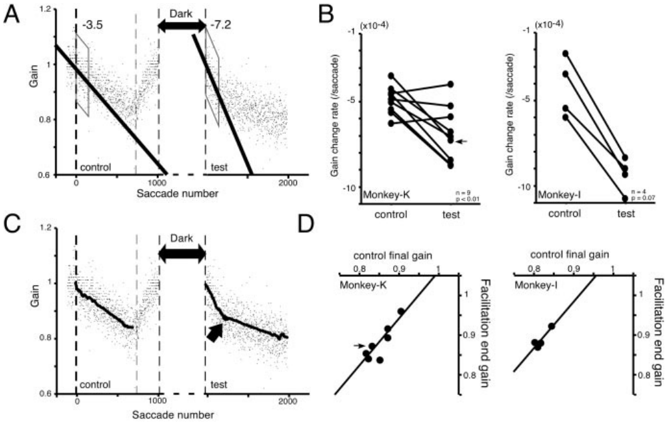
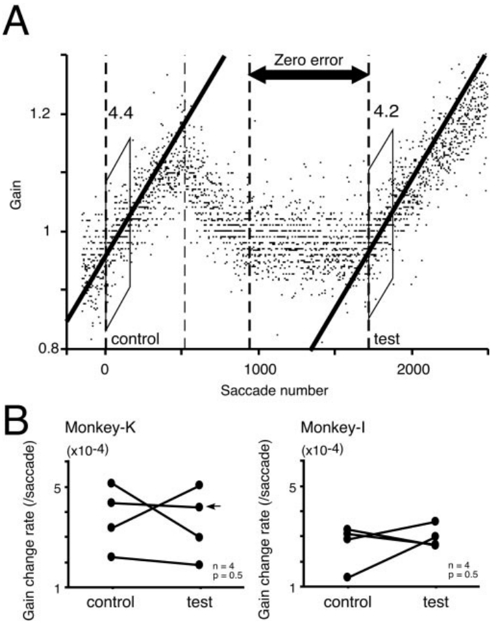
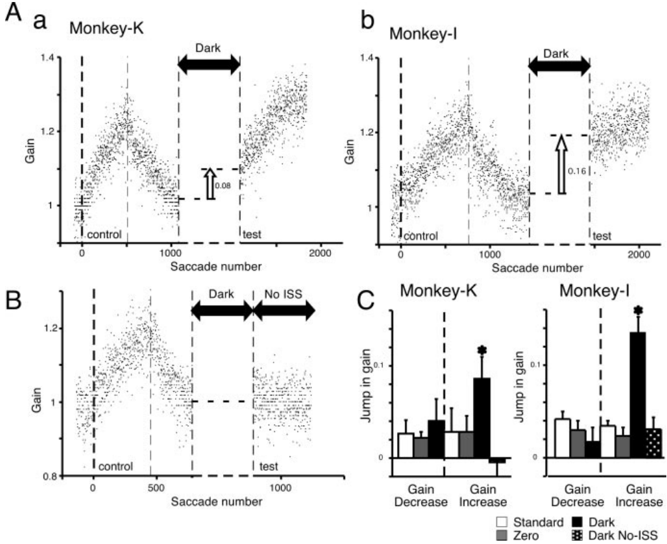
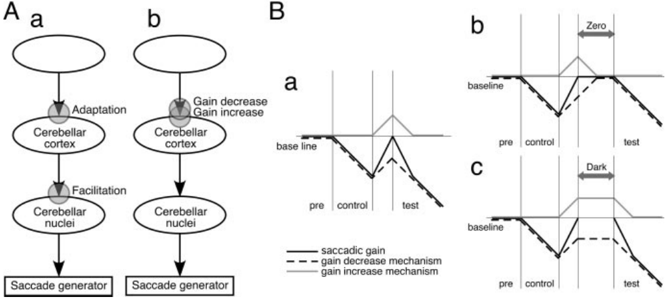
A motor learning mechanism called saccadic adaptation ensures accuracy of saccades throughout life despite growth, aging, and some pathologies of the oculomotor plant or nervous system. The present study investigates effects of preceding adaptation on the speed of subsequent adaptation during single experiments. Adaptive changes in gain (movement size divided by target eccentricity) were induced by intrasaccadic step (ISS) of the target. After the gain was altered (control block), we reversed the direction of ISS to bring the gain back to approximately 1.0 (recovery). We then reversed ISS direction again to induce another adaptation (test block). Analyses revealed that the gain changed at a higher rate in the early part of test adaptation than in the corresponding part of control. After approximately 100-300 saccades in the test block, adaptation slowed down. The gain value at which adaptation slowed was correlated with the gain achieved in the control. We further examined effects of a 30 min intervention inserted between recovery and test blocks. When zero-visual-error trials ( approximately 700 saccades) were repeated during this period, the rate of test adaptation was similar to that of control. In contrast, when the animal was deprived of visual inputs during this period, test adaptation was still influenced by preceding learning. We conclude that a memory of previous learning remains during recovery to facilitate subsequent adaptation and that such a memory does not disappear merely with time but is erased actively by repeated zero-error movements. Our results, which cannot be explained by a single mechanism, suggest that the saccadic system is equipped with more than one plasticity process.
Overview
The claims and statistics of this paper haven’t been checked yet.
Run the check — free, no account needed. It reads the open-access text and checks the sources it cites.
Integrity signals
Registry
Cites
Statistics
Figures
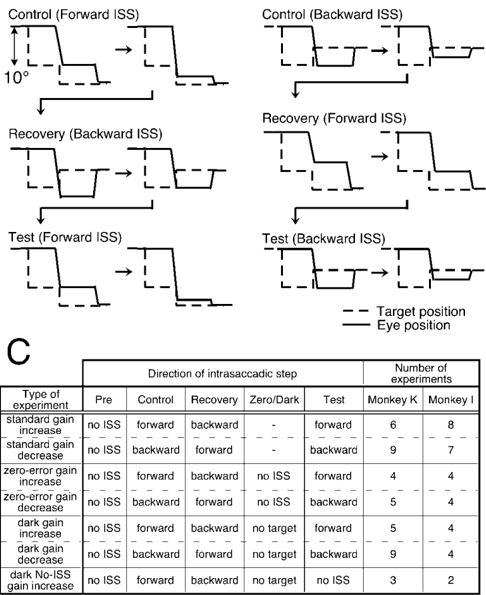
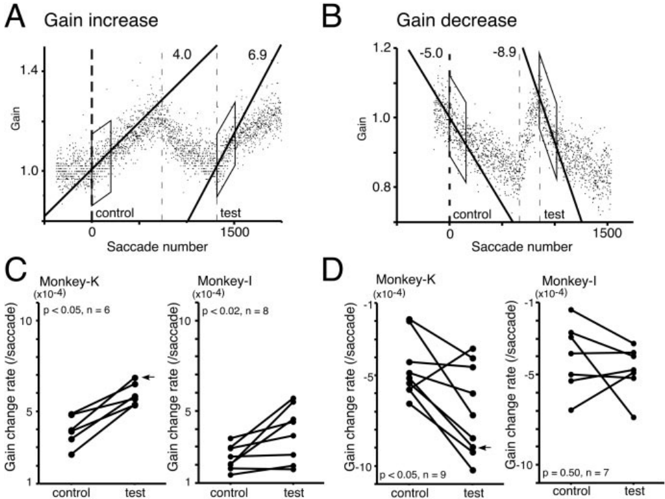
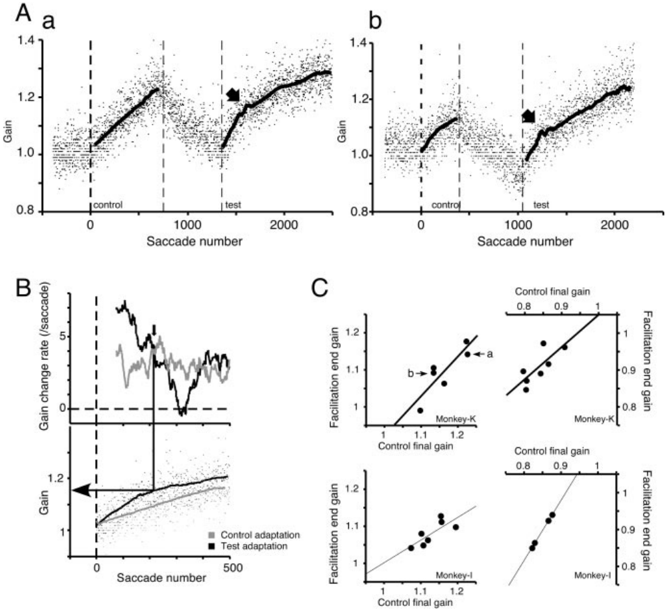
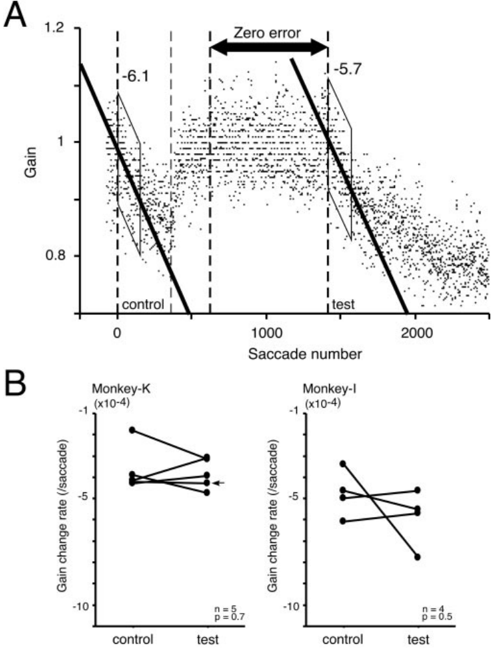
Verification
Claims the paper makes
The claims and statistics of this paper haven’t been checked yet.
Run the check — free, no account needed. It reads the open-access text and checks the sources it cites.
Claims other papers make about this one
Each is checked against this paper’s own text: does it say what the citing paper says it does?
In the citing paper
“In particular, relearning of a given perturbation for a second time is faster than initial learning – a phenomenon known as savings (Ebbinghaus, 1913; Kojima et al., 2004; Krakauer et al., 2005; Smith et al., 2006; Zarahn et al., 2008) – whereas a basic single-timescale SSM predicts that learning should always occur at the same rate, regardless of past experience (Zarahn et al., 2008).”
From Rethinking motor learning and savings in adaptation paradigms: model-free memory for successful actions combines with internal models (2011) · cites this paper as Kojima et al., 2004
Self-check
Percentages, sums and reported differences re-computed from the paper’s own numbers.
The self-check needs the paper’s full text.
Citations
Cites
A method for measuring horizontal and vertical eye movement chronically in the monkey.
Fuchs, A. F., & Robinson, D. A. (1966) · Journal of Applied Physiology · doi:10.1152/jappl.1966.21.3.1068 · Cited by 795 · cited 2×
“Two rhesus monkeys (Macaca mulatta, male; 4.5 and 6.8 kg) were prepared for eye movement recording by the magnetic search coil method (Fuchs and Robinson, 1966).”
MethodInfluentialCerebellar-dependent adaptive control of primate saccadic system
Optican, L. M., & Robinson, D. A. (1980) · Journal of Neurophysiology · doi:10.1152/jn.1980.44.6.1058 · Cited by 773 · cited 2×
“The oculo - motor vermis and the fastigial oculomotor region ( FOR ) of the cerebellum have been shown to be key players in saccadic adap - tation ( Optican and Robinson , 1980 ; Takagi et al .”
BackgroundParametric adjustment in saccadic eye movements
McLaughlin, S. C. (1967) · Perception & Psychophysics · doi:10.3758/bf03210071 · Cited by 570 · cited 3×
“Adaptive changes in saccade amplitude were induced by a conventional intrasaccadic target step paradigm (McLaughlin, 1967).”
BackgroundMethodEffects of Lesions of the Oculomotor Vermis on Eye Movements in Primate: Saccades
Takagi, M., Zee, D. S., & Tamargo, R. J. (1998) · Journal of Neurophysiology · doi:10.1152/jn.1998.80.4.1911 · Cited by 374 · cited 1×
“The oculomotor vermis and the fastigial oculomotor region (FOR) of the cerebellum have been shown to be key players in saccadic adaptation (Optican and Robinson, 1980; Takagi et al., 1998; Barash et al., 1999; Scudder, 2002; Inaba et al., 2003; Scudder and McGee, 2003).”
BackgroundLev‐Ram, V., Wong, S. T., Storm, D. R., & Tsien, R. Y. (2002) · Proceedings of the National Academy of Sciences · doi:10.1073/pnas.122206399 · Cited by 330 · cited 1×
“Recent results describe a previously unrecognized form of long-term potentiation in the cerebellar cortex (Lev-Ram et al., 2002) and a synaptic depotentiation in the hippocampus (Montgomery and Madison, 2002).”
BackgroundThe characteristics and neuronal substrate of saccadic eye movement plasticity
Hopp, J. J., & Fuchs, A. F. (2004) · Progress in Neurobiology · doi:10.1016/j.pneurobio.2003.12.002 · Cited by 316 · cited 1×
“This is because the saccadic gain (saccade amplitude divided by target eccentricity) is constantly recalibrated by a learning mechanism called saccadic adaptation (for review, see Hopp and Fuchs, 2004).”
BackgroundSaccadic Dysmetria and Adaptation after Lesions of the Cerebellar Cortex
Barash, S., Melikyan, A., Sivakov, A., Zhang, M., Glickstein, M., & Thier, P. (1999) · Journal of Neuroscience · doi:10.1523/jneurosci.19-24-10931.1999 · Cited by 312 · cited 1×
“The oculomotor vermis and the fastigial oculomotor region (FOR) of the cerebellum have been shown to be key players in saccadic adaptation (Optican and Robinson, 1980; Takagi et al., 1998; Barash et al., 1999; Scudder, 2002; Inaba et al., 2003; Scudder and McGee, 2003).”
BackgroundA Mechanism for Savings in the Cerebellum
Medina, J. F., Garcia, K. S., & Mauk, M. D. (2001) · Journal of Neuroscience · doi:10.1523/jneurosci.21-11-04081.2001 · Cited by 224 · cited 1×
“In the subsequent recovery block, the cortical plasticity decreases back to and possibly beyond the preadaptation level, as has been suggested for the extinction of eye blink conditioning (Medina et al., 2001), but the nuclear plasticity remains potentiated.”
BackgroundSaccadic Gain Modification: Visual Error Drives Motor Adaptation
Wallman, J., & Fuchs, A. F. (1998) · Journal of Neurophysiology · doi:10.1152/jn.1998.80.5.2405 · Cited by 218 · cited 2×
“There is good evidence that saccadic adaptation is a form of motor learning driven by visual error immediately after the end of saccades (Wallman and Fuchs, 1998; Shafer et al., 2000; Noto and Robinson, 2001).”
BackgroundCharacteristics of Saccadic Gain Adaptation in Rhesus Macaques
Straube, A. M., Fuchs, A. F., Usher, S., & Robinson, F. R. (1997) · Journal of Neurophysiology · doi:10.1152/jn.1997.77.2.874 · Cited by 211 · cited 6×
“Adaptation is fairly specific to the amplitude and direction of adapted saccades and does not generalize fully to those with different vectors (Straube et al., 1997; Wallman and Fuchs, 1998; Noto et al., 1999; Watanabe et al., 2000).”
BackgroundInfluential
Research works printed but not linked: 5
- 2003, Soc Neurosci Abstr, 29, 441.7
- 2003, Neurosci Res, 46, S159
- 2002, Soc Neurosci Abstr, 28, 265.2
- 2003, Neurosci Res, 46, S49
- 2003, Soc Neurosci Abstr, 29, 79.1
Cited by
Sorted by citations
Error Correction, Sensory Prediction, and Adaptation in Motor Control
Shadmehr, R., Smith, M. A., & Krakauer, J. W. (2010) · Annual Review of Neuroscience · doi:10.1146/annurev-neuro-060909-153135 · Cited by 1,869
“This phenomenon has been observed in a wide range of paradigms (Rescorla, 2004;Kojima et al., 2004;Stollhoff et al., 2005).”
BackgroundPrinciples of sensorimotor learning
Wolpert, D. M., Diedrichsen, J., & Flanagan, J. R. (2011) · Nature Reviews Neuroscience · doi:10.1038/nrn3112 · Cited by 1,391
“A recent model 79 based on this idea of temporal credit assignment can account for a number of phenomena that are related to reach movement adaptation to perturbations as well as saccadic adaptation 98 .”
BackgroundInteracting adaptive processes with different timescales underlie short-term motor learning
Smith, M. A., Ghazizadeh, A., & Shadmehr, R. (2006) · PLoS Biology · doi:10.1371/journal.pbio.0040179 · Cited by 1,113
“observed in their saccade adaptation experiment following a period of darkness [3].”
BackgroundKrakauer, J. W., Hadjiosif, A. M., Xu, J., Wong, A. L., & Haith, A. M. (2019) · Comprehensive physiology · doi:10.1002/cphy.c170043 · Cited by 918
Krakauer, J. W., & Shadmehr, R. (2006) · Trends in Neurosciences · doi:10.1016/j.tins.2005.10.003 · Cited by 516
Understanding sensorimotor adaptation and learning for rehabilitation
Bastian, A. J. (2008) · Current Opinion in Neurology · doi:10.1097/wco.0b013e328315a293 · Cited by 497
Huang, V. S., Haith, A., Mazzoni, P., & Krakauer, J. W. (2011) · Neuron · doi:10.1016/j.neuron.2011.04.012 · Cited by 472
“In particular, relearning of a given perturbation for a second time is faster than initial learning, a phenomenon known as savings (Ebbinghaus, 1913; Kojima et al., 2004; Krakauer et al., 2005; Smith et al., 2006; Zarahn et al., 2008), whereas a basic single-timescale SSM predicts that learning…”
Motor learning principles for neurorehabilitation
(2013) · Handbook of Clinical Neurology · doi:10.1016/b978-0-444-52901-5.00008-3 · Cited by 401
“Memory in adaptation paradigms is also evident in the form of savings: when subjects are re-exposed to the same rotation or force field after some time interval, adaptation occurs more rapidly (Kojima et al., 2004; Krakauer et al., 2005; Smith et al., 2006; Zarahn et al., 2008).”
BackgroundThe dynamics of memory as a consequence of optimal adaptation to a changing body
Kording, K. P., Tenenbaum, J. B., & Shadmehr, R. (2007) · Nature Neuroscience · doi:10.1038/nn1901 · Cited by 393
A memory of errors in sensorimotor learning
Herzfeld, D. J., Vaswani, P. A., Marko, M. K., & Shadmehr, R. (2014) · Science · doi:10.1126/science.1253138 · Cited by 344
Sensorimotor adaptation of saccadic eye movements
Pélisson, D., Alahyane, N., Panouillères, M., & Tilikete, C. (2009) · Neuroscience & Biobehavioral Reviews · doi:10.1016/j.neubiorev.2009.12.010 · Cited by 213
Dual Adaptation Supports a Parallel Architecture of Motor Memory
Lee, J.-Y., & Schweighofer, N. (2009) · Journal of Neuroscience · doi:10.1523/jneurosci.1294-09.2009 · Cited by 202
“…successfully accounts for a number of adaptation phenomena, including savings, wherein the second adaptation to a task is faster than the first (Kojima et al., 2004); anterograde interference, wherein learning a second task interferes with the recall of the first task (Miall et al., 2004); and…”
BackgroundMethodResultInfluentialCerebellar contributions to adaptive control of saccades in humans
Xu-Wilson, M., Chen-Harris, H., Zee, D. S., & Shadmehr, R. (2009) · The Journal of Neuroscience · doi:10.1523/jneurosci.3115-09.2009 · Cited by 190
“We considered a common paradigm in which a long period of adaptation was followed by a brief period of deadaptation (Kojima et al., 2004; Criscimagna-Hemminger and Shadmehr, 2008; Ethier et al., 2008).”
Consolidation Patterns of Human Motor Memory
Criscimagna-Hemminger, S. E., & Shadmehr, R. (2008) · Journal of Neuroscience · doi:10.1523/jneurosci.3071-08.2008 · Cited by 151
“This picture changed when it became clear that motor memories exhibited a phenomenon termed spontaneous recovery (Kojima et al., 2004; Smith et al., 2006; Ethier et al., 2008).”
Zarahn, E., Weston, G. D., Liang, J., Mazzoni, P., & Krakauer, J. W. (2008) · Journal of Neurophysiology · doi:10.1152/jn.90529.2008 · Cited by 145
“Spontaneous recovery has also been observed with saccades (Kojima et al. 2004 ).”
BackgroundMethodSpontaneous recovery of motor memory during saccade adaptation
Ethier, V., Zee, D. S., & Shadmehr, R. (2008) · Journal of Neurophysiology · doi:10.1152/jn.00015.2008 · Cited by 143
Neuroanatomical Correlates of Motor Acquisition and Motor Transfer
Seidler, R. D., & Noll, D. C. (2008) · Journal of Neurophysiology · doi:10.1152/jn.01187.2007 · Cited by 137
Sing, G. C., & Smith, M. A. (2010) · PLoS Computational Biology · doi:10.1371/journal.pcbi.1000893 · Cited by 127
“For example, a saccadic gain experiment using an A1BA2 learning paradigm found faster relearning of Task A during the second exposure, even though this second instance of Task A immediately followed exposure to Task B [3], and thus would require a switch between different internal models.”
BackgroundMethodInfluentialSoetedjo, R., & Fuchs, A. F. (2006) · Journal of Neuroscience · doi:10.1523/jneurosci.4658-05.2006 · Cited by 120
“If saccades to target steps of one amplitude and direction experience an intrasaccadic target adapt jump, ϳ500 –1000 erroneous trials are required for nearly complete adaptation in the monkey (Straube et al., 1997; Kojima et al., 2004).”
BackgroundEnvironmental Consistency Determines the Rate of Motor Adaptation
Castro, L. N. G., Hadjiosif, A. M., Hemphill, M. A., & Smith, M. A. (2014) · Current Biology · doi:10.1016/j.cub.2014.03.049 · Cited by 120
Changes in Control of Saccades during Gain Adaptation
Ethier, V., Zee, D. S., & Shadmehr, R. (2008) · Journal of Neuroscience · doi:10.1523/jneurosci.3470-08.2008 · Cited by 115
Aging affects motor learning but not savings at transfer of learningPreprint
Seidler, R. D. (2007) · Learning & Memory · doi:10.1101/lm.394707 · Cited by 114
Avraham, G., Morehead, J. R., Kim, H. E., & Ivry, R. B. (2021) · PLoS Biology · doi:10.1371/journal.pbio.3001147 · Cited by 102
Competition between parallel sensorimotor learning systems
Albert, S. T., Jang, J., Modchalingam, S., Hart, B. M. '., Henriques, D. Y. P., Lerner, G., Della‐Maggiore, V., Haith, A. M., Krakauer, J. W., & Shadmehr, R. (2022) · eLife · doi:10.7554/elife.65361 · Cited by 108
Fast But Fleeting: Adaptive Motor Learning Processes Associated with Aging and Cognitive Decline
Trewartha, K. M., Garcia, A. A., Wolpert, D. M., & Flanagan, J. R. (2014) · Journal of Neuroscience · doi:10.1523/jneurosci.1489-14.2014 · Cited by 105
“These include savings (Kojima et al., 2004), anterograde interference (Miall et al.”
BackgroundReward and punishment enhance motor adaptation in stroke
Quattrocchi, G., Greenwood, R., Rothwell, J. C., Galea, J. M., & Bestmann, S. (2017) · Journal of Neurology Neurosurgery & Psychiatry · doi:10.1136/jnnp-2016-314728 · Cited by 106
Two ways to save a newly learned motor pattern
Roemmich, R. T., & Bastian, A. J. (2015) · Journal of Neurophysiology · doi:10.1152/jn.00965.2014 · Cited by 99
“Importantly, such motor memories are also recalled even after participants unlearn the new motor pattern and return to baseline performance (Caithness et al. 2004; Kitago et al. 2013; Kojima et al. 2004; Krakauer et al. 2005; Malone et al. 2011; Shadmehr and Brashers-Krug 1997).”
BackgroundFormation of a long-term memory for visuomotor adaptation following only a few trials of practice
Huberdeau, D. M., Haith, A. M., & Krakauer, J. W. (2015) · Journal of Neurophysiology · doi:10.1152/jn.00369.2015 · Cited by 93
An implicit memory of errors limits human sensorimotor adaptation
Albert, S. T., Jang, J., Sheahan, H., Teunissen, L., Vandevoorde, K., Herzfeld, D. J., & Shadmehr, R. (2021) · Nature Human Behaviour · doi:10.1038/s41562-020-01036-x · Cited by 90
Böhm, S., Mademli, L., Mersmann, F., & Arampatzis, A. (2015) · Sports Medicine · doi:10.1007/s40279-015-0413-9 · Cited by 85
“, extinction) phase [13, 43, 44] and improves the effectiveness of the reactive recovery component [17].”
BackgroundKinetic adaptation during locomotion on a split-belt treadmill
Mawase, F., Haizler, T., Bar‐Haim, S., & Karniel, A. (2013) · Journal of Neurophysiology · doi:10.1152/jn.00938.2012 · Cited by 85
“Moreover, our findings are consistent with previous studies and support the multiple-timescale model that drives motor adaptation while learning novel motor tasks (Hatada et al. 2006; Kojima et al. 2004; Smith et al. 2006).”
ResultHadjiosif, A. M., Krakauer, J. W., & Haith, A. M. (2021) · Journal of Neuroscience · doi:10.1523/jneurosci.2125-20.2021 · Cited by 92
Task Errors Drive Memories That Improve Sensorimotor Adaptation
Leow, L., Marinovic, W., de Rugy, A., & Carroll, T. J. (2020) · Journal of Neuroscience · doi:10.1523/jneurosci.1506-19.2020 · Cited by 74
“in paradigms that are less likely to be influenced by time-consuming deliberate 756 strategies, such as saccadic adaptation (Kojima et al., 2004).”
BackgroundThe relative importance of retinal error and prediction in saccadic adaptation
Collins, T., & Wallman, J. (2012) · Journal of Neurophysiology · doi:10.1152/jn.00746.2011 · Cited by 74
Prsa, M., & Thier, P. (2011) · European Journal of Neuroscience · doi:10.1111/j.1460-9568.2011.07693.x · Cited by 74
“Moreover, immediately after a short-term adaptation has been completed and extinguished by actively deadapting saccade amplitude, a new learning sequence occurs at a faster rate (Kojima et al., 2004).”
BackgroundJoiner, W. M., Brayanov, J. B., & Smith, M. A. (2013) · Journal of Neurophysiology · doi:10.1152/jn.01072.2012 · Cited by 73
“, an interlimb version of savings; Kojima et al. 2004; Sing and Smith 2010; Smith et al. 2006; Zarahn et al. 2008) compared with the condition in which the untrained limb was tested before prior training with the opposite limb. Both the present study and the Malfait and Ostry (2004) study were carefully designed so th…”
ResultPanouilleres, M. T. N., Weiss, T., Urquizar, C., Salemme, R., Munoz, D. P., & Pélisson, D. (2008) · Journal of Neurophysiology · doi:10.1152/jn.90988.2008 · Cited by 72
Practice induces a qualitative change in the memory representation for visuomotor learning
Huberdeau, D. M., Krakauer, J. W., & Haith, A. M. (2019) · Journal of Neurophysiology · doi:10.1152/jn.00830.2018 · Cited by 68
Prospective errors determine motor learning
Takiyama, K., Hirashima, M., & Nozaki, D. (2015) · Nature Communications · doi:10.1038/ncomms6925 · Cited by 68
Saccade adaptation as a model of learning in voluntary movements
Iwamoto, Y., & Kaku, Y. (2010) · Experimental Brain Research · doi:10.1007/s00221-010-2314-3 · Cited by 68
“Kojima et al. (2004) speculate that the observed increase in saccade adaptation speed might be due to activation of one mechanism and deactivation of the other taking place at the same”
BackgroundMethodResultInfluentialDistinct Short-Term and Long-Term Adaptation to Reduce Saccade Size in Monkey
Robinson, F. R., Soetedjo, R., & Noto, C. (2006) · Journal of Neurophysiology · doi:10.1152/jn.01151.2005 · Cited by 66
Mawase, F., Shmuelof, L., Bar‐Haim, S., & Karniel, A. (2014) · Journal of Neurophysiology · doi:10.1152/jn.00734.2013 · Cited by 62
“While evidence for savings has been accumulated from different systems [saccades, arm reaching, and locomotion (Kojima et al. 2004; Krakauer et al. 2005; Malone et al. 2011)] and across paradigms [saccades, visuomotor; and force filed adaptation (Kojima et al.”
BackgroundInfluentialBoth fast and slow learning processes contribute to savings following sensorimotor adaptation
Coltman, S. K., Cashaback, J. G. A., & Gribble, P. L. (2019) · Journal of Neurophysiology · doi:10.1152/jn.00794.2018 · Cited by 64
“It is well established that when participants are re-exposed to the same perturbation, adaptation occurs more rapidly (Kojima et al. 2004; Smith et al. 2006; Huang et al. 2011; Herzfeld et al. 2014; Leow et al. 2016).”
BackgroundThree timescales in prism adaptation
Inoue, M., Uchimura, M., Karibe, A., O’Shea, J., Rossetti, Y., & Kitazawa, S. (2014) · Journal of Neurophysiology · doi:10.1152/jn.00803.2013 · Cited by 65
“The idea was proposed by Smith et al. (2006) to account for data obtained during adaptation of saccadic eye movements (Kojima et al. 2004) and was further tested in adaptation of reaching movements in response to a force field perturbation (Smith et al. 2006) and visuomotor rotations (Lee and…”
MethodBerniker, M., & Kording, K. P. (2011) · PLoS Computational Biology · doi:10.1371/journal.pcbi.1002210 · Cited by 66
“has been observed under a variety of conditions [25,26,27].”
BackgroundThe Binding of Learning to Action in Motor Adaptation
Castro, L. N. G., Monsen, C. B., & Smith, M. A. (2011) · PLoS Computational Biology · doi:10.1371/journal.pcbi.1002052 · Cited by 62
“A different group of subjects was studied on each paradigm to avoid the effects of savings [27–29].”
The Influence of the Consistency of Postsaccadic Visual Errors on Saccadic Adaptation
Havermann, K., & Lappe, M. (2010) · Journal of Neurophysiology · doi:10.1152/jn.00970.2009 · Cited by 63
Older adults can learn to learn new motor skills
Seidler, R. D. (2007) · Behavioural Brain Research · doi:10.1016/j.bbr.2007.05.024 · Cited by 68
“Savings of learning [28,32,45] can be tested by having participants adapt to a perturbation, wash out the effects of learning, and then re-adapt to the same or a similar distortion.”
BackgroundThe molecular memory code and synaptic plasticity: A synthesis
Gershman, S. J. (2023) · Biosystems · doi:10.1016/j.biosystems.2022.104825 · Cited by 63
“Like rapid reacquisition, spontaneous recovery has also been observed for habituation (Prosser and Hunter, 1936), instrumental learning (Rescorla, 1997), and visuomotor adaptation (Kojima et al., 2004).”
BackgroundObligatory Adaptation of Saccade Gains
Srimal, R., Diedrichsen, J., Ryklin, E. B., & Curtis, C. E. (2008) · Journal of Neurophysiology · doi:10.1152/jn.01024.2007 · Cited by 61
Learning to Predict and Control the Physics of Our Movements
Shadmehr, R. (2017) · Journal of Neuroscience · doi:10.1523/jneurosci.1675-16.2016 · Cited by 57
“Because behavior during adaptation exhibits numerous characteristics that are shared in both arm and eye movements, including multiple time-scales of learning, spontaneous recovery (Kojima et al., 2004; Smith et al., 2006; Ethier et al., 2008), and modulation of error sensitivity (Hanajima et al.”
BackgroundMethodSavings in sensorimotor adaptation without an explicit strategy
Yin, C., & Wei, K. (2020) · Journal of Neurophysiology · doi:10.1152/jn.00524.2019 · Cited by 54
Facilitation of learning induced by both random and gradual visuomotor task variation
Turnham, E. J. A., Braun, D. A., & Wolpert, D. M. (2011) · Journal of Neurophysiology · doi:10.1152/jn.00635.2011 · Cited by 57
Intermittent Practice Facilitates Stable Motor Memories
Overduin, S. A., Richardson, A. G., Lane, C. E., Bizzi, E., & Press, D. Z. (2006) · Journal of Neuroscience · doi:10.1523/jneurosci.1320-06.2006 · Cited by 55
“Research into saccadic adaptation by primates with either a block of catch trials or an equivalent period of rest without visual inputs suggests that actual practice under null conditions is required to cause active unlearning and relearning of the novel condition (Kojima et al., 2004).”
BackgroundEstimating properties of the fast and slow adaptive processes during sensorimotor adaptation
Albert, S. T., & Shadmehr, R. (2017) · Journal of Neurophysiology · doi:10.1152/jn.00197.2017 · Cited by 53
“The initial models assumed a single state; however, the observation of spontaneous recovery during saccade adaptation in monkeys (Kojima et al. 2004) suggested that experience of error engaged multiple learning processes.”
Panouillères, M., Miall, R. C., & Jenkinson, N. (2015) · Journal of Neuroscience · doi:10.1523/jneurosci.4064-14.2015 · Cited by 50
“…underpinned, at least in part, by different mechanisms that probably rely on separate neural substrates (Straube et al., 1997; Noto et al., 1999; Kojima et al., 2004; Ethier et al., 2008; Hernandez et al., 2008; Panouillères et al., 2009; Zimmermann and Lappe, 2010; Schnier and Lappe, 2011,…”
BackgroundRoemmich, R. T., Hack, N. K., Akbar, U., & Hass, C. J. (2014) · Behavioural Brain Research · doi:10.1016/j.bbr.2014.03.041 · Cited by 50
A double dissociation between savings and long-term memory in motor learning
Hadjiosif, A. M., Morehead, J. R., & Smith, M. A. (2023) · PLoS Biology · doi:10.1371/journal.pbio.3001799 · Cited by 49
Panouilleres, M. T. N., Neggers, S. F. W., Gutteling, T. P., Salemme, R., der Stigchel, S. V., van der Geest, J. N., Frens, M. A., & Pélisson, D. (2011) · Human Brain Mapping · doi:10.1002/hbm.21301 · Cited by 48
“Other recent indirect evidence suggests that saccade lengthening and shortening rely on separate plasticity processes [Catz et al., 2008; Golla et al., 2008; Hernandez et al., 2008; Kojima et al., 2004; Panouilleres et al., 2009; Zimmermann and Lappe, 2009].”
BackgroundCotti, J., Panouilleres, M. T. N., Munoz, D. P., Vercher, J., Pélisson, D., & Guillaume, A. (2008) · The Journal of Physiology · doi:10.1113/jphysiol.2008.159459 · Cited by 47
“Another problem with the rationale of this comparison method is that numerous studies have now demonstrated differences in shortening and lengthening adaptive processes (e.g. Semmlow et al. 1989; Straube et al. 1997; Scudder et al. 1998; Noto et al. 1999; Alahyane et al. 2004; Kojima et al. 2004; Golla et al. 2008).”
MethodCerebellar theta burst stimulation dissociates memory components in eyeblink classical conditioning
Monaco, J., Casellato, C., Koch, G., & D'Angelo, E. U. (2014) · European Journal of Neuroscience · doi:10.1111/ejn.12700 · Cited by 46
“The multi-rate model correctly predicted learning dynamics occurring before and after the consolidation process (Kojima et al., 2004).”
Modification of saccadic gain by reinforcement
Madelain, L., Paeye, C., & Wallman, J. (2011) · Journal of Neurophysiology · doi:10.1152/jn.01094.2009 · Cited by 44
“Indeed, there is evidence that the changes in gain consist of several components with different rate constants (Chen-Harris et al. 2008; Kojima et al. 2004), implying that the gain at the moment does not completely describe the state of the saccade machinery.”
BackgroundResultInfluentialDo prism and other adaptation paradigms really measure the same processes?
Fleury, L., Prablanc, C., & Priot, A.-E. (2019) · Cortex · doi:10.1016/j.cortex.2019.07.012 · Cited by 39
Kumari, N., Taylor, D., & Signal, N. (2019) · Frontiers in Human Neuroscience · doi:10.3389/fnhum.2019.00328 · Cited by 35
“, 1996) and faster rates of adaptation on subsequent exposures (Kojima et al., 2004).”
BackgroundPrinciples of operation of a cerebellar learning circuit
Herzfeld, D. J., Hall, N. J., Tringides, M. L., & Lisberger, S. G. (2020) · eLife · doi:10.7554/elife.55217 · Cited by 34
“The existence of multiple components in pursuit learning is consistent with behavioral and computational evidence from other cerebellardependent motor learning behaviors (Boyden et al., 2004; Ethier et al., 2008; Kojima et al., 2004; Kording et al., 2007; Lee and Schweighofer, 2009; Medina et al., 2000; Smith et al.,…”
BackgroundResultNeural predictors of sensorimotor adaptation rate and savings
Cassady, K. E., Ruitenberg, M. F. L., Koppelmans, V., Reuter‐Lorenz, P. A., Dios, Y. E. D., Gadd, N. E., Wood, S. J., Riascos, R., Kofman, I. S., Bloomberg, J. J., et al. (2017) · Human Brain Mapping · doi:10.1002/hbm.23924 · Cited by 33
Population coding in the cerebellum: a machine learning perspective
Shadmehr, R. (2020) · Journal of Neurophysiology · doi:10.1152/jn.00449.2020 · Cited by 32
“However, with passage of time the behavior spontaneously reverts back and they once again produce the motor commands that they had originally learned (Criscimagna-Hemminger and Shadmehr, 2008; Kojima et al., 2004; Sarwary et al., 2018; Smith et al., 2006).”
BackgroundVisuomotor learning from postdictive motor error
Masselink, J., & Lappe, M. (2021) · eLife · doi:10.7554/elife.64278 · Cited by 31
“The dissociation between saccade and CDV produces differences between inward and outward learning Another central question in studies of saccade learning is why saccade amplitude adapts more to inward target steps than to outward target steps (Kojima et al., 2004; Panouillères et al., 2009; Pélisson et al., 2010).”
BackgroundMethodInfluentialTheoretical Models of Motor Control and Motor Learning
Adrian, M. H., & John, W. K. (2015) · Routledge eBooks · doi:10.4324/9780203132746.ch1 · Cited by 31
“A similar increase in learning rates is also observed in monkeys during saccade adaptation paradigms, if the monkey is left in the dark for a period of time (Kojima et al., 2004).”
BackgroundSugiyama, T., Schweighofer, N., & Izawa, J. (2023) · Nature Communications · doi:10.1038/s41467-023-39536-9 · Cited by 30
Motor Error in Parietal Area 5 and Target Error in Area 7 Drive Distinctive Adaptation in Reaching
Inoue, M., & Kitazawa, S. (2018) · Current Biology · doi:10.1016/j.cub.2018.05.056 · Cited by 27
Timescales of motor memory formation in dual-adaptation
Forano, M., & Franklin, D. W. (2020) · PLoS Computational Biology · doi:10.1371/journal.pcbi.1008373 · Cited by 26
“Similar to visuomotor [12] and saccadic adaptation [13], adaptation to novel dynamics exhibits savings [13–15], the ability of prior learning to speed subsequent relearning, spontaneous recovery of an initially adapted state after de-adaptation [16,17] and interference, a conflict of adaptation between similar tasks […”
BackgroundFeed-forward associative learning for volitional movement control
Fujita, M. (2005) · Neuroscience Research · doi:10.1016/j.neures.2005.02.006 · Cited by 26
“These two interpretations are nearly the same as those originally given by Ito (1970) for the VOR adaptation and by McCormick and Thompson (1984) for the classical conditioning of an eye-blink response.”
BackgroundSpontaneous recovery of motion and face aftereffects
Mesík, J., Bao, M., & Engel, S. A. (2013) · Vision Research · doi:10.1016/j.visres.2013.07.004 · Cited by 25
“Classic experiments on animal learning (e.g. Bouton, 1993; Rescorla, 2004) and recent ones on motor adaptation (Kojima et al., 2004; Smith, Ghazizadeh, & Shadmehr, 2006) have demonstrated how to test for the presence of multiple temporally tuned mechanisms.”
BackgroundCerebellum-Dependent Motor Learning
Dash, S., & Thier, P. (2014) · Progress in brain research · doi:10.1016/b978-0-444-63356-9.00006-6 · Cited by 24
Eye movement sequence generation in humans: Motor or goal updating?
Quaia, C., Joiner, W. M., FitzGibbon, E. J., Optican, L. M., & Smith, M. A. (2010) · Journal of Vision · doi:10.1167/10.14.28 · Cited by 24
Eliminating Direction Specificity in Visuomotor Learning
Yin, C., Bi, Y., Yu, C., & Wei, K. (2016) · Journal of Neuroscience · doi:10.1523/jneurosci.2712-15.2016 · Cited by 23
“Furthermore,savingsisa universalmetricforalllearningsystems,includingsemantic,perceptual,andmotorsystems(Ebbinghaus,1913;LiuandWeinshall, 2000;Medinaetal.,2001;Kojimaetal.,2004;Lebro´netal.,2004; Krakaueretal.,2006).”
Neuronal representation of saccadic error in macaque posterior parietal cortex (PPC)
Zhou, Y., Liu, Y., Lu, H. D., Wu, S., & Zhang, M. (2016) · eLife · doi:10.7554/elife.10912 · Cited by 26
“There is evidence for meta-learning, that is, short-term adaptation becoming more rapid with repeated training (Kojima et al., 2004; Wong and Shelhamer, 2011); there are even contentions of ‘cognitive’ modulation of short-term saccadic adaptation (Cotti et al., 2009; Srimal and Curtis, 2010).”
BackgroundCorticospinal correlates of fast and slow adaptive processes in motor learning
Sarwary, A. M. E., Wischnewski, M., Schutter, D. J. L. G., Selen, L. P. J., & Medendorp, W. P. (2018) · Journal of Neurophysiology · doi:10.1152/jn.00488.2018 · Cited by 23
“This rebound is known as spontaneous recovery (Kojima et al. 2004; Smith et al. 2006), which slowly declines to baseline performance.”
BackgroundNguyen, K. P., Zhou, W., McKenna, E., Colucci-Chang, K., Bray, L. C. J., Hosseini, E. A., Alhussein, L., Rezazad, M., & Joiner, W. M. (2019) · Journal of Neurophysiology · doi:10.1152/jn.00569.2018 · Cited by 23
Error-Based Learning Mechanism for Fast Online Adaptation in Robot Motor Control
Thor, M., & Manoonpong, P. (2019) · IEEE Transactions on Neural Networks and Learning Systems · doi:10.1109/tnnls.2019.2927737 · Cited by 22
“, classical P, PI, and PID control) and two-state gain specific models [25], [26].”
BackgroundBrain Processing of Visual Information during Fast Eye Movements Maintains Motor Performance
Panouillères, M., Gaveau, V., Socasau, C., Urquizar, C., & Pélisson, D. (2013) · PLoS ONE · doi:10.1371/journal.pone.0054641 · Cited by 22
Yavari, F., Towhidkhah, F., & Ahmadi‐Pajouh, M. A. (2013) · Medical Hypotheses · doi:10.1016/j.mehy.2013.07.009 · Cited by 22
“Savings is a fundamental property of memory which can occur in a motor adaptation task [9].”
BackgroundWong, A. L., & Shelhamer, M. (2014) · Journal of Neurophysiology · doi:10.1152/jn.00779.2013 · Cited by 19
“…associated with reassessments of adaptation capacity, including the as-yet poorly understood phenomena of savings (in which readaptation occurs more rapidly than learning during the initial exposure to the adaptation paradigm; Haith and Krakauer 2013; Huang et al. 2011; Kojima et al. 2004).”
BackgroundIndependent voluntary correction and savings in locomotor learning
Leech, K. A., & Roemmich, R. T. (2018) · Journal of Experimental Biology · doi:10.1242/jeb.181826 · Cited by 19
“Yet, savings also occurs in adaptation paradigms less likely to be influenced by explicit cognitive control [e.g. eye blink conditioning (Medina et al., 2001), saccades (Kojima et al., 2004)].”
BackgroundMultiple components in direction learning in smooth pursuit eye movements of monkeys
Hall, N. J., Yang, Y. T., & Lisberger, S. G. (2018) · Journal of Neurophysiology · doi:10.1152/jn.00261.2018 · Cited by 21
“Research in force-field and saccade adaptation also has suggested the existence of two learning systems that operate on timescales of seconds and minutes (Ethier et al. 2008; Kojima et al. 2004; Smith et al. 2006).”
BackgroundMicrostimulation of the Midbrain Tegmentum Creates Learning Signals for Saccade Adaptation
Kojima, Y., Yoshida, K., & Iwamoto, Y. (2007) · Journal of Neuroscience · doi:10.1523/jneurosci.4958-06.2007 · Cited by 19
“We also compared the gain changes observed in the present study in monkey I to those elicited by 35% ISS in the same monkey in our previous study (Kojima et al., 2004).”
BackgroundResultMultiple timescales in the adaptation of the rotational VOR
Colagiorgio, P., Bertolini, G., Bockisch, C. J., Straumann, D., & Ramat, S. (2015) · Journal of Neurophysiology · doi:10.1152/jn.00688.2014 · Cited by 18
“As an experimental proof of the existence of multiple timescales in the short-term motor learning of the rVOR, we specifically sought to investigate whether it would show the phenomenon of spontaneous recovery (Ethier et al. 2008; Kojima et al. 2004; Myers and Davis 2002).”
BackgroundEffect of saccadic amplitude adaptation on subsequent adaptation of saccades in different directions
Kojima, Y., Iwamoto, Y., & Yoshida, K. (2005) · Neuroscience Research · doi:10.1016/j.neures.2005.08.012 · Cited by 18
Perceptual task induces saccadic adaptation by target selection
Schütz, A. C., & Souto, D. (2015) · Frontiers in Human Neuroscience · doi:10.3389/fnhum.2015.00566 · Cited by 17
“However, training effects were small and were only present in the gradual adaptation component, consistent with the effects of repetition on classical saccade adaptation (Kojima et al., 2004).”
BackgroundMethodResultInfluentialKumari, N., Taylor, D., Rashid, U., Vandal, A. C., Smith, P. F., & Signal, N. (2020) · Scientific Reports · doi:10.1038/s41598-020-68825-2 · Cited by 16
Report on a workshop concerning the cerebellum and motor learning, held in St Louis October 2004
Highstein, S. M., Porrill, J., & Dean, P. (2005) · The Cerebellum · doi:10.1080/14734220510007987 · Cited by 15
“Yoshiki Iwamoto reported studies that investigated the effects of preceding learning on the speed of saccadic adaptation in monkeys (46,47).”
BackgroundCompetition between parallel sensorimotor learning systemsPreprint
Albert, S. T., Jang, J., Haith, A. M., Lerner, G., Della‐Maggiore, V., Krakauer, J. W., & Shadmehr, R. (2020) · bioRxiv (Cold Spring Harbor Laboratory) · doi:10.1101/2020.12.01.406777 · Cited by 15
“3F; two268 sample t-test on last 10 adaptation epochs: t(30)=2.”
Rossi, C., Roemmich, R. T., Schweighofer, N., Bastian, A. J., & Leech, K. A. (2021) · Frontiers in Aging Neuroscience · doi:10.3389/fnagi.2021.729284 · Cited by 17
Johnson, B. P., Scharf, S. M., Verceles, A. C., & Westlake, K. P. (2020) · Neuroscience Letters · doi:10.1016/j.neulet.2020.134973 · Cited by 12
Saccadic Adaptation in 10–41 Month-Old Children
Lemoine, C., Alahyane, N., Tailhefer, C., Collins, T., Fagard, J., & Doré-Mazars, K. (2016) · Frontiers in Human Neuroscience · doi:10.3389/fnhum.2016.00241 · Cited by 13
“Behavioral and neurophysiological studies in humans and monkeys showed that adaptive shortening and lengthening of saccade amplitude rely on separate mechanisms (Kojima et al., 2004; Catz et al., 2008; Ethier et al., 2008a; Golla et al., 2008; Panouillères et al., 2009).”
Adaptive Internal Models in Neuroscience
Broucke, M. E. (2022) · Foundations and Trends® in Systems and Control · doi:10.1561/2600000027 · Cited by 13
Implicit and explicit learning in reactive and voluntary saccade adaptation
van Es, D. M., & Knapen, T. H. J. (2019) · PLoS ONE · doi:10.1371/journal.pone.0203248 · Cited by 15
A generative learning model for saccade adaptation
Cassanello, C. R., Ostendorf, F., & Rolfs, M. (2019) · PLoS Computational Biology · doi:10.1371/journal.pcbi.1006695 · Cited by 13
“It remains an open question how these 1004 putative subprocesses may map on distinct or overlapping anatomical structures, such as 1005 cerebellar cortices, deep cerebellar nuclei and extracerebellar structures [55,57,59,60,64,76-80].”
BackgroundMethodInfluentialSimulating the shaping of the fastigial deep nuclear saccade command by cerebellar Purkinje cells
Gad, Y. P., & Anastasio, T. J. (2010) · Neural Networks · doi:10.1016/j.neunet.2010.05.007 · Cited by 12
Metadata
- Authors
- Kojima, Y., Iwamoto, Y., & Yoshida, K.
- Affiliations
- University of Tsukuba (JP)
- Corresponding author
- Iwamoto, Yoshiki
- ORCID
- Kojima, Yoshiko
- Venue
- The Journal of Neuroscience
- Publisher
- Society for Neuroscience
- Published
- 2004-08-25
- Volume
- 24
- Issue
- 34
- Pages
- 7531-7539
- ISSN
- 0270-6474 (ISSN-L)
- 1529-2401
- PMC
- PMC6729647
- OpenAlex
- W2096184857
- Cited by
- 179
- References
- 31
- Citations by year
- 2026: 3 · 2025: 8 · 2024: 5 · 2023: 9 · 2022: 6 · 2021: 15 · 2020: 19 · 2019: 18 · 2018: 5 · 2017: 5 · 2016: 7 · 2015: 13 · 2014: 11 · 2013: 8 · 2012: 5
- FWCI
- 2.35
- Type
- journal article
- Language
- en
- Open access
- hybrid
- doi.org
- Licence
- Locations
- Journal of Neuroscience (publishedVersion, cc-by-nc-sa)
- PubMed Central (publishedVersion)
- PubMed (publishedVersion)
- Funders
- Japan Society for the Promotion of Science (13680894)
- Topics
- Life Sciences › Neuroscience › Cognitive Neuroscience › Motor Control and Adaptation
- Life Sciences › Neuroscience › Cognitive Neuroscience › Visual perception and processing mechanisms
- Life Sciences › Neuroscience › Neurology › Vestibular and auditory disorders
- Keywords
- saccadic adaptation, motor learning, visual deprivation
- MeSH terms
- Adaptation, Ocular, Animals, Learning, Macaca mulatta, Male, Memory, Saccades
About these checks
Registry, retraction, Cites and statistics results are computed, not judged, with one exception: a printed reference that no index lists is read once by a model before it counts as a citation error. Claims are extracted by a model and kept only when their quote appears verbatim in the text; each cited source is then checked, with a model’s help, for whether it says what the claim relies on. Those verdicts can be wrong — read the claim’s quote and the cited source before relying on one.
Statistics and arithmetic are recomputed, not judged.
Confidence bands are shown only for fields calibrated on our annotated test set. None is calibrated yet, so no band is shown.
What counts as a claim ›How we measure confidence ›How we check this ›
Are you an author, or do you see a problem with this page? Request a review
