

The DOI matches its Crossref record; 50 of the 50 references it cites were found in a registry or an index.
Expectation Enhances the Regional Brain Metabolic and the Reinforcing Effects of Stimulants in Cocaine Abusers
Open accessAbstract
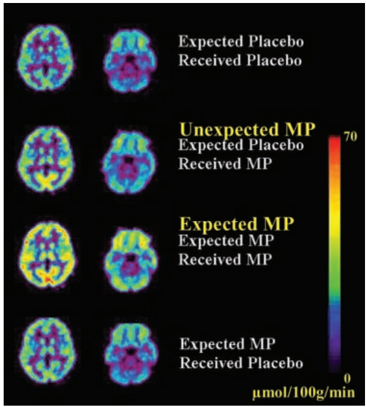
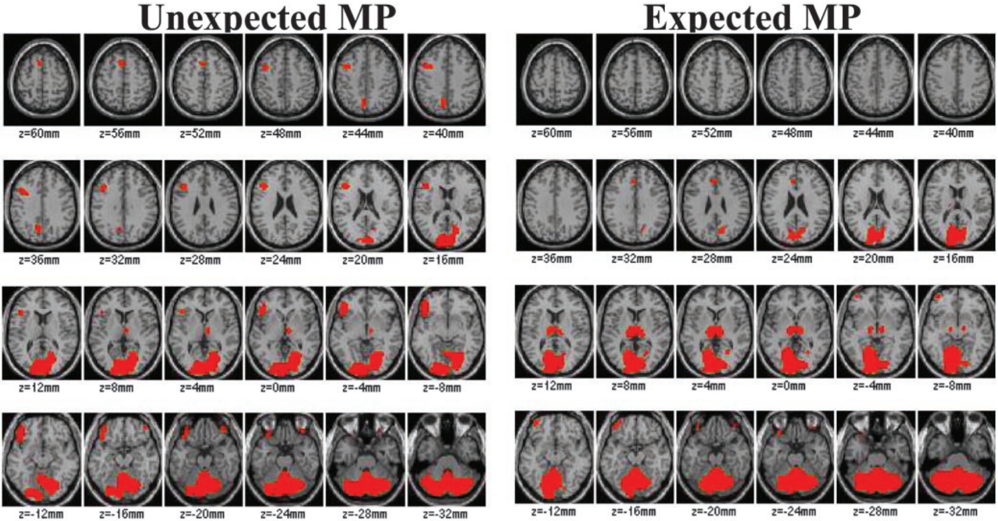
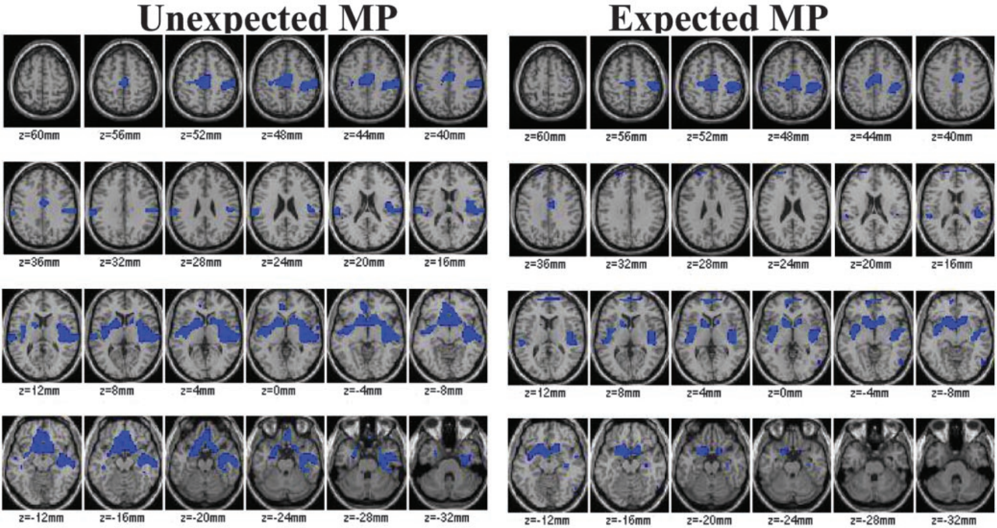
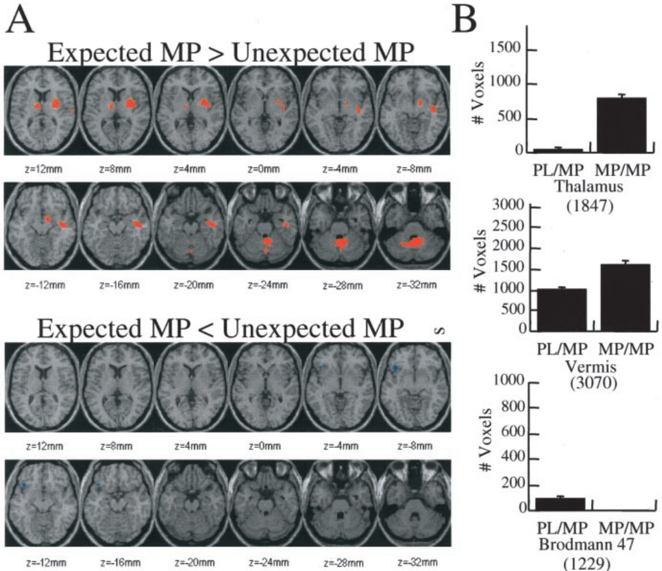
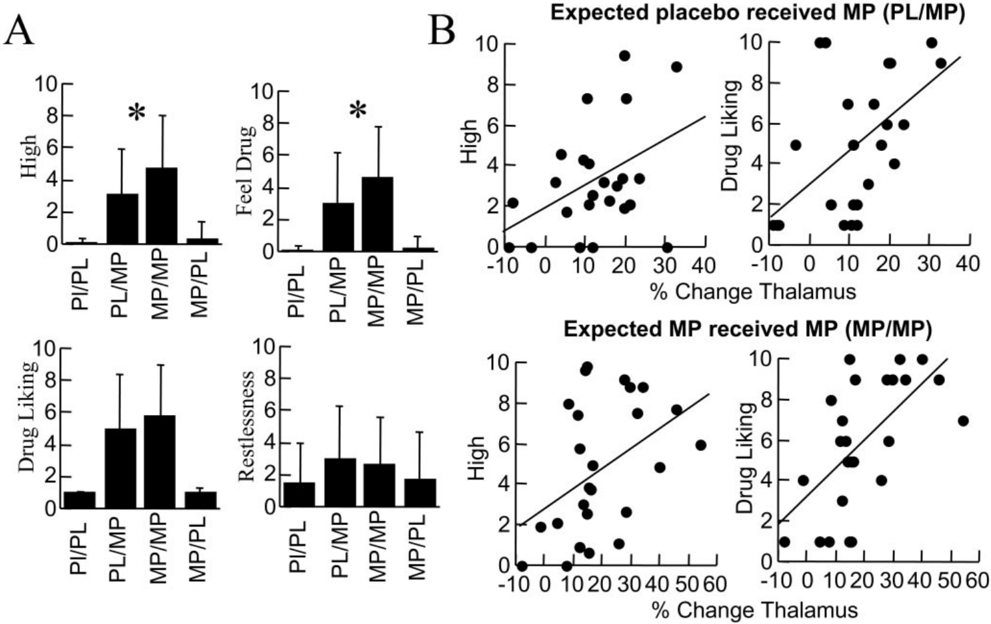
The reinforcing effects of drugs of abuse result from the complex interaction between pharmacological effects and conditioned responses. Here we evaluate how expectation affects the response to the stimulant drug methylphenidate in 25 cocaine abusers. The effects of methylphenidate (0.5 mg/kg, i.v.) on brain glucose metabolism (measured by [18 F]deoxyglucose-positron emission tomography) and on its reinforcing effects (self-reports of drug effects) were evaluated in four conditions: (1) expecting placebo and receiving placebo; (2) expecting placebo and receiving methylphenidate; (3) expecting methylphenidate and receiving methylphenidate; (4) expecting methylphenidate and receiving placebo. Methylphenidate increased brain glucose metabolism, and the largest changes were in cerebellum, occipital cortex, and thalamus. The increases in metabolism were ∼50% larger when methylphenidate was expected than when it was not, and these differences were significant in cerebellum (vermis) and thalamus. In contrast, unexpected methylphenidate induced greater increases in left lateral orbitofrontal cortex than when it was expected. Methylphenidate-induced increases in self-reports of “high” were also ∼50% greater when subjects expected to receive it than when they did not and were significantly correlated with the metabolic increases in thalamus but not in cerebellum. These findings provide evidence that expectation amplifies the effects of methylphenidate in brain and its reinforcing effects. They also suggest that the thalamus, a region involved with conditioned responses, may mediate the enhancement of the reinforcing effects of methylphenidate by expectation and that the orbitofrontal cortex mediates the response to unexpected reinforcement. The enhanced cerebellar activation with expectation may reflect conditioned responses that are not linked to conscious responses.
Overview
The claims and statistics of this paper haven’t been checked yet.
Run the check — free, no account needed. It reads the open-access text and checks the sources it cites.
Integrity signals
Registry
Cites
Statistics
Figures
Verification
Claims the paper makes
The claims and statistics of this paper haven’t been checked yet.
Run the check — free, no account needed. It reads the open-access text and checks the sources it cites.
Claims other papers make about this one
Each is checked against this paper’s own text: does it say what the citing paper says it does?
In the citing paper
“The firing of DA cells that accompanies drug use encodes a number of reward properties, including reward expectancy [117], reward learning [118], and the consolidation of contextual memories [119].”
From Reward circuitry dysfunction in psychiatric and neurodevelopmental disorders and genetic syndromes: animal models and clinical findings (2012) · cites this paper as [117]
Self-check
Percentages, sums and reported differences re-computed from the paper’s own numbers.
The self-check needs the paper’s full text.
Citations
Cites
Statistical parametric maps in functional imaging: A general linear approach
Friston, K. J., Holmes, A. P., Worsley, K. J., Poline, J. ‐., Frith, C. D., & Frackowiak, R. S. J. (1994) · Human Brain Mapping · doi:10.1002/hbm.460020402 · Cited by 9,688
The Jackknife, the Bootstrap and Other Resampling Plans
Efron, B. (1982) · Society for Industrial and Applied Mathematics eBooks · doi:10.1137/1.9781611970319 · Cited by 8,120
The neural basis of drug craving: An incentive-sensitization theory of addiction
Robinson, T. (1993) · Brain Research Reviews · doi:10.1016/0165-0173(93)90013-p · Cited by 7,346
Sokoloff, L., Reivich, M., Kennedy, C., Rosiers, M. H. D., Patlak, C. S., Pettigrew, K. D., Sakurada, O., & Shinohara, M. (1977) · Journal of Neurochemistry · doi:10.1111/j.1471-4159.1977.tb10649.x · Cited by 6,000
Di Chiara, G., & Imperato, A. (1988) · Proceedings of the National Academy of Sciences · doi:10.1073/pnas.85.14.5274 · Cited by 4,733
Miller, R. G. (1974) · Biometrika · doi:10.1093/biomet/61.1.1 · Cited by 1,391
Quenouille, M. H. (1956) · Biometrika · doi:10.1093/biomet/43.3-4.353 · Cited by 1,305
Acute effects of cocaine on human brain activity and emotion
Breiter, H. C., Gollub, R. L., Weisskoff, R. M., Kennedy, D. N., Makris, N., Berke, J. D., Goodman, J. M., Kantor, H. L., Gastfriend, D. R., Riorden, J. P., et al. (1997) · Neuron · doi:10.1016/s0896-6273(00)80374-8 · Cited by 1,270
Expectation and Dopamine Release: Mechanism of the Placebo Effect in Parkinson's Disease
de la Fuente‐Fernández, R., Ruth, T. J., Sossi, V., Schulzer, M., Calne, D. B., & Stoessl, A. J. (2001) · Science · doi:10.1126/science.1060937 · Cited by 991
Reward processing in primate orbitofrontal cortex and basal ganglia
Schultz, W. (2000) · Cerebral Cortex · doi:10.1093/cercor/10.3.272 · Cited by 942
Research works printed but not linked: 6
- 2001, J Nucl Med, 42, 535
- Dirckx, SG, Risinger RC, Ross TJ, Li Z, Li SJ, Stein EA 2003 Comparing iv methylphenidate and cocaine in the human brain using fMRI. 9th International Conference on Functional Mapping of the Human Brain, New York, June.
- 1997, Arch Ital Biol, 135, 369
- 1995, Cereb Cortex, 2, 95
- 1999, Life Sci, 65, 7
- 1992, Radiology, 186, 59
Cited by
Sorted by citations
Items 201–300 of 302
Imaging the Conditioned Behavioral Effects of Methamphetamine in Rodents
Carrión, J., Liebling, C. N. B., Reiszel, C., Dalal, R. M., Dewey, S. L., & Schiffer, W. K. (2009) · Brain Imaging and Behavior · doi:10.1007/s11682-009-9060-9 · Cited by 9
Ohlmeier, M. D., Goseberg, E., Roy, M., Dillo, W., Kordon, A., & Prox-Vagedes, V. (2011) · The European Journal of Psychiatry · doi:10.4321/s0213-61632011000300005 · Cited by 10
Szabó, A., Jobbágy, L., & Köteles, F. G. (2018) · The Journal of General Psychology · doi:10.1080/00221309.2018.1459454 · Cited by 8
Is Placebo Response Responsible for Many Phase III Failures?
Dumitrescu, T. P., McCune, J., & Schmith, V. D. (2019) · Clinical Pharmacology & Therapeutics · doi:10.1002/cpt.1632 · Cited by 8
The Neural Basis of Addiction: A Pathology of Motivation and Choice
Kalivas, P. W., & Volkow, N. D. (2007) · FOCUS The Journal of Lifelong Learning in Psychiatry · doi:10.1176/foc.5.2.foc208 · Cited by 9
Self-citationTemporal specificity in Pavlovian-to-instrumental transferPreprint
Matell, M. S., & della Valle, R. (2018) · Learning & memory (Cold Spring Harbor, N.Y.) · doi:10.1101/lm.046383.117 · Cited by 8
Words and Drugs: Same Mechanisms of Action?
Piedimonte, A., & Benedetti, F. (2015) · Journal of Contemporary Psychotherapy · doi:10.1007/s10879-015-9321-4 · Cited by 7
Neuroimaging of Dopamine Transporter Density in the Striatum of Disordered Gamblers
Guerra, R. F., Batista, I. R., Kim, H. S. A., Hoexter, M. Q., Shih, M. C., Bressan, R. A., & Tavares, H. (2022) · Journal of Gambling Studies · doi:10.1007/s10899-021-10100-8 · Cited by 8
Beliefs modulate the effects of drugs on the human brain
Volkow, N. D., & Baler, R. (2015) · Proceedings of the National Academy of Sciences · doi:10.1073/pnas.1500552112 · Cited by 7
Self-citationPorrino, L. J., Beveridge, T. J. R., Smith, H. R., & Nader, M. A. (2015) · Addiction Biology · doi:10.1111/adb.12231 · Cited by 6
Sports Augmented Cognitive Benefits: An fMRI Study of Executive Function with Go/NoGo Task
Ding, Q., Huang, L., Chen, J., Dehghani, F., Du, J., Li, Y., Li, Q., Zhang, H., Qian, Z., Shen, W., et al. (2021) · Neural Plasticity · doi:10.1155/2021/7476717 · Cited by 6
RetractedNeural correlates of cocaine-induced conditioned place preference in the posterior cerebellar cortex
Rodríguez‐Borillo, O., Roselló-Jiménez, L., Guarque‐Chabrera, J., Palau-Batet, M., Gil‐Miravet, I., Pastor, R., Miquel, M., & Font, L. (2023) · Frontiers in Behavioral Neuroscience · doi:10.3389/fnbeh.2023.1174189 · Cited by 5
Putting forward a model for the role of the cerebellum in cocaine-induced pavlovian memory
Eixea, I. M., Guarque‐Chabrera, J., Sanchez-Hernandez, A., Ibáñez-Marín, P., Pastor, R., & Miquel, M. (2023) · Frontiers in Systems Neuroscience · doi:10.3389/fnsys.2023.1154014 · Cited by 5
Non-addictive psychoactive drug use: Implications for behavioral addiction
Griffiths, M. D. (2011) · Behavioral and Brain Sciences · doi:10.1017/s0140525x11000720 · Cited by 5
Garavan, H., Lingford-Hughes, A. R., Jones, T., Morris, P. G., Rothwell, J. C., & Williams, S. (2007) · Elsevier eBooks · doi:10.1016/b978-012370624-9/50012-8 · Cited by 5
Anzolin, A. P., Collares, D. D. S., dos Santos, R. T., Pasqualotti, A., Rossato‐Grando, L. G., & Bertol, C. D. (2021) · Complementary Therapies in Clinical Practice · doi:10.1016/j.ctcp.2021.101351 · Cited by 5
The orbitofrontal cortex in drug addiction
Goldstein, R. Z., Alia‐Klein, N., Cottone, L. A., & Volkow, N. D. (2006) · Oxford University Press eBooks · doi:10.1093/acprof:oso/9780198565741.003.0019 · Cited by 5
Self-citationPlacebo doping in sport: Overview and ethical considerations
Szabó, A. (2023) · The Journal of Sport and Exercise Science · doi:10.36905/jses.2023.01.08 · Cited by 4
Patient and physician preferences: impact on treatment effectiveness*
Rheims, S., & Ryvlin, P. (2012) · Epileptic Disorders · doi:10.1684/epd.2012.0533 · Cited by 4
The Relevance of Placebo and Nocebo Mechanisms for Analgesic Treatments
Bingel, U. (2013) · Elsevier eBooks · doi:10.1016/b978-0-12-397928-5.00013-1 · Cited by 4
Ontogenetic Perspectives on the Neurobiological Basis of Psychopathology Following Abuse and Neglect
Seraphin, S. B., Teicher, M. H., Rabi, K., Sheu, Y.-S., Andersen, S. L., Anderson, C. M., Choi, J., & Tomoda, A. (2010) · Cambridge University Press eBooks · doi:10.1017/cbo9780511711879.028 · Cited by 4
Malizia, A. L. (2006) · Journal of Psychopharmacology · doi:10.1177/1359786806066555 · Cited by 4
Atlas, L. Y., Wager, T. D., Dahl, K. P., & Smith, E. E. (2009) · Wiley eBooks · doi:10.1002/9780470478509.neubb002063 · Cited by 4
Gut Hormones: Possible Mediators of Addictive Disorders?
Nestor, L. J., & Ersche, K. D. (2024) · European Addiction Research · doi:10.1159/000540743 · Cited by 4
Skarin, F., & Wästlund, E. (2020) · Frontiers in Psychology · doi:10.3389/fpsyg.2020.553764 · Cited by 3
Chronic Psychosis in Dual Disorder Heroin Use Disorder Patients
Maremmani, I., Pacini, M., & Maremmani, A. G. I. (2023) · Springer eBooks · doi:10.1007/978-3-031-30093-6_4 · Cited by 4
From Bench to Bedside: Converting Placebo Research into Belief Activation
Green, J., & Wright, H. (2017) · The Journal of Alternative and Complementary Medicine · doi:10.1089/acm.2016.0375 · Cited by 3
Dopamine and Glutamate in Attention Deficit Hyperactivity Disorder
Swanson, J. M., Volkow, N. D., Newcorn, J. H., Casey, B. J., Moyzis, R. K., Grandy, D. K., & Posner, M. I. (2005) · Humana Press eBooks · doi:10.1007/978-1-59259-852-6_13 · Cited by 4
Self-citationLindsey, K. P., Lukas, S. E., MacLean, R. R., Ryan, E. T., Reed, K. R., & Frederick, B. B. (2009) · Clinical EEG and Neuroscience · doi:10.1177/155005940904000109 · Cited by 3
Ohlmeier, M. D. (2015) · SUCHT - Zeitschrift für Wissenschaft und Praxis / Journal of Addiction Research and Practice · doi:10.1024/0939-5911.a000386 · Cited by 3
Pain, pleasure and placebo: the cannabinoids in reward processing and the perception of pain
Brodermann, M. H. (2016) · Mental Health and Addiction Research · doi:10.15761/mhar.1000115 · Cited by 3
Maremmani, I., Spera, V., Maremmani, A. G. I., Carli, M., & Scarselli, M. (2019) · Addictive Disorders & Their Treatment · doi:10.1097/adt.0000000000000157 · Cited by 3
Banks, M. L., Hutsell, B. A., & Negus, S. S. (2022) · Journal of the Experimental Analysis of Behavior · doi:10.1002/jeab.734 · Cited by 3
Swann, A. C. (2005) · Psychiatric Annals · doi:10.3928/00485713-20051001-08 · Cited by 3
Placebo y Psicología Clínica: Aspectos Conceptuales, Teóricos e Implicancias
Abarca, A. O., Chacón, S. A., Espinosa, S. F., & Vera-Villarroel, P. (2005) · Redalyc (Universidad Autónoma del Estado de México) · Cited by 3
Yuan, F., Yu, J., Liao, G., Li, J., Long, T., Li, Y., Chen, D., Dai, Q., Zhu, X., Hu, S., et al. (2021) · Addiction Biology · doi:10.1111/adb.13043 · Cited by 2
Pharmacotherapy of Attention-Deficit/Hyperactivity Disorder across the Life Span
Prince, J. B., Spencer, T. J., Wilens, T. E., & Biederman, J. (2008) · Elsevier eBooks · doi:10.1016/b978-0-323-04743-2.50051-2 · Cited by 2
Aging of reward dopamine tracts in the human brain: A diffusion tensor imaging study
Seo, J. P., & Ryu, H.-J. (2023) · Medicine · doi:10.1097/md.0000000000036112 · Cited by 2
The Neural Matrix of Pain Processing and Placebo Analgesia: Implications for Clinical Practice
Finniss, D. G., & Benedetti, F. (2005) · Headache Currents · doi:10.1111/j.1743-5013.2005.00023.x · Cited by 2
Hamamura, M., Hirata, N., Sawada, K., Shuto, T., Shimazoe, T., Terada, Y., & Fukumaki, Y. (2008) · Journal of neural transmission · doi:10.1007/s00702-008-0032-9 · Cited by 2
Ohlmeier, M. D., Peters, K., Wildt, B. T. T., Zedler, M., Ziegenbein, M., Wiese, B., Emrich, H. M., Schneider, U., & Wahrendorff, K. (2008) · Cited by 2
The Nervous System and Addictions
Anderson-Mooney, A. J., Dodd, J. N., Scott, A. B., & Guller, L. (2016) · Elsevier eBooks · doi:10.1016/b978-0-12-800213-1.00001-8 · Cited by 2
Placeboeffekte und ihre Implikationen in der Medizin
Bingel, U. (2014) · Uro-News · doi:10.1007/s00092-014-0033-y · Cited by 2
Dopamine Receptors: Neurotherapeutic Targets for Substance Use Disorders
Nilson, A. N., Felsing, D. E., & Allen, J. (2022) · Wiley eBooks · doi:10.1002/9781119564782.ch19 · Cited by 2
Placebo effects and emotion regulation: conceptual and neural similarities and differences
Bo, K., & Wager, T. D. (2025) · Handbook of clinical neurology · doi:10.1016/b978-0-443-29884-4.00004-2 · Cited by 1
Expectations Do Not Always Influence Food Liking
Hale, J. (2012) · Cited by 1
Placeboeffekte und ihre Implikationen in der Medizin
Bingel, U. (2014) · HNO Nachrichten · doi:10.1007/s00060-014-0281-1 · Cited by 1
Neuronal Mechanisms of Placebo Effects
Nayak, D., & Patel, P. (2014) · Psychiatric Annals · doi:10.3928/00485713-20140205-04 · Cited by 1
Placebo: een ingewikkeld fenomeen
Olivier, J., & Olivier, B. (2016) · Neuropraxis · doi:10.1007/s12474-016-0130-7 · Cited by 1
Neurochemical Imaging in Addiction
Wai, J. M., LEVIN, F. R., & Martínez, D. (2018) · Elsevier eBooks · doi:10.1016/b978-0-323-54856-4.00001-8 · Cited by 1
Das ADHS Kaleidoskop: State of the Art und bisher nicht beachtete Aspekte von hoher Relevanz
Universität Rostock, D., & Häßler, F. (2008) · Medizinisch Wissenschaftliche Verlagsgesellschaft eBooks · doi:10.32745/9783954661886 · Cited by 1
How Can We Reconstruct the Health Anticipation?
Goli, F., & Fard, R. J. (2016) · Studies in neuroscience, consciousness and spirituality · doi:10.1007/978-3-319-35092-9_4 · Cited by 1
Mental and behavioural disorders
Benedetti, F. (2020) · Oxford University Press eBooks · doi:10.1093/oso/9780198843177.003.0012 · Cited by 1
Neurocognitive deficits in adult ADHD : preclinical and clinical studies
Tomlinson, A. (2014) · Research Explorer (The University of Manchester) · Cited by 1
Uit de kliniek: Verslaving een chronisch recidiverende hersenziekte
van den Brink, W. (2009) · Tijdschrift voor bedrijfs- en verzekeringsgeneeskunde · doi:10.1007/bf03081165 · Cited by 2
Involvement of the cerebellum in cocaine-induced memory
Carbo‐Gas, M. (2017) · Tesis Doctorals en Xarxa (Consorci de Serveis Universitaris de Catalunya) · doi:10.6035/14023.2017.208925 · Cited by 1
Banks, M. L., Hutsell, B. A., & Negus, S. S. (2019) · bioRxiv (Cold Spring Harbor Laboratory) · doi:10.1101/753699 · Cited by 1
Brignani, D., & Bagattini, C. (2021) · Elsevier eBooks · doi:10.1016/b978-0-12-819641-0.00083-9 · Cited by 1
Turning on and off the cerebellum in drug-induced memory
Eixea, I. M., & Melchor Eixea, I. (2024) · Tesis Doctorals en Xarxa (Consorci de Serveis Universitaris de Catalunya) · doi:10.6035/14112.2024.428833 · Cited by 1
Placeboeffekte und ihre Implikationen in der Neurologie
Bingel, U. (2014) · InFo Neurologie + Psychiatrie · doi:10.1007/s15005-013-0310-4
Björk, K. (2008) · Figshare
Wilson, S. J. (2005) · D-Scholarship@Pitt (University of Pittsburgh)
Imaging Placebo Responses in the Brain
Colloca, L., & Benedetti, F. (2009) · Springer eBooks · doi:10.1007/978-1-4419-0134-7_11
POST MORTEM STUDIES ON THE HUMAN ALCOHOLIC BRAIN: DNA METHYLATION AND MOLECULAR RESPONSES
Johansson, S. (2008) · Figshare · Cited by 1
Peut-on étudier scientifiquement le placebo ?
Durand, D. V., & Fassier, T. (2010) · MT. Médecine thérapeutique · doi:10.1684/met.2010.0264
Psychiatric Applications of Placebos
Sohn, I., & Kim, I. (2014) · 대한정신약물학회지
DATA ANALYSIS OF COMPLEX METABOLOMES OBTAINED BY ION MOBILITY MASS SPECTROMETRY (IMMS)
Kaplan, K. A. (2010) · Research Exchange (Washington State University)
McFadden, K. (2010) · CU Scholar (University of Colorado Boulder)
Bresjanac, M. (2015) · Repository of the University of Ljubljana (University of Ljubljana)
Psycho-Social Mediators of Placebo Effects
Nayak, D., & Naliyath, J. (2014) · Psychiatric Annals · doi:10.3928/00485713-20140205-05
Placebos in der Schmerztherapie
Bingel, U. (2014) · MMW - Fortschritte der Medizin · doi:10.1007/s15006-014-2812-5
Rovai, L., Giovanni, A. S., Maremmani, I., Pacini, M., Pani, P., Rugani, F., Lamanna, F., Schiavi, E., & Mautone, S. (2016)
Neurobiología de la respuesta placebo
Aguilar, E. (2006)
The Cerebellar Landscape of Drug Addiction
Miquel, M., Vazquez-Sanroman, D. B., Carbo‐Gas, M., Gil‐Miravet, I., & Sanchis‐Segura, C. (2016) · Elsevier eBooks · doi:10.1016/b978-0-12-800634-4.00021-4
Worthman, C. M. (2010) · Cambridge University Press eBooks · doi:10.1017/cbo9780511711879.024
The Roots and Individual Diversity of Addiction
Leis, A. B. (2016) · Elsevier eBooks · doi:10.1016/b978-0-12-420190-3.00031-4
Placeboeekte und ihre Implikationen in der Medizin
Bingel, U. (2014)
Schlagintweit, H. E. (2017) · DalSpace (Dalhousie University)
Implications of placebos and nocebos in clinical research
Colloca, L., & Haycock, N. R. (2018) · PNEI REVIEW · doi:10.3280/pnei2018-001009
Evaluating Quality of Health Care for the Disadvantaged. A Literature Review.
Brook, R. H., & Williams, K. N. (1975) · DigitalGeorgetown (Georgetown University Library)
TRATAMIENTO FARMACOLÓGICO DEL TDAH Y LAS COMORBILIDADES
Prince, J. B., & Wilens, T. E. (2010) · Elsevier eBooks · doi:10.1016/b978-84-458-2021-6.00019-1
Reid, A. G., & Nutt, D. (2010) · Wiley eBooks · doi:10.1002/9781444318852.ch15
Häßler, F. (2008) · Medizinisch Wissenschaftliche Verlagsgesellschaft eBooks · doi:10.32745/9783954661886-7
Ohlmeier, M. D. (2019) · Nervenheilkunde · doi:10.1055/a-0979-0610
Placeboeffekte und ihre Implikationen in der Medizin
Bingel, U. (2020) · Schmerzmedizin · doi:10.1007/s00940-020-0593-8
조상수 (2007)
The Neural Correlates of Expectations Effects
Wicht, C. A. (2022) · doi:10.51363/unifr.sth.2022.003
Olive, M. F. (2019) · Faculty Opinions – Post-Publication Peer Review of the Biomedical Literature · doi:10.3410/f.734873110.793555753
Implications of Placebos and Nocebos in Clinical Research
Colloca, L., & Haycock, N. R. (2019) · Headache · doi:10.1007/978-3-030-02976-0_10
(2010) · Érès eBooks · doi:10.3917/eres.rouss.2010.01.0135
Wise, R. A. (2019) · Faculty Opinions – Post-Publication Peer Review of the Biomedical Literature · doi:10.3410/f.734873110.793560131
Vanderschuren, L. J. M. J. (2019) · Faculty Opinions – Post-Publication Peer Review of the Biomedical Literature · doi:10.3410/f.734873110.793560144
Update on pathological gambling
Grant, J. E., Williams, K. B., & Kim, S. W. (1996) · Current Psychiatry Reports · doi:10.1007/s11920-996-0062-7
La respuesta placebo en el consumo de cocaína: una revisión sistemática
Rueda, E., & Navarro, J. F. (2022) · Psiquiatría Biológica · doi:10.1016/j.psiq.2022.100370
Cholinergic modulation of circuits
Addy, N., Fowler, C. D., & Wickham, R. J. (2023) · Elsevier eBooks · doi:10.1016/b978-0-12-823453-2.00004-7 · Cited by 1
Murnane, K. S., Derouen, A. G., Provenzano, D. A., Green, K. M., Williams, B. C., Samra, N. S., Cornett, E. M., & Kaye, A. D. (2023) · Elsevier eBooks · doi:10.1016/b978-0-323-98814-8.00026-3
Substance Use and Substance Use Disorders
Sher, K. J., Conlin, W. E., & Pihl, R. O. (2023) · Oxford University Press eBooks · doi:10.1093/med-psych/9780197542521.003.0013
Amigó, S. (2023) · Psychiatry International · doi:10.3390/psychiatryint4030026
The role of expectancy in prescription stimulant misuse
Looby, A. R. (2011) · doi:10.54014/3p9r-wgkf
Metadata
- Authors
- Volkow, N. D., Wang, G.-J., Ma, Y., Fowler, J. S., Zhu, W., Maynard, L., Telang, F., Vaska, P., Ding, Y.-S., Wong, C., & Swanson, J. M.
- Affiliations
- State University of New York (US)
- ORCID
- Venue
- The Journal of Neuroscience
- Publisher
- Society for Neuroscience
- Published
- 2003-12-10
- Volume
- 23
- Issue
- 36
- Pages
- 11461-11468
- ISSN
- 0270-6474 (ISSN-L)
- 1529-2401
- PMC
- PMC6740524
- OpenAlex
- W1498104517
- Cited by
- 302
- References
- 48
- Citations by year
- 2025: 1 · 2024: 2 · 2023: 12 · 2022: 9 · 2021: 6 · 2020: 5 · 2019: 14 · 2018: 8 · 2017: 11 · 2016: 20 · 2015: 12 · 2014: 22 · 2013: 20 · 2012: 14
- FWCI
- 4.75
- Type
- journal article
- Language
- en
- Open access
- hybrid
- doi.org
- Licence
- Locations
- Journal of Neuroscience (publishedVersion, cc-by-nc-sa)
- Europe PMC (PubMed Central) (publishedVersion)
- PubMed Central (publishedVersion)
- PubMed (publishedVersion)
- Funders
- U.S. Department of Energy
- National Institute on Drug Abuse (DA 00280, K20DA000280, DA7092-01)
- Biological and Environmental Research
- Topics
- Life Sciences › Neuroscience › Cellular and Molecular Neuroscience › Neurotransmitter Receptor Influence on Behavior
- Life Sciences › Neuroscience › Cognitive Neuroscience › Neural and Behavioral Psychology Studies
- Health Sciences › Medicine › Epidemiology › Substance Abuse Treatment and Outcomes
- Keywords
- expectations, cocaine abusers, methylphenidate, drug reinforcement, conditioned response, brain glucose metabolism, thalamus, cerebellum, orbitofrontal cortex, stimulants
- MeSH terms
- Adult, Central Nervous System Stimulants, Brain, Conditioning, Psychological, Female, Glucose, Humans, Male, Methylphenidate, Reinforcement, Psychology, Tomography, Emission-Computed, Cocaine-Related Disorders
About these checks
Registry, retraction, Cites and statistics results are computed, not judged, with one exception: a printed reference that no index lists is read once by a model before it counts as a citation error. Claims are extracted by a model and kept only when their quote appears verbatim in the text; each cited source is then checked, with a model’s help, for whether it says what the claim relies on. Those verdicts can be wrong — read the claim’s quote and the cited source before relying on one.
Statistics and arithmetic are recomputed, not judged.
Confidence bands are shown only for fields calibrated on our annotated test set. None is calibrated yet, so no band is shown.
What counts as a claim ›How we measure confidence ›How we check this ›
Are you an author, or do you see a problem with this page? Request a review
