

The DOI matches its Crossref record; 44 of the 44 references it cites were found in a registry or an index.
Attention Modulates the Responses of Simple Cells in Monkey Primary Visual Cortex
Open accessAbstract
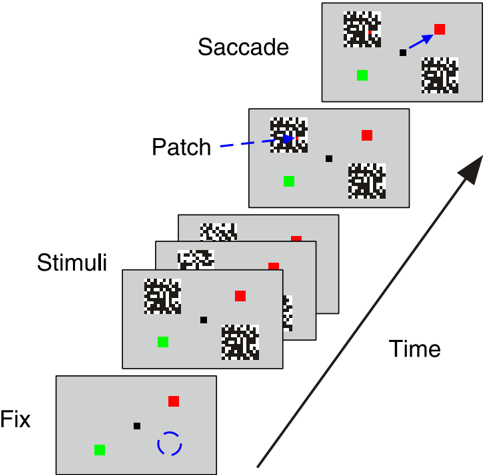
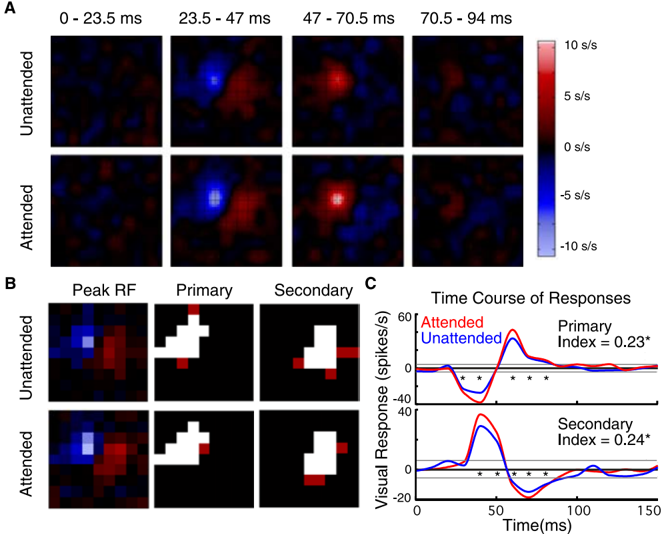
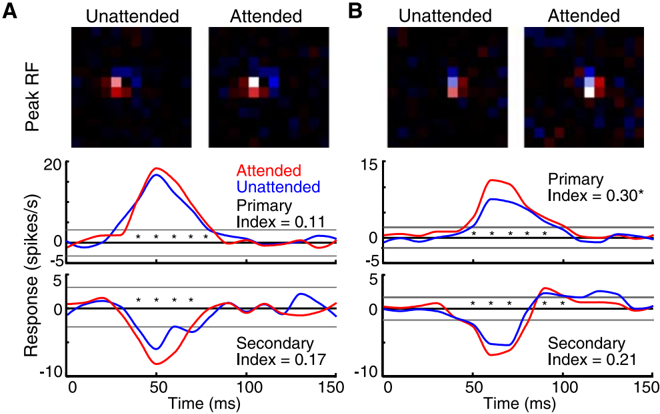
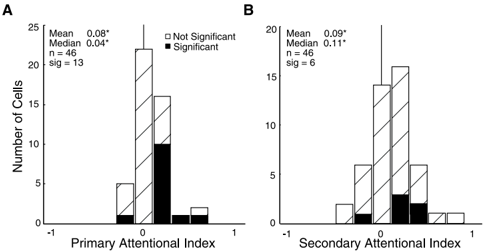
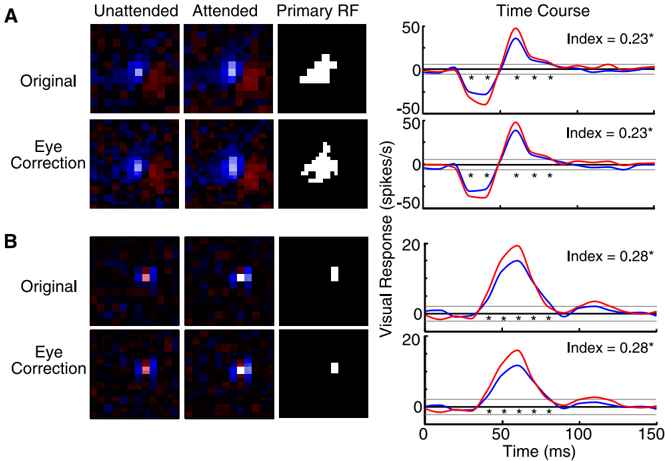
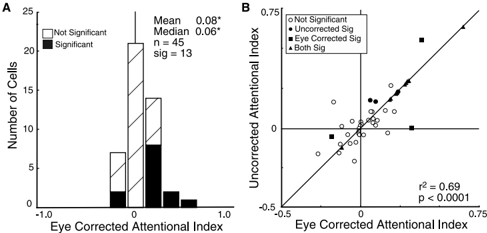
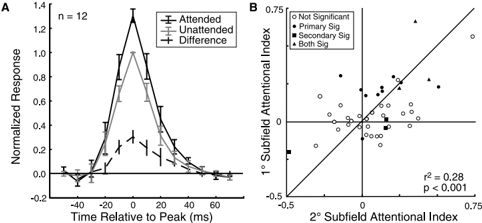
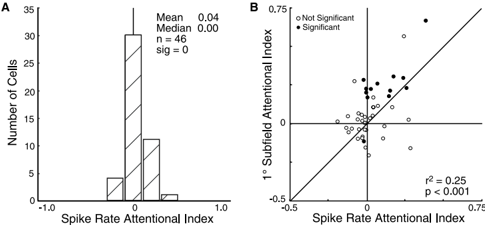
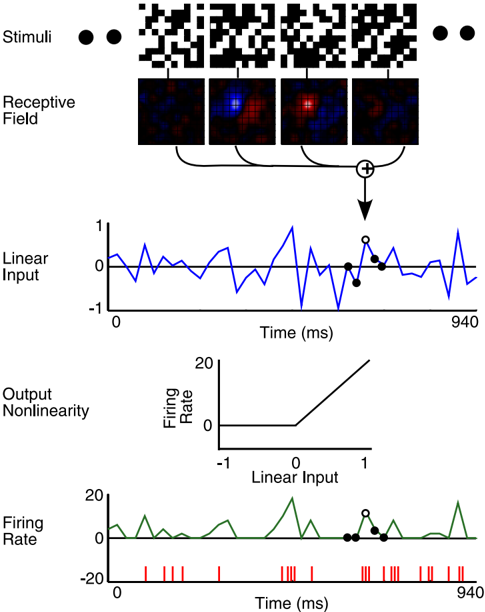
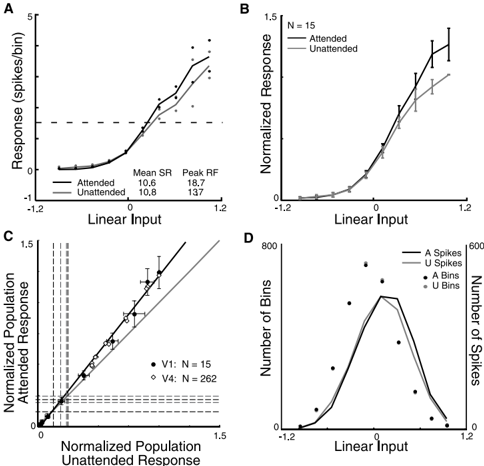
Spatial attention has long been postulated to act as a spotlight that increases the salience of visual stimuli at the attended location. We examined the effects of attention on the receptive fields of simple cells in primary visual cortex (V1) by training macaque monkeys to perform a task with two modes. In the attended mode, the stimuli relevant to the animal's task overlay the receptive field of the neuron being recorded. In the unattended mode, the animal was cued to attend to stimuli outside the receptive field of that neuron. The relevant stimulus, a colored pixel, was briefly presented within a white-noise stimulus, a flickering grid of black and white pixels. The receptive fields of the neurons were mapped by correlating spikes with the white-noise stimulus in both attended and unattended modes. We found that attention could cause significant modulation of the visually evoked response despite an absence of significant effects on the overall firing rates. On further examination of the relationship between the strength of the visual stimulation and the firing rate, we found that attention appears to cause multiplicative scaling of the visually evoked responses of simple cells, demonstrating that attention reaches back to the initial stages of visual cortical processing.
Overview
The claims and statistics of this paper haven’t been checked yet.
Run the check — free, no account needed. It reads the open-access text and checks the sources it cites.
Integrity signals
Registry
Cites
Statistics
Figures
Verification
Claims the paper makes
The claims and statistics of this paper haven’t been checked yet.
Run the check — free, no account needed. It reads the open-access text and checks the sources it cites.
Claims other papers make about this one
Each is checked against this paper’s own text: does it say what the citing paper says it does?
In the citing paper
“Attentional modulation of neural gain has been particularly well studied in the non-human primate visual system1,42,43, in which visual spatial attention within the receptive field of a recorded neuron enhances both contrast gain (that is, scaling of that neuron’s stimulus-response relationship along the contrast axis)43 and response gain (that is, multiplicative transformation of responses to all”
From Mechanisms underlying gain modulation in the cortex (2020) · cites this paper as [42]
Self-check
Percentages, sums and reported differences re-computed from the paper’s own numbers.
The self-check needs the paper’s full text.
Citations
Cites
Receptive fields, binocular interaction and functional architecture in the cat’s visual cortex
Hubel, D. H., & Wiesel, T. N. (1962) · The Journal of Physiology · doi:10.1113/jphysiol.1962.sp006837 · Cited by 13,680
Receptive fields and functional architecture of monkey striate cortex
Hubel, D. H., & Wiesel, T. N. (1968) · The Journal of Physiology · doi:10.1113/jphysiol.1968.sp008455 · Cited by 6,685
Attention and the detection of signals.
Posner, M. I., Snyder, C. R., & Davidson, B. J. (1980) · Journal of Experimental Psychology: General · doi:10.1037/0096-3445.109.2.160 · Cited by 3,778
Gorillas in our midst: sustained inattentional blindness for dynamic events
Simons, D. J., & Chabris, C. F. (1999) · Perception · doi:10.1068/p281059 · Cited by 3,181
Selective Attention Gates Visual Processing in the Extrastriate Cortex
Moran, J., & Desimone, R. (1985) · Science · doi:10.1126/science.4023713 · Cited by 2,433
Selective Attention Gates Visual Processing in the Extrastriate Cortex
Moran, J., & Desimone, R. (2003) · The MIT Press eBooks · doi:10.7551/mitpress/2834.003.0024 · Cited by 2,164
Neural mechanisms of spatial selective attention in areas V1, V2, and V4 of macaque visual cortex
Luck, S. J., Chelazzi, L., Hillyard, S. A., & Desimone, R. (1997) · Journal of Neurophysiology · doi:10.1152/jn.1997.77.1.24 · Cited by 1,615
Feature-based attention influences motion processing gain in macaque visual cortex
Treue, S., & Trujillo, J. C. M. (1999) · Nature · doi:10.1038/21176 · Cited by 1,465
Effects of Attention on Orientation-Tuning Functions of Single Neurons in Macaque Cortical Area V4
McAdams, C. J., & Maunsell, J. H. R. (1999) · Journal of Neuroscience · doi:10.1523/jneurosci.19-01-00431.1999 · Cited by 1,218
Self-citationMotter, B. C. (1993) · Journal of Neurophysiology · doi:10.1152/jn.1993.70.3.909 · Cited by 1,055
Research works printed but not linked: 1
- 1981, Exp Brain Res, 44, 213
Cited by
Sorted by citations
Modeling attention to salient proto-objects
Walther, D. B., & Koch, C. (2006) · Neural Networks · doi:10.1016/j.neunet.2006.10.001 · Cited by 1,256
Fundamental Components of Attention
Knudsen, E. I. (2007) · Annual Review of Neuroscience · doi:10.1146/annurev.neuro.30.051606.094256 · Cited by 1,091
Guarding the gateway to cortex with attention in visual thalamus
McAlonan, K., Cavanaugh, J., & Wurtz, R. H. (2008) · Nature · doi:10.1038/nature07382 · Cited by 510
Acetylcholine contributes through muscarinic receptors to attentional modulation in V1
Herrero, J. L., Roberts, M. J., Delicato, L. S., Gieselmann, M. A., Dayan, P., & Thiele, A. (2008) · Nature · doi:10.1038/nature07141 · Cited by 459
Rapid Neocortical Dynamics: Cellular and Network Mechanisms
Haider, B., & McCormick, D. A. (2009) · Neuron · doi:10.1016/j.neuron.2009.04.008 · Cited by 441
Metadata
- Authors
- McAdams, C. J., & Reid, R. C.
- Affiliations
- Harvard University (US)
- Venue
- The Journal of Neuroscience
- Publisher
- Society for Neuroscience
- Published
- 2005-11-23
- Volume
- 25
- Issue
- 47
- Pages
- 11023-11033
- ISSN
- 0270-6474 (ISSN-L)
- 1529-2401
- PMC
- PMC6725881
- OpenAlex
- W1964026607
- Cited by
- 203
- References
- 43
- Citations by year
- 2026: 8 · 2025: 5 · 2024: 5 · 2023: 7 · 2022: 8 · 2021: 23 · 2020: 10 · 2019: 4 · 2018: 7 · 2017: 9 · 2016: 7 · 2015: 7 · 2014: 9 · 2013: 11 · 2012: 10
- FWCI
- 6.29
- Type
- journal article
- Language
- en
- Open access
- hybrid
- doi.org
- Licence
- Locations
- Journal of Neuroscience (publishedVersion, cc-by-nc-sa)
- Europe PMC (PubMed Central) (publishedVersion)
- PubMed Central (publishedVersion)
- PubMed (publishedVersion)
- Funders
- National Institutes of Health
- U.S. Public Health Service (P30 12196)
- National Eye Institute (R01 EY12815, R01EY012815)
- National Institute of Neurological Disorders and Stroke (T32-NS07484, T32NS007484)
- Topics
- Life Sciences › Neuroscience › Cognitive Neuroscience › Visual perception and processing mechanisms
- Physical Sciences › Computer Science › Computer Vision and Pattern Recognition › Visual Attention and Saliency Detection
- Social Sciences › Psychology › Experimental and Cognitive Psychology › Multisensory perception and integration
- Keywords
- spatial attention, simple cells, primary visual cortex, receptive fields, visual evoked potentials, attentional modulation, macaque, early visual processing
- MeSH terms
- Acoustic Stimulation, Action Potentials, Animals, Attention, Behavior, Animal, Brain Mapping, Cues, Electrophysiology, Evoked Potentials, Visual, Macaca fascicularis, Macaca mulatta, Neurons, Photic Stimulation, Space Perception, Visual Cortex
About these checks
Registry, retraction, Cites and statistics results are computed, not judged, with one exception: a printed reference that no index lists is read once by a model before it counts as a citation error. Claims are extracted by a model and kept only when their quote appears verbatim in the text; each cited source is then checked, with a model’s help, for whether it says what the claim relies on. Those verdicts can be wrong — read the claim’s quote and the cited source before relying on one.
Statistics and arithmetic are recomputed, not judged.
Confidence bands are shown only for fields calibrated on our annotated test set. None is calibrated yet, so no band is shown.
What counts as a claim ›How we measure confidence ›How we check this ›
Are you an author, or do you see a problem with this page? Request a review
