

The DOI matches its Crossref record; 43 of the 43 references it cites were found in a registry or an index.
Neurokinin B and Dynorphin A in Kisspeptin Neurons of the Arcuate Nucleus Participate in Generation of Periodic Oscillation of Neural Activity Driving Pulsatile Gonadotropin-Releasing Hormone Secretion in the Goat
Open accessAbstract
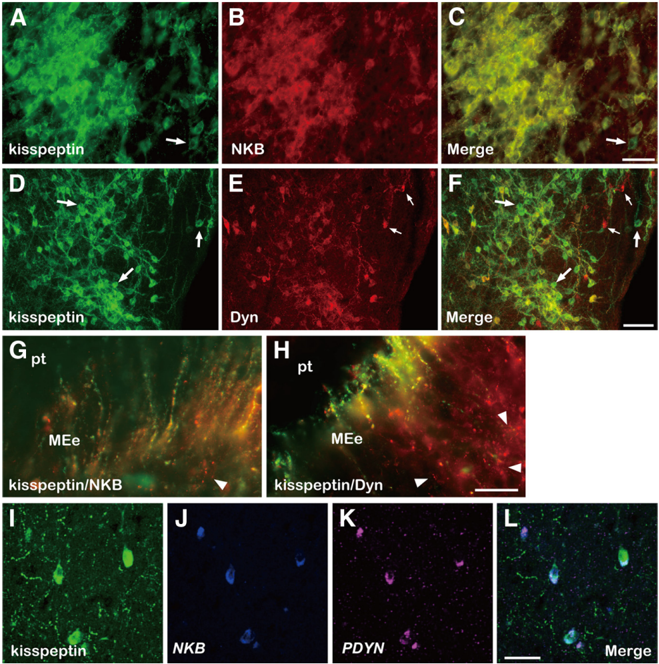
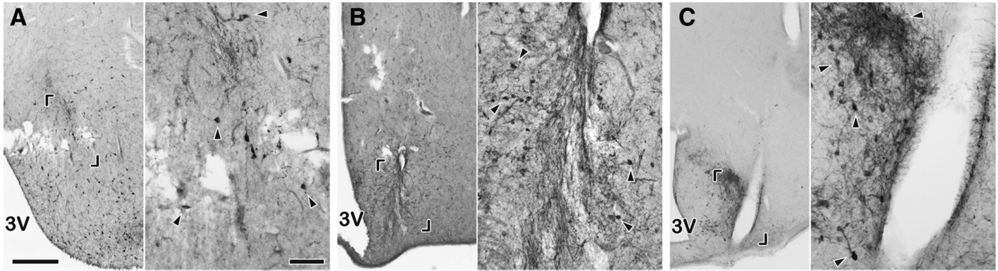
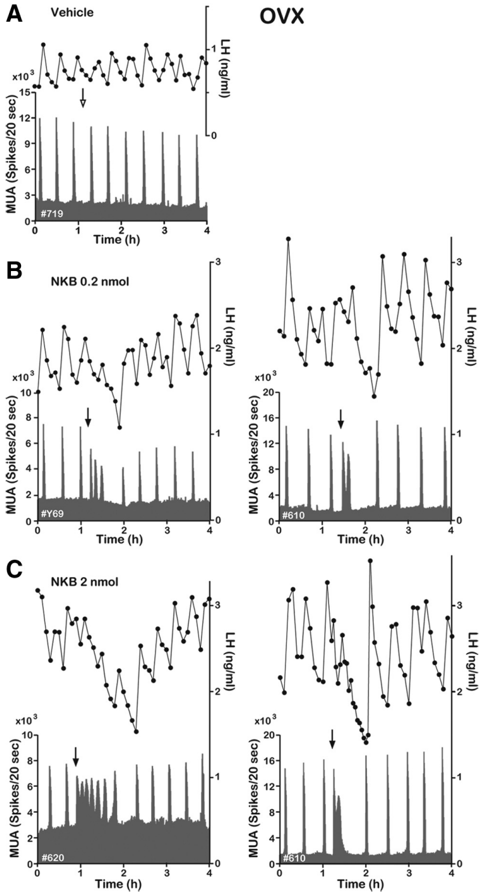
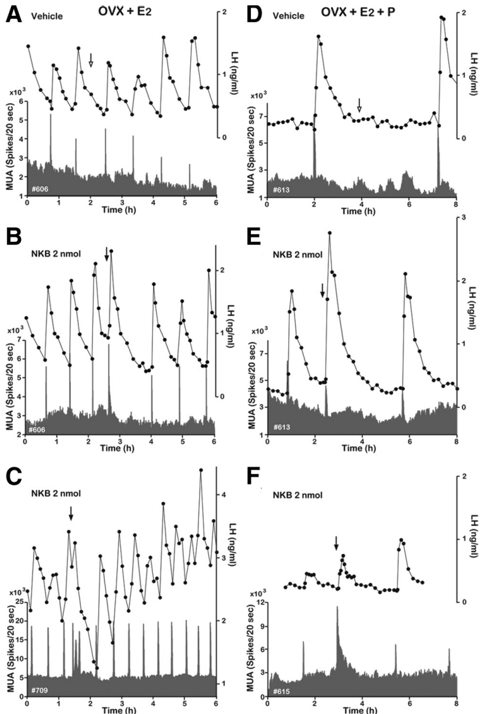
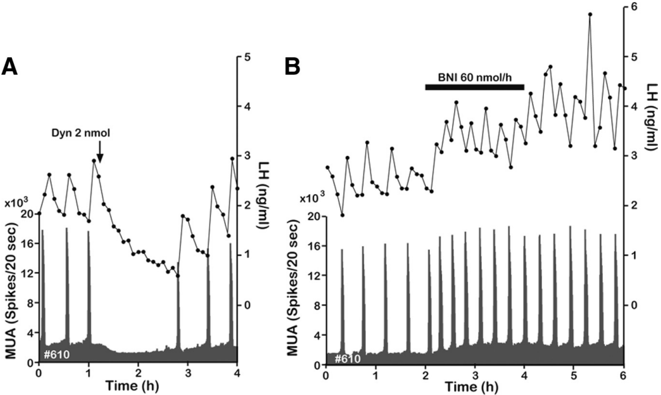
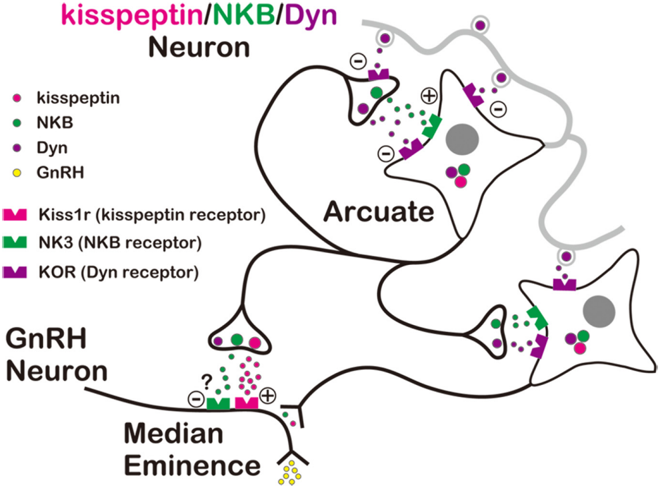
Gonadotropin-releasing hormone (GnRH) neurons in the basal forebrain are the final common pathway through which the brain regulates reproduction. GnRH secretion occurs in a pulsatile manner, and indirect evidence suggests the kisspeptin neurons in the arcuate nucleus (ARC) serve as the central pacemaker that drives pulsatile GnRH secretion. The purpose of this study was to investigate the possible coexpression of kisspeptin, neurokinin B (NKB), and dynorphin A (Dyn) in neurons of the ARC of the goat and evaluate their potential roles in generating GnRH pulses. Using double and triple labeling, we confirmed that all three neuropeptides are coexpressed in the same population of neurons. Using electrophysiological techniques to record multiple-unit activity (MUA) in the medial basal hypothalamus, we found that bursts of MUA occurred at regular intervals in ovariectomized animals and that these repetitive bursts (volleys) were invariably associated with discrete pulses of luteinizing hormone (LH) (and by inference GnRH). Moreover, the frequency of MUA volleys was reduced by gonadal steroids, suggesting that the volleys reflect the rhythmic discharge of steroid-sensitive neurons that regulate GnRH secretion. Finally, we observed that central administration of Dyn-inhibit MUA volleys and pulsatile LH secretion, whereas NKB induced MUA volleys. These observations are consistent with the hypothesis that kisspeptin neurons in the ARC drive pulsatile GnRH and LH secretion, and suggest that NKB and Dyn expressed in those neurons are involved in the process of generating the rhythmic discharge of kisspeptin.
Overview
The claims and statistics of this paper haven’t been checked yet.
Run the check — free, no account needed. It reads the open-access text and checks the sources it cites.
Integrity signals
Registry
Cites
Statistics
Figures
Verification
Claims the paper makes
The claims and statistics of this paper haven’t been checked yet.
Run the check — free, no account needed. It reads the open-access text and checks the sources it cites.
Claims other papers make about this one
Each is checked against this paper’s own text: does it say what the citing paper says it does?
The cited source says what the claim attributes to it.
In the citing paper
“administration of NKB or Dyn modulates MUA volley frequency in the ovariectomized goat (Wakabayashi et al., 2010)”
From The Origin of GnRH Pulse Generation: An Integrative Mathematical-Experimental Approach (2019) · cites this paper as Wakabayashi et al., 2010
In the citing paper
“Emerging evidence that KNDy neurons are an important part of the GnRH pulse generator (Lehman et al., 2010; Rance et al., 2010; Wakabayashi et al., 2010) strongly supports the hypothesis that they could also be involved in the generation of flushes.”
From Modulation of body temperature and LH secretion by hypothalamic KNDy (kisspeptin, neurokinin B and dynorphin) neurons: A novel hypothesis on the mechanism of hot flushes (2013) · cites this paper as Wakabayashi et al., 2010
Self-check
Percentages, sums and reported differences re-computed from the paper’s own numbers.
The self-check needs the paper’s full text.
Citations
Cites
Belchetz, P. E., Plant, T. M., Nakai, Y., Keogh, E. J., & Knobil, E. (1978) · Science · doi:10.1126/science.100883 · Cited by 1,385
The Neuroendocrine Control of the Menstrual Cycle
Knobil, E. (1980) · Elsevier eBooks · doi:10.1016/b978-0-12-571136-4.50008-5 · Cited by 1,285 · cited 1×
“The pulsatile release of gonadotropin-releasing hormone (GnRH) is a prerequisite for sustaining normal gonadotropin secretion in mammals (Knobil, 1980; Karsch, 1984); however, the cellular and molecular mechanisms that generate the rhythmic discharge of GnRH are unknown.”
BackgroundAlgorithms for the study of episodic hormone secretion
Merriam, G. R., & Wachter, K. W. (1982) · American Journal of Physiology-Endocrinology and Metabolism · doi:10.1152/ajpendo.1982.243.4.e310 · Cited by 1,221 · cited 1×
“LH pulses were identified by the PULSAR computer program (Merriam and Wachter, 1982).”
MethodAdvances in Male Contraception
Page, S. T., Amory, J. K., & Bremner, W. J. (2008) · Endocrine Reviews · doi:10.1210/er.2007-0041 · Cited by 1,138
Regulation of Kiss1 gene expression in the brain of the female mouse
Smith, J. T., Cunningham, M. J., Rissman, E. F., Clifton, D. K., & Steiner, R. A. (2005) · Endocrinology · doi:10.1210/en.2005-0488 · Cited by 1,102 · cited 1×
“Finally, kisspeptin/ NKB/Dyn neurons in the ARC have been proposed to be a primary site of negative feedback action of E2 and P (Smith et al., 2005a,b, 2007; Burke et al., 2006; Foradori et al., 2006; Goodman et al., 2007), and we demonstrated here that E2 and P suppress the occurrence of MUA…”
BackgroundSelf-citationHan, S.-K., Gottsch, M. L., Lee, K. J., Popa, S. M., Smith, J. T., Jakawich, S. K., Clifton, D. K., Steiner, R. A., & Herbison, A. E. (2005) · The Journal of Neuroscience · doi:10.1523/jneurosci.3328-05.2005 · Cited by 1,036 · cited 2×
“duces a prolonged activation of GnRH neurons in the mouse (Han et al., 2005; Pielecka-Fortuna et al., 2008).”
BackgroundResultTopaloglu, A. K., Reimann, F., Guclu, M., Yalin, A. S., Kotan, L. D., Porter, K. M., Serin, A., Mungan, N. O., Cook, J. R., Ozbek, M. N., et al. (2009) · Nature Genetics · doi:10.1038/ng.306 · Cited by 961 · cited 2×
“Indeed, Topaloglu et al. (2009) have recently shown that mutations of either Trc3 or Tacr3, which encode NKB and NK3, respectively, produce gonadotropin deficiency and pubertal failure in humans.”
BackgroundUse of cryoprotectant to maintain long-term peptide immunoreactivity and tissue morphology
Watson, R. E., Wiegand, S. J., Clough, R. W., & Hoffman, G. E. (1986) · Peptides · doi:10.1016/0196-9781(86)90076-8 · Cited by 933
Kisspeptin Signaling in the Brain
Oakley, A. E., Clifton, D. K., & Steiner, R. A. (2009) · Endocrine Reviews · doi:10.1210/er.2009-0005 · Cited by 842 · cited 1×
“Kisspeptin neurons in the hypothalamus play a key role in the regulation of GnRH neurons (Oakley et al., 2009), but the precise nature of the interaction between kisspeptin and GnRH neurons is just emerging.”
BackgroundNavarro, V. M., Gottsch, M. L., Chavkin, C., Okamura, H., Clifton, D. K., & Steiner, R. A. (2009) · The Journal of Neuroscience · doi:10.1523/jneurosci.1569-09.2009 · Cited by 779 · cited 19×
“Finally, we tested the hypothesis that NKB and Dyn play crucial roles in driving GnRH pulse generator activity by analyzing the effects of centrally administered NKB, Dyn, and a KOR antagonist on pulsatile MUA and LH secretion.”
BackgroundResultInfluential
Cited by
Sorted by citations
Dynamics of gonadotropin-releasing hormone release during a pulse.
Moenter, S. M., Brand, R. M., MIDGLEY, A. R., & Karsch, F. J. (1992) · Endocrinology · doi:10.1210/endo.130.1.1727719 · Cited by 1,257
Neuropeptide Transmission in Brain Circuits
van den Pol, A. N. (2012) · Neuron · doi:10.1016/j.neuron.2012.09.014 · Cited by 810
“Dynorphin and neurokinin B colocalize with kisspeptin in many mammals (Goodman et al, 2007); dynorphin is proposed to act back on the releasing kisspeptin neurons to synchronize and shape pulsatile release patterns of kisspeptin (Navarro et al, 2009; Wakabayashi et al, 2010).”
BackgroundKisspeptins and Reproduction: Physiological Roles and Regulatory Mechanisms
Pinilla, L., Aguilar, E., Diéguez, C., Millar, R. P., & Tena‐Sempere, M. (2012) · Physiological Reviews · doi:10.1152/physrev.00037.2010 · Cited by 843
“Thereafter, the presence of such KNDy neurons has been documented by a combination of in situ hybridization and IHC techniques in the mouse, goat, and monkey, although in the latter only NKB coexpression was analyzed (304, 305, 363, 491).”
BackgroundMethodInfluentialLehman, M. N., Coolen, L. M., & Goodman, R. L. (2010) · Endocrinology · doi:10.1210/en.2010-0022 · Cited by 768
“Although each of these three peptides is found in separate sets of neurons in other brain regions, recent evidence suggests that the colocalization of KNDy peptides seen in the ARC is unique among brain regions and is conserved across multiple mammalian species that include the rat (17), mouse (18), sheep (13), and go…”
BackgroundWitchel, S. F., Oberfield, S. E., & Peña, A. S. (2019) · Journal of the Endocrine Society · doi:10.1210/js.2019-00078 · Cited by 653
“Although GnRH and LH pulses generally exhibit a 1:1 ratio, preclinical data exist suggesting that a faster GnRH pulse frequency may be associated with decreased LH secretion [52].”
Background
Metadata
- Authors
- Wakabayashi, Y., Nakada, T., Murata, K., Ohkura, S., Mogi, K., Navarro, V. M., Clifton, D. K., Mori, Y., Tsukamura, H., Maeda, K.-I., Steiner, R. A., & Okamura, H.
- Affiliations
- Institute of Agrobiological Sciences (JP)
- Nagoya University (JP)
- University of Washington (US)
- The University of Tokyo (JP)
- ORCID
- Venue
- The Journal of Neuroscience
- Publisher
- Society for Neuroscience
- Published
- 2010-02-24
- Volume
- 30
- Issue
- 8
- Pages
- 3124-3132
- ISSN
- 0270-6474 (ISSN-L)
- 1529-2401
- PMC
- PMC6633939
- OpenAlex
- W2045555035
- Cited by
- 597
- References
- 42
- Citations by year
- 2026: 12 · 2025: 27 · 2024: 19 · 2023: 24 · 2022: 32 · 2021: 36 · 2020: 38 · 2019: 36 · 2018: 42 · 2017: 39 · 2016: 42 · 2015: 42 · 2014: 54 · 2013: 48 · 2012: 47
- FWCI
- 58.30
- Type
- journal article
- Language
- en
- Open access
- hybrid
- doi.org
- Licence
- Locations
- Journal of Neuroscience (publishedVersion, cc-by-nc-sa)
- PubMed Central (publishedVersion)
- PubMed (publishedVersion)
- Funders
- National Institutes of Health (5u54hd012629-31)
- National Institute of Child Health and Human Development
- Eunice Kennedy Shriver National Institute of Child Health and Human Development (R01HD049651, U54-HD-12629, U54HD-012629)
- Topics
- Health Sciences › Medicine › Reproductive Medicine › Hypothalamic control of reproductive hormones
- Life Sciences › Neuroscience › Cellular and Molecular Neuroscience › Neuropeptides and Animal Physiology
- Life Sciences › Neuroscience › Endocrine and Autonomic Systems › Neuroendocrine regulation and behavior
- Keywords
- kisspeptin neurons, arcuate nucleus, neurokinin B, dynorphin A, pulsatile GnRH secretion, luteinizing hormone, multi-unit activity, goats, neuroendocrine regulation of reproduction
- MeSH terms
- Action Potentials, Animals, Arcuate Nucleus of Hypothalamus, Biological Clocks, Dynorphins, Electrophysiology, Female, Goats, Luteinizing Hormone, Gonadotropin-Releasing Hormone, Neurons, Neurosecretory Systems, Ovariectomy, Periodicity, Proteins, Reproduction, Gonadal Steroid Hormones, Neurokinin B, Tumor Suppressor Proteins, Estrous Cycle, Kisspeptins
About these checks
Registry, retraction, Cites and statistics results are computed, not judged, with one exception: a printed reference that no index lists is read once by a model before it counts as a citation error. Claims are extracted by a model and kept only when their quote appears verbatim in the text; each cited source is then checked, with a model’s help, for whether it says what the claim relies on. Those verdicts can be wrong — read the claim’s quote and the cited source before relying on one.
Statistics and arithmetic are recomputed, not judged.
Confidence bands are shown only for fields calibrated on our annotated test set. None is calibrated yet, so no band is shown.
What counts as a claim ›How we measure confidence ›How we check this ›
Are you an author, or do you see a problem with this page? Request a review
