

The DOI matches its Crossref record; 82 of the 83 references it cites were found in a registry or an index, and 1 are not checked yet.
Probabilistic harmonization and annotation of single‐cell transcriptomics data with deep generative models
Open accessPublished version of a preprint
Abstract
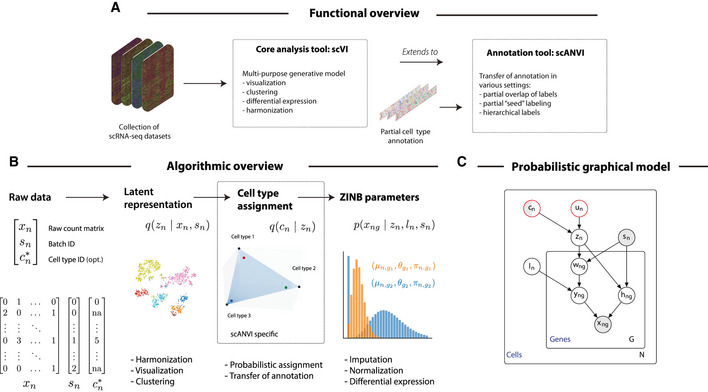
As the number of single‐cell transcriptomics datasets grows, the natural next step is to integrate the accumulating data to achieve a common ontology of cell types and states. However, it is not straightforward to compare gene expression levels across datasets and to automatically assign cell type labels in a new dataset based on existing annotations. In this manuscript, we demonstrate that our previously developed method, scVI, provides an effective and fully probabilistic approach for joint representation and analysis of scRNA‐seq data, while accounting for uncertainty caused by biological and measurement noise. We also introduce single‐cell ANnotation using Variational Inference (scANVI), a semi‐supervised variant of scVI designed to leverage existing cell state annotations. We demonstrate that scVI and scANVI compare favorably to state‐of‐the‐art methods for data integration and cell state annotation in terms of accuracy, scalability, and adaptability to challenging settings. In contrast to existing methods, scVI and scANVI integrate multiple datasets with a single generative model that can be directly used for downstream tasks, such as differential expression. Both methods are easily accessible through scvi‐tools.
Overview
The claims and statistics of this paper haven’t been checked yet.
Run the check — free, no account needed. It reads the open-access text and checks the sources it cites.
Integrity signals
Registry
Cites
Statistics
Figures
Verification
Claims the paper makes
The claims and statistics of this paper haven’t been checked yet.
Run the check — free, no account needed. It reads the open-access text and checks the sources it cites.
Claims other papers make about this one
Each is checked against this paper’s own text: does it say what the citing paper says it does?
The cited source says what the claim attributes to it.
In the citing paper
“To map SEA-AD data to cell types consistently across all 84 donors, we first defined robust transcriptional types, named supertypes, in the BICCN reference; 125 supertypes represented cell types that could be reliably reidentified in reference datasets (mean F1 score = 0.91) using hierarchical probabilistic Bayesian mapping47,48(Extended Data Fig. 5a,b).”
From Integrated multimodal cell atlas of Alzheimer’s disease (2024) · cites this paper as [48]
Self-check
Percentages, sums and reported differences re-computed from the paper’s own numbers.
The self-check needs the paper’s full text.
Citations
Cites
Adam: A Method for Stochastic Optimization
Kingma, D. P., & Ba, J. (2014) · arXiv · doi:10.48550/arxiv.1412.6980 · Cited by 98,946 · cited 4×
“We use Adam (Kingma & Ba, 2015) as a first-order stochastic optimizer to update the model parameters.”
InfluentialRobinson, M. D., McCarthy, D. J., & Smyth, G. K. (2010) · Bioinformatics · doi:10.1093/bioinformatics/btp616 · Cited by 41,364 · cited 2×
“Notably, CORAL achieves overall competitive performance except when transferring labels on the MarrowTM pairs, from 10x to Smart-Seq2.”
limma powers differential expression analyses for RNA-sequencing and microarray studies
Ritchie, M. E., Phipson, B., Wu, D., Hu, Y., Law, C. W., Shi, W., & Smyth, G. K. (2015) · Nucleic Acids Research · doi:10.1093/nar/gkv007 · Cited by 40,458 · cited 1×
“A wide range of methods have already been developed for this fundamental problem, initially for Microarrays and later on for bulk RNA sequencing, such as ComBat [15] and limma [16] which rely on generalized linear models with empirical Bayes shrinkage to avoid over-correction.”
MethodBatch Normalization: Accelerating Deep Network Training by Reducing Internal Covariate Shift
Ioffe, S., & Szegedy, C. (2015) · arXiv · doi:10.48550/arxiv.1502.03167 · Cited by 27,818 · cited 1×
“We use deterministic warmup [67] and batch normalization [68] in order to learn an expressive model.”
MethodUnpaired image-to-image translation using cycle-consistent adversarial networks
Zhu, J.-Y., Park, T., Isola, P., & Efros, A. A. (2017) · 2017 IEEE International Conference on Computer Vision (ICCV) · doi:10.1109/iccv.2017.244 · Cited by 23,602
Comprehensive Integration of Single-Cell Data
Stuart, T., Butler, A., Hoffman, P., Hafemeister, C., Papalexi, E., Mauck, W. M., Hao, Y., Stoeckius, M., Smibert, P., & Satija, R. (2019) · Cell · doi:10.1016/j.cell.2019.05.031 · Cited by 15,453
Batch Normalization: Accelerating Deep Network Training by Reducing Internal Covariate ShiftPreprint
Ioffe, S. (2024) · arXiv (Cornell University) · doi:10.57702/o9raffed · Cited by 15,273
Data Analysis Using Regression and Multilevel/Hierarchical Models
Gelman, A., & Hill, J. (2006) · doi:10.1017/cbo9780511790942 · Cited by 13,597
Integrating single-cell transcriptomic data across different conditions, technologies, and species
Butler, A., Hoffman, P., Smibert, P., Papalexi, E., & Satija, R. (2018) · Nature Biotechnology · doi:10.1038/nbt.4096 · Cited by 13,174 · cited 9×
“…or disease models in order to increase statistical robustness (Wen & Tang, 2018), achieve consistency and reproducibility among studies (Haghverdi et al , 2018; Butler et al , 2018), and ultimately converge to a common ontology of cell states and types (Wagner et al , 2016; Regev et al , 2017).”
InfluentialKass, R. E., & Raftery, A. E. (1995) · Journal of the American Statistical Association · doi:10.1080/01621459.1995.10476572 · Cited by 12,558
Research works printed but not linked: 4
- Goldberger J, Ben‐Reuven E (2017) Training deep neural‐networks using a noise adaptation layer. In Proceedings of the International Conference on Learning Representations, Toulon, France
- Kingma DP, Mohamed S, Jimenez Rezende D, Welling M (2014) Semisupervised learning with deep generative models. Adv Neural Inf Process Syst 27: 3581–3589
- Kingma DP, Welling M (2014) Auto‐encoding variational Bayes. In Proceedings of the International Conference on Learning Representations, Banff, Canada
- Louizos C, Swersky K, Li Y, Welling M, Zemel R (2016) The variational fair autoencoder. In Proceedings of the International Conference on Learning Representations, San Juan, Puerto Rico
Cited by
Sorted by citations
Dictionary learning for integrative, multimodal and scalable single-cell analysis
Hao, Y., Stuart, T., Kowalski, M. H., Choudhary, S., Hoffman, P., Hartman, A., Srivastava, A., Molla, G., Madad, S., Fernandez-Granda, C., et al. (2024) · Nature Biotechnology · doi:10.1038/s41587-023-01767-y · Cited by 5,631
“This strategy is enabled by the curation and public release of reference datasets as well as the development of new computational tools, including statistical learning 4–7 and deep learning-based approaches 8,9 , that have been successfully applied toward this goal.”
Benchmarking atlas-level data integration in single-cell genomics
Luecken, M. D., Büttner, M., Chaichoompu, K., Danese, A., Interlandi, M., Mueller, M. F., Strobl, D. C., Zappia, L., Dugas, M., Colomé-Tatché, M., et al. (2022) · Nature Methods · doi:10.1038/s41592-021-01336-8 · Cited by 1,438
“2–15), we found that the varying complexity of tasks affects the ranking of integration methods: while Seurat v3 and Harmony perform well on simpler real data tasks and some simulations, Scanorama and scVI performed particularly well on more complex real data.”
BackgroundMethodBest practices for single-cell analysis across modalities
Heumos, L., Schaar, A. C., Lance, C., Litinetskaya, A., Drost, F., Zappia, L., Lücken, M. D., Strobl, D. C., Henao, J., Curion, F., et al. (2023) · Nature Reviews Genetics · doi:10.1038/s41576-023-00586-w · Cited by 1,051
The Tabula Sapiens: A multiple-organ, single-cell transcriptomic atlas of humans
The Tabula Sapiens Consortium*, Jones, R. C., Karkanias, J., Krasnow, M. A., Pisco, A. O., Quake, S. R., Salzman, J., Yosef, N., Bulthaup, B., Brown, P., et al. (2022) · Science · doi:10.1126/science.abl4896 · Cited by 1,056
“S1 to S16 Tables S1 to S9 References (40-95)”
BackgroundSelf-citationAn integrated cell atlas of the lung in health and disease
Sikkema, L., Ramírez-Suástegui, C., Strobl, D. C., Gillett, T. E., Zappia, L., Madissoon, E., Markov, N. S., Zaragosi, L., Ji, Y., Ansari, M., et al. (2023) · Nature Medicine · doi:10.1038/s41591-023-02327-2 · Cited by 930
Self-citation
Metadata
- Authors
- Xu, C., Lopez, R., Mehlman, E., Regier, J., Jordan, M. I., & Yosef, N.
- Affiliations
- University of California, Berkeley (US)
- École Polytechnique (FR)
- University of Michigan (US)
- Harvard University (US)
- Corresponding author
- Yosef, Nir
- Venue
- Molecular Systems Biology
- Published
- 2021-01-01
- Volume
- 17
- Issue
- 1
- Pages
- e9620-e9620
- ISSN
- 1744-4292 (ISSN-L)
- PMC
- PMC7829634
- OpenAlex
- W3121168830
- Semantic Scholar
- 58c22899af553a611bbd3acfd8d2b43f86d2b3fe
- Cited by
- 691
- References
- 83
- Citations by year
- 2026: 206 · 2025: 188 · 2024: 126 · 2023: 91 · 2022: 44 · 2021: 29
- FWCI
- 23.55
- Type
- journal article
- Language
- en
- Open access
- gold
- doi.org
- Licence
- Locations
- Molecular Systems Biology (publishedVersion, cc-by)
- PubMed Central (publishedVersion, cc-by)
- PubMed (publishedVersion)
- DOAJ (DOAJ: Directory of Open Access Journals) (submittedVersion, cc-by-sa)
- Funders
- HHS | NIH | National Institute of Allergy and Infectious Diseases (U19 AI090023)
- NIH | National Institute of Mental Health (U19 MH114821)
- Topics
- Life Sciences › Biochemistry, Genetics and Molecular Biology › Molecular Biology › Single-cell and spatial transcriptomics
- Life Sciences › Biochemistry, Genetics and Molecular Biology › Molecular Biology › Gene Regulatory Network Analysis
- Life Sciences › Biochemistry, Genetics and Molecular Biology › Molecular Biology › Gene expression and cancer classification
- Keywords
- single-cell transcriptomics, data integration, cell type annotation, scVI, scANVI, variational inference, deep generative models, stochastic modeling, uncertainty quantification, semi-supervised learning, differential gene expression
- MeSH terms
- Supervised Machine Learning, Humans, Sequence Analysis, RNA, Computational Biology, Gene Expression Profiling, Databases, Genetic, Molecular Sequence Annotation, Single-Cell Analysis
About these checks
Registry, retraction, Cites and statistics results are computed, not judged, with one exception: a printed reference that no index lists is read once by a model before it counts as a citation error. Claims are extracted by a model and kept only when their quote appears verbatim in the text; each cited source is then checked, with a model’s help, for whether it says what the claim relies on. Those verdicts can be wrong — read the claim’s quote and the cited source before relying on one.
Statistics and arithmetic are recomputed, not judged.
Confidence bands are shown only for fields calibrated on our annotated test set. None is calibrated yet, so no band is shown.
What counts as a claim ›How we measure confidence ›How we check this ›
Are you an author, or do you see a problem with this page? Request a review
