

The DOI matches its Crossref record; 82 of the 83 references it cites were found in a registry or an index, and 1 are not checked yet.
Probabilistic harmonization and annotation of single‐cell transcriptomics data with deep generative models
Open accessPublished version of a preprint
Abstract
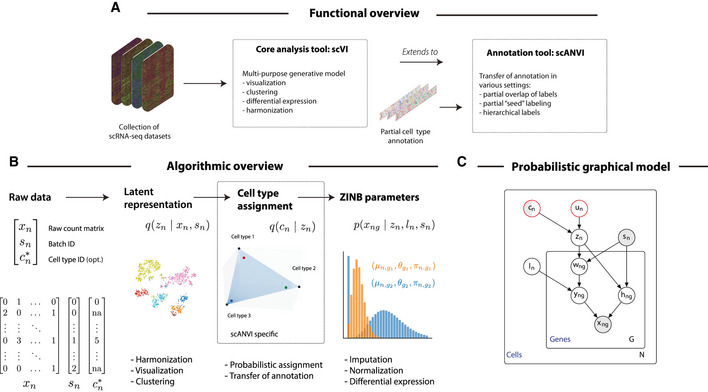
As the number of single‐cell transcriptomics datasets grows, the natural next step is to integrate the accumulating data to achieve a common ontology of cell types and states. However, it is not straightforward to compare gene expression levels across datasets and to automatically assign cell type labels in a new dataset based on existing annotations. In this manuscript, we demonstrate that our previously developed method, scVI, provides an effective and fully probabilistic approach for joint representation and analysis of scRNA‐seq data, while accounting for uncertainty caused by biological and measurement noise. We also introduce single‐cell ANnotation using Variational Inference (scANVI), a semi‐supervised variant of scVI designed to leverage existing cell state annotations. We demonstrate that scVI and scANVI compare favorably to state‐of‐the‐art methods for data integration and cell state annotation in terms of accuracy, scalability, and adaptability to challenging settings. In contrast to existing methods, scVI and scANVI integrate multiple datasets with a single generative model that can be directly used for downstream tasks, such as differential expression. Both methods are easily accessible through scvi‐tools.
Overview
The claims and statistics of this paper haven’t been checked yet.
Run the check — free, no account needed. It reads the open-access text and checks the sources it cites.
Integrity signals
Registry
Cites
Statistics
Figures
Verification
Claims the paper makes
The claims and statistics of this paper haven’t been checked yet.
Run the check — free, no account needed. It reads the open-access text and checks the sources it cites.
Claims other papers make about this one
Each is checked against this paper’s own text: does it say what the citing paper says it does?
The cited source says what the claim attributes to it.
In the citing paper
“To map SEA-AD data to cell types consistently across all 84 donors, we first defined robust transcriptional types, named supertypes, in the BICCN reference; 125 supertypes represented cell types that could be reliably reidentified in reference datasets (mean F1 score = 0.91) using hierarchical probabilistic Bayesian mapping47,48(Extended Data Fig. 5a,b).”
From Integrated multimodal cell atlas of Alzheimer’s disease (2024) · cites this paper as [48]
Self-check
Percentages, sums and reported differences re-computed from the paper’s own numbers.
The self-check needs the paper’s full text.
Citations
Cites
Adam: A Method for Stochastic Optimization
Kingma, D. P., & Ba, J. (2014) · arXiv · doi:10.48550/arxiv.1412.6980 · Cited by 98,946 · cited 4×
“We use Adam (Kingma & Ba, 2015) as a first-order stochastic optimizer to update the model parameters.”
InfluentialRobinson, M. D., McCarthy, D. J., & Smyth, G. K. (2010) · Bioinformatics · doi:10.1093/bioinformatics/btp616 · Cited by 41,364 · cited 2×
“Notably, CORAL achieves overall competitive performance except when transferring labels on the MarrowTM pairs, from 10x to Smart-Seq2.”
limma powers differential expression analyses for RNA-sequencing and microarray studies
Ritchie, M. E., Phipson, B., Wu, D., Hu, Y., Law, C. W., Shi, W., & Smyth, G. K. (2015) · Nucleic Acids Research · doi:10.1093/nar/gkv007 · Cited by 40,458 · cited 1×
“A wide range of methods have already been developed for this fundamental problem, initially for Microarrays and later on for bulk RNA sequencing, such as ComBat [15] and limma [16] which rely on generalized linear models with empirical Bayes shrinkage to avoid over-correction.”
MethodBatch Normalization: Accelerating Deep Network Training by Reducing Internal Covariate Shift
Ioffe, S., & Szegedy, C. (2015) · arXiv · doi:10.48550/arxiv.1502.03167 · Cited by 27,818 · cited 1×
“We use deterministic warmup [67] and batch normalization [68] in order to learn an expressive model.”
MethodUnpaired image-to-image translation using cycle-consistent adversarial networks
Zhu, J.-Y., Park, T., Isola, P., & Efros, A. A. (2017) · 2017 IEEE International Conference on Computer Vision (ICCV) · doi:10.1109/iccv.2017.244 · Cited by 23,602
Comprehensive Integration of Single-Cell Data
Stuart, T., Butler, A., Hoffman, P., Hafemeister, C., Papalexi, E., Mauck, W. M., Hao, Y., Stoeckius, M., Smibert, P., & Satija, R. (2019) · Cell · doi:10.1016/j.cell.2019.05.031 · Cited by 15,453
Batch Normalization: Accelerating Deep Network Training by Reducing Internal Covariate ShiftPreprint
Ioffe, S. (2024) · arXiv (Cornell University) · doi:10.57702/o9raffed · Cited by 15,273
Data Analysis Using Regression and Multilevel/Hierarchical Models
Gelman, A., & Hill, J. (2006) · doi:10.1017/cbo9780511790942 · Cited by 13,597
Integrating single-cell transcriptomic data across different conditions, technologies, and species
Butler, A., Hoffman, P., Smibert, P., Papalexi, E., & Satija, R. (2018) · Nature Biotechnology · doi:10.1038/nbt.4096 · Cited by 13,174 · cited 9×
“…or disease models in order to increase statistical robustness (Wen & Tang, 2018), achieve consistency and reproducibility among studies (Haghverdi et al , 2018; Butler et al , 2018), and ultimately converge to a common ontology of cell states and types (Wagner et al , 2016; Regev et al , 2017).”
InfluentialKass, R. E., & Raftery, A. E. (1995) · Journal of the American Statistical Association · doi:10.1080/01621459.1995.10476572 · Cited by 12,558
Research works printed but not linked: 4
- Goldberger J, Ben‐Reuven E (2017) Training deep neural‐networks using a noise adaptation layer. In Proceedings of the International Conference on Learning Representations, Toulon, France
- Kingma DP, Mohamed S, Jimenez Rezende D, Welling M (2014) Semisupervised learning with deep generative models. Adv Neural Inf Process Syst 27: 3581–3589
- Kingma DP, Welling M (2014) Auto‐encoding variational Bayes. In Proceedings of the International Conference on Learning Representations, Banff, Canada
- Louizos C, Swersky K, Li Y, Welling M, Zemel R (2016) The variational fair autoencoder. In Proceedings of the International Conference on Learning Representations, San Juan, Puerto Rico
Cited by
Sorted by citations
Dictionary learning for integrative, multimodal and scalable single-cell analysis
Hao, Y., Stuart, T., Kowalski, M. H., Choudhary, S., Hoffman, P., Hartman, A., Srivastava, A., Molla, G., Madad, S., Fernandez-Granda, C., et al. (2024) · Nature Biotechnology · doi:10.1038/s41587-023-01767-y · Cited by 5,631
“This strategy is enabled by the curation and public release of reference datasets as well as the development of new computational tools, including statistical learning 4–7 and deep learning-based approaches 8,9 , that have been successfully applied toward this goal.”
Benchmarking atlas-level data integration in single-cell genomics
Luecken, M. D., Büttner, M., Chaichoompu, K., Danese, A., Interlandi, M., Mueller, M. F., Strobl, D. C., Zappia, L., Dugas, M., Colomé-Tatché, M., et al. (2022) · Nature Methods · doi:10.1038/s41592-021-01336-8 · Cited by 1,438
“2–15), we found that the varying complexity of tasks affects the ranking of integration methods: while Seurat v3 and Harmony perform well on simpler real data tasks and some simulations, Scanorama and scVI performed particularly well on more complex real data.”
BackgroundMethodBest practices for single-cell analysis across modalities
Heumos, L., Schaar, A. C., Lance, C., Litinetskaya, A., Drost, F., Zappia, L., Lücken, M. D., Strobl, D. C., Henao, J., Curion, F., et al. (2023) · Nature Reviews Genetics · doi:10.1038/s41576-023-00586-w · Cited by 1,051
The Tabula Sapiens: A multiple-organ, single-cell transcriptomic atlas of humans
The Tabula Sapiens Consortium*, Jones, R. C., Karkanias, J., Krasnow, M. A., Pisco, A. O., Quake, S. R., Salzman, J., Yosef, N., Bulthaup, B., Brown, P., et al. (2022) · Science · doi:10.1126/science.abl4896 · Cited by 1,056
“S1 to S16 Tables S1 to S9 References (40-95)”
BackgroundSelf-citationAn integrated cell atlas of the lung in health and disease
Sikkema, L., Ramírez-Suástegui, C., Strobl, D. C., Gillett, T. E., Zappia, L., Madissoon, E., Markov, N. S., Zaragosi, L., Ji, Y., Ansari, M., et al. (2023) · Nature Medicine · doi:10.1038/s41591-023-02327-2 · Cited by 930
Self-citationA Python library for probabilistic analysis of single-cell omics data
Gayoso, A., Lopez, R., Xing, G., Boyeau, P., Valiollah Pour Amiri, V., Hong, J., Wu, K., Jayasuriya, M., Mehlman, E., Langevin, M., et al. (2022) · Nature Biotechnology · doi:10.1038/s41587-021-01206-w · Cited by 789
Self-citationLarge-scale foundation model on single-cell transcriptomics
Hao, M., Gong, J., Zeng, X., Liu, C., Guo, Y., Cheng, X., Wang, T., Ma, J., Zhang, X., & Song, L. (2024) · Nature Methods · doi:10.1038/s41592-024-02305-7 · Cited by 628
“We benchmarked scFoundation against the methods CellTypist 58 , scBERT 13 , scANVI 59 , ACTINN 60 , Scanpy 61 and SingleCellNet 62 (Methods).”
Multi-omics single-cell data integration and regulatory inference with graph-linked embedding
Cao, Z.-J., & Gao, G. (2022) · Nature Biotechnology · doi:10.1038/s41587-022-01284-4 · Cited by 616
Mapping single-cell data to reference atlases by transfer learning
Lotfollahi, M., Naghipourfar, M., Luecken, M. D., Khajavi, M., Büttner, M., Wagenstetter, M., Avsec, Ž., Gayoso, A., Yosef, N., Interlandi, M., et al. (2022) · Nature Biotechnology · doi:10.1038/s41587-021-01001-7 · Cited by 602
Self-citationSalcher, S., Sturm, G., Horvath, L., Untergasser, G., Kuempers, C., Fotakis, G., Panizzolo, E., Martowicz, A., Trebo, M., Pall, G., et al. (2022) · Cancer Cell · doi:10.1016/j.ccell.2022.10.008 · Cited by 503
Integrated multimodal cell atlas of Alzheimer’s disease
Gabitto, M. I., Travaglini, K. J., Rachleff, V. M., Kaplan, E. S., Long, B., Ariza, J., Ding, Y., Mahoney, J. T., Dee, N., Goldy, J., et al. (2024) · Nature Neuroscience · doi:10.1038/s41593-024-01774-5 · Cited by 397
“…all 84 donors, we first defined robust transcriptional types, named supertypes, in the BICCN reference; 125 supertypes represented cell types that could be reliably reidentified in reference datasets (mean F1 score = 0.91) using hierarchical probabilistic Bayesian mapping 47,48 (Extended Data Fig.”
InfluentialThe Specious Art of Single-Cell Genomics
Chari, T., & Pachter, L. (2021) · doi:10.1101/2021.08.25.457696 · Cited by 379
Lineage tracing reveals the phylodynamics, plasticity, and paths of tumor evolution
Yang, D., Jones, M. G., Naranjo, S., Rideout, W. M., Min, K. H., Ho, R., Wu, W., Replogle, J. M., Page, J. L., Quinn, J. J., et al. (2022) · Cell · doi:10.1016/j.cell.2022.04.015 · Cited by 349
“Then, we used scANVI (Xu et al. 2021) to predict labels of cells from KPL and KPA mice using 40 latent dimensions, 2 hidden layers, and a dropout rate of 0.”
Self-citationZeng, A. G. X., Bansal, S., Jin, L., Mitchell, A., Chen, W. C., Abbas, H. A., Chan‐Seng‐Yue, M., Voisin, V., van Galen, P., Tierens, A. M., et al. (2022) · Nature Medicine · doi:10.1038/s41591-022-01819-x · Cited by 353
Profiling cell identity and tissue architecture with single-cell and spatial transcriptomics
Gulati, G. S., D'Silva, J. P., Liu, Y., Wang, L., & Newman, A. M. (2024) · Nature Reviews Molecular Cell Biology · doi:10.1038/s41580-024-00768-2 · Cited by 347
Automatic cell-type harmonization and integration across Human Cell Atlas datasets
Xu, C., Prete, M., Webb, S., Jardine, L., Stewart, B. J., Hoo, R., He, P., Meyer, K. B., & Teichmann, S. A. (2023) · Cell · doi:10.1016/j.cell.2023.11.026 · Cited by 321
Self-citationDestVI identifies continuums of cell types in spatial transcriptomics data
Lopez, R., Li, B., Keren-Shaul, H., Boyeau, P., Kedmi, M., Pilzer, D., Jelinski, A., Yofe, I., David, E., Wagner, A., et al. (2022) · Nature Biotechnology · doi:10.1038/s41587-022-01272-8 · Cited by 276
“Data were processed by scVI 24 and annotated based on a public dataset 31 using scANVI 32 .”
MethodSelf-citationDental cell type atlas reveals stem and differentiated cell types in mouse and human teeth
Křivánek, J., Soldatov, R., Kastriti, M. E., Chontorotzea, T., Herdina, A. N., Petersen, J., Szarowská, B., Landová, M., Matejova, V. K., Hollá, L. I., et al. (2020) · Nature Communications · doi:10.1038/s41467-020-18512-7 · Cited by 274
Functional interpretation of single cell similarity maps
DeTomaso, D., Jones, M. G., Subramaniam, M., Ashuach, T., Ye, C., & Yosef, N. (2019) · Nature Communications · doi:10.1038/s41467-019-12235-0 · Cited by 259
Self-citationPathogenic variants damage cell composition and single cell transcription in cardiomyopathies
Reichart, D., Lindberg, E. L., Maatz, H., Miranda, A. M. A., Viveiros, A., Shvetsov, N., Gärtner, A., Nadelmann, E. R., Lee, M., Kanemaru, K., et al. (2022) · Science · doi:10.1126/science.abo1984 · Cited by 240
Automated methods for cell type annotation on scRNA-seq data
Pasquini, G., Rojo Arias, J. E., Schäfer, P., & Busskamp, V. (2021) · Computational and Structural Biotechnology Journal · doi:10.1016/j.csbj.2021.01.015 · Cited by 249
“scANVI [43] Capybara U U [44] scID U U [45] scNym U U U U [46] G.”
BackgroundMethodEfficient and precise single-cell reference atlas mapping with Symphony
Kang, J. B., Nathan, A., Weinand, K., Zhang, F., Millard, N., Rumker, L., Moody, D. B., Korsunsky, I., & Raychaudhuri, S. (2021) · Nature Communications · doi:10.1038/s41467-021-25957-x · Cited by 246
A Review of Single-Cell RNA-Seq Annotation, Integration, and Cell–Cell Communication
Cheng, C., Chen, W., Jin, H., & Chen, X. '. (2023) · Cells · doi:10.3390/cells12151970 · Cited by 253
“The mapping method gimVI [52] uses either NB distribution or zero-inflated NB (ZINB) distribution depending on the data sets; scANVI [53] uses the larger model ZINB to accommodate data sets from different platforms.”
MethodAn integrated single cell and spatial transcriptomic map of human white adipose tissue
Massier, L., Jalkanen, J., Elmastas, M., Zhong, J., Wang, T., Nono Nankam, P. A., Frendo-Cumbo, S., Bäckdahl, J., Subramanian, N., Sekine, T., et al. (2023) · Nature Communications · doi:10.1038/s41467-023-36983-2 · Cited by 195
Wu, Y., & Xie, L. (2025) · Computational and Structural Biotechnology Journal · doi:10.1016/j.csbj.2024.12.030 · Cited by 220
Liu, Z., Kong, X., Long, Y., Liu, S., Zhang, H., Jia, J., Cui, W., Zhang, Z., Song, X., Qiu, L., et al. (2023) · Nature Plants · doi:10.1038/s41477-023-01387-z · Cited by 176
An integrated transcriptomic cell atlas of human neural organoids
He, Z., Dony, L., Fleck, J. S., Szałata, A., Li, K. X., Slišković, I., Lin, H., Santel, M., Atamian, A., Quadrato, G., et al. (2024) · Nature · doi:10.1038/s41586-024-08172-8 · Cited by 190
“We applied scANVI 41 to the primary reference atlas, and used 42 to project the HNOCA to the same latent space. latent space allowed us to reconstruct a bipartite weighted k-nearest neighbor (wKNN) graph between cells in the HNOCA and the primary reference atlas.”
Searching large-scale scRNA-seq databases via unbiased cell embedding with Cell BLAST
Cao, Z., Lin, W., Shen, L., Yang, D.-C., & Gao, G. (2020) · Nature Communications · doi:10.1038/s41467-020-17281-7 · Cited by 152
Hu, J., Li, X., Hu, G., Lyu, Y., Suszták, K., & Li, M. (2020) · Nature Machine Intelligence · doi:10.1038/s42256-020-00233-7 · Cited by 146
“We selected scVI 8 as the semi-supervised method due to its popularity.”
Dib, L. H., Koneva, L. A., Edsfeldt, A., Zurke, Y.-X., Sun, J., Nitulescu, M., Attar, M., Lutgens, E., Schmidt, S., Lindholm, M., et al. (2023) · Nature Cardiovascular Research · doi:10.1038/s44161-023-00295-x · Cited by 157
A cell atlas foundation model for scalable search of similar human cells
Heimberg, G., Kuo, T. C.-Y., DePianto, D. J., Salem, O., Heigl, T., Diamant, N., Scalia, G., Biancalani, T., Turley, S. J., Rock, J. R., et al. (2024) · Nature · doi:10.1038/s41586-024-08411-y · Cited by 204
Krausgruber, T., Redl, A., Barreca, D., Doberer, K., Romanovskaia, D., Dobnikar, L., Guarini, M., Unterluggauer, L., Kleißl, L., Atzmüller, D., et al. (2023) · Immunity · doi:10.1016/j.immuni.2023.01.014 · Cited by 132
Population-level integration of single-cell datasets enables multi-scale analysis across samples
Donno, C. D., Hediyeh-zadeh, S., Moinfar, A. A., Wagenstetter, M., Zappia, L., Lotfollahi, M., & Theis, F. J. (2023) · Nature Methods · doi:10.1038/s41592-023-02035-2 · Cited by 136
“Among current reference building 60 methods [10, 12, 24, 26] only scANVI and Seurat v3 offer built-in cell-type classification coupled 61 with a reference mapping algorithm [19, 21].”
BackgroundMethodInfluentialAnnotation of spatially resolved single-cell data with STELLAR
Brbić, M., Cao, K., Hickey, J. W., Tan, Y., Snyder, M. P., Nolan, G. P., & Leskovec, J. (2022) · Nature Methods · doi:10.1038/s41592-022-01651-8 · Cited by 117
“Single-cell baselines Seurat V4 and scNym achieved lower performance than other baselines so we additionally compared to another single-cell baseline scANVI [32].”
ResultGottschlich, A., Thomas, M., Grünmeier, R., Lesch, S., Rohrbacher, L., Igl, V., Briukhovetska, D., Benmebarek, M.-R., Vick, B., Dede, S., et al. (2023) · Nature Biotechnology · doi:10.1038/s41587-023-01684-0 · Cited by 123
“To ensure CAR efficacy, a suitable candidate is target identification approach, we used scANVI, a semisupervised variational autoencoder 40 , to map the data from Petti et al. 39 onto a newly generated reference map of van Galen et al. 21 (Extended Data Fig.”
MethodSingle-cell integration reveals metaplasia in inflammatory gut diseases
Oliver, A. J., Huang, N., Bartolomé-Casado, R., Li, R., Koplev, S., Nilsen, H. R., Moy, M. R., Çakır, B., Polański, K., Gudiño, V., et al. (2024) · Nature · doi:10.1038/s41586-024-07571-1 · Cited by 132
Semisupervised adversarial neural networks for single-cell classificationPreprint
Kimmel, J. C., & Kelley, D. R. (2021) · Genome Research · doi:10.1101/gr.268581.120 · Cited by 112
“…a linear SVM (Abdelaal et al. 2019), scPred (Alquicira-Hernandez et al. 2019), SingleCellNet (Tan and Cahan 2021), CHETAH (de Kanter et al. 2019), Harmony followed by an SVM (Korsunsky et al. 2019), LIGER followed by an SVM (Stuart et al. 2019), and scANVI (Lopez et al. 2018; Xu et al. 2021).”
Large Scale Foundation Model on Single-cell Transcriptomics
Hao, M., Gong, J., Zeng, X., Liu, C., Guo, Y., Cheng, X., Wang, T., Ma, J., Song, L., & Zhang, X. (2023) · doi:10.1101/2023.05.29.542705 · Cited by 639
A brain cell atlas integrating single-cell transcriptomes across human brain regions
Chen, X., Huang, Y., Huang, L., Huang, Z., Hao, Z.-Z., Xu, L., Xu, N., Li, Z., Mou, Y., Ye, M., et al. (2024) · Nature Medicine · doi:10.1038/s41591-024-03150-z · Cited by 118
Miyoshi, E., Morabito, S., Henningfield, C. M., Das, S., Rahimzadeh, N., Shabestari, S. K., Michael, N., Emerson, N., Reese, F., Shi, Z., et al. (2024) · Nature Genetics · doi:10.1038/s41588-024-01961-x · Cited by 115
“25–29; Methods).”
InfluentialExplainable multi-task learning for multi-modality biological data analysis
Tang, X., Zhang, J., He, Y., Zhang, X., Lin, Z., Partarrieu, S., Hanna, E. B., Ren, Z., Shen, H., Yang, Y., et al. (2023) · Nature Communications · doi:10.1038/s41467-023-37477-x · Cited by 122
“We compared UnitedNet with a state-of-the-art annotation transfer method 42 and an ablated version of UnitedNet that only involved one task.”
Benchmarking strategies for cross-species integration of single-cell RNA sequencing data
Song, Y., Miao, Z., Brāzma, A., & Papatheodorou, I. (2023) · Nature Communications · doi:10.1038/s41467-023-41855-w · Cited by 112
Concordance of MERFISH spatial transcriptomics with bulk and single-cell RNA sequencing
Liu, J., Tran, V., Vemuri, V. N. P., Byrne, A., Borja, M., Kim, Y. J., Agarwal, S., Wang, R., Awayan, K., Murti, A., et al. (2022) · Life Science Alliance · doi:10.26508/lsa.202201701 · Cited by 109
“…our MERFISH measurements with Tabula Muris Senis using a few computational methods (Lopez et al, 2018; Korsunsky et al, 2019; Kang et al, 2021; Xu et al, 2021) to automatically predict cell type annotations and investigate what additional insights were offered via computational integration.”
Spatial transcriptomic characterization of pathologic niches in IPF
Mayr, C. H., Santacruz, D., Jarosch, S., Bleck, M., Dalton, J., McNabola, A., Lempp, C., Neubert, L., Rath, B., Kamp, J. C., et al. (2024) · Science Advances · doi:10.1126/sciadv.adl5473 · Cited by 123
“Using the highly variable genes as input, we used scvi-tools ( 57 , 66 ) to model the latent variables that were then used for Uniform Manifold Ap-proximation and Projection and Leiden clustering, using 30 neighbors, which then was both transferred back to the full-gene dataset.”
Ding, J., & Regev, A. (2021) · Nature Communications · doi:10.1038/s41467-021-22851-4 · Cited by 110
“When cell type annotations or cell type marker genes for some of the analyzed cells are available, we can include semi-supervised learning to annotate cell types (Xu et al., 2019; Zhang et al., 2019).”
BackgroundIntegrated analysis of multimodal single-cell data with structural similarity
Cao, Y., Fu, L., Wu, J., Peng, Q., Nie, Q. H., Zhang, J., & Xie, X. S. (2022) · Nucleic Acids Research · doi:10.1093/nar/gkac781 · Cited by 109
“Other compared reference embeddings are generated with scVI (35), scANVI (13) and Scanaroma (11) using scIB package (36).”
Lange, M., Granados, A. A., VijayKumar, S., Bragantini, J., Ancheta, S., Kim, Y. J., Santhosh, S., Borja, M., Kobayashi, H., McGeever, A., et al. (2024) · Cell · doi:10.1016/j.cell.2024.09.047 · Cited by 164
Harmonized single-cell landscape, intercellular crosstalk and tumor architecture of glioblastomaPreprint
Ruiz-Moreno, C., Salas, S. M., Samuelsson, E. R., Brandner, S., Kranendonk, M. E. G., Nilsson, M. F., & Stunnenberg, H. G. (2022) · bioRxiv (Cold Spring Harbor Laboratory) · doi:10.1101/2022.08.27.505439 · Cited by 109
“To overcome the technical challenge of data integration, we employed a semi-supervised neural network model (scANVI) (Xu et al., 2021) implemented in the transfer-learning framework of the scArches algorithm (Lotfollahi et al., 2021), which takes advantage of the uniform prior cell type labeling to…”
MethodNetskar, H., Pfefferle, A., Goodridge, J. P., Sohlberg, E., Dufva, O., Teichmann, S. A., Brownlie, D., Michaëlsson, J., Marquardt, N., Clancy, T., et al. (2024) · Nature Immunology · doi:10.1038/s41590-024-01884-z · Cited by 126
“https://doi.org/10.1038/s41590-024-01884-z our transcriptomes with five publicly available donor datasets 2,18 using scVI (single-cell Variational Inference) 19 (Supplementary Table 1).”
InfluentialBiologically informed deep learning to query gene programs in single-cell atlases
Lotfollahi, M., Rybakov, S., Hrovatin, K., Hediyeh-zadeh, S., Talavera-López, C., Misharin, A. V., & Theis, F. J. (2023) · Nature Cell Biology · doi:10.1038/s41556-022-01072-x · Cited by 100
Application of Deep Learning on Single-Cell RNA Sequencing Data Analysis: A Review
Brendel, M., Su, C., Bai, Z., Zhang, H., Elemento, O., & Wang, F. (2022) · Genomics Proteomics & Bioinformatics · doi:10.1016/j.gpb.2022.11.011 · Cited by 106
“Single-cell annotation using variational inference (scANVI) [131] is an extension of scVI [55] by incorporating semi-supervised learning to address cell type annotation with partial label information. scSemiCluster [132] learned cell labels using the combination of unlabeled data and labeled data…”
MethodEnhancing scientific discoveries in molecular biology with deep generative models
Lopez, R., Gayoso, A., & Yosef, N. (2020) · Molecular Systems Biology · doi:10.15252/msb.20199198 · Cited by 82
“In a certain number of real-world instances, using a linear model might result in an important loss of performance and the input data might not have spatial structure such as molecular information.”
BackgroundMethodInfluentialSelf-citationLiu, Z., Yang, J., Long, Y., Zhang, C., Wang, D., Zhang, X., Dong, W., Zhao, L., Liu, C., Zhai, J., et al. (2023) · Nature Plants · doi:10.1038/s41477-023-01524-8 · Cited by 89
A suite of enhancer AAVs and transgenic mouse lines for genetic access to cortical cell types
Ben‐Simon, Y., Hooper, M. J., Narayan, S., Daigle, T. L., Dwivedi, D., Way, S. W., Oster, A., Stafford, D. A., Mich, J. K., Taormina, M. J., et al. (2025) · Cell · doi:10.1016/j.cell.2025.05.002 · Cited by 85
“39,40 We compared the human taxonomy and a previously published mouse cortical taxonomy 9 to generate a common list of cell types that occur in both species.”
Ge, S., Sun, S., Xu, H., Cheng, Q. S., & Ren, Z. (2025) · Briefings in Bioinformatics · doi:10.1093/bib/bbaf136 · Cited by 97
“[136], indicating that scANVI [151], Scanorama [94], scVI [105], and scGen [152] perform well on complex integration tasks.”
Batch alignment of single-cell transcriptomics data using deep metric learning
Yu, X., Xu, X., Zhang, J., & Li, X. (2023) · Nature Communications · doi:10.1038/s41467-023-36635-5 · Cited by 85
“As for lung dataset and macaque retina dataset, Algorithm 3 suggested the numbers of clusters to be [5,10,13,16,18] and [8,12,18], respectively.”
BackgroundPrecise identification of cell states altered in disease using healthy single-cell references
Dann, E., Cujba, A.-M., Oliver, A. J., Meyer, K. B., Teichmann, S. A., & Marioni, J. C. (2023) · Nature Genetics · doi:10.1038/s41588-023-01523-7 · Cited by 88
“For latent embedding with the CR design, we trained a scANVI model 77 on the concatenated control and disease replicating the parameters used to train the HLCA model (according to the notebooks in https://github.com/ LungCellAtlas/HLCA_reproducibility), using dataset ID as the batch covariate and…”
MethodThe future of rapid and automated single-cell data analysis using reference mapping
Lotfollahi, M., Hao, Y., Theis, F. J., & Satija, R. (2024) · Cell · doi:10.1016/j.cell.2024.03.009 · Cited by 81
Guimarães, G. R., Maklouf, G. R., Teixeira, C. E., Santos, L. D. O., Tessarollo, N. G., de Toledo, N. E., Serain, A. F., de Lanna, C. A., Pretti, M. A. M., da Cruz, J. G. V., et al. (2024) · Nature Communications · doi:10.1038/s41467-024-49916-4 · Cited by 93
Liu, X., Wang, X. M., Yang, Q., Luo, L., Liu, Z., Ren, X., Lei, K., Li, S., Xie, Z., Zheng, G., et al. (2024) · Cancer Research · doi:10.1158/0008-5472.can-23-2123 · Cited by 80
Steele, L., Olabi, B., Roberts, K., Mazin, P., Koplev, S., Tudor, C. L., Rumney, B. M., Admane, C., Jiang, T., Correa‐Gallegos, D., et al. (2025) · Nature Immunology · doi:10.1038/s41590-025-02267-8 · Cited by 95
Deep learning tackles single-cell analysis—a survey of deep learning for scRNA-seq analysis
Flores, M. A., Liu, Z., Zhang, T., Hasib, M. M., Chiu, Y., Ye, Z., Paniagua, K., Jo, S., Zhang, J., Gao, S., et al. (2021) · Briefings in Bioinformatics · doi:10.1093/bib/bbab531 · Cited by 73
CellPLM: Pre-training of Cell Language Model Beyond Single CellsPreprint
Wen, H., Tang, W., Dai, X., Ding, J., Jin, W., Xie, Y., & Tang, J. (2023) · bioRxiv (Cold Spring Harbor Laboratory) · doi:10.1101/2023.10.03.560734 · Cited by 104
“Prior studies have employed variational autoencoders for single-cell analysis, which typically assumes an isotropic Gaussian distribution as the prior distribution of the latent space (Lopez et al., 2018; Xu et al., 2021).”
BackgroundSanborn, M. A., Wang, X., Gao, S., Dai, Y., & Rehman, J. (2025) · Nature Communications · doi:10.1038/s41467-025-57047-7 · Cited by 82
“Since the Human Cell Landscape contained many tissues and cell types, we transferred the annotations from Tabula Sapiens using scANVI 44 after processing the raw data with scVI-tools 45 .”
A diverse fibroblastic stromal cell landscape in the spleen directs tissue homeostasis and immunity
Alexandre, Y. O., Schienstock, D., Lee, H. J., Gandolfo, L. C., Williams, C. G., Devi, S., Pal, B., Groom, J. R., Cao, W. H. J., Christo, S. N., et al. (2022) · Science Immunology · doi:10.1126/sciimmunol.abj0641 · Cited by 76
“We corrected for batch effects and integrated all datasets together using single-cell annotation using variational inference (scANVI) (46).”
MethodInterindividual variation in human cortical cell type abundance and expression
Johansen, N., Somasundaram, S., Travaglini, K. J., Yanny, A. M., Shumyatcher, M., Casper, T., Cobbs, C., Dee, N., Ellenbogen, R. G., Ferreira, M. L., et al. (2023) · Science · doi:10.1126/science.adf2359 · Cited by 74
“7 on held-out reference data (29) (Methods).”
Semi-supervised integration of single-cell transcriptomics data
Andreatta, M., Hérault, L., Gueguen, P., Gfeller, D., Berenstein, A. J., & Carmona, S. J. (2024) · Nature Communications · doi:10.1038/s41467-024-45240-z · Cited by 75
Charting the single-cell and spatial landscape of IDH-wild-type glioblastoma with GBmap
Ruiz-Moreno, C., Salas, S. M., Samuelsson, E. R., Minaeva, M., Ibarra, I. L., Grillo, M., Brandner, S., Roy, A., Forsberg‐Nilsson, K., Kranendonk, M. E. G., et al. (2025) · Neuro-Oncology · doi:10.1093/neuonc/noaf113 · Cited by 81
“Following benchmarking of several integration tools, we selected scANVI, 19 which showed the best balance in removing batch effects while conserving biological variation.”
Hautz, T., Salcher, S., Fodor, M., Sturm, G., Ebner, S., Mair, A., Trebo, M., Untergasser, G., Sopper, S., Cardini, B., et al. (2023) · Nature Communications · doi:10.1038/s41467-023-37674-8 · Cited by 74
“Cell transcriptomes were embedded into a batch-corrected low-dimensional latent space using scVI 88,89 , treating each sample as a separate batch.”
InfluentialHe, S., Jin, Y., Nazaret, A., Shi, L., Chen, X., Rampersaud, S., Dhillon, B. S., Valdez, I. K., Friend, L. E., Fan, J. L., et al. (2024) · Nature Biotechnology · doi:10.1038/s41587-024-02173-8 · Cited by 77
“…implementations of deep generative models in single-cell omics analysis (scvi-tools 19 , scVI 20 , totalVI 21 , scArches 22 , trVAE 23 , scANVI 24 , MrVI 25 ), Starfysh jointly models ST and histology as data observed from a shared low-dimensional latent mixing of signals from…”
Integration of Single-Cell RNA-Seq Datasets: A Review of Computational Methods
Ryu, Y., Han, G. H., Jung, E., & Hwang, D. (2023) · Molecules and Cells · doi:10.14348/molcells.2023.0009 · Cited by 76
Bailey, J. I., Puritz, C. H., Senkow, K. J., Markov, N. S., Diaz, E., Jonasson, E., Yu, Z., Swaminathan, S., Lu, Z., Fenske, S. W., et al. (2024) · Nature Immunology · doi:10.1038/s41590-024-01975-x · Cited by 71
Advances and applications in single-cell and spatial genomics
Wang, J., Ye, F., Chai, H., Jiang, Y., Wang, T., Ran, X., Xia, Q., Xu, Z., Fu, Y., Zhang, G., et al. (2024) · Science China Life Sciences · doi:10.1007/s11427-024-2770-x · Cited by 70
Cross-tissue multicellular coordination and its rewiring in cancer
Shi, Q., Chen, Y., Li, Y., Qin, S., Yang, Y., Gao, Y., Zhu, L., Wang, D., & Zhang, Z. (2025) · Nature · doi:10.1038/s41586-025-09053-4 · Cited by 82
Integrated single-cell atlas of human atherosclerotic plaques
Traeuble, K., Munz, M., Pauli, J., Sachs, N., Vafadarnejad, E., Carrillo‐Roa, T., Mäegdefessel, L., Kastner, P., & Heinig, M. (2025) · Nature Communications · doi:10.1038/s41467-025-63202-x · Cited by 72
“To select the best method for this task, we performed an extensive benchmark with scib-metrics 31 of commonly used integration methods: scVI 32 , Harmony 33 , LIGER 34 , scANVI 35 , scGen 36 , scPoli (with negative binomial and mean squared error loss) 37 and baseline PCA .”
Considerations for building and using integrated single-cell atlases
Hrovatin, K., Sikkema, L., Shitov, V. A., Heimberg, G., Shulman, M., Oliver, A. J., Mueller, M. F., Ibarra, I. L., Wang, H., Ramírez-Suástegui, C., et al. (2024) · Nature Methods · doi:10.1038/s41592-024-02532-y · Cited by 72
“Similarly, the availability of cell-level metadata, mainly cell-type labels, can aid in the atlas building process in several ways, including during quality control (for example, labels of doublets), integration (for methods using cell-type labels 17,43,45,46 ) and atlas evaluation and use.”
Mapping the topography of spatial gene expression with interpretable deep learning
Chitra, U., Arnold, B. J., Sarkar, H., Sanno, K., Ma, C., Lopez-Darwin, S. L., & Raphael, B. J. (2025) · Nature Methods · doi:10.1038/s41592-024-02503-3 · Cited by 64
“6d) by using scANVI 85 to integrate the SRT data with a separate mouse olfactory bulb scRNA-seq dataset 60 ; for the scRNA-seq data, we followed the preprocessing steps in ref.”
Evaluating the Utilities of Foundation Models in Single-cell Data Analysis
Liu, T., Li, K., Wang, Y., Li, H., & Zhao, H. (2023) · doi:10.1101/2023.09.08.555192 · Cited by 62
Brown, D. A., Altermatt, M., Dobreva, T., Chen, S., Wang, A. Z., Thomson, M. W., & Gradinaru, V. (2021) · Frontiers in Immunology · doi:10.3389/fimmu.2021.730825 · Cited by 61
“subtype annotations are predicted by a model learned from the Allen Institute reference dataset using scANVI (94, 95).”
MethodEvaluating the Utilities of Foundation Models in Single‐Cell Data Analysis
Liu, T., Li, K., Wang, Y., Li, H., & Zhao, H. (2026) · Advanced Science · doi:10.1002/advs.202514490 · Cited by 91
scTab: Scaling cross-tissue single-cell annotation models
Fischer, F., Fischer, D. S., Mukhin, R. S., Isaev, A. V., Biederstedt, E., Villani, A., & Theis, F. J. (2024) · Nature Communications · doi:10.1038/s41467-024-51059-5 · Cited by 71
“…largely treat the cell type labels as mutually exclusive and ignore label relations that were previously exploited in organ-centric classi fi cation tasks 14,24 , thus questioning if the resulting benchmarking metrics are faithful evaluations of the performance on these heterogeneous datasets.”
Yang, L.-X., Qi, C., Lu, S., Ye, X.-S., Merikhian, P., Zhang, D.-Y., Yao, T., Zhao, J.-S., Wu, Y., Jia, Y., et al. (2025) · Nature Communications · doi:10.1038/s41467-024-55738-1 · Cited by 57
Transcriptomes and metabolism define mouse and human MAIT cell populations
Chandra, S., Ascui, G., Riffelmacher, T., Chawla, A., Ramírez-Suástegui, C., Castelan, V. O. C., Seumois, G., Simon, H. A., Murray, M. P., Seo, G., et al. (2023) · Science Immunology · doi:10.1126/sciimmunol.abn8531 · Cited by 63
Dopp, J., Ortega, A., Davie, K., Poovathingal, S. K., Baz, E., & Liu, S. (2024) · Nature Neuroscience · doi:10.1038/s41593-023-01549-4 · Cited by 55
“3); it was performed as described previously 48 , with the top ten marker genes (determined according to z -score) per cluster from resolution 0.8 being used as the gene subset.”
InfluentialMethods and Insights from Single-Cell Expression Quantitative Trait Loci
Kang, J. B., Raveane, A., Nathan, A., Soranzo, N., & Raychaudhuri, S. (2023) · Annual Review of Genomics and Human Genetics · doi:10.1146/annurev-genom-101422-100437 · Cited by 59
“…clustering and annotation can be subjective, an alternative is to perform label transfer from an external well-annotated reference dataset, using automated cell-type classification (3, 6, 26, 78, 141, 159, 173) or reference mapping (71, 90, 138), which offers speed and reproducibility advantages.”
MethodMaden, S. K., Kwon, S. H., Huuki-Myers, L. A., Collado‐Torres, L., Hicks, S. C., & Maynard, K. R. (2023) · Genome biology · doi:10.1186/s13059-023-03123-4 · Cited by 58
“An individual sc/snRNA-seq experiment can use either manual [42, 56], computational [155–157, 164], or combined [ 165 ]”
MethodCellcano: supervised cell type identification for single cell ATAC-seq data
Ma, W., Lu, J., & Wu, H. (2023) · Nature Communications · doi:10.1038/s41467-023-37439-3 · Cited by 51
Worley, M. I., Everetts, N. J., Yasutomi, R., Chang, R. J., Saretha, S., Yosef, N., & Hariharan, I. K. (2022) · Current Biology · doi:10.1016/j.cub.2022.06.040 · Cited by 50
Self-citationBoyeau, P., Regier, J., Gayoso, A., Jordan, M. I., Lopez, R., & Yosef, N. (2023) · Proceedings of the National Academy of Sciences · doi:10.1073/pnas.2209124120 · Cited by 56
Self-citationChen, L., Zhai, Y., He, Q., Wang, W., & Deng, M. (2020) · Genes · doi:10.3390/genes11070792 · Cited by 48
Consensus prediction of cell type labels in single-cell data with popV
Ergen, C., Xing, G., Xu, C. A., Kim, M., Jayasuriya, M., McGeever, A., Pisco, A. O., Streets, A., & Yosef, N. (2024) · Nature Genetics · doi:10.1038/s41588-024-01993-3 · Cited by 49
Self-citationChu, T., Zhu, G., Tang, Z., Qu, W., Yang, R., Pan, H., Wáng, Y., Tian, R., Chen, L., Guan, Z., et al. (2025) · Nature Communications · doi:10.1038/s41467-025-62132-y · Cited by 55
“To enable integrated analysis of single-cell multi-omics data, we utilized scANVI 21 for batch correction, which has been shown to perform wellonintegratingstrongbatchwhilepreservingunderlyingbiological information 22 (Illustrated in Supplementary Fig.”
Human hippocampal neurogenesis in adulthood, ageing and Alzheimer’s disease
Disouky, A., Sanborn, M. A., Sabitha, K. R., MOSTAFA, M., Ayala, I. A., Bennett, D. A. A., Lu, Y., Zhou, Y. F., Keene, C. D., Weıntraub, S., et al. (2026) · Nature · doi:10.1038/s41586-026-10169-4 · Cited by 59
“To identify primary cell types, we used a transfer-learning approach based on scVI 52 and scANVI 28 , in which reference dataset annotations are transferred to annotate subpopulations in a query dataset.”
InfluentialAdversarial domain translation networks for integrating large-scale atlas-level single-cell datasets
Zhao, J., Wang, G., Ming, J., Lin, Z., Wang, Y., Agarwal, S., Agrawal, A., Al‐Moujahed, A., Alam, A. A., Albertelli, M. A., et al. (2022) · Nature Computational Science · doi:10.1038/s43588-022-00251-y · Cited by 43
Scanorama: integrating large and diverse single-cell transcriptomic datasets
Hie, B., Kim, S., Rando, T. A., Bryson, B. D., & Berger, B. (2024) · Nature Protocols · doi:10.1038/s41596-024-00991-3 · Cited by 49
“…several methods such as batch-balanced k-nearest neighbors (BBKNN) 8 and deep learning models such as single-cell variational inference (scVI) 9 and single-cell annotation using variational inference (scANVI) 10 , Scanorama has emerged as one of the leading tools for scRNA-seq data integration.”
An integrated transcriptomic cell atlas of human endoderm-derived organoids
Xu, Q., Halle, L., Hediyeh-zadeh, S., Kuijs, M., Riedweg, R., Kilik, U., Recaldin, T., Yu, Q., Rall, I., Frum, T., et al. (2025) · Nature Genetics · doi:10.1038/s41588-025-02182-6 · Cited by 49
“We applied the atlas as a diverse cohort to assess organoid protocols, perturbations and disease models.”
Spatiotemporal transcriptomic maps of mouse intracerebral hemorrhage at single-cell resolution
Xiang, R., Wang, J., Chen, Z., Tao, J. Z., Peng, Q., Ding, R., Zhou, T., Tu, Z., Yang, T., Yang, T., et al. (2025) · Neuron · doi:10.1016/j.neuron.2025.04.026 · Cited by 51
Building the mega single-cell transcriptome ocular meta-atlas
Swamy, V. S., Fufa, T., Hufnagel, R. B., & McGaughey, D. M. (2021) · GigaScience · doi:10.1093/gigascience/giab061 · Cited by 45
Inferring single-cell transcriptomic dynamics with structured latent gene expression dynamics
Farrell, S., Mani, M., & Goyal, S. (2023) · Cell Reports Methods · doi:10.1016/j.crmeth.2023.100581 · Cited by 47
CellFlow enables generative single-cell phenotype modeling with flow matchingPreprint
Klein, D., Fleck, J. S., Bobrovskiy, D. M., Zimmermann, L., Becker, S., Palma, A., Dony, L., Tejada-Lapuerta, A., Huguet, G., Lin, H., et al. (2025) · bioRxiv (Cold Spring Harbor Laboratory) · doi:10.1101/2025.04.11.648220 · Cited by 65
Metadata
- Authors
- Xu, C., Lopez, R., Mehlman, E., Regier, J., Jordan, M. I., & Yosef, N.
- Affiliations
- University of California, Berkeley (US)
- École Polytechnique (FR)
- University of Michigan (US)
- Harvard University (US)
- Corresponding author
- Yosef, Nir
- Venue
- Molecular Systems Biology
- Published
- 2021-01-01
- Volume
- 17
- Issue
- 1
- Pages
- e9620-e9620
- ISSN
- 1744-4292 (ISSN-L)
- PMC
- PMC7829634
- OpenAlex
- W3121168830
- Semantic Scholar
- 58c22899af553a611bbd3acfd8d2b43f86d2b3fe
- Cited by
- 691
- References
- 83
- Citations by year
- 2026: 206 · 2025: 188 · 2024: 126 · 2023: 91 · 2022: 44 · 2021: 29
- FWCI
- 23.55
- Type
- journal article
- Language
- en
- Open access
- gold
- doi.org
- Licence
- Locations
- Molecular Systems Biology (publishedVersion, cc-by)
- PubMed Central (publishedVersion, cc-by)
- PubMed (publishedVersion)
- DOAJ (DOAJ: Directory of Open Access Journals) (submittedVersion, cc-by-sa)
- Funders
- HHS | NIH | National Institute of Allergy and Infectious Diseases (U19 AI090023)
- NIH | National Institute of Mental Health (U19 MH114821)
- Topics
- Life Sciences › Biochemistry, Genetics and Molecular Biology › Molecular Biology › Single-cell and spatial transcriptomics
- Life Sciences › Biochemistry, Genetics and Molecular Biology › Molecular Biology › Gene Regulatory Network Analysis
- Life Sciences › Biochemistry, Genetics and Molecular Biology › Molecular Biology › Gene expression and cancer classification
- Keywords
- single-cell transcriptomics, data integration, cell type annotation, scVI, scANVI, variational inference, deep generative models, stochastic modeling, uncertainty quantification, semi-supervised learning, differential gene expression
- MeSH terms
- Supervised Machine Learning, Humans, Sequence Analysis, RNA, Computational Biology, Gene Expression Profiling, Databases, Genetic, Molecular Sequence Annotation, Single-Cell Analysis
About these checks
Registry, retraction, Cites and statistics results are computed, not judged, with one exception: a printed reference that no index lists is read once by a model before it counts as a citation error. Claims are extracted by a model and kept only when their quote appears verbatim in the text; each cited source is then checked, with a model’s help, for whether it says what the claim relies on. Those verdicts can be wrong — read the claim’s quote and the cited source before relying on one.
Statistics and arithmetic are recomputed, not judged.
Confidence bands are shown only for fields calibrated on our annotated test set. None is calibrated yet, so no band is shown.
What counts as a claim ›How we measure confidence ›How we check this ›
Are you an author, or do you see a problem with this page? Request a review
