

Variation in the biochemical response to l-thyroxine therapy and relationship with peripheral thyroid hormone conversion efficiency
Open accessThe DOI matches its Crossref record; 52 of the 52 references it cites were found in a registry or an index.
Abstract
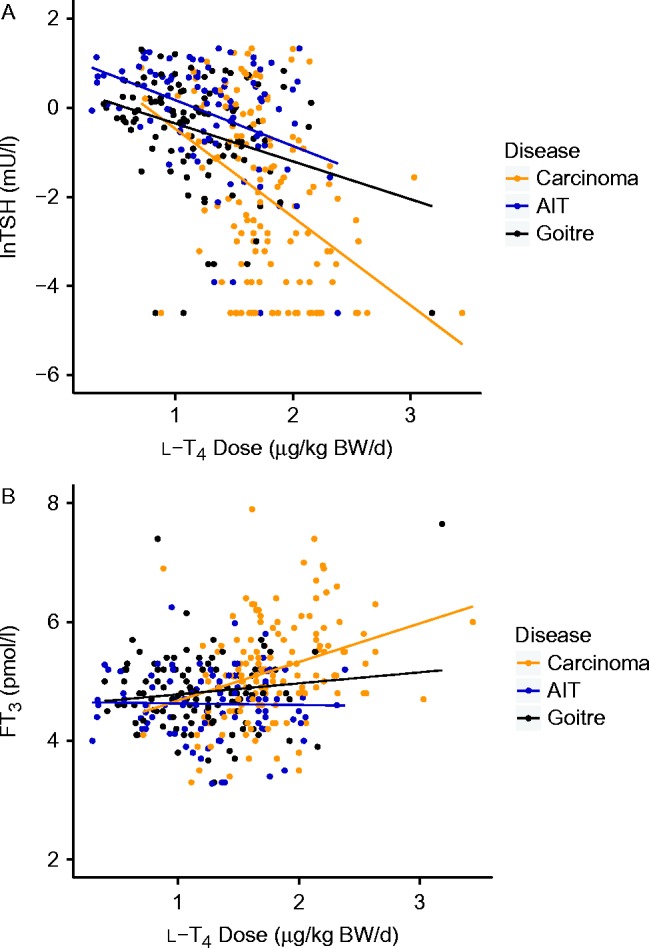
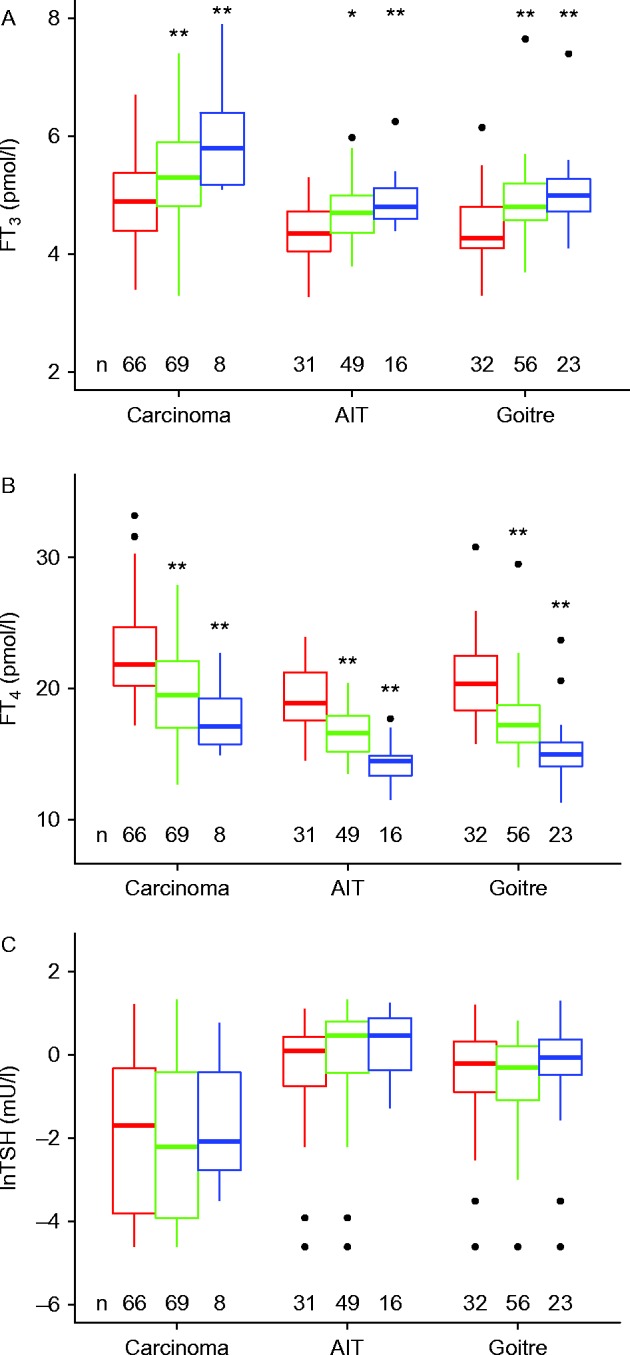
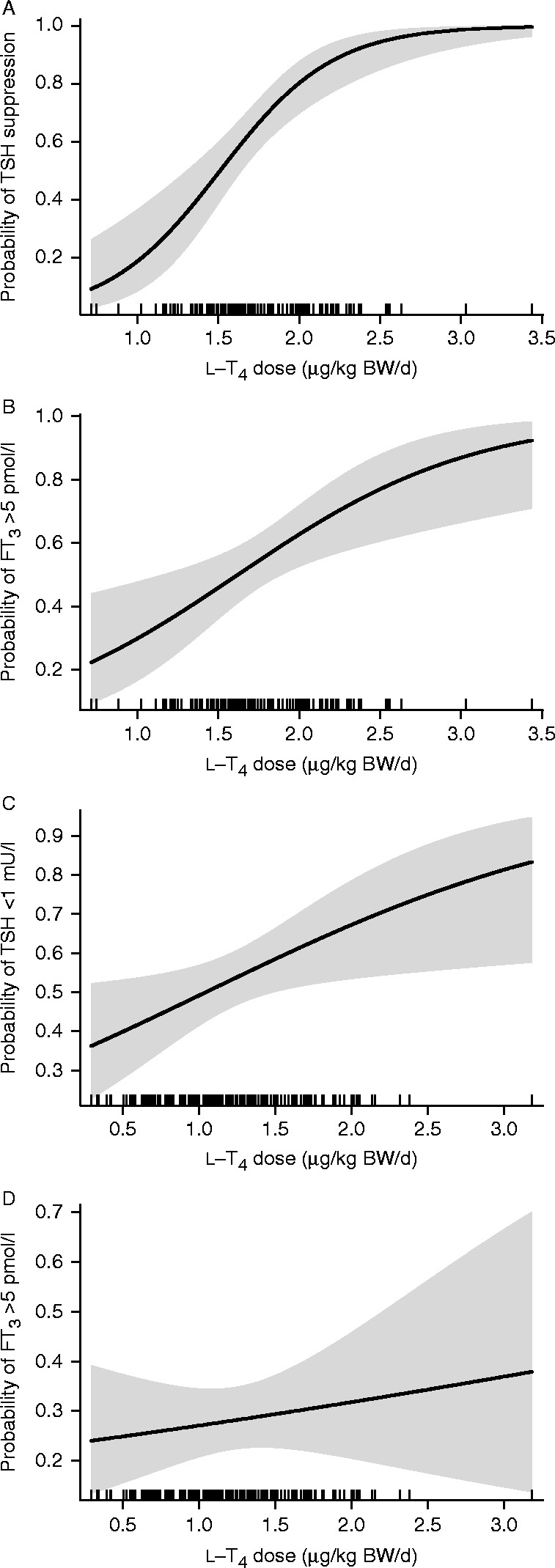
Several influences modulate biochemical responses to a weight-adjusted levothyroxine (l-T(4)) replacement dose. We conducted a secondary analysis of the relationship of l-T(4) dose to TSH and free T(3) (FT(3)), using a prospective observational study examining the interacting equilibria between thyroid parameters. We studied 353 patients on steady-state l-T(4) replacement for autoimmune thyroiditis or after surgery for malignant or benign thyroid disease. Peripheral deiodinase activity was calculated as a measure of T(4)–T(3) conversion efficiency. In euthyroid subjects, the median l-T(4) dose was 1.3 μg/kg per day (interquartile range (IQR) 0.94,1.60). The dose was independently associated with gender, age, aetiology and deiodinase activity (all P<0.001). Comparable FT(3) levels required higher l-T(4) doses in the carcinoma group (n=143), even after adjusting for different TSH levels. Euthyroid athyreotic thyroid carcinoma patients (n=50) received 1.57 μg/kg per day l-T(4) (IQR 1.40, 1.69), compared to 1.19 μg/kg per day (0.85,1.47) in autoimmune thyroiditis (P<0.01, n=76) and 1.08 μg/kg per day (0.82, 1.44) in patients operated on for benign disease (P< 0.01, n=80). Stratifying patients by deiodinase activity categories of <23, 23–29 and >29 nmol/s revealed an increasing FT(3)–FT(4) dissociation; the poorest converters showed the lowest FT(3) levels in spite of the highest dose and circulating FT(4) (P<0.001). An l-T(4)-related FT(3)–TSH disjoint was also apparent; some patients with fully suppressed TSH failed to raise FT(3) above the median level. These findings imply that thyroid hormone conversion efficiency is an important modulator of the biochemical response to l-T(4); FT(3) measurement may be an additional treatment target; and l-T(4) dose escalation may have limited success to raise FT(3) appropriately in some cases.
Overview
The claims and statistics of this paper haven’t been checked yet.
Free: it reads the open-access text and checks the first 5 claims that cite a source we can check. Create a free account to check every claim.
Integrity signals
Registry
Cites
Statistics
Figures
Verification
Claims the paper makes
The claims and statistics of this paper haven’t been checked yet.
Free: it reads the open-access text and checks the first 5 claims that cite a source we can check. Create a free account to check every claim.
Claims other papers make about this one
Each is checked against this paper’s own text: does it say what the citing paper says it does?
The cited source says what the claim attributes to it.
In the citing paper
“Hence, l-T4 dose escalation may not invariably remedy T3 deficiency but could actually hinder its attainment (121, 201).”
From Homeostatic control of the thyroid-pituitary axis: perspectives for diagnosis and treatment (2015) · cites this paper as [121]
The cited source says what the claim attributes to it.
In the citing paper
“Three remarkable phenomena have been observed in l-T4-treated patients, (1) a dissociation between FT3 and FT4, (2) a disjoint between TSH and FT3, and (3) an l-T4-related conversion inefficiency (121, 123).”
From Homeostatic control of the thyroid-pituitary axis: perspectives for diagnosis and treatment (2015) · cites this paper as [121]
The cited source says what the claim attributes to it.
In the citing paper
“In patients on l-T4 replacement therapy, SPINA-GD was an independent predictor of l-T4 dose (73).”
From Calculated Parameters of Thyroid Homeostasis: Emerging Tools for Differential Diagnosis and Clinical Research (2016) · cites this paper as [73]
In the citing paper
“From a homeostatic point of view, evidence suggests that the stability of serum T3 is maintained over a wide variation in the endogenous thyroid hormone production in healthy subjects but is lost in the l-T4-treated athyreotic patient (Figure 5) (121, 123).”
From Homeostatic control of the thyroid-pituitary axis: perspectives for diagnosis and treatment (2015) · cites this paper as [121]
1 more claim about this paper
Create a free account to see every claim other papers make about this one.
Self-check
Percentages, sums and reported differences re-computed from the paper’s own numbers.
The self-check needs the paper’s full text.
Citations
Cites
R: A Language and Environment for Statistical Computing
R Core Team (2025) · doi:10.32614/r.manuals · Cited by 352,181
Two new Later Stone Age sites from the Final Pleistocene in the Falémé Valley, eastern Senegal
Ndiaye, M., Lespez, L., Tribolo, C., Rassé, M., Hadjas, I., Davidoux, S., Huysecom, É., & Douze, K. (2024) · Monash University Research Portal (Monash University) · doi:10.3929/ethz-b-000667478 · Cited by 23,868
The incidence of thyroid disorders in the community: a twenty-year follow-up of the Whickham Survey
Vanderpump, M. P. J., Tunbrldge, W. M. G., French, J. M., Appleton, D., Bates, D., Clark, F., Evans, J. G., Hasan, D. M., Rodgers, H., Tunbridge, F., et al. (1995) · Clinical Endocrinology · doi:10.1111/j.1365-2265.1995.tb01894.x · Cited by 2,432
Jonklaas, J., Bianco, A. C., Bauer, A. J., Burman, K. D., Cappola, A. R., Celi, F. S., Cooper, D. S., Kim, B. W., Peeters, R. P., Rosenthal, M. S., et al. (2014) · Thyroid® · doi:10.1089/thy.2014.0028 · Cited by 1,928
Bianco, A. C., Salvatore, D., Gereben, B., Berry, M. J., & Larsen, P. R. (2002) · Endocrine Reviews · doi:10.1210/edrv.23.1.0455 · Cited by 1,853
Laboratory Support for the Diagnosis and Monitoring of Thyroid Disease
(2003) · Thyroid · doi:10.1089/105072503321086962 · Cited by 1,212
Roberts, C. G., & Ladenson, P. W. (2004) · The Lancet · doi:10.1016/s0140-6736(04)15696-1 · Cited by 567
Bjoro, T., Holmen, J., Kruger, O., Midthjell, K., Hunstad, K., Schreiner, T., Sandnes, L., & Brochmann, H. (2000) · European Journal of Endocrinology · doi:10.1530/eje.0.1430639 · Cited by 464
2012 ETA Guidelines: The Use of L-T4 + L-T3 in the Treatment of Hypothyroidism
Wiersinga, W. M., Duntas, L., Fadeyev, V., Nygaard, B., & Vanderpump, M. P. J. (2012) · European Thyroid Journal · doi:10.1159/000339444 · Cited by 437
Fish, L. H., Schwartz, H. L., Cavanaugh, J., Steffes, M. W., Bantle, J. P., & Oppenheimer, J. H. (1987) · New England Journal of Medicine · doi:10.1056/nejm198703263161302 · Cited by 353
Panicker, V., Saravanan, P., Vaidya, B., Evans, J., Hattersley, A. T., Frayling, T. M., & Dayan, C. M. (2009) · The Journal of Clinical Endocrinology & Metabolism · doi:10.1210/jc.2008-1301 · Cited by 327
Levothyroxine Therapy in Patients with Thyroid Disease
Mandel, S. J., Brent, G. A., & Larsen, P. R. (1993) · Annals of Internal Medicine · doi:10.7326/0003-4819-119-6-199309150-00009 · Cited by 324 · cited 3×
“1) Thyroid volume (ml) - total group - Autoimmune thyroiditis - Benign thyroid disease post surgery - Thyroid carcinoma 2 2 (0, 7) 7 (4,11) 6 (2,10) 0 (0, 0)”
BackgroundLevothyroxine Monotherapy Cannot Guarantee Euthyroidism in All Athyreotic Patients
Gullo, D., Latina, A., Frasca, F., Le Moli, R., Pellegriti, G., & Vigneri, R. (2011) · PLoS ONE · doi:10.1371/journal.pone.0022552 · Cited by 307 · cited 2×
“In two studies, approximately 15% of athyreotic patients could not even raise 297 their FT3 above the lower reference limit on L-T4 (19,20).”
BackgroundTreatment with thyroid hormone
Biondi, B., & Wartofsky, L. (2014) · Endocrine Reviews · doi:10.1210/er.2013-1083 · Cited by 259
Lean Body Mass Is a Major Determinant of Levothyroxine Dosage in the Treatment of Thyroid Diseases
Santini, F., Pinchera, A., Marsili, A., Ceccarini, G., Castagna, M. G., Valeriano, R., Giannetti, M., Taddei, D., Centoni, R., Scartabelli, G., et al. (2005) · The Journal of Clinical Endocrinology & Metabolism · doi:10.1210/jc.2004-1306 · Cited by 226
Conditions and drugs interfering with thyroxine absorption
Liwanpo, L., & Hershman, J. M. (2009) · Best Practice & Research Clinical Endocrinology & Metabolism · doi:10.1016/j.beem.2009.06.006 · Cited by 222
Laboratory support for the diagnosis and monitoring of thyroid disease
Spencer, C. (2009) · Pathology · doi:10.1097/01268031-200941001-00041 · Cited by 202
Pilo, A., Iervasi, G., Vitek, F., Ferdeghini, M., Cazzuola, F., & Bianchi, R. (1990) · American Journal of Physiology-Endocrinology and Metabolism · doi:10.1152/ajpendo.1990.258.4.e715 · Cited by 185
Werneck de Castro, J. P., Fonseca, T. L., Ueta, C. B., McAninch, E. A., Abdalla, S., Wittmann, G., Lechan, R. M., Gereben, B., & Bianco, A. C. (2015) · Journal of Clinical Investigation · doi:10.1172/jci77588 · Cited by 184 · cited 3×
“This study suggest ubiquitination may be the limiting factor for T4 283 alone to restore true tissue euthyroidism in the rodent (29).”
BackgroundCoordination of hypothalamic and pituitary T3 production regulates TSH expression
Fonseca, T. L., Correa-Medina, M., Campos, M. P. O., Wittmann, G., Werneck-de-Castro, J. P., Arrojo e Drigo, R., Mora-Garzon, M., Ueta, C. B., Caicedo, A., Fekete, C., et al. (2013) · Journal of Clinical Investigation · doi:10.1172/jci61231 · Cited by 155
Watt, T., Cramon, P., Hegedüs, L., Bjorner, J. B., Bonnema, S. J., Rasmussen, Å. K., Feldt-Rasmussen, U., & Groenvold, M. (2014) · The Journal of Clinical Endocrinology & Metabolism · doi:10.1210/jc.2014-1322 · Cited by 152
Roos, A., Linn-Rasker, S. P., van Domburg, R. T., Tijssen, J. P., & Berghout, A. (2005) · Archives of Internal Medicine · doi:10.1001/archinte.165.15.1714 · Cited by 150
Defending plasma T3 is a biological priority
Abdalla, S. M., & Bianco, A. C. (2014) · Clinical Endocrinology · doi:10.1111/cen.12538 · Cited by 147 · cited 1×
“Dosing strategies solely based on a TSH definition of euthyroidism neglect the 308 important role of FT3, which has recently emerged as an equally significant parameter in 309 defining thyroid physiology (20,22,29,30,40,41).”
BackgroundTSH and thyrotropic agonists: key actors in thyroid homeostasis
Dietrich, J. W., Landgrafe, G., & Fotiadou, E. H. (2012) · Journal of Thyroid Research · doi:10.1155/2012/351864 · Cited by 146
Self-citationDeducer: A Data Analysis GUI for R
Fellows, I. (2012) · Journal of Statistical Software · doi:10.18637/jss.v049.i08 · Cited by 144
Paradigm shifts in thyroid hormone replacement therapies for hypothyroidism
Wiersinga, W. M. (2014) · Nature Reviews Endocrinology · doi:10.1038/nrendo.2013.258 · Cited by 114 · cited 1×
“64 While TSH measurement has dominated procedural management of thyroid replacement 65 by its apparent ease and good standardisation a disturbingly high proportion of patients 66 remains unsatisfied with the treatment they receive (17,18).”
BackgroundSilva, J. E., Gordon, M. B., Crantz, F. R., Leonard, J. L., & Larsen, P. R. (1984) · Journal of Clinical Investigation · doi:10.1172/jci111313 · Cited by 111
McAninch, E. A., Jo, S., Preite, N. Z., Farkas, E., Mohácsik, P., Fekete, C., Egri, P., Gereben, B., Li, Y., Deng, Y., et al. (2015) · The Journal of Clinical Endocrinology & Metabolism · doi:10.1210/jc.2014-4092 · Cited by 93 · cited 2×
“Characteristics of study group (n=353) Parameter Median (IQR) or Percentage Gender (female, male) 280 (79%), 73 (21%) Age (years) in women vs men 56 (46, 66) 53 (45, 66) vs 59 (53, 64), p=0.”
Backgroundl-Thyroxine Requirement in Patients with Autoimmune Hypothyroidism and Parietal Cell Antibodies
Checchi, S., Montanaro, A., Pasqui, L., Ciuoli, C., De Palo, V., Chiappetta, M. C., & Pacini, F. (2008) · The Journal of Clinical Endocrinology & Metabolism · doi:10.1210/jc.2007-1544 · Cited by 89
Hoermann, R., Midgley, J. E. M., Giacobino, A., Eckl, W. A., Wahl, H. G., Dietrich, J. W., & Larisch, R. (2014) · Clinical Endocrinology · doi:10.1111/cen.12527 · Cited by 82 · cited 9×
“The cut-offs were pre-specified based on 138 observations in L-T4-treated patients vs healthy untreated subjects and in low (< 5 ml) vs 139 higher thyroid volumes (22).”
BackgroundMethodInfluentialSelf-citationUsing Body Mass Index to Predict Optimal Thyroid Dosing after Thyroidectomy
Ojomo, K. A., Schneider, D. F., Reiher, A. E., Lai, N., Schaefer, S., Chen, H., & Sippel, R. S. (2013) · Journal of the American College of Surgeons · doi:10.1016/j.jamcollsurg.2012.12.002 · Cited by 70 · cited 2×
“6 μg/kg BW or by more refined weight- or BMI-related 63 algorithms (10-16).”
BackgroundGordon, M. B., & Gordon, M. S. (1999) · Endocrine Practice · doi:10.4158/ep.5.5.233 · Cited by 67 · cited 1×
“302 L-T4 dose requirements have been well studied and various regimes based on weight, 303 BMI or more refined algorithms have been proposed to put patients on a presumed 304 adequate dose from the very beginning (10-13,14-16,35-39).”
BackgroundHoermann, R., Midgley, J. E. M., Larisch, R., & Dietrich, J. W. (2013) · European Journal of Endocrinology · doi:10.1530/eje-12-0819 · Cited by 59 · cited 4×
“In two studies, approximately 15% of athyreotic patients could not even raise 297 their FT3 above the lower reference limit on L-T4 (19,20).”
BackgroundInfluentialSelf-citationDi Donna, V., Santoro, M. G., de Waure, C., Ricciato, M. P., Paragliola, R. M., Pontecorvi, A., & Corsello, S. M. (2014) · Thyroid · doi:10.1089/thy.2014.0111 · Cited by 52 · cited 2×
“6 μg/kg BW or by more refined weight- or BMI-related 63 algorithms (10-16).”
BackgroundPredicting thyroxine requirements following total thyroidectomy: Thyroxine dose prediction
Mistry, D., Atkin, S., Atkinson, H., Gunasekaran, S., Sylvester, D., Rigby, A. S., & England, R. J. (2011) · Clinical Endocrinology · doi:10.1111/j.1365-2265.2010.03940.x · Cited by 50 · cited 3×
“2) nmol/s, thyroid volume 10 (8,13) mL (22).”
BackgroundHoermann, R., Midgley, J., Larisch, R., & Dietrich, J. (2015) · Hormone and Metabolic Research · doi:10.1055/s-0034-1398616 · Cited by 50 · cited 3×
“Lack of TSH stimulation and 284 the absence or functional deficiency of the thyroid gland may also impair T4-T3 conversion 285 (30).”
BackgroundSelf-citationLevothyroxine replacement dosage determination after thyroidectomy
Jin, J., Allemang, M. T., & McHenry, C. R. (2013) · The American Journal of Surgery · doi:10.1016/j.amjsurg.2012.10.015 · Cited by 48
Do we need still more trials on T4 and T3 combination therapy in hypothyroidism?
Wiersinga, W. M. (2009) · European Journal of Endocrinology · doi:10.1530/eje-09-0879 · Cited by 45
Taylor, P. N., Panicker, V., Sayers, A., Shields, B., Iqbal, A., Bremner, A. P., Beilby, J. P., Leedman, P. J., Hattersley, A. T., Vaidya, B., et al. (2011) · European Journal of Endocrinology · doi:10.1530/eje-10-0938 · Cited by 41
Levothyroxine dose following thyroidectomy is affected by more than just body weight
Baehr, K. M., Lyden, E., Treude, K., Erickson, J., & Goldner, W. (2012) · The Laryngoscope · doi:10.1002/lary.23186 · Cited by 36
Hoftijzer, H. C., Heemstra, K. A., Visser, T. J., le Cessie, S., Peeters, R. P., Corssmit, E. P. M., & Smit, J. W. A. (2011) · The Journal of Clinical Endocrinology & Metabolism · doi:10.1210/jc.2011-0235 · Cited by 36 · cited 1×
“313 While acknowledging the role of genetically determined differences in deiodinase activity 314 affecting conversion rates, the poor converter status described here appears to emerge 315 mainly as a consequence of the T4 mono-therapy itself, induced by the mechanisms 316 discussed above (42-45).”
BackgroundRobertson, H. M. A., Narayanaswamy, A. K. P., Pereira, O., Copland, S. A., Herriot, R., McKinlay, A. W., Bevan, J. S., & Abraham, P. (2014) · Thyroid · doi:10.1089/thy.2013.0661 · Cited by 35
Midgley, J. E. M., Hoermann, R., Larisch, R., & Dietrich, J. W. (2013) · Journal of Clinical Pathology · doi:10.1136/jclinpath-2012-201213 · Cited by 35
Self-citationSukumar, R., Agarwal, A., Gupta, S., Mishra, A., Agarwal, G., Verma, A. K., & Mishra, S. K. (2010) · World Journal of Surgery · doi:10.1007/s00268-009-0345-3 · Cited by 26
Reference range for thyrotropin: Post hoc assessment
Giacobino, A., Eckl, W., Wahl, H.-G., Midgley, J. E. M., Hoermann, R., & Larisch, R. (2015) · Nuklearmedizin · doi:10.3413/nukmed-0671-14-06 · Cited by 23
Self-citationDetermination of Replacement and Suppressive Doses of Thyroxine
Banovac, K., Carrington, S. A. B., Levis, S., Fill, M. D., & Bilsker, M. S. (1990) · Journal of International Medical Research · doi:10.1177/030006059001800305 · Cited by 19 · cited 1×
“302 L-T4 dose requirements have been well studied and various regimes based on weight, 303 BMI or more refined algorithms have been proposed to put patients on a presumed 304 adequate dose from the very beginning (10-13,14-16,35-39).”
BackgroundDeducer: A Data Analysis GUI for R
Fellows, I. (2012) · doi:10.32614/cran.package.deducer · Cited by 15
Cettour-Rose, P., Visser, T. J., Burger, A. G., & Rohner-Jeanrenaud, F. (2005) · European Journal of Endocrinology · doi:10.1530/eje.1.01984 · Cited by 14
Kristensen, T. T., Larsen, J., Pedersen, P. L., Feldthusen, A.-D., Ellervik, C., Jelstrup, S., & Kvetny, J. (2014) · Journal of Thyroid Research · doi:10.1155/2014/892573 · Cited by 8
Pepper, G. M., & Casanova-Romero, P. Y. (2014) · Cited by 7
Comparison Among the Daily Levothyroxine Doses According to the Etiology of Hypothyroidism
Lima (2013) · Journal of Endocrinology and Metabolism · doi:10.4021/jem165w · Cited by 1
Comparison Among the Daily Levothyroxine Doses According to the Etiology of Hypothyroidism
Lima, J. G., de Mesquita, D. J. T. M., Fernandes, F. D. C., de Souza, A. B. C., dos Santos, A. C., Reboucas, B. M. X. C. R., de Lima, N. N., de Sousa, A. G. P., & Nóbrega, L. H. C. (2013) · Journal of Endocrinology and Metabolism · doi:10.4021/jem.v3i1-2.165 · Cited by 1 · cited 1×
“302 L-T4 dose requirements have been well studied and various regimes based on weight, 303 BMI or more refined algorithms have been proposed to put patients on a presumed 304 adequate dose from the very beginning (10-13,14-16,35-39).”
Background
Cited by
Chatzitomaris, A., Hoermann, R., Midgley, J. E., Hering, S., Urban, A., Dietrich, B., Abood, A., Klein, H. H., & Dietrich, J. W. (2017) · Frontiers in Endocrinology · doi:10.3389/fendo.2017.00163 · Cited by 173
Self-citationDietrich, J. W., Landgrafe-Mende, G., Wiora, E., Chatzitomaris, A., Klein, H. H., Midgley, J. E. M., & Hoermann, R. (2016) · Frontiers in Endocrinology · doi:10.3389/fendo.2016.00057 · Cited by 164
“In patients on -T4 replacement therapy, SPINA-GD was an independent predictor of -T4 dose (73).”
BackgroundSelf-citationHomeostatic control of the thyroid-pituitary axis: perspectives for diagnosis and treatment
Hoermann, R., Midgley, J. E. M., Larisch, R., & Dietrich, J. W. (2015) · Frontiers in Endocrinology · doi:10.3389/fendo.2015.00177 · Cited by 143
Self-citationHoermann, R., Midgley, J. E. M., Larisch, R., & Dietrich, J. W. (2017) · Frontiers in Endocrinology · doi:10.3389/fendo.2017.00364 · Cited by 69
Self-citationRelational Stability in the Expression of Normality, Variation, and Control of Thyroid Function
Hoermann, R., Midgley, J. E. M., Larisch, R., & Dietrich, J. W. (2016) · Frontiers in Endocrinology · doi:10.3389/fendo.2016.00142 · Cited by 48
Self-citation
Metadata
- Authors
- Midgley, J. E. M., Larisch, R., Dietrich, J. W., & Hoermann, R.
- Affiliations
- Witten/Herdecke University (DE)
- Venue
- Endocrine Connections
- Publisher
- Bioscientifica
- Published
- 2015-09-02
- Volume
- 4
- Issue
- 4
- Pages
- 196-205
- ISSN
- 2049-3614 (ISSN-L)
- PMC
- PMC4557078
- OpenAlex
- W1904294385
- Cited by
- 31
- References
- 52
- Citations by year
- 2026: 1 · 2025: 7 · 2023: 1 · 2022: 2 · 2021: 2 · 2019: 3 · 2018: 3 · 2017: 6 · 2016: 4 · 2015: 2
- FWCI
- 4.35
- Type
- journal article
- Language
- en
- Open access
- gold
- doi.org
- Licence
- cc-by-nc
- Locations
- Endocrine Connections (publishedVersion, cc-by-nc)
- Endocrine Connections (publishedVersion)
- Europe PMC (PubMed Central) (publishedVersion, cc-by-nc)
- PubMed Central (publishedVersion, cc-by-nc)
- PubMed (publishedVersion)
- Topics
- Health Sciences › Medicine › Endocrinology, Diabetes and Metabolism › Thyroid Disorders and Treatments
- Health Sciences › Medicine › Surgery › Thyroid and Parathyroid Surgery
- Health Sciences › Medicine › Endocrinology, Diabetes and Metabolism › Thyroid Cancer Diagnosis and Treatment
- Keywords
- levothyroxine, thyroid hormone conversion, free T3, thyroid-stimulating hormone, autoimmune thyroiditis, thyroid cancer, thyroidectomy, hypothyroidism, dose-response relationship
About these checks
Registry, retraction, Cites and statistics results are computed, not judged, with one exception: a printed reference that no index lists is read once by a model before it counts as a citation error. Claims are extracted by a model and kept only when their quote appears verbatim in the text; each cited source is then checked, with a model’s help, for whether it says what the claim relies on. Those verdicts can be wrong — read the claim’s quote and the cited source before relying on one.
Statistics and arithmetic are recomputed, not judged.
Confidence bands are shown only for fields calibrated on our annotated test set. None is calibrated yet, so no band is shown.
What counts as a claim ›How we measure confidence ›How we check this ›
Are you an author, or do you see a problem with this page? Request a review
Data sources
Bibliographic data: Semantic Scholar, OpenAlex, Crossref.
Contains information from the Semantic Scholar Academic Graph Datasets, made available under the ODC Attribution License (ODC-BY 1.0).
Semantic Scholar’s data is described in: Kinney, R., et al. (2023). The Semantic Scholar Open Data Platform. arXiv:2301.10140.
