

Variation in the biochemical response to l-thyroxine therapy and relationship with peripheral thyroid hormone conversion efficiency
Open accessThe DOI matches its Crossref record; 52 of the 52 references it cites were found in a registry or an index.
Abstract
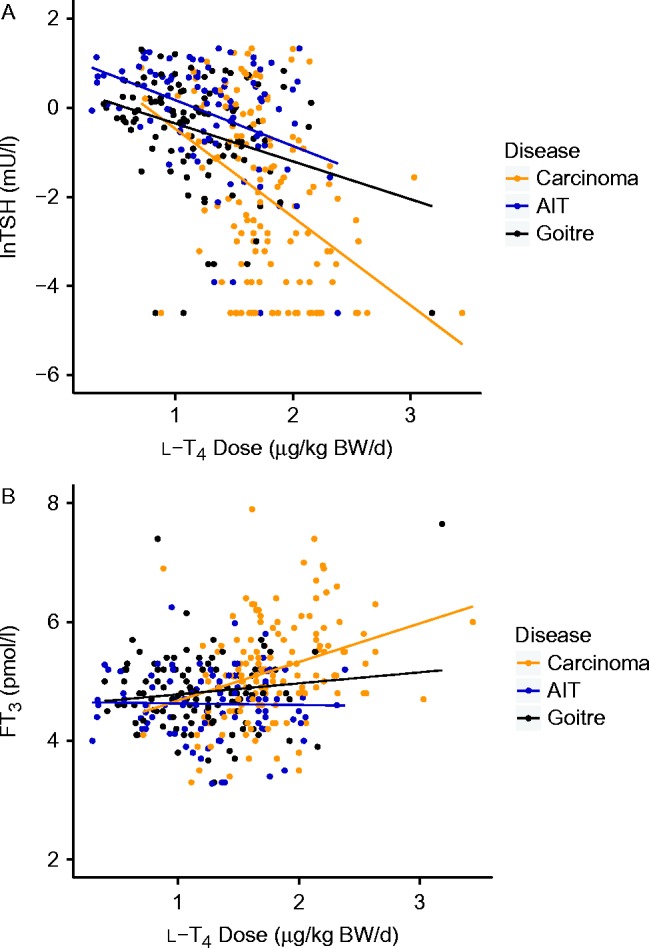
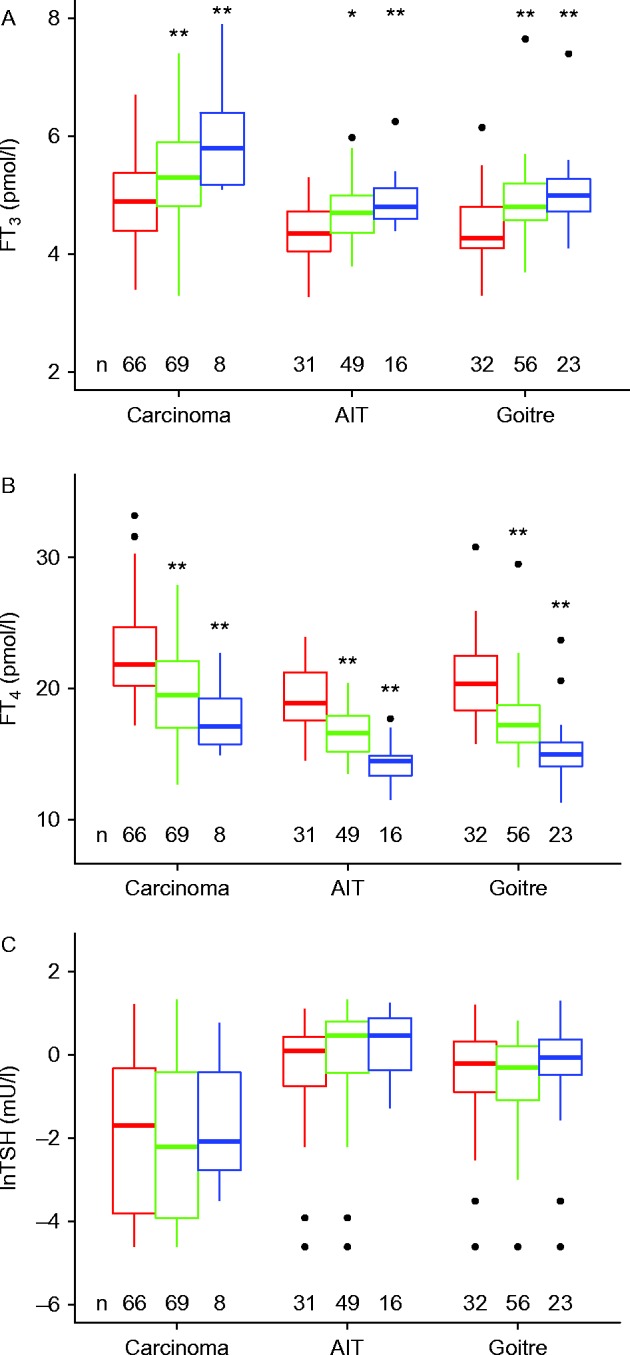
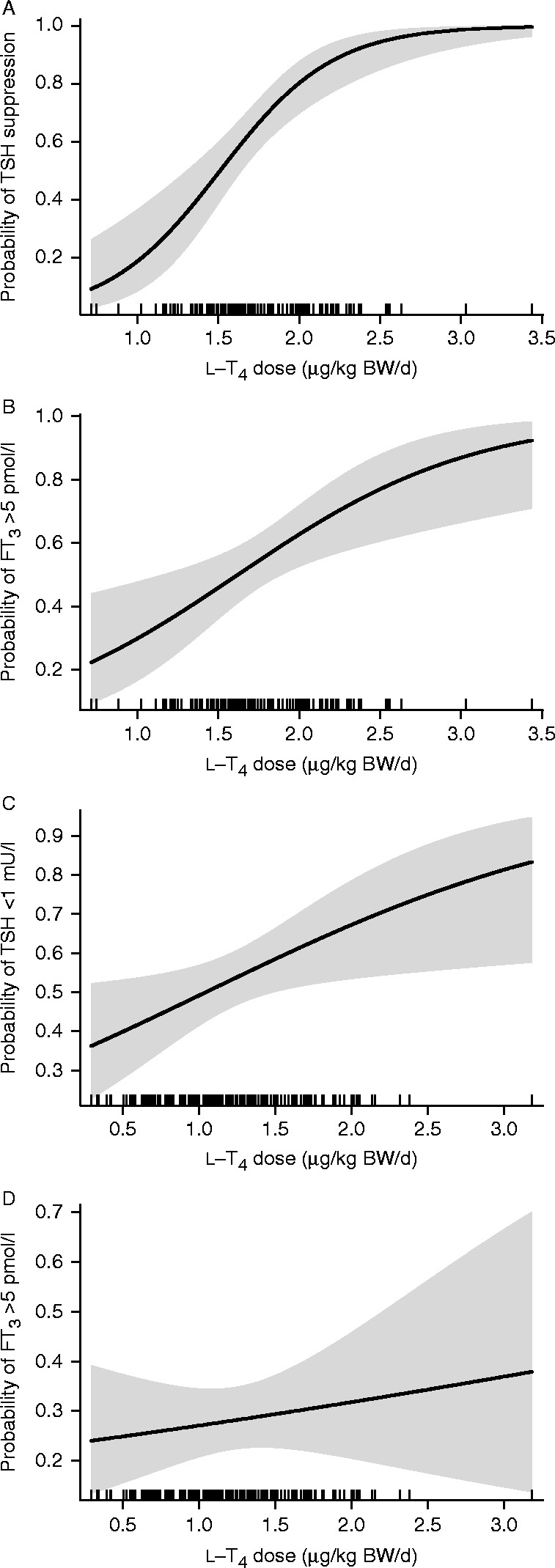
Several influences modulate biochemical responses to a weight-adjusted levothyroxine (l-T(4)) replacement dose. We conducted a secondary analysis of the relationship of l-T(4) dose to TSH and free T(3) (FT(3)), using a prospective observational study examining the interacting equilibria between thyroid parameters. We studied 353 patients on steady-state l-T(4) replacement for autoimmune thyroiditis or after surgery for malignant or benign thyroid disease. Peripheral deiodinase activity was calculated as a measure of T(4)–T(3) conversion efficiency. In euthyroid subjects, the median l-T(4) dose was 1.3 μg/kg per day (interquartile range (IQR) 0.94,1.60). The dose was independently associated with gender, age, aetiology and deiodinase activity (all P<0.001). Comparable FT(3) levels required higher l-T(4) doses in the carcinoma group (n=143), even after adjusting for different TSH levels. Euthyroid athyreotic thyroid carcinoma patients (n=50) received 1.57 μg/kg per day l-T(4) (IQR 1.40, 1.69), compared to 1.19 μg/kg per day (0.85,1.47) in autoimmune thyroiditis (P<0.01, n=76) and 1.08 μg/kg per day (0.82, 1.44) in patients operated on for benign disease (P< 0.01, n=80). Stratifying patients by deiodinase activity categories of <23, 23–29 and >29 nmol/s revealed an increasing FT(3)–FT(4) dissociation; the poorest converters showed the lowest FT(3) levels in spite of the highest dose and circulating FT(4) (P<0.001). An l-T(4)-related FT(3)–TSH disjoint was also apparent; some patients with fully suppressed TSH failed to raise FT(3) above the median level. These findings imply that thyroid hormone conversion efficiency is an important modulator of the biochemical response to l-T(4); FT(3) measurement may be an additional treatment target; and l-T(4) dose escalation may have limited success to raise FT(3) appropriately in some cases.
Overview
The claims and statistics of this paper haven’t been checked yet.
Free: it reads the open-access text and checks the first 5 claims that cite a source we can check. Create a free account to check every claim.
Integrity signals
Registry
Cites
Statistics
Figures
Verification
Claims the paper makes
The claims and statistics of this paper haven’t been checked yet.
Free: it reads the open-access text and checks the first 5 claims that cite a source we can check. Create a free account to check every claim.
Claims other papers make about this one
Each is checked against this paper’s own text: does it say what the citing paper says it does?
The cited source says what the claim attributes to it.
In the citing paper
“Hence, l-T4 dose escalation may not invariably remedy T3 deficiency but could actually hinder its attainment (121, 201).”
From Homeostatic control of the thyroid-pituitary axis: perspectives for diagnosis and treatment (2015) · cites this paper as [121]
The cited source says what the claim attributes to it.
In the citing paper
“Three remarkable phenomena have been observed in l-T4-treated patients, (1) a dissociation between FT3 and FT4, (2) a disjoint between TSH and FT3, and (3) an l-T4-related conversion inefficiency (121, 123).”
From Homeostatic control of the thyroid-pituitary axis: perspectives for diagnosis and treatment (2015) · cites this paper as [121]
The cited source says what the claim attributes to it.
In the citing paper
“In patients on l-T4 replacement therapy, SPINA-GD was an independent predictor of l-T4 dose (73).”
From Calculated Parameters of Thyroid Homeostasis: Emerging Tools for Differential Diagnosis and Clinical Research (2016) · cites this paper as [73]
In the citing paper
“From a homeostatic point of view, evidence suggests that the stability of serum T3 is maintained over a wide variation in the endogenous thyroid hormone production in healthy subjects but is lost in the l-T4-treated athyreotic patient (Figure 5) (121, 123).”
From Homeostatic control of the thyroid-pituitary axis: perspectives for diagnosis and treatment (2015) · cites this paper as [121]
1 more claim about this paper
Create a free account to see every claim other papers make about this one.
Self-check
Percentages, sums and reported differences re-computed from the paper’s own numbers.
The self-check needs the paper’s full text.
Citations
Cites
R: A Language and Environment for Statistical Computing
R Core Team (2025) · doi:10.32614/r.manuals · Cited by 352,181
Two new Later Stone Age sites from the Final Pleistocene in the Falémé Valley, eastern Senegal
Ndiaye, M., Lespez, L., Tribolo, C., Rassé, M., Hadjas, I., Davidoux, S., Huysecom, É., & Douze, K. (2024) · Monash University Research Portal (Monash University) · doi:10.3929/ethz-b-000667478 · Cited by 23,868
The incidence of thyroid disorders in the community: a twenty-year follow-up of the Whickham Survey
Vanderpump, M. P. J., Tunbrldge, W. M. G., French, J. M., Appleton, D., Bates, D., Clark, F., Evans, J. G., Hasan, D. M., Rodgers, H., Tunbridge, F., et al. (1995) · Clinical Endocrinology · doi:10.1111/j.1365-2265.1995.tb01894.x · Cited by 2,432
Jonklaas, J., Bianco, A. C., Bauer, A. J., Burman, K. D., Cappola, A. R., Celi, F. S., Cooper, D. S., Kim, B. W., Peeters, R. P., Rosenthal, M. S., et al. (2014) · Thyroid® · doi:10.1089/thy.2014.0028 · Cited by 1,928
Bianco, A. C., Salvatore, D., Gereben, B., Berry, M. J., & Larsen, P. R. (2002) · Endocrine Reviews · doi:10.1210/edrv.23.1.0455 · Cited by 1,853
Laboratory Support for the Diagnosis and Monitoring of Thyroid Disease
(2003) · Thyroid · doi:10.1089/105072503321086962 · Cited by 1,212
Roberts, C. G., & Ladenson, P. W. (2004) · The Lancet · doi:10.1016/s0140-6736(04)15696-1 · Cited by 567
Bjoro, T., Holmen, J., Kruger, O., Midthjell, K., Hunstad, K., Schreiner, T., Sandnes, L., & Brochmann, H. (2000) · European Journal of Endocrinology · doi:10.1530/eje.0.1430639 · Cited by 464
2012 ETA Guidelines: The Use of L-T4 + L-T3 in the Treatment of Hypothyroidism
Wiersinga, W. M., Duntas, L., Fadeyev, V., Nygaard, B., & Vanderpump, M. P. J. (2012) · European Thyroid Journal · doi:10.1159/000339444 · Cited by 437
Fish, L. H., Schwartz, H. L., Cavanaugh, J., Steffes, M. W., Bantle, J. P., & Oppenheimer, J. H. (1987) · New England Journal of Medicine · doi:10.1056/nejm198703263161302 · Cited by 353
Cited by
Chatzitomaris, A., Hoermann, R., Midgley, J. E., Hering, S., Urban, A., Dietrich, B., Abood, A., Klein, H. H., & Dietrich, J. W. (2017) · Frontiers in Endocrinology · doi:10.3389/fendo.2017.00163 · Cited by 173
Self-citationDietrich, J. W., Landgrafe-Mende, G., Wiora, E., Chatzitomaris, A., Klein, H. H., Midgley, J. E. M., & Hoermann, R. (2016) · Frontiers in Endocrinology · doi:10.3389/fendo.2016.00057 · Cited by 164
“In patients on -T4 replacement therapy, SPINA-GD was an independent predictor of -T4 dose (73).”
BackgroundSelf-citationHomeostatic control of the thyroid-pituitary axis: perspectives for diagnosis and treatment
Hoermann, R., Midgley, J. E. M., Larisch, R., & Dietrich, J. W. (2015) · Frontiers in Endocrinology · doi:10.3389/fendo.2015.00177 · Cited by 143
Self-citationHoermann, R., Midgley, J. E. M., Larisch, R., & Dietrich, J. W. (2017) · Frontiers in Endocrinology · doi:10.3389/fendo.2017.00364 · Cited by 69
Self-citationRelational Stability in the Expression of Normality, Variation, and Control of Thyroid Function
Hoermann, R., Midgley, J. E. M., Larisch, R., & Dietrich, J. W. (2016) · Frontiers in Endocrinology · doi:10.3389/fendo.2016.00142 · Cited by 48
Self-citationIndividualised requirements for optimum treatment of hypothyroidism: complex needs, limited options
Hoermann, R., Midgley, J. E. M., Larisch, R., & Dietrich, J. W. (2019) · Drugs in Context · doi:10.7573/dic.212597 · Cited by 41
Self-citationJonklaas, J., & Burman, K. D. (2016) · Thyroid® · doi:10.1089/thy.2015.0629 · Cited by 41
Hoermann, R., Larisch, R., Dietrich, J. W., & Midgley, J. E. M. (2016) · European Journal of Endocrinology · doi:10.1530/eje-16-0031 · Cited by 37
Self-citationTime for a reassessment of the treatment of hypothyroidism
Midgley, J. E. M., Toft, A. D., Larisch, R., Dietrich, J. W., & Hoermann, R. (2019) · BMC Endocrine Disorders · doi:10.1186/s12902-019-0365-4 · Cited by 36
“Treatment-related displacement of the equilibria between thyroid parameters, wide variations in the biochemical treatment response, and individually adjusted dose requirement pose particular challenges for thyroid trials [27, 45, 59, 60].”
BackgroundSelf-citationDynamics of thyroid diseases and thyroid‐axis gland masses
Kohanim, Y. K., Milo, T., Raz, M., Karin, O., Bar, A., Mayo, A., Cohen, N. M., Toledano, Y., & Alon, U. S. (2022) · Molecular Systems Biology · doi:10.15252/msb.202210919 · Cited by 30
Larisch, R., Midgley, J., Dietrich, J. W., & Hoermann, R. (2018) · Experimental and Clinical Endocrinology & Diabetes · doi:10.1055/s-0043-125064 · Cited by 30
Self-citationAdvances in applied homeostatic modelling of the relationship between thyrotropin and free thyroxine
Hoermann, R., Midgley, J. E. M., Larisch, R., & Dietrich, J. W. C. (2017) · PLOS ONE · doi:10.1371/journal.pone.0187232 · Cited by 24
Self-citationFunctional and Symptomatic Individuality in the Response to Levothyroxine Treatment
Hoermann, R., Midgley, J. E. M., Larisch, R., & Dietrich, J. W. (2019) · Frontiers in Endocrinology · doi:10.3389/fendo.2019.00664 · Cited by 22
“Dissimilarities in the treatment responses between individual patients are particularly apparent when patients on LT4 display substantial variation in their T4–T3 conversion efficiency and pronounced disjoints between their serum TSH and FT3 concentrations (16, 77).”
BackgroundSelf-citationHoermann, R., Midgley, J. E. M., Larisch, R., & Dietrich, J. W. (2018) · Journal of Thyroid Research · doi:10.1155/2018/3239197 · Cited by 20
“, after thyroidectomy, and may decline even further after initiation of LT4 treatment [23, 32].”
BackgroundSelf-citationEditorial: “Homeostasis and Allostasis of Thyroid Function”
Dietrich, J. W., Midgley, J. E. M., & Hoermann, R. (2018) · Frontiers in Endocrinology · doi:10.3389/fendo.2018.00287 · Cited by 22
Self-citationIncreased fT4 concentrations in patients using levothyroxine without complete suppression of TSH
Jansen, H. I., Bult, M., Bisschop, P. H. L. T., Boelen, A., Heijboer, A. C., & Hillebrand, J. J. (2023) · Endocrine Connections · doi:10.1530/ec-22-0538 · Cited by 14
Hoermann, R., Midgley, J. E. M., Dietrich, J. W., & Larisch, R. (2017) · Therapeutic Advances in Endocrinology and Metabolism · doi:10.1177/2042018817716401 · Cited by 14
Self-citationMoncayo, R., & Moncayo, H. (2017) · BBA Clinical · doi:10.1016/j.bbacli.2017.03.004 · Cited by 16
Stanculescu, D., Larsson, L., & Bergquist, J. (2021) · Frontiers in Medicine · doi:10.3389/fmed.2021.672370 · Cited by 10
Of rats and men: thyroid homeostasis in rodents and human beings
Dietrich, J. W., Midgley, J. E. M., Larisch, R., & Hoermann, R. (2015) · The Lancet Diabetes & Endocrinology · doi:10.1016/s2213-8587(15)00421-0 · Cited by 7
Self-citationNgan, T. T., Tra, D. H., Mai, N. T. Q., Dung, H. V., Khai, N. V., Linh, P. V., & Phương, N. T. T. (2025) · Frontiers in Endocrinology · doi:10.3389/fendo.2025.1415206 · Cited by 8
Free triiodothyronine/free thyroxine ratio in children with congenital hypothyroidism
Sydlik, C., Dubinski, I., Bechtold, S. M., & Schmidt, H. (2022) · Endocrine Connections · doi:10.1530/ec-22-0032 · Cited by 3
(2017) · Molecular and Cellular Endocrinology · doi:10.1016/j.mce.2017.10.007 · Cited by 3
Anand, P. K. V., & Deshpande, V. (2025) · Journal of Ayurveda and Integrative Medicine · doi:10.1016/j.jaim.2025.101172 · Cited by 1
Smyczyńska, J. (2019) · Kwartalnik Naukowy Fides et Ratio · doi:10.34766/fetr.v3i39.119 · Cited by 3
Nature’s Generosity in Protecting Human Health
Delshad, N. S., Soleimanpour, B., & Salehi, P. (2021) · University of Tehran science and humanities series · doi:10.1007/978-3-030-74326-0_3
Special Considerations in the Treatment of Hypothyroidism
Hoermann, R., & Dietrich, J. W. (2025) · Springer eBooks · doi:10.1007/978-981-96-3682-2_12
Self-citationHoermann, R., & Dietrich, J. W. (2025) · Springer eBooks · doi:10.1007/978-981-96-3682-2_11
Self-citationHoermann, R., & Dietrich, J. W. (2025) · Springer eBooks · doi:10.1007/978-981-96-3682-2_10
Self-citationThe Concept of Relational Stability
Hoermann, R., & Dietrich, J. W. (2025) · Springer eBooks · doi:10.1007/978-981-96-3682-2_2
Self-citationMechanisms of Health and Disease
Hoermann, R., & Dietrich, J. W. (2025) · Springer eBooks · doi:10.1007/978-981-96-3682-2_6
Self-citationÇiftel, E., & Mercantepe, F. (2026) · BMC Endocrine Disorders · doi:10.1186/s12902-026-02421-9
“These findings are consistent with previous reports showing that LT4 monotherapy increases total T4 levels while failing to fully restore physiologic T3 concentrations [9, 11, 40].”
Metadata
- Authors
- Midgley, J. E. M., Larisch, R., Dietrich, J. W., & Hoermann, R.
- Affiliations
- Witten/Herdecke University (DE)
- Venue
- Endocrine Connections
- Publisher
- Bioscientifica
- Published
- 2015-09-02
- Volume
- 4
- Issue
- 4
- Pages
- 196-205
- ISSN
- 2049-3614 (ISSN-L)
- PMC
- PMC4557078
- OpenAlex
- W1904294385
- Cited by
- 31
- References
- 52
- Citations by year
- 2026: 1 · 2025: 7 · 2023: 1 · 2022: 2 · 2021: 2 · 2019: 3 · 2018: 3 · 2017: 6 · 2016: 4 · 2015: 2
- FWCI
- 4.35
- Type
- journal article
- Language
- en
- Open access
- gold
- doi.org
- Licence
- cc-by-nc
- Locations
- Endocrine Connections (publishedVersion, cc-by-nc)
- Endocrine Connections (publishedVersion)
- Europe PMC (PubMed Central) (publishedVersion, cc-by-nc)
- PubMed Central (publishedVersion, cc-by-nc)
- PubMed (publishedVersion)
- Topics
- Health Sciences › Medicine › Endocrinology, Diabetes and Metabolism › Thyroid Disorders and Treatments
- Health Sciences › Medicine › Surgery › Thyroid and Parathyroid Surgery
- Health Sciences › Medicine › Endocrinology, Diabetes and Metabolism › Thyroid Cancer Diagnosis and Treatment
- Keywords
- levothyroxine, thyroid hormone conversion, free T3, thyroid-stimulating hormone, autoimmune thyroiditis, thyroid cancer, thyroidectomy, hypothyroidism, dose-response relationship
About these checks
Registry, retraction, Cites and statistics results are computed, not judged, with one exception: a printed reference that no index lists is read once by a model before it counts as a citation error. Claims are extracted by a model and kept only when their quote appears verbatim in the text; each cited source is then checked, with a model’s help, for whether it says what the claim relies on. Those verdicts can be wrong — read the claim’s quote and the cited source before relying on one.
Statistics and arithmetic are recomputed, not judged.
Confidence bands are shown only for fields calibrated on our annotated test set. None is calibrated yet, so no band is shown.
What counts as a claim ›How we measure confidence ›How we check this ›
Are you an author, or do you see a problem with this page? Request a review
Data sources
Bibliographic data: Semantic Scholar, OpenAlex, Crossref.
Contains information from the Semantic Scholar Academic Graph Datasets, made available under the ODC Attribution License (ODC-BY 1.0).
Semantic Scholar’s data is described in: Kinney, R., et al. (2023). The Semantic Scholar Open Data Platform. arXiv:2301.10140.
