

Towards a young universe cosmology
Open accessThe DOI matches its Crossref record; 17 of the 17 references it cites were found in a registry or an index; none of the 20 sources its claims cite is checked for support yet.
Abstract
Distant starlight is one of the most challenging natural phenomena to reconcile with a recent creation. Most creationist cosmologies attempt to address this apparent contradiction between God’s two books by appealing to the flexibility associated with our definition of time (Hartnett 2007; Humphreys 2008; Lisle 2010). In their current formulation, these cosmologies allow for long cosmological times periods while preserving short time periods on earth (they can thus be viewed as young earth but old universe cosmologies). Assuming that astronomical distance measurements are accurate, a consistent young universe cosmology would appear to require either some form of mature creation (i.e., local generation of starlight that is only apparently distant) or a variation in the speed of light. There is a vast literature on a variable speed of light (both creationist and non-creationist), often accompanied by a fair bit of controversy and misunderstanding. Creationist explorations have relied on suspect extrapolations of uncertain historical measurements to argue for a speed of light that has decreased since the time of Creation (Setterfield 1987). However, a speed of light that varies with gravity stands on much firmer theoretical footing. In particular, there is a direct mathematical analogy between weak-field gravity and a varying speed of light (Barceló et al. 2011). This paper will explore some of the implications associated with assuming that this analogy represents an underlying physical reality. One implication of this picture is that cosmological redshifts are due to a spatial variation in the speed of light (Dicke 1957) rather than to the expansion of space, although in principle both physical effects could be operating in concert. If light propagates faster in regions of space where gravity is weak, the extremely low gravitational potential of cosmological voids may be sufficient to put the entire universe in causal contact with the Earth on the time scale of Biblical history. Attributing cosmological redshifts to a spatial variation in the speed of light alone would obviate the need for dark energy, and a model in which the speed of light increases in the outskirts of galaxies has the potential to explain galactic rotation curves without invoking dark matter or modifying Newtonian dynamics. Finally, the model predicts a redshift evolution for the Tolman surface brightness signal (Hubble and Tolman 1935) that differs from that predicted by an expanding universe model, with the current model being more in line with observations. Not only does this hypothesis provide
Overview
CoChat Summary
TL;DR
The paper proposes that a spatially varying speed of light—faster in low-gravity or low-density regions—can solve the distant starlight problem for a young universe, obviate dark energy, and possibly dark matter. It argues this model is consistent with relativity, predicts a Tolman surface brightness exponent of (1+z)^3, and may bring the universe into causal contact with Earth on Biblical timescales.
Key findings
- A varying speed of light is consistent with Einstein’s theories; Dicke (1957) gives c = c0(1+z)^2, so at the CMB redshift z ~ 1000 the speed of light would be 10^6 times faster than on Earth, close to the 10^10/10^4 discrepancy between Big Bang and Biblical timescales.
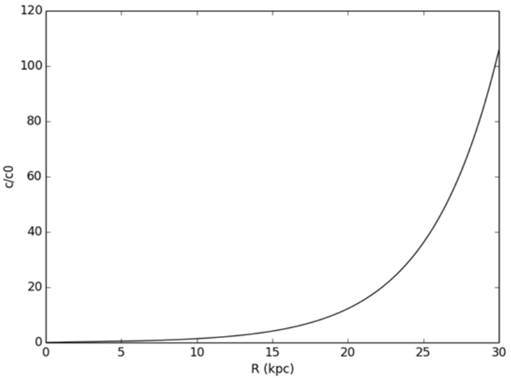
- Using a Galactic mass model and c = c0(ρ/ρ0)^−2/3 with ρ0 = 0.083 M⊙ pc^−3 calibrated at R = 8.5 kpc, the speed of light reaches c ~ 100c0 in the outskirts of the Galaxy; light travel time from the Galactic Center is 10^5 years, reduced to 8 × 10^3 years after accounting for interarm density and spiral-arm location.
- The model predicts a Tolman surface brightness factor of (1+z)^3 rather than the expanding-universe (1+z)^4; published results with exponent 2.28–3.55 are described as consistent with the varying-c prediction and inconsistent with the expanding-universe prediction.
- Attributing cosmological redshifts to a spatial variation in c alone would remove the need for dark energy, has the potential to explain galactic rotation curves without dark matter or modified Newtonian dynamics, and implies Earth is near r = 0, contradicting the Copernican Principle.
Methods
- Theoretical/conceptual paper: reviews creationist and non-creationist variable-speed-of-light literature, especially Dicke (1957) and Barceló et al. (2011), and develops implications for a young universe cosmology.
- Uses the mathematical analogy between weak-field gravity and a varying speed of light; derives redshift relations λo/λe = ce/co and compares them with the expanding-universe scale-factor relation λo/λe = ao/ae.
- Estimates Galactic c from a simple model calibrated to c = c0 at R = 8.5 kpc using the McMillan (2011) Galactic mass distribution, numerically calculates light travel time t = ∫ dR/c, and compares the predicted Tolman surface brightness evolution with published measurements.
Limitations
- The paper states it explores only the bare outlines of the theory and that much work remains; future work should solve equation (6) or a related model for actual baryonic density distributions, and extrapolating the Galactic c result much beyond the Galaxy is unwarranted.
- The paper states that attributing redshifts solely to a varying speed of light entails rejecting the expansion of the universe, dark energy, possibly dark matter, and the Copernican Principle, though expansion and c variation could in principle operate simultaneously.
- Evident from the text: no new observational measurements are presented; the low-density c variation is unconfirmed and experimentally testing it is not feasible in the near future; the Galactic estimate relies on a simplified mass model and an assumed c(ρ) scaling calibrated at one radius.
Model-written summary. Check it against the paper before relying on it.
Integrity signals
Registry
Cites
Statistics
Figures
Verification
Claims the paper makes
0 Valid · 0 Not valid · 16 Not checked · 39 Own results and interpretations
A result the paper states — it cites no source for it, so there is none to check. The quote shows it is in the paper.
In the paper
“The combination of these factors reduces the light travel time from the Galactic Center to 8 x 10 3 years, a result that is remarkably close to the Biblical time scale of 6 x 10 3 years.”
§ TOWARDS A YOUNG UNIVERSE COSMOLOGY > MAIN
plainstates a cause- Asserted: passes — The authors put it forward as true.
- Checkable: passes — It can be checked against evidence.
- Load-bearing: passes — The paper’s conclusions depend on it.
- Based: passes — The paper gives a reason why it holds.
A result the paper states — it cites no source for it, so there is none to check. The quote shows it is in the paper.
In the paper
“In this model, c ~ 100c 0 in the outskirts of the Galaxy.”
§ TOWARDS A YOUNG UNIVERSE COSMOLOGY > MAIN
plainstates a cause- Asserted: passes — The authors put it forward as true.
- Checkable: passes — It can be checked against evidence.
- Load-bearing: passes — The paper’s conclusions depend on it.
- Based: passes — The paper gives a reason why it holds.
A conclusion the paper draws from its own results — it cites no other source for it, so there is none to check. The quote shows it is in the paper.
In the paper
“a model in which the speed of light increases in the outskirts of galaxies has the potential to explain galactic rotation curves without invoking dark matter or modifying Newtonian dynamics.”
§ TOWARDS A YOUNG UNIVERSE COSMOLOGY > Abstract
hedgedstates a possible cause- Asserted: passes — The authors put it forward as true.
- Checkable: passes — It can be checked against evidence.
- Load-bearing: passes — The paper’s conclusions depend on it.
- Based: unclear — It is unclear why the paper says it holds.
None of the sources cited for this claim have been checked yet.
In the paper
“Not only that, but the theory of general relativity (in the weak field regime) can be formulated precisely in terms of a varying speed of light.”
§ TOWARDS A YOUNG UNIVERSE COSMOLOGY > MAIN
What the sources say
plainstates an association- Asserted: passes — The authors put it forward as true.
- Checkable: passes — It can be checked against evidence.
- Load-bearing: passes — The paper’s conclusions depend on it.
- Based: passes — The paper gives a reason why it holds.
A conclusion the paper draws from its own results — it cites no other source for it, so there is none to check. The quote shows it is in the paper.
In the paper
“Attributing cosmological redshifts to a spatial variation in the speed of light alone would obviate the need for dark energy”
- Also stated in: § MAIN · plain
“This obviates the need for dark energy.”
§ TOWARDS A YOUNG UNIVERSE COSMOLOGY > Abstract
plainstates a cause- Asserted: passes — The authors put it forward as true.
- Checkable: passes — It can be checked against evidence.
- Load-bearing: passes — The paper’s conclusions depend on it.
- Based: passes — The paper gives a reason why it holds.
- Also stated in: § MAIN · plain
22 more claims
Create a free account to see all 55 claims and to verify the 17 references still open.
- It may state two separate claims as one. 22
- Probably not a substantial claim. 8
- The quote only partly states this claim. 1
Self-check
Percentages, sums and reported differences re-computed from the paper’s own numbers.
Each contradiction between two passages listed here was confirmed by an independent check.
Rated major: it would touch a result — a value a result rests on, reported and recomputed p-values on opposite sides of the significance level, two passages that conflict with no sign which is right, or a cited work retracted before this paper was published.
In the paper
§ TOWARDS A YOUNG UNIVERSE COSMOLOGY > MAIN
“λ o / λ e ≡ 1 + z = c e / c o ,(1)”
§ TOWARDS A YOUNG UNIVERSE COSMOLOGY > MAIN
“The dispersion relation is the same for sound waves as for light waves: ω = ck, where ω and c are the frequency and speed of the wave, and k = 2π / λ is the wave number, with λ the wave length.”
Rated minor: it would not touch a result — a value no result rests on, a p-value that stays on the same side of the significance level, or a conflict that is clerical, resolved elsewhere in the paper, or outside its own findings.
In the paper
§ TOWARDS A YOUNG UNIVERSE COSMOLOGY > MAIN
“the wavelength will vary as λ ~ c -1 ~ T 1/2 , i.e., it will increase (decrease) when the temperature decreases (increases).”
§ TOWARDS A YOUNG UNIVERSE COSMOLOGY > MAIN
“The speed of sound varies with altitude, since c ~ √T and the temperature varies with height.”
Citations
Cites
Barceló, C., Liberati, S., & Visser, M. (2005) · Living Reviews in Relativity · doi:10.12942/lrr-2005-12 · Cited by 1,163
McMillan, P. J. (2011) · Monthly Notices of the Royal Astronomical Society · doi:10.1111/j.1365-2966.2011.18564.x · Cited by 789
A general approach to linear and non-linear dispersive waves using a Lagrangian
Whitham, G. B. (1965) · Journal of Fluid Mechanics · doi:10.1017/s0022112065000745 · Cited by 752
Barceló, C., Liberati, S., & Visser, M. (2011) · Living Reviews in Relativity · doi:10.12942/lrr-2011-3 · Cited by 598
Mimicking celestial mechanics in metamaterials
Genov, D. A., Zhang, S., & Zhang, X. (2009) · Nature Physics · doi:10.1038/nphys1338 · Cited by 353 · cited 2×
“To see that this is true, one has only to consider a meta-material in which the speed of light varies (Genov et al. 2009) to see that the theory of special relativity would apply to such a material, with the only difference being that the speed of light would be modeled as c(x, y, z, t) rather than…”
BackgroundReciprocity Principle and the Lorentz Transformations
Berzi, V., & Gorini, V. (1969) · Journal of Mathematical Physics · doi:10.1063/1.1665000 · Cited by 161
A Test of the Copernican Principle
Caldwell, R. R., & Stebbins, A. (2008) · Physical Review Letters · doi:10.1103/physrevlett.100.191302 · Cited by 140
Gravitation without a Principle of Equivalence
Dicke, R. H. (1957) · Reviews of Modern Physics · doi:10.1103/revmodphys.29.363 · Cited by 119
Two Methods of Investigating the Nature of the Nebular Redshift
Hubble, E., & Tolman, R. C. (1935) · The Astrophysical Journal · doi:10.1086/143682 · Cited by 109
Über die Transformation der Raumzeitkoordinaten von ruhenden auf bewegte Systeme
Frank, P. G., & Rothe, H. (1911) · Annalen der Physik · doi:10.1002/andp.19113390502 · Cited by 102
Research works printed but not linked: 1
- Humphreys, D. R. 2008. New time dilation helps creation cosmology. Journal of Creation 22 (3):84-92.
Cited by
Meyer, V., & Almon, J. (2024) · Journal of Student Research · doi:10.47611/jsrhs.v13i3.7132
Metadata
- Authors
- Johnson, B.
- Corresponding author
- Johnson, Bryan
- Venue
- The Proceedings of the International Conference on Creationism
- Publisher
- Centennial Library
- Published
- 2018
- Volume
- 8
- Issue
- 1
- Pages
- 46-51
- ISSN
- 2639-3999 (ISSN-L)
- 2639-4006
- OpenAlex
- W2891525883
- Cited by
- 1
- References
- 17
- Citations by year
- 2024: 1
- FWCI
- 0.00
- Type
- conference paper
- Language
- en
- Open access
- hybrid
- doi.org
- Licence
- cc-by-nc-nd
- Locations
- Proceedings of the International Conference on Creationism/Proceedings of the ... International Conference on Creationism (publishedVersion, cc-by-nc-nd)
- DigitalCommons-Cedarville (Cedarville University) (submittedVersion, cc-by-nc-nd)
- Topics
- Physical Sciences › Physics and Astronomy › Astronomy and Astrophysics › Cosmology and Gravitation Theories
- Physical Sciences › Physics and Astronomy › Astronomy and Astrophysics › Relativity and Gravitational Theory
- Physical Sciences › Physics and Astronomy › Nuclear and High Energy Physics › Noncommutative and Quantum Gravity Theories
- Keywords
- variable speed of light, cosmological redshift, cosmic voids, dark energy, galaxy rotation curves, weak-field gravity
About these checks
Registry, retraction, Cites and statistics results are computed, not judged, with one exception: a printed reference that no index lists is read once by a model before it counts as a citation error. Claims are extracted by a model and kept only when their quote appears verbatim in the text; each cited source is then checked, with a model’s help, for whether it says what the claim relies on. Those verdicts can be wrong — read the claim’s quote and the cited source before relying on one.
A language model drew the claims from the paper on 2026-11-24, under version 3 of the claim definition (model deepseek-v4.1-flash, prompt extract-v3).
A second model labelled each claim on 2026-11-24 (model jev-1.13-20260917, definition revision gold-guideline-v0.2).
Statistics and arithmetic are recomputed, not judged.
Confidence bands are shown only for fields calibrated on our annotated test set. None is calibrated yet, so no band is shown.
What counts as a claim ›How we measure confidence ›How we check this ›
Are you an author, or do you see a problem with this page? Request a review
Data sources
Bibliographic data: Semantic Scholar, OpenAlex, Crossref.
Contains information from the Semantic Scholar Academic Graph Datasets, made available under the ODC Attribution License (ODC-BY 1.0).
Semantic Scholar’s data is described in: Kinney, R., et al. (2023). The Semantic Scholar Open Data Platform. arXiv:2301.10140.
