

The DOI matches its Crossref record; 37 of the 37 references it cites were found in a registry or an index.
Implementing Inclusive Education in Lithuania: What are the main Challenges according to Teachers’ Experiences?
Abstract
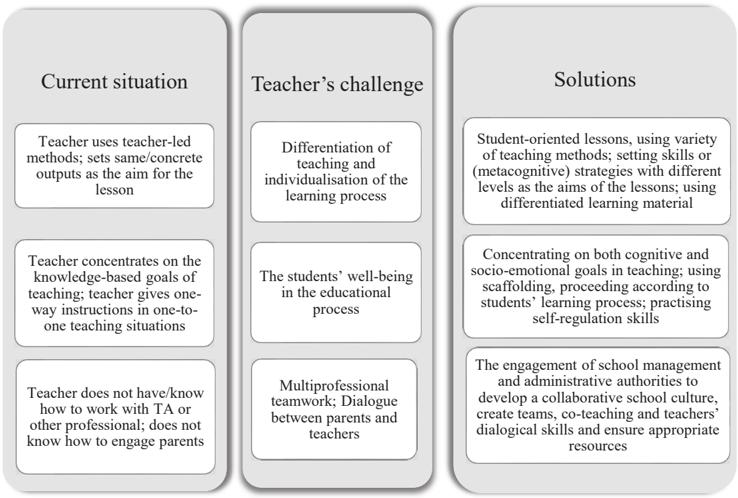
The purpose of this article was to analyse the challenges primary and subject teachers had experienced concerning the implementation of inclusive education in Lithuanian primary schools, progymnasiums and gymnasiums. In this study, 86 Lithuanian teachers reflected on their experiences of teaching in heterogeneous classes. The data were collected from 13 group interviews. The article highlights the challenges encountered by the primary and subject teachers in implementing inclusive teaching. The findings were arranged under four themes. Concerning teachers’ pedagogical competence, the teachers highlighted difficulties in differentiating their teaching and including the students with special educational needs in the classes’ social peer networks. Teachers also pointed out the need for multiprofessional collaboration and dialogue with parents. The themes were then interpreted in the theoretical frames of teachers’ professional competences. At a practical level, the study’s findings may help teacher educators understand the teacher competences needed to implement inclusive education and support them to develop existing teaching programs to target the successful implementation of inclusive education. At a conceptual level, this study presents evidence for preparing teachers to work in the conditions of striving towards inclusive education.
Overview
The claims and statistics of this paper haven’t been checked yet.
Run the check — free, no account needed. It reads the open-access text and checks the sources it cites.
Integrity signals
Registry
Cites
Statistics
Figures

Verification
Claims the paper makes
The claims and statistics of this paper haven’t been checked yet.
Run the check — free, no account needed. It reads the open-access text and checks the sources it cites.
Claims other papers make about this one
Each is checked against this paper’s own text: does it say what the citing paper says it does?
In the citing paper
“Additionally, Lakkala et al. (2019) identify that limited stakeholder support and prevailing cultural beliefs about disability can significantly impede the promotion of inclusive education.”
From Inclusive Education: Navigating the Implementation and Challenges Among Public Elementary Teachers in Las Piñas City, Philippines (2025) · cites this paper as Lakkala et al. (2019)
Self-check
Percentages, sums and reported differences re-computed from the paper’s own numbers.
The self-check needs the paper’s full text.
Citations
Cites
(1990) · Cited by 24,217
Strategies for ensuring trustworthiness in qualitative research projects
Shenton, A. K. (2004) · Education for Information · doi:10.3233/efi-2004-22201 · Cited by 9,748
Content analysis and thematic analysis: Implications for conducting a qualitative descriptive study
Vaismoradi, M., Turunen, H., & Bondas, T. (2013) · Nursing & Health Sciences · doi:10.1111/nhs.12048 · Cited by 8,327
Niemiec, C. P., & Ryan, R. M. (2009) · Theory and Research in Education · doi:10.1177/1477878509104318 · Cited by 2,542
Index for Inclusion: Developing Learning and Participation in Schools.
Booth, T., & Ainscow, M. (2000) · OpenGrey (Institut de l'Information Scientifique et Technique) · Cited by 1,233
Four Ages of Professionalism and Professional Learning
Hargreaves, A. (2000) · Teachers and Teaching · doi:10.1080/713698714 · Cited by 1,187
Brydon-Miller, M., Greenwood, D., & Maguire, P. (2003) · Action Research · doi:10.1177/14767503030011002 · Cited by 1,033
Capturing complexity: a typology of reflective practice for teacher education
Jay, J. K., & Johnson, K. L. (2002) · Teaching and Teacher Education · doi:10.1016/s0742-051x(01)00051-8 · Cited by 801
Enacting inclusion: a framework for interrogating inclusive practice
Florian, L., & Spratt, J. (2013) · European Journal of Special Needs Education · doi:10.1080/08856257.2013.778111 · Cited by 476
The Education for All and inclusive education debate: conflict, contradiction or opportunity?
Miles, S., & Singal, N. (2010) · International Journal of Inclusive Education · doi:10.1080/13603110802265125 · Cited by 447
Avramidis, E., & Kalyva, E. (2007) · European Journal of Special Needs Education · doi:10.1080/08856250701649989 · Cited by 446
Professional development through reflection in teacher education
Körkkö, M., Kyrö-Ämmälä, O., & Turunen, T. (2016) · Teaching and Teacher Education · doi:10.1016/j.tate.2016.01.014 · Cited by 311
Social justice and the changing directions in educational research: the case of inclusive education
Slee, R. (2001) · International Journal of Inclusive Education · doi:10.1080/13603110010035832 · Cited by 308
Investigating the Content and Sources of Teacher Candidates' Personal Practical Theories (PPTs)
Levin, B., & He, Y. (2008) · Journal of Teacher Education · doi:10.1177/0022487107310749 · Cited by 235
Assessment and Student Success in a Differentiated Classroom
Tomlinson, C. A., & Imbeau, M. B. (2013) · Cited by 235
Preparation for Inclusion in Teacher Education Pre-Service Curricula
Allday, R. A., Neilsen-Gatti, S., & Hudson, T. M. (2013) · Teacher Education and Special Education: The Journal of the Teacher Education Division of the Council for Exceptional Children · doi:10.1177/0888406413497485 · Cited by 228
Vesely, A. K., Saklofske, D. H., & Leschied, A. W. (2013) · Canadian Journal of School Psychology · doi:10.1177/0829573512468855 · Cited by 209
Promoting Inclusive Education: The Role of Teachers' Competence and Attitudes.
Cate, I. P.-T., Markova, M., Krischler, M., & Krolak‐Schwerdt, S. (2018) · Cited by 184
Peters, S. (2007) · Journal of Disability Policy Studies · doi:10.1177/10442073070180020601 · Cited by 183
Skinner, E. A., Pitzer, J. R., & Steele, J. S. (2016) · Developmental Psychology · doi:10.1037/dev0000232 · Cited by 164
Webster, R., Blatchford, P., Bassett, P., Brown, P., Martin, C., & Russell, A. (2010) · European Journal of Special Needs Education · doi:10.1080/08856257.2010.513533 · Cited by 161
Penrose, A., Perry, C., & Ball, I. L. (2007) · Deakin Research Online (Deakin University) · Cited by 131
Inter‐professional work and expertise: New roles at the boundaries of schools
Edwards, A., Lunt, I., & Stamou, E. (2009) · British Educational Research Journal · doi:10.1080/01411920902834134 · Cited by 120
The work of classroom assistants in special and mainstream education in Finland
Takala, M. (2007) · British Journal of Special Education · doi:10.1111/j.1467-8578.2007.00453.x · Cited by 115
Teacher education for inclusion in Europe
Donnelly, V., & Watkins, A. (2011) · PROSPECTS · doi:10.1007/s11125-011-9199-1 · Cited by 90
Research with Children: Theory & Practice
O’Reilly, M. J., Ronzoni, P., & Dogra, N. (2013) · Sage eBooks · doi:10.4135/9781526486653 · Cited by 54
Inclusion in practice: a matter of school culture
Tjernberg, C. C., & Mattson, E. H. (2014) · European Journal of Special Needs Education · doi:10.1080/08856257.2014.891336 · Cited by 48
Research with Children: Theory and Practice
O’Reilly, M. J., Ronzoni, P., Dogra, N., & Seaman, J. (2013) · Medical Entomology and Zoology · Cited by 45
Lakkala, S., Uusiautti, S., & Määttä, K. (2016) · Journal of Research in Special Educational Needs · doi:10.1111/1471-3802.12055 · Cited by 38
Self-citationRose, J., & Norwich, B. (2013) · Cambridge Journal of Education · doi:10.1080/0305764x.2013.855169 · Cited by 35
Vitalaki, E., Κουρκούτας, Η., & Hart, A. (2018) · International Journal of Inclusive Education · doi:10.1080/13603116.2018.1427150 · Cited by 27
Shani, M., & Hebel, O. (2016) · International Journal of Special Education (IJSE) · Cited by 22
Miller, G. E., Coleman, J., & Mitchell, J. (2018) · Journal of Education for Teaching International Research and Pedagogy · doi:10.1080/02607476.2018.1465660 · Cited by 18
Lakkala, S., & Määttä, K. (2011) · Global Journal of Human-Social Science · Cited by 10
Self-citationShepherd, K. G., & West, J. E. (2016) · Teacher Education and Special Education The Journal of the Teacher Education Division of the Council for Exceptional Children · doi:10.1177/0888406416638515 · Cited by 2
Mokytojų patirtys, ugdant mokinius, turinčius elgesio ir (ar) emocijų problemų
Ališauskas, A., & Šimkienė, G. (2013) · Laba (Lietuvos akademinių bibliotekų direktorių asociacija) · Cited by 2
Peculiarities of social integration of adolescents with hearing impairment
Kiušaitė, J., & Jaroš, I. (2012) · Cited by 1
Research works printed but not linked: 11
- Ambrukaitis, J. (2004). Pedagogų nuomonė apie savo pasirengimą ugdyti vaikus, turinčius specialiųjų poreikių [Teachers' Reflections on Being Ready to Educate SEN Children]. Specialusis ugdymas, 2(11), 114-123.
- Geležinienė, R., Ruškus J., & Balčiūnas, S. (2008). Mokytojų veiklų, ugdant emocijų ir elgesio sutrikimų turinčius vaikus, tipologizavimas [Typology of Teachers' Activities in Educating a Child with Emotional and Behaviour Difficulties]. Specialusis ugdymas, 2(19), 45-58.
- Gibbs, A. (2012). Focus Groups and Group Interviews. In J. A., M. Waring, R. Coe, & L. V. Hedges (Eds.), Research Methods & Methodologies in Education (pp. 186-192). London: Sage.
- Kaffemanienė, I., & Lusver, I. (2004). Moksleivių, turinčių mokymosi negalių, bendrojo lavinimo turinio individualizavimas [The Individualization of the Educational Content for Children with Learning Disabilities]. Specialusis ugdymas, 2(11), 133-150.
- Lakka.la, S., & Kyrö-Ämmälä, O. (2017). The Finnish school case. In A. Galkienė (Eds.) Inclusion in socio-educational frames. Inclusive school cases in four European countries (pp. 267-309). Vilnius: The Publishing House of the Lithuanian University of Educational Sciences.
- Määttä, K., Äärelä, T., & Uusiautti, S. (2018). Challenges of special education. In S. Uusiautti & K. Määttä (Eds.) New methods of special education (pp. 13-29). Frankfurt am Main: Peter Lang.
- Malinen, O-P. (2013). Inclusive Education from Teachers' Perspective: Examining Pre- and In-Service Teachers' Self-Efficacy and Attitudes in Mainland China. Dissertation for the degree of Doctor of Education, University of Eastern Finland, Philosophical Faculty. Retrieved from http://epublications.uef.fi/pub/urn_isbn_978-952-61-1167-4/index_en.html
- Miltenienė, L. (2004). Pedagogų nuostatos į specialųjį ugdymą ir ugdymo dalyvių bendradarbiavimą: struktūros ir raiškos ypatumai [Teachers' Attitude to Special Education and to Co-operation of Participants of Education: Peculiarities of Structure and Expression]. Specialusis ugdymas, 2(11), 151-165.
- Miltenienė, L. (2008). Vaiko dalyvavimas, tenkinant specialiuosius poreikius bendrojo lavinimo mokykloje [Child's Participation in Meeting Special Needs in General Education Schools]. Specialusis ugdymas, 1(18), 179-190.
- Monkevičienė, O., Ustilaitė, S., Navaitienė, J., & Juškevičienė, A. (2017). Theoretical Modelling of Inclusive Education in Research by Lithuanian Researchers. In A. Galkienė (Eds.) Inclusion in socio-educational frames. Inclusive school cases in four European countries (pp. 146-170). Vilnius: The Publishing House of the Lithuanian University of Educational Sciences.
- Zeichner, K. (2001). Educational Action Research. In P. Reason & H. Bradbury (Eds.) Handbook of Action Research - Participate Inquiry and Practice (pp. 273-283). London: Sage.
Cited by
Jimenez, J. A. (2025) · Journal of Interdisciplinary Perspectives · doi:10.69569/jip.2024.0434 · Cited by 5
Metadata
- Authors
- Lakkala, S., Juškevičienė, A., Česnavičienė, J., Poteliūnienė, S., Ustilaitė, S., & Uusiautti, S.
- Venue
- Acta Paedagogica Vilnensia
- Publisher
- Vilnius University Press
- Published
- 2019-12-20
- Volume
- 43
- Pages
- 37-56
- ISSN
- 1648-665X
- 1392-5016
- Cited by
- 8
- References
- 37
About these checks
Registry, retraction, Cites and statistics results are computed, not judged, with one exception: a printed reference that no index lists is read once by a model before it counts as a citation error. Claims are extracted by a model and kept only when their quote appears verbatim in the text; each cited source is then checked, with a model’s help, for whether it says what the claim relies on. Those verdicts can be wrong — read the claim’s quote and the cited source before relying on one.
Statistics and arithmetic are recomputed, not judged.
Confidence bands are shown only for fields calibrated on our annotated test set. None is calibrated yet, so no band is shown.
What counts as a claim ›How we measure confidence ›How we check this ›
Are you an author, or do you see a problem with this page? Request a review
Data sources
Bibliographic data: Semantic Scholar, OpenAlex, Crossref.
Contains information from the Semantic Scholar Academic Graph Datasets, made available under the ODC Attribution License (ODC-BY 1.0).
Semantic Scholar’s data is described in: Kinney, R., et al. (2023). The Semantic Scholar Open Data Platform. arXiv:2301.10140.
