

Crystalline materials for quantum computing: Semiconductor heterostructures and topological insulators exemplars
Open accessThe DOI matches its Crossref record; 107 of the 107 references it cites were found in a registry or an index.
Abstract
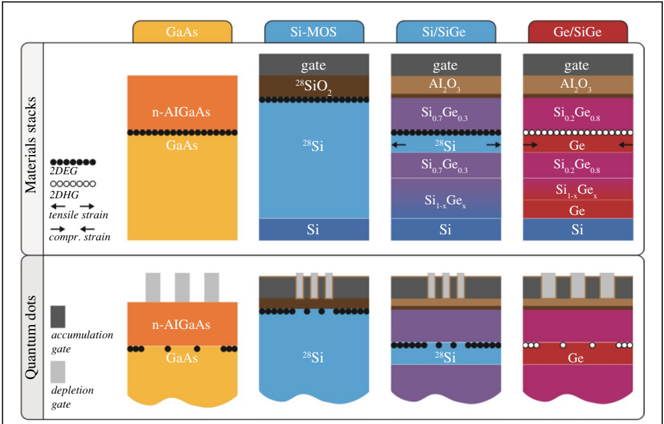
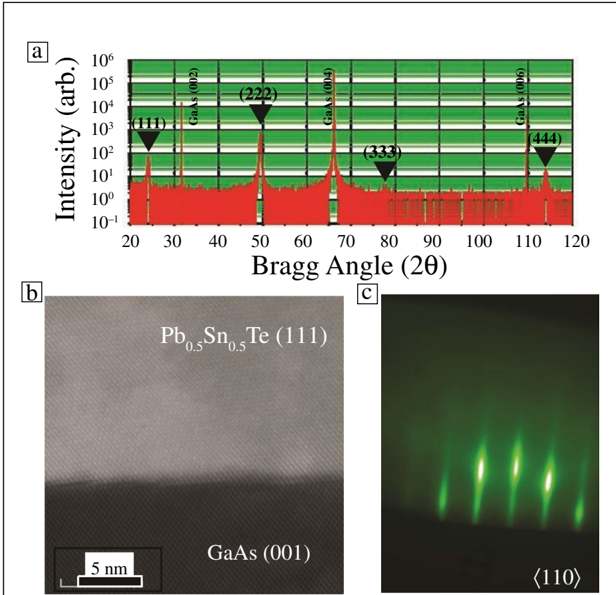
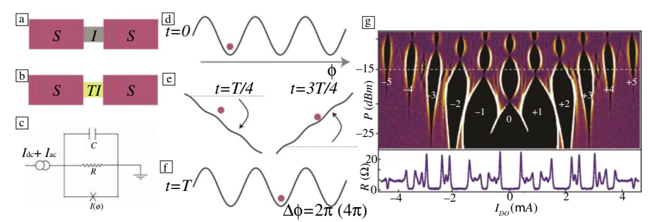
High-purity crystalline solid-state materials play an essential role in various technologies for quantum information processing, from qubits based on spins to topological states. New and improved crystalline materials emerge each year and continue to drive new results in experimental quantum science. This article summarizes the opportunities for a selected class of crystalline materials for qubit technologies based on spins and topological states and the challenges associated with their fabrication. We start by describing semiconductor heterostructures for spin qubits in gate-defined quantum dots and benchmark GaAs, Si, and Ge, the three platforms that demonstrated two-qubit logic. We then examine novel topologically nontrivial materials and structures that might be incorporated into superconducting devices to create topological qubits. We review topological insulator thin films and move onto topological crystalline materials, such as PbSnTe, and its integration with Josephson junctions. We discuss advances in novel and specialized fabrication and characterization techniques to enable these. We conclude by identifying the most promising directions where advances in these material systems will enable progress in qubit technology.
Overview
The claims and statistics of this paper haven’t been checked yet.
Free: it reads the open-access text and checks the first 5 claims that cite a source we can check. Create a free account to check every claim.
Integrity signals
Registry
Cites
Statistics
Figures




Verification
Claims the paper makes
The claims and statistics of this paper haven’t been checked yet.
Free: it reads the open-access text and checks the first 5 claims that cite a source we can check. Create a free account to check every claim.
Claims other papers make about this one
Each is checked against this paper’s own text: does it say what the citing paper says it does?
The source backs part of the claim, not all of it — or backs it for a different population, condition or comparison.
In the citing paper
“Spin qubits hosted in epitaxial group IV heterostructures offer reduced disorder27–29 but are less straightforward to integrate in an industry process owing to the 300-mm SiGe epitaxy, which comes with reduced thermal budget and increased valley-splitting challenges30 compared with Si-MOS.”
From Probing single electrons across 300-mm spin qubit wafers (2024) · cites this paper as [28]
Experimental — accuracy not yet measured
Self-check
Percentages, sums and reported differences re-computed from the paper’s own numbers.
The self-check needs the paper’s full text.
Citations
Cites
Quantum computation with quantum dots
Loss, D., & DiVincenzo, D. P. (1998) · Physical Review A · doi:10.1103/physreva.57.120 · Cited by 6,840
Introduction to Superconductivity
Tinkham, M., & Emery, V. (1996) · Physics Today · doi:10.1063/1.2807811 · Cited by 6,601
Weyl and Dirac semimetals in three-dimensional solids
Armitage, N. P., Mele, E. J., & Vishwanath, A. (2018) · Reviews of Modern Physics · doi:10.1103/revmodphys.90.015001 · Cited by 4,528
Coherent Manipulation of Coupled Electron Spins in Semiconductor Quantum Dots
Petta, J. R., Johnson, A. C., Taylor, J. M., Laird, E. A., Yacoby, A., Lukin, M. D., Marcus, C. M., Hanson, M. P., & Gossard, A. C. (2005) · Science · doi:10.1126/science.1116955 · Cited by 3,183
Spins in few-electron quantum dots
Hanson, R., Kouwenhoven, L. P., Petta, J. R., Tarucha, S., & Vandersypen, L. M. K. (2007) · Reviews of Modern Physics · doi:10.1103/revmodphys.79.1217 · Cited by 2,665
Colloquium : Topological band theory
Bansil, A., Lin, H., & Das, T. (2016) · Reviews of Modern Physics · doi:10.1103/revmodphys.88.021004 · Cited by 1,587
Zwanenburg, F. A., Dzurak, A. S., Morello, A., Simmons, M. Y., Hollenberg, L. C. L., Klimeck, G., Rogge, S., Coppersmith, S. N., & Eriksson, M. A. (2013) · Reviews of Modern Physics · doi:10.1103/revmodphys.85.961 · Cited by 1,210
Coherent Control of a Single Electron Spin with Electric Fields
Nowack, K. C., Koppens, F. H. L., Nazarov, Y. V., & Vandersypen, L. M. K. (2007) · Science · doi:10.1126/science.1148092 · Cited by 1,001
A two-qubit logic gate in silicon
Veldhorst, M., Yang, C. H., Hwang, J. C. C., Huang, W., Dehollain, J. P., Muhonen, J. T., Simmons, S., Laucht, A., Hudson, F. E., Itoh, K. M., et al. (2015) · Nature · doi:10.1038/nature15263 · Cited by 919
A quantum-dot spin qubit with coherence limited by charge noise and fidelity higher than 99.9%
Yoneda, J., Takeda, K., Otsuka, T., Nakajima, T., Delbecq, M. R., Allison, G., Honda, T., Kodera, T., Oda, S., Hoshi, Y., et al. (2018) · Nature Nanotechnology · doi:10.1038/s41565-017-0014-x · Cited by 900
Research works printed but not linked: 1
- M. Tinkham, Introduction to Superconductivity. Dover Books on Physics, 2nd ed. (Dover Publications, Mineola, NY, 2004), vol.
Cited by
Probing single electrons across 300-mm spin qubit wafers
Neyens, S., Zietz, O. K., Watson, T. F., Luthi, F., Nethwewala, A., George, H. C., Henry, E., Islam, M., Wagner, A. J., Borjans, F., et al. (2024) · Nature · doi:10.1038/s41586-024-07275-6 · Cited by 178
Roadmap on topological photonics
Price, H. M., Chong, Y. D., Khanikaev, A. B., Schomerus, H., Maczewsky, L. J., Kremer, M., Heinrich, M., Szameit, A., Zilberberg, O., Yang, Y., et al. (2022) · Journal of Physics Photonics · doi:10.1088/2515-7647/ac4ee4 · Cited by 210
Advances and opportunities in materials science for scalable quantum computing
Lordi, V., & Nichol, J. M. (2021) · MRS Bulletin · doi:10.1557/s43577-021-00133-0 · Cited by 87
Exploring quantum materials and applications: a review
Goyal, R. K., Maharaj, S., Kumar, P., & Chandrasekhar, M. (2025) · Journal of Materials Science Materials in Engineering · doi:10.1186/s40712-024-00202-7 · Cited by 69
“An impressive paper by Scappucci et al. in 2021 (Scap-pucci et al. 2021) shows the significance of high-purity crystalline solid-state materials in advancing quantum information processing, particularly in qubit technologies reliant on spins and topological states.”
Low disorder and high valley splitting in silicon
Esposti, D. D., Stehouwer, L. E. A., Gül, Ö., Samkharadze, N., Déprez, C., Meyer, M., Meijer, I. N., Tryputen, L., Karwal, S., Botifoll, M., et al. (2024) · npj Quantum Information · doi:10.1038/s41534-024-00826-9 · Cited by 72
“For spin qubits in gate-defined silicon quantum dots[2], there are currently three material-science driven requirements being pursued[3].”
BackgroundSelf-citationSilicon spin qubits from laboratory to industry
Michielis, M. D., Ferraro, E., Prati, E., Hutin, L., Bertrand, B., Charbon, E., Ibberson, D. J., & González-Zalba, M. F. (2023) · Journal of Physics D Applied Physics · doi:10.1088/1361-6463/acd8c7 · Cited by 64
Atomic-precision advanced manufacturing for Si quantum computing
Bussmann, E., Butera, R., Owen, J. H. G., Randall, J. N., Rinaldi, S. M., Baczewski, A., & Misra, S. (2021) · MRS Bulletin · doi:10.1557/s43577-021-00139-8 · Cited by 37
Peña, L. F., Koepke, J., Dycus, J. H., Mounce, A. M., Baczewski, A., Jacobson, N. T., & Bussmann, E. (2024) · npj Quantum Information · doi:10.1038/s41534-024-00827-8 · Cited by 35
“[19] G Scappucci, PJ Taylor, JR Williams, T Ginley, and S Law.”
Electrical Control of Uniformity in Quantum Dot Devices
Meyer, M., Déprez, C., van Abswoude, T. R., Meijer, I. N., Liu, D., Wang, C.-A., Karwal, S., Oosterhout, S. D., Borsoi, F., Sammak, A., et al. (2023) · Nano Letters · doi:10.1021/acs.nanolett.2c04446 · Cited by 33
“Next we apply our findings and probe the capability to homogenize the pinch-off voltages V i thres of a group of plunger gates Pi with i in [1,4] in a quantum dot array.”
Self-citationSingle-Electron Spin Qubits in Silicon for Quantum Computing
Hu, G., Huang, W., Cai, R., Wang, L., Yang, C. H., Cao, G., Xue, X., Huang, P., & He, Y. (2025) · Intelligent Computing · doi:10.34133/icomputing.0115 · Cited by 33
Botifoll, M., Pinto‐Huguet, I., Rotunno, E., Galvani, T., Coll, C., Kavkani, P. H., Spadaro, M. C., Niquet, Y., Eriksen, M., Martí‐Sánchez, S., et al. (2025) · Advanced Materials · doi:10.1002/adma.202506785 · Cited by 22
Self-citationAnomalous Zero-Field Splitting for Hole Spin Qubits in Si and Ge Quantum Dots
Hetényi, B., Bosco, S., & Loss, D. (2022) · Physical Review Letters · doi:10.1103/physrevlett.129.116805 · Cited by 21
Huang, Y., & Sarma, S. D. (2024) · Physical review. B./Physical review. B · doi:10.1103/physrevb.109.125405 · Cited by 16
Buried Unstrained Germanium Channels: A Lattice‐Matched Platform for Quantum Technology
Costa, D., Vecchio, P. D., Hudson, K., Stehouwer, L. E. A., Tosato, A., Esposti, D. D., Calvi, V., Moreschini, L., Lodari, M., Bosco, S., et al. (2026) · Advanced Science · doi:10.1002/advs.202600066 · Cited by 18
Self-citationŠolajić, A., & Pešić, J. (2024) · Scientific Reports · doi:10.1038/s41598-024-51303-4 · Cited by 12
High quality Ge layers for Ge/SiGe quantum well heterostructures using chemical vapor deposition
Nigro, A., Jutzi, E., Forrer, N., Hofmann, A., Gadea, G., & Zardo, I. (2024) · Physical Review Materials · doi:10.1103/physrevmaterials.8.066201 · Cited by 12
“In the frame of quantum information, they were developed as a successful planar technology able to combine low disorder [9], fast qubit driving [10] and scalability [11,12] as well as compatibility with the widespread micro-fabrication techniques employed in the integrated circuitry industry [13].”
MethodIslam, M. A., Rafi, J. A., & Uddin, M. A. (2023) · AIP Advances · doi:10.1063/5.0167228 · Cited by 12
Topological phase transition in the commensurate multifrequency Floquet Su-Schrieffer-Heeger model
Olin, S., & Lee, W. (2023) · Physical review. B./Physical review. B · doi:10.1103/physrevb.107.094310 · Cited by 12
“Finally, topological insulators and superconductors [10] have been proposed as a basis for quantum computing [11].”
Variability of hole-spin qubits in planar germanium
Martinez, B., & Niquet, Y. (2025) · Physical Review Applied · doi:10.1103/mtky-93p1 · Cited by 8
Heteroepitaxy of group IV materials for future device application
Yamamoto, Y., Wen, W.-C., & Tillack, B. (2023) · Japanese Journal of Applied Physics · doi:10.35848/1347-4065/acb1a6 · Cited by 6
Advances in 2D heterostructures for quantum computing applications: A review
Islam, A., Khan, S., Mim, J. J., Akter, M. F., Islam, S., Oliullah, S., & Hossain, N. (2025) · Inorganic Chemistry Communications · doi:10.1016/j.inoche.2025.113980 · Cited by 6
Soft X-ray chemically sensitive ptychographic imaging of 3D nano-objects
Krasnov, V., Makhotkin, I. A., Scheerder, J. E., Loetgering, L., Soltwisch, V., van der Heide, P. A. W., & Fleischmann, C. (2024) · Optics Express · doi:10.1364/oe.535314 · Cited by 5
Disorder-independent hole-spin manipulation by hopping
Martínez, B., Sempere-Sanchis, A., Abadillo-Uriel, J. C., & Niquet, Y. (2026) · Physical Review Applied · doi:10.1103/qwgc-mwzn · Cited by 5
Ernst, O. C., Uebel, D., Brendler, R., Kraushaar, K., Steudel, M., Acker, J., & Kroke, E. (2024) · Molecules · doi:10.3390/molecules29174222 · Cited by 6
“One potential application of these isotopically engineered nanowires is in the creation of qubits, for example, through the targeted insertion of 31 P atoms or through the development of all-silicon magnetic resonance quantum devices [217].”
BackgroundInfluentialChemical Interactions at the Interface of Au on Bi2Se3 Topological Insulator
Valant, M., Gardonio, S., Estandía, S., Fanetti, M., Matetskiy, A. V., Sheverdyaeva, P. M., Moras, P., & Tileli, V. (2024) · The Journal of Physical Chemistry C · doi:10.1021/acs.jpcc.4c04241 · Cited by 3
Kumar, N., Ищенко, Д. В., Milekhin, I., Yunin, P. A., Kyrova, E. D., Korsakov, A. V., & Tereshchenko, O. E. (2024) · Physical Chemistry Chemical Physics · doi:10.1039/d4cp02994a · Cited by 3
Insights into the Stability and Surface Termination of Topological Semimetal NbAs2
D’Olimpio, G., Zhang, Y., Rosmus, M., Nappini, S., Chakraborty, A., Olszowska, N., Ottaviano, L., Sankar, R., Agarwal, A., Bondino, F., et al. (2024) · Advanced Materials Interfaces · doi:10.1002/admi.202300810 · Cited by 2
Pit-formation in germanium homoepitaxial layers
Oezkent, M., Liu, Y., Lu, C.-H., Boeck, T., & Gradwohl, K. (2024) · Surface Science · doi:10.1016/j.susc.2024.122505 · Cited by 2
Mistroni, A., Lisker, M., Yamamoto, Y., Wen, W.-C., Fidorra, F., Tetzner, H., Diebel, L. K., Visser, L., Anupam, S., Mourik, V., et al. (2025) · Applied Physics Letters · doi:10.1063/5.0285958 · Cited by 2
Shakil, M., Rehman, A., Khan, M. I., Gillani, S. S. A., Zafar, M., Gadhi, M. A., Rafique, M., Alrowaili, Z. A., Mahmoud, Z. M. M., & Al-Buriahi, M. S. (2022) · Physica Scripta · doi:10.1088/1402-4896/ac64cf · Cited by 2
Das, S., & Singh, K. (2026) · Sensing and Imaging · doi:10.1007/s11220-026-00819-2 · Cited by 1
Sadeghifaraz, A., Irani, E., & Monfared, M. (2023) · The European Physical Journal Plus · doi:10.1140/epjp/s13360-023-04653-3 · Cited by 1
Jubair, H., & Mehenaz, M. (2025) · doi:10.22541/au.173956833.32066019/v1 · Cited by 1
Topological Advantage for Adsorbate Chemisorption on Conjugated Chains
Martinez-Gomez, L., & Ribeiro, R. F. (2026) · The Journal of Physical Chemistry Letters · doi:10.1021/acs.jpclett.5c03500
“,44 − 46 Indeed, experimental 33,47 − 50 and computational 39,51,52 studies provide evidence that, under certain conditions, topological matter exhibits enhanced reactivity mediated by topologically protected boundary electrons.”
Revisiting the Abundance of Topological MaterialsPreprint
Mirhosseini, H., Elcoro, L., Knüpfer, A., & Kühne, T. D. (2025) · Research Square · doi:10.21203/rs.3.rs-5923654/v1
Real-Time DCZ Gate Control by Bayesian Optimization with Forgetting
Sato, Y., & Kawahara, T. (2025) · IEEE International Conference on Quantum Computing and Engineering (QCE) · doi:10.1109/qce65121.2025.00151
Magnetoconductivity and Quantum Interaction Mechanisms in 2D SiGe Heterostructures
Elmourabit, F., Essakali, Y., Khadiri, K. E., Kaaouachi, A. E., Limouny, L., & Dlimi, S. (2025) · International Journal of Nanoscience · doi:10.1142/s0219581x26500018
Using Landau quantization to probe disorder in semiconductor heterostructures
Elsayed, A., Costa, D., Stehouwer, L. E. A., Tosato, A., Lodari, M., Wuetz, B. P., Esposti, D. D., & Scappucci, G. (2026) · Applied Physics Letters · doi:10.1063/5.0305352
Self-citationAdvancements in MOSFET Channel Materials a Comparative Review
Sania, S., Gangwani, P., Mohil, M., & Kaur, R. (2026) · Advanced materials research · doi:10.4028/p-pou2qy
Microwave Absorption for Detection of Dirac Fermions in SnTe Films
Prado, W., Navarro-Giraldo, J., Tahsin, M., Santana, V. T., Abramof, E., Rappl, P. H. O., de Castro, S., Peres, M. L., & Neugebauer, P. (2026) · Advanced Materials Interfaces · doi:10.1002/admi.70473
Towards Scalable Si and Ge Spin Qubit Architectures : Highlights from Modelling
Martínez, B. (2022) · theses.fr (ABES) · doi:10.70675/255c74a8z7866z4efczbf93ze3a557f678c1 · Cited by 2
Detection of Dirac Fermions in Pb1−xSnxTe films tuning the Fermi level via Bi doping
Peres, M. L., Kawata, B. A., Rappl, P. H. O., Abramof, E., & de Castro, S. (2026) · Applied Physics A · doi:10.1007/s00339-026-09921-4
TopoHSE-DB: a topological materials database for generative and predictive models
Mirhosseini, H., Elcoro, L., Knüpfer, A., & Kühne, T. D. (2026) · Machine Learning Science and Technology · doi:10.1088/2632-2153/ae97d8
Advanced semiconductor materials for future electronic systems: from conventional to quantum devices
Alqudaihi, A. A., Dhasarathan, N., Rajulapati, A., Sivasundar, V., Mishra, A., Sahu, S. K., Kumar, R., V, Aman, M., & Krishnan, K. (2026) · Advances in Physics X · doi:10.1080/23746149.2026.2727992
Metadata
- Authors
- Scappucci, G., Taylor, P. J., Williams, J. R., Ginley, T., & Law, S.
- Affiliations
- QuTech (NL)
- DEVCOM Army Research Laboratory (US)
- University of Maryland, College Park (US)
- National Institute of Standards and Technology (US)
- University of Delaware (US)
- Corresponding author
- Scappucci, G.
- Venue
- MRS Bulletin
- Published
- 2021-07
- Volume
- 46
- Issue
- 7
- Pages
- 596-606
- ISSN
- 0883-7694 (ISSN-L)
- 1938-1425
- OpenAlex
- W3192036988
- Cited by
- 38
- References
- 105
- Citations by year
- 2026: 6 · 2025: 8 · 2024: 12 · 2023: 6 · 2022: 4 · 2021: 2
- FWCI
- 2.62
- Type
- journal article
- Language
- en
- Open access
- hybrid
- doi.org
- Licence
- cc-by
- creativecommons.org/licenses/by/4.0 (tdm)
- creativecommons.org/licenses/by/4.0 (vor, 33 d)
- Locations
- MRS Bulletin (publishedVersion, cc-by)
- OSTI OAI (U.S. Department of Energy Office of Scientific and Technical Information) (submittedVersion)
- Funders
- U. S. Department of Energy (DE-SC0017801)
- National Science Foundation (DMR-1743913)
- Physics Frontier Center (PHY-1430094)
- Army Research Office (W911NF-18-2-0075)
- Netherlands Organization for Scientific Research
- Topics
- Physical Sciences › Physics and Astronomy › Condensed Matter Physics › Quantum and electron transport phenomena
- Physical Sciences › Physics and Astronomy › Condensed Matter Physics › Topological Materials and Phenomena
- Physical Sciences › Physics and Astronomy › Atomic and Molecular Physics, and Optics › Semiconductor Quantum Structures and Devices
- Keywords
- quantum computing, spin qubits, semiconductor heterostructures, quantum dots, topological insulators, topological qubits, superconducting devices, topological crystalline insulators, lead tin telluride, Josephson junctions, GaAs, silicon, germanium, thin films, crystalline materials
About these checks
Registry, retraction, Cites and statistics results are computed, not judged, with one exception: a printed reference that no index lists is read once by a model before it counts as a citation error. Claims are extracted by a model and kept only when their quote appears verbatim in the text; each cited source is then checked, with a model’s help, for whether it says what the claim relies on. Those verdicts can be wrong — read the claim’s quote and the cited source before relying on one.
Statistics and arithmetic are recomputed, not judged.
Confidence bands are shown only for fields calibrated on our annotated test set. None is calibrated yet, so no band is shown.
What counts as a claim ›How we measure confidence ›How we check this ›
Are you an author, or do you see a problem with this page? Request a review
Data sources
Bibliographic data: Semantic Scholar, OpenAlex, Crossref.
Contains information from the Semantic Scholar Academic Graph Datasets, made available under the ODC Attribution License (ODC-BY 1.0).
Semantic Scholar’s data is described in: Kinney, R., et al. (2023). The Semantic Scholar Open Data Platform. arXiv:2301.10140.
