

Emergency Department Visits for Suspected Suicide Attempts Among Persons Aged 12–25 Years Before and During the COVID-19 Pandemic — United States, January 2019–May 2021
Open accessThe DOI matches its Crossref record; 9 of the 10 references it cites were found in a registry or an index; 8 of the 11 sources its claims cite were checked for support.
Abstract
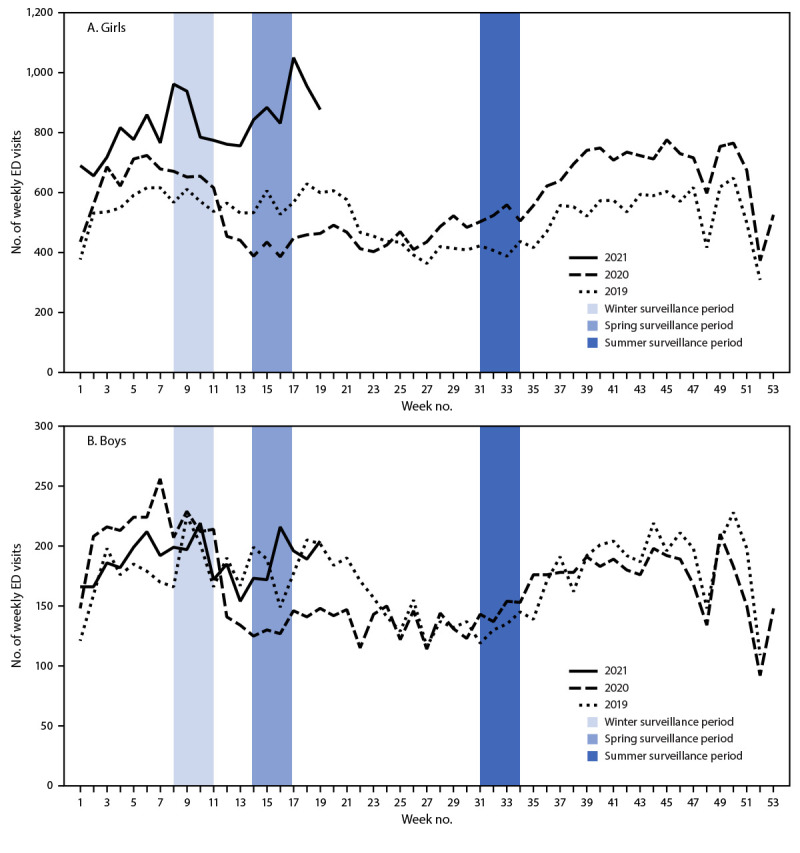
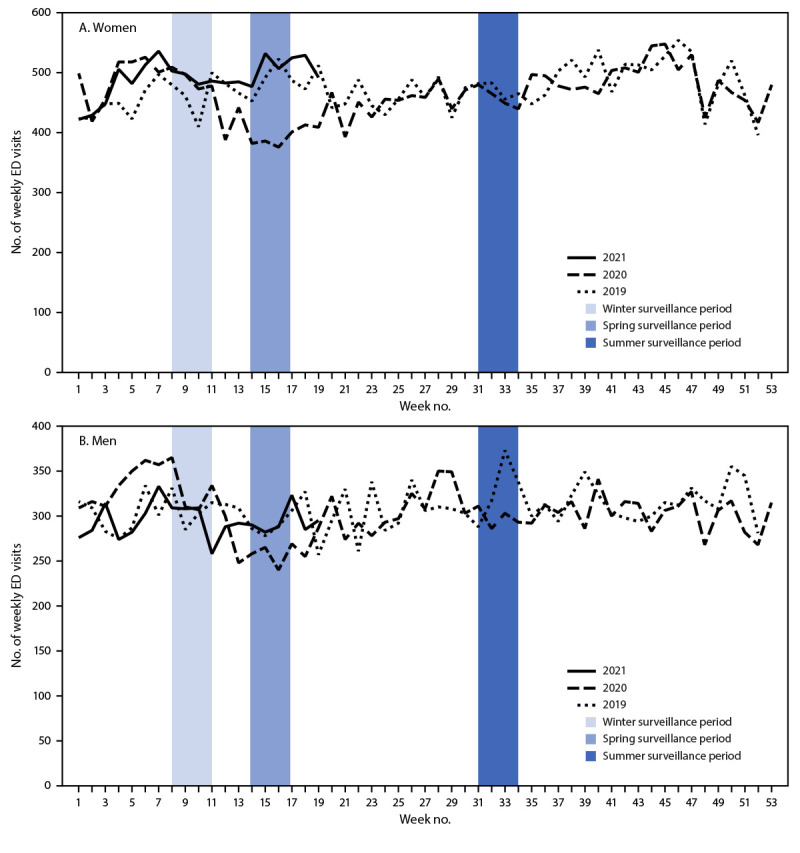
during January 1, 2019-May 15, 2021, among persons aged 12-25 years, by sex, and at three distinct phases of the COVID-19 pandemic. Compared with the corresponding period in 2019, persons aged 12-25 years made fewer ED visits for suspected suicide attempts during March 29-April 25, 2020. However, by early May 2020, ED visit counts for suspected suicide attempts began increasing among adolescents aged 12-17 years, especially among girls. During July 26-August 22, 2020, the mean weekly number of ED visits for suspected suicide attempts among girls aged 12-17 years was 26.2% higher than during the same period a year earlier; during February 21-March 20, 2021, mean weekly ED visit counts for suspected suicide attempts were 50.6% higher among girls aged 12-17 years compared with the same period in 2019. Suicide prevention measures focused on young persons call for a comprehensive approach, that is adapted during times of infrastructure disruption, involving multisectoral partnerships (e.g., public health, mental health, schools, and families) and implementation of evidence-based strategies (3) that address the range of factors influencing suicide risk.
Overview
CoChat Summary
TL;DR
CDC analyzed National Syndromic Surveillance Program emergency department (ED) data from January 2019–May 2021 and found that suspected suicide attempt ED visits among adolescents aged 12–17 years initially fell in spring 2020 but then rose, especially among girls, while counts among adults aged 18–25 years remained stable though visit rates increased. The report calls for comprehensive, adapted suicide prevention strategies for young persons.
Key findings
- Among adolescents aged 12–17 years, mean weekly ED visits for suspected suicide attempts were 22.3% higher during summer 2020 and 39.1% higher during winter 2021 than during corresponding 2019 periods; during winter 2021, visits were 50.6% higher among girls and 3.7% higher among boys.
- The rate of ED visits for suspected suicide attempts among adolescents aged 12–17 years was 2.4 times as high during spring 2020, 1.7 times as high during summer 2020, and 2.1 times as high during winter 2021 compared with corresponding 2019 periods, driven largely by females.
- Among adults aged 18–25 years, mean weekly ED visits for suspected suicide attempts dropped 16.8% during spring 2020 compared with 2019, then remained consistent with 2019 counts; however, visit rates were 1.6 times as high in spring 2020, 1.1 times as high in summer 2020, and 1.3 times as high in winter 2021.
- During spring 2020, mean weekly ED visits for suspected suicide attempts decreased 26.45% among all adolescents aged 12–17 years and 16.80% among all adults aged 18–25 years compared with 2019 reference periods.
Methods
- CDC used NSSP ED visit data covering approximately 71% of U.S. EDs in 49 states (all except Hawaii) and the District of Columbia; analyses were restricted to EDs that reported consistently during January 1, 2019–May 15, 2021 and had at least one suspected suicide attempt visit, with 41% of consistently reporting EDs having such visits.
- Suspected suicide attempts were identified using an NSSP syndrome definition combining chief complaint terms and administrative discharge diagnosis codes; these visits include suicide attempts and some nonsuicidal self-harm visits.
- Weekly counts and rates were analyzed by age group (12–17 and 18–25 years) and sex across three pandemic periods—spring 2020 (March 29–April 25), summer 2020 (July 26–August 22), and winter 2021 (February 21–March 20)—compared with corresponding 2019 periods; percent change and visit ratios with 95% CIs were calculated, with CIs excluding 1.0 considered statistically significant, using R version 4.0.5.
Limitations
- The paper states at least nine limitations: data are not nationally representative; facility participation varies; coding and reporting practices differ; initial and follow-up visits cannot be distinguished; national race and ethnicity data were unavailable; the data likely underrepresent true prevalence because less severely injured persons may have avoided emergency care; the syndrome definition excludes some but not all nonsuicidal self-harm; the sharp decline in all ED visits during the pandemic likely affected counts and proportions; and the analysis was not designed to determine causality.
- Evident from the text: the outcome is not a pure count of suicide attempts because the syndrome definition includes some nonsuicidal self-harm, and the inability to distinguish repeat visits means the number of ED visits for suspected suicide attempts might be lower than presented; both points are also stated by the authors.
Model-written summary. Check it against the paper before relying on it.
Integrity signals
Registry
Cites
Statistics
Figures
Verification
Claims the paper makes
7 Valid · 0 Not valid · 3 Not checked · 28 Own results and interpretations
The cited sources support only part of this claim — read each source’s verdict below.
In the paper
“In June 2020, 25% of surveyed adults aged 18–24 years reported experiencing suicidal ideation related to the pandemic in the past 30 days (2).”
What the sources say
- Partly supportedcites [2] Czeisler, 2020, Mental health, substance use, and suicidal ideation during the COVID-19 pandemic—United States, June 24–30, 2020., MMWR Morb Mortal Wkly Rep sourceExperimental — accuracy not yet measured
The paper reports that 25.5% of surveyed adults aged 18–24 had seriously considered suicide in the 30 days before the June 2020 survey, consistent with the claim's approximate 25%. Its survey description distinguishes suicidal ideation from outcomes explicitly measured as related to COVID-19; it does not establish that the reported ideation was related to the pandemic (main text, page not specified in our copy). (LLM, conf=0.88)
plain- Asserted: passes — The authors put it forward as true.
- Checkable: passes — It can be checked against evidence.
- Load-bearing: unclear — It is unclear whether the paper’s conclusions depend on it.
- Based: passes — The paper gives a reason why it holds.
- Partly supported
Every source the paper cites for this claim was checked and supports it.
In the paper
“the period that followed the declaration of the COVID-19 pandemic as a national emergency and a concurrent 42% decrease in the total number of U.S. ED visits (6)”
§ Emergency Department Visits for Suspected Suicide Attempts Among Persons Aged 12–25 Years Before and During the COVID-19 Pandemic — United States, January 2019–May 2021 > Discussion
What the sources say
- Supportedcites [6] Hartnett, 2020, Impact of the COVID-19 pandemic on emergency department visits—United States, January 1, 2019–May 30, 2020., MMWR Morb Mortal Wkly Rep source
The opening section states that the U.S. declared a national emergency on March 13, 2020, and that ED visits during March 29–April 25, 2020, were 42% lower than in the comparable period in 2019. The Discussion’s “What is added by this report?” section likewise reports a 42% decline. The claim describes the decrease as concurrent, not as caused by the declaration. (LLM, conf=0.94)
plainstates an association- Asserted: passes — The authors put it forward as true.
- Checkable: passes — It can be checked against evidence.
- Load-bearing: unclear — It is unclear whether the paper’s conclusions depend on it.
- Based: passes — The paper gives a reason why it holds.
- Supported
The cited sources support only part of this claim — read each source’s verdict below.
In the paper
“Compared with the rate in 2019, a 31% increase in the proportion of mental health–related emergency department (ED) visits occurred among adolescents aged 12–17 years in 2020 (1).”
- Also stated in: § What is already known about this topic? · plain
“During 2020, the proportion of mental health–related emergency department (ED) visits among adolescents aged 12–17 years increased 31% compared with that during 2019.”
What the sources say
- Partly supportedcites [1] Leeb, 2020, Mental health-related emergency department visits among children aged <18 years during the COVID-19 pandemic—United States, January 1–October 17, 2020., MMWR Morb Mortal Wkly Rep sourceExperimental — accuracy not yet measured
The results report a 31% increase for adolescents aged 12–17 compared with 2019, but specifically during weeks 12–42 of 2020 (mid-March through October). The citing sentence omits that time restriction and could be read as applying the figure to 2020 as a whole. (LLM, conf=0.85)
plainstates a cause- Asserted: passes — The authors put it forward as true.
- Checkable: passes — It can be checked against evidence.
- Load-bearing: unclear — It is unclear whether the paper’s conclusions depend on it.
- Based: passes — The paper gives a reason why it holds.
- Also stated in: § What is already known about this topic? · plain
The cited sources support only part of this claim — read each source’s verdict below.
In the paper
“research before the COVID-19 pandemic indicated that young females had both higher and increasing rates of ED visits for suicide attempts compared with males (8)”
§ Emergency Department Visits for Suspected Suicide Attempts Among Persons Aged 12–25 Years Before and During the COVID-19 Pandemic — United States, January 2019–May 2021 > Discussion
What the sources say
- Partly supportedcites [8] Mercado, 2017, Trends in emergency department visits for nonfatal self-inflicted injuries among youth aged 10 to 24 years in the United States, 2001–2015., JAMA sourceExperimental — accuracy not yet measured
The Results report that ED visit rates for self-inflicted injuries increased among females after 2009 while male rates remained stable. The paper does not establish in the available text that female rates were higher than male rates, and its definition includes injuries with nonsuicidal intent, not just suicide attempts. (LLM, conf=0.88)
hedgedstates an association- Asserted: passes — The authors put it forward as true.
- Checkable: passes — It can be checked against evidence.
- Load-bearing: unclear — It is unclear whether the paper’s conclusions depend on it.
- Based: passes — The paper gives a reason why it holds.
- Partly supported
The cited sources support only part of this claim — read each source’s verdict below.
In the paper
“However, the findings from this study suggest more severe distress among young females than has been identified in previous reports during the pandemic (1,2), reinforcing the need for increased attention to, and prevention for, this population.”
§ Emergency Department Visits for Suspected Suicide Attempts Among Persons Aged 12–25 Years Before and During the COVID-19 Pandemic — United States, January 2019–May 2021 > Discussion
What the sources say
- Supportedcites [1] Leeb, 2020, Mental health-related emergency department visits among children aged <18 years during the COVID-19 pandemic—United States, January 1–October 17, 2020., MMWR Morb Mortal Wkly Rep source
The citation identifies a previous pandemic report against which the citing authors compare their own findings; the claim of more severe distress is framed as a finding of the citing study, not of this source. The source’s results report mental health–related ED visits among children during 2020, including higher visit proportions among females than males. (LLM, conf=0.86)
- Partly supportedcites [2] Czeisler, 2020, Mental health, substance use, and suicidal ideation during the COVID-19 pandemic—United States, June 24–30, 2020., MMWR Morb Mortal Wkly Rep sourceExperimental — accuracy not yet measured
The report’s results and Table 1 (page not specified) show elevated adverse mental-health symptoms among adults aged 18–24 during the pandemic. They do not report distress specifically for young females or establish that the citing study found more severe distress than this report did; age and gender are presented separately. (LLM, conf=0.84)
hedgedstates an association- Asserted: passes — The authors put it forward as true.
- Checkable: passes — It can be checked against evidence.
- Load-bearing: passes — The paper’s conclusions depend on it.
- Based: passes — The paper gives a reason why it holds.
- Supported
22 more claims · 2 with their cited sources checked
Create a free account to see all 38 claims and to verify the 2 references still open.
- The quote only partly states this claim. 3
- It may state two separate claims as one. 5
- Probably not a substantial claim. 4
Claims other papers make about this one
Each is checked against this paper’s own text: does it say what the citing paper says it does?
The cited source says what the claim attributes to it.
In the citing paper
“The results support findings of an increase in emergency department visits for suspected suicide attempts among persons aged 12–17 years, particularly among adolescent girls, beginning in mid-2020, reported in mid-2021, based on data from the National Syndromic Surveillance Program (6).”
From Suspected Suicide Attempts by Self-Poisoning Among Persons Aged 10–19 Years During the COVID-19 Pandemic — United States, 2020–2022 (2023) · cites this paper as [6]
The cited source says what the claim attributes to it.
In the citing paper
“However, the consistency of these findings with those in other published studies highlights the association of the COVID-19 pandemic with harmful effects on youth mental health”
From Suspected Suicide Attempts by Self-Poisoning Among Persons Aged 10–19 Years During the COVID-19 Pandemic — United States, 2020–2022 (2023) · cites this paper as [6]
In the citing paper
“For youth ages 12–17 specifically, there was a 31% increase in mental health-related ED visits in 2020 compared to 2019 (Yard et al., 2021)”
From Experiences of Child and Adolescent Psychiatric Patients Boarding in the Emergency Department from Staff Perspectives: Patient Journey Mapping (2023) · cites this paper as Yard et al., 2021
In the citing paper
“Even before the pandemic, suicide was the second highest cause of death in this age group [7-9], but in 2020, emergency department (ED) visits for suspected suicide attempts increased by 30% compared to 2019 [10].”
From Chatbot-Delivered Cognitive Behavioral Therapy in Adolescents With Depression and Anxiety During the COVID-19 Pandemic: Feasibility and Acceptability Study (2022) · cites this paper as [10]
Self-check
Percentages, sums and reported differences re-computed from the paper’s own numbers.
Each contradiction between two passages listed here was confirmed by an independent check.
Rated minor: it would not touch a result — a value no result rests on, a p-value that stays on the same side of the significance level, or a conflict that is clerical, resolved elsewhere in the paper, or outside its own findings.
In the paper
§ Emergency Department Visits for Suspected Suicide Attempts Among Persons Aged 12–25 Years Before and During the COVID-19 Pandemic — United States, January 2019–May 2021
“weeks 14–17, 2019 (March 21–April 27, 2019)”
§ Emergency Department Visits for Suspected Suicide Attempts Among Persons Aged 12–25 Years Before and During the COVID-19 Pandemic — United States, January 2019–May 2021
“weeks 14–17, 2020 (March 29–April 25, 2020, Spring 2020)”
Citations
Cites
Czeisler, M. É., Lane, R. I., Petrosky, E., Wiley, J. F., Christensen, A., Njai, R., Weaver, M. D., Robbins, R., Facer-Childs, E. R., Barger, L. K., et al. (2020) · MMWR. Morbidity and Mortality Weekly Report · doi:10.15585/mmwr.mm6932a1 · Cited by 2,686
Hartnett, K. P., Kite-Powell, A., DeVies, J., Coletta, M. A., Boehmer, T. K., Adjemian, J., Gundlapalli, A. V., & Practice, N. S. S. P. C. O. (2020) · MMWR Morbidity and Mortality Weekly Report · doi:10.15585/mmwr.mm6923e1 · Cited by 1,139 · cited 1×
“Eighth, the sharp decline in all ED visits during the pandemic likely affected the number and proportion of visits for suspected suicide attempts (6).”
BackgroundSuicide mortality and coronavirus disease 2019—a perfect storm?
Reger, M. A., Stanley, I. H., & Joiner, T. E. (2020) · JAMA Psychiatry · doi:10.1001/jamapsychiatry.2020.1060 · Cited by 1,026 · cited 1×
“Some researchers have cautioned about a potential increase in suicides during the COVID-19 pandemic on account of increases in suicide risk factors; however, this study was not designed to identify the risk factors leading to increases in suspected suicide attempts, (10).”
Holland, K. M., Jones, C., Vivolo-Kantor, A. M., Idaikkadar, N., Zwald, M., Hoots, B., Yard, E., D’Inverno, A., Swedo, E., Chen, M. S., et al. (2021) · JAMA Psychiatry · doi:10.1001/jamapsychiatry.2020.4402 · Cited by 578 · cited 2×
“In addition, average ED visit rates for mental health concerns and suspected child abuse and neglect, risk factors for suicide attempts, also increased in 2020 compared with 2019 (5), potentially contributing to increases in”
BackgroundResultSelf-citationLeeb, R. T., Bitsko, R. H., Radhakrishnan, L., Martinez, P., Njai, R., & Holland, K. M. (2020) · MMWR. Morbidity and Mortality Weekly Report · doi:10.15585/mmwr.mm6945a3 · Cited by 557
Self-citationIvey-Stephenson, A. Z., Demissie, Z., Crosby, A. E., Stone, D. M., Gaylor, E., Wilkins, N., Lowry, R., & Brown, M. (2020) · MMWR Supplements · doi:10.15585/mmwr.su6901a6 · Cited by 478
Self-citationPreventing suicide : a technical package of policies, programs, and practice
National Center for Injury Prevention and Control (U.S.). Division of Violence Prevention., Stone, D., Holland, K., National Center for Injury Prevention and Control (U.S.). Division of Violence Prevention., Holland, B., Crosby, A., Davis, S., & Wilkins, N. (2017) · doi:10.15620/cdc.44275 · Cited by 214 · cited 4×
“, public health, mental health, schools, and families) and implementation of evidence-based strategies to address the range of factors influencing suicide attempts, which is a leading risk factor for suicide (3).”
BackgroundInfluentialSelf-citationMercado, M. C., Holland, K., Leemis, R. W., Stone, D. M., & Wang, J. (2017) · JAMA · doi:10.1001/jama.2017.13317 · Cited by 170
Ivey-Stephenson (2020) · doi:10.1097/nnr.0000000000000424 · Cited by 41 · cited 1×
“The difference in suspected suicide attempts by sex and the increase in suspected suicide attempts among young persons, especially adolescent females, is consistent with past research: self-reported suicide attempts are consistently higher among adolescent females than among males (7), and research before the COVID-19…”
Result
Cited by
Items 301–400 of 612
Smith, L. H., Warren, E., Hendrickson, N., & Joshua, K. (2025) · Psychology in the Schools · doi:10.1002/pits.23404 · Cited by 7
Donches, K., Murray, A. L., Carka, M., Wright, M., & Fein, J. A. (2025) · Academic Pediatrics · doi:10.1016/j.acap.2025.102843 · Cited by 4
Kietzman, H. W., Styles, W. L., Franklin-Zitzkat, L., Valerian, M. D. V., & Yuen, E. Y. (2025) · Healthcare · doi:10.3390/healthcare13091079 · Cited by 8
Effective Screening and Treatment to Reduce Suicide Risk Among Sexual and Gender Minority Youth
Murray, P. J., & Thoma, B. C. (2021) · PEDIATRICS · doi:10.1542/peds.2021-051831 · Cited by 4
Our Limited Knowledge of Youth Suicide Risk and Firearm Access
Fleegler, E. W. (2021) · JAMA Network Open · doi:10.1001/jamanetworkopen.2021.27965 · Cited by 5
Health equity and social determinants of health
Carthon, J. M. B., Pérez, A., & Brawner, B. M. (2022) · Research in Nursing & Health · doi:10.1002/nur.22222 · Cited by 4
Gupta, M., Gupta, N., & Robinson, M. (2022) · CNS Spectrums · doi:10.1017/s1092852922000724 · Cited by 4
Determinantes sociales y salud mental en las pandemias: nuevos retos
Lima‐Serrano, M. (2022) · Enfermería Clínica · doi:10.1016/j.enfcli.2022.05.001 · Cited by 4
Patriquin, M. A., Thompson, A. D., Lowry, K. W., Leffler, J. M., & Reynolds, E. K. (2022) · Evidence-Based Practice in Child and Adolescent Mental Health · doi:10.1080/23794925.2022.2127132 · Cited by 4
Li, X., & Yu, J. (2022) · Frontiers in Public Health · doi:10.3389/fpubh.2022.1052727 · Cited by 6
Henke, R. M. (2023) · American Journal of Health Promotion · doi:10.1177/08901171221140641 · Cited by 7
Heck, C. J., Theodore, D., Sovic, B., Austin, E. D., Yang, C. Y., Rotbert, J., Greissman, S., Zucker, J. E., Autry, A., Catallozzi, M., et al. (2023) · Journal of American College Health · doi:10.1080/07448481.2022.2156797 · Cited by 6
Suizide im Kindes- und Jugendalter
Falge, S., Radeloff, D., & Dreßler, J. (2023) · Rechtsmedizin · doi:10.1007/s00194-022-00611-y · Cited by 4
Fulfilling the Goals of 988 Through Crisis Stabilization Care
Hirschtritt, M. E., Howard, C. A., & Simon, G. E. (2023) · Psychiatric Services · doi:10.1176/appi.ps.20220503 · Cited by 4
Thompson, M. P., Tyson, J. S., Hege, A., & Seitz, C. M. (2023) · Journal of American College Health · doi:10.1080/07448481.2023.2186140 · Cited by 5
Investigating the factors affecting adolescents’ test anxiety in Greece during the COVID-19 pandemic
Trikoilis, D. (2023) · Pastoral Care in Education · doi:10.1080/02643944.2023.2214920 · Cited by 4
Should schools “return to normal”? Mixed outcomes resulting from COVID‐19 in schools
Tomkunas, A. J., Welliver, M., Wink, M. N., & LaRusso, M. D. (2023) · Psychology in the Schools · doi:10.1002/pits.23003 · Cited by 6
COVID-19 lockdowns and incidence of psychoactive substance exposure according to age and sex
Spinelli, A., Willeman, T., Roustit, M., & Stanke‐Labesque, F. (2021) · Clinical Toxicology · doi:10.1080/15563650.2021.2013494 · Cited by 7
Park, E.-R., Kang, J. M., Chae, H., Lim, Y. S., Kang, S., Na, K., Cho, S., & Cho, S. (2022) · 신경정신의학 · doi:10.4306/jknpa.2022.61.4.291 · Cited by 6
Pressure ulcers in the surgical patient
Iván, G. G. (2023) · Nuberos Científica · doi:10.58798/nc.2023.23.90.002 · Cited by 4
The Mental Health of School-Aged Youth: A Call to Action for School Nursing
Kubik, M., & Maughan, E. D. (2022) · The Journal of School Nursing · doi:10.1177/10598405221113312 · Cited by 4
Mirick, R. G. (2023) · Journal of Teaching in Social Work · doi:10.1080/08841233.2023.2207090 · Cited by 4
Identifying Children and Adolescents at Elevated Mental Health Risk Before and During COVID-19
Jellinek, M. S., Benheim, T. S., Dutta, A., Bergmann, P. E., STURNER, R. A., Howard, B. J., & Murphy, J. M. (2024) · Journal of Developmental & Behavioral Pediatrics · doi:10.1097/dbp.0000000000001273 · Cited by 3
Mental Health and Suicidal Behaviour in Chilean Youth during the Covid-19 Pandemic
Villarroel, A. B., Pereda, N., & Suárez-Soto, E. (2024) · Actas Españolas de Psiquiatría · doi:10.62641/aep.v52i4.1622 · Cited by 6
Dayal, R. R., Yang, P. L., Sisson, L. N., Bajaj, M. A., Archuleta, S., Yao, S., Park, D. H., Fujii-Rios, H., & Haroz, E. E. (2025) · Journal of Medical Internet Research · doi:10.2196/57602 · Cited by 6
Samuels, A., Avital-Magen, A., & Schusheim, G. (2023) · Clinical Pediatrics · doi:10.1177/00099228221150157 · Cited by 3
Guo, S., Jiao, T., Ma, Y., Lewis, S. P., Ammerman, B. A., Chen, R., Thomas, E., Yu, Y., & Tang, J. (2023) · Future · doi:10.3390/future1030009 · Cited by 5
Murdock, A. R., Rogers, M. L., Jackson, T. L., Monteiro, K., & Chambers, L. C. (2023) · Journal of School Health · doi:10.1111/josh.13424 · Cited by 5
Suicide deaths involving opioid poisoning in the United States, by sex, 1999-2021
Hoopsick, R. A., Yockey, R. A., Campbell, B. M., Sauda, T. H., & Khan, T. N. (2024) · American Journal of Epidemiology · doi:10.1093/aje/kwae094 · Cited by 3
Tamirisa, K., & Maringanti, H. B. (2024) · Cureus · doi:10.7759/cureus.66781 · Cited by 7
Sandlund, J., Duriseti, R. S., Ladhani, S. N., Stuart, K., Noble, J., & Høeg, T. B. (2024) · Paediatric Respiratory Reviews · doi:10.1016/j.prrv.2024.08.003 · Cited by 5
Schalley, S., Goldenstein, K. M., Graeve, T., Timmons, Z., Elshami, N., Beidas, R. S., & Hoffmann, J. A. (2024) · Journal of the American College of Emergency Physicians Open · doi:10.1002/emp2.13322 · Cited by 4
The protective role of competitive sports in reducing suicidality amongst youth athletes
Sparagana, P. R., Clark, V. C., Herge, W. M., & Stapleton, E. J. (2025) · Frontiers in Psychology · doi:10.3389/fpsyg.2025.1591178 · Cited by 4
Boyd, D. T., Kirklewski, S. J., Benavides, J. L., Quinn, C. R., Saigal, A., & Hill, S. V. (2025) · BMC Public Health · doi:10.1186/s12889-025-24131-y · Cited by 7
Bruns, E. J., Ehde, C., Gaias, L. M., Kebede, B. G., McWherter, C., & Wick, E. (2025) · Administration and Policy in Mental Health and Mental Health Services Research · doi:10.1007/s10488-025-01465-8 · Cited by 4
Comprehensive approaches to youth suicide prevention
Pumariega, A. J. (2021) · Asia-Pacific Psychiatry · doi:10.1111/appy.12484 · Cited by 3
How Pediatric Hospitals Must Adapt to the Adolescent Mental Health Crisis
Austin, J. P., & Marshall, R. D. (2021) · Hospital Pediatrics · doi:10.1542/hpeds.2021-006229 · Cited by 3
Making a Difference With Mental Health During Adolescence in a Global Pandemic
Plax, K. L. (2021) · Pediatric Annals · doi:10.3928/19382359-20211117-01 · Cited by 4
Herndon, A. C., & Kreth, H. L. (2022) · Journal of Hospital Medicine · doi:10.1002/jhm.2773 · Cited by 3
Bae, S., Lee, D. H., Lee, D. H., Seo, A. Y., & Choi, Y. H. (2022) · OMEGA - Journal of Death and Dying · doi:10.1177/00302228221106286 · Cited by 3
Suicide Attempts Assisted By Firefighters According to Traumatic Brain Injury
de Almeida, T. R. F., de Araújo, A. L., Munhoz, D. M., Andrade, P. G., & Wagner, G. A. (2022) · Journal of Prevention · doi:10.1007/s10935-022-00703-1 · Cited by 3
Postvention as Prevention: Coping with Loss at School
Khalid, N., Zapparrata, N. M., Loughlin, K. R., & Albright, G. L. (2022) · International Journal of Environmental Research and Public Health · doi:10.3390/ijerph191811795 · Cited by 7
Esposito-Smythers, C. L., Fischer, S. F., Whitmyre, E. D., Defayette, A. B., Maultsby, K. D., & Renshaw, K. D. (2022) · Evidence-Based Practice in Child and Adolescent Mental Health · doi:10.1080/23794925.2022.2124556 · Cited by 3
Suárez-Soto, E., Pereda, N., & Guilera, G. (2022) · Actas Españolas de Psiquiatría · Cited by 8
Differentiating Between Youth with a History of Suicidal Thoughts, Plans, and Attempts
Rivers, A. S., Winston‐Lindeboom, P., Atte, T., Rosen, P., Wintersteen, M. B., Watkins, N. K., Tien, A. Y., & Diamond, G. S. (2023) · School Mental Health · doi:10.1007/s12310-023-09575-0 · Cited by 5
Ali, M. M., West, K. D., Dubenitz, J., Horn, P. E. O., Paschane, D. M., & Lieff, S. A. (2023) · Archives of Pediatrics and Adolescent Medicine · doi:10.1001/jamapediatrics.2023.1934 · Cited by 3
Köse, S., Inal-Kaleli, I., Boru, E., Kan, Ö. Y., Hakverdi, G., Üçüncü, B., Calik, H. N., Savran-Yorulmaz, S., Pilan, B. Ş., Özbaran, B., et al. (2023) · Asian Journal of Psychiatry · doi:10.1016/j.ajp.2023.103698 · Cited by 4
School Closures and ED Visits for Suicidality in Youths Before and During the COVID-19 Pandemic
Dvir, Y., Ryan, C., & Lee, J.-A. (2023) · JAMA Network Open · doi:10.1001/jamanetworkopen.2023.43001 · Cited by 3
Lloyd, K. M., Gabard-Durnam, L. J., Beaudry, K. M., Lisio, M. D., Raine, L. B., Bernard-Willis, Y., Watrous, J. N. H., Whitfield, S., Kramer, A. F., & Hillman, C. H. (2023) · Frontiers in Public Health · doi:10.3389/fpubh.2023.1210122 · Cited by 3
Kennard, B. D., Gupta, M., Hensley, J. K., Heerschap, J. K., Moorehead, A., Wildman, R., & Nakonezny, P. A. (2024) · Journal of Child and Family Studies · doi:10.1007/s10826-023-02761-3 · Cited by 3
Sadhu, J. M., Young, J. Q., & Hunt, J. (2024) · Academic Psychiatry · doi:10.1007/s40596-024-02009-2 · Cited by 3
Chokroverty, L. (2024) · Pediatrics in Review · doi:10.1542/pir.2024-006479 · Cited by 3
Thibault, D. (2024) · Journal of Pediatric Health Care · doi:10.1016/j.pedhc.2024.10.005 · Cited by 7
Treatment Outcomes of an Adolescent Intensive Outpatient Program for Depressed and Suicidal Youth
Bero, K., Teresi, G. I., Porta, G., Poling, K. D., Brent, D. A., & Goldstein, T. R. (2024) · JAACAP Open · doi:10.1016/j.jaacop.2024.10.006 · Cited by 6
Kim, D. J. (2022) · The Lancet Regional Health - Americas · doi:10.1016/j.lana.2021.100176 · Cited by 8
Long, M., Coates, E. E., Price, O. A., & Hoffman, S. B. (2022) · The Journal of Pediatrics · doi:10.1016/j.jpeds.2022.02.009 · Cited by 4
Connection between maternal suicide attempt and chronic morbidity in children
Auger, N., Low, N., Ayoub, A., Chang, J., & Luu, T. (2022) · Psychological Medicine · doi:10.1017/s0033291722002094 · Cited by 3
Pereira, C. B. D. M., Bernardinelli, F. C. P., de Amorim, G. C., Moll, M. F., do Amaral, E. M. S., & Chaváglia, S. R. R. (2022) · Revista Enfermagem UERJ · doi:10.12957/reuerj.2022.69767 · Cited by 3
Traumatic pediatric firearm injuries during the COVID-19 pandemic
Crichton, K. G., Brink, F. W., Patterson, K. N., & Michaels, N. L. (2022) · Journal of Applied Research on Children Informing Policy for Children at Risk · doi:10.58464/2155-5834.1479 · Cited by 2
Minding Mental Health: Clinicians’ Engagement with Youth Suicide Prevention
Klee, K., & Bartkowski, J. P. (2022) · Social Sciences · doi:10.3390/socsci11050209 · Cited by 4
It’s Time to Engage Teens in Suicide Prevention in the Emergency Department
Haasz, M. (2024) · Journal of the American Academy of Child & Adolescent Psychiatry · doi:10.1016/j.jaac.2024.09.010 · Cited by 2
Bland, T., Swami, S., Martos, A., Ziemann, A., Castillón, V., Torres, I. P., & Fok, E. (2024) · Contemporary School Psychology · doi:10.1007/s40688-024-00530-7 · Cited by 4
Jang, S. Y., Choi, H. J., Kim, H., & Kim, H. J. (2025) · Psychiatry Investigation · doi:10.30773/pi.2024.0095 · Cited by 2
Marraccini, M. E., Delgaty, L. E., Middleton, T. J., Hubal, R. C., Brick, L. A. D., Galvan, A., Anderson, E., Frank, M., Farber, M. J., Li, Y., et al. (2025) · Evidence-Based Practice in Child and Adolescent Mental Health · doi:10.1080/23794925.2025.2512537 · Cited by 3
Emergency Department Visits for Suspected Suicide Attempts — United States, 2021–2025
Singichetti, B., Cammack, A. L., Rekieta, P., Schumacher, A., van Santen, K. L., Kaczkowski, W., Radhakrishnan, L., Anderson, K. N., Ballesteros, M. F., & Lee, R. (2026) · MMWR Morbidity and Mortality Weekly Report · doi:10.15585/mmwr.mm7524a1 · Cited by 2
Self-citationSuizidales Erleben und Verhalten im Rahmen der COVID-19-Pandemie
Teismann, T., Lewitzka, U., & Brieger, P. (2022) · Nervenheilkunde · doi:10.1055/a-1755-1648 · Cited by 3
Suicidality in children and adolescents - risk factors and the impact of the COVID-19 pandemic
Vatrál, M., & Trebatická, J. (2022) · Česko-slovenská pediatrie · doi:10.55095/cspediatrie2022/016 · Cited by 2
Taniguchi, E., Conant, K. D., Keller, K., & Kim, S. (2022) · Journal of Clinical Medicine · doi:10.3390/jcm11164855 · Cited by 3
Jenson, C. G., Wolff, S. F., & Milkovich, L. M. (2023) · JMIR Serious Games · doi:10.2196/48401 · Cited by 7
Management of Psychiatric Emergencies Among Migrant Youth in Institutional and Community Settings
Chokroverty, L. (2023) · Child and Adolescent Psychiatric Clinics of North America · doi:10.1016/j.chc.2023.10.002 · Cited by 2
Sajid, S., Lawrence, R. E., Galfalvy, H., Keilp, J. G., Moitra, V. K., Mann, J. J., & Grunebaum, M. F. (2023) · Journal of Affective Disorders Reports · doi:10.1016/j.jadr.2023.100690 · Cited by 2
Gupta, M. (2023) · BJPsych Open · doi:10.1192/bjo.2023.617 · Cited by 2
Delawalla, M. L. M., Tiwari, R., Evans, Y. N., Rhew, I. C., & Enquobahrie, D. A. (2024) · Current Pediatrics Reports · doi:10.1007/s40124-024-00313-x · Cited by 3
Slaten, C. D., Morris, C. A. W., Williams, M. S., Lee, J., Haberski, J., & Hovey, S. (2024) · Professional School Counseling · doi:10.1177/2156759x241247165 · Cited by 4
Rethinking Racial Matching in Children's Mental Health: The Need for Racially Conscious Therapists
Chu, W., & Robinson, T. A. (2024) · Journal of the American Academy of Child & Adolescent Psychiatry · doi:10.1016/j.jaac.2024.05.025 · Cited by 2
Cafferty, R., Haasz, M., Leonard, J. E., & Ambroggio, L. (2024) · Pediatric Emergency Care · doi:10.1097/pec.0000000000003206 · Cited by 2
Hawks, J. L., Moore, M., & Leffler, J. M. (2024) · Issues in clinical child psychology · doi:10.1007/978-3-031-62749-1_8 · Cited by 5
Brooding, reflection, and anger rumination in late life suicidal behavior
Buerke, M. L., Khani, A., Galfalvy, H., Wong, M. K., & Szántó, K. (2024) · Journal of Affective Disorders · doi:10.1016/j.jad.2024.10.093 · Cited by 5
Epidemiology of suicidal behavior in children and adolescents worldwide
Basova, A. Y., & Bezmenov, P. V. (2024) · S S Korsakov Journal of Neurology and Psychiatry · doi:10.17116/jnevro202412411216 · Cited by 3
Wallum, M., Vakkalanka, J. P., Krispin, S., & Mccabe, D. J. (2024) · The American Journal of Emergency Medicine · doi:10.1016/j.ajem.2024.11.081 · Cited by 3
Universal Suicide Risk Screening in Pediatric Neurologic, Developmental, and Behavioral Clinics
Rybczynski, S., Gornik, A. E., Schindel, B. J., Ngur, M., Matte-Ramsdell, T. E., López‐Arvizu, C., Lipkin, P. H., & Zabel, T. A. (2024) · Academic Pediatrics · doi:10.1016/j.acap.2024.102623 · Cited by 2
Implementing Screening and Counseling for Adolescent Mental Health and Substance Use
Patel, S. V., Hart, L. C., Booth, G., Rotunda, W., Kugley, S., Pilar, M. R., Coker-Schwimmer, M. J. L., Voisin, C. E., Koesters, S. C., Viswanathan, M., et al. (2025) · PEDIATRICS · doi:10.1542/peds.2024-070314 · Cited by 4
Working on mental health stigma in education: a multicentre community-based clinical trial
Ayuso, L., Pejó, L. A., & Simarro, J. V. C. (2025) · Frontiers in Public Health · doi:10.3389/fpubh.2025.1515444 · Cited by 2
Tang, S., Batterham, P. J., Slade, A., Werner‐Seidler, A., Maston, K., Corkish, B., Christensen, H. M., & Calear, A. L. (2025) · Psychiatry Research · doi:10.1016/j.psychres.2025.116683 · Cited by 3
Teen Advisory Council Survey's Factors Associated With Self-Harming Thoughts
McPherson, P., Alderman, L. L., Temple, J., Lawrence, R., Avila-Quintero, V. J., Magner, J., Sagrera, C. E., Patterson, J. C., & Murnane, K. S. (2022) · Frontiers in Psychiatry · doi:10.3389/fpsyt.2022.851477 · Cited by 4
James, J. K., Jeffery, M. M., Campbell, R. L., Wieland, M. L., & Ryu, A. J. (2022) · Mayo Clinic Proceedings Innovations Quality & Outcomes · doi:10.1016/j.mayocpiqo.2022.07.003 · Cited by 2
Toussaint, E., Florin, A., Galharret, J., Mercier, C., & Zanna, O. (2022) · Enfance · doi:10.3917/enf2.224.0435 · Cited by 3
Ghosh, P., Martinez, J., Shah, N. P., Kenan, W., Fowler, A., Limdi, N., Burns, L., Cogan, E. S., Gardiner, A. E., Hain, D. T., et al. (2022) · Pediatric Emergency Care · doi:10.1097/pec.0000000000002871 · Cited by 3
Téllez, C. D., Muñoz, L. G., Farré, M. L., Rodríguez, L. S., Morer, Á., & Lázaro, L. (2022) · Revista de Psiquiatría Infanto-Juvenil · doi:10.31766/revpsij.v39n3a2 · Cited by 2
The Impact of the COVID-19 Pandemic on Pediatric Mental Health Emergency
Fındık, O. T. P., Barin, G. G., Yıldırım, A. B. E., & Fiş, N. P. (2023) · Turkish Archives of Pediatrics · doi:10.5152/turkarchpediatr.2022.22166 · Cited by 2
Fischer, S. H., Landis, R. K., Acosta, J., & Faherty, L. J. (2023) · Disaster Medicine and Public Health Preparedness · doi:10.1017/dmp.2023.6 · Cited by 2
Hanish, L. D. (2023) · Frontiers in Developmental Psychology · doi:10.3389/fdpys.2023.1130880 · Cited by 3
Integrating Research on an Inpatient Psychiatric Unit
Radtke, S. R., Kirk, N. P. V., Patriquin, M. A., & Reynolds, E. K. (2024) · Issues in clinical child psychology · doi:10.1007/978-3-031-62749-1_26 · Cited by 4
Pronounced Regional Variation in Esketamine and Ketamine Prescribing to US Medicaid PatientsPreprint
Aguilar, A. G., Beauregard, B. A., Conroy, C. P., et al. (2022) · medRxiv · doi:10.1101/2022.04.23.22274206 · Cited by 2
Nicol, G. E., Wang, R., Graham, S. S., Dodd, S., & Garbutt, J. M. (2022) · doi:10.2196/preprints.40242 · Cited by 2
Guo, S., Jiao, T., Ma, Y., et al. (2023) · Preprints.org · doi:10.20944/preprints202308.0691.v1 · Cited by 2
Smith, L. H., Warren, E., Hendrickson, N., et al. (2024) · medRxiv · doi:10.1101/2024.01.23.24301673 · Cited by 2
Des étudiants meurent de déliaison et faute d’espoir !
Maccotta, J.-C. (2022) · Le Carnet PSY · doi:10.3917/lcp.257.0031 · Cited by 1
Metadata
- Authors
- Yard, E., Radhakrishnan, L., Ballesteros, M. F., Sheppard, M., Gates, A., Stein, Z., Hartnett, K., Kite-Powell, A., Rodgers, L., Adjemian, J., Ehlman, D. C., Holland, K., Idaikkadar, N., Ivey-Stephenson, A., Martinez, P., Law, R., & Stone, D. M.
- Affiliations
- Centers for Disease Control and Prevention (US)
- Corresponding author
- Yard, Ellen
- ORCID
- Venue
- MMWR. Morbidity and Mortality Weekly Report
- Published
- 2021-06-18
- Volume
- 70
- Issue
- 24
- Pages
- 888-894
- ISSN
- 0149-2195 (ISSN-L)
- 1545-861X
- PMC
- PMC8220953
- OpenAlex
- W3171083191
- Cited by
- 617
- References
- 10
- Citations by year
- 2026: 40 · 2025: 70 · 2024: 128 · 2023: 173 · 2022: 170 · 2021: 36
- FWCI
- 77.23
- Type
- journal article
- Language
- en
- Open access
- diamond
- doi.org
- Locations
- MMWR Morbidity and Mortality Weekly Report (publishedVersion)
- PubMed Central (publishedVersion, public-domain)
- PubMed (publishedVersion)
- Topics
- Social Sciences › Psychology › Clinical Psychology › Suicide and Self-Harm Studies
- Social Sciences › Psychology › Clinical Psychology › COVID-19 and Mental Health
- Social Sciences › Health › Gun Ownership and Violence Research
- Keywords
- suicide attempts, emergency department visits, adolescents, young adults, COVID-19 pandemic, sex differences, suicide prevention, mental health services
- MeSH terms
- COVID-19, Adolescent, Adult, Child, Emergency Service, Hospital, Female, Humans, Male, Suicide, Attempted, United States, Young Adult
About these checks
Registry, retraction, Cites and statistics results are computed, not judged, with one exception: a printed reference that no index lists is read once by a model before it counts as a citation error. Claims are extracted by a model and kept only when their quote appears verbatim in the text; each cited source is then checked, with a model’s help, for whether it says what the claim relies on. Those verdicts can be wrong — read the claim’s quote and the cited source before relying on one.
The claim verdicts this report counts are experimental: their accuracy is not yet measured.
A language model drew the claims from the paper on 2026-10-10, under version 3 of the claim definition (model deepseek-v4.1-flash, prompt extract-v3).
A second model labelled each claim on 2026-10-10 (model jev-1.13-20260917, definition revision gold-guideline-v0.2).
Cited sources are checked with a language model’s help (gpt-6-sol).
Statistics and arithmetic are recomputed, not judged.
Confidence bands are shown only for fields calibrated on our annotated test set. None is calibrated yet, so no band is shown.
What counts as a claim ›How we measure confidence ›How we check this ›
Are you an author, or do you see a problem with this page? Request a review
Data sources
Bibliographic data: Semantic Scholar, OpenAlex, Crossref.
Contains information from the Semantic Scholar Academic Graph Datasets, made available under the ODC Attribution License (ODC-BY 1.0).
Semantic Scholar’s data is described in: Kinney, R., et al. (2023). The Semantic Scholar Open Data Platform. arXiv:2301.10140.
