

The DOI matches its Crossref record; 27 of the 29 references it cites were found in a registry or an index.
Suicide Trends Among and Within Urbanization Levels by Sex, Race/Ethnicity, Age Group, and Mechanism of Death—United States, 2001–2015
Open accessAbstract
PROBLEM/CONDITION: Suicide is a public health problem and one of the top 10 leading causes of death in the United States. Substantial geographic variations in suicide rates exist, with suicides in rural areas occurring at much higher rates than those occurring in more urban areas. Understanding demographic trends and mechanisms of death among and within urbanization levels is important to developing and targeting future prevention efforts. REPORTING PERIOD: 2001-2015. DESCRIPTION OF SYSTEM: Mortality data from the National Vital Statistics System (NVSS) include demographic, geographic, and cause of death information derived from death certificates filed in the 50 states and the District of Columbia. NVSS was used to identify suicide deaths, defined by International Classification of Diseases, 10th Revision (ICD-10) underlying cause of death codes X60-X84, Y87.0, and U03. This report examines annual county level trends in suicide rates during 2001-2015 among and within urbanization levels by select demographics and mechanisms of death. Counties were collapsed into three urbanization levels using the 2006 National Center for Health Statistics classification scheme. RESULTS: Suicide rates increased across the three urbanization levels, with higher rates in nonmetropolitan/rural counties than in medium/small or large metropolitan counties. Each urbanization level experienced substantial annual rate changes at different times during the study period. Across urbanization levels, suicide rates were consistently highest for men and non-Hispanic American Indian/Alaska Natives compared with rates for women and other racial/ethnic groups; however, rates were highest for non-Hispanic whites in more metropolitan counties. Trends indicate that suicide rates for non-Hispanic blacks were lowest in nonmetropolitan/rural counties and highest in more urban counties. Increases in suicide rates occurred for all age groups across urbanization levels, with the highest rates for persons aged 35-64 years. For mechanism of death, greater increases in rates of suicide by firearms and hanging/suffocation occurred across all urbanization levels; rates of suicide by firearms in nonmetropolitan/rural counties were almost two times that of rates in larger metropolitan counties. INTERPRETATION: Suicide rates in nonmetropolitan/rural counties are consistently higher than suicide rates in metropolitan counties. These trends also are observed by sex, race/ethnicity, age group, and mechanism of death. PUBLIC HEALTH ACTION: Interventions to prevent suicides should be ongoing, particularly in rural areas. Comprehensive suicide prevention efforts might include leveraging protective factors and providing innovative prevention strategies that increase access to health care and mental health care in rural communities. In addition, distribution of socioeconomic factors varies in different communities and needs to be better understood in the context of suicide prevention.
Overview
The claims and statistics of this paper haven’t been checked yet.
Run the check — free, no account needed. It reads the open-access text and checks the sources it cites.
Integrity signals
Registry
Cites
Statistics
Figures
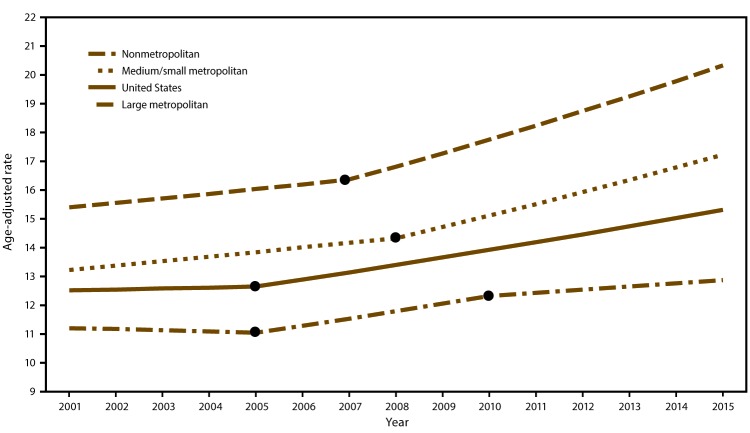
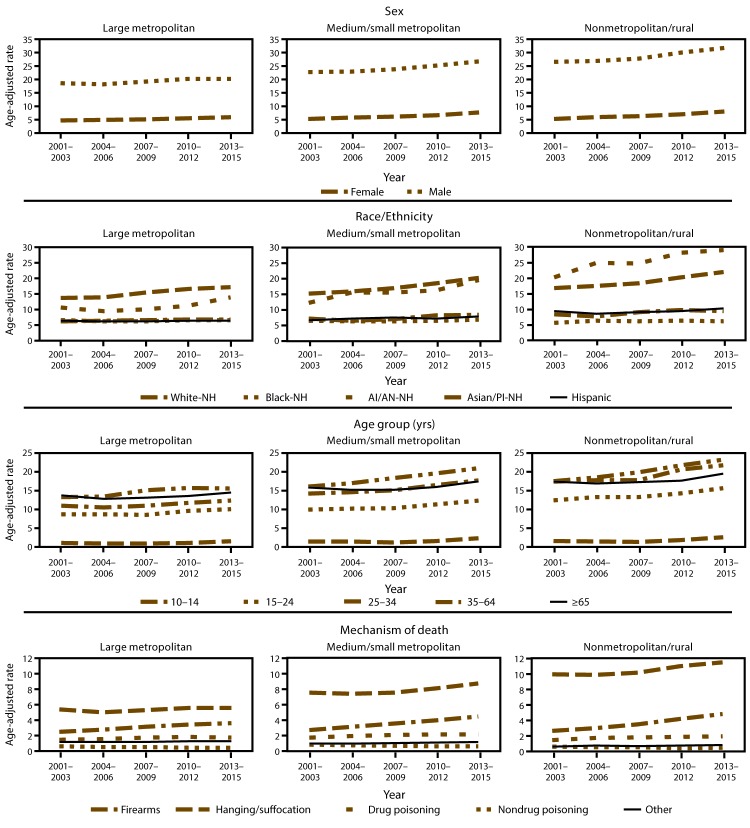
Verification
Claims the paper makes
The claims and statistics of this paper haven’t been checked yet.
Run the check — free, no account needed. It reads the open-access text and checks the sources it cites.
Claims other papers make about this one
Each is checked against this paper’s own text: does it say what the citing paper says it does?
The check wasn’t confident either way, so it gives no verdict — never disputed.
In the citing paper
“However, the WHO highlights that some risk factors, such as harmful use of alcohol and substance use disorders, contribute to suicide ideation in all age groups [14,53].”
From Toxicological Findings of Self-Poisoning Suicidal Deaths: A Systematic Review by Countries (2022) · cites this paper as [53]
Experimental — accuracy not yet measuredThe check wasn’t confident either way, so it gives no verdict — never disputed.
In the citing paper
“The young age of the victims correlates with their vulnerability and impulsiveness and their easy access to toxic drugs [52,53].”
From Toxicological Findings of Self-Poisoning Suicidal Deaths: A Systematic Review by Countries (2022) · cites this paper as [53]
Experimental — accuracy not yet measured
Self-check
Percentages, sums and reported differences re-computed from the paper’s own numbers.
The self-check needs the paper’s full text.
Citations
Cites
2013 NCHS Urban-Rural Classification Scheme for Counties.
Ingram, D. D., & Franco, S. J. (2012) · PubMed · Cited by 1,523
Mortality and Morbidity in the 21st Century
Case, A., & Deaton, A. (2017) · Brookings Papers on Economic Activity · doi:10.1353/eca.2017.0005 · Cited by 1,448
(2016) · PubMed · Cited by 580
Wyman, P. A., Brown, C. H., LoMurray, M., Schmeelk-Cone, K., Petrova, M., Yu, Q., Walsh, E., Tu, X., & Wang, W. (2010) · American Journal of Public Health · doi:10.2105/ajph.2009.190025 · Cited by 536
Suicide and Suicidal Attempts in the United States: Costs and Policy Implications
Shepard, D. S., Gurewich, D., Lwin, A. K., Reed, G. A., & Silverman, M. M. (2016) · Suicide and Life-Threatening Behavior · doi:10.1111/sltb.12225 · Cited by 413
Cunningham, T. J., Croft, J. B., Liu, Y., Lu, H., Eke, P. I., & Giles, W. H. (2017) · MMWR. Morbidity and Mortality Weekly Report · doi:10.15585/mmwr.mm6617e1 · Cited by 394
Widening Rural-Urban Disparities in Youth Suicides, United States, 1996-2010
Fontanella, C. A., Steelesmith, D. L., Phillips, G. S., Bridge, J. A., Lester, N. A., Sweeney, H. A., & Campo, J. V. (2015) · Archives of Pediatrics and Adolescent Medicine · doi:10.1001/jamapediatrics.2014.3561 · Cited by 378
Goldney, R. D. (2008) · Cited by 306
Townsend, L. C., Sathiaseelan, A., Fairhurst, G., & Wallace, C. (2013) · Local Economy The Journal of the Local Economy Policy Unit · doi:10.1177/0269094213496974 · Cited by 288
The reliability of suicide statistics: a systematic review
Tøllefsen, I. M., Hem, E., & Ekeberg, Ø. (2012) · BMC Psychiatry · doi:10.1186/1471-244x-12-9 · Cited by 223
Preventing suicide : a technical package of policies, programs, and practice
Stone, D. M., Holland, K., Holland, B., Crosby, A. E., Davis, S. P., & Wilkins, N. J. (2017) · doi:10.15620/cdc.44275 · Cited by 221
Self-citationHealth Impacts of the Great Recession: a Critical Review
Margerison-Zilko, C. E., Goldman-Mellor, S. J., Falconi, A. M., & Downing, J. M. (2016) · Current Epidemiology Reports · doi:10.1007/s40471-016-0068-6 · Cited by 208
Trends in Suicide by Level of Urbanization — United States, 1999–2015
Kegler, S. R., Stone, D. M., & Holland, K. M. (2017) · MMWR Morbidity and Mortality Weekly Report · doi:10.15585/mmwr.mm6610a2 · Cited by 194
Fowler, K. A., Gladden, R. M., Vagi, K. J., Barnes, J., & Frazier, L. (2014) · American Journal of Public Health · doi:10.2105/ajph.2014.301945 · Cited by 173
Risk and Protective Factors for Suicide and Suicidal Behaviour: A Literature Review
McLean, J., Maxwell, M., Platt, S. D., Harris, F., & Jepson, R. G. (2008) · Stirling Online Research Repository (University of Stirling) · Cited by 168
Impact of Business Cycles on US Suicide Rates, 1928–2007
Luo, F., Florence, C., Quispe‐Agnoli, M., Ouyang, L., & Crosby, A. E. (2011) · American Journal of Public Health · doi:10.2105/ajph.2010.300010 · Cited by 156
Self-citationSuicide among adults aged 35-64 years--United States, 1999-2010.
Sullivan, E., Annest, J. L., Luo, F., Simon, T. R., & Dahlberg, L. L. (2013) · PubMed Central · Cited by 155
Uncovering the Mystery: Factors of African American Suicide
Willis, L. A., Coombs, D. W., Drentea, P., & Cockerham, W. C. (2003) · Suicide and Life-Threatening Behavior · doi:10.1521/suli.33.4.412.25230 · Cited by 106
Suicide Prevention: State of the Art Review
Stone, D. M., & Crosby, A. E. (2014) · American Journal of Lifestyle Medicine · doi:10.1177/1559827614551130 · Cited by 103
Self-citationSuicide among adults aged 35-64 years--United States, 1999-2010.
(2013) · PubMed · Cited by 94
The Great Recession and America’s geography of unemployment
Thiede, B. C., & Monnat, S. M. (2016) · Demographic Research · doi:10.4054/demres.2016.35.30 · Cited by 63
The Impact of Socioeconomic Factors on State Suicide Rates: A Methodological Note
Kunce, M., & Anderson, A. L. (2002) · Urban Studies · doi:10.1080/00420980220099131 · Cited by 62
A conceptual model of suicide in rural areas
Stark, C. R., Riordan, D. V., & O’Connor, R. C. (2011) · Rural and Remote Health · doi:10.22605/rrh1622 · Cited by 57
Harper, S. B., & Bruckner, T. A. (2017) · Annals of Epidemiology · doi:10.1016/j.annepidem.2017.05.017 · Cited by 42
Suicides - United States, 2005-2009.
Crosby, A. E., Ortega, L., & Stevens, M. R. (2013) · PubMed · Cited by 21
Self-citationGiles-Sims, J., & Lockhart, C. (2006) · Suicide and Life-Threatening Behavior · doi:10.1521/suli.2006.36.6.694 · Cited by 17
Rural America at a Glance, 2016 Edition
Kusmin, L. D., & Kusmin, L. (2016) · AgEcon Search (University of Minnesota, USA) · doi:10.22004/ag.econ.262137 · Cited by 7
Cited by
Sorted by citations
Stone, D. M., Simon, T. R., Fowler, K. A., Kegler, S. R., Yuan, K., Holland, K. M., Ivey-Stephenson, A. Z., & Crosby, A. E. (2018) · MMWR. Morbidity and Mortality Weekly Report · doi:10.15585/mmwr.mm6722a1 · Cited by 634
Self-citationSuicidal Thoughts and Behaviors Among Adults Aged ≥18 Years — United States, 2015–2019
Ivey-Stephenson, A. Z., Crosby, A. E., Hoenig, J. M., Gyawali, S., Park-Lee, E., & Hedden, S. L. (2022) · MMWR. Surveillance Summaries · doi:10.15585/mmwr.ss7101a1 · Cited by 512
Self-citationA call to action to address rural mental health disparities
Morales, D. A., Barksdale, C. L., & Beckel-Mitchener, A. C. (2020) · Journal of Clinical and Translational Science · doi:10.1017/cts.2020.42 · Cited by 494
Hales, C. M., Fryar, C. D., Carroll, M. D., Freedman, D. S., Aoki, Y., & Ogden, C. L. (2018) · JAMA · doi:10.1001/jama.2018.7270 · Cited by 430
Harrington, R. A., Califf, R. M., Balamurugan, A., Brown, N., Benjamin, R. M., Braund, W. E., Hipp, J. S., Konig, M., Sánchez, E., & Maddox, K. E. J. (2020) · Circulation · doi:10.1161/cir.0000000000000753 · Cited by 393
Metadata
- Authors
- Ivey-Stephenson, A. Z., Crosby, A. E., Jack, S. P. D., Haileyesus, T., & Kresnow-Sedacca, M.-J.
- Affiliations
- National Center for Injury Prevention and Control (US)
- Division of Analysis, Research, and Practice Integration, National Center for Injury Prevention and Control, CDC
- Corresponding author
- Ivey-Stephenson, Asha Z.
- ORCID
- Crosby, Alex E.
- Venue
- MMWR. Surveillance Summaries
- Published
- 2017-10-06
- Volume
- 66
- Issue
- 18
- Pages
- 1-16
- ISSN
- 1545-8636 (ISSN-L)
- 1546-0738
- PMC
- PMC5829833
- OpenAlex
- W2762275952
- Cited by
- 319
- References
- 29
- Citations by year
- 2026: 17 · 2025: 39 · 2024: 29 · 2023: 40 · 2022: 52 · 2021: 49 · 2020: 51 · 2019: 27 · 2018: 13 · 2017: 1
- FWCI
- 31.21
- Type
- journal article
- Language
- en
- Open access
- hybrid
- doi.org
- Licence
- public-domain
- Locations
- MMWR Surveillance Summaries (publishedVersion, public-domain)
- Europe PMC (PubMed Central) (publishedVersion, cc-by)
- PubMed Central (publishedVersion, cc-by)
- PubMed (publishedVersion)
- Funders
- Centers for Disease Control and Prevention
- National Center for Injury Prevention and Control
- Topics
- Social Sciences › Psychology › Clinical Psychology › Suicide and Self-Harm Studies
- Social Sciences › Sociology and Political Science › Homicide, Infanticide, and Child Abuse
- Health Sciences › Medicine › Public Health, Environmental and Occupational Health › Injury Epidemiology and Prevention
- Keywords
- suicide, suicide rates, urbanization level, urban-rural differences, sex differences, racial and ethnic disparities, age groups, mechanism of death, firearm suicide, suicide prevention, non-Hispanic blacks, non-Hispanic whites
- MeSH terms
- Adolescent, Adult, Aged, Cause of Death, Child, Ethnicity, Female, Humans, Male, Middle Aged, Suicide, United States, Urbanization, Age Distribution, Sex Distribution, Racial Groups, Young Adult
About these checks
Registry, retraction, Cites and statistics results are computed, not judged, with one exception: a printed reference that no index lists is read once by a model before it counts as a citation error. Claims are extracted by a model and kept only when their quote appears verbatim in the text; each cited source is then checked, with a model’s help, for whether it says what the claim relies on. Those verdicts can be wrong — read the claim’s quote and the cited source before relying on one.
Statistics and arithmetic are recomputed, not judged.
Confidence bands are shown only for fields calibrated on our annotated test set. None is calibrated yet, so no band is shown.
What counts as a claim ›How we measure confidence ›How we check this ›
Are you an author, or do you see a problem with this page? Request a review
