

Interventions for music performance anxiety: Results from a systematic literature review.
Open accessThe DOI matches its Crossref record; 47 of the 50 references it cites were found in a registry or an index.
Abstract
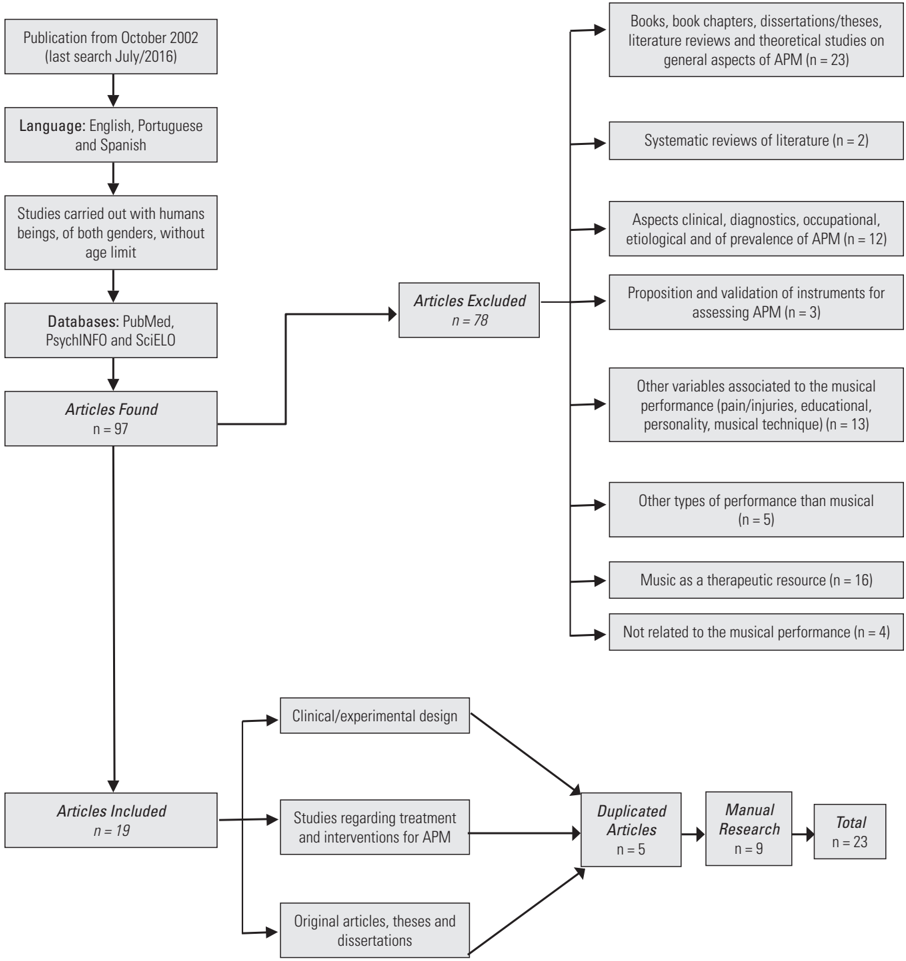
Background Music performance anxiety (MPA) is characterised by fears related to performing music. It may result in damages to personal life and professional career, so treatment and prevention are very important. Objective To undertake a systematic literature review on the effectiveness/efficacy of MPA interventions and to integrate these findings to those in the literature reviewed previously. Methods We used PubMed, PsycINFO and SciELO databases and keywords music*, performance anxiety, treatment, therapy and intervention and manual research. We selected articles published between October-2002/July-2016. Results Out of 97 articles, 23 were reviewed. Sixteen studies presented inter-group experimental design, and seven presented pre-post experimental design. The intervention modalities reviewed were cognitive behavioural therapy (CBT), virtual reality exposure, biofeedback, yoga, meditation, music therapy and the Alexander technique. Although the interventions presented some indicators of efficacy in the MPA outcomes and improvement in performance quality, important methodological limitations were observed: low number of individuals and non-specific criteria for their inclusion/exclusion. This reinforces previous findings regarding methodological fragilities associated with this context. Discussion CBT is the most frequently studied modality and with the greatest number of effectiveness indicators. The remaining modalities indicate tendencies in positive outcomes that require further and efficient investigation in more rigorous studies with greater methodological control.
Overview
The claims and statistics of this paper haven’t been checked yet.
Free: it reads the open-access text and checks the first 5 claims that cite a source we can check. Create a free account to check every claim.
Integrity signals
Registry
Cites
Statistics
Figures
Verification
Claims the paper makes
The claims and statistics of this paper haven’t been checked yet.
Free: it reads the open-access text and checks the first 5 claims that cite a source we can check. Create a free account to check every claim.
Claims other papers make about this one
Each is checked against this paper’s own text: does it say what the citing paper says it does?
The source backs part of the claim, not all of it — or backs it for a different population, condition or comparison.
In the citing paper
“Across systematic reviews (see Kenny, 2005; Burin and Osorio, 2016), there is evidence for the effectiveness of CBT interventions for MPA, with a main effect being reduction of MPA symptoms (demonstrated in 10 out of 19 studies).”
From Examining a Group Acceptance and Commitment Therapy Intervention for Music Performance Anxiety in Student Vocalists (2020) · cites this paper as Burin and Osorio, 2016
Experimental — accuracy not yet measuredThe cited source says what the claim attributes to it.
In the citing paper
“Burin and Osório (2016) and Kinney et al. (2025) systematically summarized a broad range of interventions for MPA, including CBT, biofeedback, yoga, meditation, music therapy, and the Alexander Technique, while also noting persistent methodological limitations such as small samples and weak study designs.”
From Mindfulness- and acceptance-based interventions for music performance anxiety: a three-level meta-analysis of therapeutic effects, mechanisms, and boundary conditions (2026) · cites this paper as Burin and Osório, 2016
The cited source says what the claim attributes to it.
In the citing paper
“Additionally, there are methodological weaknesses across studies, including small sample sizes, lack of standardized techniques and duration of treatment, non-statistical analyses of results, and lack of information about MPA levels experienced by participants (Kenny, 2005; Burin and Osorio, 2016).”
From Examining a Group Acceptance and Commitment Therapy Intervention for Music Performance Anxiety in Student Vocalists (2020) · cites this paper as Burin and Osorio, 2016
The cited source says what the claim attributes to it.
In the citing paper
“However, positive findings are not unanimous, and some studies do not show favorable results (Burin and Osorio, 2016).”
From Examining a Group Acceptance and Commitment Therapy Intervention for Music Performance Anxiety in Student Vocalists (2020) · cites this paper as Burin and Osorio, 2016
Self-check
Percentages, sums and reported differences re-computed from the paper’s own numbers.
The self-check needs the paper’s full text.
Citations
Cites
Preferred Reporting Items for Systematic Reviews and Meta-Analyses: the PRISMA statement
Moher, D., Liberati, A., Tetzlaff, J., Altman, D. G., & for the PRISMA Group (2009) · BMJ · doi:10.1136/bmj.b2535 · Cited by 83,823
Preferred reporting items for systematic reviews and meta-analyses: The PRISMA statement
Moher, D., Liberati, A., Tetzlaff, J., Altman, D. G., & the PRISMA Group* (2009) · Annals of Internal Medicine · doi:10.7326/0003-4819-151-4-200908180-00135 · Cited by 37,554
Cochrane Handbook for Systematic Reviews of Interventions Version 5.0.1. The Cochrane Collaboration
Higgins, J. P. T., Green, S. R., & Higgins, J. P. T. (2008) · Cited by 7,261
Mindfulness-based stress reduction and health benefits: A meta-analysis
Grossman, P., Niemann, L., Schmidt, S., & Walach, H. (2003) · Focus on Alternative and Complementary Therapies · doi:10.1111/j.2042-7166.2003.tb04008.x · Cited by 1,394
The Psychology of Music Performance Anxiety
Kenny, D. (2011) · doi:10.1093/acprof:oso/9780199586141.001.0001 · Cited by 525 · cited 3×
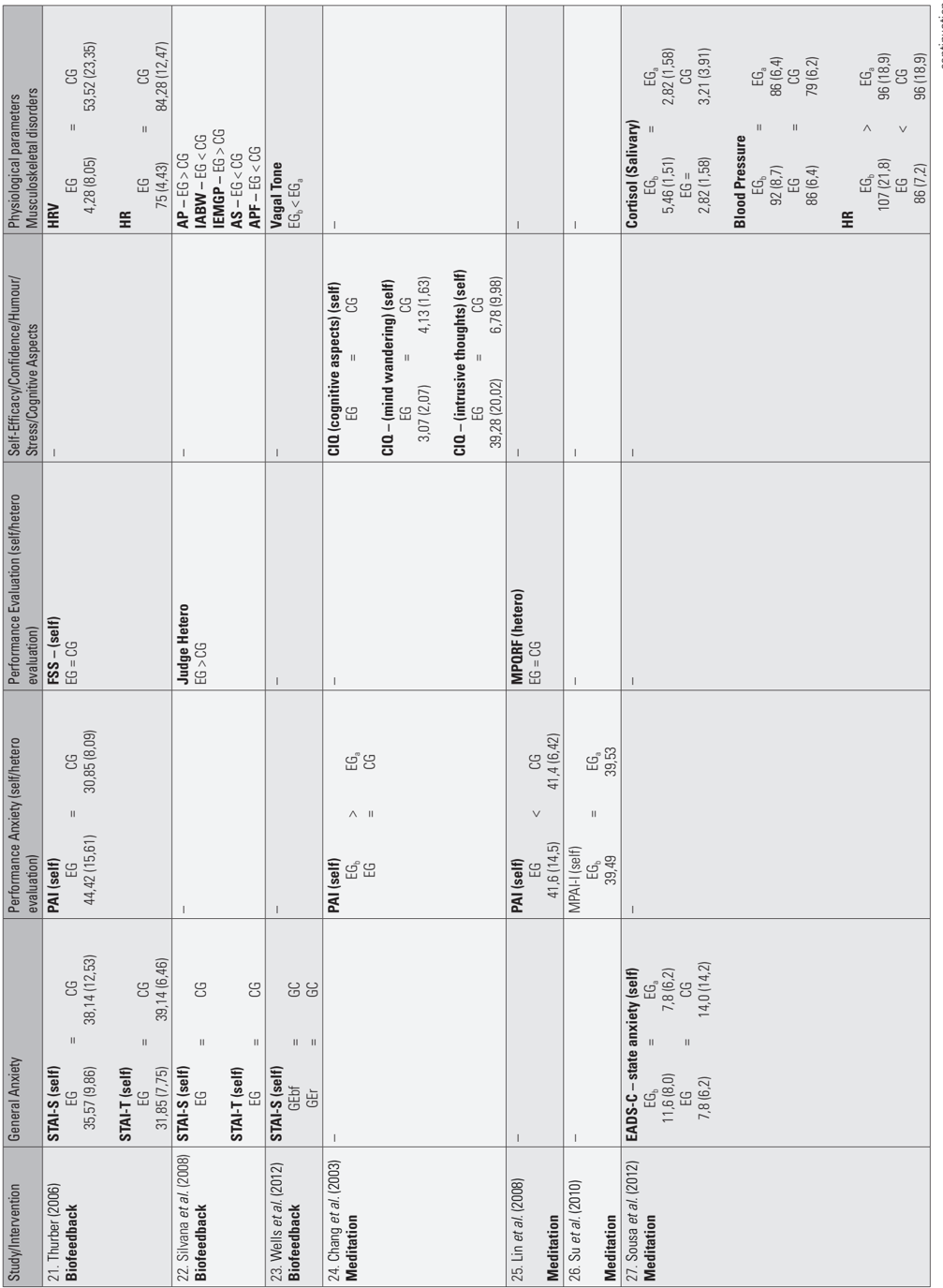
“(2003) USA 2♂ 7♀ 26,6 (6,8) A U 3♂ 7♀ 26,5 (6,6) A U S 12pi, 3st, 3v, 1ot E inter-R Me 8ss (Gr) Weekly + home practice None”
Guétin, S., Portet, F., Picot, M. C., Pommié, C., Messaoudi, M., Djabelkir, L., Olsen, A. L., Cano, M. M., Lecourt, E., & Touchon, J. (2009) · Dementia and Geriatric Cognitive Disorders · doi:10.1159/000229024 · Cited by 406
Desrosiers, A., Vine, V., Klemanski, D. H., & Nolen-Hoeksema, S. (2013) · Depression and Anxiety · doi:10.1002/da.22124 · Cited by 392
Cognitive behavioral therapy in anxiety disorders: current state of the evidence
Otte, C. (2011) · Dialogues in Clinical Neuroscience · doi:10.31887/dcns.2011.13.4/cotte · Cited by 313
Kenny, D., Driscoll, T., & Ackermann, B. (2014) · Psychology of Music · doi:10.1177/0305735612463950 · Cited by 309
Meyerbröker, K., & Emmelkamp, P. M. G. (2010) · Depression and Anxiety · doi:10.1002/da.20734 · Cited by 290
Research works printed but not linked: 11
- American Psychiatric Association. Diagnostic and Statistical Manual of Mental Disorders. Fifth Edition, Washington DC, London -England 2013.
- Bien Aime JK. Managing performance anxiety in music students: using a solution focused approach. (Doctoral Dissertation). Nova Southeastern University, USA; 2011.
- Wells R, Outhred T, Healthers JA, Quintana DS, Kemp AH. Matter over mind: a randomized-controlled trial of single-session biofeedback training on performance anxiety and heart rate variability in musicians. PLoS One. 2012;7(10):e46597.
- Orman EK. Effect of virtual reality graded exposure on heart rate self- reported anxiety. J Res Music Educ. 2003;51(4):302-15.
- Bissonnette J, Dubé F, Provencher MD, Sala MTM. The effect of virtual training on music performance anxiety. International Symposium on Performance Science 2011 [PMID: 26395619].
- Hofmann SG, Smits, JAJ. Cognitive-Behavioral therapy for adult anxiety disorders: a meta-analysis of randomized placebo-controlled trials. J Clin Psychiatry. 2008;69(4):621-32.
- Liu XC, Pan L, Hu Q, Dong WP, Yan JH, Dong L. Effects of yoga training in patients with chronic obstructive pulmonary disease: a systematic review and meta-analysis. J Thorac Dis. 2014;6(6):795-802.
- Vorkapic CF, Rangé B. Os benefícios do yoga nos transtornos de ansiedade. Rev Bras Ter Cogn. 2011;7(1):50-4.
- Zhang MF, Wen YS, Liu WY, Peng LF, Wu XD, Liu QW. Effectiveness of Mindfulness-based Therapy for Reducing Anxiety and Depression in Patients With Cancer: A Meta-analysis. Medicine (Baltimore). 2015;94(45):e0897-0.
- Maratos A, Gold C, Wang X, Crawford M. Music therapy for depression (Review). The Cochrane Collaboration. 2010; Published by John Wiley & Sons, Ltd.
- Osório FL, Crippa JAS, Loureiro SR. Instrumentos de avaliação do transtorno de ansiedade social. Rev Bras Psiquiatr. 2005;32(2):73-83.
Cited by
Health Education for Musicians
Matei, R., Broad, S., Goldbart, J., & Ginsborg, J. (2018) · Frontiers in Psychology · doi:10.3389/fpsyg.2018.01137 · Cited by 148
“Interventions designed to prevent and/or mitigate MPA were reviewed systematically by Burin and Osorio (2016), see also Matei and Ginsborg (2017), Spahn et al. (2016), Steyn et al. (2016), and Juncos et al. (2017).”
BackgroundBURIN, A. B., & OSÓRIO, F. L. (2017) · Archives of Clinical Psychiatry (São Paulo) · doi:10.1590/0101-60830000000136 · Cited by 71
Self-citationIt’s not a virus! Reconceptualizing and de-pathologizing music performance anxiety
Herman, R., & Clark, T. W. (2023) · Frontiers in Psychology · doi:10.3389/fpsyg.2023.1194873 · Cited by 83
Cohen, S., & Bodner, E. (2018) · Psychology of Music · doi:10.1177/0305735618765349 · Cited by 96
MacAfee, E., & Comeau, G. (2020) · Music Education Research · doi:10.1080/14613808.2020.1781074 · Cited by 82
“These fi ndings support Burin and Osório ’ s (2016) systematic literature review, which found that most treatment modalities indicate tendencies towards positive MPA outcomes, warranting further research.”
ResultCharacteristics of music performance anxiety among undergraduate music students: A systematic review
Barros, S., Marinho, H., Borges, N., & Pereira, A. (2022) · Psychology of Music · doi:10.1177/03057356211066967 · Cited by 78
“, 2017), choice of instrument (Casanova et al., 2018; Iusca & Dafinoiu, 2012; Robson & Kenny, 2017), low academic grades or receiving grades (Paliaukiene et al., 2018; Robson & Kenny, 2017; Umuzdaş et al., 2019), loss of concentration and focus, worries and disturbing thoughts (Oudejans et al., 2016), as well as depre…”
BackgroundClarke, L. K., Osborne, M. S., & Baranoff, J. A. (2020) · Frontiers in Psychology · doi:10.3389/fpsyg.2020.01127 · Cited by 49
“Additionally, there are methodological weaknesses across studies, including small sample sizes, lack of standardized techniques and duration of treatment, non-statistical analyses of results, and lack of information about MPA levels experienced by participants (Kenny, 2005; Burin and Osorio, 2016).”
BackgroundFlow and music performance anxiety: The influence of contextual and background variables
Cohen, S., & Bodner, E. (2019) · Musicae Scientiae · doi:10.1177/1029864919838600 · Cited by 61
“Efficacy studies indicate that cognitive behavioral therapy-based interventions are most effective in alleviating MPA (see Burin & Osorio, 2016 for an overview).”
BackgroundKaleńska-Rodzaj, J. (2020) · Psychology of Music · doi:10.1177/0305735620961154 · Cited by 55
“Meta-analysis of research on psychological interventions for MPA indicates high effectiveness of psychological techniques derived from the cognitive-behavioral therapy (Burin & Osorio, 2016).”
MethodCurrent Trends in Music Performance Anxiety Intervention
Gómez-López, B., & Sánchez-Cabrero, R. (2023) · Behavioral Sciences · doi:10.3390/bs13090720 · Cited by 44
“According to the research of Herrera, Manjón, and Quiles [31], during a music performance cognitive symptoms predominate to a greater extent than physical symptoms, which makes it necessary, therefore, to develop and implement a treatment program suitable for these characteristics by clinical professionals who can hel…”
BackgroundResultInfluentialBurin, A. B., Barbar, A. E. M., Nirenberg, I. S., & Osório, F. D. L. (2019) · Trends in Psychiatry and Psychotherapy · doi:10.1590/2237-6089-2018-0104 · Cited by 50
Self-citationKinney, C., Saville, P., Heiderscheit, A., & Himmerich, H. (2025) · Behavioral Sciences · doi:10.3390/bs15020138 · Cited by 28
“Earlier reviews routinely evaluated case reports and papers that employed unreliable outcome tools, potentially undermining the conclusiveness of their evidence (Burin & Osório, 2016; Fernholz et al., 2019; Gómez-López & Sánchez-Cabrero, 2023).”
Performance anxiety among surgeons
Hotton, M., Miller, R., & Chan, J. (2018) · Bulletin of The Royal College of Surgeons of England · doi:10.1308/rcsbull.2019.20 · Cited by 22
Emotionality and performance: An emotion-regulation approach to music performance anxiety
Kaleńska-Rodzaj, J. (2023) · Musicae Scientiae · doi:10.1177/10298649231173565 · Cited by 24
“A review of psychological interventions for MPA (Burin & Osório, 2016) indicates that psychological techniques derived from cognitive behavioral therapy can be highly effective, especially cognitive reinterpretation ( reframing ).”
BackgroundA Short Performance Anxiety Scale for Musicians
Mazzarolo, I., & Schubert, E. (2022) · Frontiers in Psychology · doi:10.3389/fpsyg.2021.781262 · Cited by 17
Lubert, V. J., & Gröpel, P. (2024) · Musicae Scientiae · doi:10.1177/10298649241290448 · Cited by 13
“…of psychological interventions in music have been focused on the (clinical) treatment or reduction of music performance anxiety (MPA; Brugués, 2011; Burin & Osório, 2016, 2017; Fernholz et al., 2019; Finch & Moscovitch, 2016; Kenny, 2005); on Alexander Technique (AT), a combination of…”
Critical thinking in musicians’ health education. Findings from four workshops with experts (Part I)
Matei, R., & Phillips, K. (2023) · Health Promotion International · doi:10.1093/heapro/daac187 · Cited by 16
van Loon, A. W. G., Creemers, H. E., Vogelaar, S., Miers, A. C., Saab, N., Westenberg, P. M., & Asscher, J. J. (2023) · Child & Youth Care Forum · doi:10.1007/s10566-023-09736-x · Cited by 28
“…to reduce test anxiety, while research on interventions targeting the broader performance anxiety in adolescents is scarce and mainly focuses on specific populations, such as music students (Burin & Osório, 2016), athletes (Cadieux et al., 2021), or young children (Blanco et al., 2015).”
BackgroundThe role of music performance anxiety in musical training: four personal histories
Casanova, Ó., Galán, M. E. R., Alzugaray, F. J. Z., & Orejudo, S. (2025) · Frontiers in Psychology · doi:10.3389/fpsyg.2025.1515970 · Cited by 10
Osório, F. D. L., Rojas, G. V. E., & AGUIAR-RICZ, L. N. (2022) · Frontiers in Neuroscience · doi:10.3389/fnins.2022.943578 · Cited by 11
“Pharmacological treatments are seldom investigated or adopted, and the use of beta blockers and some anxiolytics is not feasible for musicians because it may compromise fine motor control and cognitive functions, impairing musical performance (Burin and Osório, 2016).”
BackgroundSelf-citationDu, H., Liu, Y., & Sun, J. (2025) · Frontiers in Psychology · doi:10.3389/fpsyg.2025.1703571 · Cited by 12
Bao, H., & Yu, L. (2025) · Frontiers in Psychology · doi:10.3389/fpsyg.2025.1671941 · Cited by 11
Intervención basada en atención plena compasiva en estudiantes de música con sintomatología ansiosa
Cortés-Hernández, N. L., González‐Santoyo, I., Tello, A. L., & Moreno-Coutiño, A. B. (2022) · Psicología y Salud · doi:10.25009/pys.v33i1.2779 · Cited by 10
Why Do Music Students Attend Counseling? A Longitudinal Study of Reasons in One UK Conservatoire
Matei, R., & Ginsborg, J. (2023) · Journal of Research in Music Education · doi:10.1177/00224294231168622 · Cited by 9
“…musicians suffer from a range of health-related problems, particularly related to musculoskeletal issues (Cruder et al., 2020; Rotter et al., 2019), mental ill-health (Ackermann et al., 2014; Vaag, Saksvik-Lehouillier, et al., 2016), and music performance anxiety (MPA; Burin & Osório, 2016).”
BackgroundPerdomo-Guevara, E., & Dibben, N. (2024) · Psychology of Music · doi:10.1177/03057356241246052 · Cited by 9
“Some of these methods are prevalent among performers (Burin & Osório, 2016), but the last three are less common and were at the heart of the intervention.”
Zhang, J. (2025) · Frontiers in Psychology · doi:10.3389/fpsyg.2025.1712501 · Cited by 7
Gómez-López, B., & Sánchez-Cabrero, R. (2024) · European Journal of Investigation in Health Psychology and Education · doi:10.3390/ejihpe14050083 · Cited by 16
“Body awareness techniques: including the Alexander technique [41], yoga [47], biofeedback technique [31], and meditation [4,48].”
MethodPerformance anxiety: implications for obstetricians and gynaecologists
Hardy, M., Nagenthiran, S., Kasaven, L. S., Saso, S., Joash, K., & Jones, B. P. (2024) · The Obstetrician & Gynaecologist · doi:10.1111/tog.12962 · Cited by 5
“27 A systematic review found that CBT was the most commonly studied intervention, and around half of the studies demonstrated a reduction in performance anxiety with CBT. 28 As such, CBT should be considered in trainees who experience significant performance anxiety that is impacting their performance and patient care.”
Better practice: health promotion in the music conservatoire
Matei, R. (2026) · e-space (Manchester Metropolitan University) · doi:10.83056/mmu.32479563 · Cited by 11
Zhang, C., Shan, X., Zhang, H., Zhang, M., & Zhou, H. (2026) · Frontiers in Psychology · doi:10.3389/fpsyg.2026.1851221 · Cited by 4
“Burin and Osório (2016) and Kinney et al. (2025) systematically summarized a broad range of interventions for MPA, including CBT, biofeedback, yoga, meditation, music therapy, and the Alexander Technique, while also noting persistent methodological limitations such as small samples and weak study…”
Musical Performance Anxiety (MPA)
Rocha, S. D. F. (2021) · IntechOpen eBooks · doi:10.5772/intechopen.91646 · Cited by 9
Matei, R., & Ginsborg, J. (2024) · Open Book Publishers · doi:10.11647/obp.0389.16 · Cited by 3
Exploring the structure and functional meaning of pre-performance emotions in young adult musicians
Kaleńska-Rodzaj, J. (2025) · Scientific Reports · doi:10.1038/s41598-025-27406-x · Cited by 3
“Research on interventions based on CBT 55,56 , ACT 57 , and mindfulness 58,59 provides evidence of the effectiveness of these techniques in reducing anxiety and increasing self-efficacy in emotional regulation and emotional well-being in musicians.”
ALEXANDER TEKNİĞİ’NİN MÜZİK PERFORMANSI VE PERFORMANS KAYGISI ÜZERİNE ETKİLERİ
ÖZGÜR, C. (2019) · the Journal of Academic Social Sciences · doi:10.29228/asos.36746 · Cited by 4
Jovanović, O., Dimitrijević, A. A., Mutavdžin, D., & Bogunović, B. (2024) · Open Book Publishers · doi:10.11647/obp.0389 · Cited by 12
Sun, W. (2025) · Applied Psychophysiology and Biofeedback · doi:10.1007/s10484-025-09722-0 · Cited by 3
“The application of electromyographic monitoring, in conjunction with cogni-tively-oriented relaxation techniques, contributes not only to the reduction of muscular rigidity but also to the improvement of the kinematic characteristics of performance movements (Burin & Osório, 2016).”
Examining the CRAFT program’s impact on student musicians’ well-being compared to controls
Bartos, L. J., Posadas, M. P., Wrapson, W., Medvedev, O. N., & Krägeloh, C. U. (2025) · Musicae Scientiae · doi:10.1177/10298649251347365 · Cited by 1
“…is not surprising considering also the apparent association between being physically active and reducing the frequency and severity of both MPA (Burin & Osorio, 2016; Rocha et al., 2014; Wasley et al., 2012) and PRMDs (Lundborg & Grooten, 2018; Matei & Ginsborg, 2020; Roos & Roy, 2018) among…”
(2018) · Minerva Access (University of Melbourne) · Cited by 1
Burin, A. B. (2018) · Digital Library of Theses and Dissertations (Universidade de São Paulo) · doi:10.11606/d.17.2018.tde-25052018-144106 · Cited by 5
Self-citationAjidahun, A. T., Myezwa, H., Mudzi, W., & Wood, W.-A. (2020) · Springer eBooks · doi:10.1007/978-3-030-37480-8_6 · Cited by 3
Ansiedade social e ansiedade de performance musical em cantores brasileiros: um estudo comparativo
Hackenberg, C. C., de Oliveira, F. S., Bastos, S. F. A. D. B., & Lopes, R. D. C. T. (2025) · Actualidades en Psicología · doi:10.15517/ap.v37i134.49002
de Oliveira, G. N. (2023) · Digital Library of Theses and Dissertations (Universidade de São Paulo) · doi:10.11606/d.27.2023.tde-02042024-094947
Mapping the relationship between flow experience and music performance anxiety: a scoping review
Borges, N., Marinho, H., Araújo, M. V., Pereira, A., & Serra, S. (2026) · Frontiers in Psychology · doi:10.3389/fpsyg.2026.1746749 · Cited by 2
“…Fernholz et al., 2019; Lima et al., 2024), as well as evidence regarding coping strategies and therapeutic or intervention approaches (Kenny, 2005; Nagel, 2010; Burin and Osório, 2016; Gómez-López and Sánchez-Cabrero, 2023; Bakhtiari et al., 2025; Kinney et al., 2025; Nicholl and Abbott, 2025).”
张雪梅 (2026) · Frontiers in Psychology · doi:10.3389/fpsyg.2026.1786554 · Cited by 1
“…approaches such as graded exposure to performance settings, cognitive restructuring, and relaxation techniques have shown promise in the MPA intervention literature (Burin and Osório, 2016), though their efficacy in reducing practice procrastination specifically remains to be tested.”
ŞENTÜRK, G. C., Kaya, A., & BAŞBUĞ, Ç. (2026) · Frontiers in Psychology · doi:10.3389/fpsyg.2026.1869088
“Although there are numerous studies in the literature on musical performance anxiety (Kenny, 2011; Braden et al., 2015; Burin and Osório, 2016; Blume et al., 2017; Brooker, 2018; Barros et al., 2022; Bakhtiari et al., 2025) and general academic self-efficacy, the limited number of measurement tools…”
Cemali, M., & Akel, B. S. (2026) · BMC Psychology · doi:10.1186/s40359-026-05064-6 · Cited by 1
Liu, S., Li, X., Han, J., & Liu, S. (2026) · Frontiers in Psychology · doi:10.3389/fpsyg.2026.1895317 · Cited by 1
“…a range of interventions has been developed to address MPA, including cognitive-behavioral therapy, exposure therapy, biofeedback, beta-blockers, relaxation training, and mindfulness-based approaches (Burin and Osorio, 2016; Fernholz et al., 2019; Gómez-López and Sánchez-Cabrero, 2023).”
Uzunkavak, M. Ç., Gül, G., & Engür, D. (2026) · International Journal of Human-Computer Interaction · doi:10.1080/10447318.2026.2727272
Optimizing Physical and Psychological Health in Musicians
Kenny, D., & Ackerman, B. (2026) · Oxford University Press eBooks · doi:10.1093/9780198976936.003.0044
Metadata
- Authors
- Burin, A. B., & Osório, F. D. L.
- Affiliations
- Universidade de São Paulo (BR)
- Conselho Nacional de Desenvolvimento Científico e Tecnológico (BR)
- Venue
- Archives of Clinical Psychiatry (São Paulo)
- Publisher
- FapUNIFESP (SciELO)
- Published
- 2016-10
- Volume
- 43
- Issue
- 5
- Pages
- 116-131
- ISSN
- 0101-6083 (ISSN-L)
- 1806-938X
- OpenAlex
- W2557484863
- Semantic Scholar
- f6cf28f685010a74027882275dad02b7018bb435
- Cited by
- 49
- References
- 50
- Citations by year
- 2026: 9 · 2025: 8 · 2024: 6 · 2023: 8 · 2022: 4 · 2020: 5 · 2019: 3 · 2018: 5 · 2017: 1
- FWCI
- 0.47
- Type
- journal article
- Language
- en
- Open access
- diamond
- doi.org
- Licence
- cc-by
- Locations
- Archives of Clinical Psychiatry (São Paulo) (publishedVersion, cc-by)
- DOAJ (DOAJ: Directory of Open Access Journals) (submittedVersion)
- The Scientific Electronic Library Online (Fundação de Amparo à Pesquisa do Estado de São Paulo) (submittedVersion, other-oa)
- Funders
- Fundação de Amparo à Pesquisa do Estado de São Paulo
- Topics
- Social Sciences › Psychology › Social Psychology › Music Therapy and Health
- Social Sciences › Arts and Humanities › Music › Diverse Music Education Insights
- Health Sciences › Medicine › Rehabilitation › Musicians’ Health and Performance
- Keywords
- music performance anxiety, performance anxiety, cognitive behavioral therapy, virtual reality exposure, biofeedback, yoga, meditation, music therapy, Alexander Technique, anxiety intervention, treatment efficacy, methodological limitations
About these checks
Registry, retraction, Cites and statistics results are computed, not judged, with one exception: a printed reference that no index lists is read once by a model before it counts as a citation error. Claims are extracted by a model and kept only when their quote appears verbatim in the text; each cited source is then checked, with a model’s help, for whether it says what the claim relies on. Those verdicts can be wrong — read the claim’s quote and the cited source before relying on one.
Statistics and arithmetic are recomputed, not judged.
Confidence bands are shown only for fields calibrated on our annotated test set. None is calibrated yet, so no band is shown.
What counts as a claim ›How we measure confidence ›How we check this ›
Are you an author, or do you see a problem with this page? Request a review
Data sources
Bibliographic data: Semantic Scholar, OpenAlex, Crossref.
Contains information from the Semantic Scholar Academic Graph Datasets, made available under the ODC Attribution License (ODC-BY 1.0).
Semantic Scholar’s data is described in: Kinney, R., et al. (2023). The Semantic Scholar Open Data Platform. arXiv:2301.10140.
