

Development and characterization of chitosan-collagen films loaded with honey
Open accessThe DOI matches its Crossref record; 29 of the 29 references it cites were found in a registry or an index; none of the 14 sources its claims cite is checked for support yet.
Abstract
Biomaterials developed with biopolymers contribute to the healing process of healthy or diabetic patients. The objective of the present study was to evaluate the effect of honey incorporation (0.3, 0.6, and 1.2 g/100 mL) in chitosan/collagen/glycerol composite films. The Ch/Coll/1.2H films revealed the greatest percentage of elongation (27.10%) and Young´s modulus (65.58 MPa). The barrier properties (WVTR and WVP) exhibited a significant increase when the honey was incorporated into the films. The absorption capacity, solubility, and enzymatic biodegradability were lower in films containing honey. The chemical interactions between the functional groups of the films were verified by FTIR. The morphology studied by SEM confirmed the mixture’s homogeneity. Finally, all formulations exhibited antibacterial properties against Staphylococcus aureus, Pseudomonas aeruginosa, Listeria monocytogenes, and Salmonella Typhimurium. The aforementioned properties of formulated dressings are suitable for their potential application in chronic wounds.
Overview
CoChat Summary
TL;DR
Chitosan/collagen/glycerol films loaded with honey (0.3–1.2 g/100 mL) were prepared by solution casting and characterized for wound-dressing potential. Honey increased barrier permeability and antibacterial activity while reducing water absorption, solubility, and enzymatic biodegradation, with Ch/Coll/Gly/1.2H being most flexible and Ch/Coll/Gly/0.6H showing lower WVP.
Key findings
- Mechanical properties: Ch/Coll films had the highest tensile strength (71.78 MPa) and Young’s modulus (3882.7 MPa) but the lowest elongation at break (1.66%). Ch/Coll/Gly/1.2H showed the greatest elongation at break (27.10%) and a Young’s modulus of 65.6 MPa (abstract reports 65.58 MPa), indicating plasticization by glycerol and honey.
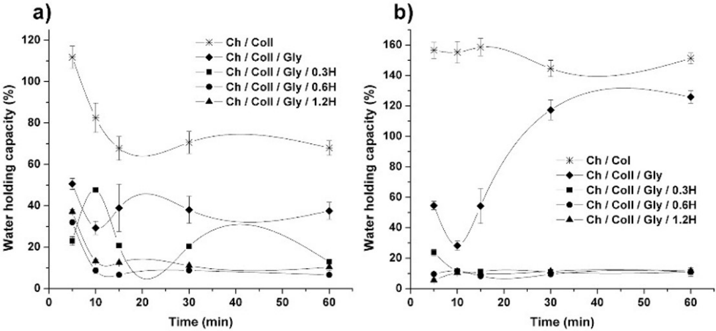
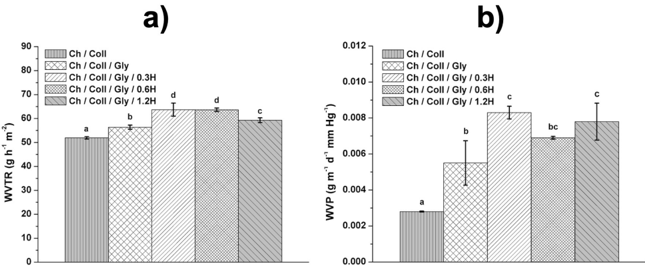
- Barrier and physicochemical behavior: honey incorporation significantly increased WVTR and WVP; Ch/Coll/Gly/0.3H had the highest WVTR/WVP, while Ch/Coll had the lowest. Ch/Coll had the highest PBS water retention (111.79% at 5 min; 67.96% at 60 min), whereas Ch/Coll/Gly/0.6H had the lowest (32.05% at 5 min; 6.63% at 60 min). Ch/Coll/Gly/0.6H also had the lowest WVP, described as best for preventing dehydration.
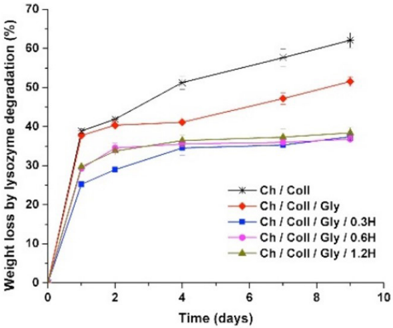
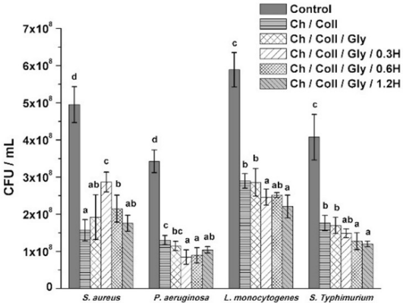
- Biodegradation and antibacterial activity: Ch/Coll showed the highest lysozyme biodegradation weight loss (62.10%), while Ch/Coll/Gly/0.6H showed the lowest (36.79% at 9 days). All formulations exhibited antibacterial properties against Staphylococcus aureus, Pseudomonas aeruginosa, Listeria monocytogenes, and Salmonella Typhimurium; effects varied by organism, e.g., S. aureus counts decreased with increasing honey, while P. aeruginosa counts increased with increasing honey.
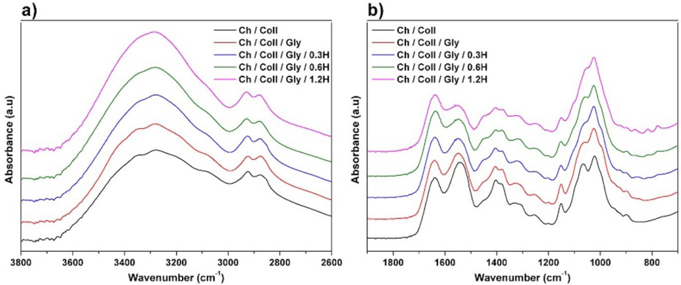
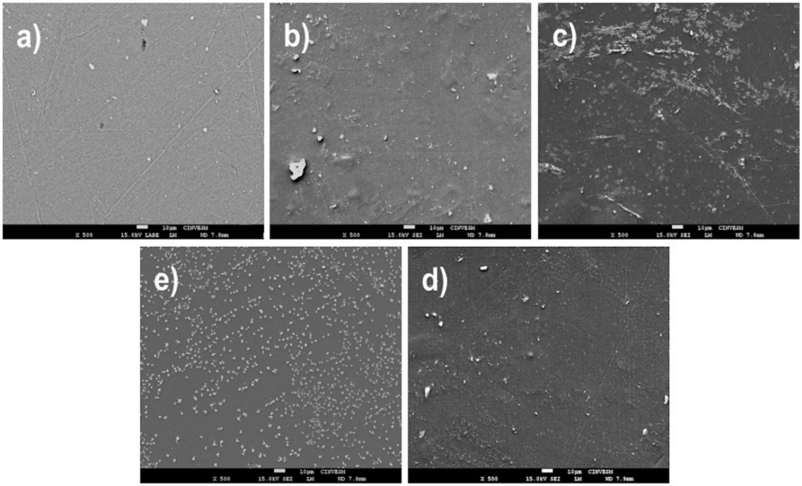
- Structural/morphological: FTIR confirmed interactions among functional groups; SEM showed smooth, homogeneous films, with small crystals appearing after honey incorporation, attributed to glucose crystallization.
Methods
- Films were prepared by solution casting: chitosan (1% w/v) and collagen (0.5% w/v) in 1% acetic acid, with glycerol (0.6 g) and honey at 0, 0.3, 0.6, or 1.2 g/100 mL; solutions were dried at 45 °C for 48 h. Ch/Coll was the control.
- Characterization included optical properties (CIELab color, transparency at 600 nm), mechanical testing (ASTM D882-02), water-holding capacity and solubility, WVTR/WVP (ASTM E96), FTIR-ATR, FESEM, in vitro enzymatic biodegradation with lysozyme (40,000 units/mg, 2 mg/mL in PBS, 37 °C, 9 days), and antibacterial assays against S. aureus ATCC 6538, P. aeruginosa ATCC 10154, L. monocytogenes ATCC 7644, and S. Typhimurium ATCC 14028.
- A completely randomized design was used; ANOVA was performed with STATGRAPHICS PLUS 5.1, and significance was set at p<0.05.
Limitations
- The paper does not state limitations.
- Evident from the text: the study is entirely in vitro; no in vivo wound-healing, cytotoxicity, or biocompatibility assays are reported.
- Evident from the text: honey was obtained from a single local source (Apis mellifera from Mani, Yuc., Mexico) and its composition was not standardized; no long-term stability or storage study is reported.
Model-written summary. Check it against the paper before relying on it.
Integrity signals
Registry
Cites
Statistics
Figures
Verification
Claims the paper makes
0 Valid · 0 Not valid · 12 Not checked · 87 Own results and interpretations
A result the paper states — it cites no source for it, so there is none to check. The quote shows it is in the paper.
In the paper
“The absorption capacity, solubility, and enzymatic biodegradability were lower in films containing honey.”
§ Development and characterization of chitosan-collagen films loaded with honey > Abstract
plainstates a cause- Asserted: passes — The authors put it forward as true.
- Checkable: passes — It can be checked against evidence.
- Load-bearing: passes — The paper’s conclusions depend on it.
- Based: passes — The paper gives a reason why it holds.
A result the paper reports from its own data — it cites no other source for it, so there is none to check. The quote shows it is in the paper.
In the paper
“The Ch/Coll/1.2Hfilms revealed the greatest percentage of elongation (27.10%) and Young´s modulus (65.58 MPa).”
§ Development and characterization of chitosan-collagen films loaded with honey > Abstract
plain- Asserted: passes — The authors put it forward as true.
- Checkable: passes — It can be checked against evidence.
- Load-bearing: unclear — It is unclear whether the paper’s conclusions depend on it.
- Based: passes — The paper gives a reason why it holds.
A result the paper reports from its own data — it cites no other source for it, so there is none to check. The quote shows it is in the paper.
In the paper
“The barrier properties (WVTR and WVP) exhibited a significant increase when the honey was incorporated into the films.”
- Also stated in: § 3.4 Barrier properties · plain
“The honey inclusion promoted significant increases in film permeability.”
§ Development and characterization of chitosan-collagen films loaded with honey > Abstract
plainstates a cause- Asserted: passes — The authors put it forward as true.
- Checkable: passes — It can be checked against evidence.
- Load-bearing: passes — The paper’s conclusions depend on it.
- Based: passes — The paper gives a reason why it holds.
- Also stated in: § 3.4 Barrier properties · plain
A result the paper reports from its own data — it cites no other source for it, so there is none to check. The quote shows it is in the paper.
In the paper
“The color difference (ΔE) revealed statistical differences among the films (p<0.05).”
§ Development and characterization of chitosan-collagen films loaded with honey > 3.1 Optical properties
plain- Asserted: passes — The authors put it forward as true.
- Checkable: passes — It can be checked against evidence.
- Load-bearing: unclear — It is unclear whether the paper’s conclusions depend on it.
- Based: passes — The paper gives a reason why it holds.
A result the paper states — it cites no source for it, so there is none to check. The quote shows it is in the paper.
In the paper
“The absorption capacity, solubility, and enzymatic biodegradability were lower in films containing honey.”
§ Development and characterization of chitosan-collagen films loaded with honey > Abstract
plainstates a cause- Asserted: passes — The authors put it forward as true.
- Checkable: passes — It can be checked against evidence.
- Load-bearing: passes — The paper’s conclusions depend on it.
- Based: passes — The paper gives a reason why it holds.
70 more claims
Create a free account to see all 99 claims and to verify the 14 references still open.
- It may state two separate claims as one. 19
- The quote only partly states this claim. 2
- Probably not a substantial claim. 3
Self-check
Percentages, sums and reported differences re-computed from the paper’s own numbers.
Each contradiction between two passages listed here was confirmed by an independent check.
Rated major: it would touch a result — a value a result rests on, reported and recomputed p-values on opposite sides of the significance level, two passages that conflict with no sign which is right, or a cited work retracted before this paper was published.
In the paper
§ Development and characterization of chitosan-collagen films loaded with honey > 4. Conclusions
“the films had enhanced antibacterial properties against S. aureus, P. aeruginosa, L. monocytogenes, and S. Typhimurium when honey was incorporated into them.”
§ Development and characterization of chitosan-collagen films loaded with honey > 3.8 Antibacterial properties
“The Ch/Coll films presented the highest bacterial reduction of all films (1.57x10 8 CFU/mL), while the Ch/Coll/ Gly/0.3Hformulation revealed the highest microbial count (2.87x10 8 CFU/mL).”
Rated minor: it would not touch a result — a value no result rests on, a p-value that stays on the same side of the significance level, or a conflict that is clerical, resolved elsewhere in the paper, or outside its own findings.
In the paper
§ Development and characterization of chitosan-collagen films loaded with honey > Abstract
“The Ch/Coll/1.2Hfilms revealed the greatest percentage of elongation (27.10%) and Young´s modulus (65.58 MPa).”
§ Development and characterization of chitosan-collagen films loaded with honey > 3.2 Mechanical properties
“The Ch/Coll films exhibited the highest values of σ max and E, although they exhibited the lowest value of ε b .”
Rated minor: it would not touch a result — a value no result rests on, a p-value that stays on the same side of the significance level, or a conflict that is clerical, resolved elsewhere in the paper, or outside its own findings.
In the paper
§ Development and characterization of chitosan-collagen films loaded with honey > 3.8 Antibacterial properties
“statistical similarities (p˂0.05) were observed between the counts of Ch/Coll and Ch/Coll/Gly films.”
§ Development and characterization of chitosan-collagen films loaded with honey > 2.11 Statistical analysis
“Statistically significant differences between the means of each group were estimated below a significance level of (p<0.05).”
Rated minor: it would not touch a result — a value no result rests on, a p-value that stays on the same side of the significance level, or a conflict that is clerical, resolved elsewhere in the paper, or outside its own findings.
In the paper
§ Development and characterization of chitosan-collagen films loaded with honey > 3.3.1 Water holding capacity and solubility
“all formulations reached equilibrium absorption after 15 min of contact with the PBS solution (Figure 2a).”
§ Development and characterization of chitosan-collagen films loaded with honey > 5. Author's Contribution
“Figure 2. WVTR (a) and WVP (b) of films based on chitosan and collagen loaded with honey.”
Citations
Cites
Advances in skin grafting and treatment of cutaneous wounds
Sun, B. K., Siprashvili, Z., & Khavari, P. A. (2014) · Science · doi:10.1126/science.1253836 · Cited by 972
Synthetic polymeric biomaterials for wound healing: a review
Mir, M., Ali, M. N., Barakullah, A., Gulzar, A., Arshad, M., Fatima, S., & Asad, M. (2018) · Progress in Biomaterials · doi:10.1007/s40204-018-0083-4 · Cited by 525
Järbrink, K., Ni, G., Sönnergren, H., Schmidtchen, A., Pang, C., Bajpai, R., & Car, J. (2016) · Systematic Reviews · doi:10.1186/s13643-016-0329-y · Cited by 454
Honey-based hydrogel: In vitro and comparative In vivo evaluation for burn wound healing
El-Kased, R. F., Amer, R. I., Attia, D., & Elmazar, M. M. (2017) · Scientific Reports · doi:10.1038/s41598-017-08771-8 · Cited by 314
Ziani, K., Oses, J., Coma, V., & Maté, J. I. (2008) · LWT - Food Science and Technology · doi:10.1016/j.lwt.2007.11.023 · Cited by 248
Composite and bi-layer films based on gelatin and chitosan
Rivero, S., García, M. A., & Pinotti, A. (2009) · Journal of Food Engineering · doi:10.1016/j.jfoodeng.2008.07.021 · Cited by 220
Honey: An immunomodulator in wound healing
Majtan, J. (2014) · Wound Repair and Regeneration · doi:10.1111/wrr.12117 · Cited by 214
Shamloo, A., Aghababaie, Z., Afjoul, H., Jami, M., Bidgoli, M. R., Vossoughi, M., Ramazani, A., & Kamyabhesari, K. (2021) · International Journal of Pharmaceutics · doi:10.1016/j.ijpharm.2020.120068 · Cited by 197
Rodríguez-Núñez, J. R., Madera-Santana, T. J., Sánchez-Machado, D. I., López-Cervantes, J., & Soto Valdez, H. (2014) · Journal of Polymers and the Environment · doi:10.1007/s10924-013-0621-z · Cited by 184
Self-citationXie, H., Chen, X., Shen, X., He, Y., Chen, W., Luo, Q., Ge, W., Yuan, W., Tang, X., Hou, D., et al. (2018) · International Journal of Biological Macromolecules · doi:10.1016/j.ijbiomac.2017.08.142 · Cited by 174
Starch‐based biomaterials for wound‐dressing applications
Torres, F. G., Commeaux, S., & Troncoso, O. P. (2013) · Starch - Stärke · doi:10.1002/star.201200259 · Cited by 168
High Concentration Honey Chitosan Electrospun Nanofibers: Biocompatibility and Antibacterial Effects
Sarhan, W. A., & Azzazy, H. M. E. (2015) · Carbohydrate Polymers · doi:10.1016/j.carbpol.2014.12.051 · Cited by 124
Madera-Santana, T. J., Freile‐Pelegrín, Y., & Azamar-Barrios, J. A. (2014) · International Journal of Biological Macromolecules · doi:10.1016/j.ijbiomac.2014.05.044 · Cited by 96
Self-citationGreen and Facile Preparation of Chitosan Sponges as Potential Wound Dressings
Wu, J., Su, C., Jiang, L., Ye, S., Liu, X., & Shao, W. (2018) · ACS Sustainable Chemistry & Engineering · doi:10.1021/acssuschemeng.8b01468 · Cited by 89
Dual crosslinked collagen/chitosan film for potential biomedical applications
Shah, R., Stodulka, P., Skopalova, K., & Saha, P. (2019) · Polymers · doi:10.3390/polym11122094 · Cited by 85
Mechanical, structural and physical aspects of chitosan-based films as antimicrobial dressings
Escárcega-Galaz, A. A., Sánchez-Machado, D. I., López-Cervantes, J., Sanches-Silva, A., Madera-Santana, T. J., & Paseiro-Losada, P. (2018) · International Journal of Biological Macromolecules · doi:10.1016/j.ijbiomac.2018.04.149 · Cited by 82
Self-citationYaşayan, G., Karaca, G., Akgüner, Z. P., & Bal‐Öztürk, A. (2020) · International Journal of Polymeric Materials · doi:10.1080/00914037.2020.1740993 · Cited by 79
Raisi, A., Asefnejad, A., Shahali, M., Doozandeh, Z., Moghadas, B. K., Saber‐Samandari, S., & Khandan, A. (2020) · Journal of Nanoanalysis · doi:10.22034/jna.2022.680836 · Cited by 63
Hydrogel wound dressings based on chitosan and xyloglucan: Development and characterization
Martínez‐Ibarra, D. M., Sánchez‐Machado, D. I., López‐Cervantes, J., Campas‐Baypoli, O. N., Sanches‐Silva, A., & Madera‐Santana, T. J. (2019) · Journal of Applied Polymer Science · doi:10.1002/app.47342 · Cited by 54
Self-citationShahali, M., Khandan, A., Raisi, A., Asefnejad, A., Sadat Kazerouni, Z., Kolooshani, A., Saber-Samandari, S., & Moghadas, B. (2020) · Archives of Trauma Research · doi:10.4103/atr.atr_10_20 · Cited by 53
Campa-Siqueiros, P., Madera-Santana, T. J., Ayala-Zavala, J. F., López-Cervantes, J., Castillo-Ortega, M. M., & Herrera-Franco, P. J. (2020) · Polímeros · doi:10.1590/0104-1428.07919 · Cited by 42
Self-citationAmiri, N., Moradi, A., Tabasi, S. A. S., & Movaffagh, J. (2018) · Materials Research Express · doi:10.1088/2053-1591/aaba1d · Cited by 41
Radoor, S., Karayil, J., Jayakumar, A., Siengchin, S., & Parameswaranpillai, J. (2021) · Journal of Polymer Research · doi:10.1007/s10965-021-02415-2 · Cited by 30
Influence of temperature and homogenization on honey crystallization
Costa, L. C. V., Kaspchak, E., Queiroz, M. B., Almeida, M. M. D., Quast, E., & Quast, L. B. (2015) · Brazilian Journal of Food Technology · doi:10.1590/1981-6723.7314 · Cited by 19
Natural polymers aposites for skin regeneration
Olivas-Armendáriz, I. (2016) · Revista Mexicana de Ingeniería Biomédica · doi:10.17488/rmib.37.3.4 · Cited by 18
Apósitos de polímeros naturales para regeneración de piel
Valencia-Gómez, L. E., Martel-Estrada, S. A., Vargas-Requena, C. L., Rodríguez-González, C., & Olivas-Armendariz, I. (2016) · Redalyc (Universidad Autónoma del Estado de México) · Cited by 12
González-Pérez, C. J., Tánori, J., Aispuro‐Hernández, E., Vargas‐Arispuro, I., & Martínez‐Téllez, M. Á. (2019) · Journal of Microbiological Methods · doi:10.1016/j.mimet.2019.105691 · Cited by 10
Lemus, L. M. R., Azamar-Barrios, J. A., Ortiz-Vazquez, E., Quintana-Owen, P., Freile-Pelegrín, Y., Perera, F. G., & Madera-Santana, T. J. (2021) · Carbohydrate Polymer Technologies and Applications · doi:10.1016/j.carpta.2021.100133 · Cited by 6
Self-citation(2020) · doi:10.22034/nmrj.2020.01.001
Cited by
Biocompatibility and antimicrobial effects of chitosan/turmeric-based casting dressings
Macedo, D. B., Pavinatto, A., Martignago, C. C. S., Macêdo, J. B., Tim, C. R., Morais, J. P., Santana, V. B., Rennó, A. C. M., & Assis, L. (2025) · Polymer Bulletin · doi:10.1007/s00289-025-06212-5 · Cited by 1
DESENVOLVIMENTO E CARACTERIZAÇÃO DE BIOCOMPÓSITO BASEADO EM QUITOSANA/ ARGILA/ COLÁGENO
Rocha, R. D. S., Silva, Y. M. D., & Meirelles, L. M. A. (2026) · Revista Multidisciplinar do Nordeste Mineiro · doi:10.66104/z4pdj670 · Cited by 1
Daniel, D., Sitorus, S., Pasaribu, S. P., Marliana, E. S., Hairani, R., Ruga, R., Purba, R., Saleh, C., Pratiwi, D. R., Magdaleni, A. R., et al. (2025) · Science & Technology Indonesia · doi:10.26554/sti.2025.10.4.1232-1241
Lee, S., Park, C., Bae, J., Son, D., & Chung, S. (2026) · Food Chemistry · doi:10.1016/j.foodchem.2026.148673
Ferreira, T. G., Fajardo, J. B., Vianna, M. H., Polo, A. B., Lemos, A. S. D. O., Souza, T. D. F., Campos, L. M., Andrade, N. B., Comitre, M. R. C., Carvalho, L. D. A., et al. (2026) · Journal of Drug Delivery Science and Technology · doi:10.1016/j.jddst.2026.108847
Metadata
- Authors
- Mora-López, D. S. D. L., Madera-Santana, T. J., López-Cervantes, J., Sánchez-Machado, D. I., Ayala-Zavala, J. F., & Soto-Valdez, H.
- Affiliations
- Centro de Investigación en Alimentación y Desarrollo, México
- Centro de Investigación en Alimentación y Desarrollo (MX)
- Instituto Tecnológico de Sonora, México
- ORCID
- Venue
- Polímeros
- Publisher
- FapUNIFESP (SciELO)
- Published
- 2023
- Volume
- 33
- Issue
- 3
- ISSN
- 0104-1428 (ISSN-L)
- 1678-5169
- OpenAlex
- W4387985171
- Semantic Scholar
- d80b12bf581aabbb95baa33841bdccd171619b15
- Cited by
- 8
- References
- 28
- Citations by year
- 2026: 6 · 2025: 2
- FWCI
- 0.43
- Type
- journal article
- Language
- en
- Open access
- gold
- doi.org
- Licence
- cc-by
- creativecommons.org/licenses/by/4.0/ (vor)
- creativecommons.org/licenses/by/4.0/ (am)
- creativecommons.org/licenses/by/4.0/ (tdm)
- Locations
- Polímeros (publishedVersion, cc-by)
- DOAJ (DOAJ: Directory of Open Access Journals) (submittedVersion, cc-by-sa)
- Topics
- Physical Sciences › Materials Science › Biomaterials › Nanocomposite Films for Food Packaging
- Health Sciences › Medicine › Surgery › Wound Healing and Treatments
- Physical Sciences › Materials Science › Biomaterials › Collagen: Extraction and Characterization
- Keywords
- chitosan, collagen, honey, composite films, wound dressings, chronic wounds, antibacterial activity, water vapor transmission rate, mechanical properties, diabetic wound healing, Staphylococcus aureus, Pseudomonas aeruginosa, Listeria monocytogenes, Salmonella typhimurium
About these checks
Registry, retraction, Cites and statistics results are computed, not judged, with one exception: a printed reference that no index lists is read once by a model before it counts as a citation error. Claims are extracted by a model and kept only when their quote appears verbatim in the text; each cited source is then checked, with a model’s help, for whether it says what the claim relies on. Those verdicts can be wrong — read the claim’s quote and the cited source before relying on one.
A language model drew the claims from the paper on 2026-11-18, under version 3 of the claim definition (model deepseek-v4.1-flash, prompt extract-v3).
A second model labelled each claim on 2026-11-18 (model jev-1.13-20260917, definition revision gold-guideline-v0.2).
Statistics and arithmetic are recomputed, not judged.
Confidence bands are shown only for fields calibrated on our annotated test set. None is calibrated yet, so no band is shown.
What counts as a claim ›How we measure confidence ›How we check this ›
Are you an author, or do you see a problem with this page? Request a review
Data sources
Bibliographic data: Semantic Scholar, OpenAlex, Crossref.
Contains information from the Semantic Scholar Academic Graph Datasets, made available under the ODC Attribution License (ODC-BY 1.0).
Semantic Scholar’s data is described in: Kinney, R., et al. (2023). The Semantic Scholar Open Data Platform. arXiv:2301.10140.
