

The DOI matches its Crossref record; 1 of the 1 references it cites were found in a registry or an index.
Temperature, pH and carbon source affect drastically indole acetic acid production of plant growth promoting yeasts
Open accessAbstract
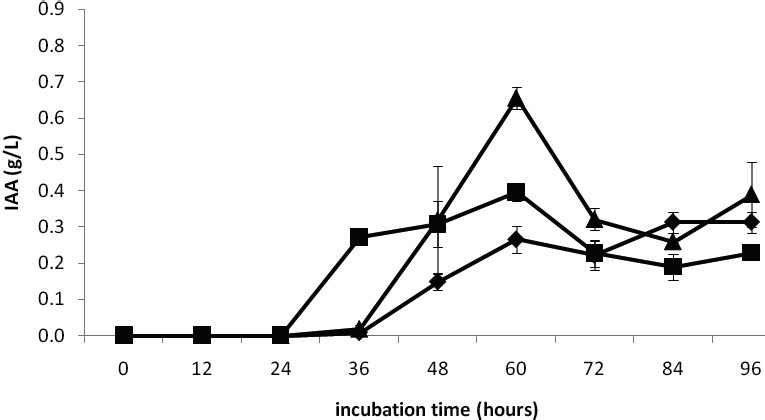
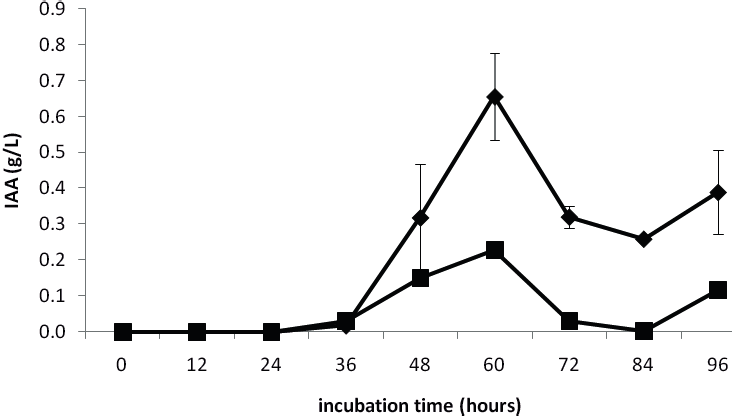
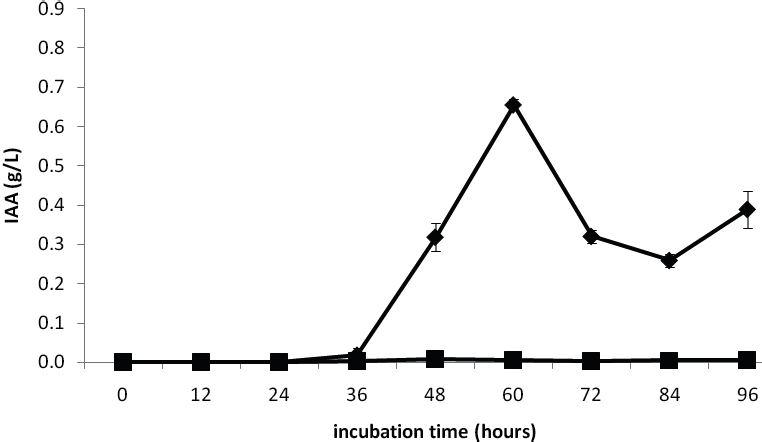
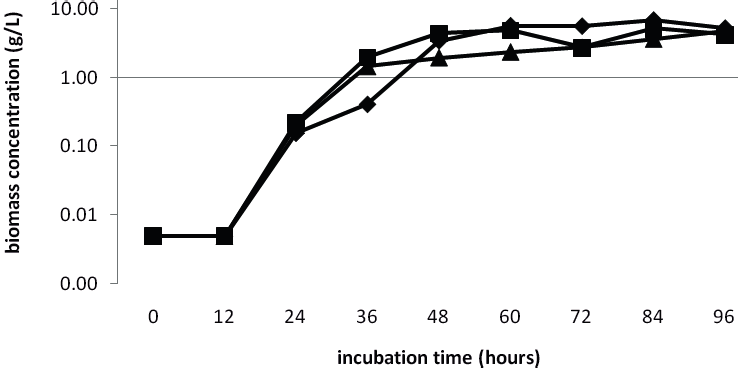
Rhizosphere and phylloplane yeasts are able to produce phytohormones, acting as potential plant growth promoters. The aim of this study was to analyze the production of indole acetic acid (IAA) by yeasts using variations in the culture conditions. The yeasts evaluated were Rhodotorula mucilaginosa and Trichosporon asahii, which were cultivated in a potato broth medium with 20 g/L of glucose or sucrose as the carbon source. The cultivation was carried out at 22°C, 25°C or 30°C, and the initial pH was adjusted to 3.0, 4.5 or 6.0. The cultures were analyzed using a colorimetric technique with Salkowski reagent. The cell count was determined in all of the conditions. The results for T. asahii showed that IAA production with sucrose was superior at pH 6.0, and that with glucose was superior at pH 4.5. These results indicate an association between the carbon source and medium pH. Rh. mucilaginosa (2F32) presented a high IAA production when compared with T. asahii (3S44 and 4C06) or even with other microorganisms referenced in the literature. The highest production (0.655 g/L) was obtained at pH 6.0 with glucose as the carbon source. Variations in the culture conditions did not affect the cell growth of the yeasts.
Overview
The claims and statistics of this paper haven’t been checked yet.
Run the check — free, no account needed. It reads the open-access text and checks the sources it cites.
Integrity signals
Registry
Cites
Statistics
Figures
Verification
Claims the paper makes
The claims and statistics of this paper haven’t been checked yet.
Run the check — free, no account needed. It reads the open-access text and checks the sources it cites.
Claims other papers make about this one
Each is checked against this paper’s own text: does it say what the citing paper says it does?
The cited source says what the claim attributes to it.
In the citing paper
“It can be observed that environmental variables can influence IAA biosynthesis among strains within the same species (Scarcella et al. 2017; Sun et al. 2014).”
From Phosphate solubilization and indole acetic acid production by rhizosphere yeast Torulaspora globosa: improvement of culture conditions for better performance in vitro (2022) · cites this paper as Scarcella et al. 2017
Self-check
Percentages, sums and reported differences re-computed from the paper’s own numbers.
The self-check needs the paper’s full text.
Citations
Cites
Indole-3-acetic acid-producing yeasts in the phyllosphere of the carnivorous plant Drosera indica L
Sun, P.-F., Fang, W.-T., Shin, L.-Y., Wei, J.-Y., Fu, S.-F., & Chou, J.-Y. (2014) · PLoS ONE · doi:10.1371/journal.pone.0114196 · Cited by 141
Research works printed but not linked: 44
- Ahemad M., 2014, Mechanisms and applications of plant growth promoting rhizobacteria: Current perspective, Journal of King Saud University - Science, 26, 1, 10.1016/j.jksus.2013.05.001 · DOI
- Ahmad M.N., 1995, Growth kinetics of single-cell protein in batch fermenters, Journal of Food Enginneering, 26, 443, 10.1016/0260-8774(94)00066-I · DOI
- Ahmed A., 2010, Auxin-producing Bacillus sp.: Auxin quantification and effect on the growth of Solanum tuberosum, Pure Applied Chemistry, 82, 313, 10.1351/PAC-CON-09-02-06 · DOI
- Bilkay S., 2010, Indole-3-acetic acid and gibberellic acid production in Aspergillus niger, Turkish Journal of Biology, 34, 313
- Brader G., 2014, Metabolic potential of endophytic bacteria, Current Opinion in Biotechnology Science, 27, 30, 10.1016/j.copbio.2013.09.012 · DOI
- Cacciari D., 1989, Phytohormone-like substances produced by single and mixed diazotrophic cultures of Azospirillum and Arthrobacter, Plant Soil, 115, 151, 10.1007/BF02220706 · DOI
- Ceccato-Antonini S.R., 2004, Filamentous growth in Saccharomyces cerevisiae, Brazilian Journal of Microbiology, 35, 173, 10.1590/S1517-83822004000200001 · DOI
- Cloete K., 2009, Evidence of symbiosis between the soil yeast Cryptococcus laurentii and a sclerophyllous medicinal shrub, Agathosma betulina (Berg.) Pillans, Microbial Ecology, 57, 624, 10.1007/s00248-008-9457-9 · DOI
- El-Tarabily K.A., 2004, Suppression of Rhizoctonia solani diseases of sugar beet by antagonistic and plant growth-promoting yeasts, Journal of Applied Microbiology, 96
- El-Tarabily K.A., 2006, Potential of yeasts as biocontrol agents of soil-borne fungal plant pathogens and as plant growth promoters, Mycoscience, 47, 25, 10.1007/S10267-005-0268-2 · DOI
- Falih A.M., 1995, Nitrification, S-oxidation and P-solubilization by the soil yeast Williopsis californica and by Saccharomyces cerevisiae, Mycology Research, 99, 200, 10.1016/S0953-7562(09)80886-1 · DOI
- Fitter A.H., 2005, Biodiversity and ecosystem function in soil, Functional Ecology, 19, 369, 10.1111/j.0269-8463.2005.00969.x · DOI
- Gordon S.A., 1951, Colorimetric estimation of indoleacetic acid, Plant Physiology, 26, 192, 10.1104/pp.26.1.192 · DOI
- Hallmann J., 1997, Bacterial endophytes in agricultural crops, Canadian Journal of Microbiology, 43, 895, 10.1139/m97-131 · DOI
- Hesham A.L., 2011, Molecular genetic identification of yeast strains isolated from egyptian soils for solubilization of inorganic phosphates and growth promotion of corn plants, Journal of Microbiology and Biotechnology, 21, 55, 10.4014/jmb.1006.06045 · DOI
- Korres A.M.N., 2011, Candida krusei and Kloeckera apis inhibit the causal agent of pineapple fusariosis, Fusarium guttiforme, Fungal Biology, 115, 1251, 10.1016/j.funbio.2011.09.001 · DOI
- Limtong S., 2014, Diversity of culturable yeasts in phylloplane of sugarcane in Thailand and their capability to produce indole-3-acetic acid, World Journal of Microbiology and Biotechnology, 30, 1785, 10.1007/s11274-014-1602-7 · DOI
- Limtong S., 2012, Yeasts from phylloplanes and their capability to produce indole-3-acetic acid, World Journal of Microbiology and Biotechnology, 28, 3323, 10.1007/s11274-012-1144-9 · DOI
- Lugtenberg B., 2009, Plant-growth-promoting rhizobacteria, Annual Review of Microbiology, 63, 541, 10.1146/annurev.micro.62.081307.162918 · DOI
- Manici L.M., 2014, Auxin-mediated relationships between apple plants and root inhabiting fungi: impact on root pathogens and potentialities of growth-promoting populations, Plant Pathology
- Maron P.A., 2011, Soil microbial diversity: methodological strategy, spatial overview and functional interest, Comptes Rendus Biologies, 334, 403, 10.1016/j.crvi.2010.12.003 · DOI
- Mirabal Alonso L., 2008, Spores of the mycorrhizal fungus Glomus mosseae host yeasts that solubilize phosphate and accumulate polyphosphates, Mycorrhiza, 18, 197, 10.1007/s00572-008-0172-7 · DOI
- Mundra S., 2011, Solubilization of insoluble inorganic phosphates by novel temperature, pH and salt tolerant yeast, Rhodotorula sp. PS4, isolated from seabuckthorn rhizosphere, growing in cold desert of Ladakh, India, World Journal of Microbiology and Technology, 27, 2387, 10.1007/s11274-011-0708-4 · DOI · Paper page
- Myresiotis C.K., 2014, Papadopoulou-Mourkidoua E., Effect of specific plant-growth-promoting rhizobacteria (PGPR) on growth and uptake of neonicotinoid insecticide thiamethoxam in corn (Zea mays L.) seedlings, Pest Management Science
- Nalini G., 2014, Effect of different carbon and nitrogen sources on growth and Indole Acetic Acid production by Rhizobium species isolated from cluster bean (Cyamopsis tetragonoloba (L.)), British Microbiology Research Journal, 4, 1189, 10.9734/BMRJ/2014/6871 · DOI
- Narayana K.J., 2009, Indole-3-acetic acid production by Streptomyces albidoflavus, Journal of Biological Research, 11, 49
- Nassar A., 2005, Promotion of plant growth by an auxin-producing isolate of the yeast Williopsis saturnus endophytic in maize (Zea mays L.) roots, Biology and Fertility of Soils, 42, 97, 10.1007/s00374-005-0008-y · DOI · Paper page
- Nutaratat P., 2014, Plant growth-promoting traits of epiphytic and endophytic yeasts isolated from rice and sugar cane leaves in Thailand, Fungal Biology, 118, 683, 10.1016/j.funbio.2014.04.010 · DOI · Paper page
- Prashar P., 2014, Plant growth promoting activities of rhizobacteria associated with tomato in semi-arid region, Advances in Life Sciences and Health, 1
- Prusty R., 2004, The plant hormone indoleacetic acid induces invasive growth in Saccharomyces cerevisiae, PNAS, 101, 4153, 10.1073/pnas.0400659101 · DOI · Paper page
- Rao R.P., 2010, Aberrant synthesis of indole-3-acetic acid in Saccharomyces cerevisiae triggers morphogenic transition, a virulence trait of pathogenic fungi, Genetics, 185, 211, 10.1534/genetics.109.112854 · DOI
- Rosa M.M., 2010, Evaluation of the biological control by the yeast Torulaspora globosa against Colletotrichum sublineolum, World Journal of Microbiology and Biotechnology, 26, 1491, 10.1007/s11274-010-0324-8 · DOI
- Rosenblueth M., 2006, Bacterial endophytes and their interactions with hosts, Molecular Plant Microbe Interactions, 19, 827, 10.1094/MPMI-19-0827 · DOI
- Ruanpanun P., 2010, Actinomycetes and fungi isolated from plant-parasitic nematode infested soils: screening of the effective biocontrol potential, indole-3-acetic acid and siderophore production, World Journal of Microbiology and Biotechnology, 26, 1569, 10.1007/s11274-010-0332-8 · DOI
- Sansone G., 2005, Control of Botrytis cinerea strains resistant to iprodione in apple with rhodotorulic acid and yeasts, Postharvest Biololgy and Technology, 35, 245, 10.1016/j.postharvbio.2004.09.005 · DOI
- Shen X.Y., 2014, Diversity and antimicrobial activity of culturable endophytic fungi isolated from moso bamboo seeds, PLoS ONE, 9
- Sirrenberg A., 2007, Piriformospora indica affects plant growth by auxin, Physiology Plant, 131, 581, 10.1111/j.1399-3054.2007.00983.x · DOI
- Tiedje J.M., 1999, Opening the black box of soil microbial diversity, Applied Soil Ecology, 13, 109, 10.1016/S0929-1393(99)00026-8 · DOI
- Torsvik V., 2002, Microbial diversity and function in soil: from genes to ecosystems, Current Opinion in Microbiology, 5, 240, 10.1016/S1369-5274(02)00324-7 · DOI
- Tsavkelova E.A., 2007, Orchid-associated bacteria produce indole-3-acetic acid, promote seed germination, and increase their microbial yield in response to exogenous auxin, Archives of Microbiology, 188, 655, 10.1007/s00203-007-0286-x · DOI
- Tsavkelova E.A., 2006, Microbial producers of plant growth stimulators and their practical use: a review, Applied Biochemistry and Microbiology, 42, 117, 10.1134/S0003683806020013 · DOI
- Van der Heijden M.G.A., 2008, The unseen majority: soil microbes as drivers of plant diversity and productivity in terrestrial ecosystems, Ecology Letters, 11, 296, 10.1111/j.1461-0248.2007.01139.x · DOI · Paper page
- Vassileva M., 2000, Rock phosphate solubilization by free and encapsulated cells of Yarowia lipolytica, Process Biochemistry, 35, 693, 10.1016/S0032-9592(99)00132-6 · DOI
- Xin G., 2009, Characterization of three endophytic, indole- 3-acetic acid-producing yeasts occurring in Populus trees, Mycology Research, 113, 973, 10.1016/j.mycres.2009.06.001 · DOI
Cited by
Sorted by citations
Albertini, J., Rocha, R. K., Bastos, R. G., Ceccato-Antonini, S. R., & Rosa-Magri, M. M. (2022) · 3 Biotech · doi:10.1007/s13205-022-03322-z · Cited by 5
Self-citation
Metadata
- Authors
- Scarcella, A. S. D. A., Bizarria Junior, R., Bastos, R. G., & Magri, M. M. R.
- Affiliations
- Universidade de São Paulo, Brazil
- Universidade Federal de São Carlos, Brazil
- Universidade Federal de São Carlos (BR)
- Venue
- Brazilian Journal of Chemical Engineering
- Publisher
- FapUNIFESP (SciELO)
- Published
- 2017-04
- Volume
- 34
- Issue
- 2
- Pages
- 429-438
- ISSN
- 0104-6632 (ISSN-L)
- OpenAlex
- W2761881250
- Cited by
- 21
- References
- 1
- Citations by year
- 2026: 2 · 2025: 1 · 2024: 2 · 2023: 2 · 2022: 2 · 2021: 5 · 2020: 2 · 2019: 3 · 2018: 2
- FWCI
- 1.82
- Type
- journal article
- Language
- en
- Open access
- hybrid
- doi.org
- Licence
- cc-by
- Locations
- Brazilian Journal of Chemical Engineering (publishedVersion, cc-by)
- LA Referencia (Red Federada de Repositorios Institucionales de Publicaciones Científicas) (publishedVersion, other-oa)
- Americanae (AECID Library) (submittedVersion, other-oa)
- DOAJ (DOAJ: Directory of Open Access Journals) (submittedVersion)
- Funders
- Fundação de Amparo à Pesquisa do Estado de São Paulo (11/02322-0)
- Topics
- Life Sciences › Agricultural and Biological Sciences › Plant Science › Plant-Microbe Interactions and Immunity
- Life Sciences › Agricultural and Biological Sciences › Plant Science › Plant Growth Enhancement Techniques
- Life Sciences › Agricultural and Biological Sciences › Plant Science › Agriculture, Plant Science, Crop Management
- Keywords
- indole acetic acid, plant growth-promoting yeasts, Rhodotorula mucilaginosa, Trichosporon asahii, carbon source, glucose, sucrose, culture medium pH, temperature, phytohormone production, yeast growth, phylloplane yeasts
About these checks
Registry, retraction, Cites and statistics results are computed, not judged, with one exception: a printed reference that no index lists is read once by a model before it counts as a citation error. Claims are extracted by a model and kept only when their quote appears verbatim in the text; each cited source is then checked, with a model’s help, for whether it says what the claim relies on. Those verdicts can be wrong — read the claim’s quote and the cited source before relying on one.
Statistics and arithmetic are recomputed, not judged.
Confidence bands are shown only for fields calibrated on our annotated test set. None is calibrated yet, so no band is shown.
What counts as a claim ›How we measure confidence ›How we check this ›
Are you an author, or do you see a problem with this page? Request a review
How to cite
Cite CoChat for the checks on this page, and the paper for its own findings.
- This page
- CoChat. (2026). Citation check: Temperature, pH and carbon source affect drastically indole acetic acid production of plant growth promoting yeasts. https://app.cochat.ai/papers/10.1590/0104-6632.20170342s20150541
- The paper
- Scarcella, A. S. D. A., Bizarria Junior, R., Bastos, R. G., & Magri, M. M. R. (2017). Temperature, pH and carbon source affect drastically indole acetic acid production of plant growth promoting yeasts. Brazilian Journal of Chemical Engineering. https://doi.org/10.1590/0104-6632.20170342s20150541
