

The DOI matches its Crossref record; 31 of the 31 references it cites were found in a registry or an index.
Chronotype ontogeny related to gender
Open accessAbstract
Chronotype is an established concept designed to identify distinct phase relationships between the expression of circadian rhythms and external synchronizers in humans. Although it has been widely accepted that chronotype is subjected to ontogenetic modulation, there is no consensus on the interaction between age and gender. This study aimed to determine the relationship between age- and gender-related changes in the morningness-eveningness character in a large sample of people. A total of 14,650 volunteers were asked to complete the Brazilian version of the Horne and Östberg chronotype questionnaire. The data demonstrated that, on average, women were more morning-oriented than men until the age of 30 and there were no significant differences between men and women from 30 to 45 years of age. In contrast to the situation observed until the age of 30, women older than 45 years were more evening-oriented than men. These results suggest that the ontogenetic development of the circadian timekeeping system is more plastic in men, as represented by the larger amplitude of chronotype changes throughout their aging process. The phase delay of adolescence and phase advance of the elderly seem to be phenomena that are more markedly present in men than in women. Thus, our data, for the first time, provide support that sharply opposes the view that there is a single path toward morningness as a function of age, regardless of gender.
Overview
The claims and statistics of this paper haven’t been checked yet.
Run the check — free, no account needed. It reads the open-access text and checks the sources it cites.
Integrity signals
Registry
Cites
Statistics
Figures
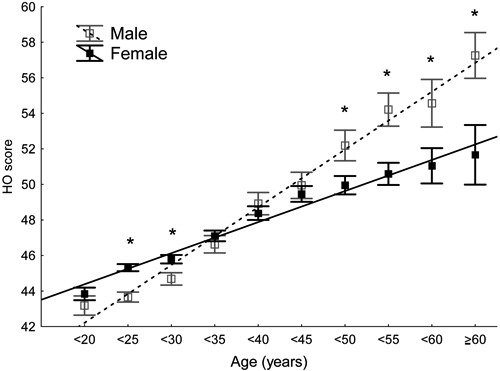
Verification
Claims the paper makes
The claims and statistics of this paper haven’t been checked yet.
Run the check — free, no account needed. It reads the open-access text and checks the sources it cites.
Claims other papers make about this one
Each is checked against this paper’s own text: does it say what the citing paper says it does?
In the citing paper
“these sex differences disappear after the age of 50 years, coinciding with menopause in women141,220,222”
From Rhythms of life: circadian disruption and brain disorders across the lifespan (2019) · cites this paper as [222]
Self-check
Percentages, sums and reported differences re-computed from the paper’s own numbers.
The self-check needs the paper’s full text.
Citations
Cites
A marker for the end of adolescence
Roenneberg, T., Kuehnle, T., Pramstaller, P. P., Ricken, J., Havel, M., Guth, A., & Merrow, M. (2004) · Current Biology · doi:10.1016/j.cub.2004.11.039 · Cited by 1,585
Epidemiology of the human circadian clock
Roenneberg, T., Kuehnle, T., Juda, M., Kantermann, T., Allebrandt, K., Gordijn, M., & Merrow, M. (2007) · Sleep Medicine Reviews · doi:10.1016/j.smrv.2007.07.005 · Cited by 1,545
Circadian preference, sleep and daytime behaviour in adolescence
Giannotti, F., Cortesi, F., Sebastiani, T., & Ottaviano, S. (2002) · Journal of Sleep Research · doi:10.1046/j.1365-2869.2002.00302.x · Cited by 703
GENDER DIFFERENCES IN MORNINGNESS–EVENINGNESS PREFERENCE
Adan, A., & Natale, V. (2002) · Chronobiology International · doi:10.1081/cbi-120005390 · Cited by 522
Paine, S.-J., Gander, P. H., & Travier, N. (2006) · Journal of Biological Rhythms · doi:10.1177/0748730405283154 · Cited by 377
Sex Differences in Phase Angle of Entrainment and Melatonin Amplitude in Humans
Cain, S. W., Dennison, C. F., Zeitzer, J. M., Guzik, A. M., Khalsa, S. B. S., Santhi, N., Schoen, M. W., Czeisler, C. A., & Duffy, J. F. (2010) · Journal of Biological Rhythms · doi:10.1177/0748730410374943 · Cited by 343
Later endogenous circadian temperature nadir relative to an earlier wake time in older people
Duffy, J. F., Dijk, D., Klerman, E. B., & Czeisler, C. A. (1998) · American Journal of Physiology-Regulatory, Integrative and Comparative Physiology · doi:10.1152/ajpregu.1998.275.5.r1478 · Cited by 318
Sleep and morningness‐eveningness in the ‘middle’ years of life (20–59y)
CARRIER, J., MONK, T. H., BUYSSE, D. J., & KUPFER, D. J. (1997) · Journal of Sleep Research · doi:10.1111/j.1365-2869.1997.00230.x · Cited by 303
Tonetti, L., Fabbri, M., & Natale, V. (2008) · Chronobiology International · doi:10.1080/07420520802394191 · Cited by 302
Randler, C. (2007) · Personality and Individual Differences · doi:10.1016/j.paid.2007.05.004 · Cited by 232
Research works printed but not linked: 1
- Posey TB, 1981, The morningness-eveningness preference of college students as measured by the Horne and Ostberg questionnaire, Int J Chronobiol, 7, 141
Cited by
Sorted by citations
Rhythms of life: circadian disruption and brain disorders across the lifespan
Logan, R. W., & McClung, C. A. (2019) · Nature Reviews Neuroscience · doi:10.1038/s41583-018-0088-y · Cited by 713
Chronotypes in the US–influence of age and sex
Fischer, D., Lombardi, D. A., Marucci-Wellman, H., & Roenneberg, T. (2017) · PLOS ONE · doi:10.1371/journal.pone.0178782 · Cited by 502
Sleep timing, chronotype and social jetlag: Impact on cognitive abilities and psychiatric disorders
Taillard, J., Sagaspe, P., Philip, P., & Bioulac, S. (2021) · Biochemical Pharmacology · doi:10.1016/j.bcp.2021.114438 · Cited by 330
Chronotype, circadian rhythm, and psychiatric disorders: Recent evidence and potential mechanisms
Zou, H., Zhou, H., Yan, R., Yao, Z., & Lu, Q. (2022) · Frontiers in Neuroscience · doi:10.3389/fnins.2022.811771 · Cited by 297
Chronotype, gender and general health
Fabbian, F., Zucchi, B., Giorgi, A. D., Tiseo, R., Boari, B., Salmi, R., Cappadona, R., Gianesini, G., Bassi, E., Signani, F., et al. (2016) · Chronobiology International · doi:10.1080/07420528.2016.1176927 · Cited by 273
From Lark to Owl: developmental changes in morningness-eveningness from new-borns to early adulthood
Randler, C., Faßl, C., & Kalb, N. (2017) · Scientific Reports · doi:10.1038/srep45874 · Cited by 238
Randler, C., & Engelke, J. (2019) · Chronobiology International · doi:10.1080/07420528.2019.1585867 · Cited by 172
At the Interface of Lifestyle, Behavior, and Circadian Rhythms: Metabolic Implications
Bae, S.-A., Fang, M., Rustgi, V. K., Zarbl, H., & Androulakis, I. P. (2019) · Frontiers in Nutrition · doi:10.3389/fnut.2019.00132 · Cited by 103
Chronotype, Sleep Behavior, and the Big Five Personality Factors
Randler, C., Schredl, M., & Göritz, A. S. (2017) · SAGE Open · doi:10.1177/2158244017728321 · Cited by 98
Beyond sleep: A multidimensional model of chronotype
Chauhan, S., Norbury, R., Faßbender, K., Ettinger, U., & Kumari, V. (2023) · Neuroscience & Biobehavioral Reviews · doi:10.1016/j.neubiorev.2023.105114 · Cited by 100
Zhang, Z., Cajochen, C., & Khatami, R. (2019) · Journal of Medical Internet Research · doi:10.2196/13482 · Cited by 87
Sleep–Wake Timings in Adolescence: Chronotype Development and Associations with Adjustment
Karan, M., Bai, S., Almeida, D. M., Irwin, M. R., McCreath, H. E., & Fuligni, A. J. (2021) · Journal of Youth and Adolescence · doi:10.1007/s10964-021-01407-1 · Cited by 89
von Schantz, M., Taporoski, T. P., Horimoto, A. R. V. R., Duarte, N. E., Vallada, H., Krieger, J. E., Pedrazzoli, M., Negrão, A. B., & Pereira, A. C. (2015) · Scientific Reports · doi:10.1038/srep09214 · Cited by 80
Self-citationQuality of sleep and anxiety are related to circadian preference in university students
Cardoso, V. M., Magalhães, J. E. D. M., & Duarte, L. L. (2020) · PLoS ONE · doi:10.1371/journal.pone.0238514 · Cited by 87
Self-citationDíaz‐Morales, J. F., Randler, C., Arrona‐Palacios, A., & Adán, A. (2017) · Chronobiology International · doi:10.1080/07420528.2017.1361437 · Cited by 72
Richter, K., Adam, S. H., Geiss, L., Peter, L., & Niklewski, G. (2016) · Chronobiology International · doi:10.1080/07420528.2016.1220388 · Cited by 70
Morningness-eveningness in a large sample of German adolescents and adults
Randler, C., Freyth-Weber, K., Rahafar, A., Jurado, A. F., & Kriegs, J. O. (2016) · Heliyon · doi:10.1016/j.heliyon.2016.e00200 · Cited by 68
Naja, F., Hasan, H. A., Khadem, S. H., Buanq, M. A., Al-Mulla, H. K., Aljassmi, A. K., & Faris, M. E. (2022) · Frontiers in Nutrition · doi:10.3389/fnut.2021.805955 · Cited by 58
Fourier, C., Ran, C., Steinberg, A., Sjöstrand, C., Waldenlind, E., & Belin, A. C. (2022) · Neurology · doi:10.1212/wnl.0000000000201688 · Cited by 54
Carvalho-Mendes, R. P., Dunster, G. P., de la Iglesia, H. O., & Menna-Barreto, L. S. (2020) · Journal of Biological Rhythms · doi:10.1177/0748730420927603 · Cited by 54
Self-citationRahafar, A., Randler, C., Díaz‐Morales, J. F., Kasaeian, A., & Heidari, Z. (2017) · Chronobiology International · doi:10.1080/07420528.2016.1267187 · Cited by 46
Sex Differences in Insomnia and Circadian Rhythm Disorders: A Systematic Review
Pajėdienė, E., Urbonavičiūtė, V., Ramanauskaitė, V., Strazdauskas, L., & Stefani, A. (2024) · Medicina · doi:10.3390/medicina60030474 · Cited by 49
Kolomeichuk, S. N., Randler, C., Shabalina, I., Fradkova, L., & Borisenkov, M. F. (2016) · Biological Rhythm Research · doi:10.1080/09291016.2016.1207352 · Cited by 48
Díaz‐Morales, J. F., & Parra-Robledo, Z. (2018) · The Journal of Genetic Psychology · doi:10.1080/00221325.2018.1424706 · Cited by 45
Sládek, M., Röschová, M., Adámková, V., Hamplová, D., & Sumová, A. (2020) · Scientific Reports · doi:10.1038/s41598-020-58413-9 · Cited by 51
Delayed sleep-wake phase disorder and its related sleep behaviors in the young generation.
Futenma, K., Takaesu, Y., Komada, Y., Shimura, A., Okajima, I., Matsui, K., Tanioka, K., & Inoue, Y. (2023) · Frontiers in Psychiatry · doi:10.3389/fpsyt.2023.1174719 · Cited by 42
Rodríguez-Muñoz, P. M., Carmona‐Torres, J. M., Picón, C. R., Fabbian, F., Manfredini, R., Rodríguez‐Borrego, M. A., & López‐Soto, P. J. (2020) · Nutrients · doi:10.3390/nu12061900 · Cited by 46
Sivertsen, B., Harvey, A. G., Gradisar, M., Pallesen, S., & Hysing, M. (2020) · Sleep Medicine · doi:10.1016/j.sleep.2020.09.028 · Cited by 43
López-Muciño, L. A., García‐García, F., Cueto‐Escobedo, J., Acosta-Hernández, M. E., Venebra-Muñoz, A., & Rodríguez‐Alba, J. C. (2022) · Neuroscience & Biobehavioral Reviews · doi:10.1016/j.neubiorev.2022.104832 · Cited by 41
Kim, H. J., Kim, R. E. Y., Kim, S., Kim, S. A., Kim, S. E., Lee, S. K., Lee, H. W., & Shin, C. (2021) · Journal of Clinical Sleep Medicine · doi:10.5664/jcsm.9072 · Cited by 40
Spanish Adaptation of the Morningness-Eveningness-Stability-Scale improved (MESSi)
Díaz‐Morales, J. F., & Randler, C. (2017) · The Spanish Journal of Psychology · doi:10.1017/sjp.2017.21 · Cited by 36
Timing and quality of sleep in a rural Brazilian family-based cohort, the Baependi Heart Study
Beijamini, F., Knutson, K. L., Lorenzi‐Filho, G., Egan, K. J., Taporoski, T. P., de Paula, L. K. G., Negrão, A. B., Horimoto, A. R. V. R., Duarte, N. E., Vallada, H., et al. (2016) · Scientific Reports · doi:10.1038/srep39283 · Cited by 34
Self-citationTakeuchi, H., Taki, Y., Sekiguchi, A., Nouchi, R., Kotozaki, Y., Nakagawa, S., Miyauchi, C. M., Iizuka, K., Yokoyama, R., Shinada, T., et al. (2015) · NeuroImage · doi:10.1016/j.neuroimage.2015.05.037 · Cited by 34
Hancox, T. P. M., Skene, D. J., Dallmann, R., & Dunn, W. B. (2021) · Metabolites · doi:10.3390/metabo11050328 · Cited by 34
Carciofo, R., & Song, N. (2019) · Chronobiology International · doi:10.1080/07420528.2019.1608225 · Cited by 32
Qualidade do sono e cronotipo de estudantes de enfermagem
dos Santos, T. C. D. M. M., Martino, M. M. F. D., Sonati, J. G., Faria, A. L. D., & Nascimento, E. F. D. A. (2016) · Acta Paulista de Enfermagem · doi:10.1590/1982-0194201600092 · Cited by 29
Antúnez, J. M. (2020) · PLoS ONE · doi:10.1371/journal.pone.0230169 · Cited by 29
Ontogeny of morningness–eveningness across the adult human lifespan
Randler, C. (2015) · Die Naturwissenschaften · doi:10.1007/s00114-015-1326-z · Cited by 27
Exercising Caution Upon Waking–Can Exercise Reduce Sleep Inertia?
Kovac, K., Ferguson, S. A., Paterson, J. L., Aisbett, B., Hilditch, C. J., Reynolds, A. C., & Vincent, G. E. (2020) · Frontiers in Physiology · doi:10.3389/fphys.2020.00254 · Cited by 20
Ulander, M., Rångtell, F. H., & Theorell‐Haglöw, J. (2021) · Sleep Medicine Clinics · doi:10.1016/j.jsmc.2021.07.004 · Cited by 19
Jiskrova, G. K., Vazsonyi, A. T., Klánová, J., & Dušek, L. (2018) · Journal of Youth and Adolescence · doi:10.1007/s10964-018-0965-8 · Cited by 16
Minz, S., & Pati, A. K. (2019) · Biological Rhythm Research · doi:10.1080/09291016.2019.1616889 · Cited by 16
Evening preference correlates with regional brain volumes in the anterior occipital lobe
Evans, S., Leocádio-Miguel, M. A., Taporoski, T. P., Gómez, L. M., Horimoto, A. R. V. R., Alkan, E., Beijamini, F., Pedrazzoli, M., Knutson, K. L., Krieger, J. E., et al. (2021) · Chronobiology International · doi:10.1080/07420528.2021.1912077 · Cited by 15
Self-citationMultimodal population study reveals the neurobiological underpinnings of chronotype
Zhou, L., Saltoun, K., Carrier, J., Storch, K.-F., Dunbar, R., & Bzdok, D. (2025) · Nature Human Behaviour · doi:10.1038/s41562-025-02182-w · Cited by 14
Pande, B., Parveen, N., Parganiha, A., & Pati, A. K. (2018) · Sleep and Biological Rhythms · doi:10.1007/s41105-018-0173-7 · Cited by 13
Three Reasons to Consider the Role of Tiredness in Sexual Risk-Taking Among Gay and Bisexual Men
Millar, B. M., Starks, T. J., Rendina, H. J., & Parsons, J. T. (2018) · Archives of Sexual Behavior · doi:10.1007/s10508-018-1258-8 · Cited by 13
Majumdar, P., & Sahu, S. (2019) · Chronobiology International · doi:10.1080/07420528.2019.1682597 · Cited by 13
Effects of sex, mating status, and genetic background on circadian behavior in Drosophila
Akpoghiran, O., Strich, A. K., & Koh, K. (2025) · Frontiers in Neuroscience · doi:10.3389/fnins.2024.1532868 · Cited by 13
PER3 gene regulation of sleep-wake behavior as a function of latitude
Leocádio-Miguel, M. A., Carneiro, B. T. S., Ximenes-da-Silva, A., Caumo, W., Kassisse, D. M. G., & Pedrazzoli, M. (2018) · Sleep Health · doi:10.1016/j.sleh.2018.10.002 · Cited by 12
Self-citationThe overlapping geography of cognitive ability and chronotype
Ujma, P. P., & Kirkegaard, E. O. W. (2021) · PsyCh Journal · doi:10.1002/pchj.477 · Cited by 13
Evening chronotype is associated with a more unrestricted sociosexuality in men and women
Matchock, R. L. (2018) · Personality and Individual Differences · doi:10.1016/j.paid.2018.06.054 · Cited by 11
Academic performance depends on chronotype: Myth or reality?
Indla, Y. R., & Nagothu, R. S. (2019) · Indian Journal of Clinical Anatomy and Physiology · doi:10.18231/j.ijcap.2019.103 · Cited by 11
Sex Differences in Temporal Sleep Patterns, Social Jetlag, and Attention in High School Adolescents
Diogo, F. M. C., Bessa, Z. C. M., Galina, S. D., de Oliveira, M. L. C., da Silva-Júnior, E. L. R., Valdéz, P., & de Azevedo, C. V. M. (2024) · Sleep Science · doi:10.1055/s-0043-1777831 · Cited by 9
Impact of night shifts on emergency medicine resident resuscitation performance
Edgerley, S., McKaigney, C. J., Boyne, D. J., Ginsberg, D., Dagnone, D., & Hall, A. K. (2018) · Resuscitation · doi:10.1016/j.resuscitation.2018.03.019 · Cited by 8
Oriyama, S. (2024) · Sleep Medicine · doi:10.1016/j.sleep.2024.03.010 · Cited by 10
Chronotypes and circadian rhythms in university students
Duarte, L. L., & Menna-Barreto, L. S. (2021) · Biological Rhythm Research · doi:10.1080/09291016.2021.1903791 · Cited by 8
Self-citationBarbosa, A. A., Leocádio-Miguel, M. A., Tufik, S., Sabino, F. C., Cendoroglo, M. S., & Pedrazzoli, M. (2016) · Brazilian Journal of Medical and Biological Research · doi:10.1590/1414-431x20165311 · Cited by 8
Self-citationSurvey of sleep practice and sleep-related problems among a sample of Egyptian youths
Ahmed, M., Zaki, N. F. W., Morsy, N. E., Awadalla, N. J., Hammad, M. A. M., Saleh, N., & Elhefnawi, S. E. (2018) · Egyptian Journal of Chest Diseases and Tuberculosis · doi:10.4103/ejcdt.ejcdt_2_18 · Cited by 8
Buekenhout, I., Clara, M. I., Gomes, A. A., & Leitão, J. (2024) · Chronobiology International · doi:10.1080/07420528.2024.2444667 · Cited by 10
Li, T., Chen, Y., Xie, Y., Tao, S., Zou, L., Yang, Y., Tao, F., & Wu, X. (2024) · Journal of Behavioral Addictions · doi:10.1556/2006.2024.00027 · Cited by 10
Vallim, J. R. D. S., do Amaral, F. G., Cipolla‐Neto, J., & D’Almeida, V. (2019) · Chronobiology International · doi:10.1080/07420528.2018.1560308 · Cited by 9
Circadian preference and relationship satisfaction among three types of couples
Díaz‐Morales, J. F., Parra-Robledo, Z., & Escribano, C. (2019) · Chronobiology International · doi:10.1080/07420528.2019.1642910 · Cited by 7
Sleep pattern and insomnia among medical students
Joshi, K., Mishra, D., Dubey, H., & Gupta, R. M. (2015) · Somnologie - Schlafforschung und Schlafmedizin · doi:10.1007/s11818-015-0012-x · Cited by 7
Social epidemiology of multidimensional sleep health in early adolescence
Nagata, J. M., Helmer, C. K., Frimpong, I., Beltran-Murillo, K., Heuer, A. W., Huang, O. H., Li, E. J., Ricklefs, C., Ganson, K. T., Testa, A. M., et al. (2025) · Pediatric Research · doi:10.1038/s41390-025-04616-7 · Cited by 6
Zhou, L., Saltoun, K., Marotta, J., Aggarwal, S., Kopál, J., Carrier, J., Storch, K.-F., Dunbar, R., & Bzdok, D. (2025) · Nature Communications · doi:10.1038/s41467-025-66784-8 · Cited by 4
Vallim, J. R. D. S., Lima, G. S., Tsuji, H. M. S., Xylaras, B. D. P., Tufik, S., Demarzo, M., & D’Almeida, V. (2023) · Chronobiology International · doi:10.1080/07420528.2023.2181179 · Cited by 8
Carciofo, R. (2024) · Chronobiology International · doi:10.1080/07420528.2024.2414047 · Cited by 5
Interaction of sleep and emotion across the menstrual cycle
Meers, J. M., Bower, J. L., Nowakowski, S., & Alfano, C. A. (2024) · Journal of Sleep Research · doi:10.1111/jsr.14185 · Cited by 6
Later Chronotype Correlates With Severe Depression in Indonesian College Students
Supit, A., Gosal, M., Mamuaja, P., Kumaat, S., & Paturusi, A. (2021) · Sleep Medicine Research · doi:10.17241/smr.2021.00969 · Cited by 7
Light in ecological settings: Entrainment, circadian disruption, and interventions
Fischer, D. R., & Hilditch, C. J. (2022) · Progress in brain research · doi:10.1016/bs.pbr.2022.04.001 · Cited by 5
Sleep quality, chronotype and academic performance of university students in the health area
Souza, S. S., de Brito, K. S., Amorim, G. M., Araújo, J. F., & Duarte, L. L. (2024) · Biological Rhythm Research · doi:10.1080/09291016.2024.2437643 · Cited by 4
Self-citationDíaz‐Morales, J. F., & Puig‐Navarro, Y. (2022) · Chronobiology International · doi:10.1080/07420528.2022.2115378 · Cited by 5
Sleep pressure and time perception in university students
Leocádio-Miguel, M. A., & Menna-Barreto, L. S. (2016) · Biological Rhythm Research · doi:10.1080/09291016.2016.1191669 · Cited by 4
Self-citationSocial jetlag in the city of São Paulo: A longitudinal study from the EPISONO cohort
Vallim, J. R. D. S., Fernandes, G. L., Tufik, S., Andersen, M. L., & D’Almeida, V. (2025) · Sleep Medicine · doi:10.1016/j.sleep.2025.108680 · Cited by 5
Relationship between chronobiology and aging: adjustments facing the technological world
Federal University of Paraná, Pinto, L. S. D. C., Vincenzi, R. A., Federal University of Paraná, Schaedler, T., Federal University of Paraná, Perrut, G., Federal University of Paraná, Louzada, F. M., & Federal University of Paraná (2017) · Geriatrics Gerontology and Aging · doi:10.5327/z2447-211520162016029 · Cited by 3
Self-citationDuarte, L. L., Closs, I., Vasconcelos, S. P., Santos, E. H. R., de Matos, R. J. B., Klein, S. D. O. T., Luz, C. D. S., Marinho, S. M. O. C., Beijamini, F., Moreno, C. R. D. C., et al. (2025) · Chronobiology International · doi:10.1080/07420528.2025.2490504 · Cited by 2
Self-citationKullik, L., Stork, M., Kellmann, M., Puta, C., & Jakowski, S. (2024) · German Journal of Exercise and Sport Research · doi:10.1007/s12662-023-00933-3 · Cited by 2
Dayı, T., & Topal, E. (2024) · Biological Rhythm Research · doi:10.1080/09291016.2024.2441412 · Cited by 2
Devaraj, D., Devaraj, U., Venkatnarayan, K., Veluthat, C., Ramachandran, P., D′Souza, G., & Maheswari, K. U. (2021) · Sleep and Vigilance · doi:10.1007/s41782-021-00128-6 · Cited by 2
The effect of subjective sleep latency on BMI of medical interns during and before COVID-19 pandemic
Bastanhagh, E., & Erfanian, R. (2021) · Sleep Science · doi:10.5935/1984-0063.20200112 · Cited by 2
Chronotype and Its Relation to Healthy Aging
Sinha, M., Pande, B., & Sinha, R. (2023) · Healthy ageing and longevity · doi:10.1007/978-3-031-22468-3_18 · Cited by 2
Circadian Rhythm, Sleep Quality, and Health-Related Quality of Life in Korean Middle Adults
Kim, D., Chang, H. J., Lee, W., Hoseong, S., Yang, K. I., Chu, M. K., & Yun, C. (2020) · Journal of Sleep Medicine · doi:10.13078/jsm.200005 · Cited by 2
The Parent’s Chronotype and Child’s Sleeping Quality in Association with Relationship Satisfaction
Ricci, C., Parra-Robledo, Z., Rothenbacher, D., Díaz‐Morales, J. F., & Genuneit, J. (2020) · Clocks & Sleep · doi:10.3390/clockssleep2030028 · Cited by 2
RICHTER, K., Peter, L., Adam, S. H., Geiss, L., & NIKELEWSKI, G. (2017) · Schlaf · doi:10.1055/s-0038-1626166 · Cited by 1
Chronotype as a predictor of scholar performance in a full-time middle school
Cezário, R. R., de Freitas, D., & Chahad‐Ehlers, S. (2023) · Brazilian Journal of Biology · doi:10.1590/1519-6984.272072 · Cited by 1
Circadian Rhythm Disorders in Children and Adults
Velamuri, K., Singh, S., Agrawal, R., Moghtader, S., & Sharafkhaneh, A. (2023) · Springer eBooks · doi:10.1007/978-3-031-30010-3_12 · Cited by 2
Uchida, T., & Kurosawa, T. (2024) · Japanese Psychological Research · doi:10.1111/jpr.12560 · Cited by 2
Gomes, H., & Bet, H. M. S. (2021) · Revista Temas em Educação · doi:10.22478/ufpb.2359-7003.2021v30n2.56306 · Cited by 1
Mendes, R. A. P. D. C. (2019) · Digital Library of Theses and Dissertations (Universidade de São Paulo) · doi:10.11606/t.47.2019.tde-18112019-191921 · Cited by 2
Avaliação do efeito hipotensivo pós-exercício em diferentes fases do dia
de Oliveira, M. A. G. (2014) · doi:10.11606/d.47.2014.tde-30032015-095608
The association of circadian typology with cognition and smoking status
Zaki, N. F. W., & El-Hadidy, M. A. (2016) · Middle East Current Psychiatry · doi:10.1097/01.xme.0000488667.63244.8a
Women amateur street runners have a higher level of chronotype self- perception than men
de Carvalho, M. V., Guimarães, J. B., Bicalho, C. C. F., Machado, F. S. M., Lopes, B., & Coimbra, C. C. (2021) · Motriz Revista de Educação Física · doi:10.1590/s1980-65742021003621 · Cited by 1
Qualidade de vida, atividade física e sono em docentes das redes estadual e federal de ensino
Araujo, L. W., Umemura, G. S., & Oliveira, M. A. (2022) · Revista Brasileira de Qualidade de Vida · doi:10.3895/rbqv.v14n0.14723
Vallim, J. R. D. S., Tsuji, H. M. S., Lima, G. S., Xylaras, B. D. P., Louzada, F. M., Tufik, S., & D’Almeida, V. (2024) · Chronobiology International · doi:10.1080/07420528.2024.2349684
Self-citationBody temperature and time perception in morning and evening types
Erdoğan, Ş., & Tavat, B. C. (2025) · Physiology & Behavior · doi:10.1016/j.physbeh.2025.114943
Bouteldja, A. A., Marceau, L. A., Srivastava, L. K., & Cermakian, N. (2025) · European Journal of Neuroscience · doi:10.1111/ejn.70134
van der Zwet, G., Bor, Z., Bos, R., van Dorp, R., Pape, L. M., van der Zwet, L., van Dijk, E., van de Stadt, H., McGlashan, E. M., Michel, S. H., et al. (2025) · bioRxiv (Cold Spring Harbor Laboratory) · doi:10.1101/2025.10.17.681907
Schulz, P., Stecher, H. I., & Herrmann, C. S. (2025) · Neurobiology of Sleep and Circadian Rhythms · doi:10.1016/j.nbscr.2025.100136
Buekenhout, I., Gomes, A. A., & Leitão, J. (2026) · Sleep Medicine · doi:10.1016/j.sleep.2026.108768
Metadata
- Authors
- Duarte, L. L., Menna-Barreto, L., Miguel, M. A. L., Louzada, F., Araújo, J., Alam, M., Areas, R., & Pedrazzoli, M.
- Affiliations
- Universidade Federal do Recôncavo da Bahia (BR)
- Universidade de São Paulo (BR)
- Universidade de São Paulo, Brasil
- Universidade Federal do Paraná (BR)
- Universidade Federal do Rio Grande do Norte (BR)
- Universidade Federal de Pelotas (BR)
- Venue
- Brazilian Journal of Medical and Biological Research
- Publisher
- FapUNIFESP (SciELO)
- Published
- 2014-04-08
- Volume
- 47
- Issue
- 4
- Pages
- 316-320
- ISSN
- 0100-879X (ISSN-L)
- 1414-431X
- PMC
- PMC4075295
- OpenAlex
- W2046580136
- Cited by
- 104
- References
- 31
- Citations by year
- 2026: 5 · 2025: 10 · 2024: 12 · 2023: 6 · 2022: 7 · 2021: 13 · 2020: 9 · 2019: 11 · 2018: 9 · 2017: 8 · 2016: 9 · 2015: 4 · 2014: 1
- FWCI
- 3.57
- Type
- journal article
- Language
- en
- Open access
- gold
- doi.org
- Licence
- cc-by
- Locations
- Brazilian Journal of Medical and Biological Research (publishedVersion, cc-by)
- Europe PMC (PubMed Central) (publishedVersion, cc-by-nc)
- PubMed Central (publishedVersion, cc-by-nc)
- PubMed (publishedVersion)
- LA Referencia (Red Federada de Repositorios Institucionales de Publicaciones Científicas) (publishedVersion, other-oa)
- Americanae (AECID Library) (submittedVersion, other-oa)
- DOAJ (DOAJ: Directory of Open Access Journals) (submittedVersion, cc-by-sa)
- Topics
- Life Sciences › Neuroscience › Endocrine and Autonomic Systems › Circadian rhythm and melatonin
- Social Sciences › Psychology › Experimental and Cognitive Psychology › Sleep and related disorders
- Social Sciences › Psychology › Experimental and Cognitive Psychology › Sleep and Work-Related Fatigue
- Keywords
- chronotype, circadian rhythm, ontogeny, gender differences, aging, adolescence, circadian phase shift
- MeSH terms
- Activities of Daily Living, Adolescent, Adult, Age Factors, Aged, Analysis of Variance, Brazil, Circadian Rhythm, Female, Humans, Human Development, Male, Middle Aged, Surveys and Questionnaires, Sex Factors
About these checks
Registry, retraction, Cites and statistics results are computed, not judged, with one exception: a printed reference that no index lists is read once by a model before it counts as a citation error. Claims are extracted by a model and kept only when their quote appears verbatim in the text; each cited source is then checked, with a model’s help, for whether it says what the claim relies on. Those verdicts can be wrong — read the claim’s quote and the cited source before relying on one.
Statistics and arithmetic are recomputed, not judged.
Confidence bands are shown only for fields calibrated on our annotated test set. None is calibrated yet, so no band is shown.
What counts as a claim ›How we measure confidence ›How we check this ›
Are you an author, or do you see a problem with this page? Request a review
