

Efficacy of the telephone-based Brief Motivational Intervention for alcohol problems in Brazil
Open accessThe DOI matches its Crossref record; 39 of the 40 references it cites were found in a registry or an index.
Abstract
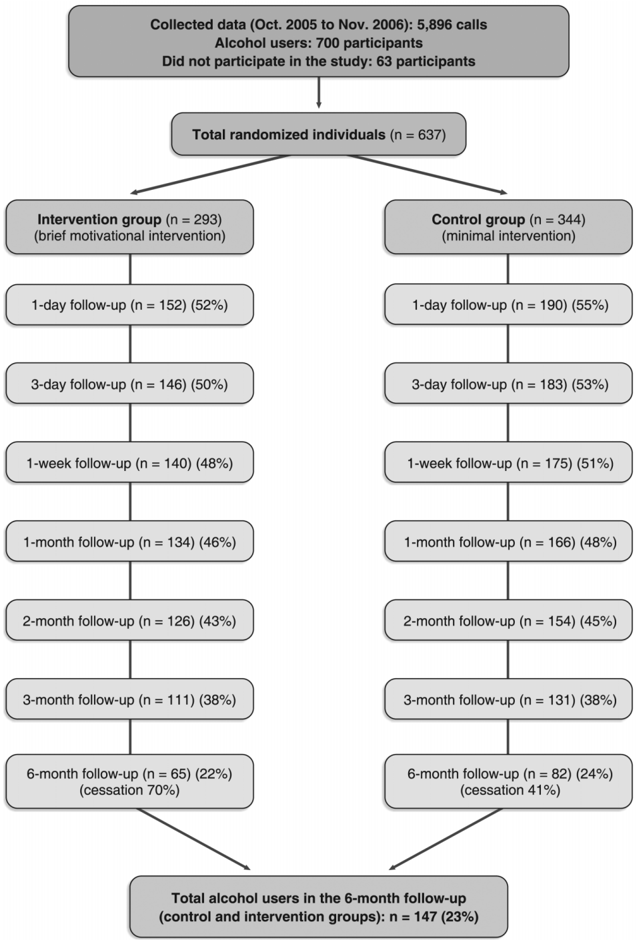
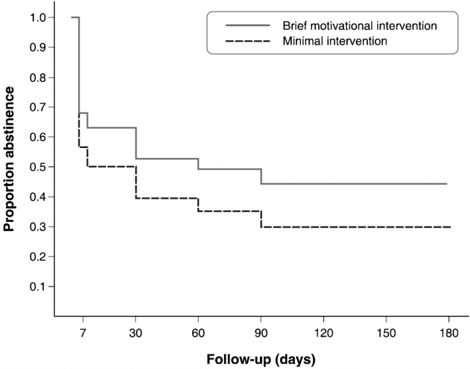
BACKGROUND: The Brief Motivational Intervention (BMI) is an effective treatment for alcohol misuse but has not been adequately tested for use in helplines for alcoholics. The main objective of this study was to evaluate the efficacy of a telephone-based BMI for Brazilians seeking help with alcohol use cessation. METHODS: A randomized, controlled trial was performed with Brazilian subjects. Participants were randomly assigned to either the minimal intervention group (i.e., given reference materials) or the BMI group. Alcohol abstinence was evaluated in a 6-month follow-up telephone counseling session. The analysis was based on the intention to treat (ITT). RESULTS: Of the 5,896 drug users who called the helpline, 700 (12%) used alcohol, 637 of whom enrolled in this study. At 6-month follow-up, 70% of the BMI group had stopped consuming alcohol compared to 41% in the control group (odds ratio = 1.5; 95% confidence interval = 1.2-1.9; p = 0.001). CONCLUSIONS: A helpline-based BMI helps alcohol users achieve abstinence.
Overview
The claims and statistics of this paper haven’t been checked yet.
Free: it reads the open-access text and checks the first 5 claims that cite a source we can check. Create a free account to check every claim.
Integrity signals
Registry
Cites
Statistics
Figures
Verification
Claims the paper makes
The claims and statistics of this paper haven’t been checked yet.
Free: it reads the open-access text and checks the first 5 claims that cite a source we can check. Create a free account to check every claim.
Claims other papers make about this one
Each is checked against this paper’s own text: does it say what the citing paper says it does?
The source backs part of the claim, not all of it — or backs it for a different population, condition or comparison.
In the citing paper
“Participants and personnel cannot be blinded for this type of intervention”
From Psychosocial and pharmacologic interventions to reduce harmful alcohol use in low- and middle-income countries (2023) · cites this paper as Signor 2013
Experimental — accuracy not yet measuredThe source backs part of the claim, not all of it — or backs it for a different population, condition or comparison.
In the citing paper
“Outcomes reported by participant not blind to intervention”
From Psychosocial and pharmacologic interventions to reduce harmful alcohol use in low- and middle-income countries (2023) · cites this paper as Signor 2013
Experimental — accuracy not yet measuredThe cited source says what the claim attributes to it.
In the citing paper
“Not described”
From Psychosocial and pharmacologic interventions to reduce harmful alcohol use in low- and middle-income countries (2023) · cites this paper as Signor 2013
The cited source says what the claim attributes to it.
In the citing paper
“Group allocation was performed using a Microsoft H software application that applied a random number technique.”
From Psychosocial and pharmacologic interventions to reduce harmful alcohol use in low- and middle-income countries (2023) · cites this paper as Signor 2013
The cited source says what the claim attributes to it.
In the citing paper
“The study attrition rate was 76.9% (490 participants dropped out).”
From Psychosocial and pharmacologic interventions to reduce harmful alcohol use in low- and middle-income countries (2023) · cites this paper as Signor 2013
1 more claim about this paper
Create a free account to see every claim other papers make about this one.
Self-check
Percentages, sums and reported differences re-computed from the paper’s own numbers.
The self-check needs the paper’s full text.
Citations
Cites
In search of how people change: Applications to addictive behaviors.
Prochaska, J. O., DiClemente, C. C., & Norcross, J. C. (1992) · American Psychologist · doi:10.1037/0003-066x.47.9.1102 · Cited by 8,596
Motivational interviewing: preparing people for change.
Miller, W. R., & Rollnick, S. (2002) · Guilford Press eBooks · Cited by 7,915
Grant, B. F., Dawson, D. A., Stinson, F. S., Chou, S. P., Dufour, M. C., & Pickering, R. P. (2004) · Drug and Alcohol Dependence · doi:10.1016/j.drugalcdep.2004.02.004 · Cited by 1,507
Dropping out of treatment: A critical review.
Baekeland, F., & Lundwall, L. (1975) · Psychological Bulletin · doi:10.1037/h0077132 · Cited by 1,111
Moyer, A., Finney, J. W., Swearingen, C. E., & Vergun, P. (2002) · Addiction · doi:10.1046/j.1360-0443.2002.00018.x · Cited by 1,092
Smetana, G. W., Lawrence, V. A., & Cornell, J. E. (2006) · Annals of Internal Medicine · doi:10.7326/0003-4819-144-8-200604180-00009 · Cited by 1,047
The Contemplation Ladder: Validation of a measure of readiness to consider smoking cessation.
Biener, L., & Abrams, D. B. (1991) · Health Psychology · doi:10.1037/0278-6133.10.5.360 · Cited by 995
Bertholet, N. (2005) · Archives of Internal Medicine · doi:10.1001/archinte.165.9.986 · Cited by 710
Lawrence, V. A., Cornell, J. E., & Smetana, G. W. (2006) · Annals of Internal Medicine · doi:10.7326/0003-4819-144-8-200604180-00011 · Cited by 635
VASILAKI, E. I., HOSIER, S. G., & COX, W. M. (2006) · Alcohol and Alcoholism · doi:10.1093/alcalc/agl016 · Cited by 581
Cited by
Naslund, J. A., Aschbrenner, K. A., Araya, R., Marsch, L. A., Unützer, J., Patel, V., & Bartels, S. J. (2017) · The Lancet Psychiatry · doi:10.1016/s2215-0366(17)30096-2 · Cited by 638
“20 We also identified four studies from Brazil of self-directed online education programmes.”
InfluentialJoseph, J., & Basu, D. (2017) · Alcohol and Alcoholism · doi:10.1093/alcalc/agw054 · Cited by 52
Closing the treatment gap for alcohol use disorders in low- and middle-income countries
Nadkarni, A., Gandhi, Y., Bhatia, U., & Velleman, R. (2023) · Cambridge Prisms: Global Mental Health · doi:10.1017/gmh.2022.57 · Cited by 46
“…of alcohol misuse (Pereira et al., 2015), telephone-based briefmotivational intervention for reducing alcohol consumption (Wongpakaran et al., 2011; Signor et al., 2013), online self-help programme for reducing alcohol consumption among harmful or hazardous users (Andrade et al., 2016) and an…”
BackgroundMethodStaton, C. A., Vissoci, J. R. N., El-Gabri, D., Adewumi, K., Concepcion, T., Elliott, S. A., Evans, D. R., Galson, S. W., Pate, C. T., Reynolds, L. M., et al. (2022) · PLOS Medicine · doi:10.1371/journal.pmed.1003961 · Cited by 41
“The types of interventions included most commonly were WHO-based brief interventions (which utilizes some MI techniques) [28,29,79–82] or MI interventions [22,58,76,88,89,91,93].”
BackgroundMethodInfluentialThe effectiveness of telephone counselling in the treatment of illicit drug and alcohol use concerns
Gates, P., & Albertella, L. (2015) · Journal of Telemedicine and Telecare · doi:10.1177/1357633x15587406 · Cited by 37
“Third, there is a paucity of research on existing helplines, with a total of only four randomised controlled trials,(41,57,58,81) only two of which included comparisons with alternative treatments.(41,58) The first was an evaluation of an internet-based intervention primarily focussed on depression which compared the…”
BackgroundMethodThe effectiveness of helplines for the treatment of alcohol and illicit substance use
Gates, P. (2014) · Journal of Telemedicine and Telecare · doi:10.1177/1357633x14555643 · Cited by 25
“Similarly, participants receiving a single call from the alcohol-specific helpline were significantly more likely to achieve abstinence at six month follow-up compared to those receiving a self-help booklet.(44) In contrast, the final trial which assessed the utility of a helpline call to support a web-based intervent…”
ResultBortolon, C. B., Moreira, T. D. C., Signor, L., Guahyba, B. L., Figueiró, L. R., Ferigolo, M., & Barros, H. M. T. (2016) · Substance Use & Misuse · doi:10.1080/10826084.2016.1223134 · Cited by 22
“Nevertheless, the losses were similar to those seen in other studies employing similar methodology with drug users (Moreira et al., 2014; Signor et al., 2013).”
MethodResultInfluentialSelf-citationA New Era of HIV Risk: It's Not What You Know, It's Who You Know (and How Infectious)
Cortopassi, A. C., Driver, R., Eaton, L. A., & Kalichman, S. C. (2018) · Annual Review of Psychology · doi:10.1146/annurev-psych-010418-102927 · Cited by 21
“This model was subsequently adapted to address substance use as a barrier to adherence and was delivered in a coaching framework (Kalichman et al. 2011b, Signor et al. 2013).”
MethodKalichman, S. C., Mathews, C., Banas, E., & Kalichman, M. O. (2018) · Global Public Health · doi:10.1080/17441692.2018.1552307 · Cited by 18
“Behavioural self-regulation counselling can also be effectively delivered by phone, extending their reach and lowering costs (Brown, Saunders, Bobula, Mundt, & Koch, 2007; Kalichman, Kalichman, & Cherry, 2017; Reynolds et al., 2008; Signor et al., 2013).”
BackgroundGreene, M. C., Kane, J., Alto, M., Giusto, A., Lovero, K., Stockton, M., McClendon, J., Nicholson, T., Wainberg, M. L., Johnson, R. M., et al. (2023) · Cochrane Database of Systematic Reviews · doi:10.1002/14651858.cd013350.pub2 · Cited by 11
CBI-20: Psychometric Properties for the Coping Behaviors Inventory for Alcohol Abuse in Brazil
Constant, H. M. R. M., Moret‐Tatay, C., Benchaya, M. C., Oliveira, M. D. S., Barros, H. M. T., & Ferigolo, M. (2018) · Frontiers in Psychiatry · doi:10.3389/fpsyt.2018.00585 · Cited by 11
“Furthermore, some research has indicated that this tool might provide a way for the patient to not suffer the stigma of being identified as an addict (6, 7).”
BackgroundSelf-citationConstant, H. M. R. M., Ferigolo, M., Barros, H. M. T., & Moret-Tatay, C. (2021) · Psychiatry Research · doi:10.1016/j.psychres.2021.114068 · Cited by 9
Self-citationKalichman, S. C., Katner, H. P., Eaton, L. A., Banas, E., Hill, M., & Kalichman, M. O. (2020) · Translational Behavioral Medicine · doi:10.1093/tbm/ibaa109 · Cited by 8
“TBM page 853 of 862 widely disseminated [8,9].”
BackgroundValente, J., Moreira, T. C., Ferigolo, M., & Barros, H. M. T. (2019) · Jornal de Pediatria · doi:10.1016/j.jped.2018.02.004 · Cited by 6
“MI has been previously evidenced in the literature related to prevention programs,(8) and in drug use treatments,(9) including in the telehealth approach.(10) In this prevention scenario, telehealth prevention programs can make an important contribution, as they offer advantages over traditional programs of drug preve…”
BackgroundSelf-citationA pragmatic randomised trial of two counselling models at the Swedish national alcohol helpline
Säfsten, E., Forsell, Y., Ramstedt, M., Damström-Thakker, K., & Galanti, M. (2019) · BMC Psychiatry · doi:10.1186/s12888-019-2199-z · Cited by 5
Khatore, P., Yolanda, H., Joyner, J., & Nadkarni, A. (2025) · Oxford Open Digital Health · doi:10.1093/oodh/oqaf004 · Cited by 12
“For instance, while some populations were seeking help from a telephone service [36] or a website [52], others had recommended inpatient care [51].”
InfluentialThe national alcohol helpline in Sweden: an evaluation of its first year
Ahačić, K., Nederfeldt, L., & Helgason, Á. R. (2014) · Substance Abuse Treatment Prevention and Policy · doi:10.1186/1747-597x-9-28 · Cited by 7
“Most randomized control studies of telephone counseling have indicated positive treatment results in health care circumstances [10-16,20,21,23,24], and also elsewise [17-19].”
BackgroundYamada, C., Siste, K., Hanafi, E., Ophinni, Y., Beatrice, E., Rafelia, V., Alison, P., Limawan, A. P., Shinozaki, T., Matsumoto, T., et al. (2021) · BMJ Open · doi:10.1136/bmjopen-2021-050259 · Cited by 9
Digital Technology, Including Telemedicine, in the Management of Mental Illness
Naslund, J. A., Bartels, S. M., & Marsch, L. A. (2019) · Wiley eBooks · doi:10.1002/9781119282686.ch29 · Cited by 6
Kalichman, S. C., Katner, H. P., Eaton, L. A., Hill, M., Ewing, W., & Kalichman, M. O. (2021) · The Journal of Rural Health · doi:10.1111/jrh.12618 · Cited by 5
Ng, S., Rentala, S., Nattala, P., & Basavaraja, A. G. (2023) · Alcohol · doi:10.1016/j.alcohol.2023.09.005 · Cited by 4
Säfsten, E., Forsell, Y., Ramstedt, M., & Galanti, M. R. (2017) · Trials · doi:10.1186/s13063-017-2005-5 · Cited by 4
“, New Zealand, the US, UK and Brazil), the evidence that the support provided by such a telephone service effectively modifies alcohol consumption remains scarce [11, 12].”
BackgroundMethodConstant, H. M. R. M., Figueiro, L. R., Tatay, C. M., Signor, L., & Fernandes, S. (2017) · Journal of Alcoholism and Drug Dependence · doi:10.4172/2329-6488.1000254 · Cited by 2
“In particular, the profile of the subjects in the present study is similar to that of alcohol users who took part in other researches in Brazil [3,21].”
BackgroundResultInfluentialSelf-citationPereira‐Morales, A. J., Mayorga, M. F. R., Ramírez-Cortázar, F., & Eslava-Schmalbach, J. H. (2025) · Revista Colombiana de Psicología · doi:10.15446/rcp.v34n2.113988 · Cited by 1
“As well as the interventions that reported statistical effectiveness but with low retention rates, were also delivered in a format different from the face-to-face one, and they were focused on alcohol use reduction and cannabis use reduction (Signor et al., 2013; Tossmann et al., 2011).”
InfluentialFernandes, D., D’Souza, E., Sambari, S., Pacheco, M. G., D’souza, J., Velleman, R. D. B., Bhatia, U., & Nadkarni, A. (2023) · Cambridge Prisms Global Mental Health · doi:10.1017/gmh.2023.51 · Cited by 1
“Global research on BIs points to the importance of using health information to increase motivation and engagement with the intervention content (Signor et al., 2013; Longstaff et al., 2014; Davey et al., 2015; Soares and Vargas, 2020).”
Haley, S. J., Athié, K., Wyka, K., Salgado, M. A., Teixeira, D. S., Alves, K., de Carvalho, V. A. L., Puig, D. S. N., & Fortes, S. (2019) · International Journal of Mental Health and Addiction · doi:10.1007/s11469-019-00127-9 · Cited by 2
“Studies have focused on total abstinence (Signor et al. 2013), individuals identified as alcohol dependent (Oliveira et al. 2008), and both individuals who meet criteria for a disorder as well as those with hazardous drinking (Signor et al. 2013).”
BackgroundThe role of positive thinking: a study of telehealth supportive counseling for alcohol abusers
Constant, H. M. R. M., Barros, H. M. T., Ferigolo, M., & Moret‐Tatay, C. (2020) · Annales Universitatis Paedagogicae Cracoviensis Studia Psychologica · doi:10.24917/20845596.13.6 · Cited by 2
“Participants A total of 232 alcohol users who intended to stop consumption were recruited when they sought help in the telehealth service from a Brief Motivational Intervention (IBM) program (Signor et al., 2013).”
MethodSelf-citationValente, J. Y., Moreira, T. D. C., Ferigolo, M., & Barros, H. M. T. (2019) · Jornal de Pediatria (Versão em Português) · doi:10.1016/j.jpedp.2018.04.008 · Cited by 1
Self-citationGeel, A., Brooks, R., & Dar, K. (2020) · Clinical Psychology Forum · doi:10.53841/bpscpf.2020.1.328.30
คําสอนทา, อ. (2016) · Chula Digiverse · doi:10.58837/chula.the.2016.633
Fernandes, D., D’Souza, E., Sambari, S., et al. (2023) · Cambridge Prisms Global Mental Health · doi:10.1017/gmh.2023.51.pr10
Fernandes, D., D’Souza, E., Sambari, S., et al. (2023) · Cambridge Prisms Global Mental Health · doi:10.1017/gmh.2023.51.pr9
Fernandes, D., D’Souza, E., Sambari, S., et al. (2023) · Cambridge Prisms Global Mental Health · doi:10.1017/gmh.2023.51.pr8
Fernandes, D., D’Souza, E., Sambari, S., et al. (2023) · Cambridge Prisms Global Mental Health · doi:10.1017/gmh.2023.51.pr7
Nadkarni, A. (2023) · Cambridge Prisms Global Mental Health · doi:10.1017/gmh.2023.51.pr6
Fernandes, D., D’Souza, E., Sambari, S., et al. (2023) · Cambridge Prisms Global Mental Health · doi:10.1017/gmh.2023.51.pr5
Fernandes, D., D’Souza, E., Sambari, S., et al. (2023) · Cambridge Prisms Global Mental Health · doi:10.1017/gmh.2023.51.pr4
Fernandes, D., D’Souza, E., Sambari, S., et al. (2023) · Cambridge Prisms Global Mental Health · doi:10.1017/gmh.2023.51.pr3
Fernandes, D., D’Souza, E., Sambari, S., et al. (2023) · Cambridge Prisms Global Mental Health · doi:10.1017/gmh.2023.51.pr2
Nadkarni, A. (2023) · Cambridge Prisms Global Mental Health · doi:10.1017/gmh.2023.51.pr1
Intervenção Breve realizada por enfermeiro via telefone: um estudo de viabilidade
Lima, A. V. C. (2023) · Digital Library of Theses and Dissertations (Universidade de São Paulo) · doi:10.11606/d.7.2023.tde-20122024-155552 · Cited by 1
Mucić, D., & Hilty, D. M. (2024) · Springer eBooks · doi:10.1007/978-3-031-59936-1_1 · Cited by 1
Brief Interventions delivered by nurse: a feasibility study
Lima, A. V. C. (2023) · LA Referencia (Red Federada de Repositorios Institucionales de Publicaciones Científicas)
Metadata
- Authors
- Signor, L., Pierozan, P. S., Ferigolo, M., Fernandes, S., Campos Moreira de, T., Mazoni, C. G., & Barros, H. M. T.
- Affiliations
- Universidade Federal de Ciências da Saúde de Porto Alegre (BR)
- Universidade Federal de Ciências da Saúde de Porto Alegre, Brazil
- Venue
- Revista Brasileira de Psiquiatria
- Publisher
- EDITORA SCIENTIFIC
- Published
- 2013-09
- Volume
- 35
- Issue
- 3
- Pages
- 254-261
- ISSN
- 1516-4446 (ISSN-L)
- OpenAlex
- W2058819631
- Semantic Scholar
- 9f4b697bd16d71344ca5b55e2427052d2e39a366
- Cited by
- 43
- References
- 40
- Citations by year
- 2025: 2 · 2024: 1 · 2023: 15 · 2022: 2 · 2021: 3 · 2020: 3 · 2019: 4 · 2018: 4 · 2017: 3 · 2016: 3 · 2015: 1 · 2014: 2
- FWCI
- 1.45
- Type
- journal article
- Language
- en
- Open access
- diamond
- doi.org
- Licence
- cc-by-nc
- Locations
- Brazilian Journal of Psychiatry (publishedVersion, cc-by-nc)
- PubMed (publishedVersion)
- LA Referencia (Red Federada de Repositorios Institucionales de Publicaciones Científicas) (publishedVersion, other-oa)
- Americanae (AECID Library) (submittedVersion, cc-by-nc)
- DOAJ (DOAJ: Directory of Open Access Journals) (submittedVersion)
- Funders
- Coordenação de Aperfeiçoamento de Pessoal de Nível Superior
- Conselho Nacional de Desenvolvimento Científico e Tecnológico
- Topics
- Health Sciences › Medicine › Epidemiology › Substance Abuse Treatment and Outcomes
- Health Sciences › Medicine › Public Health, Environmental and Occupational Health › Smoking Behavior and Cessation
- Social Sciences › Psychology › Applied Psychology › Behavioral Health and Interventions
- Keywords
- brief motivational intervention, telephone counseling, alcohol abstinence, telephone helpline, alcohol abuse, drug users
- MeSH terms
- Adult, Alcohol Drinking, Brazil, Female, Humans, Interview, Psychological, Male, Motivation, Socioeconomic Factors, Telephone, Treatment Outcome, Substance-Related Disorders, Alcohol-Related Disorders, Young Adult
About these checks
Registry, retraction, Cites and statistics results are computed, not judged, with one exception: a printed reference that no index lists is read once by a model before it counts as a citation error. Claims are extracted by a model and kept only when their quote appears verbatim in the text; each cited source is then checked, with a model’s help, for whether it says what the claim relies on. Those verdicts can be wrong — read the claim’s quote and the cited source before relying on one.
Statistics and arithmetic are recomputed, not judged.
Confidence bands are shown only for fields calibrated on our annotated test set. None is calibrated yet, so no band is shown.
What counts as a claim ›How we measure confidence ›How we check this ›
Are you an author, or do you see a problem with this page? Request a review
Data sources
Bibliographic data: Semantic Scholar, OpenAlex, Crossref.
Contains information from the Semantic Scholar Academic Graph Datasets, made available under the ODC Attribution License (ODC-BY 1.0).
Semantic Scholar’s data is described in: Kinney, R., et al. (2023). The Semantic Scholar Open Data Platform. arXiv:2301.10140.
