

Virtual reality exposure therapy for fear of driving: analysis of clinical characteristics, physiological response, and sense of presence
Open accessThe DOI matches its Crossref record; 49 of the 50 references it cites were found in a registry or an index.
Abstract
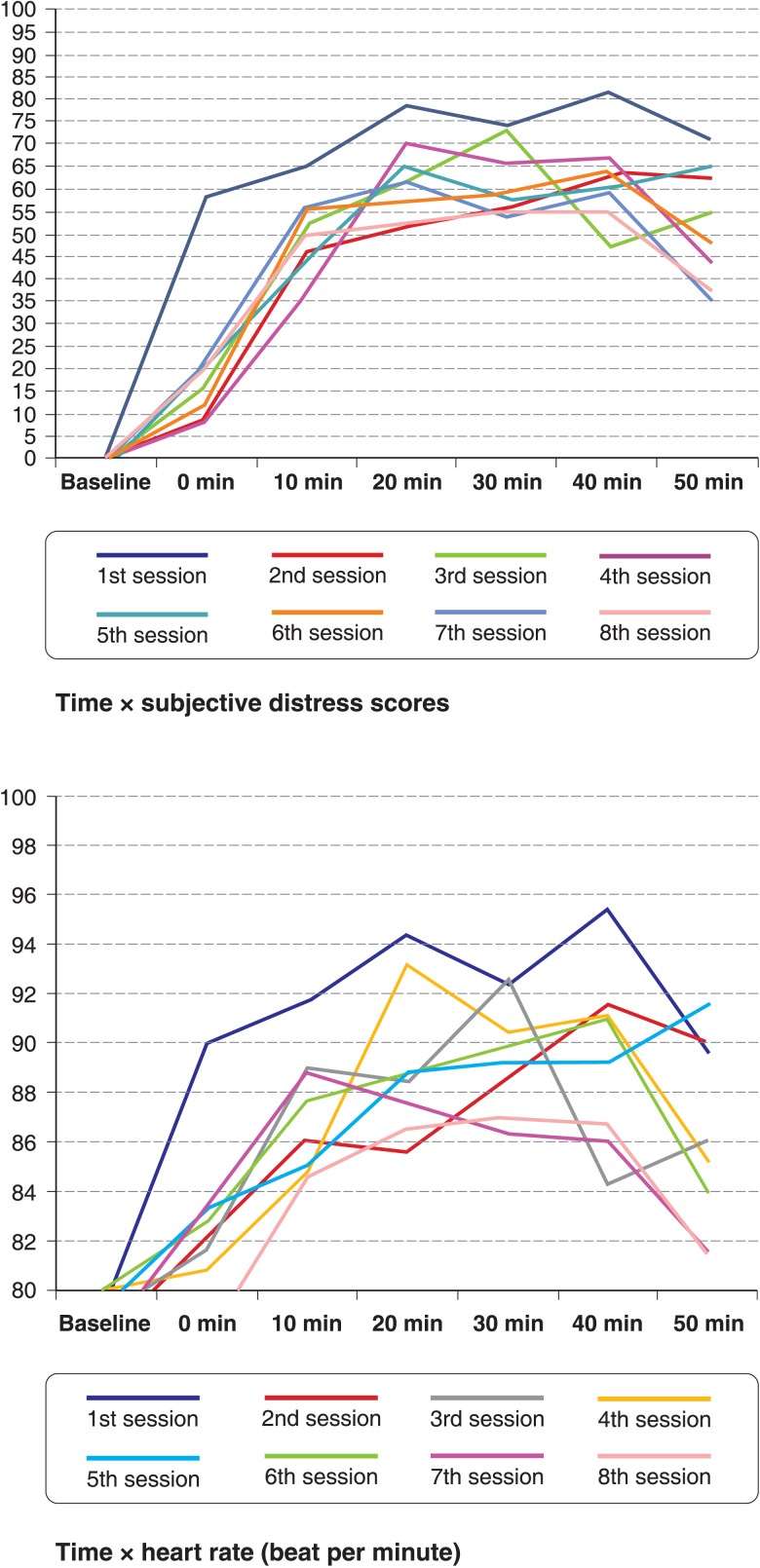
OBJECTIVE: To investigate the reactions of women with driving phobia to a therapeutic program of scheduled virtual reality exposure treatment (VRET) sessions. METHODS: The study intervention consisted of a computer game with car-driving scenarios that included several traffic situations. We investigated the participants' sense of presence, subjective distress, and physiological responses during eight virtual-reality exposures. We also evaluated clinical characteristics, driving cognitions, and quality of life in the participants. RESULTS: Thirteen women were selected. Eight were able to complete the protocol. After VRET, there was a decrease in the frequency of distorted thoughts and state anxiety scores, as well as a slight improvement in quality of life. Subjective discomfort scores, heart rate variation, and sense of presence scores confirmed that there was sense of presence in the virtual reality environment. CONCLUSION: All patients showed some degree of improvement and demonstrated different levels of anxiety in subsequent in vivo driving experiences. Our findings suggest that VRET could be used to facilitate in vivo exposure, because it can induce presence/immersion and reduce anxiety in patients with specific phobia. Furthermore, VRET is not associated with any type of risk.
Overview
The claims and statistics of this paper haven’t been checked yet.
Free: it reads the open-access text and checks the first 5 claims that cite a source we can check. Create a free account to check every claim.
Integrity signals
Registry
Cites
Statistics
Figures
Verification
Claims the paper makes
The claims and statistics of this paper haven’t been checked yet.
Free: it reads the open-access text and checks the first 5 claims that cite a source we can check. Create a free account to check every claim.
Claims other papers make about this one
Each is checked against this paper’s own text: does it say what the citing paper says it does?
The cited source says what the claim attributes to it.
In the citing paper
“The impact of treatment has also extended to CBT that incorporates virtual reality exposures (VR-CBT), which yielded QOL improvements for individuals with SAD [74] and SP [75, 76], although sample sizes were small.”
From Correlates of Quality of Life in Anxiety Disorders: Review of Recent Research (2021) · cites this paper as [75]
Self-check
Percentages, sums and reported differences re-computed from the paper’s own numbers.
The self-check needs the paper’s full text.
Citations
Cites
An inventory for measuring depression
BECK, A. T. (1961) · Archives of General Psychiatry · doi:10.1001/archpsyc.1961.01710120031004 · Cited by 38,032
(1992) · PubMed · Cited by 33,716
The MOS 36-ltem Short-Form Health Survey (SF-36): I. Conceptual Framework and Item Selection
Ware, J. E., & Sherbourne, C. D. (1992) · Medical Care · doi:10.1097/00005650-199206000-00002 · Cited by 30,033
(1970) · Cited by 24,983
The assessment of anxiety states by rating
HAMILTON, M. (1959) · British Journal of Medical Psychology · doi:10.1111/j.2044-8341.1959.tb00467.x · Cited by 11,455
Kilzer, E., & Skinner, B. F. (1953) · The American Catholic Sociological Review · doi:10.2307/3707860 · Cited by 8,943
Scoville, W. B. (1949) · Journal of neurosurgery · doi:10.3171/jns.1949.6.1.0065 · Cited by 7,381
Symonds, P. M. (1954) · Journal of Educational Psychology · doi:10.1037/h0051901 · Cited by 4,875
(1997) · American Psychiatric Press eBooks · Cited by 3,056
Conditioned Reflexes: An Investigation of the Physiological Activity of the Cerebral Cortex.
(1930) · Archives of Neurology And Psychiatry · doi:10.1001/archneurpsyc.1930.02220110256018 · Cited by 2,673
The practice of behavior therapy
Wolpe, J. (1969) · Cited by 2,343
Conditioned reflexes: An investigation of the physiological activity of the cerebral cortex
Pavlov, I. P. (2010) · Annals of neurosciences · doi:10.5214/ans.0972-7531.1017309 · Cited by 1,460
Amorim, P. (2000) · Revista Brasileira de Psiquiatria · doi:10.1590/s1516-44462000000300003 · Cited by 1,070
Virtual reality exposure therapy for anxiety disorders: A meta-analysis
Powers, M. B., & Emmelkamp, P. M. G. (2008) · Journal of Anxiety Disorders · doi:10.1016/j.janxdis.2007.04.006 · Cited by 904
Knight, R. G., Waal‐Manning, H. J., & Spears, G. F. (1983) · British Journal of Clinical Psychology · doi:10.1111/j.2044-8260.1983.tb00610.x · Cited by 693
The Practice of Behavior Therapy.
Moss, M. G. R. (1970) · Archives of General Psychiatry · doi:10.1001/archpsyc.1970.01750060095013 · Cited by 595
Psychological approaches in the treatment of specific phobias: A meta-analysis
Wolitzky-Taylor, K. B., Horowitz, J. D., Powers, M. B., & Telch, M. J. (2008) · Clinical Psychology Review · doi:10.1016/j.cpr.2008.02.007 · Cited by 530
Virtual reality exposure therapy of anxiety disorders: A review
Krijn, M., Emmelkamp, P. M. G., Olafsson, R. P., & Biemond, R. (2004) · Clinical Psychology Review · doi:10.1016/j.cpr.2004.04.001 · Cited by 492
Treatment of acrophobia in virtual reality: The role of immersion and presence
Krijn, M., Emmelkamp, P. M. G., Biemond, R., de Wilde de Ligny, C., Schuemie, M. J., & van der Mast, C. A. P. G. (2004) · Behaviour Research and Therapy · doi:10.1016/s0005-7967(03)00139-6 · Cited by 320
Virtual reality in mental health: A review of the literature
Gregg, L., & Tarrier, N. (2007) · Social Psychiatry and Psychiatric Epidemiology · doi:10.1007/s00127-007-0173-4 · Cited by 304
Andrade, L., Gorenstein, C., Vieira Filho, A. H., Tung, T. C., & Artes, R. (2001) · Brazilian Journal of Medical and Biological Research · doi:10.1590/s0100-879x2001000300011 · Cited by 186
Long-Term Outcome of Motor Vehicle Accident Injury
Mayou, R., Tyndel, S., & Bryant, B. (1997) · Psychosomatic Medicine · doi:10.1097/00006842-199711000-00004 · Cited by 184
State and trait anxiety in women affected by allergic and vasomotor rhinitis
Addolorato, G., Ancona, C., Capristo, E., Graziosetto, R., Di Rienzo, L., Maurizi, M., & Gasbarrini, G. (1999) · Journal of Psychosomatic Research · doi:10.1016/s0022-3999(98)00109-3 · Cited by 181
After the crash: Assessment and treatment of motor vehicle accident survivors.
Blanchard, E. B., & Hickling, E. J. (1997) · doi:10.1037/10237-000 · Cited by 167
The Use of Virtual Reality Exposure in the Treatment of Anxiety Disorders
Rothbaum, B. O., & Hodges, L. F. (1999) · Behavior Modification · doi:10.1177/0145445599234001 · Cited by 162
Efficacy of virtual reality exposure therapy to treat driving phobia: a case report
Wald, J., & Taylor, S. J. (2000) · Journal of Behavior Therapy and Experimental Psychiatry · doi:10.1016/s0005-7916(01)00009-x · Cited by 147
Clinical characteristics of driving phobia
Ehlers, A., Hofmann, S. G., Herda, C. A., & Roth, W. T. (1994) · Journal of Anxiety Disorders · doi:10.1016/0887-6185(94)00021-2 · Cited by 133
Computer‐supported cognitive behavioral treatment of anxiety disorders
Anderson, P., Jacobs, C., & Rothbaum, B. O. (2004) · Journal of Clinical Psychology · doi:10.1002/jclp.10262 · Cited by 132
Côté, S., & Bouchard, S. (2005) · Applied Psychophysiology and Biofeedback · doi:10.1007/s10484-005-6379-x · Cited by 125
EEG-Based Affect and Workload Recognition in a Virtual Driving Environment for ASD Intervention
Fan, J., Wade, J. W., Key, A. P., Warren, Z. E., & Sarkar, N. (2018) · IEEE Transactions on Biomedical Engineering · doi:10.1109/tbme.2017.2693157 · Cited by 121
Virtual Reality Exposure Therapy
Rothbaum, B. O. (2010) · The Corsini Encyclopedia of Psychology · doi:10.1002/9780470479216.corpsy1024 · Cited by 110
Analysis of Physiological Response to Two Virtual Environments: Driving and Flying Simulation
Jang, D. P., Kim, I. Y., Nam, S. W., Wiederhold, B. K., Wiederhold, M. D., & Kim, S. I. (2002) · CyberPsychology & Behavior · doi:10.1089/109493102753685845 · Cited by 102
Wilhelm, F. H., Pfaltz, M. C., Gross, J. J., Mauss, I. B., Kim, S. I., & Wiederhold, B. K. (2005) · Applied Psychophysiology and Biofeedback · doi:10.1007/s10484-005-6383-1 · Cited by 101
Taylor, J. E., Deane, F. P., & Podd, J. (2006) · Behaviour Research and Therapy · doi:10.1016/j.brat.2006.07.007 · Cited by 96
The Driving Cognitions Questionnaire: Development and preliminary psychometric properties
Ehlers, A., Taylor, J. E., Ehring, T. W., Hofmann, S. G., Deane, F. P., Roth, W. T., & Podd, J. (2006) · Journal of Anxiety Disorders · doi:10.1016/j.janxdis.2006.08.002 · Cited by 90
Current status of virtual reality exposure therapy in anxiety disorders: editorial review.
Pull, C. B. (2005) · PubMed · Cited by 86
Preliminary Research on the Efficacy of Virtual Reality Exposure Therapy to Treat Driving Phobia
Wald, J., & Taylor, S. (2003) · CyberPsychology & Behavior · doi:10.1089/109493103769710488 · Cited by 67
Escala Hamilton: estudo das características psicométricas em uma amostra do sul do Brasil
Freire, M. Á., Figueiredo, V. L. M. D., Gomide, A., Jansen, K., Silva, R. A. D., Magalhães, P. V. D. S., & Kapczinski, F. P. (2014) · Jornal Brasileiro de Psiquiatria · doi:10.1590/0047-2085000000036 · Cited by 66
Comparison and Characteristics of Motor Vehicle Accident (MVA) and Non-MVA Driving Fears
Taylor, J. E., & Deane, F. P. (2000) · Journal of Anxiety Disorders · doi:10.1016/s0887-6185(99)00040-7 · Cited by 66
Determining the Focus of Driving Fears
Taylor, J. E., Deane, F. P., & Podd, J. (2000) · Journal of Anxiety Disorders · doi:10.1016/s0887-6185(00)00033-5 · Cited by 65
Virtual Reality and Applied Psychophysiology
Wiederhold, B. K., & Rizzo, A. (2005) · Applied Psychophysiology and Biofeedback · doi:10.1007/s10484-005-6375-1 · Cited by 61
Virtual Reality: A New Tool for Interdisciplinary Psychology Research
HOFFMAN, H. (1998) · CyberPsychology & Behavior · doi:10.1089/cpb.1998.1.195 · Cited by 57
Acquisition and severity of driving-related fears
Taylor, J. E., & Deane, F. P. (1999) · Behaviour Research and Therapy · doi:10.1016/s0005-7967(98)00065-5 · Cited by 55
Virtual reality exposure therapy abbreviated treatment manual: Fear of flying application
ROTHBAUM, B. O., Hodges, L. F., & Smith, S. G. (1999) · Cognitive and Behavioral Practice · doi:10.1016/s1077-7229(99)80081-9 · Cited by 42
Riva, G., & Wiederhold, B. K. (2002) · IEEE Transactions on Information Technology in Biomedicine · doi:10.1109/titb.2002.802369 · Cited by 34
Virtual Reality Exposure Therapy
Meyerbröker, K. (2014) · Wiley eBooks · doi:10.1002/9781118775349.ch63 · Cited by 26
After the Crash: Assessment and Treatment of Motor Vehicle Accident Survivors
Donders, J. (1998) · Journal of Head Trauma Rehabilitation · doi:10.1097/00001199-199806000-00011 · Cited by 20
Demographics, clinical characteristics and quality of life of Brazilian women with driving phobia
da Costa, R. T., de Carvalho, M. R., Cantini, J. A., Freire, R. C. R., & Nardi, A. E. (2013) · Comprehensive Psychiatry · doi:10.1016/j.comppsych.2013.08.003 · Cited by 20
Self-citationDriving Cognitions Questionnaire: estudo de equivalência semântica
de Carvalho, M. R., da Costa, R. T., Sardinha, A., Neto, V. L. D. M., & Nardi, A. E. (2011) · Revista de Psiquiatria do Rio Grande do Sul · doi:10.1590/s0101-81082011000100007 · Cited by 12
Self-citation
Research works printed but not linked: 5
- Herda CA Ehlers A Roth WT Diagnostic classification of driving phobia Anxiety Disord Pract J 1993 1 9 16
- Costa RT Carvalho MR Nardi AE Exposição por realidade virtual no tratamento do medo de dirigir Psic Teor Pesq 2010 26 131 7
- Bellina C Fobia de dirigir Rev Assoc Bras Med Traf 2003 42 30 2
- Loomis JM Klatzky RL Golledge RG Philbeck JW Human navigation by path integration Golledge RG Wayfinding: cognitive mapping and other spatial processes Baltimore Johns Hopkins 1999 125 51
- Ciconelli RM Translation into Portuguese and validation of the generic questionnaire for assessing quality of life: “Medical Outcomes Study 36 – Item Short-Form Health Survey” (SF-36). [dissertation]. São Paulo Universidade Federal de São Paulo 1997
Cited by
Virtual reality in the diagnostic and therapy for mental disorders: A systematic review
Wiebe, A., Kannen, K., Selaskowski, B., Mehren, A., Thöne, A.-K., Pramme, L., Blumenthal, N., Li, M., Asché, L., Jonas, S., et al. (2022) · Clinical Psychology Review · doi:10.1016/j.cpr.2022.102213 · Cited by 223
Virtual Reality Exposure Treatment in Phobias: a Systematic Review
Freitas, J. R. S., Velosa, V. H. S., Abreu, L. T. N., Jardim, R. L., Santos, J. A. V., Peres, B., & Campos, P. F. (2021) · Psychiatric Quarterly · doi:10.1007/s11126-021-09935-6 · Cited by 188
“The first article [38] consisted of a computer game supported by car-driving environments, including several traffic situations.”
BackgroundHalbig, A., & Latoschik, M. E. (2021) · Frontiers in Virtual Reality · doi:10.3389/frvir.2021.694567 · Cited by 163
Correlates of Quality of Life in Anxiety Disorders: Review of Recent Research
Wilmer, M. T., Anderson, K., & Reynolds, M. (2021) · Current Psychiatry Reports · doi:10.1007/s11920-021-01290-4 · Cited by 150
Provider experiences of virtual reality in clinical treatment
Vincent, C., Eberts, M., Naik, T., Gulick, V., & O’Hayer, C. V. (2021) · PLOS ONE · doi:10.1371/journal.pone.0259364 · Cited by 52
Metadata
- Authors
- Costa, R. T. D., Carvalho, M. R. D., Ribeiro, P., & Nardi, A. E.
- Affiliations
- Conselho Nacional de Desenvolvimento Científico e Tecnológico (BR)
- Universidade Federal do Rio de Janeiro (BR)
- Universidade Federal do Rio de Janeiro, Brazil; Conselho Nacional de Desenvolvimento Científico e Tecnológico, Brazil; Laboratório de Pânico e Respiração, Brazil
- Corresponding author
- Costa, Rafael T. da
- Venue
- Revista Brasileira de Psiquiatria
- Publisher
- EDITORA SCIENTIFIC
- Published
- 2018-02-15
- Volume
- 40
- Issue
- 2
- Pages
- 192-199
- ISSN
- 1516-4446 (ISSN-L)
- 1809-452X
- PMC
- PMC6900765
- OpenAlex
- W2792379074
- Cited by
- 48
- References
- 50
- Citations by year
- 2026: 4 · 2025: 7 · 2024: 7 · 2023: 3 · 2022: 6 · 2021: 15 · 2020: 2 · 2019: 3 · 2018: 1
- FWCI
- 5.23
- Type
- journal article
- Language
- en
- Open access
- diamond
- doi.org
- Licence
- cc-by-nc
- Locations
- Brazilian Journal of Psychiatry (publishedVersion, cc-by-nc)
- Europe PMC (PubMed Central) (publishedVersion, cc-by-nc)
- PubMed Central (publishedVersion, cc-by-nc)
- PubMed (publishedVersion)
- LA Referencia (Red Federada de Repositorios Institucionales de Publicaciones Científicas) (publishedVersion, other-oa)
- Americanae (AECID Library) (submittedVersion, other-oa)
- DOAJ (DOAJ: Directory of Open Access Journals) (submittedVersion, cc-by-sa)
- Funders
- Conselho Nacional de Desenvolvimento Científico e Tecnológico
- Topics
- Physical Sciences › Computer Science › Human-Computer Interaction › Virtual Reality Applications and Impacts
- Social Sciences › Psychology › Experimental and Cognitive Psychology › Anxiety, Depression, Psychometrics, Treatment, Cognitive Processes
- Social Sciences › Psychology › Applied Psychology › Digital Mental Health Interventions
- Keywords
- virtual reality exposure therapy, fear of driving, driving phobia, specific phobia, presence, immersion, anxiety reduction, physiological responses, heart rate variability, quality of life, women
- MeSH terms
- Virtual Reality, Adult, Anxiety Disorders, Automobile Driving, Brazil, Educational Status, Fear, Female, Heart Rate, Humans, Phobic Disorders, Quality of Life, Virtual Reality Exposure Therapy
About these checks
Registry, retraction, Cites and statistics results are computed, not judged, with one exception: a printed reference that no index lists is read once by a model before it counts as a citation error. Claims are extracted by a model and kept only when their quote appears verbatim in the text; each cited source is then checked, with a model’s help, for whether it says what the claim relies on. Those verdicts can be wrong — read the claim’s quote and the cited source before relying on one.
Statistics and arithmetic are recomputed, not judged.
Confidence bands are shown only for fields calibrated on our annotated test set. None is calibrated yet, so no band is shown.
What counts as a claim ›How we measure confidence ›How we check this ›
Are you an author, or do you see a problem with this page? Request a review
Data sources
Bibliographic data: Semantic Scholar, OpenAlex, Crossref.
Contains information from the Semantic Scholar Academic Graph Datasets, made available under the ODC Attribution License (ODC-BY 1.0).
Semantic Scholar’s data is described in: Kinney, R., et al. (2023). The Semantic Scholar Open Data Platform. arXiv:2301.10140.
