

Nitrous oxide as an adjunctive therapy in major depressive disorder: a randomized controlled double-blind pilot trial
Open accessThe DOI matches its Crossref record; 36 of the 36 references it cites were found in a registry or an index.
Abstract
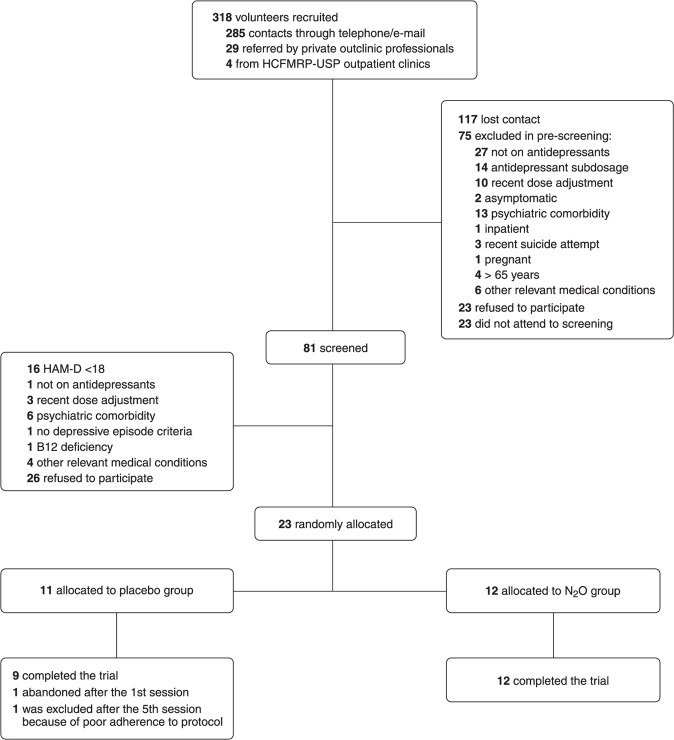
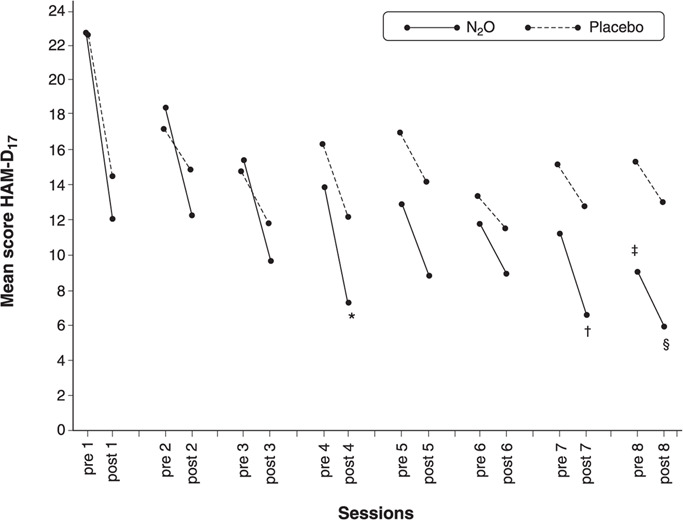
OBJECTIVE: Major depressive disorder (MDD) is related to glutamatergic dysfunction. Antagonists of glutamatergic N-methyl-D-aspartate receptor (NMDAR), such as ketamine, have antidepressant properties. Nitrous oxide (N2O) is also a NMDAR antagonist. Thus, this study aimed to evaluate the effects of augmenting antidepressant treatment with N2O. METHODS: This double blind, placebo-controlled randomized parallel pilot trial was conducted from June 2016 to June 2018 at the Hospital das Clínicas, Faculdade de Medicina de Ribeirão Preto, Universidade de São Paulo. Twenty-three subjects with MDD (aged 18 to 65, on antidepressants, with a score > 17 on the 17-item-Hamilton Depression Rating Scale [HAM-D17]) received 50% N2O (n=12; 37.17±13.59 years) or placebo (100% oxygen) (n=11; 37.18±12.77 years) for 60 minutes twice a week for 4 weeks. The primary outcome was changes in HAM-D17 from baseline to week 4. RESULTS: Depressive symptoms improved significantly in the N2O group (N2O: from 22.58±3.83 to 5.92±4.08; placebo: from 22.44±3.54 to 12.89±5.39, p < 0.005). A total of 91.7% and 75% of the N2O group subjects achieved response (≥ 50% reduction in HAM-D17 score) and remission (HAM-D17 < 7), respectively. The predominant adverse effects of N2O treatment were nausea, vomiting, and headache. CONCLUSION: N2O treatment led to a statistically significant reduction in HAM-D17 scores compared to placebo. CLINICAL TRIAL REGISTRATION: Brazilian Register of Clinical Trials, RBR-5rz5ch.
Overview
The claims and statistics of this paper haven’t been checked yet.
Free: it reads the open-access text and checks the first 5 claims that cite a source we can check. Create a free account to check every claim.
Integrity signals
Registry
Cites
Statistics
Figures
Verification
Claims the paper makes
The claims and statistics of this paper haven’t been checked yet.
Free: it reads the open-access text and checks the first 5 claims that cite a source we can check. Create a free account to check every claim.
Claims other papers make about this one
Each is checked against this paper’s own text: does it say what the citing paper says it does?
The cited source says what the claim attributes to it.
In the citing paper
“Preliminary evidence supports that inhaled N2O improves treatment-resistant depressive symptoms (120).”
From Chronic stress, neuroinflammation, and depression: an overview of pathophysiological mechanisms and emerging anti-inflammatories (2023) · cites this paper as [120]
Self-check
Percentages, sums and reported differences re-computed from the paper’s own numbers.
The self-check needs the paper’s full text.
Citations
Cites
Antidepressant effects of ketamine in depressed patients
Berman, R. M., Cappiello, A., Anand, A., Oren, D. A., Heninger, G. R., Charney, D. S., & Krystal, J. H. (2000) · Biological Psychiatry · doi:10.1016/s0006-3223(99)00230-9 · Cited by 3,856
Nestler, E. J., Barrot, M., DiLeone, R. J., Eisch, A. J., Gold, S. J., & Monteggia, L. M. (2002) · Neuron · doi:10.1016/s0896-6273(02)00653-0 · Cited by 3,217
Collingridge, G. L., Kehl, S. J., & McLennan, H. (1983) · The Journal of Physiology · doi:10.1113/jphysiol.1983.sp014478 · Cited by 2,413
Hay, S. I., Abajobir, A. A., Abate, K. H., Abbafati, C., Abbas, K. M., Abd-Allah, F., Abdulkader, R. S., Abdulle, A. M., Abebo, T. A., Abera, S. F., et al. (2017) · The Lancet · doi:10.1016/s0140-6736(17)32130-x · Cited by 2,083
Practice Guidelines for Sedation and Analgesia by Non-Anesthesiologists
(2002) · Anesthesiology · doi:10.1097/00000542-200204000-00031 · Cited by 1,950
The Economic Burden of Adults With Major Depressive Disorder in the United States (2005 and 2010)
Greenberg, P. E., Fournier, A.-A., Sisitsky, T., Pike, C. T., & Kessler, R. C. (2015) · The Journal of Clinical Psychiatry · doi:10.4088/jcp.14m09298 · Cited by 1,779
Kessler, R. C. (2012) · Psychiatric Clinics of North America · doi:10.1016/j.psc.2011.11.005 · Cited by 871
Functional antagonists at the NMDA receptor complex exhibit antidepressant actions
Trullas, R., & Skolnick, P. (1990) · European Journal of Pharmacology · doi:10.1016/0014-2999(90)90204-j · Cited by 785
Kessler, R. C., Sampson, N. A., Berglund, P., Gruber, M. J., Al-Hamzawi, A., Andrade, L., Bunting, B., Demyttenaere, K., Florescu, S., de Girolamo, G., et al. (2015) · Epidemiology and Psychiatric Sciences · doi:10.1017/s2045796015000189 · Cited by 636
Attenuation of Antidepressant Effects of Ketamine by Opioid Receptor Antagonism
Williams, N. R., Heifets, B. D., Blasey, C., Sudheimer, K., Pannu, J., Pankow, H., Hawkins, J., Birnbaum, J., Lyons, D. M., Rodriguez, C. I., et al. (2018) · American Journal of Psychiatry · doi:10.1176/appi.ajp.2018.18020138 · Cited by 519
Research works printed but not linked: 1
- Clark MS Brunik AL Handbook of nitrous oxide and oxygen sedation. 4th ed. St. Louis Elsevier 2015
Cited by
Hassamal, S. (2023) · Frontiers in Psychiatry · doi:10.3389/fpsyt.2023.1130989 · Cited by 578
“Preliminary evidence supports that inhaled N2O improves treatment-resistant depressive symptoms (120).”
BackgroundNovel Pharmacological Approaches to the Treatment of Depression
Elias, E., Zhang, A. Y., & Manners, M. T. (2022) · Life · doi:10.3390/life12020196 · Cited by 90
“Although N2O may be promising for TRD treatment, there are obstacles for utilizing this treatment such as side effects [142] and inconvenient administration.”
BackgroundTargeting NMDA Receptors in Emotional Disorders: Their Role in Neuroprotection
Wang, S., Bian, L.-H., Yin, Y., & Guo, J. (2022) · Brain Sciences · doi:10.3390/brainsci12101329 · Cited by 39
Intrinsic Connectivity Networks of Glutamate-Mediated Antidepressant Response: A Neuroimaging Review
Demchenko, I., Tassone, V. K., Kennedy, S. H., Dunlop, K., & Bhat, V. (2022) · Frontiers in Psychiatry · doi:10.3389/fpsyt.2022.864902 · Cited by 29
Kim, W. S. H., Dimick, M. K., Omrin, D., Mitchell, R. H. B., Riegert, D., Levitt, A., Schaffer, A., Belo, S., Iazzetta, J., Detzler, G., et al. (2023) · Bipolar Disorders · doi:10.1111/bdi.13288 · Cited by 24
Brenna, C. T. A., Goldstein, B. I., Zarate, C. A., & Orser, B. A. (2024) · Anesthesiology · doi:10.1097/aln.0000000000005037 · Cited by 24
All roads lead to glutamate: NMDA and AMPA receptors as targets for rapid-acting antidepressants
Freudenberg, F., Reif-Leonhard, C., Dawson, G. R., McKernan, R. M., & Reif, A. (2025) · Pharmacological Research · doi:10.1016/j.phrs.2025.107918 · Cited by 23
The boon and bane of nitrous oxide
Kronenberg, G., Schoretsanitis, G., Seifritz, E., & Olbrich, S. (2024) · European Archives of Psychiatry and Clinical Neuroscience · doi:10.1007/s00406-024-01801-3 · Cited by 20
“One study used a multiple-dose design with a longer follow-up [19] compared to the remainder of the studies and was therefore not included (Table 1).”
Liu, H., Kerzner, J., Demchenko, I., Wijeysundera, D. N., Kennedy, S. H., Ladha, K. S., & Bhat, V. (2022) · Acta Psychiatrica Scandinavica · doi:10.1111/acps.13432 · Cited by 20
“Two of the three RCTs used crossover assignment,12,13 and one used parallel assignment.(11) The concentration of 50% N2O was administered in all five studies, and one study focused on comparing 25% to 50% N2O.”
BackgroundMethodResultInfluentialRech, P., Custodio, R. M., Uggioni, M. L. R., Prestes, G. D. S., Marçal, F., Silveira, V., Dagostin, V. S., Colonetti, T., & da Rosa, M. I. (2023) · Progress in Neuro-Psychopharmacology and Biological Psychiatry · doi:10.1016/j.pnpbp.2023.110869 · Cited by 18
Advancing past ketamine: emerging glutamatergic compounds for the treatment of depression
Freudenberg, F., Reif-Leonhard, C., & Reif, A. (2024) · European Archives of Psychiatry and Clinical Neuroscience · doi:10.1007/s00406-024-01875-z · Cited by 18
“A Brazilian study examined the effect of repeated (twice weekly, over four weeks) nitrous oxide inhalations and found remarkable improvement in non-TRD patients [77].”
Nitrous Oxide: an emerging novel treatment for treatment-resistant depression
Quach, D. F., de León-Martínez, V., & Conway, C. R. (2021) · Journal of the Neurological Sciences · doi:10.1016/j.jns.2021.120092 · Cited by 17
Anesthetics as Treatments for Depression: Clinical Insights and Underlying Mechanisms
Breault, M. S., Orguc, S., Kwon, O., Kang, G. H., Tseng, B., Schreier, D. R., & Brown, E. N. (2025) · Annual Review of Neuroscience · doi:10.1146/annurev-neuro-112723-062031 · Cited by 13
Liu, J., Zhao, X., Wei, X., Yan, D., Ou, W., Liao, M., Ji, S., Peng, Y., Wu, S., Wang, M., et al. (2023) · Psychiatry Research · doi:10.1016/j.psychres.2023.115326 · Cited by 13
Desmidt, T., Dujardin, P., Andersson, F., Brizard, B., Réméniéras, J.-P., Gissot, V., Arlicot, N., Barantin, L., Espitalier, F., Belzung, C., et al. (2023) · Molecular Psychiatry · doi:10.1038/s41380-023-02217-6 · Cited by 12
“Nitrous oxide (N 2 O) has recently emerged as a potential fast-acting antidepressant, based on a series of randomized controlled trials that showed a rapid action of N 2 O to reduce depressive symptoms in patients with treatment-resistant depression (TRD) [1 – 5].”
Persistent Brain Connectivity Changes in Healthy Volunteers Following Nitrous Oxide Inhalation
Palanca, B. J. A., Conway, C. R., Zeffiro, T. A., Gott, B. M., Nguyen, T. A., Janski, A. M., Jain, N., Komen, H., Burke, B. A., Zorumski, C. F., et al. (2023) · Biological Psychiatry Global Open Science · doi:10.1016/j.bpsgos.2023.01.006 · Cited by 10
“Recently, nitrous oxide has shown promise in the treat-ment of major depressive disorder (3 – 6), posttraumatic stress disorder (7), alcohol withdrawal (8), and bipolar depression (9,10).”
BackgroundQiu, Y., Li, L., Duan, A., Wang, M., Xie, M., Chen, Z., & Wang, Z. (2023) · Psychopharmacology · doi:10.1007/s00213-023-06449-w · Cited by 8
Rapid antidepressant potential of nitrous oxide: current state and major questions
Zorumski, C. F., Cichon, J., Izumi, Y., Zeffiro, T. A., Mennerick, S. J., Nägele, P., & Conway, C. R. (2025) · Molecular Psychiatry · doi:10.1038/s41380-025-03439-6 · Cited by 7
“Guimaraes et al. [34] conducted a double-blind, parallel design trial of 12 N 2 O and 11 placebo-treated individuals using 50% N 2 O administered for one hour twice weekly for four weeks.”
Paganin, W. (2025) · PubMed Central · doi:10.36131/cnfioritieditore20250610 · Cited by 7
“(Rameau et al., 2007; Liu et al., 2020; Wang et al., 2021; Nobis et al., 2023; Nagele et al., 2021; Shao et al., 2020; Guimarães et al., 2021).”
A synopsis of multitarget therapeutic effects of anesthetics on depression
Wu, G., & Xu, H. (2023) · European Journal of Pharmacology · doi:10.1016/j.ejphar.2023.176032 · Cited by 7
Myles, P. S., Kulkarni, J., Kasza, J., Wallace, S. K. A., Deng, C., Turbić, A., Aykanat, V. M., Conway, C. R., Brown, F., Lee, R., et al. (2025) · Biological Psychiatry Global Open Science · doi:10.1016/j.bpsgos.2025.100504 · Cited by 8
“Although we and others have conducted some preliminary studies of nitrous oxide in similar populations, each supporting proof of concept, this evidence was restricted to short-term (1 – 2 weeks) follow-up (13,14,18).”
Ladha, K. S., Lee, J., Mattina, G. F., Pazmino‐Canizares, J., Wijeysundera, D. N., Nezhad, F. G., Philip, K., Tassone, V. K., Adamsahib, F., Bhat, V., et al. (2024) · PLoS ONE · doi:10.1371/journal.pone.0297330 · Cited by 7
“…with TRD and non-TRD suggests that repeated admin-istrations of nitrous oxide over four weeks may produce cumulative amelioration of depressive symptoms [19], this study also lacked adequate blinding; and it is unclear whether these results can be translated to patients with TRD specifically.”
BackgroundNitrous oxide for the treatment of depression: a systematic review and meta-analysis
Gill, K., de Cates, A. N., Wiseman, C. E., Murphy, S. E., Williams, E., Harmer, C. J., Morales‐Muñoz, I., & Marwaha, S. (2025) · EBioMedicine · doi:10.1016/j.ebiom.2025.106023 · Cited by 7
“51,54 In the meta-analysis (Fig.”
InfluentialMaji, S., Mishra, A., Mohapatra, D., Mishra, B. R., Jena, M., Srinivasan, A., & Maiti, R. (2024) · Psychiatry Research · doi:10.1016/j.psychres.2024.116257 · Cited by 5
Conway, C. R., Palanca, B. J. A., Zeffiro, T. A., Gott, B. M., Brown, F., de León-Martínez, V., Barnes, L., Nguyen, T. A., Xiong, W., Lessov‐Schlaggar, C. N., et al. (2024) · medRxiv · doi:10.1101/2024.08.12.24311729 · Cited by 6
Su, Y., Zou, J., Guo, J., Qi, Y., Li, Y., Nie, B., Dong, Z., & Zhang, W. (2025) · Frontiers in Medicine · doi:10.3389/fmed.2025.1683066 · Cited by 3
Examining memory reconsolidation as a mechanism of nitrous oxide’s antidepressant action
Williams, E., Taujanskaitė, U., Kamboj, S. K., Murphy, S. E., & Harmer, C. J. (2025) · Neuropsychopharmacology · doi:10.1038/s41386-024-02049-0 · Cited by 45
“…sessions have additionally been conducted; in a double-blind placebo-controlled trial, Guimarães and colleagues recorded acute and cumulative reductions in depressive symptoms following multiple inhalation sessions (60-minutes with 50% N 2 O), which occurred twice a week for four weeks [26].”
InfluentialKronenberg, G., Müller, A. M., Seifritz, E., & Olbrich, S. (2022) · European Archives of Psychiatry and Clinical Neuroscience · doi:10.1007/s00406-022-01502-9 · Cited by 2
“1a), corroborating previous findings [1, 2].”
BackgroundLadha, K. S., Lee, J., Mattina, G. F., Pazmino‐Canizares, J., Wijeysundera, D. N., Nezhad, F. G., Tassone, V. K., Adamsahib, F., Lou, W. Y. W., Kennedy, S. H., et al. (2025) · BJPsych Open · doi:10.1192/bjo.2025.10823 · Cited by 3
Application of Anesthetic Agents in Depression
Vutskits, L. (2024) · Elsevier eBooks · doi:10.1016/b978-0-323-93273-8.00026-2 · Cited by 1
Beyond surgery: Repurposing anesthetics for treatment of central nervous system disorders
Mielko, J., Pakulska, J., Oszczyk, A., Lustyk, K., Pytka, K., & Sałaciak, K. (2025) · Progress in Neuro-Psychopharmacology and Biological Psychiatry · doi:10.1016/j.pnpbp.2025.111386 · Cited by 1
Which is the best way of using nitrous oxide for treatment and research in neuropsychiatry?
Gillman, M. A. (2021) · Brazilian Journal of Psychiatry · doi:10.1590/1516-4446-2021-1879 · Cited by 1
General anaesthetics and therapeutic gases
Tandon, A., & Hall, A. (2022) · Side effects of drugs annual · doi:10.1016/bs.seda.2022.07.004 · Cited by 1
Nitrous Oxide in the Treatment of Depression: A Brief Review
Hughes, M. E. (2024) · American Journal of Psychiatry Residents Journal · doi:10.1176/appi.ajp-rj.2024.200207 · Cited by 1
Nunes, R. D., Fermino, P. M. P., Martins, A. L. P., dos Santos, S. L., Campos, T., Parma, G. C., & Traebert, J. L. (2021) · Brazilian Journal of Psychiatry · doi:10.1590/1516-4446-2021-1815
Janski, A. M., Hristidis, V. C., Zorumski, C. F., & Conway, C. R. (2023) · Elsevier eBooks · doi:10.1016/b978-0-323-95702-1.00064-6
The use of inhaled gases in psychiatry
Hristidis, V. C., Nägele, P., Palanca, B. J. A., Tadler, S. C., Mickey, B. J., Gott, B. M., & Conway, C. R. (2024) · Elsevier eBooks · doi:10.1016/b978-0-443-18496-3.00016-1
Provaznikova, B., Olbrich, S., Seifritz, E., Haas, M., & Kronenberg, G. (2025) · Psychiatry Research Case Reports · doi:10.1016/j.psycr.2025.100261
No Laughing Matter: Nitrous Oxide and Depression
Williams, E., & Cowen, P. J. (2025) · Biological Psychiatry Global Open Science · doi:10.1016/j.bpsgos.2025.100551
“In a small study by Guimarães et al. (9), 75% of patients with depression who received 60-minute sessions of 50% nitrous oxide twice weekly for 4 weeks achieved remission compared with 11% in the placebo group.”
Kronenberg, G., Bankwitz, A., Provaznikova, B., Müller, M., Quednow, B. B., Seifritz, E., & Olbrich, S. (2025) · BMJ Open · doi:10.1136/bmjopen-2024-096825
“30 So far, the limited literature on N 2 O mainly focused on depression (eg, adjunctive N 2 O therapy in major depression 31 ; so-called treatment-resistant depression 32–34 and bipolar depression).”
Nitrous Oxide (Laughing Gas) as a Rapid-Acting Antidepressant
Kronenberg, G., Provaznikova, B., Olbrich, S., & Seifritz, E. (2025) · Psychopharmakotherapie · doi:10.52778/ppt20250031
Wei, X., Xu, S., & Zhu, Z. (2026) · Current Neuropharmacology · doi:10.2174/011570159x458197260226055817
“Notably, N 2 O has also demonstrated rapid and sustained efficacy in treating patients with depression [67-69].”
Psychedelics: Future Therapeutics in Major Depression?
Olivier, B., & Olivier, J. D. A. (2026) · Advances in experimental medicine and biology · doi:10.1007/978-981-95-6872-7_25
González-Hernández, G., Torres-Sánchez, S., Morillo, D., Rantamäki, T., & Berrocoso, E. (2026) · Biology of Sex Differences · doi:10.1186/s13293-026-00945-2
“In recent years, several clinical trials have suggested that N₂O may also exert rapid and durable antidepressant effects in patients with major depressive disorder and treatment-resistant major depression [9–12].”
Annequin, D. (2025) · Dunod eBooks · doi:10.3917/dunod.poisb.2025.01.1405
New Developments in Anesthetic Mechanism Research
Deng, J., & Zuo, Z. (2026) · Springer eBooks · doi:10.1007/978-3-032-25214-2_2
Metadata
- Authors
- Guimarães, M. C., Guimarães, T. M., Hallak, J. E., Abrão, J., & Machado-de-Sousa, J. P.
- Affiliations
- Universidade de São Paulo (BR)
- Conselho Nacional de Desenvolvimento Científico e Tecnológico (BR)
- Universidade de São Paulo (USP), Brazil; Instituto Nacional de Ciência e Tecnologia Translacional em Medicina (INCT-TM), Conselho Nacional de Desenvolvimento Científico e Tecnológico (CNPq), Brazil
- Corresponding author
- Guimarães, Mara C.
- Venue
- Brazilian Journal of Psychiatry
- Publisher
- EDITORA SCIENTIFIC
- Published
- 2021-10
- Volume
- 43
- Issue
- 5
- Pages
- 484-493
- ISSN
- 1516-4446 (ISSN-L)
- 1809-452X
- PMC
- PMC8555644
- OpenAlex
- W3131166628
- Semantic Scholar
- 900f448142617d46dc6600f64be28d3e8e16f333
- Cited by
- 42
- References
- 36
- Citations by year
- 2026: 3 · 2025: 12 · 2024: 9 · 2023: 8 · 2022: 7 · 2021: 3
- FWCI
- 3.94
- Type
- journal article
- Language
- en
- Open access
- diamond
- doi.org
- Licence
- cc-by-nc
- creativecommons.org/licenses/by-nc/4.0/ (vor)
- creativecommons.org/licenses/by-nc/4.0/ (am)
- creativecommons.org/licenses/by-nc/4.0/ (tdm)
- Locations
- Brazilian Journal of Psychiatry (publishedVersion, cc-by-nc)
- Europe PMC (PubMed Central) (publishedVersion, other-oa)
- PubMed Central (publishedVersion, cc-by-nc)
- PubMed (publishedVersion)
- LA Referencia (Red Federada de Repositorios Institucionales de Publicaciones Científicas) (publishedVersion, other-oa)
- DOAJ (DOAJ: Directory of Open Access Journals) (submittedVersion, cc-by-sa)
- Topics
- Health Sciences › Medicine › Pharmacology (medical) › Treatment of Major Depression
- Health Sciences › Medicine › Psychiatry and Mental health › Electroconvulsive Therapy Studies
- Life Sciences › Neuroscience › Neurology › Transcranial Magnetic Stimulation Studies
- Keywords
- nitrous oxide, major depressive disorder, adjunctive therapy, NMDA receptor antagonists, antidepressant augmentation, glutamatergic dysfunction, ketamine, HAM-D-17, treatment response and remission, adverse effects
- MeSH terms
- Antidepressive Agents, Brazil, Major Depressive Disorder, Double-Blind Method, Humans, Nitrous Oxide, Pilot Projects, Treatment Outcome
About these checks
Registry, retraction, Cites and statistics results are computed, not judged, with one exception: a printed reference that no index lists is read once by a model before it counts as a citation error. Claims are extracted by a model and kept only when their quote appears verbatim in the text; each cited source is then checked, with a model’s help, for whether it says what the claim relies on. Those verdicts can be wrong — read the claim’s quote and the cited source before relying on one.
Statistics and arithmetic are recomputed, not judged.
Confidence bands are shown only for fields calibrated on our annotated test set. None is calibrated yet, so no band is shown.
What counts as a claim ›How we measure confidence ›How we check this ›
Are you an author, or do you see a problem with this page? Request a review
Data sources
Bibliographic data: Semantic Scholar, OpenAlex, Crossref.
Contains information from the Semantic Scholar Academic Graph Datasets, made available under the ODC Attribution License (ODC-BY 1.0).
Semantic Scholar’s data is described in: Kinney, R., et al. (2023). The Semantic Scholar Open Data Platform. arXiv:2301.10140.
