

Freqüência cardíaca máxima em testes de exercício em esteira rolante e em cicloergômetro de membros inferiores
Open accessThe DOI matches its Crossref record; 28 of the 28 references it cites were found in a registry or an index.
Abstract
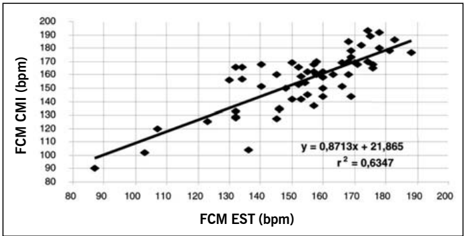
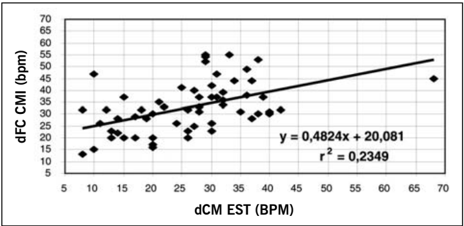
OBJECTIVE: To compare, retrospectively, the values of maximum heart rate (MHR) and the decrease of the heart rate at the first minute of recovery, which were obtained in an exercise test (ET) performed in two different ergometers and at different moments. METHODS: Sixty individuals (from 29 to 80 years old), submitted to cardiopulmonary ET in a cycle of lower limbs (CLL) in our laboratory and who had previous ET (up to 36 months) in a treadmill (TRM) in other laboratories, under identical conditions of medications of negative chronotropic action. RESULTS: MHR was similar in CLL: 156 +/- 3 and TRM: 154 +/- 2 bpm (p=0.125), whereas dHR was higher in CLL: 33 +/- 2, EST: 26 +/- 3 bpm (mean +/- standard error of the mean) (p<0.001). In hemodynamic variables studied, the systolic blood pressure and the double product were higher in the ET-CLL (p<0.001). The electrocardiogram (ECG) was similar in both ETs, except due to more frequent supraventricular arrhythmias in CLL. CONCLUSION: a) With some diligence from the examiner and previous knowledge of MHR in a previous ET it is possible to obtain high levels of MHR in an ET-CLL; b) interrupting the MHR-based ET forecast through equations tends to lead to sub-maximum efforts; c) dHR differs in active and passive recoveries; d) new ways to analyze the HR behavior under exercise, which is not only the value of MHR, are necessary to characterize an ET as maximum.
Overview
The claims and statistics of this paper haven’t been checked yet.
Free: it reads the open-access text and checks the first 5 claims that cite a source we can check. Create a free account to check every claim.
Integrity signals
Registry
Cites
Statistics
Figures
Verification
Claims the paper makes
The claims and statistics of this paper haven’t been checked yet.
Free: it reads the open-access text and checks the first 5 claims that cite a source we can check. Create a free account to check every claim.
Self-check
Percentages, sums and reported differences re-computed from the paper’s own numbers.
The self-check needs the paper’s full text.
Citations
Cites
Age-predicted maximal heart rate revisited
Tanaka, H., Monahan, K. D., & Seals, D. R. (2001) · Journal of the American College of Cardiology · doi:10.1016/s0735-1097(00)01054-8 · Cited by 3,775
Heart-rate Recovery Immediately After Exercise as a Predictor of Mortality
Cole, C. R., Blackstone, E. H., Pashkow, F. J., Snader, C. E., & Lauer, M. S. (1999) · New England Journal of Medicine · doi:10.1056/nejm199910283411804 · Cited by 1,935
Impaired Chronotropic Response to Exercise Stress Testing as a Predictor of Mortality
Lauer, M. S. (1999) · JAMA · doi:10.1001/jama.281.6.524 · Cited by 625
Ra, B. (1971) · PubMed · Cited by 598
Comparison of the ramp versus standard exercise protocols
Myers, J., Buchanan, N., Walsh, D., Kraemer, M., McAuley, P., Hamilton-Wessler, M., & Froelicher, V. F. (1991) · Journal of the American College of Cardiology · doi:10.1016/s0735-1097(10)80144-5 · Cited by 536
Lauer, M. S., Okin, P. M., Larson, M. G., Evans, J. C., & Levy, D. (1996) · Circulation · doi:10.1161/01.cir.93.8.1520 · Cited by 530
Effect of training on circulatory response to exercise.
Ekblom, B., Astrand, P. O., Saltin, B., Stenberg, J., & Wallström, B. (1968) · Journal of Applied Physiology · doi:10.1152/jappl.1968.24.4.518 · Cited by 522
Oxygen uptake during maximal treadmill and bicycle exercise.
Hermansen, L., & Saltin, B. (1969) · Journal of Applied Physiology · doi:10.1152/jappl.1969.26.1.31 · Cited by 415
Limitations to the prediction of maximum oxygen intake from cardiac frequency measurements.
Davies, C. T. (1968) · Journal of Applied Physiology · doi:10.1152/jappl.1968.24.5.700 · Cited by 193
Ramp Exercise Protocols for Clinical and Cardiopulmonary Exercise Testing
Myers, J., & Bellin, D. (2000) · Sports Medicine · doi:10.2165/00007256-200030010-00003 · Cited by 192
Research works printed but not linked: 5
- [1]1. Elhendy A, Mahoney DW, Khandheria BK et al. Prognostic significance of impair- ment of heart rate response to exercise: impact of left ventricular function and myocardial ischemia. J Am Coll Cardiol 2003; 42: 823-30.
- [2]2. Vacanti LJ, Sespedes LB, Sarpi MO. O teste ergométrico é útil, seguro e eficaz, mesmo em indivíduos muito idosos, com 75 anos ou mais. Arq Bras Cardiol 2004; 82: 147-50.
- [13]13. Araújo CGS, Bastos MAPM, Pinto NLS et al. A freqüência cardíaca máxima em no- ve diferentes protocolos de teste máximo. Rev Bras Ciên Esporte 1980; 2: 20-31.
- [15]15. Araújo CGS. Respostas cardiorrespiratórias a um exercício submáximo prolongado. Arq Bras Cardiol 1983; 41: 37-45.
- [16]16. Nagle F, Balke B, Baptista G et al. Compatibility of progressive treadmill, bycicle and step tests based on oxygen uptake responses. Med Sci Sports Exerc 1971; 3: 149-54.
Cited by
Caffeine delays autonomic recovery following acute exercise
Bunsawat, K., White, D. W., Kappus, R. M., & Baynard, T. (2015) · European Journal of Preventive Cardiology · doi:10.1177/2047487314554867 · Cited by 61
Ponto ótimo cardiorrespiratório: uma variável submáxima do teste cardiopulmonar de exercício
Ramos, P. S., Ricardo, D. R., & de Araújo, C. G. S. (2012) · Arquivos Brasileiros de Cardiologia · doi:10.1590/s0066-782x2012005000091 · Cited by 47
Self-citationFreqüência cardíaca máxima em idosas brasileiras: uma comparação entre valores medidos e previstos
Silva, V. A. P. D., Bottaro, M., Justino, M. A., Ribeiro, M. M., Lima, R. M., & Oliveira, R. J. D. (2007) · Arquivos Brasileiros de Cardiologia · doi:10.1590/s0066-782x2007000300010 · Cited by 29
Cardiorespiratory Optimal Point: A Submaximal Exercise Variable to Assess Panic Disorder Patients
Ramos, P. S., Sardinha, A., Nardi, A. E., & de Araújo, C. G. S. (2014) · PLoS ONE · doi:10.1371/journal.pone.0104932 · Cited by 24
Self-citationLower Cardiac Vagal Tone in Non-Obese Healthy Men with Unfavorable Anthropometric Characteristics
Ramos, P. S., & de Araújo, C. G. S. (2010) · Clinics · doi:10.1590/s1807-59322010000100008 · Cited by 12
Self-citation
Metadata
- Authors
- Araújo, C. G. S. D., & Pinto, V. L. M.
- Affiliations
- University Gama Filho (BR)
- Venue
- Arquivos Brasileiros de Cardiologia
- Publisher
- FapUNIFESP (SciELO)
- Published
- 2005-07
- Volume
- 85
- Issue
- 1
- Pages
- 45-50
- ISSN
- 0066-782X (ISSN-L)
- OpenAlex
- W2028858938
- Cited by
- 13
- References
- 28
- Citations by year
- 2019: 2 · 2014: 2 · 2013: 1 · 2012: 1
- FWCI
- 1.60
- Type
- journal article
- Language
- en
- Open access
- diamond
- doi.org
- Licence
- cc-by-nc
- Locations
- Arquivos Brasileiros de Cardiologia (publishedVersion, cc-by-nc)
- PubMed (publishedVersion)
- DOAJ (DOAJ: Directory of Open Access Journals) (submittedVersion, cc-by-sa)
- Topics
- Health Sciences › Medicine › Physiology (medical) › Cardiovascular and exercise physiology
- Health Sciences › Medicine › Public Health, Environmental and Occupational Health › Physical Activity and Health
- Health Sciences › Medicine › Cardiology and Cardiovascular Medicine › Heart Rate Variability and Autonomic Control
- Keywords
- maximal heart rate, exercise testing, cycle ergometer, treadmill exercise, heart rate recovery, submaximal effort, supraventricular arrhythmias, systolic blood pressure, rate-pressure product
- MeSH terms
- Adult, Aged, Aged, 80 and over, Blood Pressure, Electrocardiography, Exercise Test, Female, Heart Rate, Humans, Leg, Male, Middle Aged, Rest, Retrospective Studies, Exercise, Exercise Tolerance
About these checks
Registry, retraction, Cites and statistics results are computed, not judged, with one exception: a printed reference that no index lists is read once by a model before it counts as a citation error. Claims are extracted by a model and kept only when their quote appears verbatim in the text; each cited source is then checked, with a model’s help, for whether it says what the claim relies on. Those verdicts can be wrong — read the claim’s quote and the cited source before relying on one.
Statistics and arithmetic are recomputed, not judged.
Confidence bands are shown only for fields calibrated on our annotated test set. None is calibrated yet, so no band is shown.
What counts as a claim ›How we measure confidence ›How we check this ›
Are you an author, or do you see a problem with this page? Request a review
How to cite
Cite CoChat for the checks on this page, and the paper for its own findings.
- This page
- CoChat. (2026). Citation check: Freqüência cardíaca máxima em testes de exercício em esteira rolante e em cicloergômetro de membros inferiores. https://app.cochat.ai/papers/10.1590/s0066-782x2005001400009
- The paper
- Araújo, C. G. S. D., & Pinto, V. L. M. (2005). Freqüência cardíaca máxima em testes de exercício em esteira rolante e em cicloergômetro de membros inferiores. Arquivos Brasileiros de Cardiologia. https://doi.org/10.1590/s0066-782x2005001400009
Data sources
Bibliographic data: Semantic Scholar, OpenAlex, Crossref.
Contains information from the Semantic Scholar Academic Graph Datasets, made available under the ODC Attribution License (ODC-BY 1.0).
Semantic Scholar’s data is described in: Kinney, R., et al. (2023). The Semantic Scholar Open Data Platform. arXiv:2301.10140.
