

Sucrose ingestion causes opioid analgesia.
Open accessThe DOI matches its Crossref record; 15 of the 15 references it cites were found in a registry or an index.
Abstract
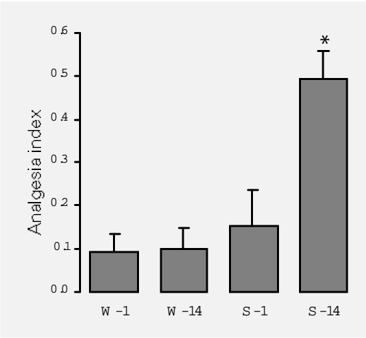
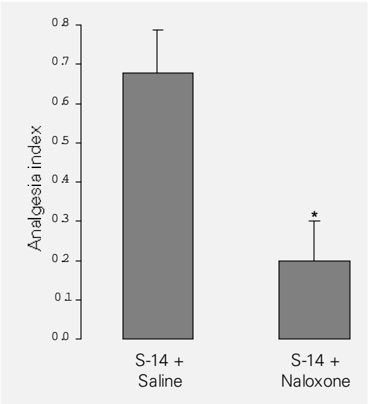
The intake of saccharin solutions for relatively long periods of time causes analgesia in rats, as measured in the hot-plate test, an experimental procedure involving supraspinal components. In order to investigate the effects of sweet substance intake on pain modulation using a different model, male albino Wistar rats weighing 180-200 g received either tap water or sucrose solutions (250 g/l) for 1 day or 14 days as their only source of liquid. Each rat consumed an average of 15.6 g sucrose/day. Their tail withdrawal latencies in the tail-flick test (probably a spinal reflex) were measured immediately before and after this treatment. An analgesia index was calculated from the withdrawal latencies before and after treatment. The indexes (mean +/- SEM, N = 12) for the groups receiving tap water for 1 day or 14 days, and sucrose solution for 1 day or 14 days were 0.09 +/- 0.04, 0.10 +/- 0.05, 0.15 +/- 0.08 and 0.49 +/- 0.07, respectively. One-way ANOVA indicated a significant difference (F(3, 47) = 9.521, P < 0.001) and the Tukey multiple comparison test (P < 0.05) showed that the analgesia index of the 14-day sucrose-treated animals differed from all other groups. Naloxone-treated rats (N = 7) receiving sucrose exhibited an analgesia index of 0.20 +/- 0.10 while rats receiving only sucrose (N = 7) had an index of 0.68 +/- 0.11 (t = 0.254, 10 degrees of freedom, P < 0.03). This result indicates that the analgesic effect of sucrose depends on the time during which the solution is consumed and extends the analgesic effects of sweet substance intake, such as saccharin, to a model other than the hot-plate test, with similar results. Endogenous opioids may be involved in the central regulation of the sweet substance-produced analgesia.
Overview
The claims and statistics of this paper haven’t been checked yet.
Free: it reads the open-access text and checks the first 5 claims that cite a source we can check. Create a free account to check every claim.
Integrity signals
Registry
Cites
Statistics
Figures
Verification
Claims the paper makes
The claims and statistics of this paper haven’t been checked yet.
Free: it reads the open-access text and checks the first 5 claims that cite a source we can check. Create a free account to check every claim.
Claims other papers make about this one
Each is checked against this paper’s own text: does it say what the citing paper says it does?
The source backs part of the claim, not all of it — or backs it for a different population, condition or comparison.
In the citing paper
“A sweet-tasting solution placed in an infant’s mouth can reduce responses to painful stimuli; sweet taste perception mediates both endogenous opioid and nonopioid systems to block pain afferents (34).”
From Sweetness and Food Preference (2012) · cites this paper as [34]
Experimental — accuracy not yet measured
Self-check
Percentages, sums and reported differences re-computed from the paper’s own numbers.
The self-check needs the paper’s full text.
Citations
Cites
Analgesia Mediated by a Direct Spinal Action of Narcotics
Yaksh, T. L., & Rudy, T. A. (1976) · Science · doi:10.1126/science.1273597 · Cited by 940
Organization of endogenous opiate and nonopiate pain control systems
Watkins, L. R., & Mayer, D. J. (1982) · Science · doi:10.1126/science.6281891 · Cited by 791
Pain reduction by focal electrical stimulation of the brain: An anatomical and behavioral analysis
Mayer, D. J., & Liebeskind, J. C. (1974) · Brain Research · doi:10.1016/0006-8993(74)90534-4 · Cited by 719
CENTRAL INFLUENCES ON SPINAL AFFERENT CONDUCTION
Hagbarth, K. E., & Kerr, D. I. B. (1954) · Journal of Neurophysiology · doi:10.1152/jn.1954.17.3.295 · Cited by 372
Interactions between sucrose, pain and isolation distress
Blass, E., Fitzgerald, E., & Kehoe, P. (1987) · Pharmacology Biochemistry and Behavior · doi:10.1016/0091-3057(87)90153-5 · Cited by 294
Morphine Tolerance in Genetically Selected Rats Induced by Chronically Elevated Saccharin Intake
Lieblich, I., Cohen, E., Ganchrow, J. R., Blass, E. M., & Bergmann, F. (1983) · Science · doi:10.1126/science.6879185 · Cited by 108
Kamei, J., Saitoh, A., Ohsawa, M., Suzuki, T., Misawa, M., Nagase, H., & Kasuya, Y. (1995) · European Journal of Pharmacology · doi:10.1016/0014-2999(95)00026-h · Cited by 68
Carpenter, D. O., Engberg, I., & Lundberg, A. (1965) · Acta Physiologica Scandinavica · doi:10.1111/j.1748-1716.1965.tb04047.x · Cited by 43
Takeshita, N., & Yamaguchi, I. (1995) · British Journal of Pharmacology · doi:10.1111/j.1476-5381.1995.tb15115.x · Cited by 29
Bergmann, F., Cohen, E., & Lieblich, I. (1984) · Psychopharmacology · doi:10.1007/bf00427783 · Cited by 21
Research works printed but not linked: 2
- Willis WD (1989). The origin and destina- tion of pathways involved in pain trans- mission. In: Wall PD & Melzack R (Edi- tors), Textbook of Pain. Churchill Livingstone, Edinburg, 112-127.
- Cobelli DA, Watkins LR & Mayer DJ (1980). Society for Neuroscience Ab- stracts, 6: 247. Apud: Watkins LR & Mayer DJ (1982). Organization of endoge- nous opiate and nonopiate pain control systems. Science, 216: 1185-1192.
Cited by
State-dependent opioid control of pain
Fields, H. (2004) · Nature Reviews Neuroscience · doi:10.1038/nrn1431 · Cited by 946
Drewnowski, A., Mennella, J. A., Johnson, S. L., & Bellisle, F. (2012) · The Journal of Nutrition · doi:10.3945/jn.111.149575 · Cited by 347
“A sweet-tasting solution placed in an infant’s mouth can reduce responses to painful stimuli; sweet taste perception mediates both endogenous opioid and nonopioid systems to block pain afferents (34).”
BackgroundKangaroo mother care diminishes pain from heel lance in very preterm neonates: A crossover trial
Johnston, C. C., Filion, F., Campbell-Yeo, M., Goulet, C., Bell, L., McNaughton, K., Byron, J., Aita, M., Finley, G. A., & Walker, C.-D. (2008) · BMC Pediatrics · doi:10.1186/1471-2431-8-13 · Cited by 203
“Although mechanisms underlying the efficacy of non-nutritive sucking or sweet taste have been debated as endorphin release or some other mechanism such as serotonin release [39-44], it seems clear that some endogenous mechanism triggered by these non-pharmacological strategies is responsible for the analgesic effect i…”
BackgroundBehavioral Approaches to Anxiety and Pain Management for Pediatric Venous Access
Cohen, L. L. (2008) · Pediatrics · doi:10.1542/peds.2008-1055f · Cited by 200
Elman, I., Borsook, D., & Lukas, S. E. (2006) · Neuropsychopharmacology · doi:10.1038/sj.npp.1301051 · Cited by 169
“…release (ie, feedforward interaction; Tanda and Di Chiara, 1998; Colantuoni et al, 2002; Grigson, 2002) so that analgesia (Mercer and Holder, 1997a; Segato et al, 1997; Lewkowski et al, 2003), opioid dependence (Schoenbaum et al, 1989, 1990; Colantuoni et al, 2001, 2002), and compensatory decrease…”
Anesthesia and Analgesia for Laboratory Rodents
Gaertner, D. J., Hallman, T., Hankenson, F. C., & Batchelder, M. (2008) · Elsevier eBooks · doi:10.1016/b978-012373898-1.50014-0 · Cited by 204
Sugar-dependent rats show enhanced intake of unsweetened ethanol
Avena, N. M., Carrillo, C. A., Needham, L., Leibowitz, S. F., & Hoebel, B. G. (2004) · Alcohol · doi:10.1016/j.alcohol.2004.09.006 · Cited by 149
“…the rewarding aspects of both ethanol (Djouma & Lawrence, 2002; Froehlich, 1996; Gianoulakis, 1996; Marinelli et al., 2000; McBride et al., 1998; Roberts et al., 2000) and sweet solutions (Kelley et al., 2002; Levine et al., 1985; Sclafani et al., 1982; Segato et al., 1997; Zhang & Kelley, 2002).”
BackgroundSucrose-induced analgesia is related to sweet preferences in children but not adults.
Pepino, Y. M., & Mennella, J. A. (2005) · Pain · doi:10.1016/j.pain.2005.09.029 · Cited by 116
“Although the mechanisms underlying sucrose-induced analgesia in human infants and children is not fully established (Gradin and Schollin, 2005; Taddio et al., 2003), animal model studies suggest the involvement of the endogenous opioid system (Segato et al., 1997).”
BackgroundA spoonful of sugar helps the medicine go down: a novel technique to improve oral gavage in mice.
Hoggatt, A. F., Hoggatt, J., Honerlaw, M., & Pelus, L. M. (2010) · PubMed Central · Cited by 104
Age-dependency of analgesia elicited by intraoral sucrose in acute and persistent pain models
Anseloni, V. C. Z., Weng, H., Terayama, R., Letizia, D., Davis, B. J., Ren, K., Dubner, R. A., & Ennis, M. J. (2002) · Pain · doi:10.1016/s0304-3959(02)00010-6 · Cited by 103
“Single intraoral infusions of highly concentrated sucrose solutions have been reported to be without analgesic properties in adult rats (Segato et al., 1997), suggesting that this is a developmentally transient phenomenon.”
Chambers, K. C. (2018) · World Journal of Otorhinolaryngology - Head and Neck Surgery · doi:10.1016/j.wjorl.2018.02.003 · Cited by 84
Mennella, J. A., Pepino, M. Y., Lehmann‐Castor, S. M., & Yourshaw, L. M. (2010) · Addiction · doi:10.1111/j.1360-0443.2009.02865.x · Cited by 75
“Animal model studies have shown that excessive sugar intake alters the efficacy of sucrose as an analgesic [70].”
BackgroundRebou�as, E. C. C., Segato, E. N., Kishi, R., de Freitas, R. L., Savoldi, M., Morato, S., & Coimbra, N. C. (2004) · Psychopharmacology · doi:10.1007/s00213-004-2045-x · Cited by 73
“1997), corroborating previous reports suggesting that the interaction of sweet substances with the opioid system modifies the sensitivity to painful stimuli (Davis et al. 1956; Lieblich et al. 1983; Bergmann et al. 1985; Klein and Green 1988; Roane and Martin 1990; Segato et al. 1997).”
BackgroundMethodResultInfluentialSelf-citationOlson, G. A., Olson, R. D., Vaccarino, A. L., & Kastin, A. J. (1998) · Peptides · doi:10.1016/s0196-9781(98)00137-5 · Cited by 70
Analgesia Accompanying Food Consumption Requires Ingestion of Hedonic Foods
Foo, H., & Mason, P. (2009) · Journal of Neuroscience · doi:10.1523/jneurosci.3514-09.2009 · Cited by 66
“Withdrawal latencies are not correlated to cumulative chip consumption Published work suggests that previous sucrose consumption has an analgesic effect on withdrawal latencies (Dum et al., 1983; Blass et al., 1987; Blass and Hoffmeyer, 1991; Segato et al., 1997).”
BackgroundTobacco industry use of flavourings to promote smokeless tobacco products
Kostygina, G., & Ling, P. M. (2016) · Tobacco Control · doi:10.1136/tobaccocontrol-2016-053212 · Cited by 62
Sweet taste-induced analgesia: an fMRI study
Kakeda, T., Ogino, Y., Moriya, F., & Saito, S. (2010) · Neuroreport · doi:10.1097/wnr.0b013e3283383df5 · Cited by 49
Detection and modulation of capsaicin perception in the human oral cavity
Smutzer, G., Jacob, J. C., Tran, J. T., Shah, D. I., Gambhir, S., Devassy, R. K., Tran, E. B., Hoang, B. T., & McCune, J. F. (2018) · Physiology & Behavior · doi:10.1016/j.physbeh.2018.05.004 · Cited by 44
Chung, M., Wang, S., Oh, S., & Kim, Y. S. (2021) · International Journal of Molecular Sciences · doi:10.3390/ijms22115810 · Cited by 44
“The long-term intake of saccharin for 2 weeks produces analgesia for heat pain in adult Wistar rats [105].”
BackgroundChoi, K. W., Somers, T. J., Babyak, M. A., Sikkema, K. J., Blumenthal, J. A., & Keefe, F. J. (2014) · Pain Research and Management · doi:10.1155/2014/598382 · Cited by 41
“Notably, experimental studies from animal and human models have shown that these foods can also lead to pain relief (17-25), possibly by modulating the endogenous opioid system (31,32) and reducing activation of brain regions associated with pain (19).”
InfluentialA narrative review of highly processed food addiction across the lifespan
Schiestl, E. T., Rios, J. M., Parnarouskis, L., Cummings, J. R., & Gearhardt, A. N. (2020) · Progress in Neuro-Psychopharmacology and Biological Psychiatry · doi:10.1016/j.pnpbp.2020.110152 · Cited by 44
Sugar Solution Analgesia: The Effects of Glucose on Expressed Mu Opioid Receptors
Kracke, G. R., Uthoff, K. A., & Tobias, J. D. (2005) · Anesthesia & Analgesia · doi:10.1213/01.ane.0000152617.11003.42 · Cited by 43
“Evidence that the mechanism of sugar solution analgesia involves the release of endogenous opioids is supported by animal studies (6,7).”
Resultde Freitas, R. L., Kübler, J. M. L., Elias-Filho, D. H., & Coimbra, N. C. (2011) · Pharmacology Biochemistry and Behavior · doi:10.1016/j.pbb.2011.12.005 · Cited by 41
“We have previously published studies on sweet substance-induced analgesia in adult rats (Segato et al., 1997; Segato et al., 2005; Irusta et al., 2001; Rebouças et al., 2005; Miyase et al., 2005; Kishi et al., 2006) weighing 250 g (mature adult rats).”
BackgroundResultSelf-citation'Neonates do not feel pain': a critical review of the evidence
Marchant, A. (2014) · Bioscience Horizons The International Journal of Student Research · doi:10.1093/biohorizons/hzu006 · Cited by 47
“More research is required (in addition to that by Segato et al. (1997)) to understand the apparent pain-alleviating mechanism of sucrose, with any adverse effects, such as that seen in paracetamol (Cuzzolin, Antoniccu and Fanos, 2013).”
BackgroundTaylor, B. F., Ramirez, H. E., Battles, A. H., Andrutis, K. A., & Neubert, J. K. (2016) · PubMed Central · Cited by 35
Paradoxical surrogate markers of dental injury-induced pain in the mouse
Gibbs, J. L., Urban, R., & Basbaum, A. I. (2013) · Pain · doi:10.1016/j.pain.2013.04.018 · Cited by 30
“And in both rodent pups and adult animals, the analgesic effect of sucrose and other highly palatable foods has been linked to endogenous opioids and is reversible with naloxone [4,22,59].”
BackgroundDuan, G., Wu, Z., Duan, Z., Yang, G., Fang, L., Chen, F., Bao, X., & Li, H. (2019) · Journal of Pain · doi:10.1016/j.jpain.2019.11.011 · Cited by 24
Kishi, R., Bongiovanni, R., de Nadai, T. R., de Freitas, R. L., de Oliveira, R., Ferreira, C. M. D. R., & Coimbra, N. C. (2005) · Neuroscience Letters · doi:10.1016/j.neulet.2005.10.046 · Cited by 21
Self-citationValidity of mental and physical stress models
Hendry, E., McCallister, B., Elman, D. J., Freeman, R. L., Borsook, D., & Elman, I. (2024) · Neuroscience & Biobehavioral Reviews · doi:10.1016/j.neubiorev.2024.105566 · Cited by 19
Irusta, A. E. C., Savoldi, M., Kishi, R., Resende, G. C. C., de Freitas, R. L., Carvalho, A. D., & Coimbra, N. C. (2001) · Neuroscience Letters · doi:10.1016/s0304-3940(01)01824-9 · Cited by 18
Self-citationMiyase, C. I., Kishi, R., de Freitas, R. L., Paz, D. A., & Coimbra, N. C. (2005) · Neuroscience Letters · doi:10.1016/j.neulet.2004.12.058 · Cited by 18
Self-citationEffect of caloric and non-caloric sweet reward solutions on thermal facial operant conditioning
Nolan, T. A., Caudle, R. M., & Neubert, J. K. (2010) · Behavioural Brain Research · doi:10.1016/j.bbr.2010.08.023 · Cited by 16
Evaluation and comparison of antinociceptive activity of aspartame with sucrose
Rani, S., & Gupta, M. C. (2012) · Pharmacological Reports · doi:10.1016/s1734-1140(12)70767-3 · Cited by 16
“opioids, serotonergic mechanisms, muscarinic and nicotinic cholinergic receptors have been earlier postulated [10, 18, 20].”
BackgroundMethodResultInfluentialSegato, E. N., Rebouças, E. C. C., de Freitas, R. L., Caires, M., Cardoso, A. V., Resende, G. C. C., Shimizu-Bassi, G., Elias-Filho, D. H., & Coimbra, N. C. (2005) · Nutritional Neuroscience · doi:10.1080/10284150500069413 · Cited by 17
“…at postnatal (P) day 0 (P0), appearing consistently from P3 to P10-P17 (Anseloni et al. 2002, 2004), other studies suggested that sweetened substances caused persisted opioid and non-opioid analgesia in adult rats (Segato et al. 1997, Irusta et al. 2001, Miyase et al. 2005, Rebouças et al. 2005).”
BackgroundResultSelf-citationAnesthesia and analgesia in laboratory rodents
Jirkof, P., & Lofgren, J. (2023) · Elsevier eBooks · doi:10.1016/b978-0-12-822215-7.00007-x · Cited by 17
Opioid-receptor antagonism increases pain and decreases pleasure in obese and non-obese individuals
Price, R. C., Christou, N. V., Backman, S. B., Stone, L. S., & Schweinhardt, P. (2016) · Psychopharmacology · doi:10.1007/s00213-016-4417-4 · Cited by 16
“Yet, we purposefully performed the sweet taste test after pain testing to avoid potential analgesic effects of sucrose (Bucher et al. 1995; Segato et al. 1997).”
MethodGender differences in pain modulation by a sweet stimulus in adults: A randomized study
Kakeda, T., & Ishikawa, T. (2011) · Nursing and Health Sciences · doi:10.1111/j.1442-2018.2010.00573.x · Cited by 14
Ventromedial hypothalamic mediation of sucrose feeding induced pain modulation
Mukherjee, K., Mathur, R., & Nayar, U. (2001) · Pharmacology Biochemistry and Behavior · doi:10.1016/s0091-3057(00)00441-x · Cited by 14
Potential of sucrose‐induced analgesia to relieve pain in male adults: A preliminary study
Kakeda, T. (2010) · Japan Journal of Nursing Science · doi:10.1111/j.1742-7924.2010.00150.x · Cited by 12
Sucrose-induced analgesia in mice: Role of nitric oxide and opioid receptor-mediated system
Dehpour, A. R., Shahlaee, A., Farahanchi, A., Javadi, S., & Delfan, B. (2013) · Indian Journal of Pharmacology · doi:10.4103/0253-7613.121370 · Cited by 10
“[3] More recent studies have used a 12-day regimen to investigate the analgesic properties of various sweetening agents.”
The evidence for sweet substance-induced analgesia in adult human
Kakeda, T., Ito, M., Matsui, T., & Ishikawa, T. (2008) · PAIN RESEARCH · doi:10.11154/pain.23.159 · Cited by 10
Adding Cocoa to Sucrose: The Effect on Cold Pain Tolerance
Eggleston, K. M., White, T. L., & Sheehe, P. R. (2010) · Chemical Senses · doi:10.1093/chemse/bjq016 · Cited by 10
“2001), and the experience of its taste triggers the release of opioids that could create an analgesic effect (Segato et al. 1997).”
BackgroundRole of OPRM1, clinical and anthropometric variants in neonatal pain reduction
Erbi, I., Ciantelli, M., Farinella, R., Tuoni, C., Gentiluomo, M., Moscuzza, F., Rizzato, C., Bedini, A., Faraoni, M., Giusfredi, S., et al. (2020) · Scientific Reports · doi:10.1038/s41598-020-63790-2 · Cited by 10
Hunt, S. P., & Urch, C. (2006) · Elsevier eBooks · doi:10.1016/b0-443-07287-6/50028-x · Cited by 9
Spinal and supraspinal mechanisms of placebo analgesia
Eippert, F., & Büchel, C. (2013) · Elsevier eBooks · doi:10.1016/b978-0-12-397928-5.00007-6 · Cited by 7
Heightened eating drive and visual food stimuli attenuate central nociceptive processing
Wright, H., Li, X., Fallon, N. B., Giesbrecht, T., Thomas, A. K., Harrold, J. A., Halford, J. C. G., & Stančák, A. (2014) · Journal of Neurophysiology · doi:10.1152/jn.00504.2014 · Cited by 7
“Abundant evidence shows that eating (Aloisi and Carli 1996; Casey and Morrow 1983; Foo and Mason 2005; Kakeda et al. 2010; LaGraize et al. 2004; Schobel et al. 2012; Segato et al. 1997; Zmarzty et al. 1997), or expecting to eat (Dum and Herz 1984), can reduce pain.”
Taste modulation of nociception differently affects chronically stressed rats
Fontella, F. U., Nunes, M. D. L., Crema, L. M., Balk, R. D. S., Dalmaz, C., & Netto, C. A. (2003) · Physiology & Behavior · doi:10.1016/j.physbeh.2003.10.010 · Cited by 8
Koekkoek, L. L., Masís‐vargas, A., Kool, T., Eggels, L., van der Gun, L. L., Lamuadni, K., Slomp, M., Diepenbroek, C., Kalsbeek, A., & la Fleur, S. E. (2021) · Nutritional Neuroscience · doi:10.1080/1028415x.2021.1975365 · Cited by 9
DEVASCONCELLOS, A., NIETO, F., Fontella, F. U., DAROCHA, E., & Dalmaz, C. (2006) · Physiology & Behavior · doi:10.1016/j.physbeh.2006.04.004 · Cited by 6
Nuseir, K. Q., Kassab, M. I., & Al‐Azzani, M. (2017) · InTech eBooks · doi:10.5772/66596 · Cited by 5
“In addition, sucrose ingestion for a relatively long period of time produces analgesia [58, 59].”
BackgroundPereira, C. M., & Sério, T. M. D. A. P. (2012) · Revista Brasileira de Análise do Comportamento · doi:10.18542/rebac.v6i1.994 · Cited by 3
The Effects of Palatable Sweet Ingesta on Human Responsivity to Heat Pain
Mercer, M. E., Holder, M. D., & Adams, R. J. (2015) · Journal of Behavioral and Brain Science · doi:10.4236/jbbs.2015.510039 · Cited by 3
“414 of adult rats [10] [11] [40]-[42] have investigated the effects of chronic sucrose ingestion on analgesia and found that sweet-induced analgesia does persist with maturity.”
BackgroundResultInfluentialA contribution to the therapeutic valorization of Moroccan Cistus Ladanifer L
Adadi, I., Aydi, R. E., Ibaoui, H. E., & Bentayeb, A. (2021) · E3S Web of Conferences · doi:10.1051/e3sconf/202123400102 · Cited by 2
“Finally, we formulated a syrup based on the aqueous extract at its effective analgaesic dose (500 mg / kg), in order to assess its possible analgaesic effect, the results of this part showed a slight increase (statistically not significant) of the anti-nociceptive effect of AECLSyrup compared to EECL-500, in both the…”
ResultAssessing the Analgesic Effects of Sucrose to Cold Pressor Pain in Human Adults
Mercer, M. E., & Holder, M. D. (2013) · Journal of Behavioral and Brain Science · doi:10.4236/jbbs.2013.31002 · Cited by 2
“velopmentally transient phenomenon [9,11].”
Antinociceptive activity of aqueous fruit extract of Dillenia retusa T. in rats
Lanka, S. S. (2014) · Cited by 2
Chambers, K. C. (2015) · Wiley eBooks · doi:10.1002/9781118971758.ch38 · Cited by 5
Study of the Analgesic Potential of the Ethanolic Extract of Moroccan Cistus ladanifer L.
Adadi, I., Ayadi, R. E., Hajji, L., Eddouks, M., & Ibaoui, H. E. (2023) · Cardiovascular & Haematological Disorders - Drug Targets · doi:10.2174/1871529x23666230721105716 · Cited by 1
Ayaz, B. D., Murphy, N. P., Vivanco-Estela, A. N., Sapio, M. R., de Paula, B. B., Guo, S., Malphurs, W. L., Song, Q., Neubert, J. K., & Caudle, R. M. (2026) · Journal of Pain · doi:10.1016/j.jpain.2026.106367 · Cited by 1
Jovanovic, N., Džodić, R. R., Čelebić, A., Zegarac, M., Djurisic, I., & Stojiljkovic, D. (2003) · Srpski arhiv za celokupno lekarstvo · doi:10.2298/sarh0302052j · Cited by 1
Ribeiro, L. G., Kerppers, I. I., Paz, I. D. A., Rolão, M. P. P., de Oliveira, T. B., Eltchechem, C. D. L., & Pereira, M. C. D. S. (2014) · Medical Express · doi:10.5935/medicalexpress.2014.02.07 · Cited by 1
EFEITOS DO PROTOCOLO DE ESTRESSORES SOBRE A PREFERÊNCIA DE ÁGUA COM SACAROSE EM RATOS
da Silva, P. E., & Malerbi, F. E. K. (2018) · Revista Brasileira de Análise do Comportamento · doi:10.18542/rebac.v14i2.7530 · Cited by 1
Evaluation of analgesic activity of glucose in Swiss Albino mice
Velarul, S., Shobnaarani, Vinotha, S., & Ponnuswamy (2019) · International Journal of Basic & Clinical Pharmacology · doi:10.18203/2319-2003.ijbcp20190156 · Cited by 1
Mechanisms of behavioral choice in the nervous system of the medicinal leech
Gaudry, Q. (2008) · eScholarship (California Digital Library)
Spinal sensory processing in the human infant: development of the flexion withdrawal reflex
Cornelissen, L. (2011) · UCL Discovery (University College London)
Rebouças, E. C. C. (2004) · Digital Library of Theses and Dissertations (Universidade de São Paulo) · doi:10.11606/d.17.2004.tde-10112006-091759
Understanding Consumption of Sugar-Sweetened Beverages by Adolescents with Dental Caries
Mitko, V. A. (2015) · OhioLink ETD Center (Ohio Library and Information Network)
The Management of the Pediatric Patient and Adolescent During Skin Cryosurgery
Gal‐Or, N., & Har‐Shai, Y. (2016) · Springer eBooks · doi:10.1007/978-1-4471-6765-5_51
Effect of Genetic Variation on Salt, Sweet, Fat and Bitter Taste
Dias, A. G. (2014) · TSpace (University of Toronto) · Cited by 1
Sweetness and Food Preference 1-3
Drewnowski, A., Mennella, J. A., & Johnson, S. L. (2012) · Cited by 1
Berridge, K. C. (2010) · Faculty Opinions – Post-Publication Peer Review of the Biomedical Literature · doi:10.3410/f.2514956.2159058
Eggleston, K. M., & White, T. L. (2012) · Humana Press eBooks · doi:10.1007/978-1-61779-803-0_32 · Cited by 2
Striatal and hypothalamic control of food intake and glucose metabolism
Koekkoek, L. L. (2022) · UvA-DARE (University of Amsterdam)
Hunt, S. P., & Urch, C. (2007) · Elsevier eBooks · doi:10.1016/b978-84-8174-949-6.50023-x
Metadata
- Authors
- Segato, F. N., Castro-Souza, C., Segato, E. N., Morato, S., & Coimbra, N. C.
- Affiliations
- Universidade de São Paulo (BR)
- Venue
- Brazilian Journal of Medical and Biological Research
- Publisher
- FapUNIFESP (SciELO)
- Published
- 1997-08
- Volume
- 30
- Issue
- 8
- Pages
- 981-984
- ISSN
- 0100-879X (ISSN-L)
- OpenAlex
- W2108448953
- Semantic Scholar
- 2c62343c23caa163ef689643589d626e85514eea
- Cited by
- 72
- References
- 15
- Citations by year
- 2026: 1 · 2024: 1 · 2023: 2 · 2021: 3 · 2020: 2 · 2019: 2 · 2018: 3 · 2017: 1 · 2016: 4 · 2015: 2 · 2014: 6 · 2013: 4 · 2012: 5
- FWCI
- 0.20
- Type
- journal article
- Language
- en
- Open access
- gold
- doi.org
- Licence
- cc-by
- Locations
- Brazilian Journal of Medical and Biological Research (publishedVersion, cc-by)
- PubMed (publishedVersion)
- LA Referencia (Red Federada de Repositorios Institucionales de Publicaciones Científicas) (publishedVersion, other-oa)
- Americanae (AECID Library) (submittedVersion, cc-by-nc)
- DOAJ (DOAJ: Directory of Open Access Journals) (submittedVersion, cc-by-sa)
- Funders
- Fundação de Amparo à Pesquisa do Estado de São Paulo
- Conselho Nacional de Desenvolvimento Científico e Tecnológico (523094/95-7)
- Universidade de São Paulo
- Fundação de Apoio ao Ensino, Pesquisa e Assistência do Hospital das Clínicas da Faculdade de Medicina de Ribeirão Preto da Universidade de São Paulo
- Topics
- Health Sciences › Medicine › Physiology (medical) › Pain Mechanisms and Treatments
- Life Sciences › Neuroscience › Cellular and Molecular Neuroscience › Neurotransmitter Receptor Influence on Behavior
- Life Sciences › Neuroscience › Cellular and Molecular Neuroscience › Neuropeptides and Animal Physiology
- Keywords
- sucrose, opioid analgesia, endogenous opioids, sweet taste, saccharin, tail-flick test, tail withdrawal latency, naloxone, pain modulation
- MeSH terms
- Analgesia, Animals, Male, Naloxone, Pain Measurement, Sucrose, Rats, Wistar, Opioid Peptides, Rats
About these checks
Registry, retraction, Cites and statistics results are computed, not judged, with one exception: a printed reference that no index lists is read once by a model before it counts as a citation error. Claims are extracted by a model and kept only when their quote appears verbatim in the text; each cited source is then checked, with a model’s help, for whether it says what the claim relies on. Those verdicts can be wrong — read the claim’s quote and the cited source before relying on one.
Statistics and arithmetic are recomputed, not judged.
Confidence bands are shown only for fields calibrated on our annotated test set. None is calibrated yet, so no band is shown.
What counts as a claim ›How we measure confidence ›How we check this ›
Are you an author, or do you see a problem with this page? Request a review
Data sources
Bibliographic data: Semantic Scholar, OpenAlex, Crossref.
Contains information from the Semantic Scholar Academic Graph Datasets, made available under the ODC Attribution License (ODC-BY 1.0).
Semantic Scholar’s data is described in: Kinney, R., et al. (2023). The Semantic Scholar Open Data Platform. arXiv:2301.10140.
