

Effects of caffeine on the electrophysiological, cognitive and motor responses of the central nervous system
Open accessThe DOI matches its Crossref record; 40 of the 40 references it cites were found in a registry or an index.
Abstract
Caffeine is the most consumed psychoactive substance in the world. The effects of caffeine have been studied using cognitive and motor measures, quantitative electroencephalography (qEEG) and event-related potentials. However, these methods are not usually employed in combination, a fact that impairs the interpretation of the results. The objective of the present study was to analyze changes in electrophysiological, cognitive and motor variables with the ingestion of caffeine, and to relate central to peripheral responses. For this purpose we recorded event-related potentials and eyes-closed, resting EEG, applied the Stroop test, and measured reaction time. Fifteen volunteers took caffeine (400 mg) or placebo in a randomized, crossover, double-blind design. A significant reduction of alpha absolute power over the entire scalp and of P300 latency at the Fz electrode were observed after caffeine ingestion. These results are consistent with a stimulatory effect of caffeine, although there was no change in the attention (Stroop) test or in reaction time. The qEEG seems to be the most sensitive index of the changes produced by caffeine in the central nervous system since it proved to be capable of detecting changes that were not evident in the tests of cognitive or motor performance.
Overview
The claims and statistics of this paper haven’t been checked yet.
Free: it reads the open-access text and checks the first 5 claims that cite a source we can check. Create a free account to check every claim.
Integrity signals
Registry
Cites
Statistics
Figures
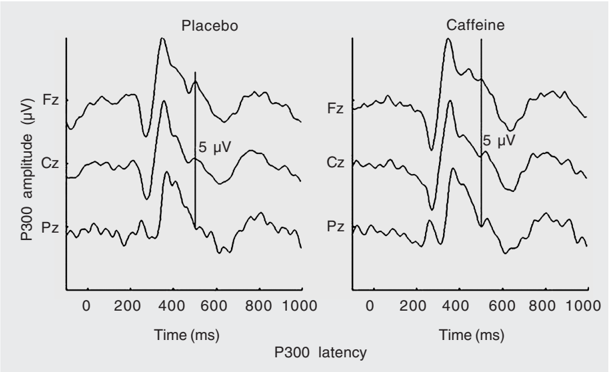
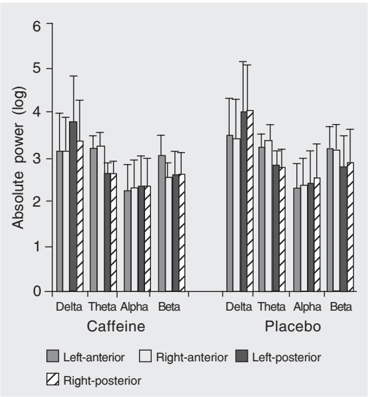
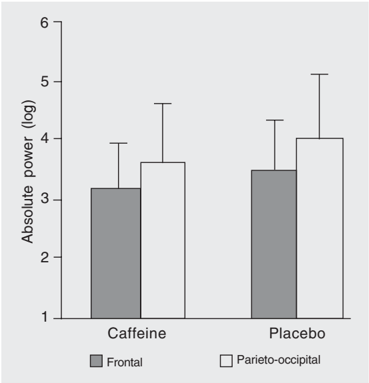
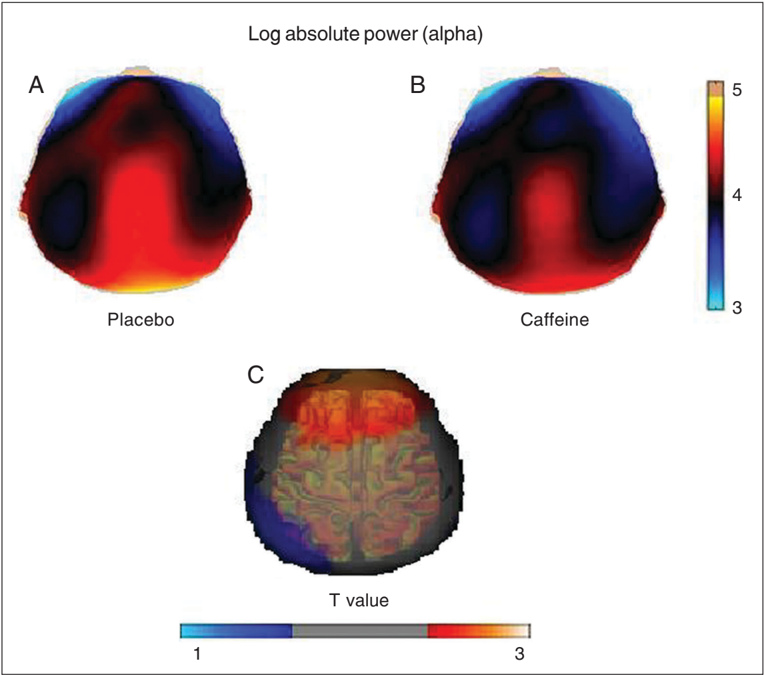
Verification
Claims the paper makes
The claims and statistics of this paper haven’t been checked yet.
Free: it reads the open-access text and checks the first 5 claims that cite a source we can check. Create a free account to check every claim.
Claims other papers make about this one
Each is checked against this paper’s own text: does it say what the citing paper says it does?
The source backs part of the claim, not all of it — or backs it for a different population, condition or comparison.
In the citing paper
“Previous studies have reported a drop in absolute alpha power during resting with eyes open on ingestion of caffeine at higher dosages, e.g., 200 mg (30) and 400 mg (31).”
From L-Theanine and Caffeine in Combination Affect Human Cognition as Evidenced by Oscillatory alpha-Band Activity and Attention Task Performance (2008) · cites this paper as [31]
Experimental — accuracy not yet measured
Self-check
Percentages, sums and reported differences re-computed from the paper’s own numbers.
The self-check needs the paper’s full text.
Citations
Cites
Picton, T. W., Bentin, S., Berg, P., Donchin, E., Hillyard, S. A., Johnson, R., Miller, G. A., Ritter, W., Ruchkin, D. S., Rugg, M. D., et al. (2000) · Psychophysiology · doi:10.1111/1469-8986.3720127 · Cited by 2,157 · cited 1×
“The ERP recordings were obtained according to standard guidelines (35).”
MethodCognitive and biological determinants of P300: an integrative review
Polich, J., & Kok, A. (1995) · Biological Psychology · doi:10.1016/0301-0511(95)05130-9 · Cited by 1,613 · cited 3×
“Some studies indicate a shortening of latency (17,18,2931), while others show an increase in amplitude (28,32).”
BackgroundEvent-related brain potentials in the study of visual selective attention
Hillyard, S. A., & Anllo-Vento, L. (1998) · Proceedings of the National Academy of Sciences · doi:10.1073/pnas.95.3.781 · Cited by 1,525 · cited 1×
“EEG and ERP data provide a neuropsychophysiological estimation of brain processes which are linked to behavior (20-23).”
BackgroundNehlig, A., Daval, J.-L., & Debry, G. (1992) · Brain Research Reviews · doi:10.1016/0165-0173(92)90012-b · Cited by 1,461 · cited 5×
“Figure 3 illustrates the results of two-way ANOVA which revealed main effects of condition (F (1,118) = 5.”
BackgroundInfluentialCentral nervous system effects of caffeine and adenosine on fatigue
Davis, J. M., Zhao, Z., Stock, H. S., Mehl, K. A., Buggy, J., & Hand, G. A. (2003) · American Journal of Physiology-Regulatory, Integrative and Comparative Physiology · doi:10.1152/ajpregu.00386.2002 · Cited by 588
P300 as a clinical assay: rationale, evaluation, and findings
Polich, J. (2000) · International Journal of Psychophysiology · doi:10.1016/s0167-8760(00)00127-6 · Cited by 480
Egner, T., & Gruzelier, J. H. (2004) · Clinical Neurophysiology · doi:10.1016/s1388-2457(03)00353-5 · Cited by 455 · cited 1×
“The spectral attributes of the EEG are susceptible to changes under cognitive demands such as attention (24,25).”
BackgroundCaffeine, fatigue, and cognition
Lorist, M. M., & Tops, M. (2003) · Brain and Cognition · doi:10.1016/s0278-2626(03)00206-9 · Cited by 342 · cited 10×
“The main concept is that caffeine modulates information processing through an effect on the perceptual system and output-related processes (9).”
BackgroundResultInfluentialNeurophysiological indices of strategy development and skill acquisition
Smith, M. E., McEvoy, L. K., & Gevins, A. (1999) · Cognitive Brain Research · doi:10.1016/s0926-6410(98)00043-3 · Cited by 284 · cited 2×
“The Stroop test evaluates focused attention and assesses the integrative power of cognitive mechanisms in reaching decisions based upon information from two different modalities (lexical and perceptual) (26).”
BackgroundElectroencephalography, Basic Principles, Clinical Applications and Related Fields
Walker, A. E. (1982) · The Journal of Nervous and Mental Disease · doi:10.1097/00005053-198211000-00020 · Cited by 271
Research works printed but not linked: 1
- Hollingworth HL (1912). The influence of caffeine on mental and motor efficiency. Archives of Psychology, 22: 1-166.
Cited by
Caffeine use in children: What we know, what we have left to learn, and why we should worry
Temple, J. L. (2009) · Neuroscience & Biobehavioral Reviews · doi:10.1016/j.neubiorev.2009.01.001 · Cited by 326
“Studies in adults show mild improvement on some cognitive tasks, including simple (Attwood et al., 2007) and choice reaction time tests (Attwood et al., 2007; van Duinen et al., 2005), but not on the Stroop task (Deslandes et al., 2005).”
Caffeine as an Attention Enhancer: Reviewing Existing Assumptions
Einöther, S. J. L., & Giesbrecht, T. (2013) · Psychopharmacology · doi:10.1007/s00213-012-2917-4 · Cited by 215
“…and De Wit 2006 N.A. RT * Tieges et al. 2009 2 60 ACC * Tieges et al. 2009 1 60 RT * Stroop task Complex ex. control Schmitt et al. 2003 N.A. Int * Deslandes et al. 2005 N.A. ACC, RT * both by reducing response speed and by improving accuracy (Owen et al. 2008; Tieges et al. 2006, 2007), and the…”
InfluentialCognition enhancers between treating and doping the mind
Lanni, C., Lenzken, S. C., Pascale, A., Del Vecchio, I., Racchi, M., Pistoia, F., & Govoni, S. (2008) · Pharmacological Research · doi:10.1016/j.phrs.2008.02.004 · Cited by 166
“thers have suggested that the observed ability of caffeine in ounteracting the performance decrement on fatigue state is due o an indirect increase of dopamine [36,37].”
BackgroundKelly, S. P., Gomez-Ramirez, M., Montesi, J. L., & Foxe, J. J. (2008) · The Journal of Nutrition · doi:10.1093/jn/138.8.1572s · Cited by 119
Iranpour, S., & Sabour, S. (2019) · Psychiatry Research · doi:10.1016/j.psychres.2018.11.004 · Cited by 115
Brain foods - the role of diet in brain performance and health
Ekstrand, B., Scheers, N., Rasmussen, M. K., Young, J. F., Ross, A. B., & Landberg, R. (2021) · Nutrition Reviews · doi:10.1093/nutrit/nuaa091 · Cited by 101
Effects of caffeine and maltodextrin mouth rinsing on P300, brain imaging, and cognitive performance
Pauw, K. D., Roelands, B., Knaepen, K., Polfliet, M., Stiens, J. H., & MEEUSEN, R. R. (2015) · Journal of Applied Physiology · doi:10.1152/japplphysiol.01050.2014 · Cited by 97
“According to the authors (10, 11, 13), these results demonstrate that CAF ingestion leads to a facilitation effect on information processing.”
BackgroundResultBarry, R. J., Clarke, A. R., Johnstone, S. J., & Rushby, J. A. (2007) · Biological Psychology · doi:10.1016/j.biopsycho.2007.11.002 · Cited by 92
Diukova, A., Ware, J. J., Smith, J. E., Evans, J., Murphy, K., Rogers, P. J., & Wise, R. G. (2012) · NeuroImage · doi:10.1016/j.neuroimage.2012.04.041 · Cited by 76
“…after caffeine ingestion through a significant shortening of P300 latency, especially in the frontal cortex (medial frontal electrode Fz) (Deslandes et al., 2005; Kenemans and Lorist, 1995; Montenegro et al., 2005; Pan et al., 2000), consistent with the frontal distribution shown in the…”
BackgroundResultInfluentialRadiofrequency signal affects alpha band in resting electroencephalogram
Ghosn, R., Yahia‐Cherif, L., Hugueville, L., Ducorps, A., Lemaréchal, J.-D., Thuróczy, G., de Sèze, R., & Selmaoui, B. (2015) · Journal of Neurophysiology · doi:10.1152/jn.00765.2014 · Cited by 62
“In addition, previous studies reported a drop in absolute alpha power during rest with eyes open when caffeine was ingested at high doses (Siepmann and Kirch 2002; Deslandes et al. 2005).”
Mohsenpour, H., Pesce, M., Patruno, A., Bahrami, A., Pour, P. M., & Farzaei, M. H. (2021) · International Journal of Molecular Sciences · doi:10.3390/ijms22020833 · Cited by 50
“Caffeine is a non-selective adenosine antagonist and shows a wide range of actions on the brain [298,299].”
BackgroundEffect of mobile phone radiofrequency signal on the alpha rhythm of human waking EEG: A review
Wallace, J., & Selmaoui, B. (2019) · Environmental Research · doi:10.1016/j.envres.2019.05.016 · Cited by 43
Effects of dietary caffeine on EEG, performance and mood when rested and sleep restricted
Keane, M. A., & James, J. E. (2008) · Human Psychopharmacology: Clinical and Experimental · doi:10.1002/hup.987 · Cited by 37
Renda, G., Committeri, G., Zimarino, M., Nicola, M. D., Tatasciore, A., Ruggieri, B., Ambrosini, E., Viola, V., Antonucci, I., Stuppia, L., et al. (2015) · European Neuropsychopharmacology · doi:10.1016/j.euroneuro.2015.03.001 · Cited by 43
“, executive control processes) (Deslandes et al., 2005; Einother and Giesbrecht, 2013; Kenemans et al., 1999).”
Current therapeutic targets and multifaceted physiological impacts of caffeine
Song, X., Kirtipal, N., Lee, S., Malý, P., & Bharadwaj, S. (2023) · Phytotherapy Research · doi:10.1002/ptr.8000 · Cited by 36
“Other studies suggest that caffeine can improve focused attention and elevate activities in the brain via an indirect effect on dopamine (Deslandes et al., 2005; Jones, 2008; Smith et al., 2003).”
BackgroundElectro-physiological changes in the brain induced by caffeine or glucose nasal spray
Pauw, K. D., Roelands, B., Cutsem, J. V., Marušič, U., Torbeyns, T., & MEEUSEN, R. R. (2016) · Psychopharmacology · doi:10.1007/s00213-016-4435-2 · Cited by 38
“Further two-way ANOVAs revealed a significant effect at CP1-CP2-Cz [F(Deslandes et al. 2005) = 3.”
InfluentialEffect of Caffeine on Information Processing: Evidence from Stroop Task
Dixit, A., Goyal, A., Thawani, R., & Vaney, N. (2012) · Indian Journal of Psychological Medicine · doi:10.4103/0253-7176.106013 · Cited by 32
“did not find any significant effect of caffeine on Stroop task[19,20]”
BackgroundLanini, J., Galduróz, J. C. F., & Pompéia, S. (2015) · Human Psychopharmacology Clinical and Experimental · doi:10.1002/hup.2511 · Cited by 34
“Findings of positive effects of caffeine in switching tasks (Deslandes et al., 2005; Tieges et al., 2006; Tieges et al., 2007; Barry et al., 2007) have been ascribed to other cognitive requirements of the tests rather than switching per se (see Tieges et al.”
BackgroundLabbe, D., Martin, N., le Coutre, J., & Hudry, J. (2010) · Food Quality and Preference · doi:10.1016/j.foodqual.2010.08.002 · Cited by 28
Evaluation of cognitive brain functions in caffeine users: a P3 evoked potential study.
Dixit, A., Vaney, N., & Tandon, O. P. (2006) · PubMed · Cited by 25
Molecular mechanisms of caffeine‐mediated intestinal epithelial ion transports
Zhang, F., Wan, H., Yang, X., He, J., Cheng, L., Yang, S., Tuo, B., & Dong, H. F. (2019) · British Journal of Pharmacology · doi:10.1111/bph.14640 · Cited by 22
“As caffeine is widely consumed worldwide in our daily life, its biomedical effects and the mechanisms of action outside the GI tract have been intensively investigated (Davis et al., 2003; Deslandes et al., 2005; Nehlig, Daval, & Debry, 1992).”
BackgroundKeane, M. A., James, J. E., & Hogan, M. (2007) · Neuropsychobiology · doi:10.1159/000120625 · Cited by 22
Cognition-Enhancing Drugs and Their Appropriateness for Aviation and Ground Troops: A Meta-Analysis
Kelley, A. M., Webb, C. M., Athy, J. R., Ley, S. L., & Gaydos, S. (2010) · Defense Technical Information Center (DTIC) · doi:10.21236/ada533727 · Cited by 19
de Almeida, R. F., de Oliveira, M., Furigo, I. C., Aquino, R., Clarke, N. D., Tallis, J. A., & Guimarães‐Ferreira, L. (2023) · Nutrients · doi:10.3390/nu15143094 · Cited by 20
Wallace, J., Yahia‐Cherif, L., Gitton, C., Hugueville, L., Lemaréchal, J.-D., & Selmaoui, B. (2021) · International Journal of Radiation Biology · doi:10.1080/09553002.2021.2009146 · Cited by 16
“2014) and caffeine consumption (Siepmann and Kirch 2002; Deslandes et al. 2005) or emotional stress behavior (Lewis et al.”
BackgroundWilson, M. J., Harkrider, A. W., & King, K. (2012) · Ear and Hearing · doi:10.1097/aud.0b013e3182446a42 · Cited by 18
“Subjects were asked to refrain from caffeine, nicotine, and alcohol for at least 4 hr before testing because some drugs, such as stimulants and depressants, have been shown to have an adverse effect on the P300 response (Naylor et al. 1985; Schuckit et al. 1988; Deslandes et al. 2004, 2005).”
MethodTrunk, A., Stefanics, G., Zentai, N., Bacskay, I., Felinger, A., Thuróczy, G., & Hernádi, I. (2014) · Pharmacology Biochemistry and Behavior · doi:10.1016/j.pbb.2014.07.011 · Cited by 19
“These results confirm prior reports (Lorist and Tops, 2003; Deslandes et al., 2004, 2005; Montenegro et al., 2005; Barry et al., 2007) that caffeine affects neural correlates of information processing such as stimulus detection indexed by P300.”
ResultWang, S. (2007) · Synapse · doi:10.1002/syn.20384 · Cited by 20
“However, the precise mechanism of action of caffeine in improving cognitive performance has not been definitively established, although adenosine antagonism is assumed to be the most important mechanism for explaining the cognitive effect of caffeine (Deslandes et al., 2005).”
BackgroundInfluentialCognição e eletrofisiologia: uma revisão crítica das perspectivas nacionais
Jaeger, A., & Parente, M. A. D. M. P. (2010) · Psico-USF · doi:10.1590/s1413-82712010000200005 · Cited by 21
Effects of Caffeine on Electrophysiological and Neuropsychological Indices after Sleep Deprivation
Deslandes, A. C., Ferreira, C., Veiga, H., Cagy, M., Piedade, R. A. M., Pompeu, F. A. M. S., & Ribeiro, P. F. M. (2006) · Neuropsychobiology · doi:10.1159/000098263 · Cited by 16
“The effect of caffeine ingestion is expected to be accentuated in situations where there is physical and/or mental fatigue. Thus, sleep deprivation can be a sensitive model for the analysis of the effects of caffeine in the CNS.Several studies have identified caffeine as a stimulant using motor, behavioral and electro…”
BackgroundSelf-citationBougrine, H., Ammar, A., Salem, A., Trabelsi, K., Jahrami, H., Chtourou, H., & Souissi, N. (2024) · Brain Sciences · doi:10.3390/brainsci14030280 · Cited by 14
Neural correlates of expectations-induced effects of caffeine intake on executive functions
Wicht, C. A., Pretto, M. D., Mouthon, M., & Spierer, L. (2022) · Cortex · doi:10.1016/j.cortex.2022.02.004 · Cited by 13
Wallace, J., Yahia‐Cherif, L., Gitton, C., Hugueville, L., Lemaréchal, J.-D., & Selmaoui, B. (2021) · Scientific Reports · doi:10.1038/s41598-021-02560-0 · Cited by 11
A systematic review and meta-analysis of the acute effect of caffeine on attention
Kløve, K., & Petersen, A. (2025) · Psychopharmacology · doi:10.1007/s00213-025-06775-1 · Cited by 10
Irwin, C. G., McCartney, D., Khalesi, S., & Desbrow, B. (2018) · Current Research in Nutrition and Food Science Journal · doi:10.12944/crnfsj.6.2.08 · Cited by 9
Acute Stimulant Ingestion and Neurocognitive Performance in Healthy Participants
Powers, M. E. (2015) · Journal of Athletic Training · doi:10.4085/1062-6050-50.1.07 · Cited by 9
Maciejewska, K., & Grabowska, K. (2020) · Acta Neurobiologiae Experimentalis · doi:10.21307/ane-2020-038 · Cited by 7
“…concentration, endurance infor‑ mation processing and vigilance, decrease fatigue, and reduce reaction times (Seidl et al., 2000; Kennedy et al., 2004; Deslandes et al., 2005; Smith et al., 2005; Heckman et al., 2010; Alsunni, 2011; Gurley et al., 2015; Boolani et al., 2017; Socci et al., 2017;…”
BackgroundUnsafe Ingredients Included in Malaysian Food Drug Interphase (FDI) Products: Toyyiban perspective
Aziz, A., Bakar, N. K. A., & Zakaria, Z. B. (2020) · Malaysian Journal of Halal Research · doi:10.2478/mjhr-2020-0011 · Cited by 7
Daou, M., Sassi, J., Miller, M. W., & Gonzalez, A. M. (2018) · Journal of Dietary Supplements · doi:10.1080/19390211.2018.1440686 · Cited by 6
“…in absolute alpha power has been reported under resting conditions following ingestion of caffeine at higher dosages, for example, 200 mg (Siepmann & Kirch, 2002) and 400 mg (Deslandes et al., 2005), yet not at lower dosages, for example, 50 mg (Kelly, Gomez-Ramirez, Montesi, & Foxe, 2008).”
BackgroundJung, J. Y., Lee, H., Jang, I., Suk, K., & Lee, M. (2014) · Journal of Korean Sleep Research Society · doi:10.13078/jksrs.14002 · Cited by 7
“A reduction of alpha power and reduction of beta power have been reported in some studies.(5,8,13) In the present study, 3 mg/kg caffeine was used and actually 181±34 mg caffeine was used.”
Maciejewska, K., & Moczarska, W. (2023) · Neuroscience · doi:10.1016/j.neuroscience.2023.07.011 · Cited by 5
Hua, L., Gao, F., Leong, C., & Yuan, Z. (2022) · Cerebral Cortex · doi:10.1093/cercor/bhac308 · Cited by 5
Karami, E., Sarkaki, A., Farbood, Y., & Vastegani, S. M. (2025) · Scientific Reports · doi:10.1038/s41598-025-13760-3 · Cited by 4
“The effects of caffeine on EEG and neuronal activity have been shown in the other studies, which these results are consistent with a stimulatory effect of caffeine 69,70 .”
The Effects of Coffee Consumption on Cognition and Dementia Diseases
N, H. H. J. (2015) · Journal of Gerontology & Geriatric Research · doi:10.4172/2167-7182.1000233 · Cited by 6
“One effect of caffeine is in the lengthening the post firing duration in the hippocampus [34,35] This effect lasts longer than the changes induced by caffeine on the EEG.”
BackgroundBalcı, C., Toktaş, N., Erman, A., Aktop, A., Kavukçu, E., & Şahan, A. (2024) · Psychopharmacology · doi:10.1007/s00213-024-06710-w · Cited by 3
“However, the effect of CAF-MR on cognitive performance has been less extensively studied than other sources of caffeine intake (capsules, gums, and drinks) (Deslandes et al. 2005; Dixit et al. 2012; Lorenzo-Calvo et al. 2021; Wickham and Spriet 2018).”
Effects of Caffeine on Cognitive Tasks
Bedford, A., Ćosić, I., & Valladares, L. (2009) · Proceedings of the Annual Meeting of the Cognitive Science Society · Cited by 5
Carneiro, J. G., Bortolotti, H., Camata, T. V., Bigliassi, M., Kanthack, T. F. D., & Altimari, L. R. (2013) · journal of physical education · doi:10.4025/reveducfis.v24i2.16991 · Cited by 3
Tempo e qualidade de sono autoinformada versus alerta e atenção em trabalhadores de dois turnos
Rodrigues, M. M. D. S., & de Souza, C. M. Z. (1999) · Revista Neurociências · doi:10.34024/rnc.2008.v16.8619 · Cited by 2
Kenger, E. B., Karahan, T. Ö., Agopyan, A., Ergün, C., Uslu, A., Dinsel, B., Disli, D., & Akdeniz, N. (2022) · Nutrition & Food Science · doi:10.1108/nfs-08-2022-0268 · Cited by 2
Chmiel, J., Malinowska, A., & Kurpas, D. (2026) · Nutrients · doi:10.3390/nu18101489 · Cited by 1
Behavioural effects of caffeine : the specificity hypothesis
Snowden, W. (2012) · Bucks New University Repository (Bucks New University)
Acute CardiovascularEffects of Caffeine: Hemodynamics and HeartFunction
Smith, B. D., & Aldridge, K. (2006) · CRC Press eBooks · doi:10.1201/9781420006568.sec2
Caffeine and Cannabis Effects on the Cerebellar Cortex of Juvenile Rats
Owolabi, J., Olatunji, S., Olanrewaju, A., & Abu, P. (2017) · Journal of Advances in Biology & Biotechnology · doi:10.9734/jabb/2017/36943
“from reported human use of the substances that were further subjected to a pilot study before the main experiment [7-16].”
BackgroundFingerprint of Tea: acute mental benefits of tea consumption
Einöther, S. J. L. (2016) · Research Publications (Maastricht University) · doi:10.26481/dis.20160511se
The Neural Correlates of Expectations Effects
Wicht, C. A. (2022) · doi:10.51363/unifr.sth.2022.003
QEEG findings in adolescents complaining of headache
Elkholy, S. H., Amer, H. M. A., Basheer, M. A., & Sabbah, A. (2023) · The Egyptian Journal of Neurology Psychiatry and Neurosurgery · doi:10.1186/s41983-023-00657-z
“Correlation between various variables was done using Spearman rank correlation equation [15] Two-sided p values less than 0.”
MethodResultImpact of Short-Term Caffeine Intake on Beta-Endorphin Levels, EEG Signals, and Exhausting Exercise
Fakhrpour, R. (2024) · The Neuroscience Journal of Shefaye Khatam · doi:10.61186/shefa.12.2.56
Singhal, G., Rao, N. M., Amit, C. S., Badge, S., Sivaraman, J., Pal, K., & Neelapu, B. C. (2025) · Communications in computer and information science · doi:10.1007/978-3-031-81342-9_22
Additional file 1 of QEEG findings in adolescents complaining of headache
Kholy, S. H. E., Amer, H. M. A., Basheer, M., & Sabbah, A. (2024) · Figshare · doi:10.6084/m9.figshare.26585790
Wallace, J. (2020) · theses.fr (ABES) · doi:10.70675/a3b4c3b0z942az4fffz81ffz298ffd548bcc
Effects of caffeine on P300: A systematic review and meta-analysis
Pinho, B. B., Mazer, P., Barroso, B. C. R., & Pinto, J. O. (2026) · International Journal of Psychophysiology · doi:10.1016/j.ijpsycho.2026.113417
Chmiel, J., & Kładna, A. (2026) · Nutrients · doi:10.3390/nu18172898
Metadata
- Authors
- Deslandes, A. C., Veiga, H., Cagy, M., Piedade, R., Pompeu, F., & Ribeiro, P.
- Affiliations
- Universidade Federal do Rio de Janeiro (BR)
- Venue
- Brazilian Journal of Medical and Biological Research
- Publisher
- FapUNIFESP (SciELO)
- Published
- 2005-07
- Volume
- 38
- Issue
- 7
- Pages
- 1077-1086
- ISSN
- 0100-879X (ISSN-L)
- OpenAlex
- W2127163598
- Semantic Scholar
- 6542d1b12508d292bd056e4460012bba537a8896
- Cited by
- 65
- References
- 39
- Citations by year
- 2026: 3 · 2025: 3 · 2024: 4 · 2023: 4 · 2022: 4 · 2021: 3 · 2020: 4 · 2019: 2 · 2018: 3 · 2017: 1 · 2016: 2 · 2015: 6 · 2014: 2 · 2013: 2 · 2012: 6
- FWCI
- 1.91
- Type
- journal article
- Language
- en
- Open access
- gold
- doi.org
- Licence
- cc-by
- Locations
- Brazilian Journal of Medical and Biological Research (publishedVersion, cc-by)
- PubMed (publishedVersion)
- LA Referencia (Red Federada de Repositorios Institucionales de Publicaciones Científicas) (publishedVersion, other-oa)
- Americanae (AECID Library) (submittedVersion, cc-by-nc)
- DOAJ (DOAJ: Directory of Open Access Journals) (submittedVersion, cc-by-sa)
- Funders
- Coordenação de Aperfeiçoamento de Pessoal de Nível Superior
- Universidade Federal do Rio de Janeiro
- Topics
- Health Sciences › Medicine › Pharmacology (medical) › Coffee research and impacts
- Social Sciences › Psychology › Experimental and Cognitive Psychology › Sleep and Work-Related Fatigue
- Life Sciences › Neuroscience › Cognitive Neuroscience › Neural dynamics and brain function
- Keywords
- caffeine, central nervous system, event-related potentials, P300 latency, alpha power, quantitative EEG, Stroop task, reaction time, cognitive performance, motor performance, stimulant effects, placebo-controlled
- MeSH terms
- Adult, Central Nervous System Stimulants, Analysis of Variance, Caffeine, Central Nervous System, Cognition, Double-Blind Method, Electroencephalography, Electrophysiology, Female, Humans, Male, Psychomotor Performance, Reaction Time, Cross-Over Studies, Event-Related Potentials, P300
About these checks
Registry, retraction, Cites and statistics results are computed, not judged, with one exception: a printed reference that no index lists is read once by a model before it counts as a citation error. Claims are extracted by a model and kept only when their quote appears verbatim in the text; each cited source is then checked, with a model’s help, for whether it says what the claim relies on. Those verdicts can be wrong — read the claim’s quote and the cited source before relying on one.
Statistics and arithmetic are recomputed, not judged.
Confidence bands are shown only for fields calibrated on our annotated test set. None is calibrated yet, so no band is shown.
What counts as a claim ›How we measure confidence ›How we check this ›
Are you an author, or do you see a problem with this page? Request a review
Data sources
Bibliographic data: Semantic Scholar, OpenAlex, Crossref.
Contains information from the Semantic Scholar Academic Graph Datasets, made available under the ODC Attribution License (ODC-BY 1.0).
Semantic Scholar’s data is described in: Kinney, R., et al. (2023). The Semantic Scholar Open Data Platform. arXiv:2301.10140.
