

Involvement of glutamate and reactive oxygen species in methylmercury neurotoxicity
Open accessThe DOI matches its Crossref record; 62 of the 62 references it cites were found in a registry or an index.
Abstract
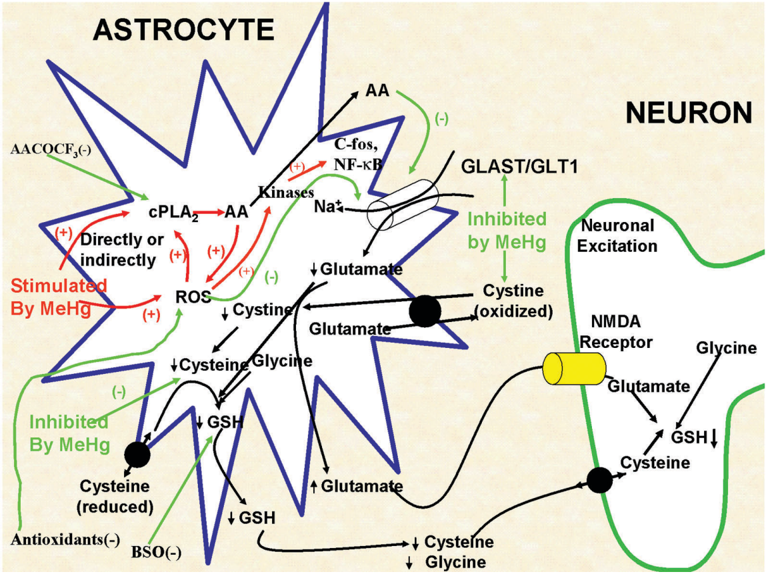
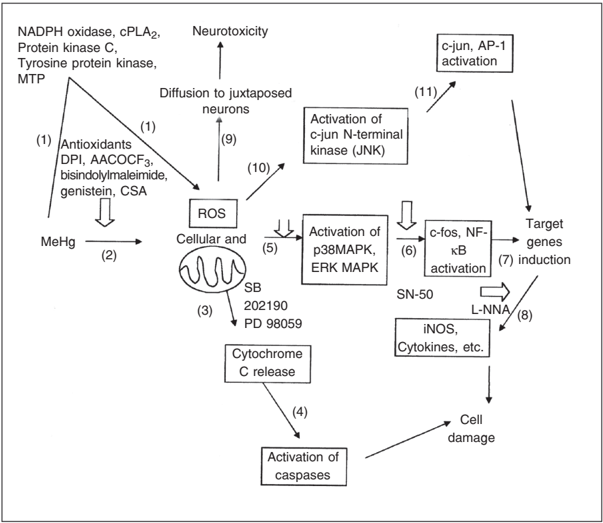
This review addresses the mechanisms of methylmercury (MeHg)-induced neurotoxicity, specifically examining the role of oxidative stress in mediating neuronal damage. A number of critical findings point to a central role for astrocytes in mediating MeHg-induced neurotoxicity as evidenced by the following observations: a) MeHg preferentially accumulates in astrocytes; b) MeHg specifically inhibits glutamate uptake in astrocytes; c) neuronal dysfunction is secondary to disturbances in astrocytes. The generation of reactive oxygen species (ROS) by MeHg has been observed in various experimental paradigms. For example, MeHg enhances ROS formation both in vivo (rodent cerebellum) and in vitro (isolated rat brain synaptosomes), as well as in neuronal and mixed reaggregating cell cultures. Antioxidants, including selenocompounds, can rescue astrocytes from MeHg-induced cytotoxicity by reducing ROS formation. We emphasize that oxidative stress plays a significant role in mediating MeHg-induced neurotoxic damage with active involvement of the mitochondria in this process. Furthermore, we provide a mechanistic overview on oxidative stress induced by MeHg that is triggered by a series of molecular events such as activation of various kinases, stress proteins and other immediate early genes culminating in cell damage.
Overview
The claims and statistics of this paper haven’t been checked yet.
Free: it reads the open-access text and checks the first 5 claims that cite a source we can check. Create a free account to check every claim.
Integrity signals
Registry
Cites
Statistics
Figures
Verification
Claims the paper makes
The claims and statistics of this paper haven’t been checked yet.
Free: it reads the open-access text and checks the first 5 claims that cite a source we can check. Create a free account to check every claim.
Claims other papers make about this one
Each is checked against this paper’s own text: does it say what the citing paper says it does?
In the citing paper
“There is certainly evidence that exposure to this agent causes oxidative stress (Ali et al. 1992; Aschner et al. 2007; Atchison and Hare 1994; Franco et al. 2009; Johansson et al. 2007; Sanfeliu et al. 2003; Sarafian et al. 1994; Yee and Choi 1994, 1996; Yin et al. 2007) and raises cellular iron levels (Ilbäck et al. 2000)”
Self-check
Percentages, sums and reported differences re-computed from the paper’s own numbers.
The self-check needs the paper’s full text.
Citations
Cites
LeBel, C. P., Ischiropoulos, H., & Bondy, S. C. (1992) · Chemical Research in Toxicology · doi:10.1021/tx00026a012 · Cited by 2,689 · cited 1×
“, ischemia and rheumatoid arthritis), cancer, diabetes mellitus, and atherosclerosis (32-34), as well as in metalinduced toxicity (35,36).”
BackgroundChoi, D. W. (1992) · Journal of Neurobiology · doi:10.1002/neu.480230915 · Cited by 2,314 · cited 1×
“In fact, MeHg-induced inhibition of astrocyte glutamate transporters leads to increased glutamate concentrations in the extracellular fluid, causing hyperactivation of N-methyl D-aspartate type glutamate receptors and leading to an increase in Na+ and Ca2+ influx (46).”
BackgroundCognitive Deficit in 7-Year-Old Children with Prenatal Exposure to Methylmercury
Grandjean, P., Weihe, P., White, R. F., Debes, F., Araki, S., Yokoyama, K., Murata, K., SØRENSEN, N., Dahl, R., & JØRGENSEN, P. J. (1997) · Neurotoxicology and Teratology · doi:10.1016/s0892-0362(97)00097-4 · Cited by 1,738 · cited 1×
“br aberrant central nervous system (CNS) functions (3-5).”
BackgroundMethylmercury Poisoning in Iraq: An interuniversity report.
Bakir, F., Damluji, S. F., Amin-Zaki, L., Murtadha, M., Khalidi, A., Al-Rawi, N. Y., Tikriti, S., Dhahir, H. I., Clarkson, T. W., Smith, J. C., et al. (1973) · Science · doi:10.1126/science.181.4096.230 · Cited by 1,606 · cited 1×
“Methylmercury (MeHg) is a major neurotoxicant that continues to pose appreciable risk to human health as evidenced by the tragic epidemics of MeHg poisoning in Japan and Iraq (1,2).”
BackgroundBetteridge, D. J. (2000) · Metabolism · doi:10.1016/s0026-0495(00)80077-3 · Cited by 1,455
NMDA-dependent superoxide production and neurotoxicity
Lafon-Cazal, M., Pietri, S., Culcasi, M., & Bockaert, J. (1993) · Nature · doi:10.1038/364535a0 · Cited by 1,183 · cited 1×
“Increased intracellular Ca2+ levels are associated with the generation of ROS (47).”
BackgroundFree Radicals and Antioxidants: A Personal View
Halliwell, B. (2009) · Nutrition Reviews · doi:10.1111/j.1753-4887.1994.tb01453.x · Cited by 1,077 · cited 1×
“, ischemia and rheumatoid arthritis), cancer, diabetes mellitus, and atherosclerosis (32-34), as well as in metalinduced toxicity (35,36).”
BackgroundDugan, L., Sensi, S., Canzoniero, L., Handran, S., Rothman, S., Lin, T., Goldberg, M., & Choi, D. (1995) · The Journal of Neuroscience · doi:10.1523/jneurosci.15-10-06377.1995 · Cited by 772 · cited 1×
“In addition, an increase in ROS has been observed in a) mitochondria isolated from MeHg-injected rat brains (36), b) mitochondria isolated in vitro from rat brain and then exposed to MeHg (43), and c) mitochondria from Hg- and glutamateexposed astrocytes and neurons (44,45).”
BackgroundHunot, S., Brugg, B., Ricard, D., Michel, P. P., Muriel, M.-P., Ruberg, M., Faucheux, B. A., Agid, Y., & Hirsch, E. C. (1997) · Proceedings of the National Academy of Sciences · doi:10.1073/pnas.94.14.7531 · Cited by 678 · cited 1×
“br physiological role in optimal cell function, excessive oxidative stress has been implicated in a variety of neurodegenerative diseases, including Alzheimer’s disease, Parkinson’s disease and amyotrophic lateral sclerosis (29-31).”
BackgroundDavidson, P. W., Myers, G. J., Cox, C., Axtell, C., Shamlaye, C., Sloane-Reeves, J., Cernichiari, E., Needham, L., Choi, A., Wang, Y., et al. (1998) · JAMA · doi:10.1001/jama.280.8.701 · Cited by 671 · cited 1×
“However, despite these observations, the issue remains controversial, as exemplified by other studies (8,9) in which no association was noted between MeHg and neurodevelopmental outcomes in children at 66 months of age.”
Research works printed but not linked: 2
- Takeuchi T. Biological reactions and pathological changes in human beings and animals caused by organic mercury contamination. In: Hartung R, Dinman BD (Editors), Environmental mercury contami- nation. Ann Arbor: Ann Arbor Science; 1972. p 247-289.
- Myhre O, Fonnum F. The effect of aliphatic, naphthenic, and aro- matic hydrocarbons on production of reactive oxygen species and reactive nitrogen species in rat brain synaptosome fraction: the involvement of calcium, nitric oxide synthase, mitochondria, and phospholipase A. Biochem Pharmacol 2001; 62: 119-128.
Cited by
ROS and diseases: role in metabolism and energy supply
Yang, S., & Lian, G. (2020) · Molecular and Cellular Biochemistry · doi:10.1007/s11010-019-03667-9 · Cited by 658
Metals, oxidative stress and neurodegeneration: A focus on iron, manganese and mercury
Farina, M., Avila, D. S., da Rocha, J. B. T., & Aschner, M. (2013) · Neurochemistry International · doi:10.1016/j.neuint.2012.12.006 · Cited by 553
“…MeHg increases extracellular glutamate levels, which result from both inhibition of glutamate uptake (Aschner et al., 2000; Brookes and Kristt, 1989) and stimulation of its release into the synaptic cleft (Reynolds and Racz, 1987), culminating in excitotoxic events (Aschner et al., 2007b).”
InfluentialSelf-citationEnvironmental toxicity, oxidative stress and apoptosis: Ménage à Trois
Franco, R., Sánchez-Olea, R., Reyes-Reyes, E. M., & Panayiotidis, M. I. (2009) · Mutation Research/Genetic Toxicology and Environmental Mutagenesis · doi:10.1016/j.mrgentox.2008.11.012 · Cited by 541
Mechanisms of methylmercury-induced neurotoxicity: Evidence from experimental studies
Farina, M., Rocha, J. B. T., & Aschner, M. (2011) · Life Sciences · doi:10.1016/j.lfs.2011.05.019 · Cited by 445
“Glutamate dyshomeostasis in the CNS represents another critical target in MeHg-induced neurotoxicity (for a review, see Aschner et al., 2007).”
Self-citationToxicity of mercury: Molecular evidence
Yang, L., Zhang, Y., Wang, F., Luo, Z., Guo, S., & Strähle, U. (2020) · Chemosphere · doi:10.1016/j.chemosphere.2019.125586 · Cited by 413
Metadata
- Authors
- Aschner, M., Syversen, T., Souza, D. O., Rocha, J. B. T., & Farina, M.
- Affiliations
- Vanderbilt University Medical Center (US)
- Norwegian University of Science and Technology (NO)
- Universidade Federal de Santa Maria (BR)
- Universidade Federal do Rio Grande do Sul (BR)
- Universidade Federal de Santa Catarina (BR)
- Venue
- Brazilian Journal of Medical and Biological Research
- Publisher
- FapUNIFESP (SciELO)
- Published
- 2007-03
- Volume
- 40
- Issue
- 3
- Pages
- 285-291
- ISSN
- 0100-879X (ISSN-L)
- OpenAlex
- W2012550963
- Semantic Scholar
- 68f1fb876c6e751c8c266a320b8ad449dccbd377
- Cited by
- 287
- References
- 61
- Citations by year
- 2026: 7 · 2025: 8 · 2024: 9 · 2023: 5 · 2022: 19 · 2021: 11 · 2020: 13 · 2019: 15 · 2018: 17 · 2017: 17 · 2016: 21 · 2015: 13 · 2014: 22 · 2013: 14 · 2012: 27
- FWCI
- 1.88
- Type
- journal article
- Language
- en
- Open access
- gold
- doi.org
- Licence
- cc-by
- Locations
- Brazilian Journal of Medical and Biological Research (publishedVersion, cc-by)
- PubMed (publishedVersion)
- Americanae (AECID Library) (publishedVersion, other-oa)
- LA Referencia (Red Federada de Repositorios Institucionales de Publicaciones Científicas) (publishedVersion, other-oa)
- Lume (Universidade Federal do Rio Grande do Sul) (submittedVersion, other-oa)
- LA Referencia (Red Federada de Repositorios Institucionales de Publicaciones Científicas) (submittedVersion, cc-by-nc-sa)
- Americanae (AECID Library) (submittedVersion, cc-by)
- DOAJ (DOAJ: Directory of Open Access Journals) (submittedVersion, cc-by-sa)
- Funders
- National Institute of Environmental Health Sciences (ES07331)
- Topics
- Physical Sciences › Environmental Science › Health, Toxicology and Mutagenesis › Mercury impact and mitigation studies
- Physical Sciences › Environmental Science › Health, Toxicology and Mutagenesis › Heavy Metal Exposure and Toxicity
- Health Sciences › Medicine › Clinical Neurology › Parkinson's Disease Mechanisms and Treatments
- Keywords
- methylmercury, neurotoxicity, oxidative stress, reactive oxygen species, astrocytes, glutamate uptake, glutamate, mitochondria, selenocompounds, antioxidants, neuronal injury, stress proteins, kinases, immediate early genes
- MeSH terms
- Animals, Astrocytes, Disease Models, Animal, Methylmercury Compounds, Neurons, Reactive Oxygen Species, Oxidative Stress, Glutamic Acid, Mercury Poisoning, Nervous System, Rats
About these checks
Registry, retraction, Cites and statistics results are computed, not judged, with one exception: a printed reference that no index lists is read once by a model before it counts as a citation error. Claims are extracted by a model and kept only when their quote appears verbatim in the text; each cited source is then checked, with a model’s help, for whether it says what the claim relies on. Those verdicts can be wrong — read the claim’s quote and the cited source before relying on one.
Statistics and arithmetic are recomputed, not judged.
Confidence bands are shown only for fields calibrated on our annotated test set. None is calibrated yet, so no band is shown.
What counts as a claim ›How we measure confidence ›How we check this ›
Are you an author, or do you see a problem with this page? Request a review
Data sources
Bibliographic data: Semantic Scholar, OpenAlex, Crossref.
Contains information from the Semantic Scholar Academic Graph Datasets, made available under the ODC Attribution License (ODC-BY 1.0).
Semantic Scholar’s data is described in: Kinney, R., et al. (2023). The Semantic Scholar Open Data Platform. arXiv:2301.10140.
