

A randomized crossover clinical study showing that methylphenidate-SODAS improves attention-deficit/hyperactivity disorder symptoms in adolescents with substance use disorder
Open accessThe DOI matches its Crossref record; 37 of the 37 references it cites were found in a registry or an index.
Abstract
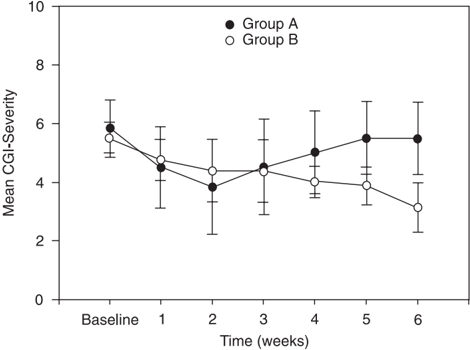
Our objective was to evaluate the effectiveness of a long-acting formulation of methylphenidate (MPH-SODAS) on attention-deficit/hyperactivity disorder (ADHD) symptoms in an outpatient sample of adolescents with ADHD and substance use disorders (SUD). Secondary goals were to evaluate the tolerability and impact on drug use of MPH-SODAS. This was a 6-week, single-blind, placebo-controlled crossover study assessing efficacy of escalated doses of MPH-SODAS on ADHD symptoms in 16 adolescents with ADHD/SUD. Participants were randomly allocated to either group A (weeks 1-3 on MPH-SODAS, weeks 4-6 on placebo) or group B (reverse order). The primary outcome measures were the Swanson, Nolan and Pelham Scale, version IV (SNAP-IV) and the Clinical Global Impression Scale (CGI). We also evaluated the adverse effects of MPH-SODAS using the Barkley Side Effect Rating Scale and subject reports of drug use during the study. The sample consisted of marijuana (N = 16; 100%) and cocaine users (N = 7; 43.8%). Subjects had a significantly greater reduction in SNAP-IV and CGI scores (P < 0.001 for all analyses) during MPH-SODAS treatment compared to placebo. No significant effects for period or sequence were found in analyses with the SNAP-IV and CGI scales. There was no significant effect on drug use. MPH-SODAS was well tolerated but was associated with more severe appetite reduction than placebo (P < 0.001). MPH-SODAS was more effective than placebo in reducing ADHD symptoms in a non-abstinent outpatient sample of adolescents with comorbid SUD. Randomized clinical trials, with larger samples and SUD intervention, are recommended.
Overview
The claims and statistics of this paper haven’t been checked yet.
Free: it reads the open-access text and checks the first 5 claims that cite a source we can check. Create a free account to check every claim.
Integrity signals
Registry
Cites
Statistics
Figures

Verification
Claims the paper makes
The claims and statistics of this paper haven’t been checked yet.
Free: it reads the open-access text and checks the first 5 claims that cite a source we can check. Create a free account to check every claim.
Claims other papers make about this one
Each is checked against this paper’s own text: does it say what the citing paper says it does?
The cited source says what the claim attributes to it.
In the citing paper
“They found MPH-SODAS to be more effective than placebo at improving ADHD symptoms and global functioning, but not at reducing substance use [36].”
From Treatment of Adolescents with Concurrent Substance Use Disorder and Attention-Deficit/Hyperactivity Disorder: A Systematic Review (2021) · cites this paper as [36]
The cited source says what the claim attributes to it.
In the citing paper
“Concerning pharmacotherapy, the results of the reviewed randomized trials in adolescents with concurrent ADHD and SUD were equivocal, with contradictory findings between the primary and secondary outcome measures pertaining to ADHD [37,38] and SUD [37], overall negative findings for both ADHD and SUD [39], and a small sample size [36].”
From Treatment of Adolescents with Concurrent Substance Use Disorder and Attention-Deficit/Hyperactivity Disorder: A Systematic Review (2021) · cites this paper as [36]
Self-check
Percentages, sums and reported differences re-computed from the paper’s own numbers.
The self-check needs the paper’s full text.
Citations
Cites
The worldwide prevalence of ADHD: a systematic review and metaregression analysis
Polanczyk, G., de Lima, M. S., Horta, B. L., Biederman, J., & Rohde, L. A. (2007) · American Journal of Psychiatry · doi:10.1176/ajp.2007.164.6.942 · Cited by 5,346
Self-citationManual for the Wechsler Adult Intelligence Scale.
Wechsler, D. (1955) · Psychological Corp. eBooks · Cited by 4,941
Attention Deficit Hyperactivity Disorder: A Handbook for Diagnosis and Treatment
Barkley, R. A., & Poillion, M. J. (1994) · Behavioral Disorders · doi:10.1177/019874299401900205 · Cited by 4,639
A Children's Global Assessment Scale (CGAS)
Shaffer, D. (1983) · Archives of General Psychiatry · doi:10.1001/archpsyc.1983.01790100074010 · Cited by 3,716 · cited 2×
“Other measures were: a) the Clinical Global Assessment Scale (CGAS) (29); b) the Brazilian Association of Market Research Form (30) for evaluation of socioeconomic status (SES); c) Block Design and Vocabulary subtests of the Wechsler Intelligence Scale, third edition (WISC-III) (31), and the Wechsler Adult Intelligenc…”
MethodInfluentialDrug abuse: hedonic homeostatic dysregulation
Koob, G. F., & Moal, M. L. (1997) · Science · doi:10.1126/science.278.5335.52 · Cited by 2,535 · cited 1×
“well established that SUD progression affects the reward system (38).”
BackgroundChambers, R. A., Taylor, J. R., & Potenza, M. N. (2003) · American Journal of Psychiatry · doi:10.1176/appi.ajp.160.6.1041 · Cited by 1,719 · cited 1×
“These findings may not necessarily be translated to adolescents, since there are reports of different MPH (22) and drug responses (23,24) between adults and adolescents.”
BackgroundGueorguieva, R., & Krystal, J. H. (2004) · Archives of General Psychiatry · doi:10.1001/archpsyc.61.3.310 · Cited by 1,529
Attention Deficit Hyperactivity Disorder. A Handbook for Diagnosis and Treatment
SILVER, L. B. (1991) · Journal of the American Academy of Child & Adolescent Psychiatry · doi:10.1097/00004583-199107000-00040 · Cited by 1,384
Amorim, P. (2000) · Revista Brasileira de Psiquiatria · doi:10.1590/s1516-44462000000300003 · Cited by 1,070 · cited 1×
“The diagnoses of SUD relied on the drug section of the Mini International Neuropsychiatry Interview (MINI), Brazilian version (28), which generates diagnoses of abuse or dependence according to Diagnostic and Statistical Manual of Mental Disorders (DSM-IV) criteria.”
MethodToga, A. W., Thompson, P. M., & Sowell, E. R. (2006) · Trends in Neurosciences · doi:10.1016/j.tins.2006.01.007 · Cited by 872 · cited 1×
“Last, the adolescent brain is still in development (40), which might favor recruitment of some brain pathways involved in the effects of MPH.”
Background
Research works printed but not linked: 2
- National Institute of Mental Health, 1985, CGI (Clinical Global Impression) scale, Psychopharmacol Bull, 21, 839
- Littell RC, 2000, Modelling covariance structure in the analysis of repeated measures data, Stat Med, 19, 1793, 10.1002/1097-0258(20000715)19:13<1793::AID-SIM482>3.0.CO;2-Q · doi:10.1002/1097-0258(20000715)19:13<1793::aid-sim482>3.0.co;2-q
Cited by
Methylphenidate for children and adolescents with attention deficit hyperactivity disorder (ADHD)
Storebø, O. J., Ramstad, E., Krogh, H. B., Nilausen, T. D., Skoog, M., Holmskov, M., Rosendal, S., Groth, C., Magnusson, F. L., Moreira-Maia, C. R., et al. (2015) · Cochrane Database of Systematic Reviews · doi:10.1002/14651858.cd009885.pub2 · Cited by 347
Storebø, O. J., Krogh, H. B., Ramstad, E., Moreira-Maia, C. R., Holmskov, M., Skoog, M., Nilausen, T. D., Magnusson, F. L., Zwi, M., Gillies, D., et al. (2015) · BMJ · doi:10.1136/bmj.h5203 · Cited by 209
Thurstone, C., Riggs, P. D., Salomonsen-Sautel, S., & Mikulich-Gilbertson, S. K. (2010) · Journal of the American Academy of Child & Adolescent Psychiatry · doi:10.1016/j.jaac.2010.02.013 · Cited by 96
Harvey, R. C., Sen, S., Deaciuc, A., Dwoskin, L. P., & Kantak, K. M. (2011) · Neuropsychopharmacology · doi:10.1038/npp.2010.223 · Cited by 86
“Compared to placebo treatment, studies show decreases (Biederman et al , 1999; Levin et al , 2007), increases (Barkley et al , 2003; Lambert and Hartsough, 1998), or no changes (Schubiner et al , 2002; Szobot et al , 2008) in cocaine use with methylphenidate treatment among individuals with ADHD.”
Methylphenidate for children and adolescents with attention deficit hyperactivity disorder (ADHD).
Storebø, O., Storm, M., Ribeiro, J. P., Skoog, M., Groth, C., Callesen, H., Schaug, J. P., Rasmussen, P. D., Huus, C. L., Zwi, M., et al. (2023) · Cochrane Database of Systematic Reviews · doi:10.1002/14651858.cd009885.pub3 · Cited by 213
Metadata
- Authors
- Szobot, C. M., Rohde, L. A., Katz, B., Ruaro, P., Schaefer, T., Walcher, M., Bukstein, O., & Pechansky, F.
- Affiliations
- Universidade Federal do Rio Grande do Sul (BR)
- Universidade Luterana do Brasil (BR)
- University of Pittsburgh (US)
- Centro de Pesquisas em Álcool e Drogas
- Venue
- Brazilian Journal of Medical and Biological Research
- Publisher
- FapUNIFESP (SciELO)
- Published
- 2008-02-20
- Volume
- 41
- Issue
- 3
- Pages
- 250-257
- ISSN
- 0100-879X (ISSN-L)
- 1414-431X
- OpenAlex
- W2097467510
- Cited by
- 51
- References
- 37
- Citations by year
- 2026: 1 · 2025: 4 · 2023: 3 · 2022: 3 · 2021: 4 · 2020: 3 · 2019: 1 · 2018: 3 · 2017: 1 · 2016: 1 · 2015: 4 · 2014: 3 · 2013: 3 · 2012: 3
- FWCI
- 3.27
- Type
- journal article
- Language
- en
- Open access
- gold
- doi.org
- Licence
- cc-by
- Locations
- Brazilian Journal of Medical and Biological Research (publishedVersion, cc-by)
- PubMed (publishedVersion)
- LA Referencia (Red Federada de Repositorios Institucionales de Publicaciones Científicas) (publishedVersion, other-oa)
- Americanae (AECID Library) (submittedVersion, cc-by)
- Americanae (AECID Library) (submittedVersion, other-oa)
- DOAJ (DOAJ: Directory of Open Access Journals) (submittedVersion, cc-by-sa)
- Lume (Universidade Federal do Rio Grande do Sul) (submittedVersion, other-oa)
- LA Referencia (Red Federada de Repositorios Institucionales de Publicaciones Científicas) (submittedVersion, cc-by-nc-sa)
- Funders
- Bristol-Myers Squibb
- Eli Lilly and Company
- Conselho Nacional de Desenvolvimento Científico e Tecnológico (307780/2004-0)
- Hospital de Clínicas de Porto Alegre
- Shire
- National Institute on Drug Abuse
- National Institute of Allergy and Infectious Diseases
- Cilag
- Topics
- Health Sciences › Medicine › Psychiatry and Mental health › Attention Deficit Hyperactivity Disorder
- Health Sciences › Medicine › Epidemiology › Substance Abuse Treatment and Outcomes
- Health Sciences › Medicine › Psychiatry and Mental health › Schizophrenia research and treatment
- Keywords
- methylphenidate, long-acting stimulants, attention deficit hyperactivity disorder, substance use disorders, adolescents, comorbidities, cannabis use, cocaine use, ADHD symptom reduction, appetite suppression, tolerability
- MeSH terms
- Adolescent, Adult, Central Nervous System Stimulants, Attention Deficit Disorder with Hyperactivity, Humans, Male, Methylphenidate, Single-Blind Method, Treatment Outcome, Cross-Over Studies, Substance-Related Disorders
About these checks
Registry, retraction, Cites and statistics results are computed, not judged, with one exception: a printed reference that no index lists is read once by a model before it counts as a citation error. Claims are extracted by a model and kept only when their quote appears verbatim in the text; each cited source is then checked, with a model’s help, for whether it says what the claim relies on. Those verdicts can be wrong — read the claim’s quote and the cited source before relying on one.
Statistics and arithmetic are recomputed, not judged.
Confidence bands are shown only for fields calibrated on our annotated test set. None is calibrated yet, so no band is shown.
What counts as a claim ›How we measure confidence ›How we check this ›
Are you an author, or do you see a problem with this page? Request a review
How to cite
Cite CoChat for the checks on this page, and the paper for its own findings.
- This page
- CoChat. (2026). Citation check: A randomized crossover clinical study showing that methylphenidate-SODAS improves attention-deficit/hyperactivity disorder symptoms in adolescents with substance use disorder. https://app.cochat.ai/papers/10.1590/s0100-879x2008005000011
- The paper
- Szobot, C. M., Rohde, L. A., Katz, B., Ruaro, P., Schaefer, T., Walcher, M., Bukstein, O., & Pechansky, F. (2008). A randomized crossover clinical study showing that methylphenidate-SODAS improves attention-deficit/hyperactivity disorder symptoms in adolescents with substance use disorder. Brazilian Journal of Medical and Biological Research. https://doi.org/10.1590/s0100-879x2008005000011
Data sources
Bibliographic data: Semantic Scholar, OpenAlex, Crossref.
Contains information from the Semantic Scholar Academic Graph Datasets, made available under the ODC Attribution License (ODC-BY 1.0).
Semantic Scholar’s data is described in: Kinney, R., et al. (2023). The Semantic Scholar Open Data Platform. arXiv:2301.10140.
